Unlock insights into which geo metrics matter most for competitive visibility in ai search in 2026? Learn how regional signals boost visibility for B2B success.
Figuring out which geo metrics matter most for competitive visibility in AI search in 2026 requires a fundamental shift in thinking. It’s not about a single factor. Instead, it's about a dynamic mix of user location, language, and the specific AI platforms that dominate a given area.
Think of the AI search world less like one massive global city and more like a collection of distinct digital neighborhoods. What works in one doesn't automatically mean you'll be seen in another.
The New Geography of AI Search Visibility
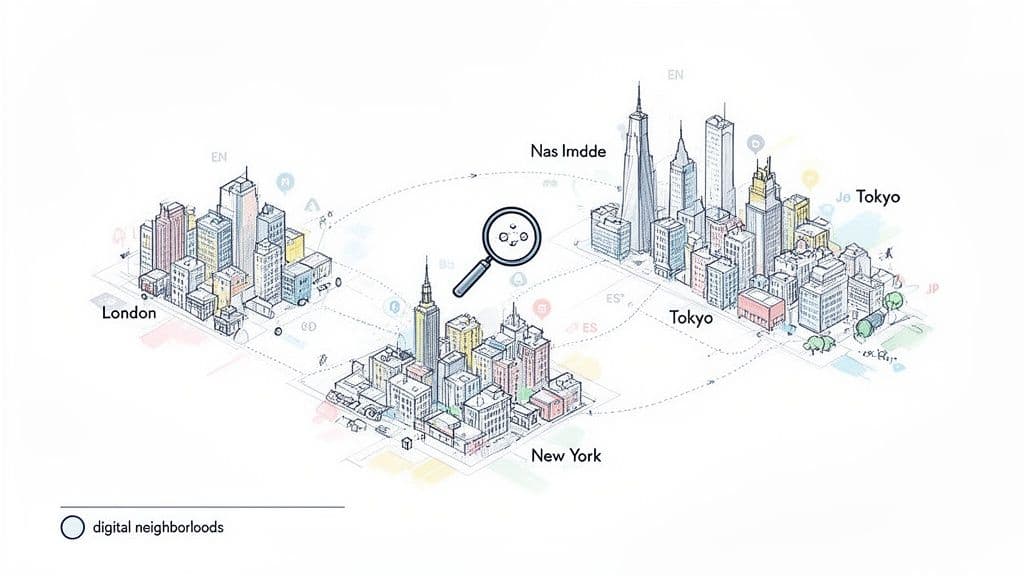
The old SEO playbook is being completely rewritten. A user's physical location is now just the starting line for an AI model. By 2026, your competitive visibility will depend on a much deeper, more contextual grasp of geography. Things like regional user intent, subtle cultural nuances in language, and the market share of platforms like ChatGPT are creating a complex, multi-layered map for businesses to navigate.
This evolution means a geographically-tuned strategy isn't just a nice-to-have for B2B companies anymore—it's essential for winning. Simply targeting a country is a blunt instrument when AI models can tell the difference between a query from rural Texas and one from downtown Manhattan, even when the keywords are identical.
Understanding the Key Battlegrounds
Some regions are already clear frontrunners in AI search adoption, making them critical places to focus your competitive analysis. North America, for instance, has become a vital competitive geography for any serious B2B enterprise.
Recent data shows North America commanded the largest revenue share of the global AI search engine market at 31.1%, with the United States leading the charge. This heavy concentration tells you where user engagement is most mature and where monitoring your visibility is an absolute priority.
The Rise of Generative Engine Optimization
To really understand where competitive visibility is headed, you have to get familiar with concepts like Generative Engine Optimization (GEO). This isn't just a new buzzword; it's a completely different approach that goes way beyond traditional SEO. It's all about how AI models interpret and present information using a rich blend of signals.
GEO isn't just about ranking on a search results page. It’s about becoming a trusted, authoritative source that AI models cite directly in their generated answers—answers that are uniquely tailored to a user's specific geographic and cultural context.
As different AI platforms gain a foothold in various regions, your strategy has to be flexible enough to adapt. The way people talk to their AI assistants and the ad models that emerge will look very different from one market to another. Getting a handle on these differences is crucial, especially as you start exploring new revenue streams like the role of ads in ChatGPT.
Let's break down the most important geo metrics, how to measure them, and how to build a strategy that makes sure your brand shows up where it counts.
To start, let's simplify these concepts into a quick reference. The table below outlines the most critical geo-centric metrics and why they're so vital for your competitive analysis in the new AI search environment.
Key Geo Metrics for AI Search Visibility in 2026 at a Glance
This table provides a high-level view, but the real advantage comes from knowing how to use these metrics to your advantage. We'll explore each one in more detail next.
Why Traditional SEO Location Signals Fall Short for AI
For years, we've relied on a predictable playbook for local and regional SEO. Think of it like a static paper map. You'd pin your business address, sprinkle city names in your content, and chase down a few local backlinks. This told Google where you were, and if someone nearby searched, you'd hopefully pop up. It was straightforward, if a bit blunt.
AI search, however, isn’t using a paper map. It's more like a personal tour guide. This guide doesn't just know your physical coordinates; it understands the entire context of that location. It knows the local dialect, what’s happening in the news there, the cultural nuances, and even what a user has looked for in that area before. This fundamental shift makes a lot of old tactics feel clumsy and outdated.
The real difference is the move from explicit signals to inferred context. A classic search engine sees a business in "New York, NY" and matches it to a user with a New York IP address. Simple. An AI model, on the other hand, goes much, much deeper.
Beyond the IP Address
AI platforms weave together a rich tapestry of data points to build a geo-contextual profile for every single query. A simple IP address lookup is just one thread in that fabric. The system is built to understand not just where a user is, but who they are within that specific location.
This multi-layered approach pulls from signals like:
- Language and Dialect Settings: An AI can easily tell the difference between a user set to "English (UK)" versus "English (US)," tweaking results to match regional terms and cultural touchstones.
- Query Phrasing: How a user frames a question is a massive clue. A search for the "best solicitor for property law" screams UK context, whereas "best real estate attorney" points squarely to the US.
- Historical Location Behavior: The AI has a memory. It recalls past location-based searches and interactions, slowly building a profile of a user’s typical geographic needs and patterns.
This level of sophistication means that just stuffing location keywords into your content isn’t going to cut it anymore. In fact, it can easily backfire. To an AI trained to spot nuance, it just looks generic and inauthentic. It’s the equivalent of shouting "I'M IN LONDON!" at a local who already knows you're there and is far more interested in what you have to say about their neighborhood.
The Shift From Keywords to Contextual Authority
Winning in this new game requires a completely different strategy. You're no longer optimizing just for keywords; you have to optimize for contextual authority. This is all about proving you have a genuine, deep understanding of a specific geographic market. Your content needs to breathe the local air—reflecting the unique challenges, regulations, and language of that place.
AI models don't just scan for location tags; they hunt for proof of expertise within a geographic context. Your goal is to become the source an AI trusts to give the most relevant, localized answer for someone in a specific city or region.
Take a B2B software company trying to break into the German market. A simple website translation won't work. They need content that digs into specific German data privacy laws (like GDPR nuances), discusses integrations with local business software, and uses terminology that actually clicks with German professionals.
This is a far more intricate challenge than traditional local SEO, demanding a meticulous approach to your content and overall strategy. A great place to start is with a thorough audit of your existing website to see how it stacks up from a geo-contextual standpoint. You can learn more about structuring this by understanding the basics of how to do a website audit and then applying those principles through an AI lens. This process will quickly show you where your content fails to signal deep regional expertise, giving you a clear roadmap for what to fix.
The Core Geo Metrics You Must Track for AI Search
If you're still treating your AI search strategy as a single, global effort, you're already falling behind. To get ahead in 2026, you have to start seeing your visibility through a geographic lens. It’s not enough to know the old rules of SEO are changing; you need a new playbook that shows you what to track now.
Think of it this way: AI doesn’t view the internet as one giant, flat map. Instead, it sees a complex overlay of countless smaller maps, each defined by a unique combination of location, language, and culture. Your job is to figure out which of these maps your customers are using and make sure your brand is a can't-miss landmark on every single one.
This is essentially how an AI model processes a user's location to deliver a relevant answer.
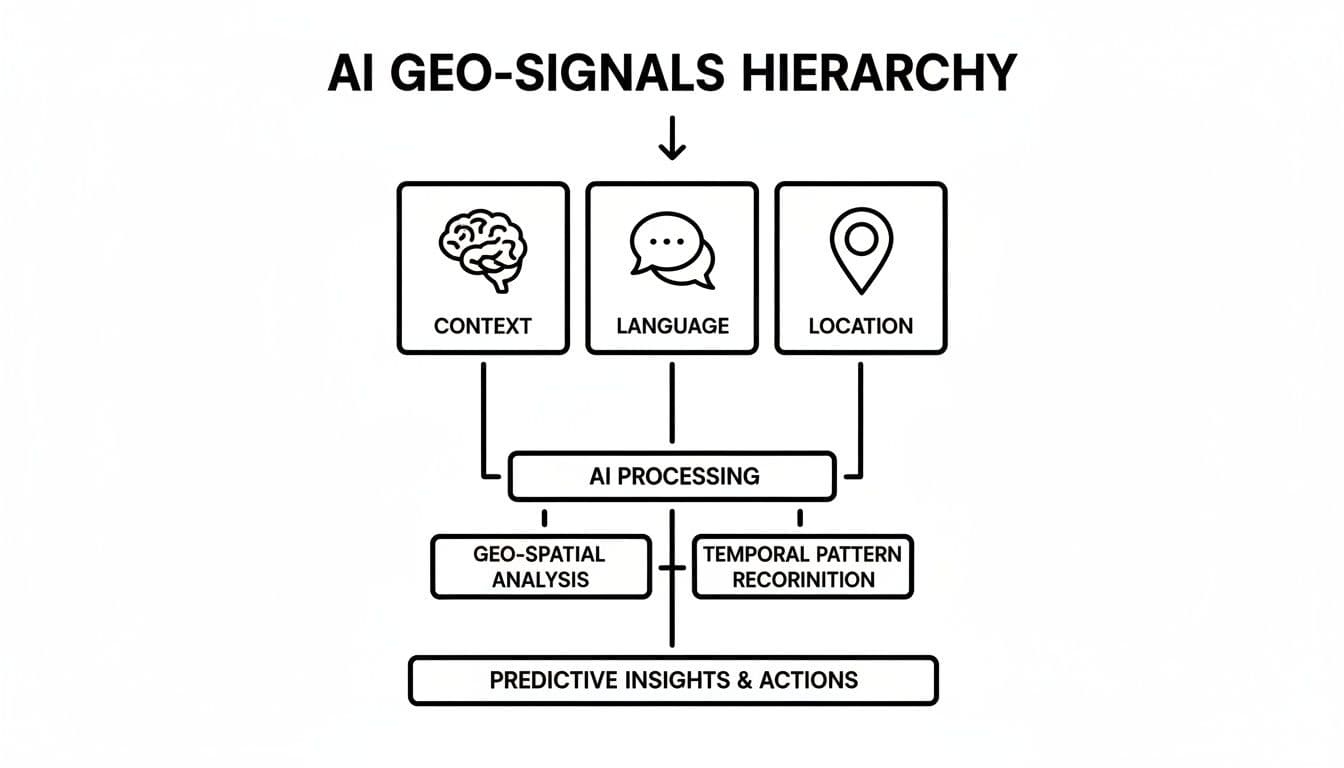
As you can see, a user's physical location is just the starting point. The real magic happens when the AI layers in language and contextual signals to understand what the user really wants.
Country and Region Specificity
The most foundational metric is a user’s country and region. This is the first, broadest filter an AI applies, and it sets the stage for everything that follows. It defines the legal frameworks, the services available, and the overarching cultural context.
A search for "best financial compliance software," for example, will generate completely different answers in the United States compared to the European Union. Why? Because the AI understands that FINRA regulations are useless in a market governed by MiFID II. Brands that prove they have deep expertise within a specific regulatory environment will get the nod.
This means your first step is to align your content with the macro-level realities of your target countries. This goes far beyond just translating words; it’s about addressing the distinct business challenges and legal landscapes that define each market.
City and Hyper-Local Signals
From the country, we zoom right into the city level. This is where an AI’s ability to understand local intent becomes a massive competitive edge. Any query that includes phrases like "near me," "in Austin," or even hints at a need for local services will trigger a completely different evaluation process.
The AI will immediately start looking for sources with a tangible, authentic connection to that specific place. That could mean:
- Mentioning local neighborhoods or well-known landmarks.
- Discussing regional industry events or business meetups.
- Featuring case studies from clients based in that city.
Imagine a B2B company selling office management software. They could write a generic blog post, or they could publish a guide on "optimizing hybrid work models for London's financial district." That hyper-specific angle signals a genuine understanding of the local market that a broad-strokes article never could, making it a perfect source for an AI-generated answer.
Language and Cultural Nuance
This is probably the most sophisticated—and most important—geo metric of all. Modern AI models are trained on massive datasets of regional language, which includes slang, common idioms, and even professional jargon. To earn the AI’s trust (and your user's), your content has to speak the local dialect.
Think about the small but crucial differences between "lorry" (UK) and "truck" (US), or "holiday" (UK) and "vacation" (US). They might seem trivial, but using the right regional terms is a powerful signal of authenticity. AI models are sharp enough to pick up on these cues to decide if your content is truly for a specific audience.
An AI evaluates content not just for keywords, but for cultural fluency. It's looking for proof that you are part of the conversation in a specific region, not just an outsider trying to sell to it.
This means you have to invest in localization that captures cultural context, not just direct translation. It’s about understanding local business etiquette, referencing relevant regional news, and adapting your brand’s tone to meet local expectations.
The table below breaks down how these different metrics can shape AI-generated responses for B2B queries and what you need to do about it.
Impact of Geo Metrics on AI Search Results
Ultimately, a successful strategy requires a nuanced approach where content is finely tuned to the specific geographic and cultural context of each target audience.
IP Address Versus Declared Location
Finally, it’s critical to understand how an AI weighs different types of location signals. A user’s IP address gives a strong clue about where they are, but it’s not foolproof. A much more powerful signal is a declared location—when a user manually sets their location in a profile or explicitly states it in their query.
If these two signals clash—say, a user with a New York IP address asks for the "best marketing agencies in Los Angeles"—the AI will prioritize the declared intent. It correctly deduces the user is researching or planning for that specific location.
This insight is a game-changer for B2B marketers who target national or international clients. Your content can't just serve customers where they are; it has to cater to where they do business. By creating content for these research-heavy queries, you can capture high-intent users much earlier in their buying journey.
Keeping track of all these moving parts is no small feat. Using a dedicated search visibility tracker is no longer a luxury but a necessity for monitoring your performance across these diverse geographic dimensions.
Why Platform Market Share Is a Critical (and Overlooked) Geo Metric
Knowing where your audience is searching from is a solid start, but it's only half the battle. If you really want to understand competitive visibility in AI search by 2026, you have to ask a tougher question: which platform are they using in that specific location?
This is a critical layer of geographic intelligence that most teams are completely missing.
Think about it like this. People in different cities have their favorite local news channels or social media apps. It’s the same with AI search tools. Different regions and countries are already forming distinct habits and preferences. Assuming your entire global audience is on a single platform is a fast track to becoming invisible.
Competitive visibility in this new era requires a multi-platform strategy, one that's finely tuned to the geographic habits of your real-world audience. You can't just monitor your rankings on Google and call it a day anymore.
The Search Landscape is Breaking Apart
The old monopoly is over. We're moving from a single dominant search engine to a much more diverse ecosystem of tools. What's fascinating is that user demographics, the reason for the search, and even the types of questions people ask vary wildly between platforms like Google's AI Overviews, Perplexity, and ChatGPT.
Geography just magnifies these differences.
A developer in Germany, for example, might gravitate toward Perplexity for its precise citations and technical depth. A marketing manager in Brazil, on the other hand, could be using ChatGPT for creative brainstorming sessions. Each platform is carving out a niche in a user’s daily workflow, and these preferences are becoming geographically concentrated.
This fragmentation means your brand has to show up where your ideal customers are actually having these AI-powered conversations. Being visible on one platform gives you zero guarantee of visibility on another. It's like having separate digital territories you now have to conquer.
Follow the User Data, Not the Hype
The shifting market dynamics really bring this point home. While Google is still a giant, the ground is undeniably shifting beneath its feet. Recent figures show Google holding 90.83% of global search traffic, but this also marked its first-ever dip below the 90% mark since 2015. At the same time, platforms like ChatGPT now field an incredible 17.1% of all digital queries worldwide. You can discover more insights on search engine market share to see these trends for yourself.
The geographic variations are just as stark. Take Google's AI Overviews. By early 2025, they were already appearing in 13.14% of all U.S. desktop searches, a clear sign of an aggressive push in a core market. This data tells us something crucial: you have to track the platform's adoption rate in your priority regions just as closely as you track your own brand's visibility.
Your competitive strategy has to be fluid. It must adapt not just to where your audience is, but to the tools they choose to use when they're there. Ignoring platform market share is like planning an ad campaign without knowing which TV channels your audience actually watches.
If you don't monitor this, you risk pouring your budget into ranking on a platform that your target audience has already left behind for a more specialized or locally popular alternative.
From Monitoring to a Winning Strategy
So, how do you put this insight into action? It starts with monitoring your brand’s presence across a portfolio of AI tools, not just one.
You need to be looking at:
- Brand Mentions: How often does your brand pop up for key queries on each platform, and in which countries?
- Share of Voice: Who are the real competitors on ChatGPT in France versus Perplexity in the UK? They’re probably not the same.
- Citation Sources: Which tools are citing your content directly, and which ones are pulling from third-party sources to talk about you?
Once you have this data, you can start allocating resources intelligently. If you find your German audience is all-in on one particular AI tool, you can start tailoring your content specifically for how that model ingests information and crafts its answers.
Building this kind of platform-specific authority is a central part of learning how to increase market share in this new, fragmented world. It’s how you turn a massive potential blind spot into a real competitive advantage.
Building Your Geo-Specific AI Visibility Dashboard
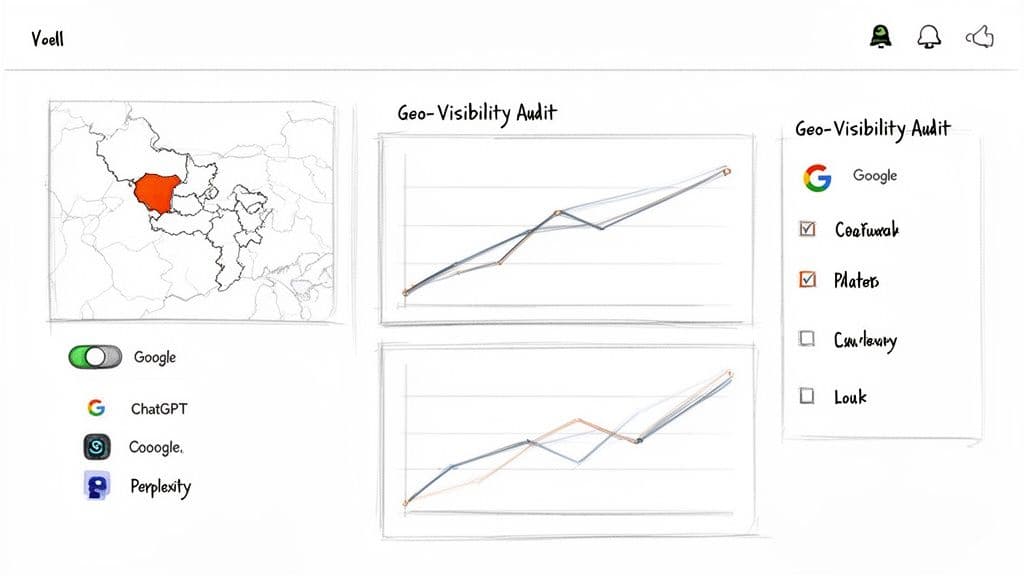
Knowing the theory behind geo metrics is great, but the real competitive edge comes from turning that knowledge into a repeatable, practical process. The goal here is to build a system that gives you a crystal-clear view of your AI search performance in the markets that actually matter. It’s about creating a focused framework that moves you past guesswork.
This isn’t about chasing every data point under the sun. It's about answering the critical questions: Where are we visible? Who are we beating? Where are the hidden opportunities? A solid monitoring system helps you spot those chances before anyone else and react to threats before they hurt your bottom line. Without a system like this, you're essentially flying blind.
Setting Up Your Monitoring Framework
First things first: you need a baseline. You can’t track progress if you don't know where you’re starting from. This means simulating searches from different locations across various AI platforms to map out your brand's current footprint.
This can be as simple as using a VPN to set your location to a target city and manually running queries on a few AI platforms. It’s a quick-and-dirty way to get a snapshot. But for reliable, scalable data, you'll need specialized tools. We actually cover this in more detail in our guide to https://attensira.com/blog/ai-search-monitoring.
Your framework should be built to track a few core components:
- Platform Coverage: Are you showing up on the AI platforms your customers actually use in your target regions (like ChatGPT, Perplexity, or Google AI Overviews)?
- Location Simulation: How does your brand appear in your top-priority cities and countries, not just some generic global view?
- Competitive Benchmarking: What’s your share of voice compared to your main rivals within each specific geographic market?
Core Metrics for Your Geo-Dashboard
A cluttered dashboard is a useless dashboard. You need to focus on the metrics that directly tie back to your strategy and expose performance gaps. Think of these as the pillars of your monitoring efforts, giving you an at-a-glance read on how you're doing geographically. For a solid foundation, it helps to understand the principles of effective marketing dashboards.
The best dashboards don't just throw data at you; they tell a story. Your dashboard should instantly show you where you're winning, where you're losing, and—most importantly—why.
Here are the essential metrics to start with:
- Geo-Segmented Brand Mentions: This is a raw count of how many times your brand gets mentioned for key queries, broken down by country and city. A huge number of mentions in the US but crickets in the UK? That’s a massive content gap you need to fix.
- Regional Share of Voice (SOV): Don't just look at your own numbers. Pit your brand mentions against your top three competitors in each key market. This shows you who truly owns the AI conversation in that specific location.
- Citation Source by Location: When AIs talk about your brand in different regions, are they citing your own domain or someone else's? If you're the primary source, it’s a powerful sign of authority. If not, you've got work to do.
- Sentiment by Market: AI responses are often neutral, but the context is gold. Are you positioned as a "leader," an "alternative," or a "niche player"? Tracking this across countries gives your sales and marketing teams invaluable intel.
Turning Geo-Data into a Winning Content Strategy
Collecting all this geographic data is one thing, but actually using it to outmaneuver the competition is where the magic happens. It's about moving away from that old "one-size-fits-all" global content mindset and building a sharp, targeted portfolio of content that speaks directly to the geographic markets you care about most.
The real aim here is to build what I call contextual authority. You want the AI to see you not just as some generic global entity, but as a genuine local expert who deeply understands the specific challenges, regulations, and business culture of a region.
Crafting Content for Specific Regions
The most straightforward way to build this kind of authority is to create content that’s laser-focused on a particular market. Instead of having a single landing page for a service, why not create different versions for your most important regions? This lets you get incredibly specific about the pain points and market dynamics in each place.
Take a cybersecurity firm, for example, that wants to win in both the US and the UK. A smart strategy would be to develop separate content that:
- Speaks to Local Laws: The US page would dive into CCPA compliance, while the UK version would be all about navigating GDPR.
- Uses Local Language: It’s subtle, but using terms like "data breach notification laws" for an American audience versus "personal data breach reporting" for a British one makes a difference.
- Showcases Local Wins: Each page should be packed with case studies and testimonials from clients in that specific country. Nothing builds trust faster than seeing you've already helped someone just like them, right down the road.
This kind of tailored approach sends a crystal-clear signal to both users and the AI that your expertise isn't just theoretical—it's relevant and proven in their backyard.
Weaving in Cultural and Local Signals
Beyond creating dedicated pages, you can sprinkle subtle local signals throughout your broader content. This is much more nuanced than just a find-and-replace keyword job; it’s about naturally reflecting the local business environment.
AI models are getting frighteningly good at spotting authenticity. Content that genuinely reflects a region's business culture—its unique struggles, its big opportunities, and the way people actually talk—will crush generic, superficially "localized" content every single time.
Think about it. You could reference major industry events happening in a specific city, or talk about how local economic news is impacting your sector. You could even use analogies that would click instantly with a professional in that market. These small, authentic touches add up, creating a powerful signal of geographic relevance that AI systems are now built to pick up on. This is what takes your content from just being available in a region to being an authority there, which is exactly what you need to dominate AI-powered search results.
Frequently Asked Questions
Diving into geo-centric AI search often brings up more questions than answers. Let's tackle some of the most common ones that marketers and SEOs are asking right now.
How Is This Different From Regular Local SEO?
It’s a fair question. Traditional local SEO has always been about clear, explicit signals—think your Google Business Profile listing, local citations, and keywords like "near me." It's direct and transactional.
Geo-optimization for AI is a whole different ballgame. It’s less about telling the search engine where you are and more about showing an AI you understand a place. This means weaving in subtle cultural cues, using regional language naturally, and demonstrating deep expertise on the problems that matter to people in a specific market.
You're shifting from just listing an address to becoming a recognized, authentic voice within a digital neighborhood.
Can a Small Business Actually Compete with Big Brands Here?
Yes, and in many cases, they have the upper hand. AI search can be a great equalizer. Big enterprises might have a massive footprint, but small businesses can win by going deep.
Think about it: a small business can build unmatched authority in a very specific niche or a hyper-local community. By creating content that speaks directly to the unique challenges and conversations happening in that area, you become the most credible source for an AI to pull from. This precision allows you to outrank larger, more generic competitors for those focused queries.
The winning playbook is depth over breadth. An AI will always prefer the source that gives the most precise, authentic answer for a local query. Your deep-rooted expertise isn't just a nice-to-have; it's your biggest competitive advantage.
Where Do I Even Start With All This?
The most important first step is to get laser-focused on your priority markets. Don't just target "the United States" or "Germany." Pinpoint the exact regions, cities, or even industrial corridors where your most valuable customers live and work.
Once you have that clarity, you can start auditing your brand's visibility on the major AI platforms within those specific zones. This initial check-up gives you the baseline you need to build a smart, targeted strategy that actually moves the needle.
Stop guessing how your brand shows up in AI-generated answers. With Attensira, you can monitor your visibility across the platforms that matter, pinpoint competitive gaps, and build a winning geo-centric strategy. Start tracking your AI presence today at https://attensira.com.