


Boost your practice with ai visibility for dentists: practical AI-driven steps to attract more patients and improve local search results.
When we talk about "AI visibility" for your dental practice, we're really talking about one thing: showing up when a potential patient asks an AI assistant for a recommendation. Think Google's SGE, ChatGPT, or even Siri. It's a whole different game than just ranking on a search results page.
This new approach is all about structuring your practice's information—your services, your reputation, your location—in a way that these AI models can instantly understand and trust. If you get this right, you’ll be the one recommended, capturing the next wave of new patients before your competitors even know what's happening.
Why AI Search Is Reshaping Patient Acquisition
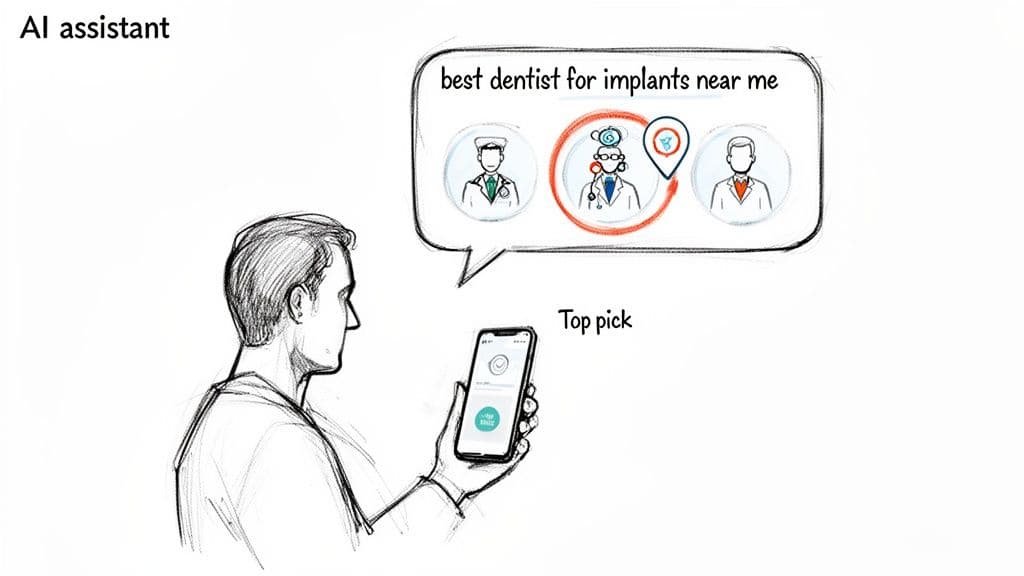
The way people find a new dentist is changing right under our noses. For the last decade, the entire goal was to climb a list of ten blue links. Now, patients are just asking their phones, "Find the best dentist for implants near me," and getting a single, direct answer.
This isn't a small shift; it's a fundamental change in patient behavior. People want immediate, reliable information, not a list of websites to sift through. If an AI doesn't understand your practice well enough to recommend it, you're not just lower on the list—you're completely invisible at that critical moment of decision. The risk is being left out of the conversation entirely.
The New Digital Word-of-Mouth
You can think of these AI assistants as the ultimate digital word-of-mouth referral. They’re constantly pulling together data from all over the web—your website's content, patient reviews on Google and Healthgrades, local directory listings, and even reputable health articles—to build a comprehensive profile of your practice. The AI’s only job is to give its user the most trustworthy and relevant answer.
This demands a strategy that goes beyond traditional SEO for healthcare providers. Your entire digital footprint has to be built for machine comprehension, not just for a human to read. The signals you send out need to be crystal clear about:
- Who you are: The specific credentials and specializations of your dentists.
- What you do: Every service you offer, from routine cleanings to advanced cosmetic or surgical procedures.
- Where you are: Perfectly consistent name, address, and phone number everywhere online.
- How you're perceived: The quality, quantity, and sentiment of your patient reviews.
The core of AI visibility for dentists is proving your trustworthiness and authority through clear, consistent, and well-structured digital signals. AI models reward practices that make it easy to verify their expertise and reputation.
As more patients rely on AI for recommendations, practices that fail to show up in these answers will lose a massive opportunity. We dive deeper into this topic in our guide on AI search engine optimization.
Keeping an eye on this visibility gap is crucial, especially when you consider predictions that 75% of practices will be using AI in some capacity by 2025. This isn't a future trend; it's happening now.
Dominate Your Local Market for AI Recommendations
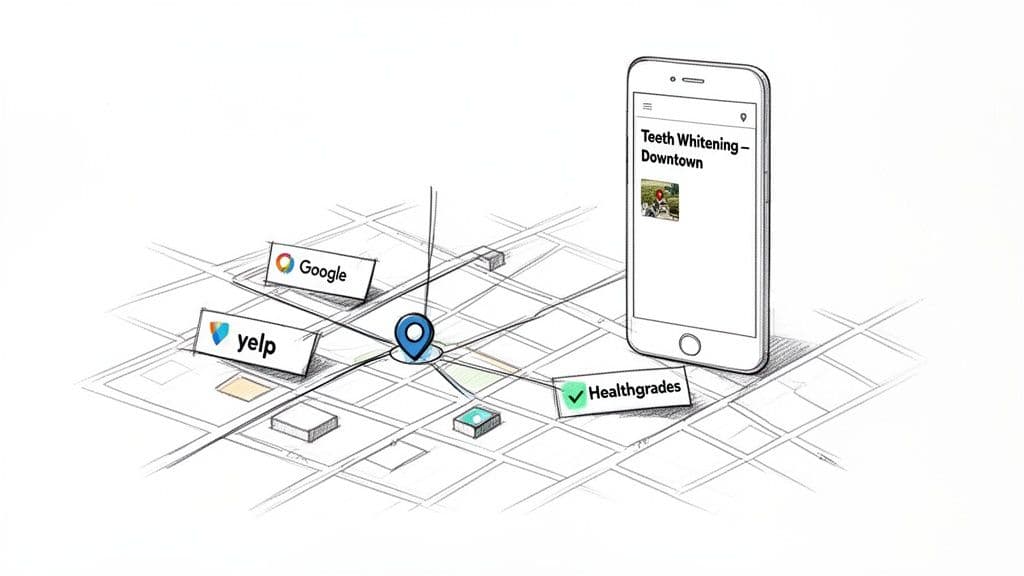
When someone asks an AI assistant, "find the best cosmetic dentist near me," the AI isn't making a random guess. It's rapidly scanning the web for the clearest, most consistent, and authoritative local signals it can find to make a solid recommendation.
If your practice’s online information is a jumbled mess of conflicting details, the AI will simply look past you. It will favor a competitor whose digital house is in order. Think of your local online presence as the foundational data AI models use to learn who you are, what you do, and precisely where patients can find you. Inconsistencies create doubt, and an AI is built to avoid giving a doubtful answer.
The Critical Role of NAP Consistency
Everything starts with NAP consistency. This means your Name, Address, and Phone number must be absolutely identical everywhere online. This isn't just a small detail—it's one of the strongest trust signals for both old-school search engines and new AI models.
Here’s why it matters so much: if one directory lists you as "Main Street Dental" while another has you as "Main St. Dentistry," an AI might interpret these as two different businesses. That confusion instantly splits and weakens your authority, making a confident recommendation nearly impossible. You need to start with a thorough audit, systematically checking and correcting your listings.
Pay close attention to these key platforms:
- Google Business Profile (GBP): This is, without a doubt, your single most important local asset.
- Healthgrades: A non-negotiable directory for any healthcare provider.
- Yelp: It remains a major source of local business data and reviews that AI pulls from.
- Local Chamber of Commerce: A highly authoritative and trusted local citation.
Your goal is absolute, painstaking uniformity. Every comma, every suite number, every abbreviation needs to match perfectly. This level of detail removes all ambiguity when an AI tries to verify your practice’s legitimacy and location.
Advanced GBP and Website Optimization
With your NAP locked down, the next step is to enrich your online profiles with specific, location-based details. AI models are hungry for granular data that helps them answer more complex patient questions. Just listing "dentist" on your profile isn't going to cut it anymore.
A genuinely effective strategy is creating location-specific service pages on your website. Instead of a generic "Teeth Whitening" page, build one out for "Teeth Whitening in Downtown Seattle." On that page, you’d detail the service, maybe mention a few local landmarks near your office, and embed a Google Map. This gives the AI precise, geographically relevant content to work with.
Your Google Business Profile needs the same level of attention. It should be a dynamic hub of activity, not just a static listing. Keep it fresh by:
- Uploading geo-tagged photos of your team, your office, and new equipment.
- Using Google Posts to announce patient specials or highlight new technology.
- Filling out your services list completely, from "Invisalign treatment" to "emergency root canals."
This steady stream of relevant, local activity signals to AI that your practice is active, authoritative, and a real part of the community. To make sure all your local signals are firing correctly, take a look at our complete local SEO checklist for healthcare practices. It lays out the exact framework needed to build the kind of local authority AI is looking for.
Build Unshakeable Authority with E-E-A-T and Schema
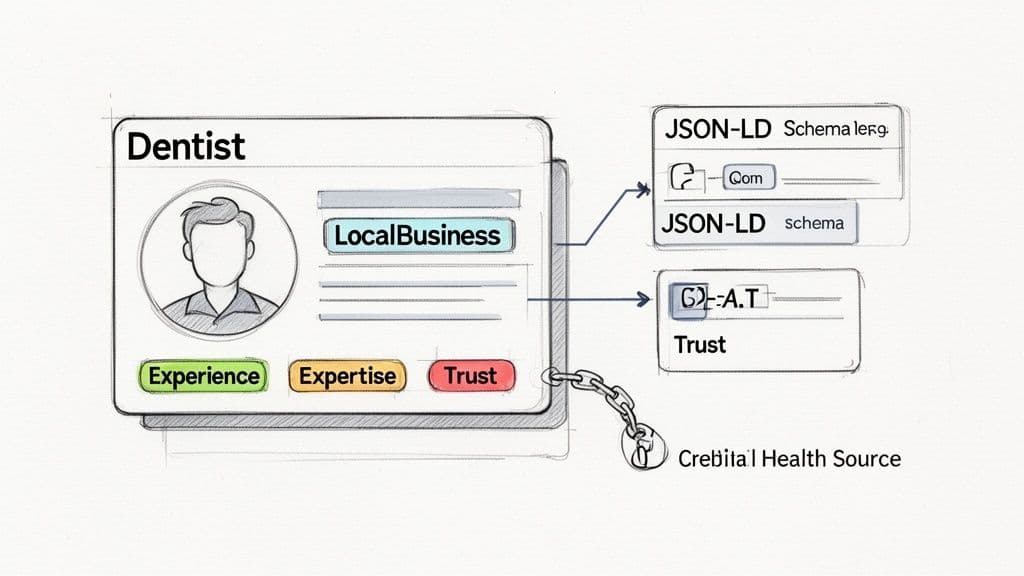
Before an AI assistant will confidently recommend your dental practice, it has to be absolutely certain about your credibility. We're talking about more than just knowing your address and phone number. The AI needs to understand who your dentists are, what their qualifications are, and why your practice is a trustworthy source for patient care.
This is exactly where Google’s E-E-A-T framework comes into play and why it's so critical for improving your AI visibility for dentists. E-E-A-T stands for Experience, Expertise, Authoritativeness, and Trustworthiness. In simple terms, it's the checklist AI models use to gauge the quality and reliability of your entire online presence. If an AI can't trust you, it won't recommend you. It's that simple.
Speaking the AI’s Language with Schema Markup
So, E-E-A-T is the concept, but how do you actually communicate it to a machine? The answer is Schema markup, also known as structured data.
Think of Schema as a behind-the-scenes language that adds specific, descriptive labels to your website's code. These labels don’t change what human visitors see, but for AI and search engine crawlers, they provide perfectly clear context.
For any dental practice, there are two types of Schema that I consider non-negotiable:
DentistSchema: This is where you identify the professionals in your practice. You can mark up their names, specialties (like orthodontics or periodontics), medical education, and professional affiliations.LocalBusinessSchema: This clarifies all the crucial operational details: your official practice name, address, phone number, hours, and even which insurance plans you accept.
By implementing this, you help an AI instantly grasp that "Dr. Jane Smith" is a board-certified pediatric dentist at your specific location, instead of it just seeing her name in a paragraph. That level of clarity is a massive leap forward in building digital authority. You can see how this structured data helps organize information by checking out our guide on the Google Knowledge Panel.
Putting E-E-A-T into Practice on Your Site
Schema provides the structure, but the content on your website has to deliver the substance. You need to create tangible proof of your experience and expertise that an AI can analyze and verify. Just saying you're the best won't cut it. You have to show it.
This means going way beyond basic service descriptions and building out a rich ecosystem of content that validates your credentials.
AI models don't just read content; they cross-reference it. They look for connections between your dentists, their published work, their credentials, and mentions on other reputable health sites. Your goal is to create a web of interconnected proof.
Here are a few ways to start building that proof right now:
- Flesh Out Your Dentist Bios: Don’t stop at a name and the dental school they attended. Get detailed. List each dentist's years in practice, specialized training they've completed, and any articles or research they've published. Make sure to link out to their professional profiles on sites like LinkedIn or Healthgrades.
- Showcase Patient Case Studies: Anonymized case studies are powerful. A post titled "A Full-Mouth Reconstruction for a Patient in Seattle" is a perfect example. Describe the patient's initial problem, the treatment you designed, and the successful outcome. This is real-world proof of experience.
- Cite and Link to Credible Sources: When you're writing blog posts about conditions like gingivitis or the benefits of dental implants, link out to authoritative sources like the American Dental Association (ADA) or peer-reviewed medical journals. This signals that your practice is an active participant in the broader, trusted healthcare conversation.
When you combine the technical precision of Schema with content that actively demonstrates your E-E-A-T, you build an unshakeable foundation of authority. It's this foundation that AI models can easily recognize and, ultimately, reward with patient recommendations.
Create Content That Answers Questions for Patients and AI
AI models have one job: give the most direct, helpful answer to a user's question. That simple fact completely changes the content game for your dental practice. The old strategy of just targeting a keyword like "dental implants" is no longer enough. You have to start thinking about—and explicitly answering—the actual questions your potential patients are asking about them.
When someone asks an AI, "How much do dental implants cost in San Diego?" or "Is sedation dentistry safe for nervous patients?", it's not just looking for keywords. The AI is actively hunting for content that gives a clear, comprehensive, and authoritative response. If your website has a page that directly tackles these questions, you signal to the AI that your practice is the definitive source. This dramatically increases the odds of your content—and your practice—getting featured in its answer.
Build a Powerful FAQ Hub
One of the most effective ways to do this is by building out a robust FAQ section on your website. I don't just mean a single, generic page. Think thematically. Organize questions and answers around your most important services.
For instance, you could create dedicated FAQ hubs for:
- Cosmetic Dentistry: Dive into common questions about the cost of veneers, how long teeth whitening lasts, or what's involved in a full smile makeover.
- Implant Dentistry: Cover topics like implant success rates, the typical recovery time, and the key differences between a single implant and an All-on-4 solution.
- General & Family Dentistry: Address those frequent concerns about root canals, the safety of dental x-rays, or what to do if you have a dental emergency over the weekend.
Structuring your information this way creates a well-organized resource that's incredibly easy for both people and AI models to crawl and understand.
Answering patient questions is no longer just good customer service—it's a core component of modern SEO. Each answered question becomes a potential entry point for a patient asking an AI for help.
Go Deep with Procedural Blog Posts
While FAQs are perfect for those quick, direct answers, in-depth blog posts are where you can really flex your expertise and build serious authority. These articles should go way beyond surface-level explanations. Use them to explore specific procedures, new dental technologies you've adopted, and common patient concerns in real detail.
Imagine a patient who's on the fence about Invisalign. They probably have questions that a simple FAQ can't fully cover. A detailed blog post, maybe titled "A Patient's Guide to the Invisalign Journey," could walk them through every single step, from the initial consultation to seeing their final results.
This approach doesn't just provide immense value to the reader; it also feeds AI models the rich, contextual information they crave to identify your practice as a true subject matter expert. By consistently creating this kind of helpful, patient-first content, you build a powerful library of answers that directly fuels your AI visibility for dentists. To get a better grasp of this concept, you can learn more about how answer engine optimization is shaping the future of search.
Leverage Your Digital Reputation to Earn AI Trust
AI models don't just scan for keywords; they're built to find and recommend the most trustworthy businesses. While all the technical SEO work builds a solid foundation, an AI's confidence in your practice gets a massive boost from what real patients are saying about you.
Your digital reputation, built one review at a time, is essentially a powerful dataset. AI systems sift through this data, analyzing sentiment, how recent the comments are, and the sheer volume of feedback. A steady stream of positive, recent reviews sends a clear signal: this practice is active, valued by its community, and a safe bet for a recommendation.
On the flip side, a profile with just a handful of old reviews—or worse, a mix of outdated positive ones and a string of recent negative comments—creates uncertainty. For an AI, uncertainty equals risk, making it far less likely to put your name forward.
The Non-Negotiable Act of Responding
One of the most powerful things you can do to manage this perception is to respond to every single review. It's a simple action with a huge dual benefit. For potential patients scrolling through, it shows you're engaged and that you actually care about feedback.
For the AI models, it creates a rich, positive data trail demonstrating excellent customer service. Responding to a glowing review reinforces that good sentiment. Even more crucial, however, is how you handle a negative one. A thoughtful, professional response can neutralize its impact, demonstrating accountability and providing context that both humans and AI can process. It shows you're proactive, not passive.
Responding to reviews isn't just good etiquette; it's a strategic move that enriches the sentiment data AI models use to evaluate your practice. A managed reputation is a trusted reputation.
Systematize Your Review Generation
To get the volume of reviews you need to make a real impact, you can't just hope for the best. Relying on patients to remember to leave a review on their own is a recipe for a stagnant, outdated profile. You need a system.
The good news is that it doesn't have to be complicated. An automated process is your best friend here:
- Pinpoint the right moment: The ideal time to ask is right after a positive experience, like at the end of a successful treatment or a great check-up.
- Automate the ask: Use your patient communication software to trigger a polite email or text message a day or so after their appointment.
- Make it frictionless: Always provide direct links to your most important review profiles, especially your Google Business Profile and Healthgrades. The fewer clicks it takes, the more likely they are to follow through.
Beyond just asking for reviews, it’s vital to understand the mechanics of how reviews can affect your local search engine optimisation. By ethically encouraging feedback and diligently managing every response, you are actively shaping the narrative an AI "reads" about your practice.
We dive deeper into these strategies in our guide to search engine reputation management. This consistent effort is what provides the strong, positive sentiment data an AI needs to confidently recommend you over your competitors.
Measure and Refine: Gauging Your Practice's AI Visibility
Getting your practice ready for AI search is just the beginning. The real work lies in a continuous cycle of action, measurement, and refinement. After all, if you aren't tracking your efforts, you’re just flying blind, hoping something sticks.
So, how do you know if you're actually showing up? Start with some hands-on investigation.
Put yourself in a potential patient's shoes and ask AI assistants the same questions they would. Go to Google SGE, ChatGPT, or Perplexity and try prompts like:
- "Who is the best dentist for Invisalign in [Your City]?"
- "Find a pediatric dentist that accepts [Insurance Provider] near me."
- "What are my options for emergency dental care on a Saturday in [Your Neighborhood]?"
Carefully document where your practice appears in these answers—or if it appears at all. This manual check is your baseline, giving you a raw, real-time snapshot of your visibility.
Tracking Performance and Online Sentiment
While manual checks are a great starting point, they can be time-consuming and hard to scale. This is where specialized platforms come into play, offering a much more structured and automated approach to tracking your digital footprint.
Tools like Attensira can take over this monitoring process for you. They don't just track your mentions across the web; they also analyze the sentiment behind them. This gives you a clear picture of how AI models are likely to interpret your practice's reputation based on the data they find.
This simple workflow is key to managing what AI systems learn about your practice.
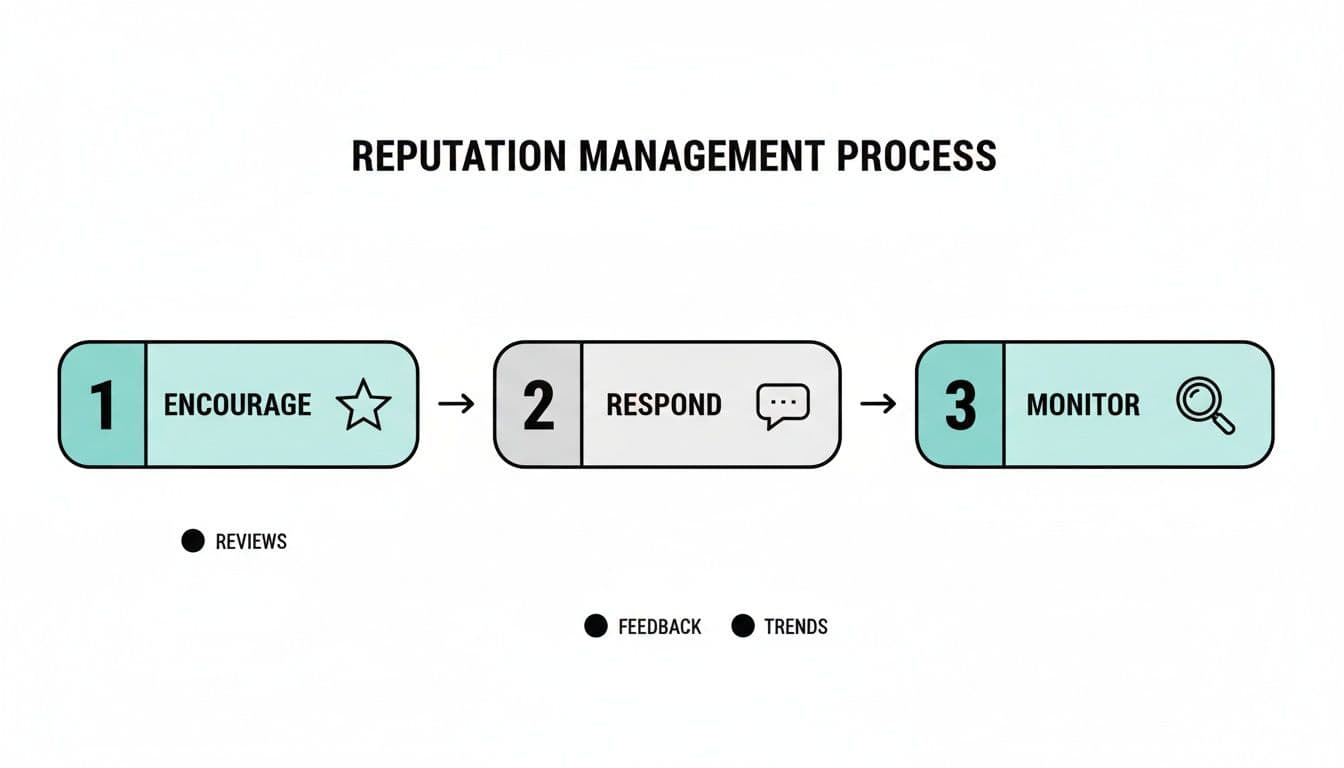
The process is straightforward: actively encourage reviews, make a point to respond to all feedback (good and bad), and then monitor the results. This creates a powerful, positive feedback loop.
Every new, positive review is fresh data that signals to AI models that your practice is trustworthy, active, and highly recommended by real patients. Over time, that's what builds the authority needed to earn a top spot in AI-generated answers.
Answering Your Questions About AI Visibility
As dental practices start to grapple with AI-driven search, a lot of good questions come up. It's a new frontier for most, so let's clear up some of the common things we hear from practice owners and marketers trying to get ahead.
How Is AI Visibility Really Different from Regular SEO?
This is the big one. Traditional SEO is all about climbing the ranks to get your website link on that first page of Google, hoping someone clicks it. AI visibility, on the other hand, is about getting your practice's information pulled directly into the AI's answer.
Think of it this way: instead of just a link, the AI is looking to state facts. It wants to tell a user, "Mint Dental is a top-rated dentist in your area that offers cosmetic dentistry, and they're open until 6 PM today." To do that, it needs to trust your data implicitly. This means structured data, a rock-solid reputation built on reviews, and content that directly answers a patient's question are far more important than just ranking for a keyword.
Which Patient Reviews Actually Matter to AI?
All positive reviews help paint a good picture, but if you have to prioritize, Google reviews are paramount. They are native to Google's ecosystem, which means its AI models look there first and give that feedback the most weight when deciding who to recommend. Your Google Business Profile is essentially a primary source document for these AI systems.
That said, don't ignore other platforms. Reviews on sites like Healthgrades or even Yelp act as secondary validation. They help the AI connect the dots and confirm that the great reputation it sees on Google isn't a fluke. It’s all about building a comprehensive web of trust.
Can I Actually Improve AI Visibility Without a Huge Budget?
Absolutely. In fact, some of the most powerful moves you can make cost more in time and consistency than they do in dollars. You can make serious headway without a massive marketing spend.
The secret to a budget-friendly AI visibility strategy isn't throwing money at it—it's consistency. By focusing on the foundational tasks that build trust, you create a digital footprint that AI algorithms naturally favor over time.
If you're working with limited resources, zero in on these tasks:
- Obsess over your Google Business Profile. Keep every single detail—hours, services, photos—perfectly up to date.
- Make review requests part of your process. A simple, automated text or email follow-up after an appointment is incredibly effective.
- Write one or two genuinely helpful, question-based blog posts each month. Answer the real questions patients are asking.
Ready to stop guessing and start measuring your practice's AI visibility? Attensira provides the insights you need to see where you stand and how to improve. Start tracking your AI presence today.