Discover how to evaluate and hire an ai search optimization agency canada with a clear vetting framework, timelines, and collaboration tips.
An AI search optimization agency in Canada does one crucial thing: it makes your business show up in conversational search results on platforms like ChatGPT and Google's AI Overviews. As more customers get answers directly from AI, old-school SEO just doesn't cut it anymore. These agencies are specialists in making sure your brand's information is what AI models find, trust, and ultimately recommend.
The Shift to AI Search and Why Canadian Businesses Must Adapt

The way your customers find you is changing right under our feet. For years, we’ve obsessed over the "ten blue links" on a Google results page. Now, those are quickly being overshadowed by direct, conversational answers spit out by artificial intelligence. This isn't some far-off prediction; it's happening right now.
Think about it. Platforms like Perplexity, ChatGPT, and even Google's own AI-powered summaries are completely changing the search game. People aren't just typing in keywords anymore. They're asking detailed questions and expecting a single, comprehensive answer right away. For any Canadian business, this is a make-or-break moment.
Beyond Traditional SEO Tactics
Standard SEO was built for a world of keywords and clicks. It's still a piece of the puzzle, but it’s no longer the whole picture. The new challenge is Answer Engine Optimization (AEO), which is all about positioning your content as the go-to source that AI models use to build their answers. If you ignore this shift, you risk becoming invisible to a huge chunk of your audience.
Your competitors are already moving on this. They're busy restructuring their content so it's easy for AI to digest and cite, making sure their brand name is front and centre in these new, critical interactions. Every day you wait, the gap gets wider.
Finding the right ai search optimization agency canada isn’t a luxury for the future—it's a strategic imperative for staying relevant today. This is about future-proofing your brand for the next decade of customer engagement.
This guide is here to cut through the noise for Canadian business leaders. I'm going to lay out a clear, practical plan for you to tackle this new reality. We’ll walk through how to:
- Figure out exactly what your business needs to win in AI search.
- Properly vet and evaluate potential agency partners to find the true experts.
- Forge a strong partnership that secures your brand's future.
As Canadian companies get to grips with AI in search, using practical tools like AI content creation tools becomes a key part of staying competitive. The entire point is to stop reacting and start proactively shaping how people discover your brand in this new environment. For a deeper dive into the basics, check out our guide on https://attensira.com/blog/ai-search-optimization.
Defining Your Goals for AI Search Optimization
Before you even start looking at AI search optimization agencies in Canada, you need to know what a win actually looks like for you. Just chasing "more traffic" is a relic of the past; it's a vanity metric that doesn't capture what's really happening in AI-powered search. Success here is about hitting specific, measurable targets that tie directly to your bottom line.
If your goals are fuzzy, you'll get fuzzy strategies and results you can't really measure. You have to get crystal clear on what success means for your business.
For a B2B SaaS company, a win might be ensuring your product's technical specs show up accurately in AI-generated comparisons. If you're a specialized industrial supplier, it could be about becoming the go-to brand mentioned whenever an AI answers a question about a niche manufacturing process.
This clarity is your biggest advantage. It turns the agency search from a shot in the dark into a deliberate process of finding a partner whose skills perfectly match what you need.
Moving Beyond Traditional Metrics
The first real shift is mental: you have to stop thinking only about traditional SEO metrics and start focusing on AI-centric performance. Organic traffic and keyword rankings still matter, of course, but they don't paint the full picture of your visibility in this new conversational search world.
You need to think about the outcomes that reflect how people are actually finding information now. This requires a much deeper strategic dive than just building a keyword list.
Here are the kinds of sophisticated goals you should be setting:
- Securing Brand Mentions in AI Answers: The aim is to get your company, products, or key people cited as the authority in AI-generated responses to high-value questions.
- Dominating Niche Technical Queries: For B2B companies, this is gold. Ensuring your detailed guides and whitepapers become the foundation for AI answers on complex topics cements you as the industry expert.
- Ensuring Product Data Accuracy: Your goal should be to make sure AI models pull the correct pricing, features, and availability straight from your structured data, preventing the spread of bad information.
This kind of focused approach helps you define the exact expertise you need from an ai search optimization agency in Canada, making it much easier to spot the true specialists among the generalists.
A Practical Checklist for Articulating Your Needs
To turn these ideas into something concrete, build a checklist to document your requirements. This isn't just an internal memo—it becomes a foundational piece of your Request for Proposal (RFP) and guides your first conversations with potential agencies. A detailed list of needs ensures everyone is on the same page from the get-go.
Start building your custom checklist by considering these areas:
- AI Response Tracking: How will you actually monitor when and where your brand gets mentioned across platforms like Perplexity, ChatGPT, and Google's AI Overviews?
- Generative Content Optimization: What’s the plan for creating and structuring content so that large language models can easily understand and cite it?
- AI-Focused Content Gap Analysis: What topics in your industry are AIs frequently answering where your brand is completely invisible?
- Structured Data and Entity Optimization: How will you make sure AI systems clearly understand your company's core information—its "entity"—to solidify your authority?
Writing these points down gives you a tangible scorecard to evaluate agencies against. As you begin tracking these new metrics, you'll need a solid framework for evaluation. For a deeper look into connecting your efforts to financial outcomes, you might find our guide on how to measure marketing ROI helpful.
The goal is to move from asking "Are we getting traffic?" to "Are we the definitive answer?" When a potential customer asks an AI a question related to your industry, your brand should be part of the solution provided. That is the new benchmark for success.
This level of preparation is quickly becoming non-negotiable. In the second quarter of 2025, 12.2% of Canadian businesses reported using artificial intelligence, a huge jump from just 6.1% the previous year. You can learn more about this trend in Canadian business on www150.statcan.gc.ca. With a clear set of goals in hand, you’re ready to find a partner who can truly navigate this shift.
How to Vet and Shortlist Canadian AI SEO Agencies
Once your goals are locked in, the real work begins: finding the right partner. Let's be clear—evaluating an AI search optimization agency in Canada isn't like picking a traditional SEO firm. You're not just buying a set of services; you're investing in a specialized skillset that will quite literally define your brand's future visibility.
This isn't about being wowed by a slick website or a long list of past clients. It's about finding a team that has a proven, repeatable system for getting brands like yours to show up in AI-driven search results. The whole process needs to be methodical, helping you cut through the noise and narrow down a long list to a few true contenders who actually get the Canadian market.
The game plan is simple: let your goals dictate your selection criteria. This ensures you’re aligned from day one.
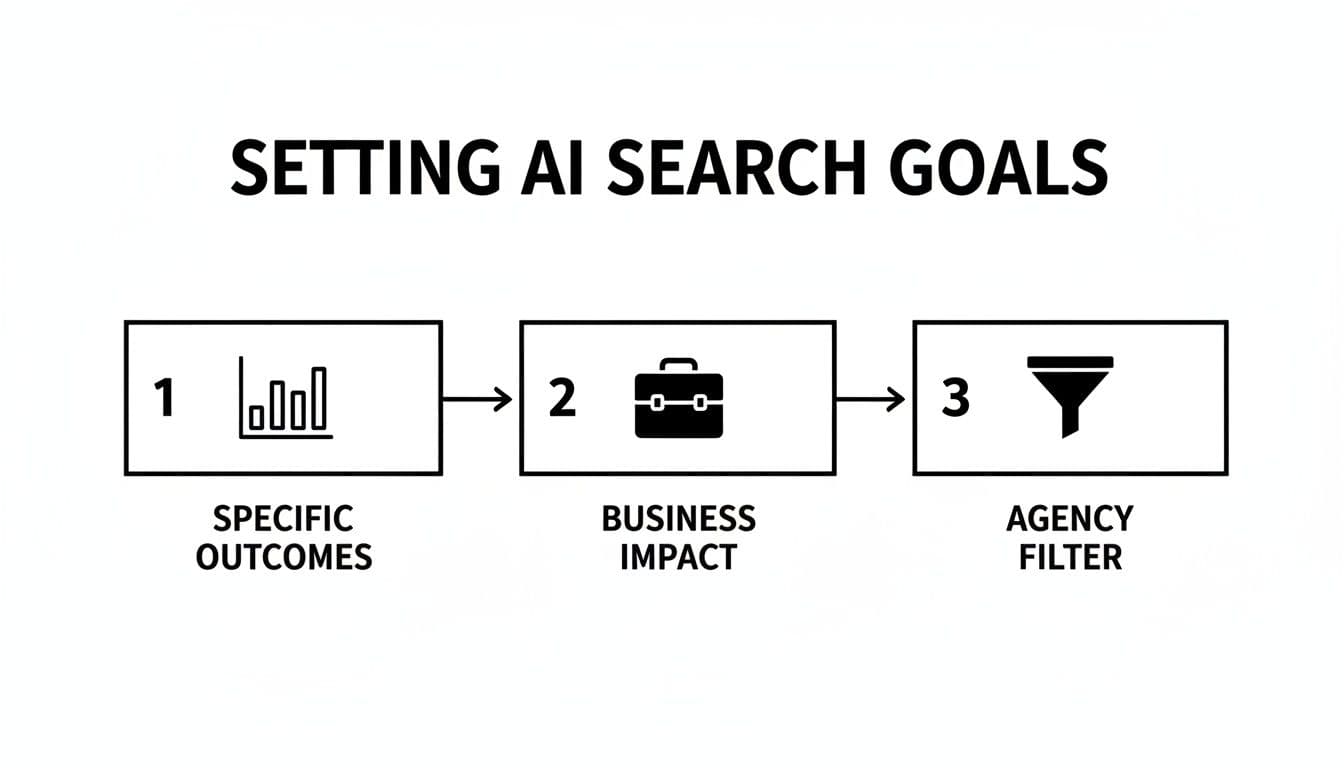
As the visual shows, your business objectives act as the ultimate filter. If an agency's pitch doesn't directly address them, they're not the right fit. Period.
Crafting a Purpose-Built Request for Proposal
A generic RFP gets you generic, copy-paste answers. If you want to properly vet an agency, your Request for Proposal has to ask sharp, insightful questions that dig into their actual AI search expertise. Think of this document as your primary tool for separating the talkers from the doers.
Your RFP should be designed to force agencies to go beyond buzzwords and show you concrete proof. This is your chance to see how they think, so make them lay their cards on the table.
Here's a checklist of what absolutely must be in your RFP:
- Their AI Visibility Playbook: Ask them to detail their exact process for getting clients featured in AI Overviews, ChatGPT, and Perplexity. What specific on-page and off-page tactics do they use?
- The Tech Stack: What platforms are they using to track brand mentions in AI responses? Do they have their own proprietary software, or are they just using off-the-shelf tools?
- Proof of Performance: Demand at least two relevant case studies. The data can be anonymized, but it must show tangible results like a jump in "Share of AI Voice" or measurable conversions from AI-generated traffic.
- The Human Element: Who, specifically, would be working on your account? Ask for the backgrounds of the team members. You're looking for experience with large language models (LLMs), structured data, and semantic SEO.
- Reporting & KPIs: What does success look like to them, and how do they prove it? Ask for a sample report to see exactly what you'll be getting.
This direct line of questioning creates a level of transparency that quickly exposes which agencies have a genuinely mature offering. For a wider view on what separates the best from the rest, looking at how top firms are evaluated elsewhere, like these reviews of the best SEO agencies in the UK, can provide some valuable context.
Analyzing Case Studies and Testimonials
Case studies are far more than just success stories—they're a window into an agency's strategic mind. When you're reviewing them, look past the big-name client logos and get into the weeds. Was the client in a similar industry? Did they have the same kinds of challenges you're facing?
For example, a killer case study for a B2B SaaS company won't just talk about boosting blog traffic. It will detail how the agency got their technical documentation to surface directly in AI-generated answers for complex queries. Context is king.
Generic testimonials are almost useless. You want detailed endorsements that talk about the agency's process, communication, and problem-solving skills, not just the final numbers.
The most telling case studies are the ones that are honest about the challenges they faced. If they explain a roadblock and how they pivoted their strategy to overcome it, that shows real agility and expertise—two things you absolutely need in the fast-moving world of AI search.
To keep your evaluation objective and avoid getting swayed by a slick presentation, use a scorecard. It forces you to rate each potential partner systematically, giving you a clear, data-driven foundation for your final decision.
AI Search Optimization Agency Evaluation Scorecard
A scorecard like this one helps you objectively compare potential Canadian agencies across the capabilities that matter most. Score each criterion from 1 (Poor) to 5 (Excellent).
By scoring each agency against the same criteria, you create a simple, side-by-side comparison that instantly highlights the best potential partner for your specific needs, removing guesswork from the equation.
Navigating Agency Pricing Models and Proving ROI
Figuring out how an ai search optimization agency in Canada structures its fees is your first step toward building a predictable budget. But cost is only half the story. The real challenge is proving your investment is delivering tangible business value—a task that requires moving beyond traditional SEO metrics and adopting a new framework for what success actually looks like.
The financial commitment isn't trivial, and it’s important to grasp the scale of this market. The Canadian Search Engine Optimization Advertising Software Market hit USD 5,441.77 billion in 2024. It’s projected to more than double to USD 11,485.71 billion by 2033. That reflects a massive 8.74% compound annual growth rate, highlighting just how seriously Canadian businesses are investing in their search visibility. You can discover more insights about this growing Canadian market on reedintelligence.com.
Decoding Common Agency Pricing Structures
Most agencies you'll encounter work on one of three main models. Each has its pros and cons, and the right one for you really depends on the nature of the engagement.
- Monthly Retainers: This is the industry standard for a reason. You pay a fixed fee each month for an agreed-upon scope of work. It’s perfect for long-term strategies that need constant monitoring, optimization, and content development. A retainer gives you budget predictability and, frankly, fosters a much deeper, more integrated partnership.
- Project-Based Fees: If you have a specific, one-off goal in mind, a project-based fee can make a lot of sense. Think of things like an initial AI readiness audit, a complex structured data implementation, or optimizing a particular content hub. The model is clean—defined deliverables, fixed cost—but it lacks the ongoing agility you get with a retainer.
- Performance-Based Models: These are less common for the foundational work AI search optimization demands, but you’ll see some agencies offer hybrid approaches. This usually looks like a smaller base retainer with bonuses tied to hitting specific KPIs, like achieving a target increase in brand mentions within AI answers. It aligns the agency’s success with your own but can get complicated to structure fairly.
Ultimately, the best model depends entirely on your goals and internal resources. For the kind of continuous effort AI optimization requires, a retainer is almost always the way to go.
The New KPIs for Measuring AI Search ROI
Proving the return on your investment means you have to start tracking metrics that directly reflect your visibility in this new conversational search world. Old-school KPIs like keyword rankings and organic traffic are still part of the picture, but they don't tell the whole story anymore.
It's time to introduce a new set of performance indicators that capture the unique value of getting your brand cited by AI.
The core question is no longer just "Did they find our website?" It’s become "Did an AI cite our brand as the definitive answer?" This fundamental shift demands a new measurement framework to justify the investment to your stakeholders.
Here are the critical KPIs you should be tracking with any agency partner worth their salt:
- Share of AI Voice: Think of this as the new "market share." It measures the percentage of times your brand appears in AI-generated answers for your target queries, directly compared to your competitors.
- Accuracy of Brand Mentions: Getting mentioned is one thing; getting mentioned correctly is another. This KPI tracks the accuracy of details like product specs, pricing, and company info cited by AI models. Inaccurate information can be incredibly damaging.
- Conversions from AI-Generated Summaries: This is where the rubber meets the road. It involves tracking users who click through from links embedded in AI answers and then complete a goal, like filling out a form or buying a product. It’s the clearest line you can draw from AI visibility to revenue.
- Citation Velocity: This metric measures how quickly your new content gets picked up and cited by AI platforms. A high velocity is a strong signal that your content strategy is perfectly aligned with what AI models are looking for.
Focusing on these outcomes helps you build a powerful business case. You can clearly show leadership how the agency's work is building brand authority, driving qualified leads, and protecting your brand's reputation in a new and critical channel. If you want to get a handle on the financial impact, our tools can help you calculate ROI and payback period. This ensures the conversation is always grounded in business results, not just marketing metrics.
Building a Successful Agency Partnership from Day One
Choosing the right ai search optimization agency in Canada is a huge win, but it’s really just the beginning. The actual success of your new relationship is forged in the weeks that follow the signed contract. A deliberate, structured onboarding process is what turns a simple vendor agreement into a powerful strategic partnership right out of the gate.
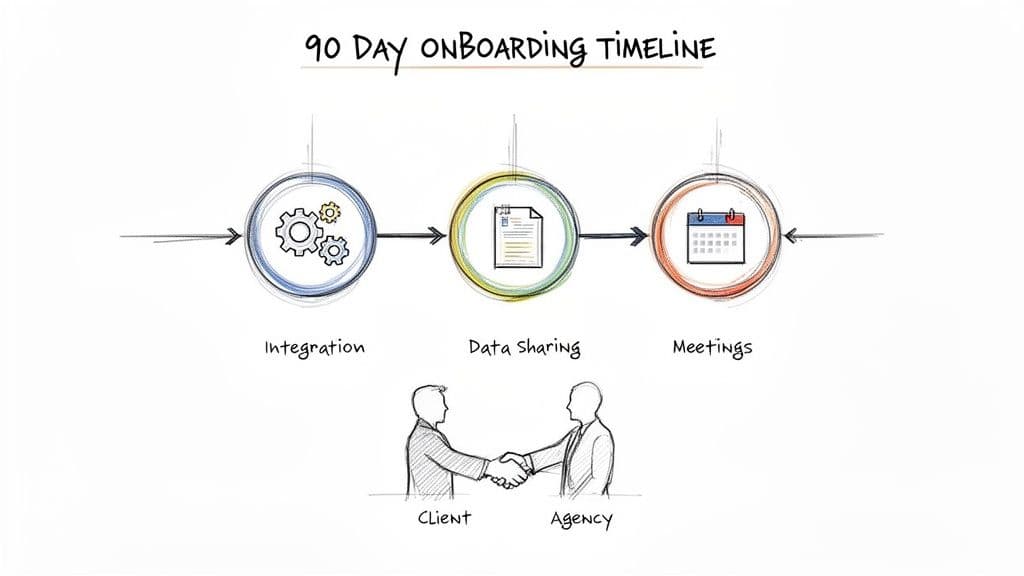
Without a solid plan, those first few months can easily get bogged down in misaligned expectations, technical roadblocks, and frustrating communication gaps. A well-thought-out 90-day plan gets both your team and the agency moving in sync, focused on the goals you worked so hard to define.
The First 30 Days: Foundational Alignment
The first month is all about getting the operational plumbing right. This is where you move past the sales pitch and get down to the brass tacks of working together day-to-day. The kickoff meeting is the anchor point for everything that follows.
This meeting isn't just a round of introductions; it’s a working session to lock in objectives, KPIs, and the immediate priorities. During this period, you’ll be granting the agency access to critical platforms like your analytics, CMS, and any search tools you’re already using.
Your checklist for the first 30 days should include:
- A Comprehensive Kickoff: Nail down the communication plan, introduce the core teams on both sides, and reaffirm the strategic goals from the RFP.
- Technical Integration: Hand over the necessary credentials and get agency accounts set up in your systems. This is also when the first technical audits should be getting underway.
- Data-Sharing Protocols: Agree on secure methods for sharing information and clarify exactly what data will be shared and how often.
This initial phase sets the entire rhythm for the partnership.
The Next 60 Days: Execution and Refinement
Once the foundation is solid, days 31 through 90 shift to execution, reporting, and strategic fine-tuning. By now, the agency should have a clear picture of your technical setup and content landscape, moving from auditing to actually implementing their first wave of recommendations.
This is also when the first real performance reports start rolling in. It's vital to establish a consistent meeting cadence—bi-weekly is a great starting point. These shouldn't be status updates; they should be data-led conversations about what’s working, what’s not, and what adjustments need to be made.
Clarifying roles is absolutely key here. Your internal team must know their primary point of contact, and the agency needs a direct line to your subject matter experts for things like content validation and approvals.
A strong partnership is built on mutual accountability. Clearly defined Service-Level Agreements (SLAs) for response times and reporting deadlines prevent ambiguity and ensure that both teams are held to the same high standard.
This period truly tests an agency's agility. As they get their hands on real-world data, their initial strategy will almost certainly need some tweaks. A great partner won’t just make changes; they’ll proactively explain the "why" behind every single recommendation.
Red Flags to Watch For During Final Negotiations
Even with the most rigorous vetting process, some warning signs can pop up as you’re finalizing the contract. Spotting these red flags can save you from a mismatched partnership before it even starts.
Keep your eyes peeled for an agency that:
- Guarantees Specific Rankings: In the fluid world of AI-driven search, nobody can promise a top spot in an AI-generated answer. A promise like that shows a fundamental misunderstanding of how modern search actually works.
- Is Vague About Their Tech Stack: A genuine expert will be completely open about the tools they use to track AI mentions and measure performance. If their answers feel evasive, it might mean they don’t have a sophisticated process.
- Uses High-Pressure Sales Tactics: A confident agency knows its worth and will give you room to make a thoughtful decision. Rushed deadlines or "exploding offers" are usually signs of desperation, not expertise.
- Assigns a Junior Team Post-Sale: Make sure the senior experts you met during the sales process are the people who will actually be managing your account. A last-minute switch to a less experienced team is a classic bait-and-switch.
By going into the relationship with a clear onboarding map and an eye for these potential issues, you set the stage for a collaboration built on trust, transparency, and a shared drive to hit your goals.
Finding Your Competitive Edge in Canada's New Search Reality
We've walked through the entire process, from defining your goals to measuring ROI. If there's one thing to take away, it's this: an AI-first search strategy isn't something to plan for tomorrow. It's the cost of entry for growth today. Getting this right means you're not just reacting to change—you're getting ahead of it and defining your brand's future on your own terms.
For most businesses, the most effective way to make this happen is to partner with a specialized AI search optimization agency in Canada. This isn't just about staying current. It’s about building a real, lasting competitive advantage right here in the Canadian market. It’s the difference between being a passive result in an AI's answer and becoming the authoritative voice that shapes those answers.
The Canadian AI Opportunity is Here
You can feel the momentum building around artificial intelligence in Canada, and for B2B leaders, it’s a clear signal. This isn't just a tech-sector phenomenon; it’s a fundamental shift in how businesses work and how customers find what they need.
When you align your search strategy with this powerful shift, you're not just making small improvements. You're claiming a leadership spot in your industry as search behaviour itself is rewritten.
The numbers don't lie. Canada's artificial intelligence market is on a tear, projected to hit an estimated USD 40,866.6 million in 2025 and rocket to USD 362,886.4 million by 2033. That’s a compound annual growth rate of 30.1%, a clear sign that AI adoption is accelerating across the board. The fact that "services" is the largest piece of that pie tells you everything you need to know: the demand for specialized expertise in areas like AI search is exploding. You can see the full breakdown of Canada's AI market growth on grandviewresearch.com.
This isn't a speculative bet. Investing in your AI visibility is a direct, strategic response to where the market has already moved.
Your Next Move
For B2B leaders, the path forward is clear. The frameworks and checklists in this guide are your roadmap. Use them. Start defining your brand's voice in AI-driven search, solidify your authority, and turn conversational AI into a reliable engine for growth. The future of search has arrived, and the winners will be those who act decisively.
The strategies we've covered are the core of what's now called Generative Engine Optimisation. It's a discipline you can't afford to ignore. To get a deeper understanding of the mechanics, I'd recommend reading our detailed guide on Generative Engine Optimisation. By taking these steps, you’re doing more than just optimizing for search—you're future-proofing your brand.
Frequently Asked Questions
When it comes to AI search optimization, there are always plenty of questions. It's a new frontier, after all. Here are a few of the most common ones we hear from Canadian business leaders trying to get ahead of the curve.
So, How Is AI Search Optimization Really Different from Traditional SEO?
That's the big question, isn't it? Think of it this way: a traditional SEO agency is laser-focused on getting your website into those classic "ten blue links" on a Google search page. Their world revolves around ranking web pages.
An AI search optimization agency has a different endgame. While they still care about rankings, their primary mission is to get your brand cited as the definitive source in AI-generated answers, whether that's in a ChatGPT response or a Google AI Overview. The goal is to become the trusted authority that AI systems rely on, which is a whole different ballgame than just chasing clicks.
What Kind of Budget Are We Talking About?
Let's be direct: this isn't your standard SEO package. You should think of it as a premium, highly specialized service. Why? Because it demands more sophisticated tools to track AI mentions and a much deeper, more strategic approach to content creation.
For a serious engagement with a top-tier Canadian agency, you should plan for an investment that's higher than a typical SEO retainer. You're paying for specialized expertise that can give you a genuine first-mover advantage in a brand-new competitive space.
How Quickly Can I Expect to See Results?
Here’s some good news. Unlike traditional SEO, where you might be waiting six months just to see a flicker of movement in the rankings, you can sometimes see the impact of AI optimization much faster. A skilled agency might be able to land your brand in an AI-generated summary for a key query within 90 days.
A word of caution, though: quick wins are one thing, but long-term dominance is another. Building the kind of deep-seated authority that makes your brand the go-to source for AI is a marathon, not a sprint. This is about methodically building foundational trust with the AI, which requires a sustained effort over many months.
Ready to secure your brand's visibility in the new era of search? Attensira provides the insights you need to get cited by AI and connect with your next customer. Start tracking your AI presence today.