



Discover search engine reputation management strategies to protect your brand, improve trust, and push negative results down in search.
Search engine reputation management, or SERM, is all about taking control of how your brand appears in search results. Think of it as curating your digital storefront on Google. It’s the deliberate practice of ensuring that when people look you up, they find the best and most accurate version of your brand first.
At its core, SERM is a strategic blend of SEO, content creation, and public relations, all working together to shape and protect your online story.
What Is Search Engine Reputation Management
Imagine a potential customer’s first interaction with your brand isn’t your website or your storefront—it's the Google search results page. For most people, this is your first and often most important impression. SERM is the art and science of making sure that impression is a great one.
This isn't just about reacting when a bad review pops up. True SERM is a proactive, ongoing effort to build, maintain, and defend your brand's image where it matters most. When you do it right, you get to control the narrative.
The Power of the First Page
Let's be blunt: visibility on the first page of Google isn't a "nice-to-have." It's everything. User attention is overwhelmingly focused on the top few results, making that digital real estate incredibly valuable.
In search, if it's not on the first page, it might as well not exist. A strong digital presence isn’t a luxury anymore; it’s the bedrock of trust and credibility for any modern business.
This reality is amplified by Google's massive 79.1% market share. The data tells a compelling story: the #1 search result gets a whopping 27.6% of all clicks, while the result at the bottom of the page, in the #10 spot, gets a meager 2.3%. That steep decline is precisely why a solid SERM strategy is non-negotiable.
The chart below shows just how dramatic the drop-off in user attention is from the top to the bottom of page one.
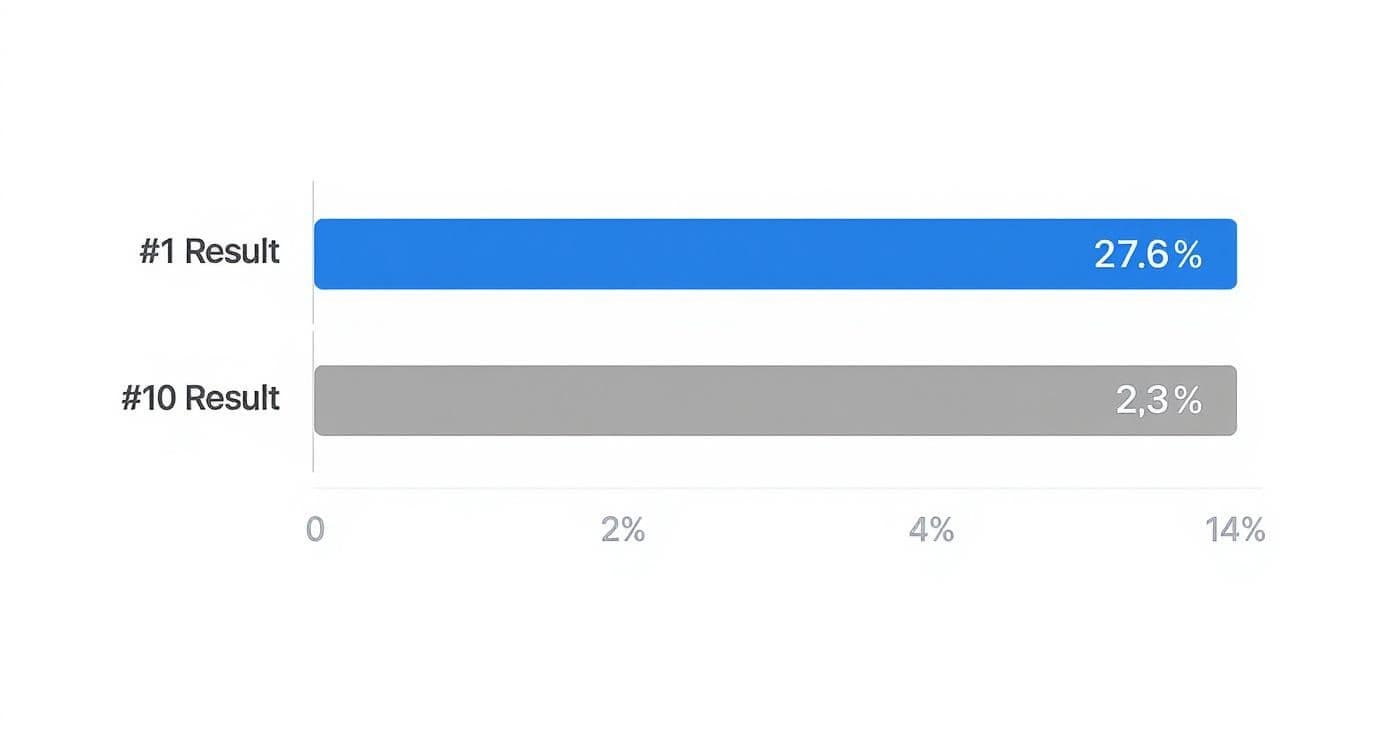
This stark difference in click-through rates underscores a simple truth: where your content ranks directly shapes how the public sees your brand. For a deeper dive, you can explore more online reputation statistics and see their direct impact on business outcomes.
How Search Rankings Shape Brand Perception
The position of search results isn't just about traffic; it's about trust. Users subconsciously associate higher rankings with authority and credibility. This table breaks down why controlling that first page is so critical.
As you can see, the difference between ranking at the top of the page versus the bottom is the difference between being seen as a leader and being almost entirely overlooked.
Beyond Search Rankings
Ultimately, SERM is about building a strong, resilient brand that can stand up to public scrutiny. It's about making sure that when people go looking for you, they find a story that reinforces your value and builds their confidence.
A good SERM strategy accomplishes this through a few key activities:
- Promoting Positive Assets: This means actively creating and promoting high-quality content—like blog posts, positive press, and case studies—to rank for your brand name.
- Suppressing Negative Content: It also involves using smart SEO tactics to push down any misleading, outdated, or unfair search results where fewer people will ever see them.
- Monitoring Online Conversations: You have to keep a close eye on what’s being said about your brand across the web so you can respond quickly and stay ahead of the narrative.
The Three Pillars of a Strong SERM Strategy

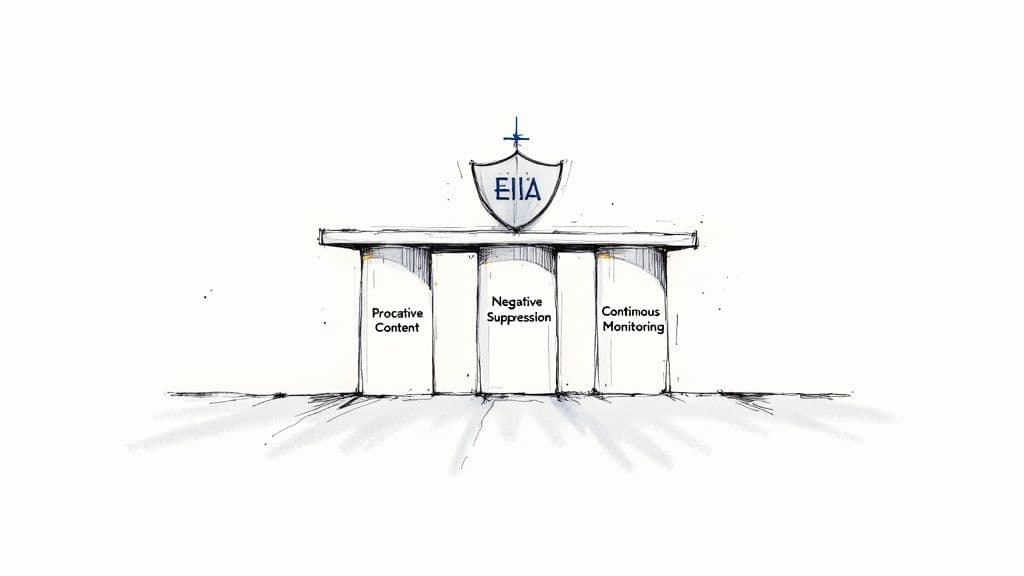
A truly effective search engine reputation management program isn't a quick fix; it's a living, breathing process. It's built on three core pillars that have to work in concert to create a positive and resilient digital footprint. Getting a handle on how these pieces fit together is the first real step toward building a strategy that not only promotes your brand but also defends it when necessary.
I like to think of these pillars as a three-legged stool. If one leg is wobbly or missing entirely, the whole thing comes crashing down. A successful SERM program demands a balanced, sustained effort across all three areas to make sure your online reputation is solid, accurate, and, most importantly, something you can actually control.
Pillar 1: Proactive Content Creation
The best defense is a good offense. In SERM, that means building a fortress of positive, high-quality content before you ever find yourself in a crisis. This pillar is all about actively creating and promoting a deep library of brand-owned assets. You're essentially flooding the search results with content you've created and control, which becomes your first line of defense.
This goes way beyond just publishing a few blog posts. It's a deliberate, strategic push to establish your brand as a genuine authority and a go-to resource in your field.
Here are the key types of proactive content you should focus on:
- Expert Articles and Guides: Deep-dive content that proves your expertise and directly answers the questions your audience is asking. This is how you become a thought leader.
- Positive Press and Media Mentions: Actively seeking out and amplifying favorable stories from respected news outlets and industry publications.
- Case Studies and Success Stories: Nothing sells your value better than showing it. Use real-world examples of how you've helped clients get results.
- Optimized Digital Profiles: Make sure your company’s social media profiles, especially professional platforms like LinkedIn, are complete, polished, and consistently active.
By constantly publishing and optimizing this kind of content, you create a powerful buffer of positive search results. This proactive work ensures that when someone looks you up, the story they find is the one you’ve written.
A strong proactive content strategy is like having a well-stocked pantry before a storm hits. When a crisis arrives, you have the resources ready to weather it, rather than scrambling to find supplies in the middle of the chaos.
This also plays into controlling the structured data that appears in search results. For example, by claiming and managing your official online presence, you can secure a much more authoritative look. You can get the full story on that in our guide to the Google Knowledge Panel.
Pillar 2: Negative Content Suppression
If proactive content is about building the fortress, then negative content suppression is about actively defending the walls. This pillar uses proven SEO and digital PR tactics to systematically push unfavorable or flat-out inaccurate search results further down the page. The goal isn't always outright removal—that can be incredibly difficult, if not impossible. Instead, the focus is on burying negative items where they are far less likely to be seen.
Let’s be real: research shows that pages beyond the first page of Google get less than 1% of all clicks. Just by pushing a negative result from position #3 down to #11, you've essentially made it invisible to almost everyone.
This is done by taking all those positive assets you created in Pillar 1 and building up their authority with high-quality backlinks and smart promotion. This process slowly but surely outranks the negative content, forcing it down the search engine results page (SERP). It’s a meticulous, ongoing effort that requires real expertise in how search algorithms work.
Pillar 3: Continuous Monitoring
This final pillar is your intelligence-gathering operation. It’s what makes the other two pillars work. Continuous monitoring means using specialized tools to track mentions of your brand, your products, and your key executives across the web—all in real-time. Think of it as your reputation’s early-warning system.
Without monitoring, you're flying blind. It's the only way to:
- Spot potential crises early before they blow up into major problems.
- Keep a pulse on customer sentiment to truly understand how the public sees your brand.
- Uncover new opportunities for engagement and fresh content.
- Measure the actual impact of your content creation and suppression work.
This constant vigilance is what allows you to react quickly to new threats and jump on new opportunities, keeping your entire search engine reputation management strategy agile and effective.
Navigating Reputation Management in the AI Search Era
The world of search is going through its biggest shake-up in decades. With the arrival of AI-powered engines and features like Google's AI Overviews, the old playbook for search engine reputation management is officially out of date. We're leaving behind the familiar "ten blue links" and stepping into a new reality where a single, synthesized answer reigns supreme.
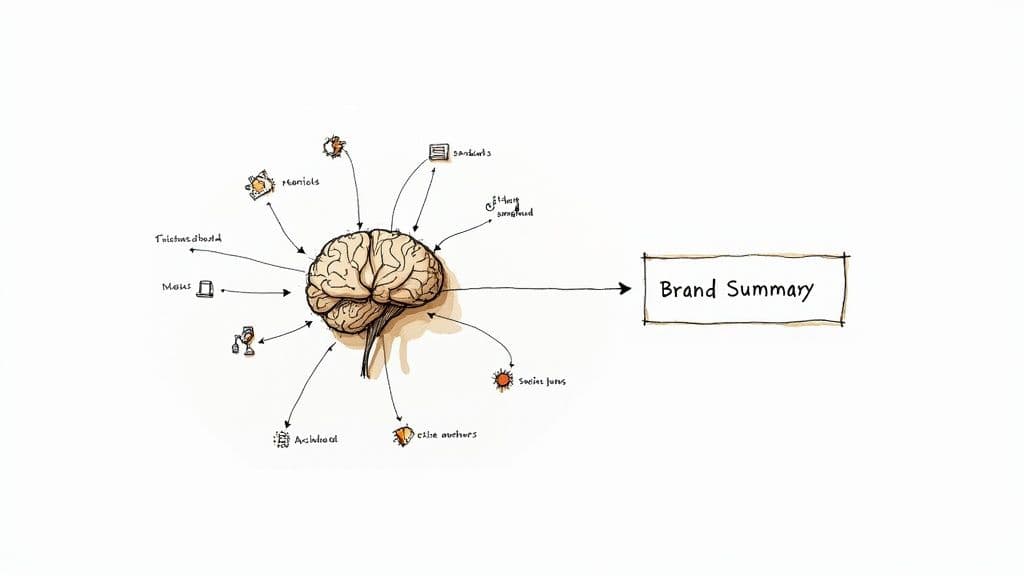
Think of it this way: traditional search was like a bookshelf. A user could browse multiple "books"—websites, reviews, articles—about your brand and decide which ones to open. AI search, on the other hand, is like a librarian who reads everything and then gives the user a quick verbal summary. Suddenly, your entire brand reputation gets boiled down to that one definitive answer.
This consolidation is both a massive opportunity and a serious risk. If the AI model picks up on your positive, well-crafted content, your reputation gets a huge boost. But if it latches onto one bad review or a single misleading article, that negativity can define your brand in the AI's summary.
The New Risks of AI-Synthesized Reputations
The challenges in this new era are far more subtle. Misinterpretation is a huge one. An AI simply doesn't have the human context to understand sarcasm in a customer review or the complex nuances of a news story. A single, out-of-context quote can be plucked from an article and presented as a standalone fact, completely twisting its original meaning.
Worse yet, the problem of fake content is exploding. The accessibility of artificial intelligence has led to an astonishing 758% increase in AI-generated fake reviews in recent years. It's gotten so bad that the U.S. Federal Trade Commission has moved to ban them outright. With AI-generated overviews expected to pop up in over 60% of local search results, blending genuine human engagement with smart AI insights is no longer optional for managing your reputation. You can dig into more of these trends with these reputation management statistics on ReputationX.com.
In the AI search era, your goal isn't just to rank first. It's to become the most citable, factually dense, and trusted source of information about your own brand.
This new dynamic demands a strategic pivot. Your content can't just be for human readers anymore; it has to be built for AI consumption. That means focusing on clarity, provable facts, and structured data that AI models can easily understand and verify.
Adapting Your SERM Strategy for AI
To stay ahead, your approach has to evolve. The foundational pillars of reputation management haven't changed, but how you execute them needs a major tune-up for an AI-first world. Here's how to adapt:
- Create Factually Dense Content: The best defense is a good offense. Produce authoritative, data-rich content that directly answers common questions about your brand, products, and industry. AI models are programmed to find and cite definitive sources.
- Prioritize Structured Data: Use schema markup on your website to explicitly label key information like company details, product specs, and customer reviews. This is like putting clear, easy-to-read labels on your data so the AI has zero confusion.
- Encourage Authentic Reviews: Double down on your efforts to generate a steady stream of genuine customer feedback. A high volume of authentic, positive reviews creates a powerful signal that can easily drown out the noise from a few negative comments.
- Monitor AI-Generated Summaries: You absolutely have to keep an eye on how your brand is being portrayed in AI Overviews and other generative search results. Catching and addressing misrepresentations early is key. Check out our detailed guide on [https://blog.attensira.com/ai-brand-monitoring] to learn how to track your visibility effectively.
As we all navigate this new terrain, maintaining an authentic voice is more important than ever. It's critical to know how to humanize your content to build trust with both your audience and the algorithms. For anyone looking to master this, the ultimate guide to AI Text to Human Text offers some great techniques. The future of reputation management lies in building a digital presence so clear and authoritative that AI models have no choice but to reflect the positive reality you've built.
Your Action Plan for Building a Positive Digital Footprint
Okay, let's shift from theory to action. This is where a search engine reputation management strategy stops being a concept and starts becoming a tangible plan. Building a strong digital footprint doesn't happen by accident; it's the result of a deliberate, step-by-step process to fortify your brand’s presence across the web. Think of this as your blueprint for building a resilient and authoritative online identity.
The very first move is to claim your core digital assets. Imagine these as plots of land where you’ll build your brand's story. If you don't own them, they can sit empty, or worse, someone else could build something that confuses your customers and the search engines.
Claim and Optimize Your Digital Properties
Before you can start building, you need to secure your territory. That means going through and methodically claiming every key profile that represents your brand online. Consistency is the name of the game here—it sends a loud, clear signal to search algorithms about who you are and what you stand for.
Start with the non-negotiables:
- Google Business Profile (GBP): This is your single most important asset for local SEO, bar none. You need to fill out every single section, upload high-quality photos, and triple-check that your name, address, and phone number are an exact match to your website.
- Professional and Social Profiles: Go claim your brand name on major platforms like LinkedIn, Facebook, and X (formerly Twitter). Do this even if you don't plan to be super active on all of them. For any B2B company, a fully optimized LinkedIn Company Page is an absolute must.
- Industry-Specific Directories: Hunt down and claim your listings on the review sites and directories that matter in your niche. If you’re a software company, that’s G2 and Capterra. If you run a hotel, it's TripAdvisor.
By taking control of these profiles, you start to dominate the search results for your own brand name with digital real estate that you control. This is the foundation of your digital fortress.
Develop an Authoritative Content Strategy
With your properties secured, it's time to furnish them with high-value content that puts your expertise on full display. Your content strategy should be built around answering the questions your audience is actually asking, all while reinforcing the brand identity you want to project. This is how you prove you're an authority to both people and AI.
Your content is your brand's voice online. If you aren't actively telling your own story, you're allowing others to tell it for you—and you might not like their version.
A smart content plan uses a mix of formats to build trust. You might publish in-depth articles to climb the SEO rankings, create engaging social media posts to grow an audience, and issue press releases to earn positive media coverage. It's also becoming critical to see how this content shows up in new search environments. As AI models like ChatGPT become a go-to source for information, knowing if your brand is being mentioned is key. We cover exactly how to track your brand's visibility in ChatGPT & other top LLMs in our detailed guide.
Systematize Your Review Generation Process
Positive customer reviews are probably the most potent form of social proof you have. Just sitting back and waiting for them to trickle in is a slow, unreliable game. The right approach is to build a repeatable system for encouraging, collecting, and showcasing that authentic feedback.
A good review generation strategy is all about turning happy customers into your biggest cheerleaders. It’s not about being pushy; it’s about making it dead simple for them to share their great experience.
Here’s a simple, automated process you can put in place:
- Identify Happy Customers: Send a feedback request right after a positive moment, like when a project is successfully completed or a customer makes a repeat purchase.
- Request Private Feedback First: Start with a simple email asking for a quick rating (like on a scale of 1-10). This gauges their sentiment privately.
- Guide Positive Responders: If they give you a high score, the follow-up email can provide a direct link to the review site you want to boost, whether that’s Google, G2, or somewhere else.
- Learn from Negative Feedback: If the score is low, that follow-up email should direct them to a private contact form. This gives you a chance to resolve their issue offline and turns a potential public complaint into a private learning opportunity.
This structured system not only drives up your public ratings but also gives you a goldmine of feedback to improve your business. It creates a powerful, self-reinforcing cycle for your brand's reputation.
How to Respond to Negative Reviews and Online Crises
Sooner or later, every business gets hit with negative feedback online. It could be a simple one-star review from a disappointed customer or a full-blown news story that puts your brand in a bad light. What really matters is what you do next. Your response can either pour fuel on the fire or show everyone that your company has integrity. This is where a solid plan for search engine reputation management becomes so important.
The trick is to know what you’re dealing with. A single bad review needs a different touch than a major online crisis, but both demand a swift and professional response. In these situations, speed isn't just a suggestion—it's a critical ingredient for building trust.
The 24-Hour Rule and Timely Responses
When it comes to online feedback, silence is deafening. People often see a lack of response as an admission of guilt or, worse, that you just don't care. With 97% of consumers using the internet to find local businesses, your online reputation is constantly under a microscope.
Responding to negative feedback within 24 to 48 hours is the gold standard. It sends a powerful message that you're listening and can actually improve customer confidence. Platforms like Yelp process over 26,000 reviews per minute, so you have to be ready to act fast. That kind of quick engagement can turn a negative comment into a public display of great customer service.
A well-handled negative review can build more consumer trust than a page filled only with perfect five-star ratings. It demonstrates transparency, accountability, and a genuine commitment to customer satisfaction.
A Practical Framework for Responding to Criticism
Let's be clear: not all criticism is the same. You need a flexible game plan that can handle everything from a legitimate customer complaint to an unfair online attack. In every case, the goal is to de-escalate the situation and take back control of the story.
Here are the essential dos and don'ts for handling public feedback:
What You Should Always Do:
- Acknowledge and Empathize: Always start by thanking the person for their feedback and showing you understand their frustration. Something as simple as, "We're sorry to hear your experience didn't meet your expectations," can make a huge difference.
- Respond Publicly, Resolve Privately: Post a short, professional reply in public. Then, immediately invite them to take the conversation offline via email or phone to sort out the specifics.
- Stay Professional: No matter what, don't get drawn into a public argument. Keep your tone calm and helpful, even if the criticism feels personal or unfair.
What You Must Never Do:
- Get Defensive or Make Excuses: This will only make the customer angrier and make you look bad to everyone else watching.
- Ignore the Feedback: Ignoring a negative comment lets it sit there, unanswered, giving the impression that you don’t care about your customers.
- Offer Public Compensations: Don't talk about refunds or freebies in public. It can encourage others to post fake complaints just to get something for free. Handle all resolutions privately.
Knowing the nuances of each platform is key. A great place to start is learning how to respond to negative Google reviews, since that’s often the first place customers look. By sticking to a consistent and professional playbook, you can protect your brand and turn a potential crisis into a chance to shine.
Answering Your Top Questions About Search Engine Reputation Management
Even with a solid plan, a few practical questions always come up when you start digging into reputation management. Let's tackle some of the most common ones I hear from clients to help you set the right expectations from the get-go.
How Long Until I See a Change in My Search Results?
This is the classic "it depends" answer, but it's the truth. The timeline is completely tied to the complexity of your situation. If you're being proactive and just building up a positive online footprint, you can start seeing your own websites and positive mentions gain traction within a few months.
On the other hand, if you're trying to push down a stubborn negative result, you need to be patient. Trying to outrank a negative article on a major news site, for instance, isn't a quick fix. That kind of effort can easily take six months to a year of consistent, focused work. Think of it as a marathon, not a sprint.
Can You Just Get Google to Permanently Remove a Negative Result?
Getting something wiped from Google for good is extremely rare. It typically only happens in specific legal situations, like a clear case of copyright infringement or the exposure of highly sensitive personal information. For the vast majority of businesses dealing with a bad review or a critical article, removal just isn't on the table.
This is where the real strategy of modern reputation management comes into play. It’s not about removal; it’s about suppression. The goal is to create and promote so much high-quality, positive content that it systematically pushes the negative item down in the rankings until it’s off the first page and, for all practical purposes, invisible.
What’s the Real Difference Between SEO and SERM?
It's easy to get these two mixed up, but think of it this way: SEO is one of the essential tools in the SERM toolbox, but SERM is the overall strategy for building the house.
- SEO (Search Engine Optimization): This is all about the technical and content-specific tactics used to get a single page to rank higher for a certain keyword. An SEO specialist’s job is to get your product page to the #1 spot for a term like "best accounting software."
- SERM (Search Engine Reputation Management): This is the big-picture view. It uses SEO, public relations, content creation, and social media to shape the entire first page of search results for your brand's name. The end goal isn't just ranking one page; it's making sure that anyone searching for you gets a positive, accurate, and comprehensive first impression.
Ready to take control of your brand's narrative in the AI search era? Attensira provides the tools you need to monitor your visibility, identify content gaps, and build a resilient digital reputation. Start tracking your AI presence today.


