Learn how to increase market share with a modern B2B playbook featuring competitive analysis, AI-driven search optimization, and sustainable growth.
If you want to grow your market share today, you have to think beyond traditional SEO. The real game is about getting your brand featured inside AI-driven answer engines. This means digging deep into market analysis, sharpening your value proposition so AI will source it, and creating the kind of authoritative content that nails high-intent questions.
The goal is simple: become the cited source in AI-generated responses. That’s how you capture motivated buyers right when they’re making decisions.
Rethinking Market Share in the Age of AI
The old playbook for grabbing market share—climbing up the search engine results page (SERP)—is quickly becoming obsolete. The new battleground for B2B brands is a channel that didn't even exist a few years ago: AI-powered search. Tools like Google’s AI Overviews and ChatGPT are completely changing how business buyers find and vet solutions.
Forget the growth tactics that worked yesterday. This guide lays out a modern framework for increasing your market share by leaning into this massive shift. We’re moving past legacy strategies to unpack a playbook designed for a world of AI-driven discovery, covering everything from market analysis to the new metrics that actually matter.
Why AI Search Visibility Is Non-Negotiable
This move to "answer engines" isn't some far-off trend; it's here now. Showing up in AI responses has gone from a nice-to-have to a fundamental part of staying competitive. The smartest B2B brands are already flipping this disruption into a major advantage.
This new reality demands a strategic pivot. It's no longer just about ranking for keywords. The real aim is to establish your brand as an authority whose data and insights are directly referenced by AI models. Doing this builds a powerful moat around your business, positioning you as the go-to answer for your customers' biggest problems.
To get there, you need to focus on a few key areas:
- AI Mentions: Actively tracking every time your brand gets cited.
- Content Gaps: Pinpointing the informational voids that AI struggles to fill, then filling them yourself.
- Optimized Drafts: Creating and structuring content specifically so that AI models can easily understand and use it.
Your objective is to build a content ecosystem so robust and authoritative that AI models have no choice but to cite your brand as the primary source of truth. This is the new frontier of brand authority.
The data backs this up. As the search landscape evolves, brands that have adapted their content for AI search are seeing huge visibility gains. By mid-year, AI Overviews were already showing up for 13.14% of queries. Platforms that track AI mentions show a clear correlation between a focus on AI citations and market success.
Mastering this new channel takes a specific set of tools and skills. For a deeper dive into the tactics required, our comprehensive guide on AI Search Optimization provides the foundation you need to get started.
Uncovering Opportunities with Market Analysis
If you want to grab more market share, you can't just guess where the opportunities are. You need a precise map of the competitive terrain. Real market analysis isn't about a quick glance at your top three rivals; it's a deep dive to find the strategic gaps and underserved customer segments they've completely ignored. This is the foundational work that informs a smart, targeted growth strategy.
The game has changed. Winning market share today isn't just about ranking on Google anymore. It’s about being the answer in the new AI-powered search ecosystem. The old playbook is obsolete.
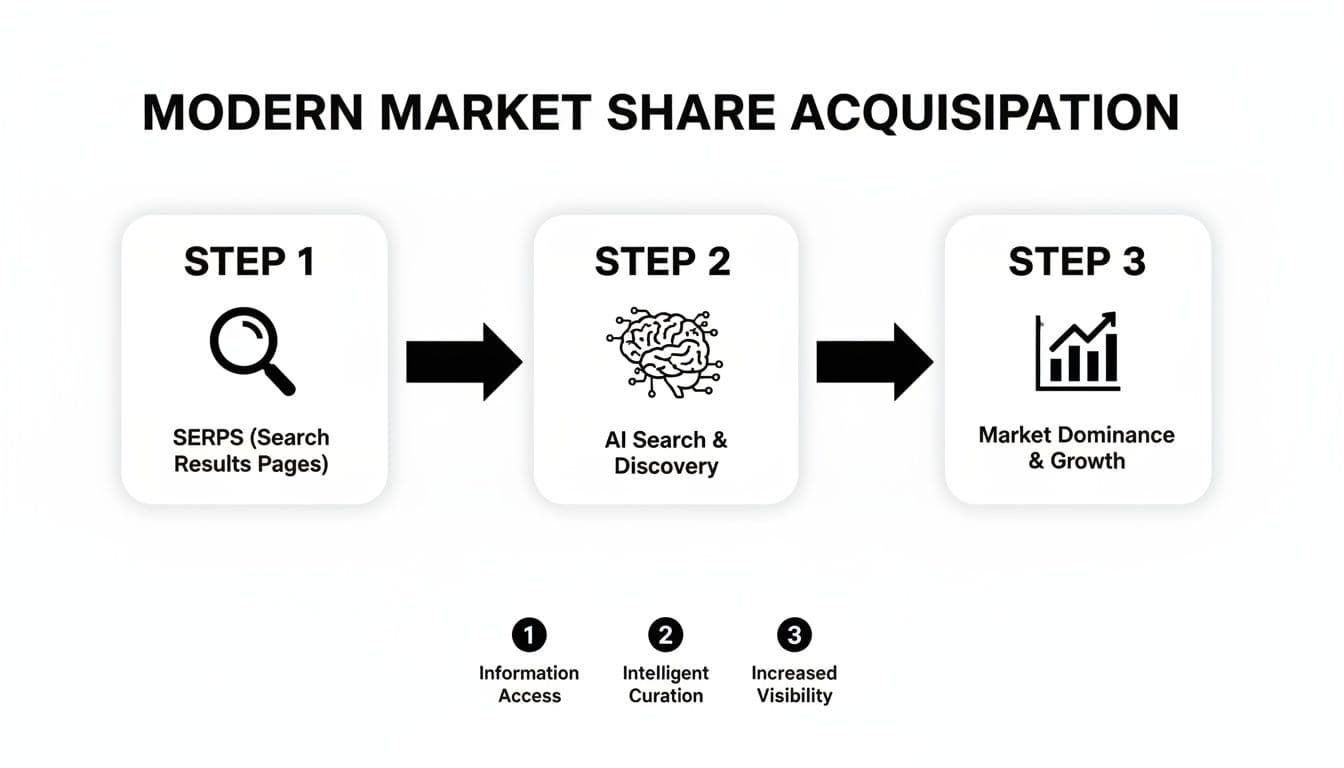
As you can see, visibility in traditional search is now just the entry point. The real battle for authority and market leadership is won or lost in how AI search engines perceive and present your brand.
Identifying Strategic Gaps with Competitive Intelligence
Your competitors are broadcasting their strategies every single day through their content. What they publish, where they focus their marketing spend, and the questions they try to answer—it’s all out there. The trick is knowing how to read the signals. Effective competitive intelligence is about understanding not just what your rivals are doing, but why.
For instance, if a competitor suddenly drops a series of webinars and whitepapers on a specific industry niche, that’s a flare gun signaling their intent to own that segment. This is your cue. Do you counter with a stronger, more specialized message, or do you pivot to a less contested, more profitable segment?
Leveraging AI Visibility Tools for Deeper Insights
Here's where things get interesting. Traditional analysis often misses the most critical new channel: AI-generated answers. Knowing where your competitors are being cited by AI models is like having a direct line into which parts of their content are actually working and what their audience truly cares about.
Tools that track AI mentions can show you patterns you’d never spot otherwise.
- Frequent citations on "how-to" queries? This tells you their content is structured as clear, actionable guidance that AI models trust for instructional answers.
- Mentions in "best solution for X" summaries? This is proof their value proposition is landing and they're seen as a top contender for specific use cases.
- Nowhere to be found on critical problem-solving topics? If your competitors aren't showing up for major industry pain points, you've just found a golden opportunity to create the definitive content that fills that gap.
By monitoring your competitors' visibility in AI search, you're not just tracking past performance. You're predicting their future strategy and finding the perfect entry points to disrupt it.
This process transforms abstract market trends into a concrete, actionable roadmap. To formalize this, we use a framework to systematically evaluate where competitors are winning and where the open field lies.
Competitive AI Visibility Analysis Framework
This framework helps turn raw data into a strategic plan. By asking the right questions, you can pinpoint exactly where to focus your resources for maximum impact on your market share.
This level of detailed analysis shows you exactly where the informational demand is and who is—or isn't—meeting it. Your objective is to become the definitive source where others are failing.
Translating Analysis into an Actionable Content Strategy
Once you've identified the gaps, you can create content with surgical precision. This isn't about producing more; it's about being more relevant.
If your analysis reveals competitors are weak on the topic "integrating CRM with marketing automation for SaaS," your content team has its marching orders. You don't just write one blog post. You build a content pillar.
- A comprehensive, data-backed guide that becomes the go-to resource.
- A step-by-step implementation checklist that readers can actually use.
- A compelling case study that proves the value with real-world results.
This approach ensures you're creating assets that directly solve underserved needs, making your brand the most helpful answer for high-intent queries. And the payoff is significant. According to research from infront.com, AI search traffic converts at 14.2% versus Google's 2.8%, and 38% of decision-makers have already budgeted for AI Search Optimization. This data-driven strategy is no longer optional—it's fundamental to any modern plan to increase market share.
Building a Value Proposition That Wins
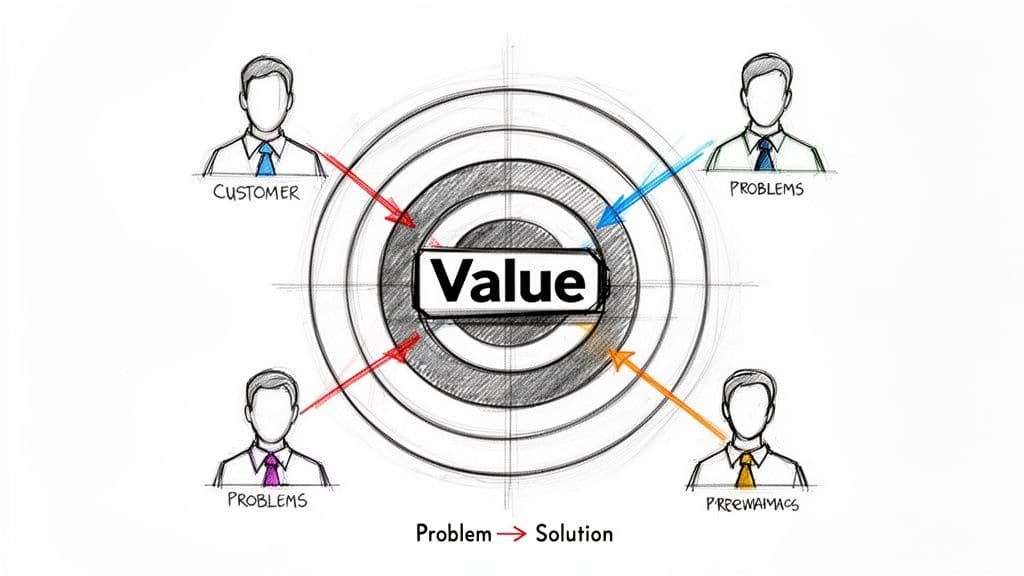
Once you’ve mapped the competitive terrain, your next move is to craft a message that actually cuts through the noise. A generic value proposition is a surefire way to be ignored, but a powerful one becomes the engine for your entire market penetration strategy. The goal isn't just to list what you do; it's to articulate why you are the only real choice for your customer's biggest headache.
This means you have to get beyond a simple feature list. Your prospects don't buy features—they buy outcomes. They’re looking for solutions that kill a pain point, create new efficiencies, or open up revenue streams they couldn't access before. So, your messaging needs to be relentlessly focused on their world, not yours.
From Features to Indispensable Solutions
A great place to start is with a quick audit of your current messaging. Pull up your website, sales decks, and marketing collateral. Are you leading with product specs, or are you leading with customer problems? It’s a classic mistake to assume that technical superiority alone will win the day.
Instead, you need to frame your differentiators as direct answers to what keeps your customers up at night.
- Instead of: "Our platform uses a proprietary algorithm."
- Try: "Our platform eliminates costly manual errors, saving your team an average of 10 hours per week."
See the difference? This simple tweak reframes the conversation from what it is to what it does for them. Nailing this message comes directly from a deep understanding of your ideal customer's real-world challenges—which is exactly why that initial market analysis is so critical.
Sharpening Your Core Message for AI Search
This kind of clear, authoritative messaging is also your best friend when it comes to AI search visibility. Models like Perplexity and Google’s AI Overviews prioritize content that is concise, well-structured, and directly answers a user's intent. Vague, feature-heavy language is far less likely to get sourced and cited in an AI-generated summary.
Think about how an AI would answer a query like, "What is the best solution for reducing supply chain logistics costs?" It’s going to scan credible sources for unambiguous statements of value backed by proven results. Your content has to serve those statements up on a silver platter.
A value proposition optimized for AI is simple: It solves a specific problem for a specific audience and proves it with clear, quantifiable outcomes. This clarity not only wins customers but also earns you citations from AI answer engines, amplifying your reach.
To make this happen, embed your core value proposition across all your key digital assets. Your homepage, service pages, and pillar content should all echo the same customer-centric message. That consistency signals authority to both human buyers and AI crawlers, cementing your position as a go-to leader. This process is a key part of developing strong messaging, and you can explore more detailed brand positioning statement examples to see how top companies articulate their unique value.
Don't Guess—Validate Your Message
Crafting a strong value prop isn't a one-and-done task you hash out in a conference room. It’s a hypothesis. And every good hypothesis needs to be tested, validated, and refined with real-world feedback. If you skip this, you’re just operating on assumptions that could be costing you dearly.
Here are a few practical ways to create that feedback loop:
- Talk to Your Customers: Go straight to the source. Get on the phone with your best customers and ask them why they chose you. Ask what specific problem you solved and how they’d describe your value to a colleague. Their language is often more powerful than any marketing copy you could ever write.
- Run A/B Tests: Put your messaging to the test. Try different headlines, CTAs, and value statements on your website and in your ad campaigns. The data will give you a clear, unbiased look at what truly resonates with your target audience.
- Listen to Your Sales Team: Your sales team is on the front lines every single day, hearing objections and fielding questions. They know what’s landing and what’s falling flat. Create a formal process for them to share that intel—it’s pure gold for sharpening your positioning.
By blending qualitative insights from interviews with hard data from your tests, you can systematically improve your message. To really solidify your appeal and turn prospects into buyers, it pays to learn how to create a value proposition that truly wins customers. This iterative process is what ensures your message stays sharp, relevant, and perfectly aligned with the market segment you’re aiming to dominate.
Fine-Tuning Your Go-To-Market Strategy
Having a fantastic product and a compelling value proposition is a great start, but it’s only half the battle. Without a smart distribution strategy, even the most innovative solutions can get lost in the noise. Sharpening your go-to-market (GTM) plan is all about figuring out which channels give you the most bang for your buck and then going all-in. It's the nitty-gritty execution that turns a brilliant idea into real market share.
For B2B companies, the game has changed. It's no longer enough to rely on the old playbook. The new center of gravity for buyer research is AI search. Decision-makers are turning to tools like ChatGPT and Google's AI Overviews first when they're evaluating complex solutions. If you're not showing up in these conversations, you're becoming invisible.
Treat AI Search as a Core Distribution Channel
The old approach of funneling all traffic to your website to hopefully get a conversion is quickly becoming outdated. Today, success means distributing your expertise directly onto the platforms where your audience is already asking questions. It’s a complete flip of the script—instead of pulling buyers to your content, you’re pushing your content directly to them.
When you start thinking of AI search as a distribution channel, it fundamentally changes how you create content. The objective shifts from simply ranking on a SERP to becoming the go-to, cited authority within an AI-generated response. To do that, you have to get granular and understand the specific, high-intent questions your audience is asking when they’re in problem-solving mode.
A modern GTM strategy has to account for a brand-new touchpoint in the buyer's journey: the moment an AI model crafts an answer. Winning at this stage means your brand becomes intertwined with the solution itself, often before a prospect even thinks about clicking to a website.
To break into new markets or successfully launch a new product, a solid plan is non-negotiable. This essential go-to-market strategy guide offers a great framework for this kind of multi-channel planning.
And the scale of this new channel? It's simply too big to ignore. ChatGPT reportedly handles 2 billion queries daily, holds an 81% AI chatbot dominance, and sees 5.7 billion monthly visits. Its referral traffic accounts for a staggering 89% of measured AI referrals, even with only a 17.7% user share. Those who sleep on this shift are going to find themselves on the outside looking in.
Find and Dominate High-Intent Queries
To capture this incredibly valuable traffic, you need to climb inside your ideal customer's head. What specific, problem-focused questions are they typing into AI tools? We're not talking about simple keywords here; these are nuanced, conversational prompts.
Here’s how you can start unearthing them:
- Listen to Sales and Support Calls: Your customer-facing teams are sitting on a goldmine. What are the recurring questions, sticking points, and frustrations they hear every day? Every single one is a potential high-intent query.
- Role-Play with AI Tools: Open up ChatGPT and act as your target persona. Try prompts like, "I'm a VP of Ops at a logistics company. How can I improve warehouse efficiency without a huge CapEx?" Pay close attention to the follow-up questions the AI suggests—they're breadcrumbs leading to other informational needs.
- Track Competitor AI Mentions: Use modern visibility tools to see where your competitors are being cited in AI answers. This effectively reverse-engineers their strategy and shows you which topics they own... and, more importantly, reveals the gaps you can fill.
Once you’ve built a solid list of target queries, it's time to create the absolute best, most structured content to answer them.
Create Content That AI Engines Trust
AI answer engines have a clear preference for content that is well-organized, factually dense, and gets straight to the point. To become their go-to source, you need to structure your content for easy parsing by both people and machines.
That boils down to a few key tactics:
- Answer the Question Immediately: Lead your content with a concise, direct answer to the main question. Then, use clear H2 and H3 headings to break the topic down into logical, digestible pieces.
- Use Structured Data: AI models love organized information. Incorporate lists, tables, and bullet points to present data and steps clearly. This makes it easy for them to pull out specific facts for a summarized answer.
- Go Deep and Prove It: Don't just make claims; back them up with data, statistics, and real-world examples. This builds the kind of topical authority that AI algorithms are specifically designed to find and reward.
- Weave in a Product-Led Motion: For most B2B companies, showing is always better than telling. A powerful GTM motion can involve integrating elements of your product directly into your content to demonstrate value. In fact, building an effective product-led growth strategy pairs perfectly with this content-first approach.
By systematically identifying the questions your market is asking and creating the definitive answers, you can turn AI search from a looming threat into your most powerful channel for grabbing market share. You'll be placing your brand right in front of motivated buyers at the very moment they’re looking for a solution.
Driving Growth with Demand and Retention
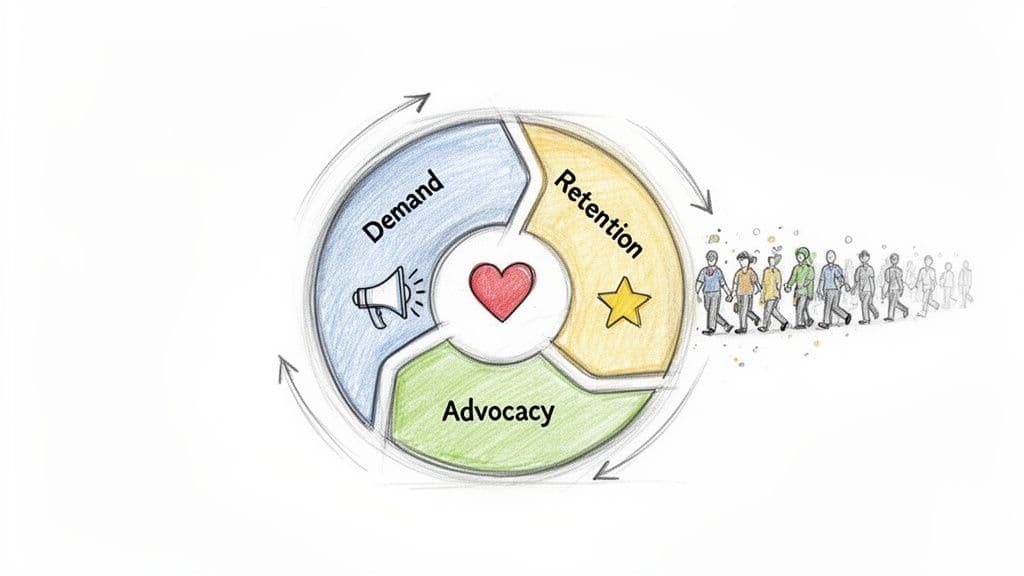
Chasing new customers is expensive. Losing them while you're trying to grow your market share is just fatal. Real, sustainable growth isn't about just pouring leads into the top of your funnel. It's about building a powerful flywheel where demand generation and customer retention feed each other.
If you ignore retention, you've got a leaky bucket. You’re spending a fortune to fill it up, only to watch your revenue base drain right out the bottom.
This integrated approach starts with a smarter way to generate demand. Forget broad, generic campaigns. The goal is to create hyper-relevant thought leadership and lead magnets that zero in on your ideal customer profiles with surgical precision. This is exactly where insights from AI search become your secret weapon.
Attracting Your Ideal Customers with AI Insights
What if you had a direct line into the exact questions your target audience is asking? By analyzing the queries they type into AI engines, that's what you get. You can see their most pressing challenges and what information they desperately need, right now.
This data lets you move way beyond basic keyword targeting. You can create content that acts as an irresistible lead magnet because it gives them immediate, tangible value.
Let's imagine you're a B2B SaaS company that handles supply chain logistics. Instead of a bland e-book on "The Future of Logistics," AI search insights might show you that operations managers are constantly asking about "reducing last-mile delivery costs with automation." That's not just a topic; it's a foundation for a whole targeted campaign.
- Create a data-rich whitepaper: "The B2B Playbook for Cutting Last-Mile Delivery Costs by 15%."
- Build an interactive ROI calculator: Let prospects plug in their own numbers to see the potential savings for themselves.
- Host a detailed webinar: Get a current customer who has crushed it with these strategies to tell their story.
Each one of these assets tackles a known, specific pain point. That makes them exponentially more effective at capturing qualified leads than some generic, high-level content piece. The trick is to use AI search visibility tools to listen for the market's specific problems and then create the definitive answer.
Turning Retention into a Growth Engine
Once you land that new customer, the real work of grabbing market share begins. Keeping customers isn't just a defensive move; it's your single most powerful offensive strategy.
Think about the numbers. It can cost five times more to acquire a new customer than to keep an existing one. On top of that, boosting customer retention by just 5% can crank up your profitability by anywhere from 25% to 95%.
The whole process comes down to two things: a flawless onboarding experience and proactive, ongoing support.
A world-class onboarding process does more than just teach a customer how to use your product. It validates their purchasing decision and sets the stage for a long-term, high-value partnership.
If a customer feels disconnected from day one, they are a churn risk. Proactive support—where you anticipate their needs, share best practices, and check in on their progress—transforms a simple transaction into a strategic partnership. This builds the kind of loyalty you need to not only keep their business but also to expand it with upsells and cross-sells, directly increasing your share of their wallet.
The Ultimate Goal: Customer Advocacy
The final gear in this flywheel is turning those happy, long-term customers into your biggest fans. These are the people who leave five-star reviews, give you glowing testimonials, and refer new business your way without you even asking.
This kind of word-of-mouth marketing is gold. It comes with a level of trust and credibility that no paid ad campaign can ever hope to replicate.
This entire lifecycle shows just how intertwined demand and retention really are. We're already seeing how new technologies can shake things up. For instance, when Bing integrated Copilot, it nudged its market share up to 4%—proof that AI features can build loyalty even against a giant.
Right now, tools like Attensira are giving SEOs and CMOs the visibility they need to capture the growing 5-10% AI search share, which is projected to hit 10-14% by 2028. You can learn more about AI's impact on search market share and see how this disruption can become your competitive edge. When you focus on the entire customer journey, you build a powerful, self-sustaining engine for increasing market share.
Measuring What Actually Moves the Needle
Let's be blunt: a strategy to grow market share is just a wish list without the right metrics. You can't walk into a budget meeting with vanity numbers like website traffic or social likes and expect to get taken seriously. To prove your efforts are actually working—and to secure the resources to scale them—you need to track the KPIs that directly signal you're taking ground from competitors.
If you can't measure it, you can't manage it. Simple as that.
The old guard of metrics—Customer Acquisition Cost (CAC), Customer Lifetime Value (LTV), and Share of Voice (SOV)—are still table stakes. Of course, you need a healthy LTV:CAC ratio, and seeing your SOV climb tells you that your message is breaking through the noise. But today, these metrics are just part of the story. They're rearview mirror stuff in a world that's accelerating forward.
Adopting KPIs for the AI-Powered Buyer
B2B buyers are increasingly using AI to get answers and create shortlists. This isn't a future trend; it's happening right now. If you're not measuring your visibility on this new frontier, you're flying blind with a massive competitive disadvantage.
It’s time to start tracking a new set of benchmarks. Immediately.
- Share of AI Mention: Think of this as the new Share of Voice. It's a straightforward count of how often your brand, products, or experts get cited in AI answers to the high-intent questions your prospects are asking. A high share of mention is a powerful signal that AI models view you as an authority.
- AI Visibility Score: This metric adds a crucial layer of quality on top of the raw mention count. It answers the question: how are you being mentioned? Are you the top-cited source in a detailed summary, or just another name buried in a list of ten? This score separates real influence from fleeting presence.
Tracking these numbers gives you a direct line of sight into how your content is performing where it matters most—in the new spaces where decisions are being made.
This dashboard from Attensira is a great example of how you can visualize this data over time.
The real magic here is connecting the dots. You can directly correlate a spike in AI mentions with a specific content launch or campaign, finally proving the ROI of your content efforts in a concrete way.
Connecting AI Visibility to Bottom-Line Results
Just tracking these new KPIs isn't the endgame. The real power comes when you connect them to actual business outcomes. Your goal should be to build a data-backed story that draws a straight line from your AI visibility to your core revenue metrics.
Imagine being able to prove that a 15% increase in your AI Visibility Score consistently leads to a 10% lift in qualified inbound leads the next quarter. That’s not a hopeful tactic; that’s an undeniable business case for more investment.
This creates an incredibly powerful feedback loop. You'll quickly see which content formats and topics are earning the most valuable AI citations, allowing you to double down on what’s working. For instance, the recent surge of Reddit being cited by ChatGPT and Google's AI Overviews offers a huge clue: AI models prize structured, community-vetted content from authoritative sources. Understanding these shifts, as detailed in this analysis of AI's impact on search market share, is key to winning.
Building Your Complete Measurement Framework
A truly effective measurement framework doesn't throw out the old for the new. It integrates both traditional and AI-era KPIs into a single, cohesive dashboard. This is how you get the full picture.
You should be able to track how your top-of-funnel AI visibility is influencing mid-funnel engagement and, ultimately, driving bottom-funnel conversions. This holistic view is non-negotiable for anyone serious about growing their market share.
For a deeper dive into building out your analytics, check out our complete guide on digital marketing performance metrics. By focusing on the metrics that truly matter, you stop guessing and start knowing—turning your growth strategy from a cost center into a predictable engine for revenue.
Ready to stop guessing and start measuring your brand's visibility in the AI era? Attensira provides the tools to track your AI mentions, uncover content gaps, and generate optimized drafts that get you cited. See how it works and claim your market share at Attensira.