Build a winning B2B product led growth strategy with this playbook. Learn to master PLG metrics, user onboarding, growth loops, and team alignment.
At its core, a product-led growth strategy is a business model where your product does the heavy lifting. Instead of relying solely on traditional marketing funnels and sales demos, the product itself becomes the main vehicle for acquiring, converting, and expanding your customer base. It’s a simple but powerful idea: let people experience the value of your tool firsthand, usually through a freemium offering or a free trial.
The Inevitable Shift to Product-Led Growth in B2B
The way B2B software is bought and sold has completely transformed. Gone are the days of enduring lengthy sales cycles, sitting through generic demos, and making six-figure decisions based on a salesperson's pitch. Today’s buyers are a different breed—they're empowered, incredibly well-informed, and would much rather educate themselves. They want to get their hands on a tool and see its value before they even think about committing.
This fundamental shift in buyer behavior is exactly why a product-led growth strategy has moved from a niche tactic to a mainstream imperative. It’s more than just a go-to-market plan; it's a company-wide philosophy built on a single, powerful principle: deliver undeniable value before ever asking for a credit card. You stop telling prospects how great your product is and start showing them instead.
This model fits perfectly into the modern B2B buyer's journey. It often starts with a simple Google search or a recommendation from a colleague. By offering a self-serve way to get started, you eliminate friction and let potential customers discover your solution on their own terms. When the product is your primary sales and marketing engine, every team in the company—from engineering to support—naturally aligns around improving the user experience.
Why PLG Is a Necessity, Not an Option
Adopting a product-led mindset isn't about chasing the latest trend; it's about building a more efficient, scalable, and sustainable business. Companies that get this right often see massive improvements across their most important metrics.
- Lower Customer Acquisition Costs (CAC): When the product markets and sells itself, you're far less dependent on expensive ad campaigns and massive sales teams. Organic growth, fueled by word-of-mouth and built-in viral loops, becomes your most powerful acquisition channel.
- Shorter Sales Cycles: Your users essentially qualify themselves. By the time they're ready to speak with a salesperson (if they ever need to), they're already educated, activated, and sold on the product's value. This changes the conversation from a high-pressure pitch to a strategic partnership discussion.
- Higher Retention and Expansion: Focusing on delivering a stellar product experience from the very first click builds an intensely loyal user base. Happy users don't just stick around longer; they're also more likely to explore advanced features and upgrade their plans, driving that all-important expansion revenue.
This isn't just theory; the data backs it up. In a recent landmark survey, a staggering 74% of SaaS companies reported that their product is now the main engine driving their growth. And this belief pays off—companies that prioritize PLG are 4x more likely to be in the top quartile of their market for growth rates. Just look at Slack. It exploded to over 10 million daily active users by 2019, with a mind-blowing 85% of customers coming from its frictionless, bottom-up viral loop.
You can learn more about how these models create such powerful growth flywheels on Userlytics.
Sales-Led Growth vs Product-Led Growth Key Differences
To truly grasp the shift, it's helpful to see the two models side-by-side. The differences in philosophy and execution are stark, impacting everything from who you hire to how you measure success.
As you can see, PLG fundamentally flips the traditional GTM model on its head by putting the end-user and the product experience at the absolute center of the growth strategy.
Redefining Go-To-Market Roles
In a PLG world, traditional departmental roles get a major rewire. Marketing’s primary goal shifts from generating "marketing qualified leads" for sales to driving users to sign up for a trial or freemium plan. Sales teams transform from gatekeepers into trusted advisors, engaging with users who have already demonstrated high-intent signals inside the product. This approach directly tackles many of the most common B2B marketing challenges by forcing every team to align around a single goal: user success.
A sales-led strategy passes costs to consumers that have no connection to the product value. If you currently use a sales-led strategy, you need to watch out for competitors with a more efficient customer acquisition model.
This efficiency is the killer app of PLG. To capitalize on this inevitable shift, especially in the competitive B2B space, learning how to create a SaaS MVP rapidly can give you a massive advantage. It allows you to test, iterate, and get your product into the hands of real users faster than ever.
Ultimately, embracing a product-led growth strategy isn't just an option anymore—it's a necessity to compete and win.
Identifying the PLG Metrics That Actually Matter
In a product-led world, data is the lifeblood of your strategy. But let's be honest—drowning in dashboards full of vanity metrics like total signups or page views gets you nowhere. The real trick is moving from broad observation to precise measurement, zeroing in on the key performance indicators (KPIs) that directly mirror user value and business health.
A solid product led growth strategy is built on metrics you can actually act on. These numbers tell you a story: where users find that "Aha!" moment, where they get stuck, and where your best chances for monetization and expansion really lie. Without this clarity, you're just flying blind.
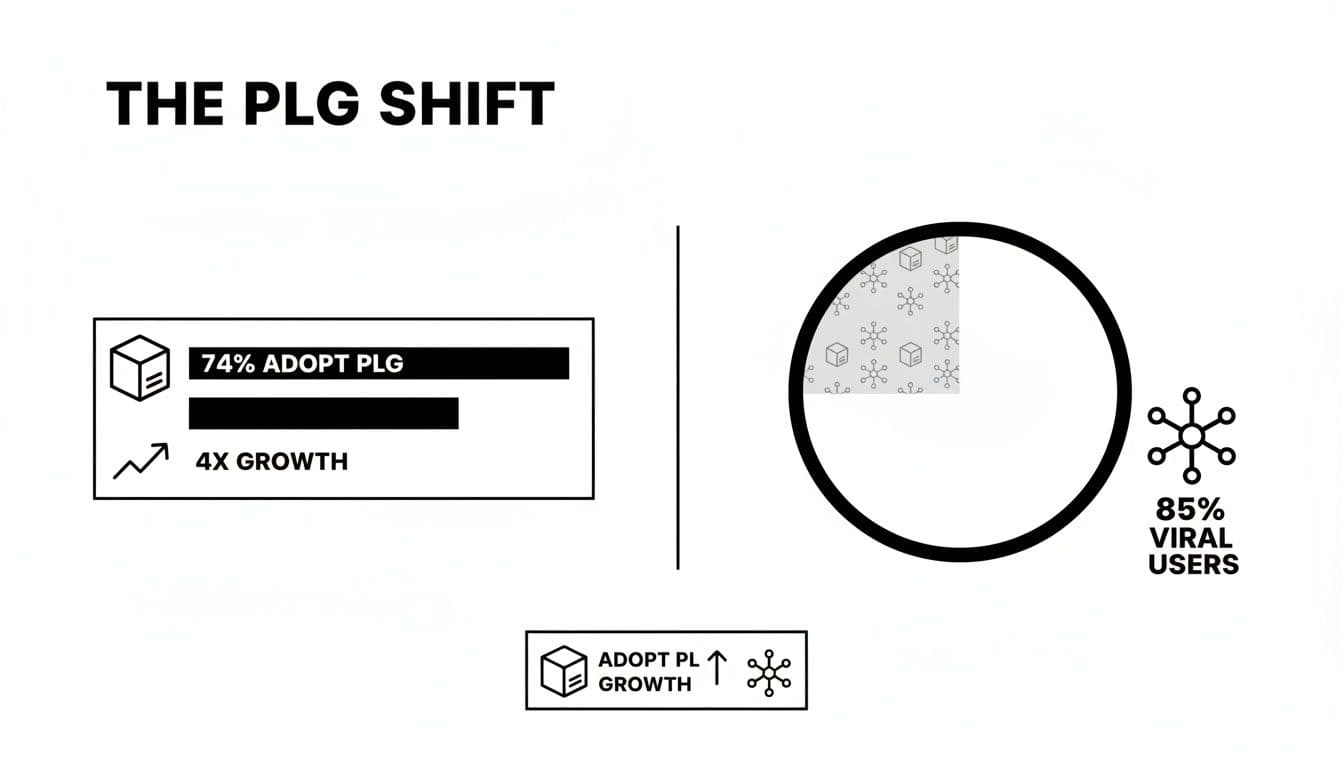
The data speaks for itself. Companies that truly embrace this model aren't just surviving; they're building powerful, self-sustaining growth engines fueled by the product itself.
Measuring Time to Value and Activation
Those first few moments a user spends with your product are make-or-break. This is where you need to obsessively track two metrics that are completely intertwined.
First up is Time to Value (TTV). This measures how long it takes a new user to reach their "Aha!" moment—that instant they get the core value your product promises. A shorter TTV almost always leads to better long-term retention. To track it, you first have to define what that key value-delivering action is.
For an analytics tool, that moment might be creating their first dashboard. For a project management app, it could be assigning a task to a colleague.
TTV Formula: (Date/Time of Activation Event) - (Date/Time of Sign-up) = TTV
Working hand-in-hand with TTV is the Activation Rate. This is simply the percentage of new users who actually reach that "Aha!" moment within a set timeframe, like their first 7 days. If your activation rate is low, it’s a massive red flag that your onboarding has friction that needs to be fixed, fast.
Defining Your Product Qualified Leads
It’s time to move beyond old-school Marketing Qualified Leads (MQLs) based on who downloaded an ebook. In PLG, your most valuable leads reveal themselves through their in-product behavior. A Product Qualified Lead (PQL) is a user who has hit certain usage milestones, signaling they're a prime candidate to convert to a paid plan.
Your PQL criteria will be unique to your product, but it often boils down to a mix of things like:
- Feature Adoption: Using key premium features multiple times.
- Usage Frequency: Logging in consistently over a week.
- Team Expansion: Inviting a certain number of colleagues.
A collaboration tool, for instance, might define a PQL as a free account that has created 5 projects, invited 3+ teammates, and connected an integration. When you track PQLs, you hand your sales team a list of users who are already sold on the product's value, which can radically shorten the sales cycle.
The Power of Expansion Revenue
Bringing in new customers is great, but the most efficient growth almost always comes from the ones you already have. Expansion Revenue, often called expansion MRR, tracks the new revenue you generate from existing customers through upgrades, add-ons, and cross-sells.
This metric is the bedrock of a healthy PLG model because expansion revenue is often 2-3x cheaper to generate than acquiring a brand-new customer. Just look at the giants. Top-tier PLG companies like Dropbox saw expansion rates climb to 20% annually after nailing their referral strategy. Zoom's pivot in 2020 led to $4 billion ARR by 2021, with an incredible 70% of that revenue coming from existing customers adding more seats after a positive free experience.
Calculating it is straightforward:
- Expansion MRR Formula: (MRR at End of Month) - (MRR at Start of Month) - (MRR from New Customers) = Expansion MRR
By focusing on these core metrics—TTV, activation, PQLs, and expansion revenue—you get a real-time pulse on your business. It forces a shift away from superficial acquisition numbers and toward deep user engagement, which is where sustainable growth is born. Of course, you also need to understand your spending, and you can learn more in our guide on customer acquisition cost calculation.
Crafting a Seamless User Onboarding Experience
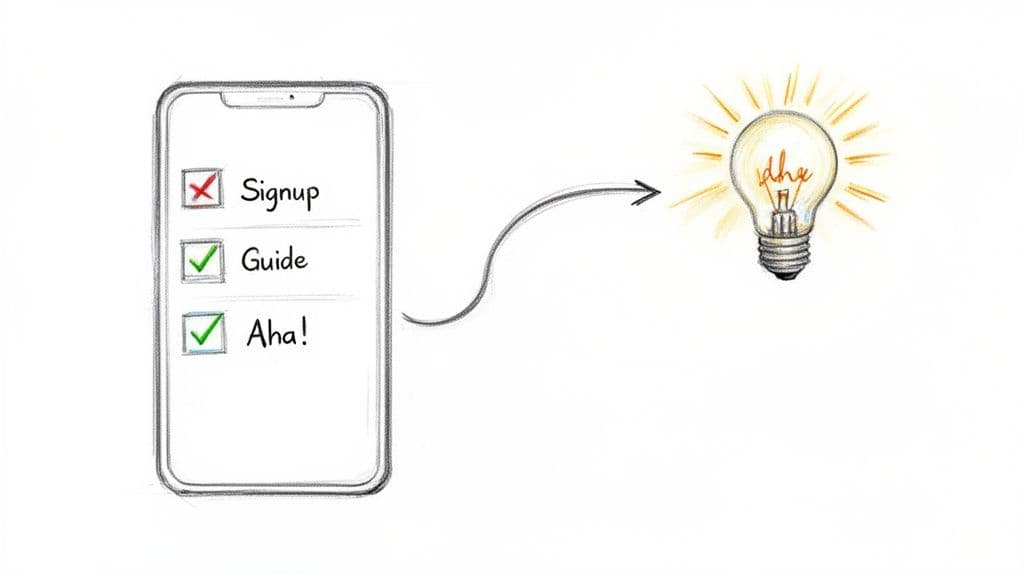
Let's be blunt: the first five minutes a user spends with your product are more critical than the next five months. A successful product led growth strategy lives or dies by its ability to guide a curious new signup to their "Aha!" moment—that instant they truly get the value you promise—as fast as humanly possible. This isn't about a warm welcome screen; it’s a meticulously engineered journey that strips away every last bit of friction.
Think of your user onboarding as the first handshake and the first proof point. A clunky, confusing, or overwhelming start is a surefire way to lose someone before they ever have a chance to become a Product Qualified Lead (PQL).
Designing a Painless Signup Process
The journey begins before anyone even sees your dashboard. Your signup form is the very first signal you send about how easy your product is to use. From my experience, every single field you add is another reason for a potential user to just close the tab.
Keep it minimal. Only ask for what is absolutely essential to create an account, which is almost always just an email and a password. Better yet, offer social sign-ins through Google or Microsoft to reduce the entire process to a single click.
The goal here is to make signing up an impulse, not a major commitment. You're not trying to qualify a lead at this stage; you're just trying to open the door and get them to see the value inside.
You can always ask for company size, job role, or a phone number later. A great time to do this is when they're exploring team features or trying to unlock a specific workflow. By then, they've already seen what your product can do and are far more willing to share that information.
Guiding Users to Their 'Aha!' Moment
Once someone is in, the clock is officially ticking. Your sole mission is to steer them toward the one or two key actions that unlock the product's core benefit. Forget the generic, one-size-fits-all product tour—they rarely work. What you need is contextual, action-oriented guidance.
Here are a few methods that actually get results:
- Interactive Checklists: Don't just tell users what to do. Give them a short, dynamic checklist that actually tracks their progress. Frame each task around a benefit ("Connect your calendar to save 5 hours this week") instead of a feature ("Integrate your calendar").
- Contextual Tooltips: Trigger small, helpful pop-ups when a user engages with a key feature for the first time. This delivers guidance at the exact moment of need, preventing the dreaded information overload.
- Meaningful Empty States: A blank dashboard is a missed opportunity. Use those empty states to teach and prompt action. A project management tool's empty board, for instance, could say, "Your first project starts here! Click the '+' to get started and invite your team."
This approach isn't about teaching; it's about getting people to do something meaningful right away. The faster they accomplish a real outcome, the more likely they are to stick around.
Leveraging Automated Nudges and Communication
Your onboarding efforts shouldn't be confined to the app itself. A well-timed email sequence is an incredibly powerful tool for re-engaging users who drop off or encouraging those who are on the right track. The trick is to make these emails behavior-driven, not just time-based.
Ditch the generic "Day 3" email. Instead, trigger messages based on what users are actually doing (or not doing).
- Welcome & First Step: Send an email immediately after signup that welcomes them and pushes them toward completing that single most important first action.
- Activation Nudge: If someone signs up but hasn't completed that key action within 24 hours, send a gentle reminder that highlights the value they're missing out on.
- Success Celebration: When a user hits that first activation milestone, send a quick congratulatory email that also suggests the next logical step.
This kind of automated, personalized communication makes users feel seen and keeps their momentum going. By combining a frictionless signup, action-oriented in-app guidance, and smart, triggered communication, you create an onboarding flow that builds momentum. This is the foundation for turning free users into paying customers and, eventually, your biggest advocates.
Engineering Sustainable Growth Loops for Your Product
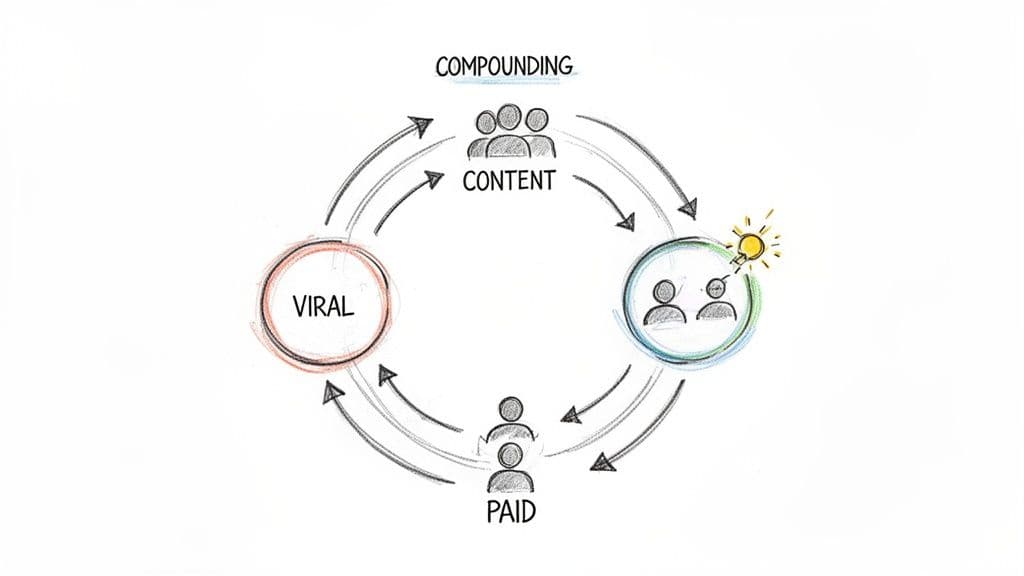
Let's be honest, the classic marketing funnel is broken. It's a linear, leaky bucket. The best PLG companies have moved on. They build self-sustaining systems where one group of users brings in the next, creating a powerful compounding effect. This is a growth loop.
Think of a well-designed growth loop as the engine of a truly scalable product led growth strategy. Instead of just pouring more and more money into advertising, you create a flywheel. The output of your product—user actions, content, or even revenue—becomes the input for the next cycle. You're building a growth machine that feeds itself.
The Viral Loop
This is the one everyone knows, powered by users inviting other users. But it’s not just about simple word-of-mouth. True virality is engineered directly into the product, making sharing and collaboration a fundamental part of the experience.
A project management tool is the perfect example. Someone signs up, creates a project, but to get any real value, they have to invite their team. Those new users (the output) sign up, create their own projects, and repeat the process. The cycle continues. For this to really catch fire, the invitation can't feel like a chore; it has to be a critical step for the original user to solve their own problem.
A true viral loop isn't a feature you tack on at the end. It's embedded in the product's core value proposition. The act of sharing must directly benefit the person doing the sharing, making it feel like a natural, necessary step.
Remember Dropbox's legendary referral program? They gave free storage to both the person referring and the new user. That simple, value-first incentive turned millions of users into evangelists and was the rocket fuel for their explosive growth.
The Content Loop
A content loop is all about turning your users into a content-creation engine that attracts new people through search and social media. Every time a user interacts with your product in a public way, they're creating a new asset that search engines can index and others can discover.
Look at a platform like Quora or Reddit. A user asks a question (input). Others provide answers, creating a rich page of user-generated content (output). That page starts ranking on Google, pulling in new visitors searching for that answer. A fraction of those visitors sign up and start asking their own questions.
To build a solid content loop, you need to focus on three things:
- Enable Content Creation: Make it dead simple for users to generate public content—think profiles, templates, published reports, or community posts.
- Ensure Discoverability: Structure that content so it’s SEO-friendly. We're talking clean URLs, proper titles, and metadata that search engines love.
- Drive Conversion: When someone lands on that user-generated content, the path to signing up and becoming a creator themselves should be frictionless.
Imagine a data visualization tool that lets users publish their best dashboards to a public gallery. That gallery quickly becomes a massive magnet for organic search traffic from people looking for specific chart examples, all powered by the product's own user base.
The Paid Loop
A paid loop is a more disciplined, financially-driven system. It's where revenue from your current customers is systematically reinvested into paid acquisition channels to bring in the next wave of customers. This is far more sophisticated than just "running some ads." It's a closed-loop system tied directly to your unit economics.
The mechanics are straightforward, but it demands serious analytical rigor. A user signs up and converts to a paid plan. You calculate that user's Customer Lifetime Value (CLV). A portion of that CLV is then put right back into paid channels—like Google Ads or LinkedIn—to acquire more users just like them.
The whole thing falls apart if your numbers don't work. For this loop to be sustainable, your CLV must be significantly higher than your Customer Acquisition Cost (CAC). The two main levers you can pull here are the efficiency of your ad spend and the stickiness of your product.
For example, a B2B SaaS company might discover through their data that users coming from a specific LinkedIn ad campaign have a 20% higher conversion rate to their enterprise plan. With that insight, they can confidently pour more budget into that channel, knowing that every dollar is generating a predictable, profitable return and fueling a scalable growth engine.
Getting Your Whole Company on Board with the Product
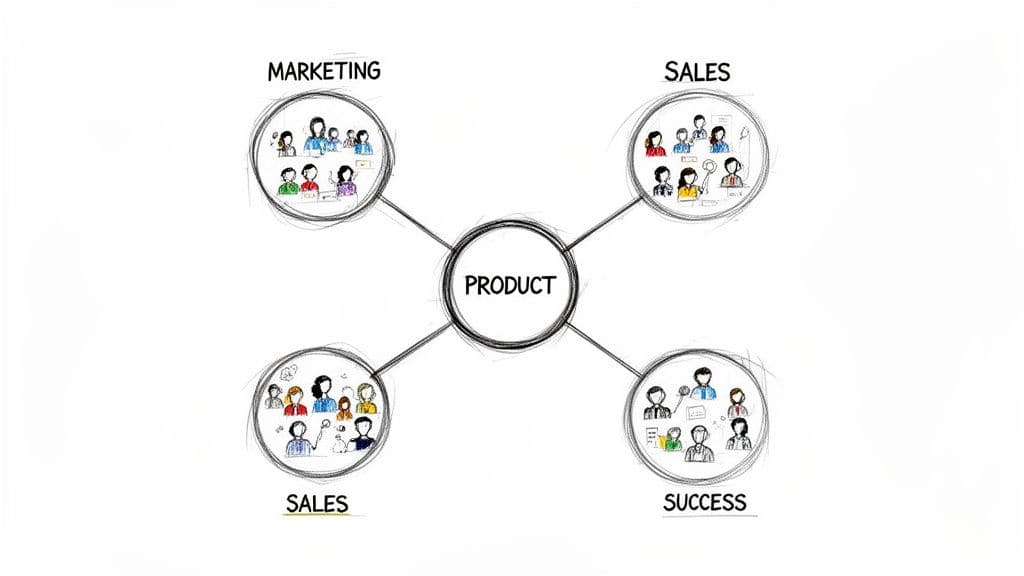
Having a great product is one thing, but making a product led growth strategy work is a whole different ballgame. You can't just slap a "free trial" button on your homepage and expect magic. A true PLG motion requires rewiring your entire company—how every team operates, what they measure, and how they work together.
This means shifting everyone's focus away from abstract sales funnels and onto the real, tangible user journey. It's about getting marketing, sales, and customer success to rally around the product as the single source of truth. The product stops being just another department's responsibility and becomes the company's central nervous system.
When you get this alignment right, you create a powerful, unified force that makes the user experience better at every single step.
How Marketing’s Role Has to Change
In a traditional sales-led company, marketing’s job is simple: generate Marketing Qualified Leads (MQLs). They put up content gates, run campaigns to get email addresses, and then toss a list of names over the wall to sales. In a PLG world, that entire playbook is obsolete.
Marketing's new mission is to get the right people to sign up for and actually use the product. Success isn't measured by how many ebooks were downloaded, but by the activation rate of new users.
- Content Strategy: Forget lead capture. Blog posts and guides now need to help people solve real problems inside the product.
- Performance Marketing: Ad campaigns should point directly to a free trial or freemium signup. The key metric becomes cost per activated user, not cost per lead.
- Product Marketing: This team becomes the critical link, working with product and engineering to announce features and guide users toward value with in-app messages, tooltips, and smart email triggers.
Making this transition work requires a crystal-clear understanding of the user's path, which is why a well-defined roadmap is non-negotiable. You can learn more about building one in our guide on how to write product requirements.
Reinventing Sales and Customer Success
The sales team probably faces the biggest change of all. They have to stop being cold callers and demo jockeys and start acting like strategic consultants. Their pipeline is no longer a list of MQLs. Instead, it’s filled with Product Qualified Leads (PQLs)—users who have already hit that "Aha!" moment and are signaling real intent through their actions in the product.
This changes the conversation completely. Instead of asking, "So, what are your pain points?" they can jump right in with, "I noticed your team has already created ten projects. Let's talk about how our enterprise plan can help you scale that."
Customer success also shifts from a reactive to a proactive role. They're not just waiting for support tickets to roll in. They're diving into product data to find users who are stuck, identify churn risks before they become problems, and spot clear opportunities for expansion.
This data-first approach is insanely efficient. Companies that truly nail PLG have seen 63% faster growth rates than their sales-led competitors. A huge part of that comes from slashing customer acquisition costs—often by 30-50%—because the product does the heavy lifting of educating and converting new users. This frees up your human teams to focus on high-value, strategic conversations.
By reorienting these core teams around the product, you build a much smoother journey for the user. Marketing brings in the right people, the product proves its own value, and your sales and success teams show up at just the right moment to help them grow. It's not just a different strategy; it's a smarter, more customer-centric way to build a business.
Common Questions About Making the PLG Switch
Even with a solid game plan, shifting to a product-led growth model kicks up a lot of practical questions. It’s a major change in mindset and operations, so it’s completely normal for leaders to have some reservations.
Let's dig into some of the most common hurdles we see teams grapple with. These aren't just theories; they're the real-world challenges that pop up when you decide to put your product at the very center of your growth engine.
Can Product-Led Growth Actually Work for a Complex Enterprise Product?
Yes, but you have to adapt the model. For a highly technical enterprise tool, a pure self-serve flow is probably a non-starter. You can't expect a CIO at a Fortune 500 company to swipe a credit card for a massive annual contract.
The solution is what’s often called a ‘product-led sales assist’ motion. Here, the product isn’t meant to close the deal on its own; its job is to start a much smarter, more qualified conversation.
You do this by offering a tangible piece of value right away. This might look like:
- A Freemium Plan: Offer a stripped-down version that solves one specific, nagging problem for a small team.
- A Focused Free Trial: Instead of overwhelming them with the whole platform, give them a trial of one high-impact workflow.
- An Interactive Demo: Let prospects play around in a guided sandbox environment to feel the product's magic without any setup headaches.
The goal is to generate Product-Qualified Leads (PQLs). When a user hits certain usage milestones—like inviting five teammates or creating 100 reports—that’s your signal. Your sales team can then step in, armed with context, to talk about enterprise-grade features, security, and pricing. It's a far cry from a cold call.
What Are the Very First Steps to Move from Sales-Led to Product-Led?
Trying to do everything at once is the fastest way to fail. The key is to be gradual and iterative. Think of it as a series of small, calculated experiments, not one big, disruptive launch.
First, you have to get laser-focused on your product's "Aha!" moment. Pinpoint that core value and then ruthlessly redesign your onboarding to get new users there as quickly as humanly possible.
Next, introduce a frictionless way for people to get started, like a free trial that doesn't require a sales call. At the same time, you absolutely must have analytics in place to track crucial PLG metrics like activation rate and time-to-value.
Finally, get really specific about what a PQL looks like for your business. Define those triggers and build a clean, automated handoff process to your sales team. This phased rollout lets you learn and tweak as you go without torpedoing your current revenue streams.
Don't chase perfection on day one. Your first PLG motion will have flaws, and that's okay. The real goal is to start learning from actual user behavior right away and use those insights to make your strategy better over time.
How Do You Balance a Self-Serve Funnel with a High-Touch Sales Team?
The trick is to use product data to be smart about who gets a human touch. A solo consultant or a small business might be perfectly happy to sign up, use the product, and upgrade all on their own. Great—let them! But when someone from a target account signs up and starts inviting their whole department, that's a five-alarm fire for your sales team to get involved.
You need to set up automated triggers based on a mix of user behavior and company data.
For example, a sales alert could be triggered when:
- Behavioral Signal: A user activates three key features in their first 24 hours.
- Firmographic Signal: The user’s email domain matches a company on your target account list.
When both of those things happen, an alert can go straight to the right salesperson. This data-driven system lets your low-touch, self-serve engine run for the majority of users while you deploy your expensive sales experts exactly where they'll have the biggest impact.
For a handy reference on these concepts, this PLG Cheatsheet is a great resource.
Ready to see how your brand shows up in this new AI-driven world? Attensira provides the critical visibility you need to ensure your product led growth strategy succeeds. Track your brand's presence across AI platforms and get actionable insights to optimize your content. Start monitoring your AI visibility today at https://attensira.com.