Discover brand positioning statement examples and learn concise formulas to define your unique market stance and win more customers.
In an era dominated by AI-driven search and discovery, a brand positioning statement is no longer just a line in a marketing brief; it's the strategic core of your digital identity. A powerful statement dictates how you're understood not only by customers but also by the algorithms that now mediate brand visibility. The clarity of your positioning directly influences how systems like Google's AI Overviews and ChatGPT interpret and present your value proposition to potential buyers.
This guide moves beyond theory, dissecting 10 potent brand positioning statement examples to show how they are engineered for both human and machine contexts. We will break down the formula for each, analyze its strategic DNA, and provide actionable templates and tweaks you can immediately apply. By the end, you will understand how to craft a positioning statement that doesn't just define your brand but actively propels its visibility, turning your core message into a competitive advantage.
This is especially crucial for B2B enterprises where authority and precision are paramount for attracting high-value clients. Successfully translating your position into a clear digital signal is no longer optional. To maximize your brand's presence as an AI Visibility Engine, leveraging the best generative AI tools for marketing can provide a significant competitive edge in this process. Our analysis will equip you with the frameworks needed to achieve that clarity and drive measurable growth.
1. AI-First Search Engine Visibility Positioning
As conversational AI reshapes how users find information, a new positioning frontier has emerged. AI-First Search Engine Visibility moves beyond traditional keyword-based SEO, focusing instead on ensuring a brand's presence and authority within AI-generated responses from platforms like ChatGPT, Perplexity, and Google's AI Overviews. This strategy is critical for businesses that need to be the definitive answer when a user asks a complex question.
The core principle is to position your brand not just as a result on a page, but as a citable, authoritative source for AI models. This requires a deep focus on structured data, semantic content, and establishing topical authority so that AI systems recognize your content as the most reliable and comprehensive resource.
Strategic Breakdown
- Target Audience: Chief Marketing Officers, Heads of Growth, and SEO specialists at B2B tech and enterprise companies who understand that the future of search is conversational.
- Problem Solved: Addresses the growing threat of brand invisibility in a world where users get direct answers from AI instead of clicking through to websites.
- Key Differentiator: Proactive optimization for generative AI and semantic search, rather than reactive keyword-chasing. It's about being the source of the AI's answer.
Actionable Takeaways
This approach is highly effective for thought leaders and B2B SaaS companies whose complex products solve nuanced problems. For instance, a company like Attensira positions itself directly around this need with messaging like, "Monitor how brands appear in AI responses." Their strategy successfully isolates a high-value, emerging pain point for enterprise marketing teams.
To adopt this positioning, start by clearly distinguishing "AI visibility" from "SEO" in all marketing collateral. Use data on the rapid adoption of AI search to build urgency and create case studies demonstrating how this focus leads to being cited in AI Overviews. This is one of the most forward-thinking brand positioning statement examples because it anticipates a fundamental market shift.
2. Content Intelligence and AI Optimization Positioning
This positioning strategy moves beyond simply monitoring AI search visibility to actively creating content optimized for AI interpretation and generation. It places the brand as an intelligent partner that helps businesses create data-driven content that satisfies both human readers and AI algorithms. This is crucial for B2B enterprises that must maintain authority and relevance across a high volume of content channels.
The core of this approach is to provide actionable, AI-informed content drafts and optimization recommendations. Instead of just identifying a problem (like poor AI visibility), this positioning offers a direct solution by embedding intelligence into the content creation workflow, ensuring every article, blog post, or whitepaper is primed for machine consumption.
Strategic Breakdown
- Target Audience: Content Directors, B2B Marketers, and SEO Strategists at enterprise-level companies who are overwhelmed by the need to scale high-quality content that performs in both traditional and AI-driven search.
- Problem Solved: It tackles the dual challenge of creating content that resonates with human experts while also being structured, semantically rich, and clear enough for AI models to use as a source.
- Key Differentiator: The emphasis is on proactive content creation and optimization, not just reactive monitoring. It positions the brand as a co-creator and strategic tool, rather than a passive analytics platform.
Actionable Takeaways
This strategy is powerfully implemented by B2B SaaS platforms in the content and SEO space. For instance, platforms like Jasper AI and Copy.ai have evolved their positioning from general AI writers to specialized content intelligence tools that offer industry-specific templates and optimization features. They address the pain point of creating performant content at scale.
To leverage this positioning, focus marketing on the tangible outputs of the tool, such as "AI-optimized content drafts" or "performance-graded content briefs." Showcase clear before-and-after metrics demonstrating traffic uplift and improved rankings from using AI-optimized content. This approach makes for powerful brand positioning statement examples because it directly ties a complex technology (AI) to a clear business outcome: better content performance.
3. Competitive Intelligence and AI Benchmarking Positioning
Knowing where you stand is the first step to winning the market. This positioning strategy frames a brand not just as a tool, but as an essential source of competitive intelligence for the AI era. It moves beyond simple performance metrics to provide a clear, comparative analysis of how a brand’s visibility and mentions in AI-driven search stack up against direct competitors. This approach is highly compelling for enterprises in competitive B2B sectors that need to benchmark performance to justify marketing spend and inform strategy.
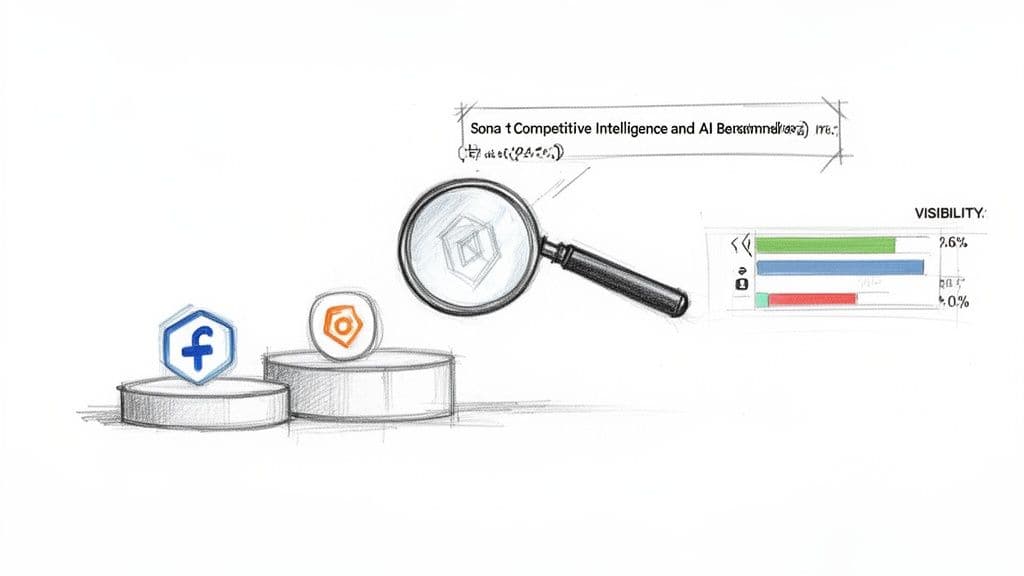
The core idea is to transform raw visibility data into strategic business intelligence. By showing marketing leaders exactly where they win, lose, or are invisible compared to their rivals in AI-generated answers, this positioning provides a clear roadmap for action. It ties marketing efforts directly to market share and competitive advantage.
Strategic Breakdown
- Target Audience: Brand Managers, Product Marketers, and CMOs at competitive enterprise companies who are measured on market share and competitive displacement.
- Problem Solved: Answers the critical question, "How are we performing against our competitors in the new AI search landscape?" It removes uncertainty and provides actionable data.
- Key Differentiator: Focuses on relative performance rather than absolute metrics. The value is not just in knowing your own visibility, but in understanding it within the context of the competitive environment.
Actionable Takeaways
This strategy is perfect for platforms that aggregate market data, such as Crayon or SEMrush. A company like Attensira effectively uses this by allowing users to directly compare their AI visibility against a list of competitors, turning data points into a competitive narrative. This framing immediately highlights gaps and opportunities for their clients.
To implement this positioning, focus messaging on "gaining a competitive edge" or "outsmarting the competition in AI search." Create industry-specific reports that benchmark key players and use this data as lead magnets. Positioning your insights as strategic business intelligence, not just SEO metrics, makes this a powerful example of modern brand positioning statement examples that resonate with executive leadership.
4. Zero-Friction Implementation and No-Code Positioning
In a market saturated with complex enterprise tools, this positioning strategy carves out a niche by emphasizing simplicity, speed, and accessibility. Zero-Friction and No-Code positioning frames a product not as a technical challenge but as a simple extension of a team's existing workflow. It directly counters the common enterprise fear of long, costly, and IT-dependent implementation cycles.
 into a primary strength: immediate results.
5. AI-Native Growth Strategy Positioning
This positioning elevates AI visibility from a marketing tactic to a fundamental driver of business growth. Instead of focusing on technical SEO, it frames optimization for AI-driven discovery as an essential component of a modern B2B growth stack. This strategy resonates with executives who view technology not just as a tool, but as a core competitive advantage.
The principle is to connect AI visibility directly to measurable growth outcomes like lead generation, pipeline acceleration, and market share expansion. It positions the solution as foundational for any company needing to adapt its go-to-market strategy for a world where AI is the primary interface for discovery and decision-making.
Strategic Breakdown
- Target Audience: Chief Growth Officers, VPs of Growth, and product-focused executives at B2B enterprises who are accountable for revenue and market penetration.
- Problem Solved: Overcomes the challenge of integrating new discovery channels (like AI search) into existing growth models and proving their ROI. It moves the conversation from "ranking" to "revenue."
- Key Differentiator: It’s a strategic growth lever, not a channel optimization tactic. This positioning focuses on integrating with the entire growth stack (CRM, analytics, etc.) to demonstrate a clear impact on business KPIs.
Actionable Takeaways
This approach is ideal for B2B SaaS companies that sell to growth-oriented teams. Attensira, for instance, targets growth leaders by framing AI visibility as a competitive intelligence and market capture tool. Similarly, companies like Amplitude and Mixpanel built their brands around positioning analytics as central to growth, a model that can be adapted for AI visibility. To empower your brand's growth and strategy, consider how you can leverage AI tools for crafting compelling pitch decks to clearly communicate this value.
To implement this, create growth playbooks that show how improved AI presence translates into cohort-based user acquisition. Develop case studies that feature Chief Growth Officers as heroes and highlight metrics like pipeline growth and reduced customer acquisition costs. This is one of the most effective brand positioning statement examples for aligning a technical solution with executive-level business objectives.
6. Enterprise Risk and Visibility Compliance Positioning
This positioning elevates the conversation from a marketing optimization to a critical governance issue. Enterprise Risk and Visibility Compliance focuses on the inherent dangers of brand misrepresentation or invisibility within AI-generated search results. It frames AI visibility not as a way to get more traffic, but as an essential component of brand safety, reputation management, and risk mitigation.
The core strategy is to appeal to risk-conscious enterprises, particularly those in regulated industries like finance, healthcare, and law. It highlights the potential for brand damage, misinformation, and loss of market control when AI models present inaccurate or negative information about a company. This positioning offers a solution that functions like an insurance policy against digital brand threats.
Strategic Breakdown
- Target Audience: Chief Risk Officers, General Counsel, and Brand Safety Managers at large enterprises, in addition to CMOs.
- Problem Solved: Addresses the uncontrolled risk of brand reputation damage from inaccurate or negative AI-generated responses, which traditional PR and marketing tools are not equipped to handle.
- Key Differentiator: It shifts the focus from marketing ROI to risk mitigation and compliance. The value proposition is about preventing catastrophic brand events rather than just achieving incremental marketing gains.
Actionable Takeaways
This approach is powerful for platforms that monitor brand mentions or manage online reputations. Companies like Brandwatch and Reputation.com are well-positioned to integrate this angle into their offerings, framing AI visibility as the next frontier of brand safety. They can demonstrate how their tools provide an early-warning system for negative AI trends.
To implement this positioning, create industry-specific risk assessment reports showing how AI can misrepresent brands in high-stakes fields. Develop compliance scoring dashboards that audit and grade a brand's visibility and accuracy across major AI platforms. Use case studies centered on brand reputation damage avoidance rather than traffic acquisition. This strategy is one of the more sophisticated brand positioning statement examples because it successfully connects a marketing function to a C-suite-level business imperative: risk management.
7. Product-Led Discovery and Category Leadership Positioning
This strategy centers on establishing and defending category leadership, particularly within AI-driven search results. It moves beyond simple visibility to frame the brand as the definitive, authoritative voice in its niche, making it the default answer when AI systems respond to user queries. This approach is ideal for companies with strong product differentiation aiming for market dominance.
The goal is to become synonymous with the category itself. When a user asks an AI about "the best CRM," the system should cite Salesforce. When asked about collaborative design, Figma should be the primary reference. This requires a deep investment in content that not only answers questions but defines the entire problem space your product solves.
Strategic Breakdown
- Target Audience: Product Managers, B2B Founders, and Heads of Growth at companies with a superior product aiming to create or dominate a market category.
- Problem Solved: Prevents commoditization and getting lost among "alternatives" by establishing the brand as the industry standard and primary reference for AI models.
- Key Differentiator: Focuses on owning a conceptual category, not just a set of keywords. The ambition is to be the encyclopedia entry for the entire niche.
Actionable Takeaways
This positioning is most potent for category creators or clear market leaders. HubSpot, for example, didn't just sell marketing software; it created and evangelized the "inbound methodology" category. Today, AI responses about this methodology naturally point back to HubSpot as the originator and leading resource.
To implement this, build comprehensive topic clusters around your core category, not just product features. Invest in original research and thought leadership that AI systems are likely to cite as authoritative sources. The objective is to make your company the default answer for any high-level category query, cementing your place as the leader. Analyzing brand positioning statement examples like this reveals a shift from product-centric to category-centric messaging for long-term defensibility.
8. Data Privacy and Ethical AI Visibility Positioning
As organizations and consumers grow more concerned with data privacy, a new positioning strategy has emerged that champions ethical AI optimization. This approach focuses on achieving AI search visibility through transparent, privacy-first methods, rejecting manipulative tactics that could erode user trust. It is particularly vital for brands in regulated industries or those targeting a clientele that values data integrity above all else.
The core of this strategy is to build brand authority not just on expertise, but on ethical conduct. It means optimizing content for AI visibility while simultaneously communicating a commitment to user privacy and transparent data handling. Brands like Apple and DuckDuckGo have successfully used this broader privacy-centric positioning for years, creating a powerful market distinction.
Strategic Breakdown
- Target Audience: Chief Information Security Officers (CISOs), compliance officers, and marketing leaders at B2B enterprises in finance, healthcare, and legal sectors.
- Problem Solved: Addresses the market’s growing distrust of opaque algorithms and invasive data practices, turning a potential compliance burden into a competitive advantage.
- Key Differentiator: Prioritizes ethical methods and transparency over aggressive, black-hat optimization. The goal is to be seen as a trustworthy source by both AI models and human users.
Actionable Takeaways
This positioning is essential for companies whose customers face strict data governance and compliance requirements. For example, a company like Attensira can use a privacy-first stance in its AI monitoring tools to appeal directly to enterprises worried about data exposure in generative AI models. Their messaging can focus on secure, compliant monitoring rather than just performance metrics.
To implement this, prominently feature privacy certifications, GDPR/CCPA compliance, and transparent methodology documentation on your site. Create content that educates your audience on what ethical AI visibility looks like, contrasting it with riskier methods. This is one of the most resonant brand positioning statement examples for the modern enterprise, as it aligns marketing goals with core corporate values of trust and security.
9. Integrated Marketing Platform and Ecosystem Positioning
This positioning strategy frames a product not as a standalone solution, but as an essential, integrated component of a broader marketing technology stack. Rather than competing for budget as a new, isolated tool, the solution is presented as a connector that multiplies the value of existing investments in CRM, analytics, and content platforms like HubSpot or Salesforce. This is ideal for enterprises focused on centralizing operations and maximizing ROI from their current tech.
The core principle is to position your brand as the "missing link" or "optimizer" within the customer's established workflow. It shifts the conversation from "Do I need this new tool?" to "How does this make all my other tools work better together?" This approach successfully leverages the customer's existing ecosystem as a selling point for your product.
Strategic Breakdown
- Target Audience: Enterprise marketing operations leaders, Chief Information Officers, and department heads who are wary of tool sprawl and seek to streamline their marketing stack.
- Problem Solved: Addresses the fragmentation and data silos created by having too many disconnected marketing tools. It provides a way to unify data and automate workflows across disparate systems.
- Key Differentiator: Focuses on deep, native integrations and quantifiable efficiency gains, rather than on standalone features. The value is measured by how it enhances the entire ecosystem.
Actionable Takeaways
This strategy is particularly effective for B2B SaaS companies whose products rely on data from other platforms to function. For example, Zapier masterfully positions itself as the integration backbone that makes hundreds of other apps more powerful together. Similarly, Segment positions itself as the central customer data platform that feeds cleaner, unified data into every other marketing tool.
To implement this positioning, map your integration points directly to common customer workflows and create playbooks for high-value scenarios. Emphasize how your solution saves time and eliminates manual data entry by automating synchronization between critical systems. This is one of the most powerful brand positioning statement examples for technology companies because it aligns directly with the enterprise goal of operational efficiency.
10. Predictive Analytics and Opportunity Forecasting Positioning
This positioning strategy moves a brand from a reactive or current-state analytics provider to a proactive, strategic foresight engine. Instead of merely reporting on what has happened, it focuses on forecasting future opportunities, especially in emerging channels like AI-driven search. This approach is highly valued by enterprise leaders who need to anticipate market shifts and allocate resources before trends become common knowledge.
The core principle is to use predictive models and data analysis to identify where user attention and AI-driven traffic will flow next. This positions the brand as an indispensable partner for long-term strategic planning, helping companies gain a first-mover advantage. It's about selling foresight, not just insight.
Strategic Breakdown
- Target Audience: Strategic executive personas, including Chief Strategy Officers, VPs of Innovation, and forward-thinking CMOs at enterprise-level organizations.
- Problem Solved: Addresses the high-stakes risk of being outmaneuvered by competitors due to a lack of visibility into future market dynamics and emerging search behaviors.
- Key Differentiator: Focuses on predicting future AI visibility opportunities rather than just measuring the current state. It transforms data from a historical record into a strategic roadmap.
Actionable Takeaways
This positioning is powerful for analytics platforms and strategic consultancies like Gartner or Forrester, which have built their brands on trend forecasting. A company like Attensira leverages this by providing insights that forecast where brands will need to build authority to be visible in future AI-generated answers, framing their tool as essential for proactive strategy.
To adopt this positioning, use historical accuracy data to validate the reliability of your predictions. Develop proprietary assets like quarterly "AI Opportunity Forecast" reports that highlight emerging trends. In all marketing, emphasize case studies where clients acted on early trend detection to secure a competitive edge. This is one of the most sophisticated brand positioning statement examples because it shifts the value proposition from information to strategic advantage.
10 Brand Positioning Statements Comparison
From Statement to Strategy: Activating Your AI-Ready Brand Position
We've dissected a wide array of brand positioning statement examples, from B2B SaaS platforms championing ethical AI to enterprise solutions focused on zero-friction implementation. The common thread woven through each successful example is not just clever wording, but a deep, strategic commitment to owning a specific, defensible territory in the minds of a target audience. This is more critical than ever in an era where AI-driven search engines, like Google's Search Generative Experience and Perplexity, are the new arbiters of brand visibility. A vague or generic position simply gets lost in the noise.
The examples showcased demonstrate that a powerful positioning statement is a strategic compass. It aligns internal teams, from product development to sales, and provides the foundational logic for every piece of content created. For brand managers and CMOs, it becomes the ultimate litmus test: Does this campaign, this feature launch, or this blog post reinforce our core position? If the answer is no, it's a distraction that dilutes your authority and confuses both human prospects and AI crawlers.
Key Takeaways: From Analysis to Action
The journey from analyzing brand positioning statement examples to crafting your own requires a shift in mindset. It’s less about finding the perfect sentence and more about building a strategic framework. The most critical insights to carry forward are:
- Specificity is Your Superpower: Vague claims of being "the best" or "most innovative" are invisible to AI. As seen in the competitive intelligence and predictive analytics examples, the winning statements targeted a precise pain point for a clearly defined audience.
- Differentiation is Non-Negotiable: Your position must answer the question, "Why you?" It must establish a clear line in the sand between your solution and every other alternative, whether it's through superior technology, a unique methodology, or a commitment to a value like data privacy.
- AI-Readiness is a Mandate: Your positioning statement and the content that supports it must be structured for machine comprehension. This means using clear, consistent language, targeting specific keywords and concepts, and building a deep well of content that proves your stated claims. An AI will connect the dots; you must provide them.
Your Next Steps: A Roadmap to Dominance
Armed with these frameworks and insights, your path forward is clear. It’s time to move from the theoretical to the tactical. The goal is to build a positioning strategy that not only reads well but also performs exceptionally in the competitive digital landscape.
- Conduct a Positioning Audit: Begin by evaluating your current brand position against the examples in this article. Is it truly differentiated? Is it understood and articulated consistently across your entire organization? Does it address a high-value customer need that you can uniquely solve?
- Pressure-Test with the AI Lens: Reread your statement and ask, "How would an AI interpret this?" Identify ambiguous terms or generic claims. Refine the language to be as precise and definitive as possible, ensuring it aligns with the core keywords and concepts you aim to own.
- Translate Position into a Content Strategy: Your positioning statement is the blueprint for your content. Every article, whitepaper, and case study should be a proof point that substantiates your position. This creates the topical authority that AI models reward with high visibility.
- Implement, Measure, and Iterate: A brand position is not a "set it and forget it" asset. It must be activated in the market and its performance must be tracked rigorously. Monitoring your visibility, share of voice, and competitive benchmarks is essential for long-term success.
Ultimately, mastering your brand position is the most powerful lever you have for sustainable growth. It's the source code of your marketing, the foundation of your product roadmap, and your best defense against market commoditization. By building a clear, differentiated, and AI-ready position, you are not just defining your brand; you are engineering its future visibility and success.
Ready to see how your brand's positioning performs in the real world of AI-driven search? Attensira provides the competitive intelligence and content performance analytics you need to track your visibility, measure against competitors, and ensure your strategic message is winning. Stop guessing and start measuring what matters at Attensira.