Uncover the truth about ads in ChatGPT. Learn why old marketing rules don't apply and discover how to build brand visibility in an AI-first world.
Right now, you won't find any traditional banner or search-style ads in ChatGPT. Instead, brand visibility happens organically when the AI references authoritative sources. This means the focus for marketers has to shift from buying ad space to earning trust.
Why Traditional Ads in ChatGPT Are an Illusion
If you're hunting for banner ads, sponsored placements, or anything resembling paid search results inside ChatGPT, you'll come up empty. The platform was built on a premise that completely sidesteps the ad-driven internet we've all grown accustomed to over the last two decades. The absence of traditional ads in ChatGPT isn’t an accident; it's a fundamental part of its design.
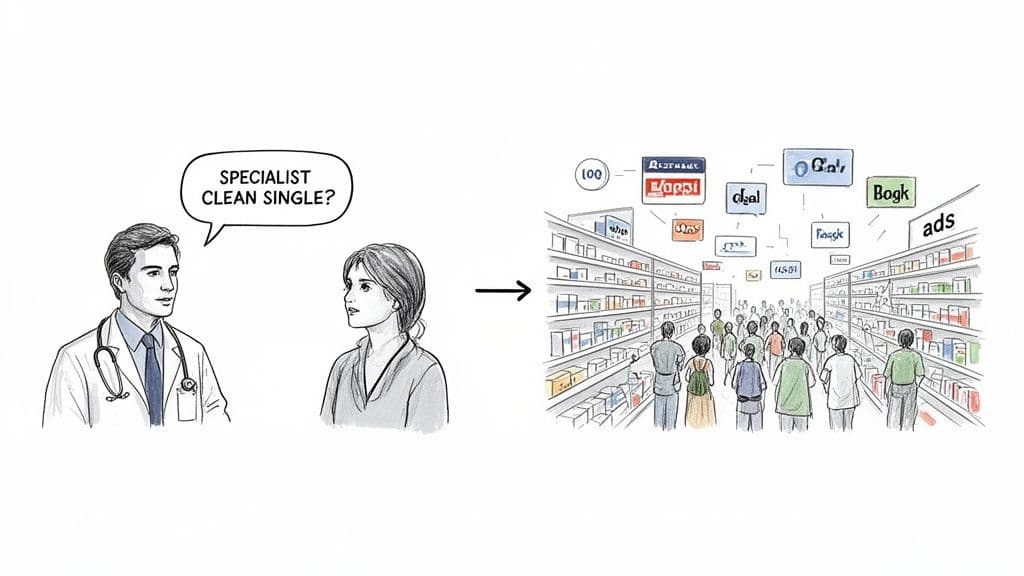
Here’s a helpful way to think about it. Using Google is like walking through a massive supermarket. You see products on the shelves, but you also see paid promotions on endcaps and splashy displays designed to catch your eye. Chatting with ChatGPT, on the other hand, is more like having a private consultation with a specialist. You ask a direct question and expect a trusted, unbiased answer based on their deep expertise, not on which company paid for better placement.
This ad-free model is the bedrock of user trust. The second a paid ad interrupts a conversation, that perception of objectivity is gone. Because of this, brands need a completely different mindset. The goal is no longer to buy attention but to earn it by becoming the authoritative source the specialist naturally quotes.
The Data Tells the Story
User behavior data for ChatGPT is telling and confirms this pivot away from traditional ad channels. People aren't discovering ChatGPT through paid campaigns; they are going there directly with a specific purpose: to get answers.
Let's look at the numbers. The following table breaks down where ChatGPT's traffic comes from, and it paints a clear picture of user intent.
ChatGPT Traffic Sources Paid Channels Versus Direct Engagement
As you can see, the vast majority of users are bypassing ad-filled funnels and going straight to the source.
This chart visualizes just how dominant direct engagement is compared to conventional advertising channels.
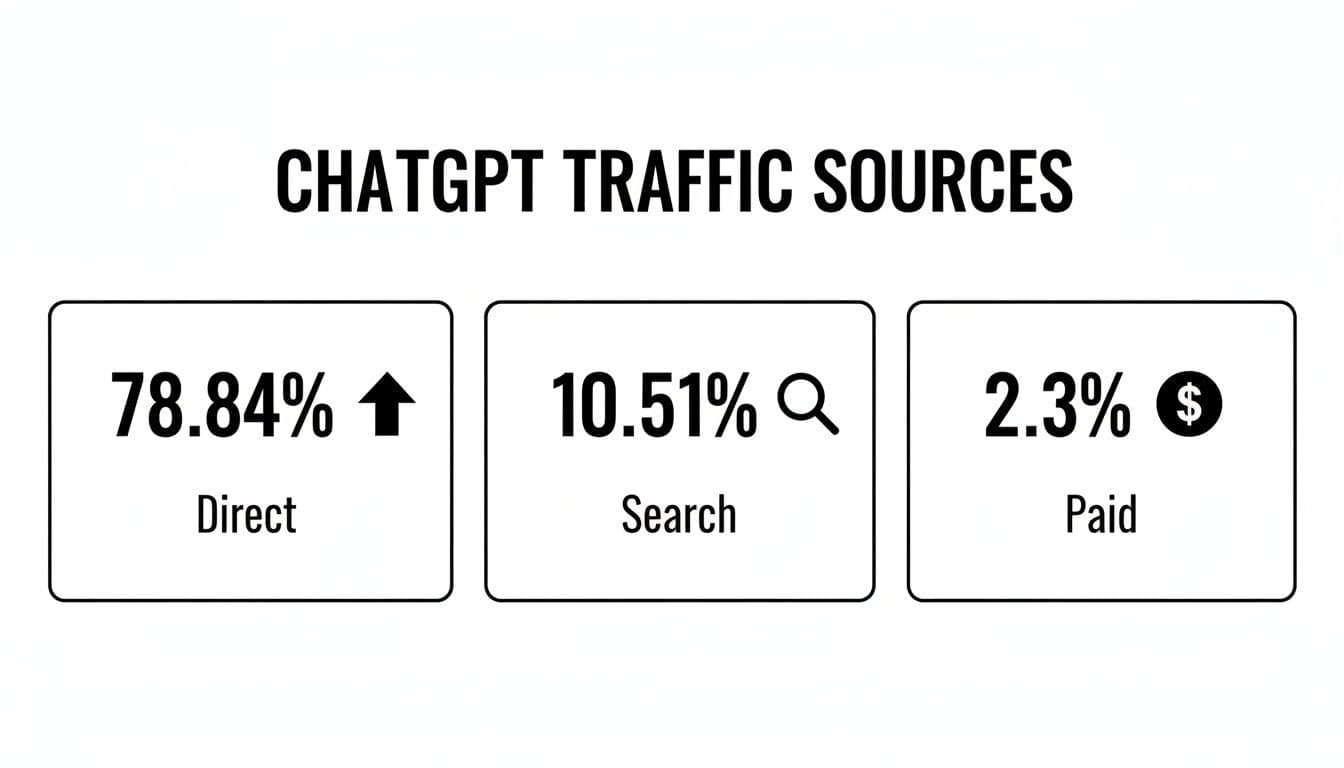
Despite handling an incredible 5.1 billion monthly visits, traditional ad channels barely register. Direct traffic makes up a massive 78.84% of visitors, while paid search contributes a tiny 2.3%. Display ads are practically a rounding error at just 0.21%.
These numbers send an unmistakable signal: throwing money at old-school advertising playbooks won't get you visibility inside AI chat.
The core challenge for marketers has changed. It's no longer about winning an auction for a keyword. It's about becoming so authoritative and trustworthy that the AI cites your brand as the definitive source.
Earning Trust in an Ad-Free World
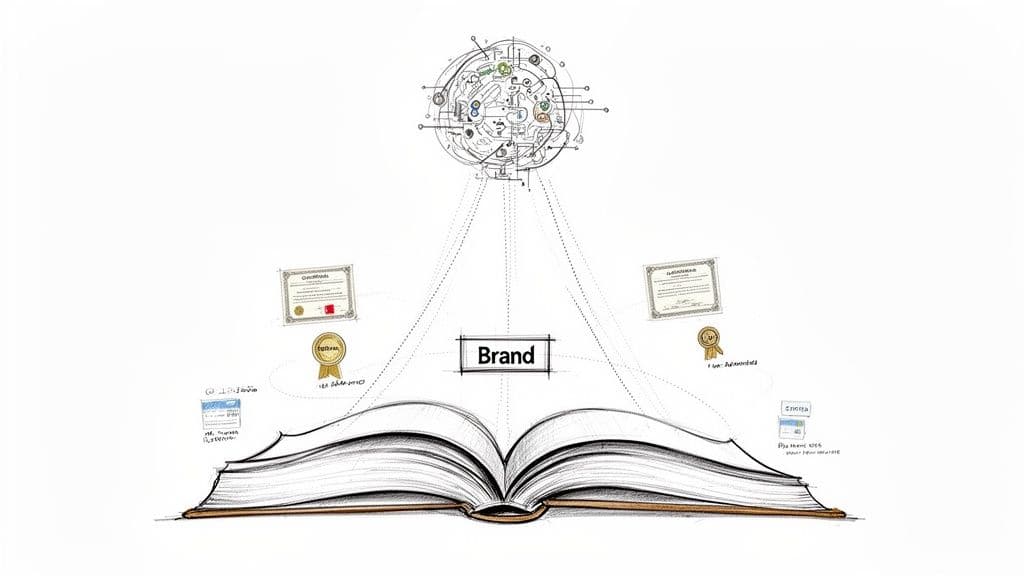
So, if you can't buy your way in, how does a brand become the go-to source for an AI model? It all comes down to building a deep, verifiable footprint of expertise across the web. The AI's knowledge is a direct reflection of the information it was trained on, which means your digital presence is its textbook. You can get a much deeper understanding of this by reading our guide on how ChatGPT indexes content.
Ultimately, visibility in this new environment is a byproduct of authority. Instead of renting space on a billboard, you are now building the library from which the AI draws its knowledge. This demands a long-term strategy focused on creating high-quality, citable content that cements your brand as an undisputed leader in its field.
Your Brand as an AI Endorsement: The New Authority
In a world without paid ads, an AI mentioning your brand isn't just a mention—it's a powerful endorsement. This completely changes the game for brand visibility, shifting focus from paid placements to earned authority and trust. When ChatGPT names your company, it's not serving an ad; it's offering what feels like a trusted recommendation.
It's the difference between a paid influencer shouting out a product and a respected industry veteran giving a genuine referral. One is a transaction, and everyone knows it. The other is built on a foundation of credibility and objective expertise. That’s exactly how brand mentions work inside the current generation of large language models (LLMs).
How AI Decides Who to Trust
To play in this new arena, you first have to understand how models like ChatGPT actually pull information. They aren't "searching" the live internet for every single query. Instead, they're tapping into a massive, pre-built knowledge base created from their training data—a vast snapshot of the internet filled with articles, research, forums, and websites.
When an LLM generates a response, it's synthesizing information from the sources it learned were the most credible and authoritative during its training. That credibility is determined by a complex set of signals that feel a lot like traditional SEO, but with much higher stakes.
These signals boil down to things like:
- Topical Authority: How deep and consistent is your expert content on a given subject?
- Reputable Citations: How often is your brand mentioned and linked to by other respected sources in your field?
- Data Integrity: Is the information you publish factually accurate and easy to verify?
Essentially, the AI has learned to "trust" certain domains as the go-to sources for specific topics. So, when a user asks a question, the AI pieces together an answer based on what its most trusted sources have already taught it.
The Goal Isn't Ranking, It's Integration
This reality completely reframes the purpose of content marketing for B2B leaders. The goal is no longer just to rank #1 on a search results page. The new, far more important objective is to become a fundamental, citable part of the AI’s core knowledge. You're not just fighting for a temporary spot at the top; you're aiming for permanent residency in the AI's "brain."
An AI endorsement isn't won with ad dollars. It's earned by becoming the undeniable answer to a question so consistently and authoritatively that the model learns to associate your brand with the solution itself.
This means every whitepaper, blog post, and case study has to be created for a dual audience: the human reader and the AI model that's learning from it. To truly succeed here, it helps to understand the fundamentals of how these systems generate content. For a deeper look, you might want to explore resources that explain what AI copywriting is and how it can be structured for maximum impact.
The New Content Mandate
To achieve this deep level of integration, B2B brands need a new content strategy built on three core pillars:
- Build a Definitive Knowledge Hub: Your website has to become the most thorough and reliable resource in your niche. Period.
- Secure Widespread Validation: Your expertise needs to be backed up and cited by other authoritative platforms and experts.
- Ensure Structural Clarity: Your content must be organized in a way that’s dead simple for both humans and AI crawlers to understand.
When your brand becomes the go-to reference point—the source others cite, the data others use, the guide others follow—you stop being just another voice online. You become the authority the AI relies on. This is the new path to visibility in a world without traditional ads in ChatGPT.
The Subscription-First Model Powering AI Chat
To really get why you're not seeing banner ads in ChatGPT, you have to look past the user interface and dig into the business engine driving it all. Companies like OpenAI made a deliberate choice to steer clear of the ad-soaked model that defined the last era of the web. Their entire game plan isn't about selling your attention to the highest bidder; it's about selling a premium, clean experience directly to you.
This is a massive strategic split from a giant like Google, whose entire empire is built on advertising. For Google, the user is the audience, and their attention is the product. For OpenAI, the user is the customer, and the product is the powerful, efficient AI itself.
The Financial Muscle of an Ad-Free Experience
This subscription-first approach isn't some quirky experiment—it’s a seriously profitable business model. The financial success of going ad-free proves its strength and pretty much eliminates the need to chase traditional ad revenue.
ChatGPT's revenue growth is the kind of story that makes headlines. It shot up from less than 10 million** in 2022 to an estimated **2.7 billion in 2024. And it's not slowing down, with projections hitting $4 billion by the end of 2025. This explosion is powered by 35 million paying subscribers, all without a single banner ad getting in the way. You can see a full breakdown of these ChatGPT user and revenue statistics for a deeper dive.
So, where's the money coming from? It's all about two key streams:
- Premium Subscriptions: Individuals pay for upgraded versions like ChatGPT Plus to get faster responses, early access to new features, and more capable models.
- Enterprise Deals: Businesses pay for API access and custom solutions to weave the AI into their own products and internal systems.
Why This Model Is a Moat for User Trust
When a user pays a subscription, the deal is clear. You pay a fee, and you get a powerful tool without the noise or potential bias of third-party ads. This is a crucial difference that helps build and protect user trust.
Imagine if you asked for complex financial advice and the answer was quietly shaped by a sponsoring bank. The trust would evaporate. Introducing conventional ads would put that core value at risk.
By making the user the direct customer, OpenAI aligns its financial success with the quality of the user experience. A better product brings in more subscribers. It's a simple, powerful feedback loop that an ad model would only complicate.
This has huge implications for marketers. Instead of waiting around for ad products that might never show up in the way we expect, the real challenge is adapting right now. The focus has to shift to earning mentions organically within this trusted, ad-free space. And while direct ads are off the table for now, OpenAI is already dipping its toes into subtle commercial features, which we break down in our post on how users can now shop on ChatGPT.
A Strategic Break from the Ad-Based Web
Opting for subscriptions over ads is a long-term strategic bet. OpenAI and others are positioning themselves as essential utilities—an "intelligence layer" for your life and business, much like a cloud service or a must-have software subscription.
In this world, the key metric isn't clicks or impressions; it's user retention and the value people feel they're getting. The platform's stickiness comes from its genuine utility, not its ability to target you with ads. For any CMO or brand manager, this is a critical insight. It tells you the path to visibility isn't through your media buying team. It's through a content and authority strategy that makes your brand an essential part of the AI's knowledge base.
How to Become an AI-Cited Authority in Your Niche
Since you can't just buy traditional ads in ChatGPT, the whole game has changed. Your strategy needs a complete overhaul, moving away from purchasing visibility to earning it. Becoming an authority that AI models cite isn't about one clever trick; it's a layered approach built on one foundational idea: make your brand the most credible and complete source of information in your space.
The logic is actually pretty straightforward. Large Language Models learn from the web. If your content consistently shows up as the most detailed, well-supported, and frequently referenced source on a topic, the AI eventually learns to trust it. Before you know it, your insights become its insights. Your brand becomes the default citation.
This isn’t a quick fix. It’s a long-term commitment to building a deep reservoir of expertise. Think of it less like writing blog posts and more like building the definitive reference library that future AI models will use for their education.
Conduct a Rigorous Content Audit
First things first: you have to take a brutally honest look at your current digital footprint. A content audit for AI authority isn't just about spotting broken links or old statistics. You’re hunting for gaps in your expertise and clear opportunities to strengthen your position.
Your audit needs to answer a few tough questions:
- Topical Completeness: Do you cover every single angle of your core topics? I mean everything from 101-level concepts to the most advanced applications. Where are the blind spots an actual expert would immediately notice?
- Evidence and Substantiation: Are your claims backed by solid data, original research, or citations from other reputable sources? AI models are getting very good at sniffing out weak, unsubstantiated content.
- Clarity and Structure: Is your content organized logically? Think clear headings, lists, and structured data. A clean, logical flow makes it much easier for AI to parse and correctly understand what you're saying.
This whole process will clearly show where you're a genuine expert versus where you're just echoing what everyone else is saying. It’s the foundational work you can't skip.
Your goal is to create a content ecosystem so complete that an AI model can learn everything it needs to know about your niche just by studying your domain. This is the essence of becoming a primary source.
Secure Citations on Reputable Industry Sites
In the world of AI, what others say about you matters immensely. It's a lot like academic circles—a citation from a respected source carries a ton of weight. When other authoritative sites in your industry link to your content, it sends a powerful signal to AI models: this information is trustworthy.
This is more than just basic link-building. You need to focus on earning mentions and backlinks from the best of the best:
- Top-tier industry publications
- Recognized academic institutions
- Well-respected research organizations
- Leading experts and influencers in your field
Every one of these citations acts as a vote of confidence, cementing your status as a reliable source. A single link from a highly trusted domain can easily be more impactful than dozens from low-authority sites. This is a huge part of what's now being called Answer Engine Optimization, which is all about optimizing for these new AI-driven answer platforms.
Optimize for Semantic Search
Finally, you have to make sure your content is optimized for how AI thinks. This means moving beyond stuffing in simple keywords and fully embracing semantic search. At its core, semantic search is about understanding a user's intent and the contextual meaning behind their words, not just matching text strings.
In practice, this means creating content that answers questions completely and connects the dots between related concepts. So, instead of just targeting "cloud computing services," you'd create a whole cluster of content that explains "what is cloud computing," explores the "benefits of a multi-cloud strategy," and details "how to migrate to the cloud."
You're building a web of interconnected knowledge that screams deep expertise. For those looking to get more technical, exploring methods like using Python for NLP and semantic SEO can provide a serious advantage. When you structure your content this way, you make it incredibly easy for an AI to recognize your domain as the definitive authority on the entire subject.
Your Command Center for AI Visibility
Pulling off this strategy isn't a "set it and forget it" deal. It requires precise, ongoing monitoring and analysis. You can't build authority if you have no way to measure your presence. This is exactly where a platform like Attensira becomes your command center for this new frontier.
Attensira gives you the tools to systematically track your brand's visibility across different AI models. It helps you:
- Monitor AI Mentions: See exactly when, where, and how your brand is being cited in AI responses.
- Diagnose Content Weaknesses: Pinpoint the content gaps and authority deficits that are holding you back.
- Build a Strategic Roadmap: Use data-driven insights to map out a clear plan for becoming the go-to source in your industry.
By combining a smart, robust content strategy with intelligent monitoring, you can methodically build your brand into an AI-cited authority, making sure you show up in the conversations that matter most.
Measuring Your Brand Presence in Generative AI
The old marketing wisdom—you can’t manage what you don’t measure—has never been more relevant than in the age of AI. But for most brands, what happens inside an AI conversation is a total black box.
When someone asks ChatGPT about your industry, does your brand pop up? If it does, is the context positive? Negative? Neutral? Tools like Google Analytics are completely blind to these interactions, leaving you without a clue.
Think about it: those platforms are built to track clicks, sessions, and conversions that start with discoverable web traffic. An AI conversation is entirely different. It’s a self-contained world. A user asks a question, gets an answer, and that's often the end of the journey. No click-through to your site ever happens, which means a powerful brand impression just vanished into thin air, completely unrecorded. This creates a massive visibility gap for marketers.
Without a way to peer inside these conversations, your entire AI visibility strategy is pure guesswork. You’re flying blind, with no idea if your content is hitting the mark, where competitors are pulling ahead, or how AI models even perceive your brand. This is where specialized monitoring tools shift from being a "nice-to-have" to an absolute necessity.
Why You Need a Brand Radar for the AI Ecosystem
Imagine having a brand radar specifically for the AI ecosystem. That’s what these platforms are. They’re built from the ground up to do what general analytics can’t: systematically prompt AI models, log every response, and analyze the text for mentions of your brand, products, and competitors. Suddenly, the fuzzy, abstract concept of "AI visibility" becomes a measurable, manageable marketing channel.
This kind of intelligence is critical right now. User behavior on platforms like ChatGPT signals a major departure from traditional ad-supported channels. We're talking about a platform fielding over 1 billion queries a day. With the current absence of ads in ChatGPT, brands have to find a new way to play in an ecosystem where organic mentions are everything. The data doesn't lie: paid search drives just 2.3% of its traffic, and display ads account for a laughably small 0.21%. To really dig into this shift, you can explore the full ChatGPT statistics on EmailVendorSelection.
This change makes tracking your organic footprint more important than ever. You can't just buy your way to the top. Without the crutch of paid ads, understanding where and how your brand shows up naturally is the only way to build a real, sustainable strategy.
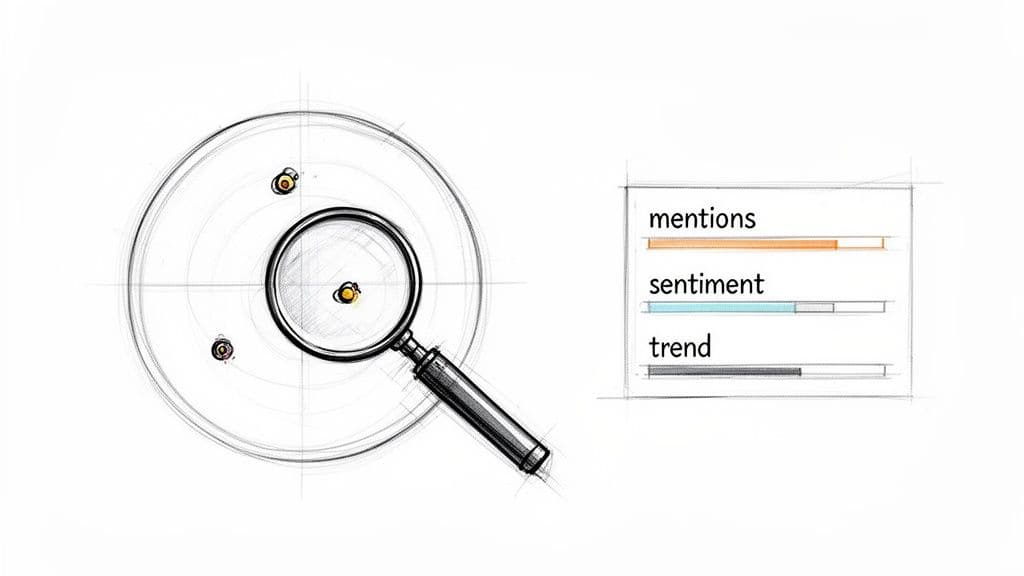
In an ad-free world, metrics like click-through rates and cost-per-acquisition are useless. The new KPIs are mention frequency, sentiment, and contextual accuracy—and you need a whole new class of tools to measure them.
Transforming Ambiguity into Actionable Insights
This is exactly the problem a platform like Attensira was built to solve. It delivers the hard data you need to turn your AI strategy from a shot in the dark into a data-driven plan. Instead of wondering, you get a crystal-clear picture of your brand's standing inside the major AI models.
Attensira provides a central dashboard that uncovers mission-critical insights. Here’s how:
- Systematic Mention Monitoring: It constantly pings AI models with relevant queries to see how your brand is being represented, giving you a real-time pulse on your visibility.
- Sentiment and Context Analysis: It’s about more than just counting mentions. The platform analyzes how the AI portrays your brand—positively, negatively, or neutrally—and the context surrounding the mention.
- Competitive Gap Identification: You can immediately see where competitors are getting mentioned and you aren't. This reveals golden opportunities to create content that fills those specific knowledge gaps.
Armed with this data, you can finally demonstrate a clear ROI for all your content and authority-building work. You can walk into a meeting with executives and show them exactly how your efforts are translating into a stronger brand presence on the platforms that a new generation of users relies on. For a complete walkthrough, check out our guide on how to track your brand’s visibility in ChatGPT and other top LLMs.
By connecting your domain to a platform like Attensira, you can start mapping your presence, pinpointing weaknesses, and building a targeted content plan to improve your standing. This structured approach takes the guesswork out of the equation, giving you a clear path to getting executive buy-in and proving the value of your AI visibility initiatives.
Frequently Asked Questions About AI Brand Visibility
It's completely normal to have questions when a new channel like this emerges. As we all get our heads around a future without straightforward ads in ChatGPT, getting clear on the fundamentals is the top priority. Here, we'll tackle the most common questions we hear from marketers to help you build a solid strategy.
We’ve pulled these questions together to clear up any lingering confusion and hammer home the main takeaways from this guide. The idea is to give you quick, actionable answers so you can understand the playing field and make your next move with confidence.
Will ChatGPT Introduce Traditional Ads in the Future?
While you can never say never, OpenAI's business model is leaning heavily into premium subscriptions and enterprise services, not advertising. Their core promise is a clean, helpful, and uninterrupted experience. Shoving banner ads into that would completely undermine the user's trust.
Considering their massive revenue growth from subscriptions alone, there’s very little financial incentive for them to pivot to a conventional ad model. For now, your strategy needs to focus on earning organic mentions, not waiting around for ad placements that may never materialize.
The only winning move is to operate based on how the platform works today. If you wait for a hypothetical ad model to appear, you're just giving your competitors a head start in building real authority.
It’s all about adapting to the ecosystem as it is, not as we might want it to be. The game has shifted from buying attention to earning trust.
How Does Traditional SEO Impact ChatGPT Visibility?
Think of traditional SEO as the absolute bedrock of visibility in AI. Large Language Models like ChatGPT are trained on the public internet, and they learn to identify credible, authoritative sources using the same signals that SEOs have focused on for years.
When a website has strong SEO fundamentals—things like high-quality backlinks, clear subject matter authority, structured data, and truly expert content—the model sees it as reliable. A solid SEO strategy, therefore, directly increases the odds that an AI will learn from your content, trust it, and cite your brand in its answers. You're essentially creating the definitive source material for its future conversations.
Is a Mention in ChatGPT Different from Google SGE?
Yes, they're worlds apart in how users experience them. A mention from Google's Search Generative Experience (SGE) still feels like it’s part of a search engine. It often includes direct, clickable citations that act like supercharged featured snippets. It's clearly a bridge connecting a query to web content.
Getting mentioned in a ChatGPT conversation, on the other hand, feels more like getting a recommendation from a knowledgeable assistant. Because it's presented conversationally and isn't just a list of links, the endorsement can feel more organic and carry more weight. Both require a strong authority strategy, but the user's perception makes a ChatGPT mention an incredibly powerful form of social proof.
What Is the First Step to Monitor Our AI Presence?
The single most important first step is to establish a data-driven baseline. You can’t improve what you don’t measure. Using a specialized tool lets you connect your domain and instantly start tracking where, when, and how your brand is being mentioned across the major AI models. This is the heart of effective AI brand monitoring.
This initial data gives you a clear picture of where you stand right now, helps you spot gaps where competitors are winning, and provides the foundation for an informed strategy. Without dedicated monitoring, any efforts to boost your presence are just shots in the dark. A baseline turns that guesswork into measurable KPIs you can actively work to improve.
Ready to stop guessing and start measuring your brand's presence in AI? Attensira provides the clear insights you need to build authority and win visibility in this new landscape. Connect your domain in seconds and get your free AI visibility report today.