Master AI search monitoring to track and optimize your brand's presence across AI platforms. Learn the strategies you need to improve brand visibility.
Think of AI search monitoring as the new frontier of brand management. It's the practice of actively tracking, analyzing, and ultimately influencing how your brand shows up in the answers generated by AI tools like ChatGPT and Google's AI Overviews.
Why does this matter so much now? Because not appearing in these AI-powered answers is the modern equivalent of being buried on page ten of Google. It's a massive, and growing, threat to your brand's visibility.
Why AI Search Monitoring Is the New Brand Survival Skill
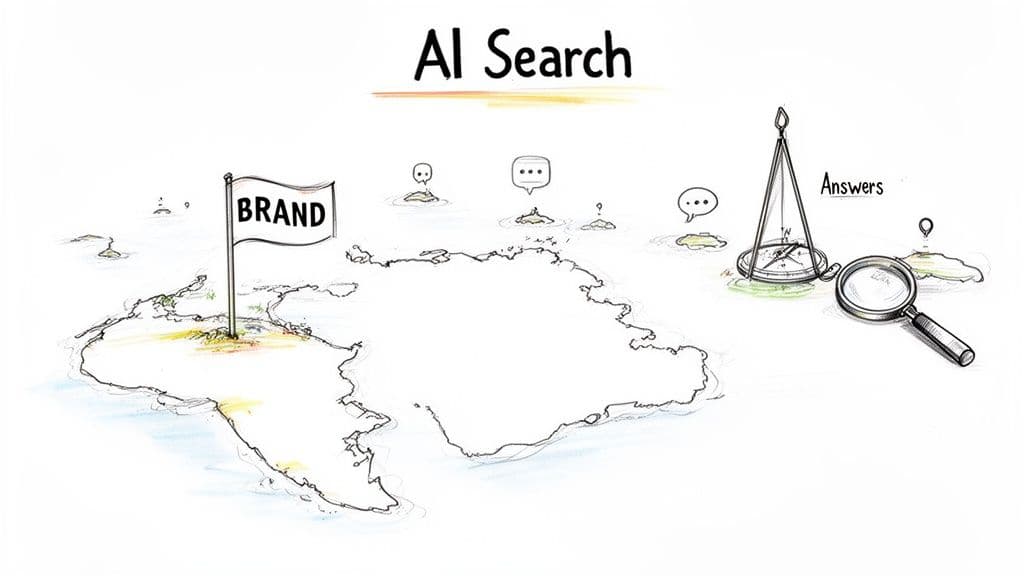
Picture a newly discovered continent, a vast, uncharted territory where all your future customers are heading. This isn't some distant landmass; it's the digital terrain of AI-powered search. For decades, we all learned how to navigate the familiar map of Google’s search results. But today, answer engines like Google AI Overviews, ChatGPT, and Perplexity are redrawing that map right before our eyes.
This isn’t just a minor update. The fundamental shift from a list of blue links to a single, synthesized answer changes absolutely everything for brand visibility. Traditional SEO was all about climbing the ladder of rankings. In the AI era, the goal is completely different: you have to become part of the definitive answer itself.
If your brand isn’t mentioned, cited, or recommended in these AI summaries, you effectively don’t exist for a rapidly growing number of people.
The New Rules of Visibility
The explosion of AI search is one of the most significant shifts we've ever seen in how people find information. The numbers are staggering. Recent data shows that AI search traffic has grown by an incredible 527% year-over-year.
A huge part of that is driven by ChatGPT, which now fields an estimated 2 billion queries every single day and holds a dominant 81% of the AI chatbot market. When you add in platforms like Perplexity and Claude, these tools are drawing billions of visits monthly. The momentum is undeniable, and it’s only a matter of time before AI search becomes the default.
This massive user migration to AI answers is both a major challenge and a huge opportunity. Here’s what this new world looks like for your business:
- Synthesis Over Clicks: AI models don't just point to links. They consume information from dozens of sources and blend it all into what appears to be a single, authoritative response. An algorithm is now writing and summarizing your brand's story.
- The Stakes are Higher: Being invisible in an AI answer is far more damaging than a low ranking. People might scroll to page two of Google, but they almost never question or look beyond the single, confident answer an AI provides.
- Reputation on Autopilot: Without you knowing, AI summaries can misrepresent your products, pull in negative sentiment from an obscure forum, or even favor a competitor. If you aren't monitoring this, you've completely lost control of your brand's narrative.
AI search monitoring isn't just another marketing tactic to add to the list; it's a foundational discipline for modern brand management. It’s about seeing your brand through the "eyes" of an AI to ensure your story is accurate, positive, and prominent where it counts the most.
To illustrate just how different this new landscape is, let's compare the old and new ways of thinking.
Comparing Traditional SEO and AI Search Monitoring
The table below breaks down the fundamental differences between conventional SEO practices and the emerging discipline of AI search monitoring. It really highlights the strategic shift that's required to stay relevant.
As you can see, the game has changed entirely. The focus is no longer just on keywords and backlinks but on building a holistic, trustworthy digital presence that an AI can understand and rely upon.
Understanding how to track and influence these AI-generated conversations is now non-negotiable. For those interested in the more technical underpinnings, the principles of AI Observability Monitoring offer a deeper look. This shift isn't just about technology; it's about reclaiming your brand’s voice in a world where algorithms are the new storytellers. You can learn more about how this discipline works in our comprehensive guide to https://attensira.com/blog/ai-brand-monitoring.
The Key Platforms and Signals You Need to Monitor
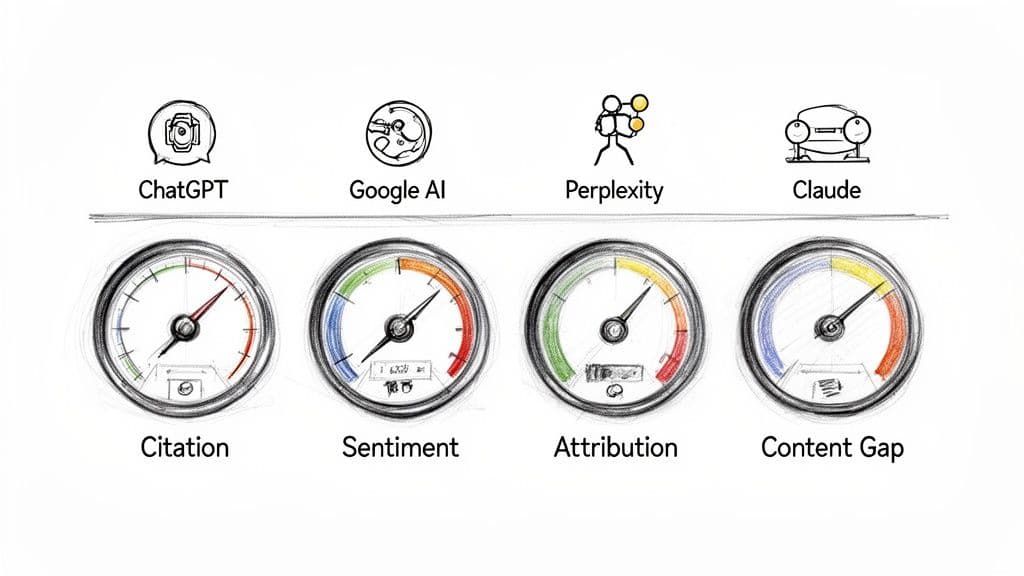
To do AI search monitoring right, you first need to know where to look and what to look for. We're not dealing with a single entity like the old Google Search anymore. The new ecosystem is a collection of distinct AI platforms, each with its own quirks, data sources, and user base.
Think of it less like watching traffic on one highway and more like tracking flight patterns across several major international airports. Your monitoring strategy has to cover the main hubs where people are now going for answers. These platforms are the new front lines for brand visibility.
The Core AI Platforms to Watch
Not all AI engines are built the same. Each one synthesizes information differently, which means your brand's story can get twisted or told in wildly different ways depending on the platform. A solid strategy means keeping a close eye on these key players:
- ChatGPT: As the undisputed market leader, what happens on ChatGPT has massive ripple effects on public perception. Its answers can cement your brand's authority or spread misinformation with alarming speed, making it your number one monitoring priority.
- Google AI Overviews: Because it's baked directly into the world's biggest search engine, AI Overviews have a huge impact on click-through rates and brand discovery. Getting cited here is basically the new page-one ranking.
- Perplexity: This one bills itself as a "conversational answer engine" and has a reputation for detailed responses with clear source citations. It’s a favorite for research-heavy queries, making it absolutely vital for B2B brands to monitor.
- Claude: Developed by Anthropic with an emphasis on safety and reliability, Claude is another major player. Watching its responses helps you ensure your brand narrative stays consistent and accurate across the AI landscape.
Keeping tabs on these diverse platforms requires the right toolkit. Brands should look into data quality monitoring tools that can ensure the analytics you're feeding your strategy are trustworthy—a non-negotiable for getting real AI insights.
Beyond Keywords: New Signals to Track
Traditional SEO metrics like keyword rankings just don't cut it anymore. It's like being a pilot with a brand-new cockpit; you need to learn a new set of instruments to fly safely. To navigate this new terrain, you have to monitor a fresh set of signals that give you the full picture of your brand's health.
The goal is no longer just to rank for a search term. It's to become a trusted, frequently cited source within the AI-generated answer itself. Visibility isn’t about your position on a list; it’s about your influence in a conversation.
Here are the four essential signals you need to add to your monitoring dashboard immediately.
1. Citation Frequency and Quality This is the most direct way to measure your influence. It answers one simple question: "How often is our content cited as a source in AI answers?" Frequent, high-quality citations from your domain tell the AI that you're an authority worth listening to.
2. Sentiment Analysis in Summaries AI models don't just spit back facts; they interpret and summarize them, often assigning a tone in the process. This signal tracks whether the language in AI-generated summaries about your brand is positive, neutral, or negative. A negative sentiment can poison your reputation if you're not watching.
3. Source of Truth Attribution This signal digs into which brands or sources an AI model treats as the definitive expert on a given topic. If a competitor is consistently named as the "source of truth" in your core business area, you have a serious visibility problem that needs fixing, fast.
4. Content Gap Identification Finally, monitoring AI search helps you find the questions people are asking where your brand is completely absent. These are your content gaps—and your biggest opportunities. By spotting these missed conversations, you can create targeted content to fill the void and become the go-to source. This is a much more proactive approach, building on the basic principles of how to track brand mentions online by focusing on what's next.
Connecting AI Visibility to Your Bottom Line
Good AI search monitoring isn't just a defensive play to protect your brand's reputation—it's a powerful engine for business growth. While keeping an eye on mentions and sentiment is a great start, the real goal is to draw a straight line from your AI visibility to tangible results like quality traffic, better leads, and more revenue.
Think of your brand’s presence in AI-generated answers as a new kind of digital storefront. Getting featured is like landing the main window display on the busiest street in the city. You're capturing the attention of people who are actively looking for answers and are often much closer to making a purchase.
The High Value of AI-Referred Traffic
Let's be clear: not all website traffic is created equal. The visitors who land on your site from an AI search platform often have much stronger commercial intent. When a user gets a direct, synthesized answer that points to your brand or cites your content, they arrive with a built-in level of trust and a very specific goal in mind.
This translates directly into healthier business metrics. Research shows that the monetization potential here is massive, with AI search users being up to 4.4 times more valuable than your typical organic search visitor. They simply convert at higher rates because they're more qualified from the get-go. While AI platforms might only represent 2-5% of total search volume today, their influence is growing fast. You can find more of these AI SEO statistics on beomniscient.com.
The takeaway is simple: a user guided to your solution by a trusted AI is essentially pre-qualified. They aren't just browsing; they are acting on a specific, high-intent recommendation, making their visit far more likely to end in a conversion.
Turning Challenges into Strategic Opportunities
Of course, this shift to AI answers isn't without its hurdles. The rise of "zero-click searches"—where users find their answer directly on the results page without visiting any website—is a real concern. Roughly 60% of searches now result in no clicks, and Google's AI Overviews have been seen to slash click-through rates by as much as 80% in some sectors.
But this drop in traditional traffic isn't a dead end. It's a signal to pivot your strategy. The objective is no longer just about winning the click; it's about winning the "mention." Being the brand cited in an AI answer establishes you as the go-to authority, even if that user doesn't click through right away.
This new reality means we need to look beyond simple traffic numbers. We need a more sophisticated way to measure influence, which is where concepts like Share of Voice become essential. To dive deeper, check out our guide on how to calculate Share of Voice. By tracking how often your brand appears in AI answers compared to your competitors, you get a much clearer picture of your dominance in this new arena.
Ultimately, putting resources into a solid AI search monitoring strategy is a direct investment in your future revenue. It helps you navigate the evolving search landscape, capture the most valuable traffic available, and make sure your brand's voice is the one being heard—and trusted—by the next wave of customers.
A Practical Framework For AI Search Monitoring
Knowing you need to monitor AI search is one thing; actually doing it is another. To make this work, you need a repeatable process that turns monitoring from a one-off task into an always-on, proactive part of your strategy.
This isn't just about survival as AI changes the search game. It’s about getting ahead of the curve, shaping your brand’s story, and finding new ways to grow.
The whole point is to connect the dots between monitoring what AI says about you and real business results.
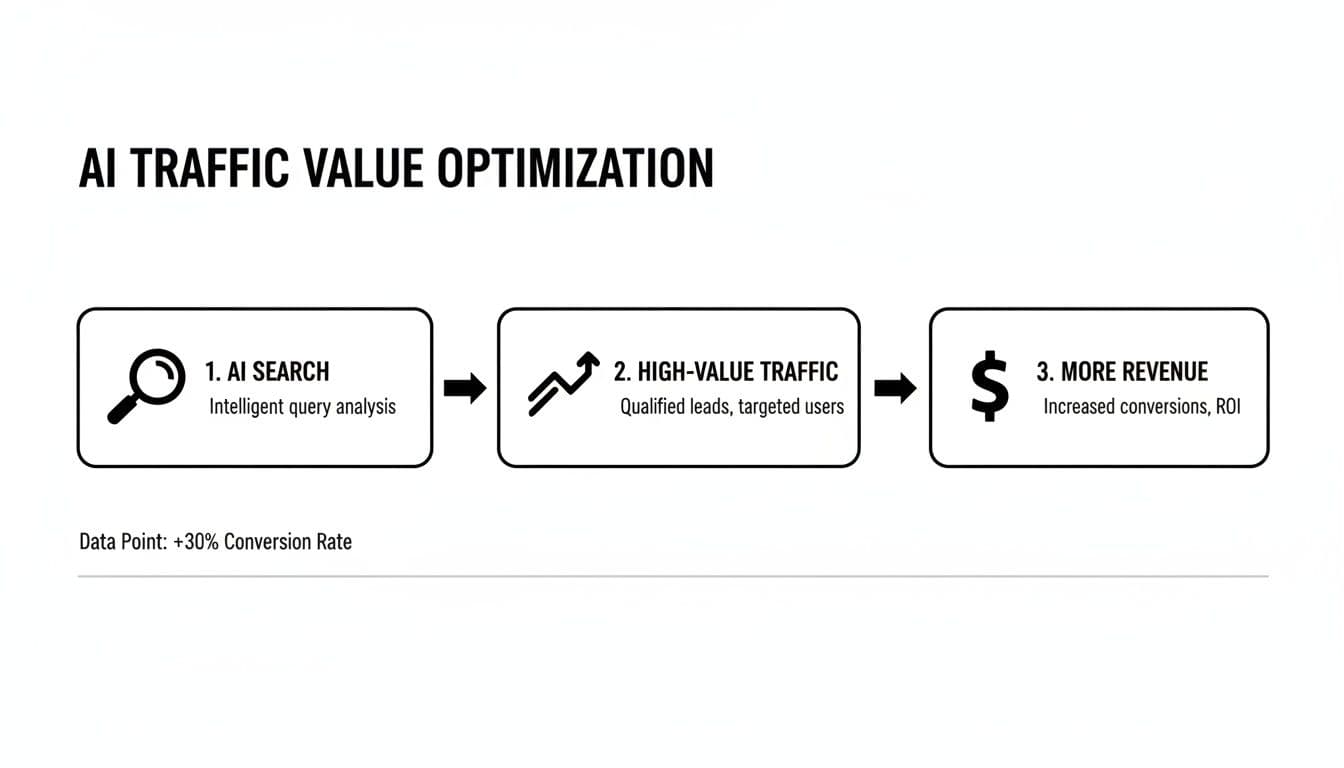
As this shows, keeping a close eye on AI search drives the right kind of traffic to your site, which ultimately leads to more revenue. It’s a direct line from insight to income.
Stage 1: Baseline Your Current AI Visibility
You can't improve what you don't measure. The first step is to get a clear picture of where you stand right now. This means doing a full audit to see how AI platforms currently see and talk about your brand. Think of it as a deep-dive investigation into your digital reputation through the eyes of an algorithm.
Start by brainstorming a list of the most important questions and prompts related to your brand, products, services, and industry. Make sure you cover different types of user intent, from broad informational questions to specific, bottom-of-the-funnel queries.
For instance, a project management software company might test prompts like:
- "What are the best tools for agile team collaboration?"
- "Compare [Your Brand] vs. [Competitor A]"
- "What are the main disadvantages of using [Your Brand]?"
Run these prompts across the big players—ChatGPT, Google AI Overviews, and Perplexity—and document everything. Log every mention, every source cited, and the overall sentiment. This becomes your starting point, your initial visibility report.
Stage 2: Set Up Automated Monitoring Systems
Checking all this manually just won't scale. AI models are updated constantly, and their answers can change from one day to the next. The second stage is all about putting automated systems in place to track your key prompts and signals over time.
This is where a dedicated AI search monitoring platform is no longer a "nice-to-have." These tools can run your list of queries at scale and on a set schedule, alerting you the moment something important changes in how your brand is being portrayed. Automation takes the grunt work off your team’s plate and delivers the consistent data you need for real, long-term analysis.
By automating the data collection process, you transform AI search monitoring from an occasional project into a continuous strategic function. This consistency is the key to moving from a reactive to a proactive stance.
Stage 3: Analyze Insights To Find Gaps And Opportunities
Once you have a steady flow of data coming in, the real work begins: analysis. This is where you connect the raw output from your monitoring to actionable business intelligence. The goal is to spot the threats and, more importantly, the opportunities hidden in those AI-generated answers.
Start digging for patterns by asking some critical questions:
- Who is the "Source of Truth"? Which competitors or publications are these AI models consistently citing as the authority in your field?
- Are There Sentiment Issues? Is negative language popping up in summaries about your brand? Find the source content it's pulling from.
- Where are the Content Gaps? What questions are AI models struggling to answer, or worse, answering by sending users to your competitors?
Finding these gaps gives you a crystal-clear roadmap for your content and digital PR teams. Every gap is an opportunity to create the definitive resource that AI models will prefer to cite next time. This entire analytical process is a central part of a new discipline called Generative Engine Optimisation (GEO). To learn more, check out our in-depth guide on Generative Engine Optimisation.
Stage 4: Execute Targeted Optimization Strategies
The final stage is all about action. Armed with insights from your analysis, you can now launch targeted campaigns to improve your visibility in AI search. This becomes a continuous cycle: create, optimize, measure, and repeat.
If your monitoring shows a competitor owning the conversation on a key topic, your content team can build a more comprehensive, better-structured, and more authoritative resource designed to take its place. If you find negative sentiment, your PR team can work to address the source, whether it's an old review or a misleading article.
This framework ensures that your efforts to win in AI search are always driven by data and directly tied to your business goals.
AI Search Monitoring Implementation Playbook
To bring these stages together, here’s a quick-reference playbook that outlines how to put this framework into practice. This table summarizes the key actions, metrics, and the role of automation in each phase.
This playbook provides a structured, repeatable process. By following it, you can move from simply reacting to AI search to actively shaping your brand's presence within it.
Real-World Examples of AI Search Monitoring in Action
Theory is great, but seeing AI search monitoring work in the real world is what truly makes its impact click. These stories show how actual businesses are turning AI-driven insights into a serious competitive advantage, shifting from a reactive stance to one of proactive control.
Each example walks through a specific business problem, the monitoring strategy used to diagnose it, and the concrete actions that drove a positive result. These scenarios prove that monitoring isn't just a defensive tactic—it's a strategic engine for growth, smarter content, and brand protection.
Use Case 1: Overtaking a Competitor in B2B SaaS
A mid-sized B2B SaaS company selling project management software hit a wall. Their traditional SEO rankings were solid, but lead quality was flatlining. They decided to launch a targeted AI search monitoring campaign, zeroing in on prompts their ideal customers would use, like "best software for managing remote engineering teams" or "agile workflow automation tools."
The data didn't take long to reveal a huge problem. For nearly every high-intent query, AI platforms like ChatGPT and Perplexity were consistently anointing one specific competitor as the go-to solution. Their rival’s content was being treated as the source of truth, effectively locking them out of AI recommendations.
Armed with this critical insight, the company took immediate action.
- Content Gap Analysis: They dissected the competitor's top-cited articles, mapping out their structure, depth, and the specific data points that AI models were clearly favoring.
- Strategic Content Creation: Their team built a comprehensive resource hub designed to blow the competitor's content out of the water. It included expert interviews, fresh data from a user survey, and incredibly detailed implementation guides.
- Digital PR Push: They got this new hub in front of industry publications and influencers, earning high-authority backlinks and mentions.
Within three months, their monitoring showed a complete turnaround. Their new resource hub started showing up as the primary citation for their target prompts, and their brand was now frequently recommended. The bottom-line result? A 25% increase in qualified demo requests directly attributed to AI-referred traffic.
Use Case 2: Correcting a Damaging Brand Misrepresentation
A professional services firm in the supply chain logistics space got some jarring feedback from a potential client. The prospect mentioned that AI-generated summaries were describing the firm's services as being "primarily for small businesses"—a total misrepresentation of their enterprise-level focus.
The firm immediately set up an AI search monitoring system to track prompts related to their core services and brand name. The data confirmed their worst fears. AI summaries were pulling information from a handful of outdated press releases and a poorly worded directory listing from years ago, creating a false narrative that was costing them business.
An inaccurate AI summary isn't just a minor error; it's a persistent, automated salesperson telling your ideal customers the wrong story about your business. Proactive monitoring is the only way to catch and correct it.
Their response was swift and precise. The firm launched a "narrative correction" campaign, updating old online profiles, issuing a new press release to clarify their enterprise focus, and working with industry blogs to publish articles that showcased their work with large corporations. By fixing the source material, they directly influenced the information AI models used for synthesis and successfully protected their market position.
Use Case 3: Building an Authoritative Resource Hub
A tech hardware company that sells specialized components kept seeing the same highly specific technical questions pop up on forums and social media, but no one was answering them well. They used AI search monitoring to track these emerging customer questions at scale, quickly identifying recurring themes around product integration and troubleshooting.
Instead of answering these questions one by one, they saw a much bigger opportunity. They built a comprehensive, public-facing knowledge base designed to be the ultimate resource for these exact issues. This proactive strategy not only addressed customer pain points but also created content perfectly structured for AI models to consume. Of course, proper execution is key to building this authority, and you can learn more about how to do this in our guide on how to increase ChatGPT visibility.
The outcome was a huge win. AI models began citing their knowledge base as the top source for technical queries in their niche. This move simultaneously reduced the burden on their support team and established their brand as the undisputed technical authority, driving high-value traffic and building incredible customer trust.
Keeping Your Brand Relevant in the Age of AI
Dealing with AI search isn't a one-and-done project. It's a new, ongoing discipline that's absolutely critical for your brand's long-term health. The algorithms and the answers they generate are constantly changing. To stay ahead, you need to build a culture of 'AI readiness'—getting your teams comfortable with being agile, responsive, and guided by data as this technology evolves.
This means you have to stop just reacting to problems as they pop up. Instead, AI search monitoring needs to become a fundamental part of your marketing and content strategy. Think of it as creating a continuous feedback loop. The insights you gather from AI platforms should directly shape your next move, making sure your brand’s story stays accurate, visible, and persuasive.
Get Comfortable with Constant Change
The shift to AI-powered discovery is happening much faster than a lot of people think. Consumer habits are already changing, and AI search is quickly becoming a go-to method for finding information. We're seeing major shifts between generations, too. More than 50% of consumers are now using AI tools on purpose, and this is especially true for younger people. In fact, new data shows that nearly 35% of Gen Z in the U.S. already use AI chatbots to find information, which signals a huge change in how new audiences learn about the world. You can dig deeper into the rapid growth of the AI search market on visalytica.com.
These aren't just abstract numbers; they point to a permanent evolution in user behavior. It's projected that 90 million Americans will be using AI for search soon, and an incredible 66% of consumers believe AI will completely replace traditional search engines within the next five years. Simply waiting to see what happens is no longer a viable strategy.
The most important thing to remember is that today's AI answer is temporary. Your brand's position isn't static—it's a living metric that you have to actively cultivate through constant monitoring, sharp analysis, and smart, strategic action.
Your Blueprint for Long-Term Success
To keep your edge, your strategy has to move beyond just creating content. You now have to actively manage how that content gets interpreted and presented by AI systems. This guide has laid out a framework to help you do exactly that.
Here’s a quick rundown of the essential actions you need to take:
- Monitor the Core Platforms: Keep a close eye on your brand’s presence in ChatGPT, Google AI Overviews, Perplexity, and other major answer engines.
- Track the New Signals: Start focusing on the metrics that actually matter in this new era, like how often you're cited, the sentiment of AI summaries about you, and whether you're seen as the source of truth.
- Tie It All to Business Goals: Make a direct connection between your AI visibility efforts and real business results—things like high-quality traffic, better leads, and ultimately, revenue.
- Build a Proactive Framework: Put a continuous cycle in place. You need to baseline your current visibility, automate the monitoring, analyze what you find, and then execute targeted optimizations based on those insights.
When you commit to this discipline, you're setting your brand up to do more than just survive; you're positioning it to thrive. You'll gain the power to shape your own narrative, see market shifts coming, and build a truly resilient digital presence that holds up in this new AI-powered world.
Ready to take control of your brand's story in the age of AI? Attensira gives you the tools to monitor, analyze, and improve your visibility across every major AI platform. It’s time to stop guessing and start building a strategy driven by real data.