Discover how a modern search visibility tracker delivers real-time, actionable insights to outpace competitors in an AI-driven market.
If you're a B2B marketer, that SEO playbook you've spent the last decade perfecting is on the fast track to becoming a relic. The way your customers find answers is changing right under our feet, thanks to AI search, and the traditional rank tracking tools you've relied on just can't keep up. This is where a modern search visibility tracker comes in—it's now the only way to measure what really matters: your brand's presence inside AI-generated responses.
Why Your Old SEO Playbook Is Failing
Let's just be direct—the rules of search have changed, fundamentally. For years, the game was straightforward: land your webpage on the first page of Google. We measured success in keyword positions, organic traffic, and backlinks. But that model is quickly becoming irrelevant in a world where AI is the new discovery engine.
The rise of tools like ChatGPT, Perplexity, and Google's AI Overviews has forged a completely new customer journey. Instead of sifting through a list of blue links, users now get direct, synthesized answers to their questions. If your brand isn't cited or even mentioned within these AI responses, you are, for all practical purposes, invisible to a huge and growing chunk of your audience.
Sticking to old SEO tactics now is like meticulously tracking the foot traffic to your single brick-and-mortar store while a massive, AI-powered shopping mall opens up right next door. You're measuring activity in a place where fewer and fewer customers are even bothering to shop.
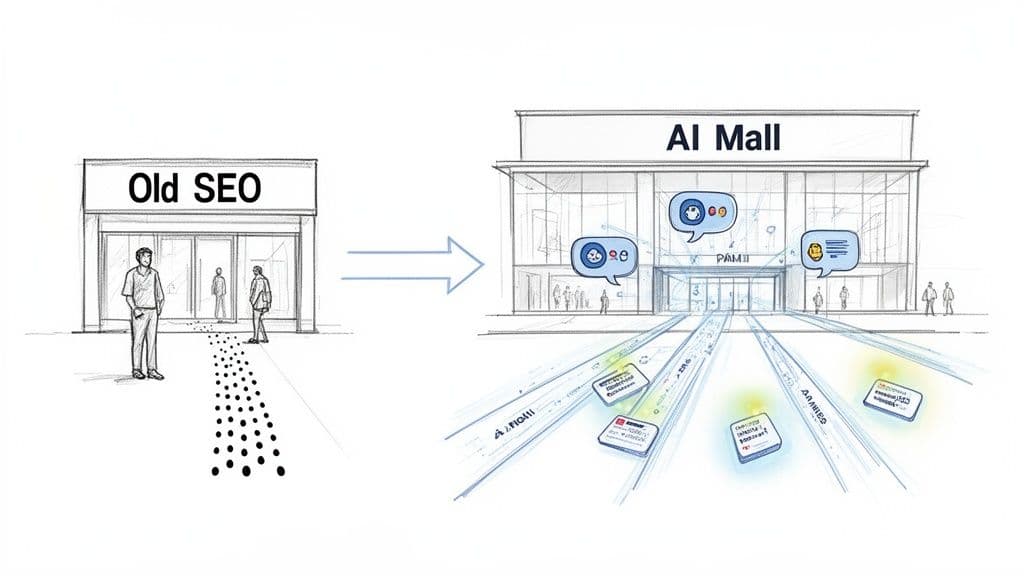
The Inadequacy of Traditional Metrics
Think about it: traditional rank trackers were built for a different internet. They do one thing well—tell you where your URL sits on a static search results page. But they offer absolutely zero insight into your brand's actual influence inside an AI-driven conversation. This creates a massive, dangerous blind spot for any serious enterprise.
Here’s a quick rundown of why the old metrics just don't cut it anymore:
- They Miss AI Mentions: A standard rank tracker has no idea if ChatGPT just recommended your competitor's software over yours in response to a high-intent query from a potential buyer.
- They Ignore Context: Ranking #1 for a keyword feels great, but it's a hollow victory if an AI Overview summarizes a competitor's article right above your link, effectively pushing you out of sight.
- They Lack Competitive Intelligence: You're completely in the dark about how often your competitors are being cited as authoritative sources by AI. This isn't just a vanity metric; it's a leading indicator of who is winning mindshare and market leadership.
The Rise of the Search Visibility Tracker
This is exactly the gap a search visibility tracker is designed to fill. It moves past simple rankings to give you a complete, 360-degree view of your brand’s presence across the platforms that matter now. This new breed of tool is built to answer the critical business questions that traditional SEO software can't even begin to ask.
A search visibility tracker isn't just an evolution of rank tracking; it's a necessary adaptation to a new search reality. It provides the crucial oversight B2B enterprises need to compete when the battlefield has shifted from a list of links to the content of an AI-generated answer.
Failing to make this shift is one of the most significant yet common SEO mistakes a brand can make today. It's essentially choosing to become irrelevant. The goal isn't just to be found anymore. The new goal is to be part of the answer. Without clear visibility into these new AI channels, you’re flying blind, unable to measure your impact, adapt your strategy, or win in this new era of search.
Understanding the Modern Search Visibility Tracker
So, what exactly is a search visibility tracker in this new era? Forget the old definitions. Think of it less as a tool and more as a brand’s command center—a radar system built specifically for the complex world of AI-driven search.
The whole game has changed. We've moved from simply "ranking" to truly "appearing." It’s no longer about fighting for the top spot on a static list of blue links. The real prize is ensuring your brand is present, accurately represented, and even recommended within the direct, conversational answers that AI engines generate.
A modern search visibility tracker is engineered to see what traditional rank trackers miss entirely. It’s designed to answer the crucial questions: how, when, and where is our brand being talked about across this massive new ecosystem of information?
From Keywords to Brand Presence
The old playbook was all about keywords. You picked a term, built some content around it, and watched your position on a results page. That's yesterday's news. Today, the model is brand-centric. The goal is to embed your brand into the foundational knowledge that AI models draw from to construct their answers.
This means a search visibility tracker has to look far beyond your website’s URL. It’s actively scanning for things like:
- Brand Mentions: Any direct reference to your company name, products, or services that shows up in AI-generated text.
- Content Citations: Instances where AI models point to your articles, research, or case studies as the source of their information.
- Sentiment Analysis: The overall tone—positive, negative, or neutral—that surrounds mentions of your brand.
It's simple, really. If an AI doesn't "know" you as an authority on a subject, it can’t recommend you when a potential customer asks for a solution. Visibility now means being part of the AI's institutional knowledge.
Monitoring Across the New Search Landscape
A true search visibility tracker doesn't just watch one channel. Its real value comes from giving you a unified, 360-degree view of your brand’s presence across all the platforms where your audience is now looking for answers.
This means keeping a close eye on a diverse set of channels:
- Traditional Search: The classic SERPs, of course, but also new features like Google's AI Overviews.
- AI Chatbots: The major players like ChatGPT, Gemini, and Claude, where people are having detailed, back-and-forth conversations.
- Generative AI Results: Specialized AI search engines like Perplexity that deliver synthesized answers with direct citations.
This holistic approach is non-negotiable because user behavior is splintering. A huge part of navigating this shift is understanding What Is Intent Data and How Does It Work?. When you know what users are actually trying to accomplish, you can better align your content with the kinds of questions they’re posing to AI.
A search visibility tracker is your brand's eye in the new digital world, seeing not just where you rank, but how you are represented in the conversations AI is having with your customers.
The Urgency of Tracking AI Visibility
The need to monitor this isn't some far-off, "we'll get to it later" problem. It’s happening right now. A massive industry shift is already in motion.
Forecasts show that by 2028, traffic from AI search will actually overtake traditional organic search, with ChatGPT referrals expected to lead the pack. That's a serious wake-up call for B2B enterprises. The data shows that users already spend significantly more time on AI platforms—an average of 13 minutes and 9 seconds per session on ChatGPT versus just 6 minutes and 12 seconds on Google—which leads to much deeper engagement.
Ignoring your brand’s presence in AI is no longer a viable option. Our own guide on AI search monitoring dives deeper into how to build a strategy for this new reality. Without a dedicated search visibility tracker, you're essentially flying blind, completely unable to measure or influence how your brand is being perceived by a huge and growing part of your market.
The Key Metrics That Actually Drive Growth
If you're still obsessing over keyword rankings, you're playing yesterday's game. In a world where your customers get answers directly from AI, simply ranking #1 for a search term has lost its meaning. To compete, B2B enterprises need to let go of these vanity metrics and embrace what really matters. A modern search visibility tracker shifts the focus to a new breed of metrics that measure your actual influence and presence inside AI-generated responses.
This isn't just a minor tweak to your reporting; it's a fundamental change in how we define success. We're moving away from tracking where a URL lands on a page and toward analyzing how deeply our brand is embedded in an AI's knowledge base. Getting a handle on these new metrics is the first step to building a strategy that wins in this new era of search.
The image below breaks down the three pillars of modern search visibility: being present, being discussed, and being perceived in the right way.
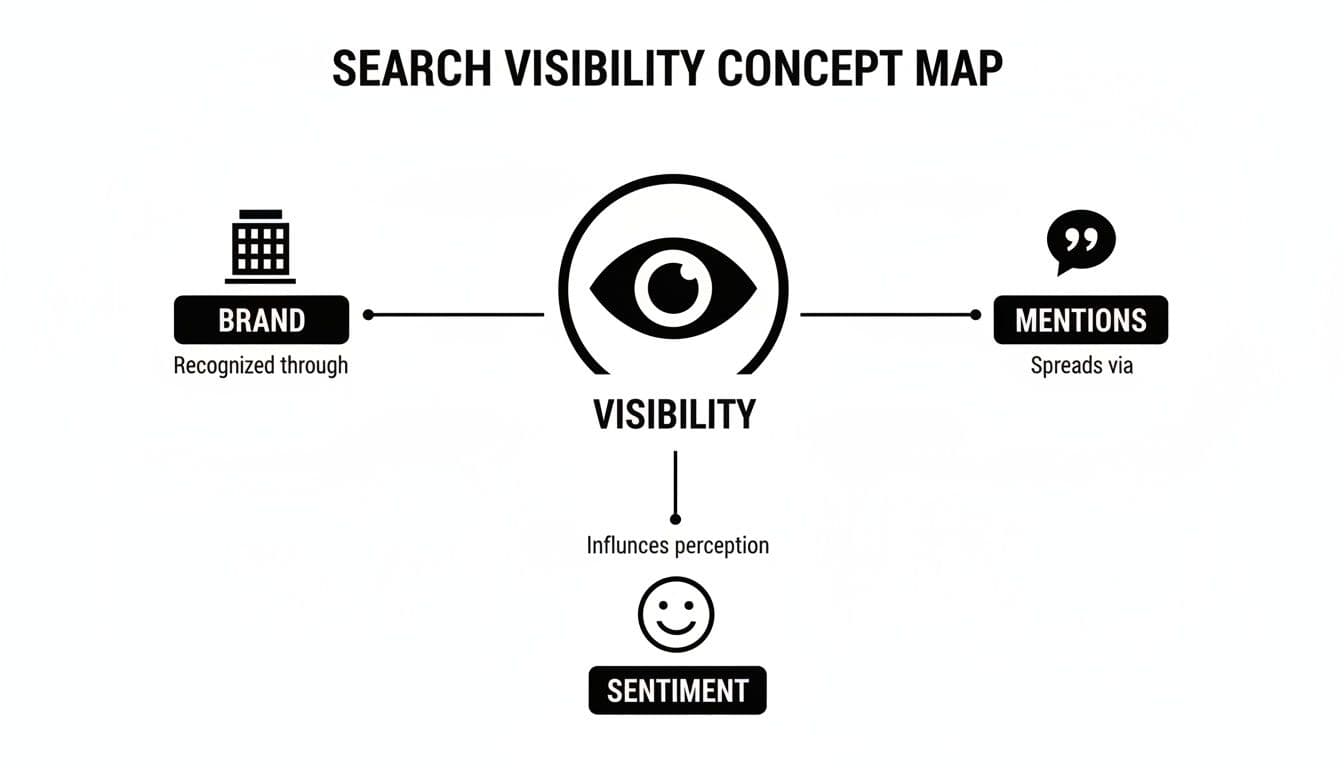
True visibility is a mix of all three. You have to show up (Brand), be part of the conversation (Mentions), and have that conversation be a positive one (Sentiment). A search visibility tracker is built to measure exactly that.
AI Share of Voice and Mention Frequency
The single most important metric today is your Share of Voice (SoV) in AI Responses. This has nothing to do with how often your website shows up in a list of blue links. Instead, it measures how often AI platforms mention, cite, or recommend your brand compared to your competitors when a user asks an important question in your field.
For a B2B company, this is everything. Imagine a prospect asks an AI, "What are the top 5 CRM platforms for manufacturing companies?" If your brand isn't in that list, you've just lost a high-intent lead without ever knowing they were looking.
Right alongside SoV is Mention Frequency and Context. A good search visibility tracker doesn't just count if you were mentioned; it analyzes how. Was your product recommended as the go-to solution? Was your latest research cited as the definitive source on a topic? This context is gold because it tells you exactly how to refine your content strategy.
Citation Quality and AI Content Gap Analysis
From there, we look at Citation Quality. Let's be honest, not all mentions are created equal. A passing reference in a long list is one thing, but being cited as the primary source in a high-level strategic answer is what positions your brand as a true thought leader. A visibility tracker helps you separate the low-impact mentions from the high-authority citations that build real credibility.
This data flows directly into AI Content Gap Analysis. By seeing which topics your competitors are consistently cited for while you're nowhere to be found, the tracker pinpoints your exact content gaps. It hands you a roadmap, showing you which articles, whitepapers, or case studies to create to fill those knowledge voids and inject your brand into the AI-driven conversation. To dig deeper into this, you can learn more by reviewing key content performance metrics.
The goal is to move from reactive SEO to proactive visibility management. Instead of just tracking what happened, you're using data to influence what AI platforms will say about you next.
The need to adopt these metrics isn't some far-off future concern—it's happening right now. Recent data from Semrush shows that AI search traffic has exploded by an astonishing 527% in just one year. With some sites already seeing over 1% of total sessions coming from platforms like ChatGPT and Perplexity, brand and product managers can't afford to fly blind. This is precisely why a tool like Attensira is becoming essential for monitoring AI mentions and staying ahead of the curve.
To truly grasp the change, it helps to see the old and new approaches side-by-side.
Modern vs. Traditional SEO Metrics
The table below starkly contrasts the old world of rank tracking with the new reality of search visibility. It's a shift from chasing positions to earning influence.
This comparison makes it clear: the definition of "winning" in search has fundamentally changed. While traditional metrics offered a narrow snapshot, modern visibility metrics provide a holistic view of your brand's authority and influence where it now matters most.
Putting Your Search Visibility Strategy Into Action
Knowing you need a modern search visibility tracker is one thing. Actually using one to get real business results is something else entirely. The good news is that moving from theory to practice is pretty straightforward, especially with tools designed for marketing and content teams, not developers. It's all about building a system to monitor, analyze, and act on what you find.
The setup itself isn't a huge technical lift. You don't need to write code or loop in engineering. Modern platforms are built to be intuitive, letting you get started fast so you can focus on the strategy, not the configuration.
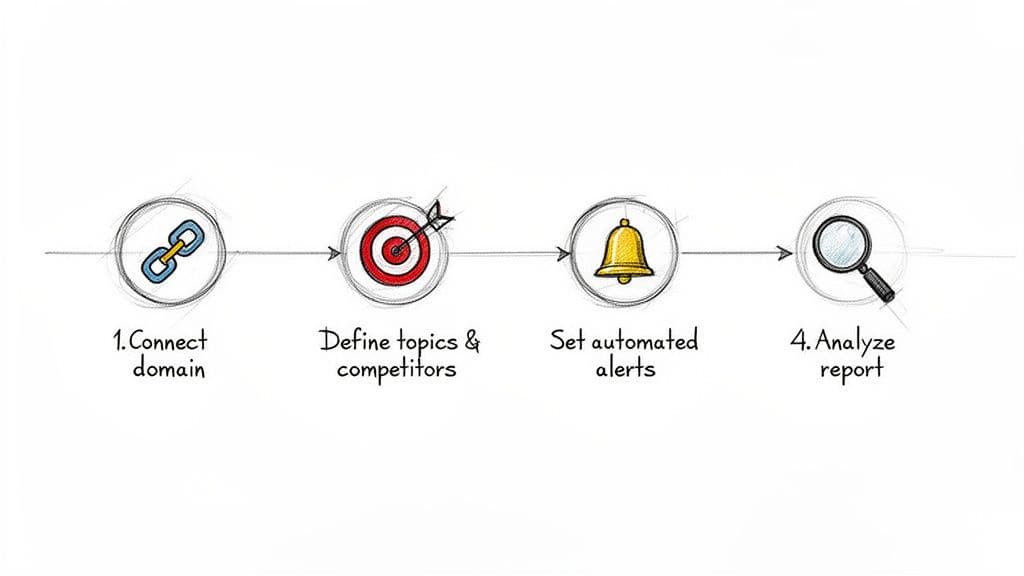
The Implementation Workflow
Getting up and running follows a few logical steps. Each one builds on the last, creating a powerful feedback loop that turns raw data into a clear strategic roadmap for your marketing team.
- Connect Your Domain and Key Content: First things first, you need to tell the tool what to track. You start by connecting your main domain. From there, you can often pinpoint specific high-value assets—like cornerstone blog posts or critical product pages—that you want to watch like a hawk.
- Define Your Core Topics and Competitors: Next, you map out the competitive battlefield. This means identifying the core themes you want to dominate and listing the key players you're up against. A good search visibility tracker will even suggest competitors based on your content, which can save you a ton of research time.
- Set Up Automated Monitoring and Alerts: Once your brand and competitors are locked in, you flip the switch on automated tracking. The platform will start its continuous watch of AI platforms, looking for mentions, citations, and the sentiment around your topics. You can also set up alerts to get a heads-up on big changes, like a new competitor suddenly popping up in important AI answers.
- Analyze Your Initial Visibility Report: After a short period of gathering data, you’ll get your first full visibility report. This is your baseline. It's a critical snapshot that shows you where you stand right now and helps you spot the low-hanging fruit—areas where you can make quick gains. For a deeper dive on this, check out our guide on monitoring SEO performance.
A Real-World B2B SaaS Use Case
Let's make this concrete with an example. Imagine a B2B SaaS company that sells project management software. They started using a search visibility tracker to see how they showed up in AI-generated answers. On paper, their traditional SEO looked great; they had solid rankings for several important keywords.
But their first visibility report uncovered a massive blind spot.
When people asked AI chatbots things like, "What are the best project management tools for remote teams?", their brand was nowhere to be found. Instead, three of their biggest competitors were being recommended over and over again.
This insight was a game-changer. The company realized that simply ranking on Google was no longer enough; they were completely invisible in the high-intent conversations happening on AI platforms.
Armed with this data, the content team sprang into action. They developed a series of in-depth articles, comparison guides, and how-to posts specifically about project management for distributed teams. They focused on creating clear, well-structured content that AI models could easily digest and cite.
The needle started to move within weeks. The search visibility tracker showed their brand finally breaking into those crucial "best of" lists. At first, it was just a small mention. Soon, they were a consistent recommendation, with citations pointing directly to their new content. They had successfully used visibility insights to change the AI's perception of their authority, capturing leads that were previously going straight to their competitors.
How to Choose the Right Search Visibility Tracker
Picking a search visibility tracker is a make-or-break decision for your SEO strategy. Not all platforms are created equal. Choose the wrong one, and you’ll drown in a sea of data with no clear direction. For B2B leaders, this isn't just about monitoring—it's about securing a strategic edge.
You need to look past the flashy dashboards and focus on the core capabilities that actually move the needle. Let's break down what really matters when you're evaluating your options.
Breadth of AI Platform Monitoring
First things first: where is the tool actually looking? The AI search world isn't a monolith. While Google still owns a massive 90% of the traditional search market, a whole new ecosystem of AI-native platforms is where your B2B buyers are starting their research.
Your tracker has to see the whole picture, not just a sliver of it. In 2026, your customers are getting answers from all over the place.
- Essential AI Chatbots: You absolutely need coverage for the heavy hitters like ChatGPT, Gemini, and Claude, where your audience asks complex, long-form questions.
- AI Search Engines: Platforms like Perplexity are non-negotiable. They directly cite sources, which means they can either build or break your brand's authority overnight.
- AI Overviews: And yes, you still need to watch traditional search. The tool must track your presence in Google's and Bing's AI-powered answer boxes.
This kind of comprehensive coverage isn't a "nice-to-have." The numbers tell the story: ChatGPT alone handles around 2 billion queries every day and holds 60.6% of the AI segment. More importantly, AI platforms drove over 1.13 billion referral visits in June 2025 alone—a staggering 357% jump from the previous year. You need to be where these conversations are happening.
Quality of Actionable Insights
Data is useless if you don't know what to do with it. A great search visibility tracker doesn't just show you metrics; it connects the dots and gives you a clear "what next."
Look for a tool that turns raw numbers into a strategic roadmap. For instance, it’s one thing to be told you have a content gap. It's another thing entirely for the tool to help you fill it.
The best search visibility tracker doesn't just give you data; it gives you a clear path to action.
This is where a platform like Attensira really shines. It doesn't just identify gaps; it generates AI-optimized content drafts to fill them. This single feature closes the loop between analysis and execution, giving your content team the exact blueprint they need to win more visibility.
Ease of Use for Non-Technical Teams
Let's be realistic. Your CMO, brand managers, and content strategists are the ones who will be living in this tool every day. If it’s so complex that it requires a data science degree to operate, it will end up as expensive shelfware.
The right platform presents complex data in a way that's intuitive for the entire marketing team.
Look for a few key things:
- A clean, straightforward dashboard.
- Clear charts and graphs that make trends obvious.
- Automated, shareable reports that don't need manual translation.
The goal is to empower your whole team, not create a bottleneck. A user-friendly interface is the difference between a tool that gets adopted and one that gets ignored. You can explore our guide on the best AI SEO software to see how leading platforms make this a priority.
Tailored B2B Features and Integrations
Finally, a B2B enterprise plays by a different set of rules. Consumer-focused tools just won't cut it. Your tracker needs to be built from the ground up with a B2B mindset.
Deep competitor analysis is a perfect example. You have to see more than just your own performance; you need to benchmark yourself against key rivals on the topics that define your industry. This is how you spot their blind spots and find opportunities to capture a greater share of voice.
For today’s marketers, leveraging advanced AI Search Visibility Tools is no longer optional—it's essential for building a winning strategy. The right platform gives you the intelligence to outmaneuver your competition right where it counts: inside the AI-generated answers that your future customers are learning to trust.
Why Visibility Is the Future of Search
The way people find information has changed for good. For years, the SEO playbook was all about a predictable set of rules tied to the classic search engine results page. That playbook is now officially out of date. Relying on traditional rank tracking today is like trying to navigate a new city with a ten-year-old map—the roads have moved, and the places you need to be are nowhere in sight.
The fundamental truth is this: your brand's relevance is now being decided inside AI-powered conversations. Every time a potential customer asks an AI for a recommendation, a solution, or just a simple explanation, a new digital front line is drawn. If your brand doesn't appear in those answers, it simply doesn't matter where you rank on a list of blue links. You're invisible.
A New Competitive Advantage
Getting a handle on this shift isn't just about playing defense to avoid being left behind. Actively managing your presence in AI-driven search with a search visibility tracker is a powerful offensive move. It gives you a crystal-clear view of the entire landscape, showing you exactly where competitors are capturing attention and revealing opportunities to weave your brand into the most important conversations.
This forward-thinking mindset shifts marketing from a reactive game of chasing rankings to a proactive strategy of shaping how your audience perceives you. The companies that will win are the ones that start measuring what actually matters now:
- Influence inside AI answers, not just a position on a SERP.
- Authority as a trusted, cited source, not just a raw traffic number.
- Presence everywhere your customers are actually looking for information.
Owning Your Narrative
Ultimately, the future of search boils down to comprehensive visibility. The question is no longer "Where do we rank?" but "How are we being represented?" Every single mention, citation, and recommendation within an AI response is another chapter in your brand's story.
This is the defining challenge for marketers today: you can either let the AI define your brand for you, or you can take control and actively shape the narrative. A dedicated platform is the tool that makes this possible.
The time to act is now. Start by assessing your brand's current visibility across the AI platforms your customers are already turning to. Look into how a dedicated search visibility tracker like Attensira can deliver the insights you need to not just compete in this new era of search, but to lead it. Don’t just be part of the search results; become part of the answer.
A Few Common Questions
As we all adjust to AI's growing role in search, a few key questions always seem to come up. Let's break down some of the most common ones to get a clearer picture of how a modern search visibility tracker fits into this new world.
What's the Real Difference Between a Search Visibility Tracker and a Rank Tracker?
It’s easy to get these two confused, but they operate in completely different worlds. Think of it this way: a traditional rank tracker is like having a stopwatch. It’s built for a single purpose—to time one thing: where your URL sits on a classic, ten-blue-links search results page for a specific keyword. It’s a one-dimensional measurement for a world that’s quickly fading.
A search visibility tracker, however, is more like a full diagnostic dashboard for a complex engine. It sees the multi-dimensional reality of today's search. Instead of just a ranking number, it measures your brand's actual footprint inside those dynamic, AI-generated answers. We’re talking about share of voice within an AI response, how often your brand gets mentioned, and why it’s being mentioned. A rank tracker is completely blind to all of this. It’s the difference between counting cars on one street versus getting a satellite view of traffic patterns across the entire city.
How Does This Actually Improve My Marketing ROI?
This is where the rubber meets the road. A search visibility tracker connects directly to your bottom line by showing you exactly where your brand is—and isn't—surfacing in the high-intent conversations people are having with AI.
Instead of your content team throwing darts in the dark, they suddenly have a roadmap. They can see the precise questions your audience is asking and create content that answers them directly. This isn't just about traffic; it’s about capturing the right users at the exact moment they’re looking for a solution.
It all boils down to better leads and higher conversion rates. You're not just getting clicks. You're attracting people who have already seen an AI recommend your brand as the answer. That's a powerful endorsement that strengthens your entire marketing funnel and delivers a much stronger return on investment.
Is This Going to Be Complicated to Set Up and Use?
Not at all. If you're imagining a tool that requires a team of data scientists to get running, you can breathe easy. The days of clunky, code-heavy analytics platforms are over. Modern tools are designed to be completely no-code.
Getting started is usually as simple as plugging in your domain, listing your competitors, and letting it run. The real magic is in the dashboard, which is built to turn mountains of data into simple, clear insights. This means everyone from the deep-in-the-weeds SEO specialist to the CMO can log in, understand what they're seeing, and make smarter decisions without needing a technical degree.
Ready to see how your brand really shows up in AI search? Attensira gives you the insights needed to monitor your AI visibility, see what competitors are up to, and take control of your narrative. Start tracking your brand's AI presence today.