Discover what is enterprise seo and how it scales for large sites with governance, teams, and proven optimization strategies.
Enterprise SEO is a whole different ballgame. It’s a strategic discipline built for the unique challenges of massive, complex websites, zeroing in on scale, automation, and deep integration with business goals. This isn't about just tweaking a few pages; it's about managing millions of them and tying organic search performance directly to the company's bottom line.
Defining Enterprise SEO Beyond The Buzzwords
Imagine the difference between running a local corner boutique and managing the global logistics for a retail empire like Walmart. The boutique owner can handle inventory by hand, but the empire needs a sophisticated, automated system to even function. That’s the perfect analogy for enterprise SEO. It’s not just "SEO for big companies"—it’s a fundamentally different strategic approach.
A small business might be laser-focused on getting a handful of service pages to rank locally. An enterprise, on the other hand, is wrestling with millions of URLs, countless subdomains, and audiences spread across the globe. At that scale, manual optimization isn't just inefficient; it's completely impossible. The complexity is on another level, and standard SEO tactics just don't cut it.
The Core Pillars of Enterprise SEO
When you strip it all down, enterprise-level SEO stands on three core pillars that set it apart from traditional search marketing:
- Massive Scale: The entire strategy has to be designed to govern huge websites—we're talking hundreds of thousands, or even millions, of pages across different countries and languages.
- Systematic Automation: Success hinges on powerful tools and automated workflows. From technical audits and keyword tracking to content deployment, automation is key to reducing manual work and minimizing human error.
- Strategic Alignment: SEO isn't a siloed marketing function. It’s woven directly into C-suite objectives, making a direct, measurable impact on revenue, market share, and overall brand authority.
This strategic focus explains why large enterprises command a massive 56% market share of the global SEO software sector, an industry that pulls in around USD 44.7 billion in revenue. Their sprawling digital footprints demand serious firepower to manage all that complexity.
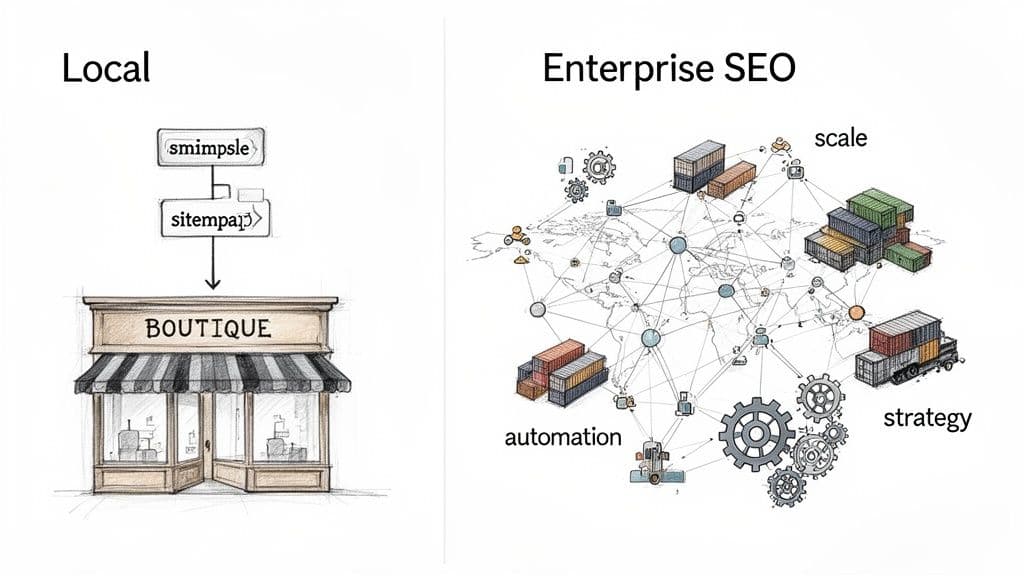
To really drive home the difference, let's look at a side-by-side comparison.
Traditional SEO vs Enterprise SEO At a Glance
This table makes it clear: we're talking about two fundamentally different disciplines operating on completely different planes.
From Tactics to Systems
Ultimately, the objective shifts from running individual campaigns to building a predictable, resilient system for organic growth. This means wrangling content created by dozens of teams on multiple platforms, a challenge that absolutely requires strong governance. You can dig deeper into this in our guide on effective enterprise content management solutions.
Enterprise SEO transforms search optimization from a series of disconnected marketing campaigns into a core, governed business discipline. It’s about building a scalable engine that consistently drives measurable value and builds long-term brand authority.
As we define what enterprise SEO really is, it's also helpful to understand the fundamental role of SEO in ecommerce, since that’s where many of these large-scale operations live. Grasping that foundation makes it obvious why a specialized, enterprise-grade approach isn't just a "nice-to-have"—it's a must-have for any corporation serious about market leadership.
The Three Pillars of an Enterprise SEO Strategy
A winning enterprise SEO program isn't a happy accident. It’s built on a foundation of three core pillars, each one supporting the others to drive scalable, long-term organic growth. Think of them less as separate to-do lists and more as the essential supports holding up the entire structure.
These pillars are technical scalability, content architecture, and organizational integration. Anyone leading an enterprise SEO effort needs to master how they work together to build a framework that can truly last. Let's dig into what each one really means.
Technical Scalability
When you’re juggling millions of URLs, technical SEO stops being about spot-checking for quick fixes. It becomes a game of architectural integrity. A small error doesn't just impact a single page; it can ripple across the entire site and create a massive headache overnight.
Technical scalability is all about making sure your website's infrastructure can handle extreme complexity without buckling under the pressure. This goes way beyond just fixing broken links or nudging up site speed scores.
- Crawl Budget Optimization: With millions of pages, you have to accept that search engine crawlers won't visit every single one. Your job is to act as a traffic cop, directing them toward your most important pages and away from the noise, like faceted navigation or temporary session IDs. This stops you from bloating the index with junk and ensures your best content actually gets found.
- Complex Internationalization: Managing sites for different countries and languages is a minefield. You have to nail the implementation of
hreflangtags and make smart decisions about using ccTLDs versus subdirectories. One wrong move can result in search engines showing your German site to users in France, which tanks both the user experience and your rankings. - Systemic Issue Management: Imagine a single coding error in a page template. In an enterprise environment, that one mistake can instantly create duplicate content or break structured data across thousands of pages. Technical scalability is about having systems in place to catch and fix these widespread issues before they do real damage.
Content Architecture
At the enterprise level, content isn't just a bunch of articles. It's a massive, interconnected library of assets. The pillar of content architecture is all about designing and governing that library to ensure every piece works together for maximum impact.
This is where you shift from just creating content to engineering a content ecosystem. It means building programmatic systems that enforce quality and relevance for every single asset, no matter who writes it or where it's published.
At the enterprise level, your goal is to build a content machine, not just a series of one-off campaigns. The architecture must support governance, topical authority, and brand consistency across hundreds of thousands of pages.
This strategic approach involves:
- Scalable Topic Clusters: To build deep authority on a subject, you need to structure your content in hub-and-spoke models—but at a colossal scale. This is how you prove your expertise to search engines and organize your content in a way that makes sense to users.
- Global Content Governance: How do you keep the brand voice consistent when you have teams in different countries creating content in multiple languages? A solid content architecture establishes clear workflows, style guides, and approval processes to keep everyone on the same page.
Organizational Integration
The final, and often toughest, pillar is getting everyone in the organization on board. You can have the most brilliant technical setup and a world-class content plan, but if your teams are working in silos, you're going to fail. Enterprise SEO has to be woven into the very fabric of the business.
This means knocking down the walls that traditionally separate Marketing, IT, Product, and even Legal. SEO can't be the pet project of a small, isolated team anymore. It requires a fundamental culture shift where SEO principles are part of the conversation across departments. For example, the product team needs to think about SEO when designing new site features, and IT has to understand how server choices affect crawlability.
A huge part of this integration is helping other teams understand the value of external validation, especially through backlinks. When you can educate them on why authoritative mentions from other sites are so powerful, it becomes much easier to prioritize work that helps earn them. For a deeper look, our guide on how to build backlinks to your website provides effective strategies that can be adapted across teams.
When these three pillars—technical scalability, content architecture, and organizational integration—are strong and aligned, they create a powerful, self-sustaining system that drives serious, durable organic growth.
Navigating The Unique Challenges of Enterprise SEO
Scaling up your SEO efforts in a large organization isn’t just about doing more of the same. It's an entirely different ballgame, filled with obstacles that smaller businesses simply don’t run into. The real shift is moving from one-off tactics to building a sustainable, system-wide program, and that path is loaded with technical, organizational, and strategic hurdles.
The first, and often most frustrating, challenge is the sheer weight of internal bureaucracy. In an enterprise, a simple change like tweaking a page title can get bogged down in a complex approval chain. Legal, brand compliance, IT, and marketing leadership all need to sign off. This molasses-like pace can turn what should be an agile response into a month-long project, killing your ability to react to market shifts.
The Weight of Legacy Systems and Technical Debt
Another massive roadblock is technical debt. Big companies often operate on a Frankenstein's monster of aging tech stacks, cobbled together over decades or through various acquisitions. These legacy systems are frequently rigid and unforgiving, making it a nightmare to implement essential SEO improvements like schema markup, page speed enhancements, or foundational site architecture changes.
What takes a few clicks for a small business—like installing a plugin—can morph into a major development project at the enterprise level, demanding huge resources and navigating endless red tape. This technical inertia often forces SEO teams to create workarounds instead of implementing best practices directly.
To get ahead of this, you have to conduct regular, deep-dive technical analyses. Our guide on how to do a website audit gives you a solid framework for spotting these deep-seated technical problems before they become full-blown crises.
High-Stakes Migrations and Brand Consistency
The stakes are also exponentially higher. A botched website migration isn't just a headache; it can be catastrophic, potentially erasing years of built-up SEO equity and costing millions in lost revenue. With so many pages and complex dependencies, the margin for error is razor-thin.
Keeping brand and messaging consistent is another uphill battle. When you have hundreds, or even thousands, of content creators spread across different teams, business units, and countries, maintaining a unified voice is a monumental effort. All it takes is one piece of off-brand content lurking on an old subdomain to damage the entire company’s reputation.
The complexity of enterprise SEO isn't just about the number of pages. It’s about navigating the intricate web of people, processes, and platforms that govern them. Overcoming these hurdles requires as much political savvy as it does technical expertise.
This complexity is exactly why companies are seeking specialized help. The market for enterprise SEO consulting is expected to more than double, exploding from USD 1.5 billion to USD 3.5 billion. This incredible growth is fueled by organizations trying to get a handle on these very challenges across millions of URLs. You can dig into the numbers in the full market report.
The image below breaks down the core pillars you need to get right to tackle these issues head-on.
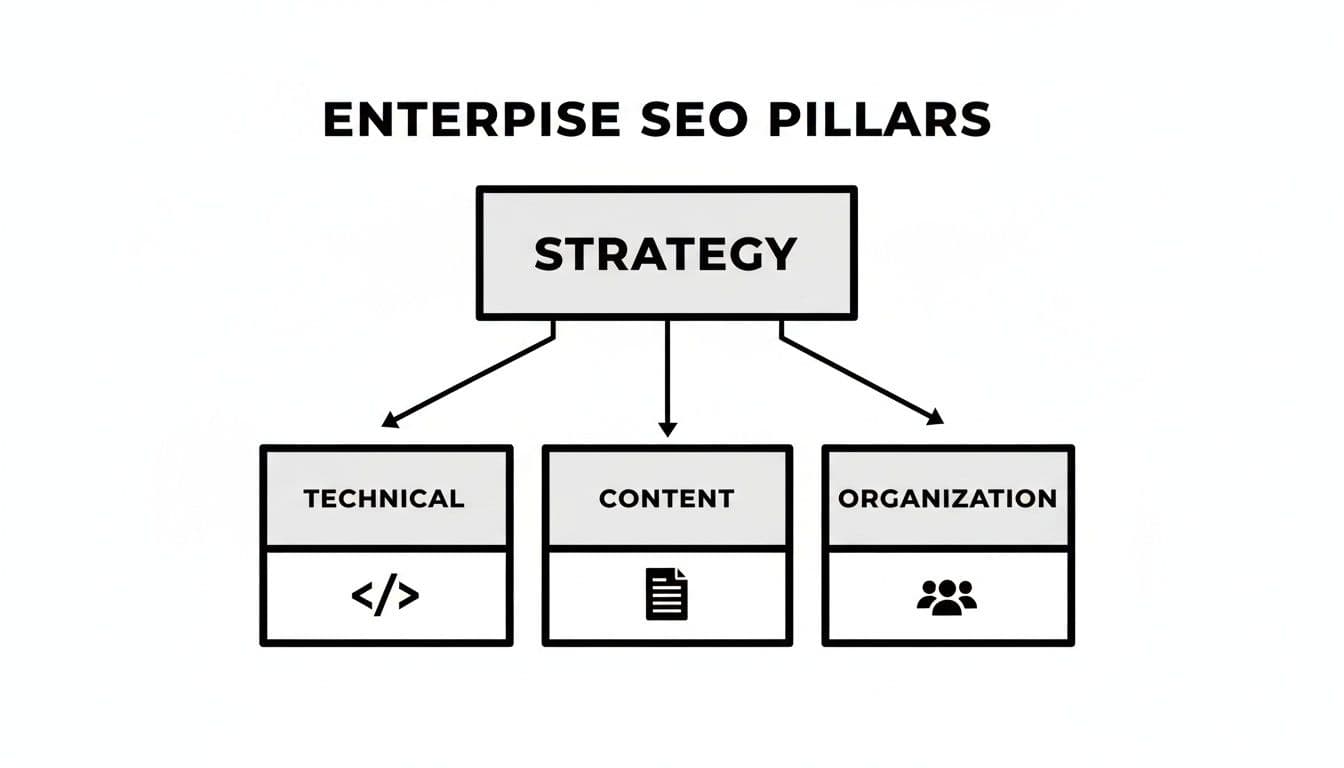
As you can see, a winning enterprise strategy hinges on balancing technical health, content excellence, and organizational buy-in. If any one of these pillars crumbles, it creates risk across the entire system. It’s a powerful reminder that a holistic approach isn't just nice to have—it's absolutely essential.
The Essential Technology Stack for Enterprise SEO
Trying to do enterprise SEO without the right technology is like trying to build a skyscraper with a hammer and a handful of nails. It’s just not going to work. When you're dealing with millions of pages, a solid, integrated tool stack isn't just a nice-to-have; it's the absolute foundation of your entire program. The off-the-shelf tools that work fine for smaller businesses simply buckle under the weight of enterprise-level data and complexity.
The right tech stack elevates an enterprise SEO program from a disconnected series of manual tasks to a scalable, data-driven machine. These platforms act as a central hub, pulling together technical audits, content strategy, rank tracking, and business intelligence into a single, cohesive view. That integration is what allows you to make smart, strategic decisions that actually move the needle on business goals.
Core Enterprise SEO Platforms
At the heart of any serious enterprise stack, you'll find the big, all-in-one SEO platforms. Think of these as your command center, giving you a comprehensive look at organic performance, what your competitors are up to, and how your team is managing its workflows.
The two names you'll hear most often here are BrightEdge and Conductor. These platforms go way beyond simple keyword tracking. They're built with sophisticated features designed for large, complex organizations, helping teams forecast the potential ROI of different initiatives, automate stakeholder reporting, and manage content optimization across dozens of teams and international markets.
Specialized Technical Crawlers
While the all-in-one platforms are great for high-level strategy, you need specialized crawlers to get your hands dirty with deep technical analysis. For forensic-level audits on massive websites, tools like Lumar (formerly Deepcrawl) and Screaming Frog are indispensable. They can crawl millions of URLs to sniff out critical issues that would otherwise go completely unnoticed.
- Indexation Bloat: Finding and getting rid of thousands of low-value pages that are just eating up your crawl budget.
- Internationalization Errors: Diagnosing tangled
hreflangimplementations across your global domains. - JavaScript Rendering Issues: Seeing your site the way Google does to find content that isn't being indexed correctly.
These tools provide the granular, nitty-gritty data required to keep a sprawling web property technically sound. They stop tiny errors from snowballing into catastrophic performance drops.
Enterprise SEO platforms are especially critical for large B2B companies navigating the AI-disrupted search landscape. It's a massive market, with large enterprises already making up 56% of SEO software revenue. Top-tier platforms are doubling down on features for global expansion—a key focus since 91% of marketers credit SEO for successfully hitting their goals. You can find more data about the SEO software market on researchandmarkets.com.
The Next Frontier: AI Visibility Monitoring
The traditional SEO toolkit has a big, emerging blind spot: generative AI. As search engines like Google increasingly inject AI-generated answers directly into the results, just tracking keyword rankings isn't enough anymore. The new metric that matters is brand visibility within those AI-powered responses.
This is where new platforms like Attensira come in. They are built specifically to fill this gap, monitoring how your brand, products, and core messages are being represented in AI answers. It’s an essential layer of intelligence that older tools completely miss, allowing you to protect your brand reputation and ensure your expertise is being properly reflected. Knowing how you appear here is a crucial part of using a modern https://attensira.com/blog/search-visibility-tracker.
Building a successful enterprise SEO program starts with a powerful tech stack. To see what's out there, check out a practical AI SEO tools comparison to help figure out which platforms fit your needs. By combining an all-in-one platform with specialized crawlers and forward-thinking AI monitoring, you can build a tech stack ready for today's complexities and whatever comes next.
Measuring Success With KPIs That Matter
In enterprise SEO, getting hung up on vanity metrics like keyword rankings is a fast track to becoming irrelevant. Sure, rankings can be a decent diagnostic tool, but they mean absolutely nothing to the C-suite if you can't connect them directly to business value. Success isn't about hitting number one; it's about hitting the bottom line.
If you want a seat at the executive table, you have to change the conversation. Stop talking about tactical outputs and start demonstrating strategic outcomes. This means focusing on key performance indicators (KPIs) that tell a clear, compelling story of growth and profitability.
Moving Beyond Vanity Metrics
The first step is to completely redefine what success looks like for your program. A small local business might throw a party for ranking first for a niche term, but an enterprise needs to measure its influence across an entire market. This demands a much more sophisticated set of metrics that tie your SEO activities to high-level business goals.
The performance indicators that actually move the needle include:
- Non-Branded Organic Traffic Growth: This is your proof that you’re attracting new customers—people who don't know your brand name yet. It’s a direct measure of your content’s authority and relevance in the wider market.
- Competitive Share of Voice (SOV): This metric is crucial. It shows your organic visibility for a core set of keywords compared to your main competitors. When your SOV is growing, it means you're capturing more market share and cementing your position as the industry leader.
- SEO's Contribution to Revenue: This is the ultimate KPI. By tracking leads, sales, and conversions that originate from organic search, you can put a real dollar value on your work. This is how you prove undeniable ROI.
Introducing Forward-Looking Indicators
Search is always changing, and our measurement frameworks have to keep up. One of the biggest blind spots for most companies right now is the rise of generative AI. Your traditional tools can't tell you how your brand is showing up in AI-generated answers, which are quickly becoming a major source of information for consumers.
This is where forward-looking metrics become absolutely essential.
Measuring your brand's visibility and sentiment within AI-generated responses is no longer a futuristic idea—it is a leading indicator of your brand's authority and a crucial metric for protecting its reputation in this new era of search.
Tracking your visibility in AI gives you an early warning system. It lets you spot and correct misinformation before it hurts your brand. More importantly, it shows you where you can become a primary source for these new AI engines, solidifying your expertise for the next wave of search.
Enterprise SEO KPI Framework
To truly align SEO with business objectives, it helps to categorize your metrics. The following table provides a framework for organizing KPIs based on their direct impact on the company, moving from operational diagnostics to strategic business outcomes.
This framework helps shift the conversation from "what did we do?" to "what did we achieve?"—a language that resonates with leadership.
Building Dashboards That Tell a Story
Ultimately, the goal is to present all this data in a way that your stakeholders actually understand and care about. This means creating clean, concise dashboards that connect the dots between SEO performance and business goals. You have to translate complex data into a compelling narrative about growth, efficiency, and return on investment.
A great dashboard isn't just a wall of charts and numbers. It highlights the most critical insights, shows your progress against targets, and clearly demonstrates how SEO is helping the company win. Communicating your results effectively is just as important as getting them. Learning how to build an impactful SEO report is a non-negotiable skill for any enterprise SEO leader. When you focus on the KPIs that matter, you elevate the entire conversation and prove the strategic value of your program.
Building Your Enterprise SEO Program From The Ground Up
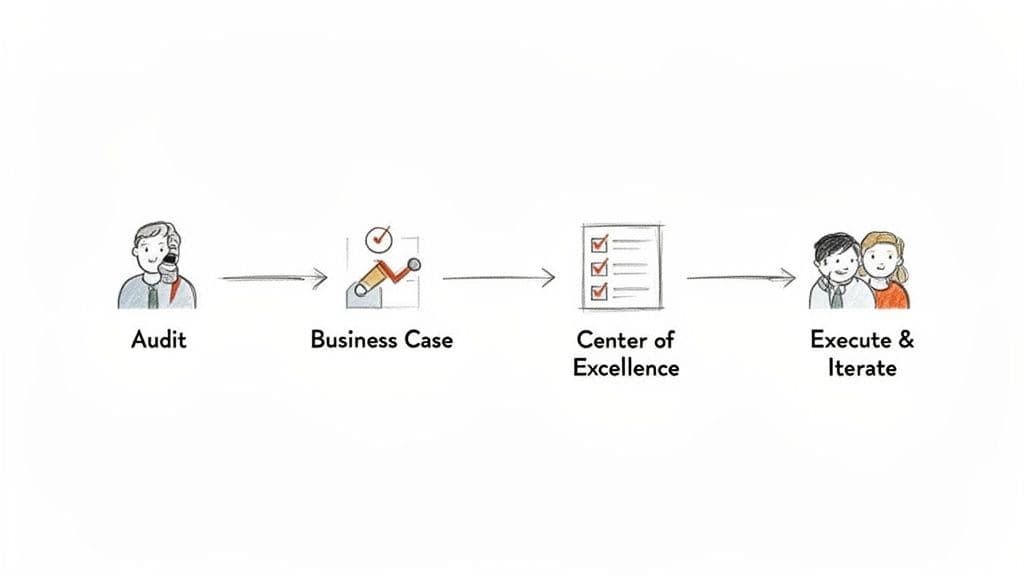
Moving from theory to actual results demands a deliberate, structured plan. Getting an enterprise SEO program off the ground isn't a single project; it’s a phased journey. This kind of systematic approach is critical because it ensures each step reinforces the last, building a resilient foundation for sustainable organic growth.
The whole thing kicks off with a massive audit to figure out exactly where you stand. After that, you'll need to build a rock-solid business case to get the executives and their budgets on your side. The next step is creating a central governing body—often called a Center of Excellence—to set the rules, design scalable workflows, and make SEO everyone's job. Only then do you move into the ongoing loop of doing the work, measuring what happens, and making it better.
Phase 1: Establish a Performance Baseline with a Comprehensive Audit
Before you can draw a map to where you're going, you need to pinpoint exactly where you are. An enterprise-level audit is so much more than a simple checklist. It's a full-blown investigation into the technical health, content effectiveness, and backlink authority of every single digital asset you own. This isn't the time to skim the surface.
Your audit needs to systematically uncover performance gaps and hidden opportunities across three core pillars:
- Technical Foundation: Dig into crawlability, indexation, site speed, and international setups like hreflang. At this scale, even a seemingly tiny technical mistake can hamstring millions of pages.
- Content Performance: Break down your content by page type and user intent. You're looking for the high-potential pages to double down on and the low-value ones that need to be pruned or redirected.
- Link Equity Distribution: You need to map how authority from both internal and external links flows through the site. This is how you ensure your most important pages are getting the link juice they need to actually rank.
This audit is what gives you the hard data you'll need for the next, and arguably most important, phase: turning all these insights into a plan that stakeholders can get behind.
Phase 2: Secure Executive Buy-In with a Business Case
With your audit data in hand, the real challenge begins: translating technical problems into the language of the C-suite. That means talking about revenue, risk, and ROI. A powerful business case doesn't just list problems; it connects your proposed SEO fixes directly to the company's bottom line. It has to clearly show the current situation, paint a picture of the desired future, and detail the resources needed to get there.
An effective business case for enterprise SEO isn't a list of technical fixes. It’s a financial forecast that quantifies the opportunity cost of inaction and models the potential revenue impact of a well-executed strategy.
This is your moment to shift the perception of SEO from a cost center to a true growth engine. Frame your recommendations around big-picture strategic goals that leaders care about, like “Expanding Market Reach” or “Increasing Brand Authority.” When executives see how your individual tasks ladder up to their objectives, securing the budget and cross-departmental support you need becomes a whole lot easier.
Phase 3: Create an SEO Center of Excellence
Once you’ve got the green light, the focus shifts to making it all happen. An SEO Center of Excellence (CoE) is a cross-functional group or a central governing body that’s in charge of creating the standards, processes, and best practices for the entire organization. Its real purpose is to tear down silos and weave SEO into the company’s very DNA.
The CoE is what standardizes workflows for things like content creation, technical development sprints, and reporting. It becomes the central hub for training, tools, and knowledge sharing, making sure every team—from product and marketing all the way to IT—knows exactly what their role is in driving organic success. Without this kind of centralized governance, maintaining any semblance of consistency and quality at enterprise scale is nearly impossible.
Answering Your Enterprise SEO Questions
Even after mapping out the strategy, some practical questions always come up. Let's tackle the most common ones I hear from teams navigating this complex world.
How Is Enterprise SEO Different From Regular SEO?
The real difference boils down to scale and complexity. Standard SEO is often tactical, focusing on a specific set of keywords or a limited number of pages. Enterprise SEO, on the other hand, is a whole different beast. It's a strategic, systemic approach built to manage and grow organic traffic across hundreds of thousands—or even millions—of pages.
Think about it like this: regular SEO is like a chef running a single, high-end restaurant kitchen. Enterprise SEO is like being the executive chef managing the entire supply chain, logistics, and quality control for a global restaurant franchise.
Enterprise SEO isn’t about running a few campaigns. It’s about building a predictable, scalable engine for organic growth. That requires a completely different mindset, a more diverse skillset, and a far more powerful tech stack.
What Are The Biggest Hurdles in Enterprise SEO?
You might think the biggest challenges are technical, like wrestling with crawl budgets or complex site migrations. And while those are tough, the truly massive hurdles are almost always organizational.
Success in enterprise SEO comes down to overcoming these internal roadblocks:
- Internal Silos: The biggest fight is often getting marketing, IT, product, and legal teams to talk to each other, let alone collaborate. When everyone is in their own lane, progress grinds to a halt.
- Bureaucracy and Red Tape: In a large company, even a simple change can get tangled in layers of approval. This kills the agility you need to react to algorithm updates or competitor moves.
- Securing Buy-In: You have to be a translator. Your job is to turn technical SEO needs into a compelling business case that makes sense to the C-suite. Without that, you'll never get the budget or resources you need.
What Kind of Team Do You Need?
You can't win at this level with just one or two SEO specialists working in a vacuum. You need a dedicated, cross-functional team. The best structure I've seen is an SEO "Center of Excellence" that pulls together key roles:
- A Strategic Leader: This person builds the business case, gets all the key stakeholders on the same page, and owns the overall vision.
- Technical SEO Specialists: These are the deep experts who can untangle gnarly site architectures, manage major migrations, and solve tough performance issues.
- Content Strategists: You need people who can think big, architecting massive content ecosystems and creating the governance to keep it all consistent.
- Data Analysts: This role is critical for turning mountains of performance data into clear, actionable insights that prove your value to the business.
When Should a Company Invest in Enterprise SEO?
A business needs to start thinking about enterprise-level strategies and tools when the old way of doing things starts to break. The signs are usually pretty clear.
You've hit the tipping point when you're managing a site with over 50,000 to 100,000 pages, expanding into multiple countries and languages, or when organic search has become a mission-critical revenue channel. If you feel like you're constantly fighting fires and your standard tools can't keep up with the sheer scale of your digital footprint, it's time to make the leap.
The next frontier is navigating brand visibility in an AI-driven search world. Attensira is built to give you the intelligence needed to monitor and shape how your brand appears in AI-generated answers, protecting your authority where it matters most. See how you show up in AI today.