Discover enterprise content management solutions that unify your data, streamline complex workflows, and prepare your business for an AI-driven future.
Enterprise Content Management is really a combination of a business strategy and the technology to make it happen. At its core, it's about getting a handle on all the information floating around your company by capturing, managing, storing, and delivering it from one central hub.
Think of it as the ultimate digital librarian for your business, turning a chaotic mess of files and data into a structured, valuable asset.
Taming the Digital Chaos with Enterprise Content Management
Picture it: your company’s most important documents—contracts, marketing collateral, invoices, HR records—are everywhere. They’re squirreled away on individual hard drives, buried in email threads, and scattered across a dozen different cloud apps. It’s a digital library with no card catalog, and the result is wasted time, version control disasters, and some serious security vulnerabilities.
This is exactly the problem that Enterprise Content Management (ECM) was designed to solve. But don't mistake it for just another piece of software; it's a fundamental shift in how you treat your business information.
The real goal of an ECM is to strategically capture, manage, preserve, and deliver all of an organization's unstructured content. It's about turning that content from a liability into a genuine asset by making sure the right information gets to the right people at the right time.
The Central Nervous System for Your Information
A great way to think about an ECM is as the central nervous system for your company's information. It connects all the disparate parts—from finance to marketing to legal—and ensures data flows smoothly and intelligently between them.
Without it, departments operate in their own little worlds, often duplicating work and making critical decisions based on information that's outdated or just plain wrong. A solid ECM system creates a single source of truth that everyone can rely on, which is the bedrock of consistency and efficiency.
This central repository becomes critical for a few key reasons:
- Operational Efficiency: You can automate tedious, manual processes like document approvals and reviews. This frees up your team to focus on work that actually drives the business forward.
- Regulatory Compliance: It helps you enforce document retention policies and provides clear audit trails, which is essential for meeting standards like HIPAA or GDPR.
- Brand Consistency: Everyone, from the sales team on the road to the designers in-house, is using the most current, approved brand assets and messaging. No more rogue logos or outdated taglines.
- Enhanced Decision-Making: When leaders need to make a strategic call, they have immediate access to accurate, reliable data. No more gut feelings or guesswork.
Ultimately, a modern ECM isn't just a "nice-to-have"—it's the foundation for operational excellence. It also sets the stage for making your internal data far more discoverable. We dive deeper into this in our guide on how AI search chunking works, which explains how content is broken down and prepared for intelligent search. By getting your content organized in an ECM first, you're paving the way for more powerful information retrieval and analysis down the road.
What Really Makes Up a Modern ECM System?
To get a real handle on enterprise content management, you have to look past the buzzwords. A modern ECM isn't just one piece of software; it's a strategic framework built on five interconnected pillars. Each one handles a specific stage of your content's lifecycle, and they all have to work together to create a system that actually delivers value.
Think of it like an assembly line for your company's information. Each station has a job to do, turning messy, raw data into a secure, searchable, and genuinely useful business asset. If one of these pillars is weak, the whole process grinds to a halt, opening the door to inefficiency and risk.
This diagram breaks down the core functions into three simple stages: capturing information, managing it, and delivering it to the people who need it.
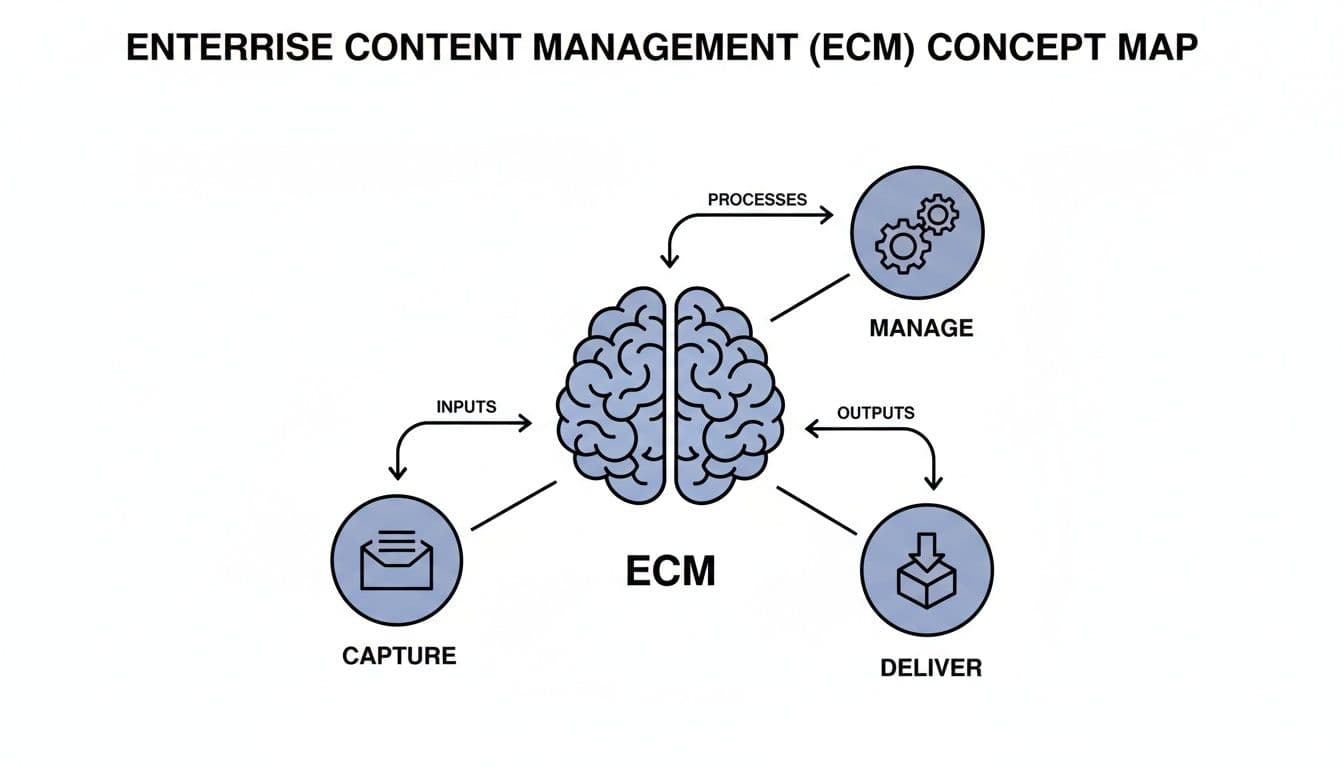
It’s a continuous loop. Great ECM strategy ensures your content flows smoothly from the moment it’s created to the moment it’s used.
Pillar 1: Intelligent Capture
First things first: you have to get information into the system. Intelligent capture is all about pulling content from any source—scanned invoices, email attachments, digital contracts, even video files—and turning it into something your system can understand and work with.
This isn't just about scanning. Modern platforms use technologies like Optical Character Recognition (OCR) to read text from images and AI to figure out what kind of document it is. For example, the system can see a new file, identify it as an "invoice," automatically pull out the vendor name and amount due, and kick off the payment process without anyone lifting a finger.
Pillar 2: Document Management
Once content is inside the system, it needs a home. This pillar is essentially the digital library, giving you the tools to organize, find, and secure all your information. This is where the day-to-day work gets done.
Key features you'll find here include:
- Version Control: This is critical. It makes sure everyone is working from the latest draft, killing the confusion that comes from having multiple versions of a file floating around.
- Audit Trails: Ever wonder who touched a document last? This feature tracks every single action—who viewed it, who edited it, and when—creating a clear record for compliance and accountability.
- Granular Permissions: You get to control exactly who can see, edit, or share specific files, keeping sensitive data locked down.
Pillar 3: Workflow Automation
This is where an ECM really starts to shine, going from a simple digital filing cabinet to a true business process engine. Workflow automation lets you map out and enforce the steps for any content-heavy task, cutting out the manual handoffs and bottlenecks that slow everything down.
Think about a standard contract approval. Instead of emailing a Word doc back and forth, a workflow can automatically send the contract from the legal team to finance and then to an executive for a digital signature, firing off reminders at every stage.
This pillar is all about making business processes faster, slashing human error, and ensuring everyone follows the correct procedure every single time.
This push for greater efficiency is a huge reason the ECM market is growing so quickly. It's projected to climb from USD 50.15 billion in 2025 to a massive USD 190.87 billion by 2035, driven largely by cloud platforms that offer better flexibility and disaster recovery. You can dig into the research on the growing ECM market to see the full picture.
Pillar 4: Records Management and Compliance
Let's be honest, not all content is created equal. Some documents—like financial statements or HR records—have to be kept for a specific amount of time to meet legal or industry regulations. Records management automates these retention and deletion rules.
The system can be set up to automatically archive a client contract after seven years and then flag it for secure deletion when the time is up. This takes the guesswork out of compliance, ensuring you meet your obligations without someone having to manually track thousands of documents. For anyone dealing with regulations like GDPR or HIPAA, this isn't just nice to have; it's essential.
Pillar 5: Secure Collaboration and Delivery
Finally, what good is all this perfectly managed content if the right people can't use it? This last pillar is focused on giving teams secure ways to work together on documents and deliver the final product wherever it needs to go.
This could mean publishing a new marketing piece directly to the company website, sharing a quarterly report with an external partner through a secure portal, or just making sure a new policy document is easily accessible to every employee. It closes the loop, connecting your managed content to real-world action.
Measuring the True Business Value of ECM
When companies first look at enterprise content management solutions, they tend to focus on the easy-to-spot savings, like using less paper or cutting down on physical storage costs. And sure, those are nice perks. But they’re just the tip of the iceberg.
The real value of a modern ECM isn't about trimming expenses; it's about fundamentally changing how your business runs. We're talking about a powerful engine for growing revenue, sharpening operations, and gaining a serious competitive edge. To see the true return on investment (ROI), you have to look past the small stuff and measure the strategic wins in productivity, risk management, and overall business speed.
Radical Gains in Productivity
The first and most obvious impact you'll see is a massive jump in employee productivity. Think about how much time your team wastes just trying to find the right document. When all that information lives in one central, searchable place, that wasted time practically disappears.
It adds up faster than you’d think. Research shows that knowledge workers can burn up to 20% of their day—that's a full day every week—just searching for internal information. An ECM goes right after that inefficiency.
By centralizing information and killing off those tedious manual searches, enterprise content management solutions hand precious time back to your best people. That recovered time goes straight into getting more done, finishing projects faster, and freeing up brainpower for real innovation.
Significant Cost Reductions Through Automation
Beyond just finding things faster, ECM drives major cost savings by automating all those repetitive, manual jobs that nobody wants to do. Processes that used to bounce around in emails and spreadsheets get turned into clean, efficient digital workflows.
This automation pays off in a few key ways:
- Faster Invoice Processing: Automated workflows can take invoice cycle times from weeks down to just days. That means you can grab early payment discounts and dodge late fees.
- Fewer Manual Errors: Automation nearly eliminates the risk of human error in data entry, which saves you from costly fixes and financial headaches.
- Less Administrative Drag: The system can handle routine approvals and notifications on its own, freeing up your admin staff to focus on more important work.
Figuring out the exact dollar value here requires a solid approach. Resources like this guide on how to measure marketing ROI provide excellent frameworks that you can easily adapt to calculate the financial upside of smarter content operations.
Fortified Security and Compliance
This one is a little tougher to put a number on, but it might be the most important benefit of all. A single data breach or compliance slip-up can lead to eye-watering fines, legal battles, and a damaged reputation that's hard to fix.
A solid ECM strengthens your defenses with tight access controls, detailed audit trails, and automated rules for how long to keep documents. This ensures sensitive information stays locked down and that you're always meeting regulatory demands. It turns compliance from a stressful manual chore into an automatic safety net. For more on calculating these less-tangible benefits, our guide on how to measure marketing ROI offers some great parallel concepts.
In the end, calculating the real business value of an ECM means looking at the whole picture. It’s the sum of every hour saved, every error prevented, every process sped up, and every risk avoided. When you see it like that, the investment isn't just justified—it's a no-brainer.
How to Select the Right ECM Solution for Your Enterprise
Picking the right partner for your enterprise content management system can feel overwhelming. The market is packed with vendors, and every single one claims to have the magic bullet for your content chaos. The secret is to look past the shiny feature lists and get methodical. You need a structured evaluation that's laser-focused on your actual, long-term business goals.
Think of it this way: you’re not just buying software; you're entering a strategic partnership. The right choice will sharpen your operations, lock down your data, and grow right alongside you. But the wrong one? That path leads to frustrated users, out-of-control costs, and a failed implementation that can stall your business.
To make a smart decision, you need a solid framework. This means judging every potential solution against the same set of criteria—from its technical muscle to the vendor's own stability and vision for the future.
Define Your Core Requirements
Before you watch a single demo, you have to know exactly what you need. What specific business pains are you trying to fix? Are you buried under a mountain of manual invoices? Struggling to keep up with compliance demands? Or just trying to get a handle on brand assets for teams scattered across the globe?
Start by hammering out a detailed list of requirements. Make sure you break it down:
- Must-Have Features: These are the absolute deal-breakers. Think specific workflow automations, bulletproof version control, or whatever functions your business simply can't live without.
- Nice-to-Have Features: These are the features that would make life easier but aren't critical on day one, like on-the-go mobile editing or advanced reporting dashboards.
- Integration Needs: List every single system the ECM needs to talk to. This includes your CRM (like Salesforce), your ERP (like SAP), and any other critical business applications.
Nailing this down first keeps you from getting distracted by a cool feature that doesn't actually solve your real-world problems.
Evaluate Scalability and Architecture
Your business won't stand still, and your ECM can't afford to either. How well a system can scale is one of the most critical tests. It’s time to ask some tough questions. Can it handle a 200% explosion in data over the next five years without grinding to a halt? Can it support a growing army of users in different time zones?
A solution that works beautifully for one department today might completely buckle under the weight of an enterprise-wide rollout tomorrow. Look for a cloud-native architecture that gives you elastic scalability. That way, you pay for what you use but have the runway to grow without a massive, expensive hardware overhaul.
This is non-negotiable for large organizations. In fact, big enterprises are the real engine of the ECM market, on track to command a massive 79.64% revenue share by 2025. Their huge data volumes, intricate global workflows, and tough compliance needs are driving this dominance. As this trend continues, the scalability of enterprise content management solutions becomes a top-tier deciding factor. You can explore more data on enterprise adoption trends to get a better feel for where the market is headed.
Scrutinize Vendor Support and Viability
The software is just one piece of the puzzle. The company behind it is your partner for the long haul. A brilliant product from a vendor with lousy support can turn into a nightmare real fast.
When you're sizing up vendors, dig into these areas:
- Implementation Expertise: Do they actually have a proven track record in your industry? Don't just take their word for it—ask for case studies and talk to their current clients.
- Customer Support: What do their support SLAs look like? If you're a global company, do they offer 24/7 help? A good test is to see how responsive they are during the sales process itself.
- Product Roadmap: A clear, transparent roadmap is a great sign that the vendor is investing in the future. Ask them where they see the product in the next two to five years.
- Financial Stability: You need to know if the vendor is on solid ground. A financially healthy company isn't likely to get acquired or suddenly discontinue the product, giving you much-needed long-term security.
By vetting both the technology and the people behind it, you can find an ECM solution that doesn’t just fix today's problems but sets your organization up for success for years to come.
Connecting ECM to AI Search for Greater Brand Authority
The purpose of an enterprise content management solution has fundamentally changed. It’s no longer just about keeping your internal house in order. In a world now dominated by generative AI and intelligent search, how you organize content internally has a direct, measurable impact on how the world sees your brand. Your ECM has become the primary source that teaches AI what your company is, what it does, and why it matters.
Think of your ECM as the official, undisputed "single source of truth" for your brand. It’s where every approved product spec, case study, technical document, and company bio resides. When AI-driven search engines and language models scan the web for information to build answers, they crave consistent, structured, and authoritative data. A well-oiled ECM ensures they find exactly the information you want them to.
This direct link turns an internal governance tool into a powerful strategic asset for building brand authority. If your internal content is a disorganized mess of outdated files and conflicting data, that chaos will eventually bleed into AI-generated search results, damaging your brand's reputation.
Creating a Strategic Feedback Loop
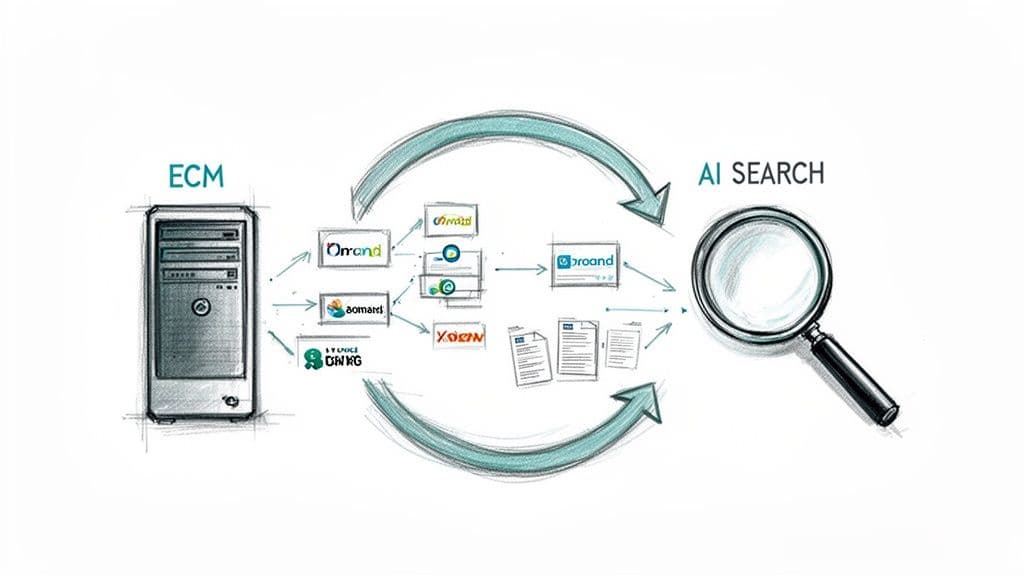
To really get this right, you need a feedback loop. Your ECM supplies the high-quality, foundational content, but that's just step one. The second, equally crucial step is to see how that content is actually performing out in the real world—specifically, within AI search answers.
This is where a platform like Attensira becomes indispensable. It serves as your brand's eyes and ears in the AI search ecosystem, tracking how your information is being interpreted and flagging any gaps or inaccuracies.
This creates a powerful cycle of continuous improvement:
- Foundation: Your ECM delivers clean, approved, and structured content as the definitive source.
- Monitoring: A tool like Attensira constantly analyzes how AI search engines are using and presenting this content.
- Insight: The platform provides clear, actionable data, showing you where your brand message is hitting the mark and where it’s being misunderstood or completely ignored.
- Refinement: Armed with these insights, you can circle back to your ECM and optimize the source content, tweaking it for better performance in AI search.
This isn’t a one-and-done project; it’s an ongoing strategic discipline. It's like constantly tuning your brand’s core message to resonate perfectly on the new stage of AI-powered search.
From Content Management to Brand Control
This strategic alignment is so critical because AI search engines don’t play by the old rules. They don’t just link to your website; they synthesize information from multiple sources to give users a direct answer. This makes controlling your source material more important than ever before. To better understand how AI enhances content discovery, it helps to be familiar with Natural Language Processing (NLP) basics.
Your ECM stops being a simple file cabinet and becomes the command center for your brand's digital identity. It's the central hub where you define reality for AI, ensuring that every answer generated about your company is accurate, consistent, and on-brand.
This evolution demands a new mindset about enterprise content management solutions. The goal expands from just improving internal workflows to actively protecting and projecting your brand externally. Managing your content well inside your organization is the first and most critical step in controlling your narrative everywhere else. To learn more about this strategy, check out our complete guide to AI search optimization.
The companies that will win in this new era are the ones that build a solid bridge between their internal content world and the external AI-driven landscape. By pairing a robust ECM with intelligent monitoring, you can ensure your brand not only survives but thrives.
ECM Implementation Pitfalls and How to Avoid Them
Let’s be honest: implementing an enterprise content management solution is less about the technology and more about the people and processes you’re trying to change. A successful rollout requires a deep understanding of the human side of things, because many of these projects fail not because the software was bad, but because the organization just wasn't ready for it.
Getting this right means sidestepping the common landmines that can blow up your ROI. The real work begins long before a single file is migrated—it starts with a clear vision and unwavering leadership. Without that, even the most powerful ECM platform will just gather digital dust, leaving you with nothing but wasted money and frustrated teams.
Underestimating the Human Element
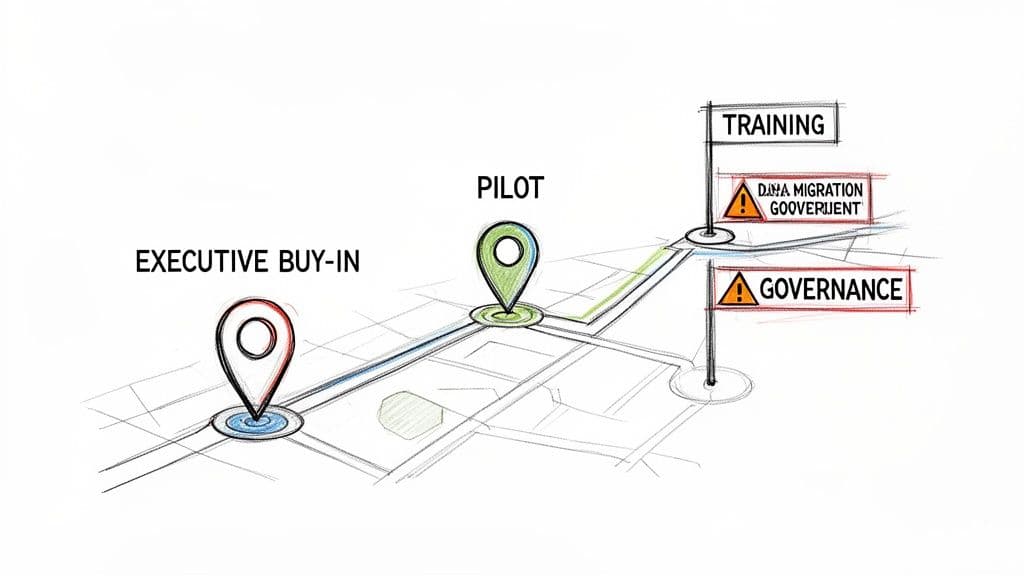
The single biggest mistake you can make is treating an ECM rollout as just another IT project. It’s not. It’s a full-blown change management initiative. If you don't get genuine, visible support from your executive team from day one, the project is probably dead on arrival. People follow their leaders; if leadership seems indifferent, your employees won't bother adopting the new system.
Just as damaging is skimping on user training. And I don't mean a quick webinar showing people which buttons to click. Real training has to connect the dots for them. It must focus on the "why"—explaining precisely how this new platform will make their specific jobs less painful and help the business hit its goals.
A system that nobody uses is a system that has failed. Low user adoption is the silent killer of ECM projects, often stemming from a lack of clear communication, inadequate training, and a failure to address user resistance head-on.
Neglecting Governance and Data Migration
Another classic blunder is kicking the data governance can down the road. You absolutely must establish clear, enforceable rules for how content is created, tagged, stored, and eventually deleted before you start migrating anything. Figuring out who owns what and what the retention policies are isn't a "post-launch" task—it’s step one.
People also consistently underestimate the nightmare that is data migration. It is never a simple "lift and shift." You're often dealing with years of unstructured, messy content scattered across legacy drives and forgotten platforms. This requires a dedicated, meticulous strategy.
Common hurdles include:
- Cleaning "Dirty" Data: You have to get your hands dirty. That means weeding out duplicates, archiving irrelevant files, and forcing standardized naming conventions before you move a single byte.
- Mapping Metadata: All that valuable context—the who, what, when of a document—needs to be carefully mapped from the old system to the new one, or it's lost forever.
- Validating the Transfer: You need a plan to double- and triple-check that everything moved over correctly and nothing was corrupted in the process.
Starting Too Big and Failing to Scale
Trying to roll out an ECM to the entire organization in one go is a textbook recipe for disaster. This "big bang" approach creates an overwhelming amount of complexity and dramatically increases the risk of a catastrophic failure that poisons the well for any future attempts.
A much smarter strategy is to start small. Pick a single department or a specific workflow for a pilot project.
This phased approach gives you three huge advantages:
- Secure an Early Win: A successful pilot builds incredible momentum. It creates internal champions who will sell the project for you.
- Learn and Adapt: You can find and fix problems on a small, manageable scale before they become enterprise-wide catastrophes.
- Refine Your Process: The pilot is your lab. Use it to fine-tune your training, test your governance policies, and perfect your migration plan based on real-world feedback.
By starting small, proving the value, and then scaling methodically, you build a foundation for lasting success. This approach keeps the project grounded, avoids costly mistakes, and ensures your ECM actually delivers on its promise.
Got Questions About ECM? We’ve Got Answers.
Even with a solid plan, you’re bound to have questions when you start digging into enterprise content management solutions. Let's tackle some of the most common ones we hear from leaders on both the business and tech sides of the house.
What’s the Real Difference Between an ECM and a DMS?
It's a classic question, and the distinction is crucial. Think of a Document Management System (DMS) as a highly organized, secure digital filing cabinet. It’s fantastic for storing documents, tracking different versions, and controlling who can access what. Its world revolves around the file itself.
An Enterprise Content Management (ECM) system, on the other hand, is the entire automated assembly line that the filing cabinet sits within. It does everything a DMS does but also manages the business processes surrounding the content. It automates workflows for approvals, enforces records management policies for compliance, and provides tools for teams to collaborate across the entire lifecycle of content—not just standard documents, but images, videos, emails, and more.
How Long Does an ECM Implementation Actually Take?
This is the "how long is a piece of string?" question, but we can give you some realistic goalposts. The timeline really depends on the scale of your ambition. We almost always recommend a phased rollout to get wins on the board early and make sure people actually use the new system.
- A single-department, cloud-based setup with mostly out-of-the-box features can be up and running in as little as three to six months.
- A full enterprise-wide deployment is a different beast. If you're migrating massive amounts of data from old systems, building custom integrations with your ERP or CRM, and designing complex workflows from scratch, you should probably budget for twelve to eighteen months, sometimes longer.
How Can an Internal Tool Like ECM Possibly Help My SEO?
This is where things get interesting. An ECM directly fuels your digital presence by creating a "single source of truth" for all your company’s information. When your website, blog, and customer portals all pull from this same trusted well, the content they publish is inherently consistent, accurate, and current. Search engines absolutely love that.
By centralizing your assets, you can systematically enforce SEO best practices and keep your brand messaging locked in. This trove of structured, high-quality information is the perfect fuel for both traditional search engines and the new wave of AI answer engines, cementing your brand's authority and visibility online.
Suddenly, your internal content hub becomes a strategic pillar of your external marketing efforts.
Ready to see how your brand shows up in AI search? Attensira delivers the insights you need to get your content right and win in the new era of search. Start tracking your AI presence today.