A practical guide to web content creation for AI-driven search. Learn to build a strategy, conduct AI-aware research, and optimize for B2B brands.
At its core, web content creation is the whole nine yards: the research, the planning, the actual writing, and finally, publishing information on a website. This isn't just about blog posts; it's everything from hard-hitting articles and video scripts to the landing pages that drive conversions. The real goal is always to pull in the right audience, keep them engaged, and ultimately, get them to act. To do this well, you have to genuinely understand what your audience needs, how search engines actually work, and what you’re trying to achieve for the business.
Building a Resilient Web Content Creation Strategy
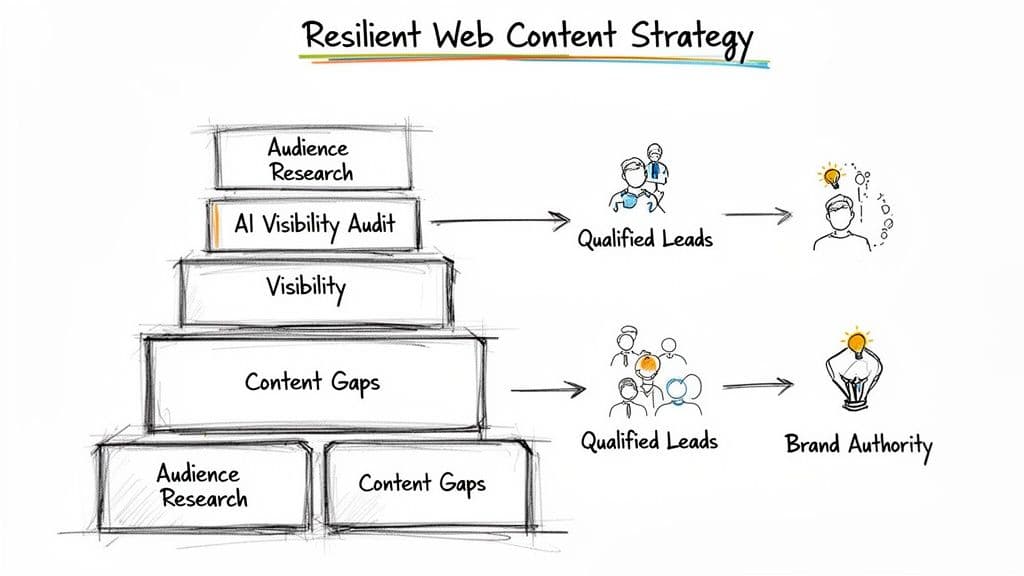
Throwing content at the wall and hoping something sticks is a dead-end strategy. In a world where AI-driven search engines serve up direct answers, your content needs a purpose. It must be deliberate, backed by data, and built to last.
This means shifting your focus from just chasing keywords to creating a body of work that cements your brand as an undeniable authority. Every single article, guide, or video must tie back to a real business outcome—whether that’s bringing in qualified leads, cutting down on customer support tickets, or simply owning the conversation in your niche.
The global content marketing industry is expected to hit a staggering $107 billion in revenue by 2026. With 82% of businesses already in the game, the competition is fierce. A scattershot approach will just get you lost in the noise.
Connecting Content to Business Goals
Before you even think about writing, you need to know what winning looks like. Vague goals like "get more traffic" won't cut it. You need specific, measurable outcomes that directly support your company's bigger picture.
- Lead Generation: Your content should be a magnet for your ideal customer profiles (ICPs). For example, a B2B SaaS company could publish an exhaustive guide to solving a specific industry problem, with a clear call-to-action for a product demo.
- Brand Authority: The aim here is to become the definitive source in your space. This means building out comprehensive pillar pages and topic clusters that answer every question your audience could possibly have on a subject.
- Customer Education: Create content that helps your current customers succeed with your product. This is a powerful way to reduce churn, build fierce loyalty, and turn users into advocates.
An essential content marketing strategy guide can give you a solid framework for this level of planning, ensuring every dollar and hour you invest is pulling its weight.
Uncovering Audience Intent with Deep Research
To create content that actually lands, you need to know your audience inside and out. I’m not just talking about basic demographics. You need to dig into their motivations, their biggest frustrations, and—most importantly—the exact words they use when they’re looking for help. This is absolutely critical for capturing the conversational queries that are so common with voice search and AI assistants.
A truly effective content strategy is built on empathy. It's about deeply understanding the user's problem and providing the most helpful, comprehensive answer, regardless of the format. This user-centric approach is what both people and algorithms reward.
Start digging through your customer support tickets. Listen to sales call recordings. Lurk in relevant subreddits and Quora threads. These are goldmines of authentic, unfiltered customer language. Documenting these phrases gives you a blueprint for content that meets people right where they are. This kind of deep research is also the foundation of smart enterprise content management solutions, ensuring every asset you create is findable and relevant.
The Foundational AI Visibility Audit
You can't plan a journey without knowing where you're starting from. That’s where an AI visibility audit comes in. It’s a non-negotiable first step in any modern content strategy. This involves a deep dive into how your brand, your products, and even your key executives show up in the answers generated by AI search tools and chatbots.
This audit benchmarks your current position and shines a harsh light on any gaps. Using a platform like Attensira, you can track these mentions and pinpoint where your content is either completely missing or just isn't providing the clear, authoritative answers AI models look for.
The audit tells you where competitors are eating your lunch and reveals the biggest opportunities for you to make an impact. It ensures your strategy is built on hard data, not just hunches.
Finding Topics That Resonate with AI and Humans
The old playbook for keyword research is gathering dust. Chasing high-volume, short-tail keywords just doesn't cut it anymore, especially when people are asking AI assistants full, complex questions. Your content strategy has to evolve. The real goal now is to identify and completely own entire conversations, not just rank for a handful of terms.
This means shifting your focus to long-tail, conversational queries—the kind of questions a real person would ask. Think less "cloud security" and more "what are the best practices for securing a multi-cloud environment for a fintech startup?" When you can answer these hyper-specific, high-intent questions, you're not only attracting qualified traffic but also positioning your content as the perfect source for AI-generated answers.
Shifting from Keywords to Topic Clusters
Instead of getting hung up on single keywords, the smart move is to build topic clusters. The concept is simple but powerful: you create a central "pillar" page that covers a broad topic, then surround it with multiple "cluster" pages, each one diving deep into a specific subtopic. This structure does more than just organize your content; it signals to search algorithms that you're an authority on the subject.
Let's imagine a B2B SaaS company that specializes in cybersecurity. They could build a robust topic cluster around "Cloud Security Solutions."
- Pillar Page: "The Ultimate Guide to Cloud Security Solutions for Enterprises"
- Cluster Content:
- "Comparing AWS vs Azure Security Features"
- "How to Implement Zero-Trust Security in a Hybrid Cloud"
- "Common Cloud Misconfigurations and How to Avoid Them"
- "Data Encryption Standards for Cloud Storage in 2024"
By linking these pieces together, you create a dense, interconnected web of content. This builds a strong semantic relationship between your pages, showing search engines you have comprehensive knowledge and making your site a go-to source for AI models.
To truly understand this shift, it helps to see the old and new approaches side-by-side.
Comparing Traditional SEO vs AI-Driven SEO
The table below breaks down how the focus of content strategy has changed, moving from a keyword-centric model to a more holistic, topic-based approach designed for modern search.
As you can see, the AI-driven approach is far more about building a comprehensive resource than just winning a single keyword race. It’s a deeper, more strategic way of thinking about content.
Leveraging Semantic SEO for Deeper Relevance
Building effective topic clusters requires you to think semantically. This means moving beyond your primary keyword to include related concepts, entities, and synonyms that give your content rich context. These are sometimes called LSI (Latent Semantic Indexing) keywords—basically, terms and phrases that are thematically related to your main subject.
When you naturally weave these related terms into your content, you help search engines grasp the nuance and depth of what you're talking about. If you want to go deeper on this, our detailed guide explains what LSI keywords are and how they impact SEO. This technique ultimately makes your content more thorough and capable of satisfying a much wider range of user queries.
The real power of semantic SEO is that it forces you to create more valuable, in-depth content. You're not just optimizing for a machine; you're building a resource so thorough that it becomes the go-to answer for a human user, which is exactly what AI aims to replicate.
A Practical Playbook for Topic Identification
So, how do you find these high-value topics? It takes a mix of solid data analysis and genuine human insight. Don't just live inside your keyword research tool; get out there and listen to the actual questions your audience is asking.
- Analyze Customer Conversations: Your sales and support teams are sitting on a goldmine. Dig into call transcripts, support tickets, and chat logs to find the recurring questions and pain points that come up again and again.
- Explore Q&A Platforms: Sites like Quora and Reddit are fantastic for uncovering the raw, unfiltered language your audience uses. Search for your core topics and just observe the discussions.
- Use "People Also Ask" Sections: Google's "People Also Ask" (PAA) boxes are a direct line into the user's mind. Answering these questions directly within your content is a proven way to gain visibility in search results.
This focused approach pays dividends in efficiency. The use of AI in content creation is exploding—AI-generated content usage jumped a staggering 70% in 2023. For marketers, this is a massive opportunity. Without AI, 38% of marketers report spending up to three hours on a single article. That timeframe can be slashed to under an hour with AI assistance. The latest content marketing statistics from OptinMonster highlight this trend, underscoring why a smarter, more targeted topic selection process is critical for maximizing your content ROI.
Building a Scalable Content Production Workflow
Great content isn't a happy accident; it's the output of a well-oiled machine. If you want to scale your efforts and consistently publish content that actually moves the needle, you have to move beyond sporadic bursts of creativity and build a deliberate, repeatable system. A rock-solid workflow takes the guesswork out of the equation, gets your whole team on the same page, and ensures every single article is strategically sound before you even start writing.
This operational backbone doesn't just help your human writers. It also makes your entire content architecture crystal clear to search algorithms. When AI can easily grasp your content's structure, its purpose, and how it connects to other pages, your potential for visibility skyrockets. The real goal here is to build an efficient content engine that runs smoothly from the initial idea all the way through to publication and analysis.
A critical first step in that process is figuring out what to even write about—discovering, clustering, and mapping your topics forms the foundation of this entire workflow.
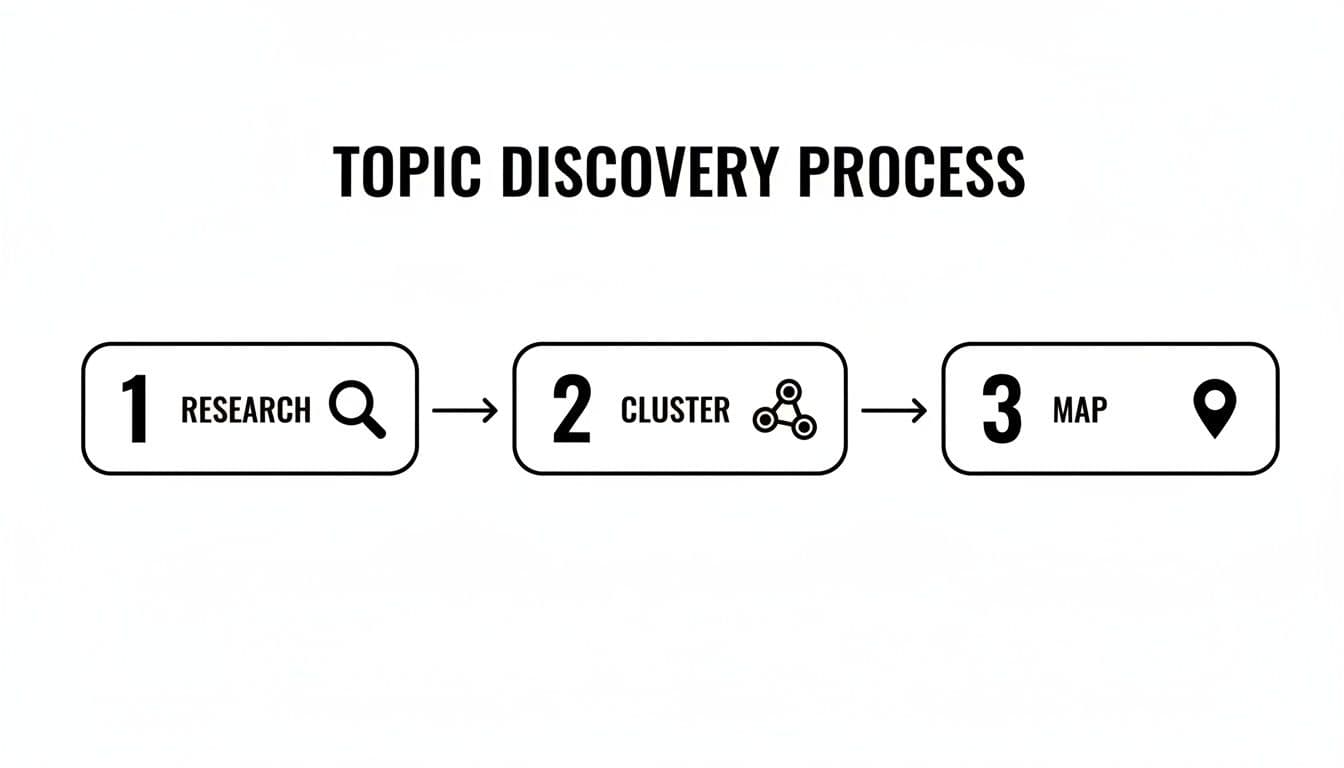
This process visualizes the logical path from broad research to grouping related ideas and, finally, mapping them into a coherent content plan. Taking this systematic approach is how you avoid creating "orphan" articles that float around aimlessly instead of contributing to your site's overall topical authority.
The B2B Content Brief: Your Cornerstone of Production
If there's one document that can make or break a scalable workflow, it's the content brief. Think of it as the architectural blueprint that guides your writers, editors, and SEO specialists. It ensures everyone is building the same house. For B2B content, a generic, one-page brief just won't cut it. You need to account for a longer sales cycle and a much more discerning, expert audience.
A battle-tested brief needs to get specific. It must include:
- Primary & Secondary Queries: Go beyond a single keyword. List the specific conversational questions and long-tail phrases the article absolutely must answer.
- Target Audience Profile: Who, exactly, are we writing for? Define their job title, their biggest pain points, and what truly motivates them. Is this a CMO thinking about budget allocation, or a developer stuck on an API integration?
- Key Semantic Entities: Identify the non-negotiable concepts, people, products, and organizations that need to be mentioned. This is how you signal real topical depth to search engines.
- Internal Linking Directives: Don't leave this to chance. Specify at least 3-5 existing articles on your site that this new piece must link to. This is how you weave your topic clusters together.
- Structured Data Goals: Clearly state the intended Schema markup from the outset (e.g.,
FAQPage,HowTo,Product) so it can be built into the content, not tacked on as an afterthought.
Getting this level of detail down on paper dramatically cuts down on revision cycles and ensures the final article is primed for search visibility right from the get-go.
Your content brief should be so thorough that a freelance writer who knows nothing about your company could use it to produce a draft that is on-brand and strategically perfect. This isn't about micromanagement; it's about setting your entire team up for a win.
Crafting an AI-Aware Editorial Workflow
With a solid brief in hand, the next piece of the puzzle is designing an editorial process that bakes in modern tools while maintaining impeccable quality. A practical workflow moves through distinct stages, each with a clear owner and a specific job to do. This is especially crucial for effective AI content optimization, as it builds in the necessary checkpoints for strategic alignment.
Here’s what a practical, modern workflow often looks like:
- Briefing: The content strategist or SEO manager puts together the comprehensive brief. This is ground zero.
- AI-Assisted Drafting: The writer doesn't start with a blinking cursor on a blank page. They use a tool like Attensira to generate an initial, AI-optimized draft based on the brief's parameters and identified content gaps. This speeds things up immensely, freeing the writer to focus on adding their unique insights and expertise.
- SME Review: For any technical B2B piece, this step is non-negotiable. An internal subject matter expert (SME) reviews the draft for technical accuracy, depth, and authenticity. They catch the nuances that AI and generalist writers miss.
- Editorial Review: Next, an editor polishes the piece. They're looking at clarity, tone of voice, grammar, and making sure it aligns perfectly with brand guidelines.
- Final SEO & Formatting: Before hitting publish, the SEO specialist does a final check. They implement the specified structured data, fine-tune the metadata, and ensure the formatting is optimized for readability.
By building quality and optimization into the very fabric of your process, excellence stops being a happy accident and becomes a repeatable, scalable outcome.
Mastering On-Page SEO and Structured Data
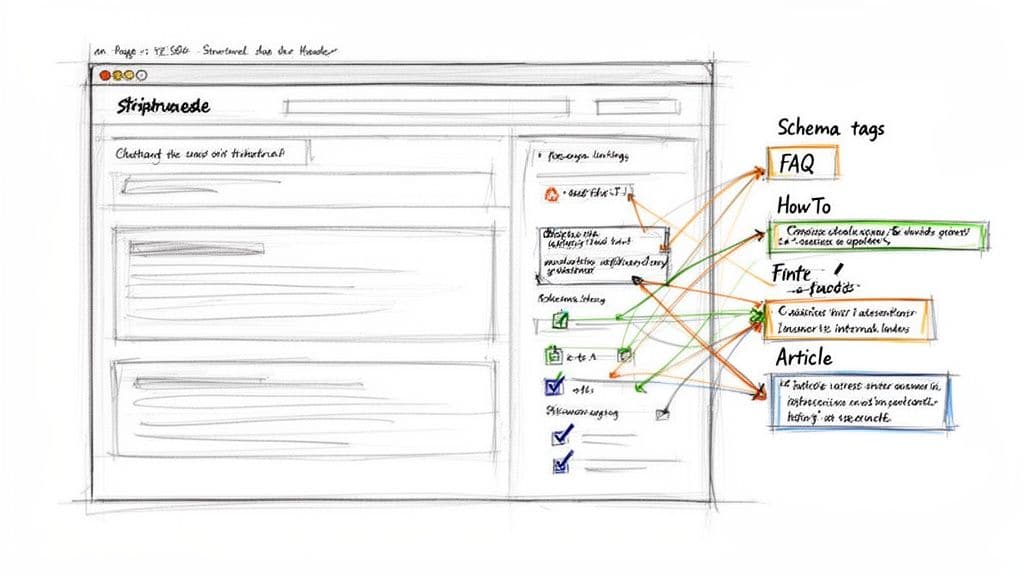
This is the point where all your strategic prep work starts to pay off. On-page optimization has moved way beyond just stuffing keywords into your metadata. It's now about structuring your content so precisely that you give AI-driven search engines clear, unmistakable signals about its purpose and value.
The goal is to make it incredibly easy for algorithms to see not just what your page is about, but who it's for and what problem it solves. That level of clarity is what lands you in rich snippets and AI-generated answers. It’s how you go from being just another indexed page to being the definitive source.
With roughly 1.13 billion websites out there and 252,000 new ones popping up daily, technical precision is a massive competitive advantage. To see where you stand, it's a good idea to get a solid baseline on your site's current health. You can learn more about how to do a website audit before jumping into these more advanced methods.
Speaking the Language of Search with Schema Markup
Structured data, often just called Schema markup, is your direct communication channel with search engines. Think of it as a special vocabulary you add to your HTML that gives explicit context to your content. So instead of making an algorithm guess that you've written a tutorial, you can just label it with HowTo schema.
This simple act removes ambiguity and seriously boosts your chances of being featured in rich results. For B2B brands, certain schema types are especially powerful because they line up perfectly with high-intent content like guides, product pages, and FAQs. You're basically pre-packaging your information so AI can understand and use it instantly.
By implementing comprehensive Schema markup, you are essentially translating your content into a language that machines can understand with perfect clarity. This is the single most effective way to optimize for a future where algorithms are the primary gatekeepers of information.
Essential Schema Markup for B2B Content
Focusing your efforts on the right schema types can give you a real edge. The table below breaks down some of the most impactful options for B2B web content, explaining their purpose and where you can apply them for the best results.
These are the foundational types that cover the majority of B2B use cases and can have an immediate, visible impact on how your content appears in search.
Structuring Content for Scannability and AI
Beyond the code, the actual layout of your content on the page is huge. Both people and AI models prefer content that's easy to scan and digest. That means breaking down complex ideas into logical, bite-sized pieces.
Try structuring your articles to answer questions head-on. Use your target search queries as H2 or H3 subheadings, then provide a direct, concise answer right underneath. This "answer-first" approach is exactly what AI is looking for when sourcing information for generative summaries.
Finally, don't forget to build a strong internal linking network. Every new article is an opportunity to strategically link back to relevant, existing content on your site. This does more than just help users find more of your stuff—it signals your topical expertise to search engines and helps establish your authority across an entire subject area.
Measuring Performance and Refining Your Plan
Once your content is live, the real work begins. Hitting "publish" isn't the finish line; it’s the starting line for measurement and refinement. A great content strategy is a living thing—it has to be tracked, analyzed, and fine-tuned. Otherwise, you’re just throwing resources into the dark, hoping something sticks.
Think of it as a feedback loop. This cycle of analysis and iteration is what elevates your content from a collection of static pages into a powerful, dynamic engine for business growth. It's how you find out what's really working and, more importantly, what isn't.
Defining KPIs for an AI-First World
The old-school metrics still matter. Keyword rankings and organic traffic are fundamental, but they don't paint the full picture anymore. In a world where AI-powered search engines deliver direct answers, your Key Performance Indicators (KPIs) have to get a lot smarter.
Success isn't just about traffic to your site; it's about influence and authority across the web. You need to look beyond your own analytics dashboard to understand how your brand is being represented in these new AI-driven spaces.
To get that complete picture, you need a mix of traditional and modern metrics. I'd recommend tracking these:
- Brand Mentions in AI Answers: This is the new frontier. Tools like Attensira are built specifically to track how often your brand, products, or key people get cited in AI-generated search results. It's a direct measure of trust.
- Topical Share of Voice: Stop obsessing over single keywords. Instead, measure your visibility across entire topic clusters. How frequently do you show up for a whole range of related, conversational questions compared to your competition?
- Click-Through Rates (CTR) from Rich Snippets: When you land a featured snippet or an FAQ rich result, what percentage of people actually click through? A high CTR here tells you your structured data isn't just working—it's compelling.
- Assisted Conversions: How often did a piece of content contribute to a conversion, even if it wasn't the final click? This is crucial for proving the ROI of your top-of-funnel, educational articles.
In the new search landscape, visibility within AI-generated answers is a direct measure of your content's authority and clarity. If AI models trust your content enough to use it as a source, it's a powerful signal that your strategy is working.
Leveraging the Right Tools for Analysis
No single platform gives you all the answers. Effective measurement means pulling together a 360-degree view of your performance by integrating data from a few key sources.
Google Search Console (GSC) is your non-negotiable starting point. It's firsthand data straight from Google. I always tell my team to live in the "Performance" report. Look for pages with high impressions but stubbornly low CTR—those are your low-hanging fruit for a quick content refresh or a meta description rewrite.
Then you have platforms like Attensira, which were designed for this modern search reality. They go beyond your website's data to give you that critical intelligence on your AI visibility. This is how you diagnose why you're not showing up in generative answers and pinpoint the exact content gaps you need to fill.
And of course, your content's journey doesn't stop on Google. A crucial part of refining your plan is mastering social media analytics and reporting to see what themes and formats are actually connecting with your audience on different channels.
A Framework for Quarterly Content Reviews
All this data is useless if you don't act on it. A structured review process is what turns insights into actual improvements. For most B2B teams, a quarterly review hits the sweet spot—it’s enough time to gather meaningful data without letting underperforming content drag you down for too long.
A simple, repeatable framework keeps everyone on the same page and ensures your content strategy stays agile. Here's a four-part process we use:
- Diagnose Underperformers: Start by identifying what's not meeting its goals. Is a blog post getting decent traffic but zero conversions? Is a pillar page failing to rank for its most important queries? Get specific.
- Identify High-Performers: Now, what's crushing it? Dig into your top content to find the patterns. Is it a particular format, a certain topic, or a specific tone of voice that your audience loves?
- Uncover New Opportunities: Your data will show you where to go next. GSC might reveal search queries you're ranking for by accident, pointing to a new topic cluster you can build out intentionally.
- Create an Action Plan: Based on everything you've learned, make a plan. Decide what to update, what to merge, and what new content to create to fill the gaps you've identified.
This cycle creates a system of continuous improvement. If you want to go deeper, we've outlined several other key content performance metrics you should be tracking to make sure your efforts are truly paying off. This structured approach is what separates good content from truly great content.
Got Questions About Creating Web Content? We've Got Answers.
Even with the best playbook in hand, the real world of content creation is full of tricky questions. How do you actually talk to a B2B audience differently than a B2C one? Is AI going to take my job? And the big one: how do I prove any of this is actually working?
These are the questions that come up time and time again. Let’s tackle three of the most common ones head-on, so you can refine your strategy, justify your budget, and get back to creating content that connects.
How Is B2B Content Really Different From B2C?
On the surface, it’s all about providing value. But dig a little deeper, and you'll find that B2B and B2C content creation are two completely different ballgames. The real difference comes down to the buyer's mindset and just how complicated their decision-making process is.
B2B content is built to solve complex business problems. Its job is to earn the trust of a whole committee of people—think the CMO, the Head of Growth, and the Tech Founder—over a sales cycle that can last for months.
This kind of content needs to be:
- Packed with Proof: It leans heavily on hard data, detailed case studies, and original research to build an undeniable business case.
- Deeply Technical: You're not scratching the surface here. This content dives into specific operational headaches and proves you have serious domain expertise.
- Targeted with Precision: We’re often dealing with low-volume keywords, but they carry massive commercial intent. Someone searching for "enterprise data integration platform security" isn't just window shopping.
B2C content, on the other hand, is usually playing to individual emotions and immediate needs. The journey from discovery to purchase is much faster, so the content is designed for broad appeal, social sharing, and quick conversions. The tone is often more casual and personal.
What's the Real Role of AI in the Content Process?
Let's clear this up right away: AI isn't here to replace expert strategists or talented writers. Think of it as a ridiculously powerful assistant—an accelerator that helps you work smarter and faster across the entire content lifecycle.
Here’s where AI really shines:
- Research and Discovery: AI platforms can chew through massive amounts of data to spot emerging trends, find clusters of related questions, and pinpoint content gaps you'd never find manually.
- Outlining and Drafting: Give a good AI tool a detailed brief, and it can spin up a solid outline or a workable first draft in minutes. For example, a platform like Attensira is designed to generate AI-optimized drafts that specifically target visibility gaps, saving your team hours of groundwork.
- Refining and Optimizing: AI can also act as an editor, scanning your content to suggest SEO improvements, boost readability, and sharpen your tone. It polishes the final product for maximum impact.
The human touch, however, is what makes content truly great. The strategy, the industry-specific insights, the creative spark, and the final editorial judgment—that’s what builds a genuine connection with your audience. AI can't fake that.
How Can We Actually Measure the ROI of Our Content?
Proving the ROI of your content means looking past vanity metrics like page views and connecting your work to real business goals. You need a multi-layered view that tracks performance all the way from a first click to a closed deal.
True content ROI isn't just measured in traffic; it's measured in trust. It’s the journey from a prospect finding your helpful article to them becoming a customer because you consistently had the best answers.
To get the full picture, you need to track the right metrics at each stage of the funnel:
- Top of Funnel (Awareness): This is where you'll look at organic traffic, keyword ranking improvements, and new backlinks. A crucial new metric to watch is brand mentions in AI responses, which platforms like Attensira are specifically built to track.
- Mid-Funnel (Consideration): Here, you want to see engagement. Track metrics like time on page, newsletter sign-ups, and downloads of gated assets like whitepapers or e-books.
- Bottom of Funnel (Decision): This is where the money is. Use marketing attribution models to tie content consumption directly to demo requests, qualified leads, and, ultimately, new revenue.
The secret weapon here is integrating your content analytics directly with your CRM. That’s how you trace a customer's entire journey and prove, without a doubt, how your content helped turn them from a stranger into a customer.
Ready to see how your brand appears in AI-driven search and pinpoint your biggest content opportunities? Attensira provides the visibility you need to build a winning strategy. Start tracking your AI presence and get actionable insights to dominate your market. Learn more at https://attensira.com.