Discover what are lsi keywords and how modern AI-driven search uses them; a practical guide to upgrade your SEO strategy.
Let's be blunt: LSI keywords (Latent Semantic Indexing keywords) are simply terms and phrases that are conceptually related to your main topic. The SEO world grabbed onto this term years ago as a way to describe the related words that help search engines figure out what a page is really about.
What LSI Keywords Were Supposed To Be
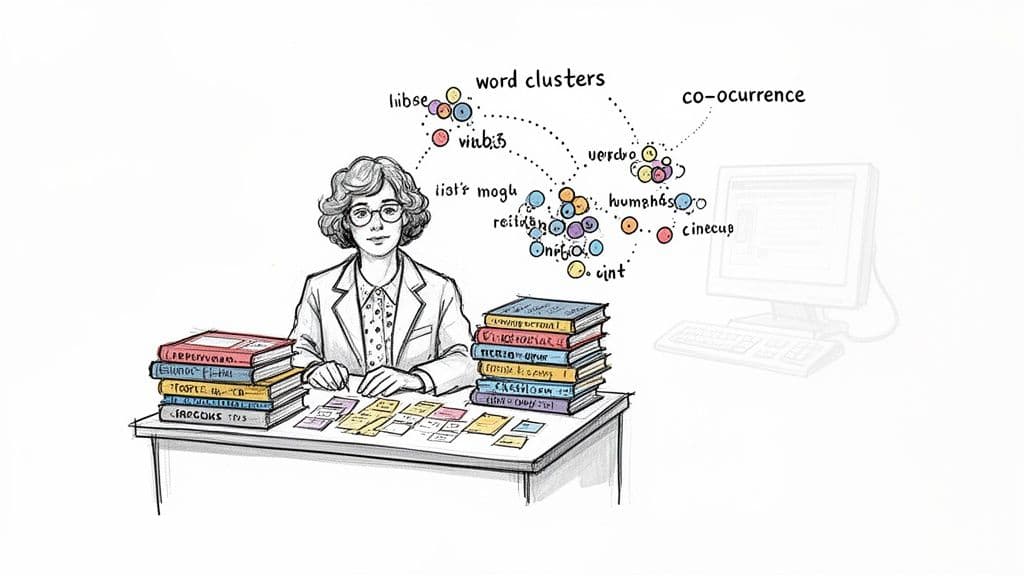
It's time to cut through the noise. The phrase "LSI keywords" is one of the stickiest and most widespread myths in the SEO industry. The core idea—using related terms to build context—is absolutely correct. But the technology it's named after, Latent Semantic Indexing, is an ancient computer science concept from the 1980s that Google has never used for web search.
Think of it like this: LSI was designed to analyze a small, closed set of documents, like a single encyclopedia. It would scan the collection and notice which words tended to show up together, allowing it to guess that "engine" and "transmission" were probably related to "cars." It was a clever solution for its time, but it's primitive by today's standards.
The Myth Collides with Modern Search
So how did this outdated term become an SEO staple? In the early days, as the industry scrambled to move away from damaging practices like keyword stuffing, "LSI" sounded sophisticated and technical. It became a handy buzzword for the simple act of adding synonyms and related phrases to content.
The intention was good, but the name was just plain wrong. Google's own experts have shot this myth down again and again.
"There's no such thing as LSI keywords – anyone who's telling you otherwise is mistaken, sorry." - John Mueller, Google Search Advocate
Modern search engines use something light-years beyond LSI. They run on sophisticated AI and Natural Language Processing (NLP) models that can grasp content with a level of nuance that's getting remarkably close to human understanding.
This isn't just a technicality; it's a fundamental shift in how we need to think about content. The goal isn't to sprinkle in some "LSI terms." The real work lies in building comprehensive, topically rich content that naturally includes the full spectrum of relevant language.
So, what's the right way to think about this?
The answer is semantic SEO. This is the modern, reality-based approach. It’s all about creating content that thoroughly covers a subject, which means you’ll naturally incorporate:
- Synonyms: Different words for the same thing (like "car" and "automobile").
- Related Concepts: The constellation of terms that orbit your main topic (for "car," this would be "brakes," "headlights," "insurance," and "financing").
- User Questions: The actual language people use when they search for information.
From this point on, we're leaving the LSI myth behind. Instead, we'll dive into how modern AI actually interprets your content and show you how to build pages that align with the powerful semantic analysis driving today's search results. It's time to stop chasing a ghost and start building real topical authority.
The Old LSI Myth vs Modern Semantic SEO Reality
The shift from the outdated idea of "LSI keywords" to the current reality of semantic SEO is a critical one for any content strategist. This table breaks down the core differences in thinking and execution.
Ultimately, semantic SEO isn't a trick; it's a commitment to creating genuinely useful content. By understanding this distinction, you can move past outdated tactics and focus your energy on what truly matters: building expertise and serving your audience.
The True Story Behind The LSI Keyword Myth
To get to the bottom of the "LSI keyword" debate, we have to go back in time—way before Google even existed. The story starts in a computer science lab in the late 1980s with a mathematical method called Latent Semantic Indexing (LSI).
Its original job was pretty specific: to help a computer figure out how words relate to each other within a small, static set of documents, like a digital encyclopedia. It was a clever statistical trick for its era, allowing a system to connect "engine" and "transmission" to "car" without any real-world understanding. Think of it as a librarian's index card system for a single, unchanging bookshelf.
How The Myth Took Hold
So, if LSI was an old academic concept, how did it become such a persistent piece of SEO folklore? It all comes down to timing and a need for a better strategy. In the early 2000s, SEO was a messy game of keyword stuffing, and marketers were desperate for something that sounded more sophisticated. "LSI" was the perfect candidate.
The term felt technical, complex, and hinted at some secret knowledge of how search engines worked. SEOs started telling everyone to sprinkle "LSI keywords" into their content. Now, the advice itself wasn't bad—adding topically related terms absolutely makes content more comprehensive—but they had the right tactic for the wrong reason.
The core misunderstanding was applying a system designed for a closed, unchanging database to the wild, chaotic, and ever-expanding internet. A true LSI system would need to re-process the entire web every time a new page was added, a computationally impossible task.
Google Sets The Record Straight
This is where the myth really falls apart. For years, Google’s own engineers have been trying to put this idea to rest, stating publicly that they do not use, and have never used, Latent Semantic Indexing for web search. Their architecture was built on a different, more scalable foundation from day one.
LSI as a technique dates back to 1989, built for finding hidden connections in large text collections. But Google has been clear since at least 2013 that this wasn't their approach. As engineer Maile Ohye and others have confirmed, the web's dynamic nature—with billions of pages added yearly—makes the constant reindexing required by classic LSI completely impractical. You can find a great deep dive into the history of LSI and Google's statements over on Increv.co.
While the SEO world was fixated on LSI, Google was miles ahead, developing its own advanced systems built on synonyms, topic modeling, and eventually, full-blown Natural Language Processing (NLP). The way modern search engines understand context is a world away from the simple indexing process of LSI. You can learn more about how modern AI models interpret information in our guide on how ChatGPT indexes content.
At the end of the day, the LSI keyword is a ghost from SEO's past. It’s a classic case of the industry trying to reverse-engineer a black box with incomplete information. Today, we know better. Winning at search isn't about chasing a mythical list of keywords; it's about creating genuinely comprehensive content that covers a topic from every meaningful angle.
How AI Actually Understands Your Content

Now that we’ve put the whole "LSI keyword" myth to rest, we can dig into what really moves the needle in modern search: Semantic SEO. This is the playbook for how today's incredibly smart, AI-driven search engines figure out what your content is really about—and how relevant and useful it is.
Stop thinking of Google as a simple word-matching tool. A much better way to picture it is as a brilliant researcher who can digest millions of documents in a heartbeat, pick up on the subtle nuances of language, and understand the real intent behind someone's search.
This isn't magic; it’s a field of AI called Natural Language Processing (NLP). NLP is what allows search engines to go beyond just recognizing text on a page and start understanding the complex web of relationships between ideas.
Moving From Keywords To Concepts
The biggest change in SEO over the last few years has been the shift from a keyword-first to a topic-first mindset. When a modern search engine sees the word "Paris," it doesn't just see a string of five letters. It recognizes "Paris" as an entity—a distinct concept with a whole network of attributes and connections.
The AI instantly knows that "Paris" is:
- A city (a type of thing)
- Located in France (a relationship to another place)
- Home to the Eiffel Tower (a related entity)
- Connected to topics like tourism, French cuisine, and art history
So when you write an article about "Paris," the AI isn't just counting how many times you used the keyword. It’s actively checking to see if you also mention related entities like the "Louvre Museum," the "Seine River," or "croissants." Including these related concepts is a powerful signal that your content is comprehensive and authoritative, not just a thin article stuffed with a target keyword.
This forces us to ask a fundamentally different question. We need to stop asking, "What keywords should I add?" and start asking, "Have I covered this topic so completely that I’ve answered all the user's underlying questions?"
This change in perspective is huge because it aligns your content strategy with how advanced AI models like Google's BERT actually work. These systems are built to understand context by looking at the words that come before and after a term, giving them a much richer understanding of meaning than ever before.
Building Topical Authority In An AI-First World
So, what does this actually mean for your day-to-day content strategy? Your primary goal is now to build topical authority. A page with strong topical authority is recognized by search engines as a deeply reliable resource on a subject because it naturally uses the same language and concepts an expert would.
Let's compare two ways to write an article about "cold brew coffee":
- The Old Way (Keyword-Focused): You’d make sure to repeat "cold brew coffee" and variations like "cold coffee drink" over and over again.
- The Modern Way (Semantic SEO): You’d create a complete guide that naturally talks about things like "coarse grind," "steep time," "filtration methods," "acidity levels," and "ideal water temperature."
The second approach is infinitely more powerful. It proves genuine expertise and satisfies a much broader range of user needs. As AI gets even better at understanding content, the foundational concepts of Search Engine Optimization (SEO) keep shifting away from old-school keyword tactics toward this more holistic, topic-based model.
At the end of the day, semantic SEO isn't about checking boxes. It’s about truly becoming the best possible answer for a user. When you create in-depth, well-organized content that explores a topic from all angles, you're giving the AI exactly the signals it needs to see your page as a top-tier result. To learn more about how to optimize your content for these advanced systems, check out our guide on AI search optimization.
Finding and Using Semantically Related Concepts
Alright, now that we’ve cleared up the theory and busted the myths, it’s time to get practical. The game isn’t about hunting down some mythical list of "LSI keywords" anymore. Instead, the real goal is to think like a subject matter expert and build a resource so thorough it leaves no question unanswered for your audience. That's what signals true authority to today's search engines.
The best part? You don’t need a bunch of complicated, expensive software to get started. Google itself gives you some of the most powerful clues for uncovering the web of concepts connected to your main topic. You just need to know where to look and how to interpret what you find.
Uncovering Concepts with Google's Own Tools
Honestly, the Google search results page is a goldmine for understanding what users are really looking for. If you pay close attention to the hints it drops, you can build an incredibly robust content outline that covers the full spectrum of a user's needs.
Here are the built-in features you should be using:
- People Also Ask (PAA): This box is a cheat sheet. It shows you the immediate follow-up questions real people have about your topic. Every single one is a potential subtopic for your content.
- Related Searches: Scroll down to the bottom of the page. This section shows you what people search for next. These terms often reveal different angles or more specific queries you might have missed.
- Autocomplete Suggestions: As you type into the search bar, Google tries to finish your thought. Those suggestions are direct insights into how people frame their questions and what they expect to find.
By systematically pulling ideas from these spots, you can shift from a narrow, single-keyword focus to mapping out the entire topical universe your audience lives in. This is the foundation for creating genuinely comprehensive content.
Analyzing Top-Ranking Content
Your next move is to see what's already winning. The pages ranking at the top for your target topic are your roadmap—Google has already given them a stamp of approval as high-quality, relevant resources. Your job is to reverse-engineer why they’re so successful.
As you analyze the top three to five results, look for common themes and subtopics they all cover. Don't just skim the headings; actually read the content to get a feel for the depth and nuance they offer. Ask yourself:
- What specific questions are these articles answering?
- Are there common examples, stats, or case studies that pop up in all of them?
- What related concepts do they bring in naturally to explain the main idea?
This isn’t about copying what your competitors did. It's about figuring out the "table stakes"—the baseline information any great article on this topic must include. From there, you can find your opening to go deeper, offer a unique perspective, or provide better, more practical examples.
Weaving Concepts into Your Content
Once you have your list of related concepts, entities, and user questions, the final step is to integrate them naturally into your writing. The goal is to create a seamless, valuable experience for the reader, not to mechanically stuff a checklist of terms into the text.
The real art of semantic SEO is building a narrative that flows logically from one concept to the next, guiding the reader through the topic in a way that feels intuitive and helpful.
Let’s say your core topic is “B2B content marketing.” Instead of just hammering that phrase over and over, a semantically rich article would naturally weave in discussions about:
- Sales Enablement: How content can be a powerful tool for the sales team.
- Customer Journey Mapping: How different types of content fit into different stages of the buying process.
- Account-Based Marketing (ABM): How to create hyper-personalized content for high-value accounts.
- Lead Generation Funnels: The specific role content plays in attracting and nurturing leads.
By including these related ideas, you're not just optimizing for a keyword; you're demonstrating a deep, expert-level grasp of the subject. This satisfies a much wider range of user intents and sends powerful authority signals to search engine AI. Since the rollout of BERT and the rise of advanced NLP models, we've seen that pages strategically enriched with related concepts can rank for 50+ long-tail queries on average.
To really nail this, you need to use the right tools for the job. Beyond what Google offers, dedicated platforms can speed up your research and give you deeper insights. Finding the best SEO tools for your workflow can make all the difference, helping ensure your content isn't just optimized, but genuinely authoritative.
Measuring The Success Of Your Semantic Strategy
It's one thing to build a semantic strategy, but it’s another to prove it’s actually working. The impact can feel a bit fuzzy if you're stuck on old-school metrics. To really see the value, you have to stop obsessing over a single primary keyword and start looking at the bigger picture: building broad topical authority.
The old way was simple and linear: pick a keyword, write about it, and watch its rank like a hawk. Today, that approach is far too narrow. A single, semantically rich page is a powerhouse asset that can—and should—rank for hundreds, sometimes even thousands, of related search queries. That's where the real ROI is.
Shifting To Topical Performance Indicators
Instead of fixating on one keyword's position, you need to track KPIs that show the overall health and authority of the page itself. This gives you a much truer sense of how search engines see your content and its ability to cover a topic from every angle.
Here are the metrics that really matter:
- Total Number of Ranking Keywords: This is your north star. Using a tool like Google Search Console or Attensira, you can see just how many unique queries a single page is showing up for. If you've done your job right, this number will climb steadily over time.
- Organic Traffic Growth to the Page: Don't get lost in sitewide traffic numbers. Zoom in on the specific page you've optimized and watch its organic traffic. An upward trend is a clear signal that its growing keyword footprint is pulling in more searchers.
- Engagement Signals: Don't sleep on metrics like Time on Page and a low Bounce Rate. These are your proof points. They tell Google that when people land on your page—no matter which of the hundreds of queries they used—the content is good enough to keep them there.
This process isn't just a one-and-done task; it's a continuous loop of refining your content based on what the data tells you.
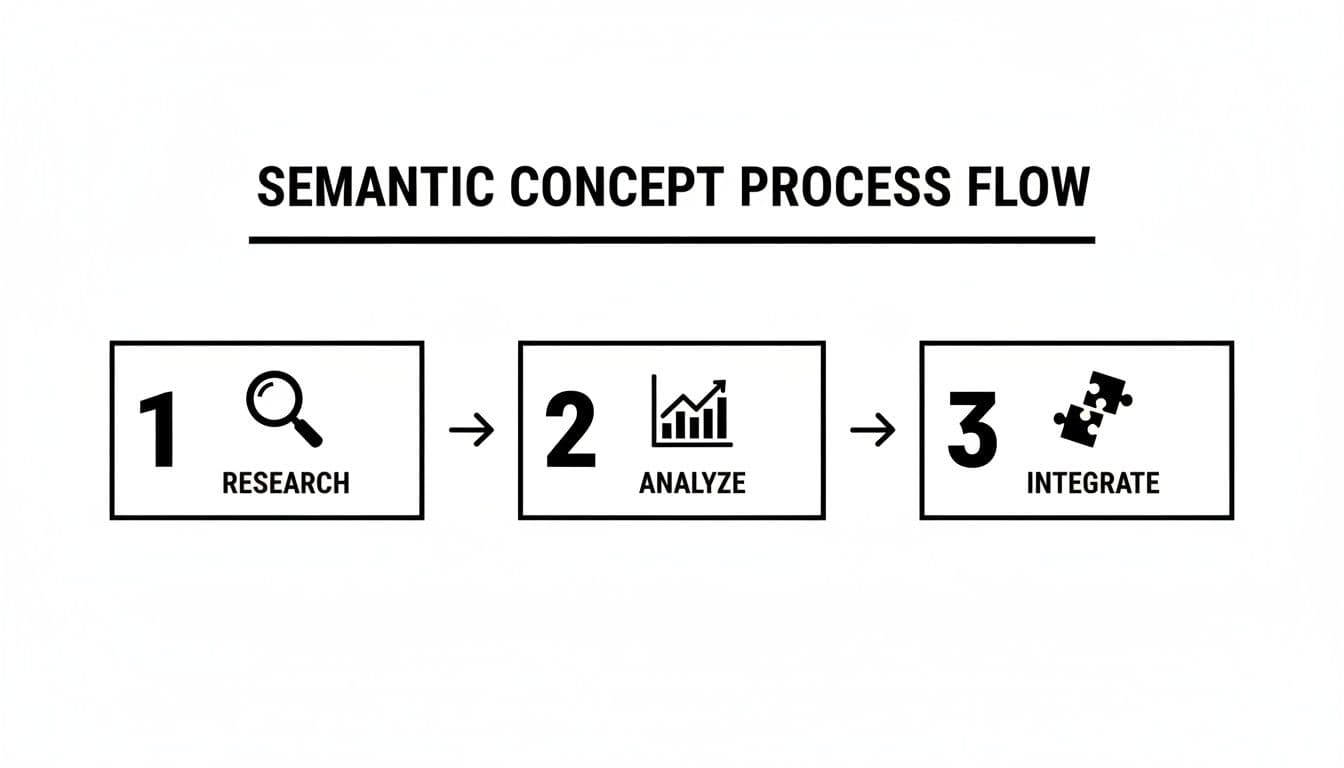
This flow from research to integration really drives home that a successful strategy is a cycle of constant analysis and improvement.
Connecting Metrics To Business Goals
These SEO metrics aren't just vanity numbers; they paint a clear picture of performance. When a single page ranks for 500+ keywords instead of just five, it becomes a powerful engine for your business. It captures people at every stage of their journey, from those asking broad questions to those ready to make a decision.
The real win is when a single piece of content becomes a magnet for a whole spectrum of relevant traffic. This is how you know you've built topical authority that search engines trust and reward.
For a deeper dive into the specific KPIs and tools you'll need, check out our guide on monitoring SEO performance. Properly tracking these broader metrics is the only way to measure the success of a modern, semantic-first strategy. When you focus on the total keyword footprint and user engagement, you can finally prove the true value of creating comprehensive content that truly serves your audience.
How To Position Your Brand In AI-Powered Search
The familiar world of ten blue links is giving way to a single, AI-generated answer. With conversational AI and experiences like Google's Search Generative Experience (SGE) taking center stage, the very definition of search success is being redrawn. Simply landing on page one isn't the finish line anymore.
The real prize now is to become a cited source—the trusted authority whose expertise is woven directly into the AI's response. This is the next frontier of visibility. It’s about making sure your brand isn't just another result, but the foundation of the answer itself.
From SERP Visibility To AI Integration
For years, SEO was a game of winning a click from a Search Engine Results Page (SERP). The new challenge? Winning the AI's trust so your content gets featured in its generative summary. When someone asks a complex question, the AI pulls information from the best sources to craft a direct answer on the spot.
If your content provides the clearest, most thorough explanation, your brand gets the credit. Suddenly, your business becomes a primary source of truth for both the user and the AI.
Being featured in an AI-generated answer is more than just a mention; it's a powerful endorsement. It positions your brand as an authoritative leader in your field, building credibility at a critical point in the user's journey.
This is exactly where a deep understanding of semantic relationships pays off. AI models depend on identifying entities, understanding context, and connecting related concepts to build their answers. A page that's already built on a strong semantic SEO foundation is perfectly structured to be understood and used by these systems.
Navigating The New Search Landscape
This evolution requires a whole new way of thinking about performance and a new set of tools to match. Tracking keyword rankings alone doesn't cut it when the real measure of success is your presence inside AI-generated responses. You need to know:
- When is my brand mentioned? Are you being cited as an authority for the core topics in your industry?
- What content is driving these mentions? Pinpointing which pages the AI models find most valuable helps you double down on what works.
- Where are the content gaps? Seeing which user questions don't feature your brand reveals clear opportunities to create new, targeted content.
This is precisely the problem platforms like Attensira are designed to solve. By monitoring your brand’s presence across AI-driven search environments, you get the insights needed to adapt and win. It's no longer just about tracking "LSI keywords" in a vacuum, but about measuring your brand's entire semantic footprint.
Ultimately, positioning your brand for AI-powered search means leaving outdated tactics behind. It requires a serious commitment to creating genuinely authoritative content that covers topics from every angle. This semantic approach ensures your expertise isn't just visible on a SERP, but is integrated into the fabric of the answers users receive, making it a cornerstone of modern brand strategy.
Frequently Asked Questions
Even after busting the myths, I get it—moving from old-school "LSI keywords" to modern semantic SEO can still feel a bit fuzzy. Let's clear up some of the most common questions so you can put these ideas to work with confidence.
Are LSI Keywords Still Relevant For SEO?
In a word, no. The term "LSI keywords" is a ghost from the past, built on a misunderstanding of a technology Google never actually used for web search. It's one of those SEO myths that just won't die.
That said, the idea people were trying to get at—covering a topic thoroughly—is more critical than ever. We just have a better name for it now: Semantic SEO. It's all about building genuine topical authority, not chasing a phantom algorithm.
How Is Semantic SEO Different From Keyword Stuffing?
They're polar opposites. Keyword stuffing is that old, clumsy trick of shoving the same keyword into a page as many times as possible. It reads terribly, offers zero value, and search engines have been penalizing it for years.
Semantic SEO, on the other hand, is about weaving a rich tapestry of related concepts, synonyms, and answers to real user questions into your content.
Think of it this way: keyword stuffing is like a broken record, repeating the same note over and over. Semantic SEO is like a symphony, where different instruments (related concepts) come together to create a full, satisfying piece of music.
One approach is manipulative and harms the user experience; the other enriches it by providing real depth and context, signaling true expertise to search engines.
What Is The Best Way To Implement A Semantic SEO Strategy?
The most powerful shift you can make is to stop thinking about a single keyword and start thinking about the entire topic. Your goal is to become the go-to resource on that subject.
Here’s a practical way to approach it:
- Choose Your Topic: Don't just pick "running shoes." Think bigger: "choosing the right running shoes for beginners."
- Become a Detective: Dive into Google's "People Also Ask" and "Related Searches" sections. These are goldmines of real questions and connected ideas your audience has.
- Study the Competition: Look at what the top-ranking pages are doing. What sub-topics do they all cover? That's your table stakes.
- Create the Definitive Guide: Build an outline that answers every question and covers every important angle you found. Your mission is to create the single most helpful page on the internet for that topic.
This process builds content that doesn't just chase a ranking—it earns authority that modern, AI-driven search engines are built to recognize and reward.
Ready to see how your brand appears in AI-driven search? Attensira provides the actionable insights you need to optimize your content, track your visibility in AI responses, and stay ahead of the curve. Start monitoring your AI presence today at https://attensira.com.