Master modern SEO visibility search metrics. This guide explains rankings, share of voice, and how AI is transforming B2B search strategy and measurement.
When we talk about SEO visibility, we're looking at a set of search metrics that paint a picture of your brand's total presence on the search engine results page (SERP). These aren't just vanity numbers; key performance indicators like impressions, keyword rankings, and share of voice tell you how often—and how prominently—your brand shows up when potential customers are looking for answers. It's about measuring your digital footprint beyond just website traffic.
What SEO Visibility Metrics Actually Reveal
Let’s get beyond the textbook definitions. True search visibility isn't just about snagging the number one spot for a single keyword. It’s a measure of your brand’s total digital real estate across the entire search landscape.
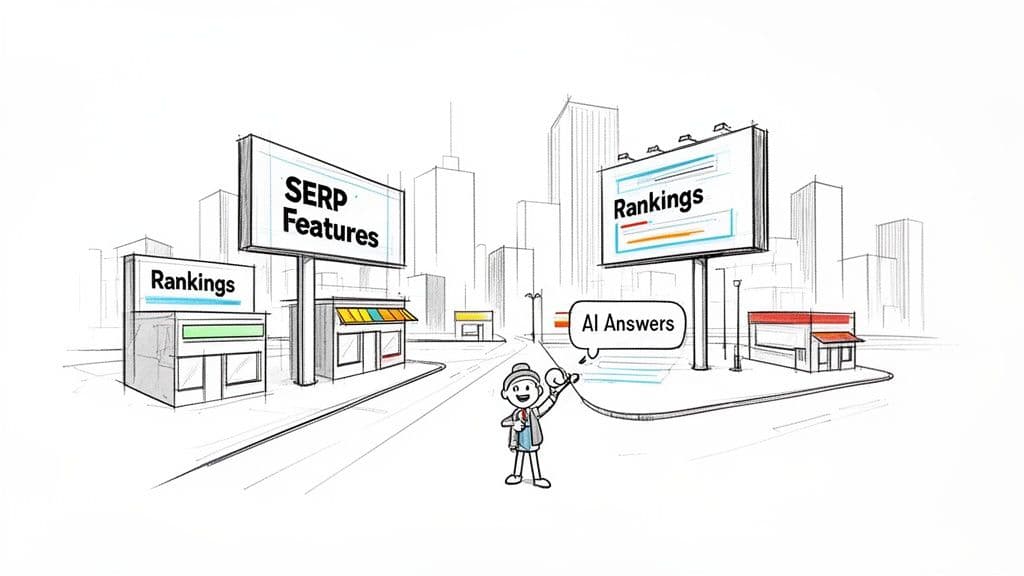
Imagine the SERP is a bustling city. Your keyword rankings are like having storefronts on different streets. That's a great start, but to really own the city, you need more. You need billboards (think SERP features like featured snippets and video carousels) and to be the trusted local guide everyone recommends (that’s your brand being cited in AI Overviews). This multi-faceted presence is what modern SEO visibility is all about, and it's a critical concept for B2B marketers to grasp as old metrics lose their meaning.
Visualizing Your Digital Real Estate
To really get a feel for this, think about how all these different pieces come together to build your overall presence. It’s a powerful mix of classic rankings, eye-catching SERP features, and the new frontier of AI-powered answers.
This diagram breaks down how these core components contribute to a strong digital presence in search.
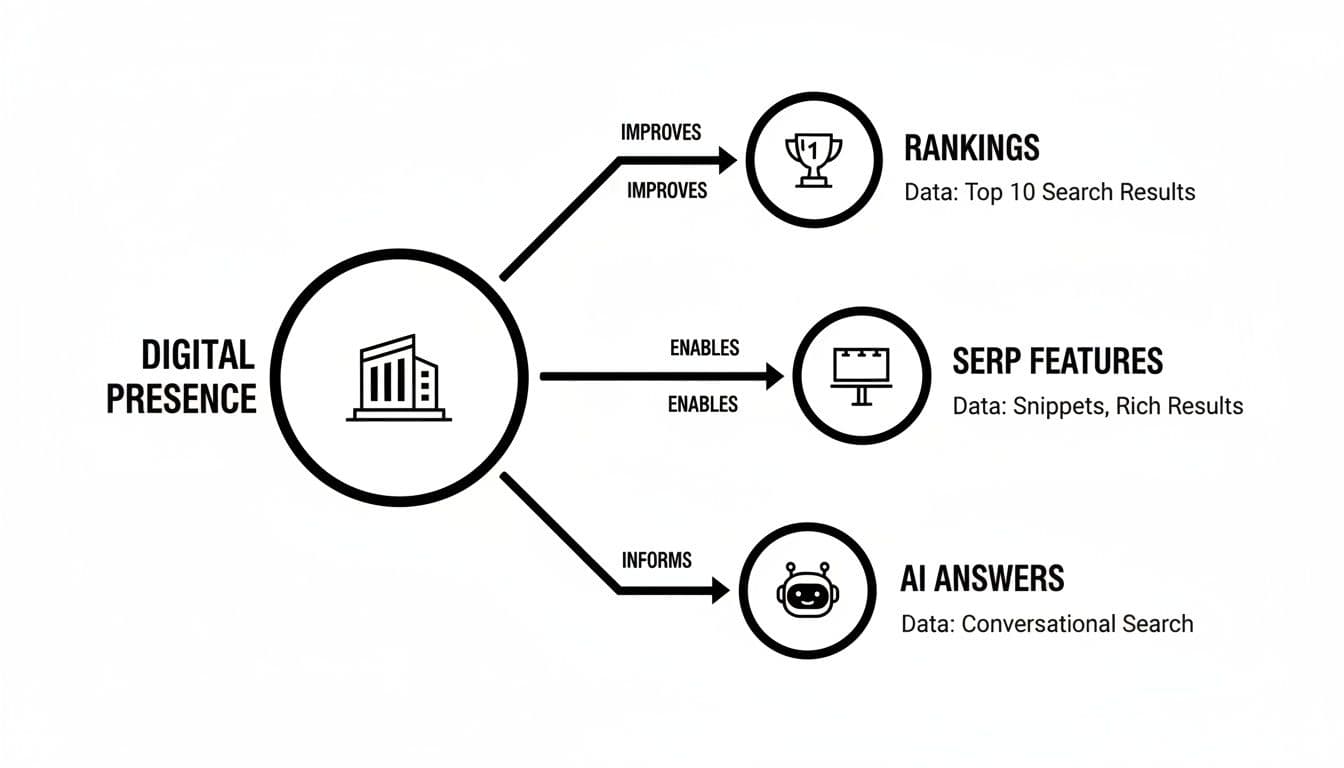
As you can see, a holistic strategy has to account for winning not just the traditional "blue links" but also those valuable placements in on-SERP elements and AI-generated responses.
Why Old Metrics No Longer Tell the Full Story
Here’s the fundamental challenge for B2B marketers right now: the game has completely changed. For years, clicks and traffic were the holy grail. But what happens when an AI Overview gives a user a perfect, direct answer? They might not need to click through to your website at all.
Does that mean your content failed? Absolutely not.
If your brand was cited as the source in that AI answer, you’ve just won a massive visibility and authority-building moment. The problem is, this crucial interaction is completely invisible to traditional analytics tools that only care about website visits. This is where we have to evolve our thinking.
The goal is shifting from merely driving clicks to owning the conversation wherever it happens. Success is now measured by your brand’s ability to be the authoritative source, whether that’s in a search result, a featured snippet, or an AI-generated summary.
Among the most important indicators of your market standing, effective Share of Voice measurement is one of the best ways to quantify your brand's prominence against competitors in this new context. If you want to dive deeper into the basics, you can explore our detailed guide on what is SEO visibility.
This new reality sets the stage for a more sophisticated way to measure our impact, one where simply appearing in the right context can be just as valuable as earning a click.
To help put this all into perspective, here's a quick look at the metrics that matter most today.
Key SEO Visibility Metrics at a Glance
This table summarizes the essential SEO visibility metrics—both traditional and emerging—and explains why each one is critical for a modern B2B strategy in a world increasingly shaped by AI.
Understanding these metrics is the first step. The next is learning how to track, interpret, and act on them to build a winning strategy that accounts for how search works today, not how it worked five years ago.
Getting the Foundations of Search Visibility Right
Before we dive into how AI is changing the game, it's crucial to have a rock-solid grasp on the fundamentals. These classic SEO visibility search metrics are the building blocks of any smart strategy. Without them, you’re flying blind.
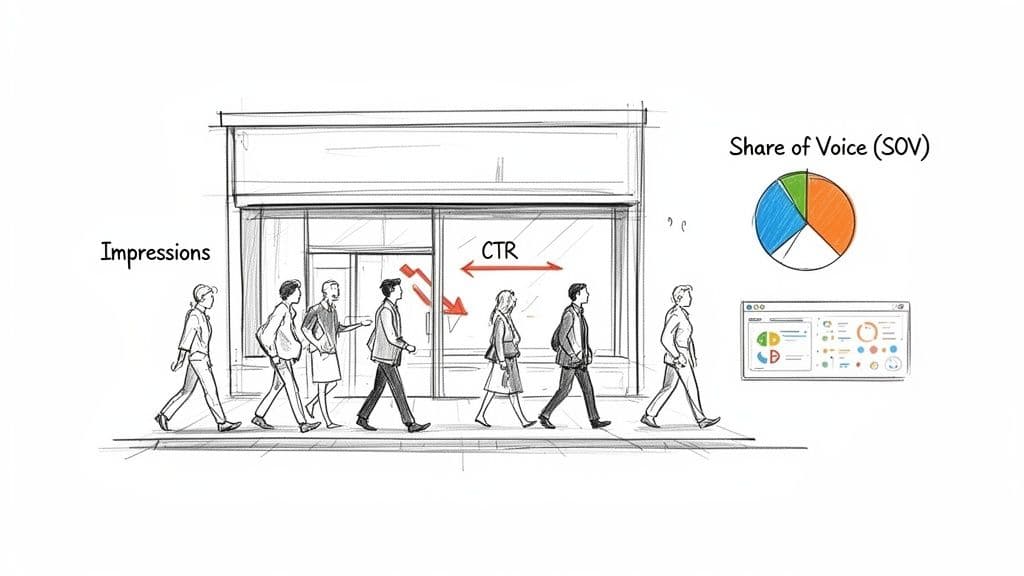
Let's start with a simple analogy. Think of Impressions as the total foot traffic passing by your digital storefront. You can find this number right in Google Search Console, and it tells you the size of your potential audience. It’s the broadest measure of awareness you have.
From there, we look at Click-Through Rate (CTR). This is the percentage of people who saw your storefront and decided to walk in. A ton of impressions is great, but a high CTR means your window display—your title tag and meta description—is actually convincing people to come inside.
These two metrics give you a basic picture of how users interact with your brand on the search results page. But real visibility isn't just about your own numbers; it’s about where you stand in a crowded market.
Understanding Your Place in the Market
You don't do SEO in a vacuum. To get the full picture, you need metrics that add competitive context, which is where things like keyword rankings and Share of Voice come in.
Keyword Rankings tell you your exact street address for a specific search. Are you on the main drag in position #1, or are you tucked away on page three where no one looks? Even as the value of a #1 ranking evolves, knowing where you stand for your most important, high-intent keywords is still a vital diagnostic. It shows you where you're winning and where a competitor is eating your lunch.
But be careful. It's easy to get caught up chasing individual rankings. A #1 spot for a "vanity" keyword that no qualified customer actually searches for is like having a gorgeous storefront on a deserted street—it looks good, but it does nothing for the business.
That’s why we need a metric that looks at the bigger picture.
Share of Voice (SOV) is that bigger picture. It moves beyond single keywords to measure your brand’s total visibility across an entire set of strategic terms compared to your rivals. It answers the one question that really matters: "Of all the important conversations happening in our space, how much of that conversation do we own?"
To really dig in and make these metrics work, you first have to understand the core concepts. If you're new to this, take some time to learn what is search engine optimization and see how all these pieces fit together. Knowing that is the key to interpreting your data correctly.
Turning Raw Data into Smart Decisions
Just collecting this data isn't enough. The real magic happens when you interpret it to make better decisions. Tools like Google Search Console are fantastic for pulling the raw numbers on impressions, CTR, and average position.
But to truly get a handle on these foundational metrics, you have to connect them to what the business actually cares about. Here’s how you can start turning data into a real strategy:
- Low CTR on High-Ranking Keywords: You’re ranking in the top three, but your CTR stinks. This is a huge red flag that your messaging is off. It’s a direct signal to start testing new title tags and meta descriptions that better align with what searchers want.
- High Impressions, Low Rankings: You’re seeing tons of impressions for keywords where you’re stuck on page two or three. Good news: Google sees you as topically relevant. Bad news: you don't have enough authority to crack the first page. This insight should immediately point your efforts toward content improvements and building quality backlinks.
- Declining Share of Voice: Your SOV is slipping, even if some of your individual rankings are holding steady. This means your competitors are getting more aggressive and winning more of the overall search landscape. It’s time for a competitive content audit to find out where they're beating you and how to close those gaps.
When you start analyzing patterns like these, you stop being a reporter of numbers and become a strategist. You're using foundational SEO visibility search metrics to spot weaknesses and jump on opportunities. Nailing this analytical approach is what gives you the stable footing you need to adapt as AI continues to rewrite the rules of search.
How AI Is Reshaping Search Metrics
The foundational metrics we’ve covered so far give you a solid baseline, but the ground is shifting right under our feet. The rise of AI-driven search, especially with Google's AI Overviews, isn't just another algorithm update—it’s a fundamental change in how people find information. And that means we have to change how we measure our own SEO visibility and search metrics.
This is the point where classic SEO playbooks collide with a new reality. User behavior is changing fast. If your measurement strategy doesn't keep up, you'll be stuck measuring the past while your competitors are busy winning the future.
The old, comfortable model of "rank, click, convert" is quickly becoming obsolete for a huge chunk of searches. Think about it: when an AI summary spits out a direct answer at the very top of the page, the user's journey often ends right there. They never even have to scroll down to the traditional blue links.
The Declining Value of a Number One Ranking
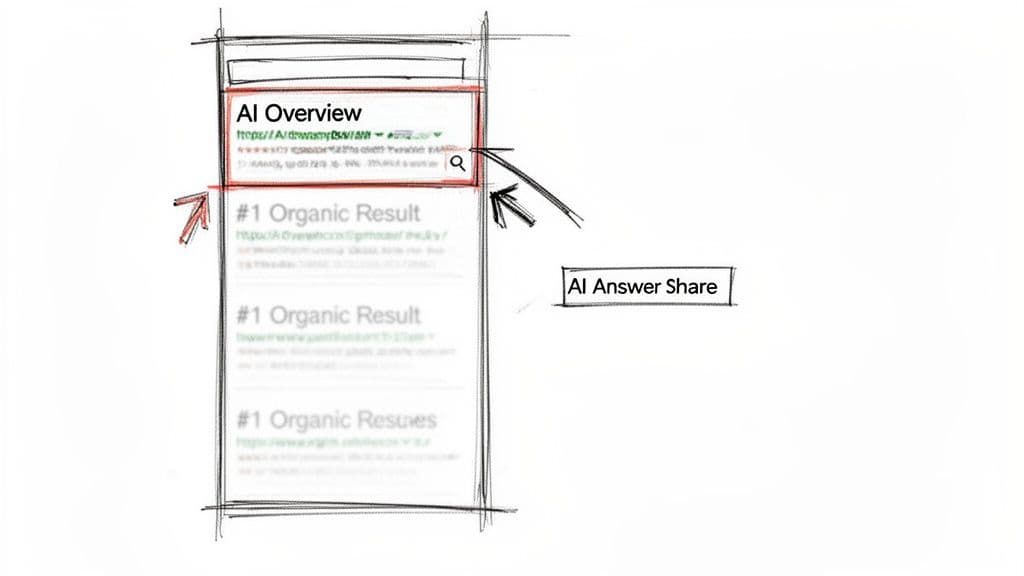
For years, getting that #1 organic spot was the holy grail of SEO. It practically guaranteed you the most visibility and, usually, the lion's share of clicks. But what is that top spot really worth when an AI Overview sits above it, creating a new "Position Zero" that answers the user's question before they even see your listing?
The impact is already stark and measurable. In this new search world, AI Overviews appeared in 47% of Google searches as of 2025—a massive shift that is completely upending performance benchmarks. We're seeing this lead to a 15-25% drop in organic traffic for the traditional results below these summaries.
Even more alarming for anyone focused on clicks is the frequent 50%+ nosedive in CTR when an AI Overview dominates the SERP. This data forces us to ask a tough question: if a click is no longer a given, what are we even optimizing for?
The new goal is to become the source. Success isn't just about ranking anymore; it's about being the authoritative voice that an AI engine trusts and cites in its generated answers. It's a shift from winning the SERP to winning the conversation.
This strategic pivot demands a new set of metrics built for this new reality.
Introducing AI Answer Share
To actually measure success in this environment, we need a new KPI: AI Answer Share. This metric calculates the percentage of time your brand's content is cited, mentioned, or directly used as a source within AI-generated summaries for your key topics and keywords.
You can think of it as the Share of Voice for the age of AI. It's a direct measurement of your brand's authority and presence inside the answers people are increasingly turning to. A high AI Answer Share is proof that you're successfully positioning your content as the definitive source. You can learn more about how to improve your AI search visibility in our detailed guide.
Of course, tracking this requires a completely new approach and tools that can specifically monitor AI responses, which your standard rank tracker simply can't do.
The Rise of Generative Engine Optimization
This new measurement framework is one piece of a much larger strategic discipline known as Generative Engine Optimization (GEO). Unlike traditional SEO, which is all about optimizing for web crawlers to earn a high ranking, GEO is about optimizing your content to be understood, trusted, and synthesized by large language models (LLMs).
The core principles of GEO aren't magic. They revolve around:
- Clarity and Factual Accuracy: AI models are built to prioritize content that is clear, well-structured, and factually verifiable. Ambiguous language or poorly sourced claims are quickly discarded.
- Authoritative Signals: You have to demonstrate expertise. This comes from comprehensive content, clear authorship, and a strong backlink profile that signals to an AI that your information is trustworthy.
- Structured Data: Using Schema markup and other forms of structured data is like giving the AI a cheat sheet. It helps models understand the context and key entities in your content, making it far easier to parse and use in a summary.
Optimizing for GEO means shifting your content strategy from simply answering a question to providing the best, most authoritative, and most easily digestible answer online. Your content has to be so compelling and well-supported that an AI model has no choice but to conclude it's the most reliable source to show its users. By embracing GEO and tracking metrics like AI Answer Share, you can adapt your strategy and thrive in this reshaped search world.
Building a Modern B2B Reporting Framework
Knowing how SEO visibility search metrics are changing is one thing, but actually using that insight is a whole different ball game. To really prove your work is paying off in an AI-driven world, you need a reporting framework that looks past vanity metrics. It has to speak the language of the business: leads, pipeline, and revenue.
For B2B companies, that means building a tiered reporting structure that tells a complete story. It starts with the basics and builds up to show how you’re preparing for the future of search. This way, every stakeholder—from the hands-on SEO specialist to the CMO—gets the data they need in a way they can actually understand.
This isn’t just about organizing data. It’s about crafting a narrative that draws a straight line from your SEO activities to the company’s bottom line.
Tier 1: Foundational Performance Metrics
This is the bedrock of your report. It covers the vital signs of your SEO program, the kind of stuff your team should be checking weekly to catch trends and put out fires. These metrics answer a simple question: "Are people finding us, and are they taking action?"
- Organic Traffic: The raw number of people coming to your site from unpaid search results. It's still a fundamental measure of your overall reach.
- Keyword Rankings: Where you stand for a handpicked list of high-intent, bottom-of-funnel keywords. These should be the terms that map directly to your products and services.
- Organic Traffic Conversions: The number of leads, demo requests, or sign-ups that came from search. This is the first, most critical connection between SEO and revenue.
Tier 2: Advanced Visibility Metrics
Here’s where we elevate the conversation from simple performance to market context. These are the metrics you should review monthly to see how you’re really doing against the competition. They answer a much more strategic question: "Are we winning our market?"
Think of this tier as your competitive battleground report. It’s not just about how you're doing; it's about how you're doing relative to the rivals you need to beat. That context is what turns raw data into strategic intelligence.
Key metrics to watch here include:
- Share of Voice (SoV): Your brand’s visibility percentage across a strategic set of keywords compared to your top 3-5 competitors. A rising SoV is a direct signal of growing market leadership.
- SERP Feature Presence: How often you show up in things that aren't the standard blue links, like Featured Snippets, "People Also Ask" boxes, and video carousels. Owning these is how you dominate the most valuable real estate on the page.
Tier 3: Future-Ready AI Metrics
This final tier is your forward-looking dashboard. It shows you’re not just keeping up, but actively preparing for the next chapter of search. Tracking these emerging metrics monthly helps you understand your influence in AI-powered results and answers the most important question of all: "Is our brand becoming the source of truth for AI?"
This is where you report on:
- AI Answer Share: The percentage of time your brand is cited or sourced within AI Overviews for your most critical topics. This is the ultimate proof of topical authority.
- Brand Mentions in AI: The raw count of unlinked mentions of your brand within AI-generated answers. This is a powerful proxy for brand recall and authority.
When you structure your reporting this way, you create a powerful communication tool. Specialists get the nitty-gritty details they need from Tier 1. Executives see the competitive landscape in Tier 2 and the strategic vision in Tier 3. For a deeper look at this, you might find our guide on building a comprehensive search engine marketing reporting strategy helpful.
Ultimately, this tiered framework turns your SEO report from a data dump into a strategic asset that proves exactly how visibility drives business growth.
How to Track and Amplify Your AI Visibility
Knowing how AI search works is one thing; actually doing something about it is another. The reality is that clicks are disappearing and AI Overviews are here to stay. This might seem like a threat, but for brands willing to adapt, it's a massive opportunity. The trick is to start using tools and strategies built for this new world—ones that can measure and influence your brand’s presence inside AI-generated answers.
This means your old rank tracker and analytics setup just won't cut it anymore. The questions we need to answer have changed. Now, it's about, "Is my brand actually being cited in AI responses?" and "Which of my competitors is dominating the conversation around my most important topics?" Answering these questions is how you turn all this uncertainty into a real competitive edge.
From Insight to Action
Let's make this tangible. Say you’re a B2B SaaS company that sells cybersecurity solutions. You run a quick analysis and discover your brand has absolutely no visibility in AI answers for "enterprise ransomware protection," but your main competitor is cited every single time. That’s not just a data point to shrug at; it’s a glaring hole in your business intelligence.
But an insight like that also gives you a clear path forward.
- Find the Gaps: First, you pinpoint the exact queries where your competitors are getting sourced by AI models and you're invisible.
- Analyze Their Winning Content: Next, dig into the specific pages that are earning them those citations. Is it a long-form guide? A data-heavy research report? Maybe a super-clear FAQ page?
- Build Something Better: Armed with that knowledge, you create your own piece of authoritative content designed to fill that gap. Make it factually dense, structure it logically, and ensure it answers the user’s question more thoroughly than the competition.
- Track and Adjust: After you hit publish, the work isn't over. You have to continuously monitor your AI Answer Share for that topic to see if your new content is working and make adjustments as needed.
Following a process like this transforms your content strategy from guesswork into a precise, data-backed operation.
Securing Your Place in AI Search
This shift isn't just a niche trend; it's backed by some serious market growth that demands a hybrid approach to SEO. The global SEO market is on track to hit 106.15 billion** by 2030, while the specialized AI SEO segment is projected to explode to **3.06 billion by 2033. And here's the kicker: recent data shows that 28% of the pages most cited by ChatGPT have zero organic visibility on Google. This is proof that AI is carving out entirely new paths to authority that exist outside of traditional rankings. You can dig into more of this data in the latest SEO industry statistics.
By proactively managing your presence in AI-driven search, you're not just playing defense against traffic loss—you're building a new, more resilient kind of authority. Becoming the go-to source for AI is the most durable competitive advantage you can have in search today.
This isn't just about clawing back a few lost clicks. It's about cementing your brand as the definitive source of truth in your field. It's about making sure you’re the one shaping the conversation, even if a user never clicks through to your website. Using a dedicated search visibility tracker that understands these new dynamics is no longer a nice-to-have. For any B2B brand that's serious about growth, it’s absolutely essential.
A Few Lingering Questions About SEO Visibility
Even with a solid framework in place, some practical questions always pop up when you're in the trenches measuring and improving SEO visibility. Let's tackle a few of the most common ones I hear from B2B marketing teams. Think of this as a quick reference guide to keep you on track.
How Often Should I Be Looking at These Metrics?
For B2B brands, I've found a tiered approach works best. It keeps you responsive to what's happening right now without getting bogged down in meaningless daily noise.
Here’s a good rhythm to follow:
- Weekly: Keep a close eye on your core metrics. This means checking organic traffic and, more importantly, the rankings for your high-intent, bottom-of-funnel keywords. This is your early warning system for any sudden drops or new opportunities.
- Monthly: This is the right cadence for broader metrics like Share of Voice and your presence in SERP features. You need about a month's worth of data to spot any real, meaningful shifts in the competitive landscape.
- Monthly: Also check your AI Answer Share monthly. AI models are constantly changing, so a monthly check-in is essential to see how your brand's authority is holding up in AI-generated results.
- Quarterly: This is when you zoom out for the big picture. Use this time for a full strategic review. How is performance tracking against business goals? What are your competitors up to? It's the perfect time to make significant adjustments to your content plan.
This schedule creates a nice balance between tactical oversight and high-level strategic thinking.
What's a Good SEO Visibility Score?
This is a trick question. There's no such thing as a universally "good" SEO visibility score. The number is completely relative to your industry, your specific market, and who you're up against. Chasing an arbitrary number is a waste of time.
The only way to use this metric effectively is by benchmarking. Pinpoint your top three to five direct competitors and measure your score against theirs, consistently.
A 'good' score is one that is consistently growing month-over-month and actively surpassing your key competitors for the topics that matter most to your business. The ultimate goal is market leadership, so your score should directly reflect your progress toward that objective.
Forget the standalone number. Focus on relative improvement and winning against the competition.
How Do Zero-Click Searches Change How I Measure Success?
Zero-click searches completely flip the script. The goal shifts from earning a click to winning visibility within the search results page itself. This means your reporting and your KPIs have to change, too. You might see your impressions hold steady or even go up, but your organic traffic might not follow suit.
In a zero-click world, success is measured differently. It’s about how often your brand shows up in on-SERP elements like Featured Snippets, People Also Ask boxes, and—the new heavyweight—AI Overviews. The value isn't just in the website visit anymore; it's in the brand exposure and authority you build right there on the search page.
Your reporting needs to reflect this new reality. To get the full story, you need to understand how to build a comprehensive SEO report for your business that incorporates these modern metrics. It’s the only way to demonstrate the true impact of your work, even when it doesn't lead to a click.
Ready to stop guessing about your AI search presence? Attensira provides the critical insights you need to track your AI Answer Share, identify content gaps, and build the authority required to win in the new era of search. Start tracking your true visibility today.