Learn practical tactics to boost ai search visibility and dominate AI-generated answers with actionable SEO insights.
Think of AI search visibility as your brand's ability to show up—and get cited—within the answers generated by platforms like Google's AI Overviews, ChatGPT, and Perplexity. This goes way beyond old-school rankings. It’s about becoming a trusted source that fuels conversational, AI-driven discovery.
Why AI Search Visibility Is Now Essential
Search is evolving, and fast. If traditional SEO was like using a paper map to find your destination by following a list of ranked street names, then AI search is your real-time, voice-guided GPS. It pulls together all the information out there to give you the single best, most direct route.
This isn't just a minor update; it's a fundamental shift in how people find what they're looking for. Queries are no longer just a few keywords. They're complex, conversational questions. For any brand paying attention, this is a critical moment. Being visible isn't just about grabbing the top spot on a results page anymore. It’s about becoming part of the core knowledge AI models use to construct their answers.
The Shift from Clicks to Citations
The very idea of an online presence is being redefined right now. Success used to be a simple game of counting clicks and impressions from a list of blue links. The new currency? Citations and mentions within an AI-generated response.
This change presents both a challenge and a massive opportunity. The hard part is that you can't just rely on the classic SEO playbook anymore. But the opportunity is huge: brands that adapt first will gain a serious edge by directly influencing the information AI systems provide.
The goal is no longer just to rank. It's to become a citable, trusted authority that's worthy of being included in an AI's direct answer. That means a much deeper focus on content quality, structured data, and provable expertise.
The Explosive Growth of AI Search
The urgency here is backed by some pretty stark numbers. We're seeing user habits change at an incredible pace. Imagine a world where your brand’s relevance doesn't depend on where you rank on Google, but on how often you're featured in an AI summary. That world is already here.
Recent data shows a staggering surge in this behavior, with AI search traffic skyrocketing by 527% year-over-year. We're talking about a jump from roughly 17,000 to over 107,000 sessions in the same five-month period. This isn't a trend; it's a mass migration in how people find information. You can dig into more insights about the rise of AI search on semrush.com.
For any business looking to stay competitive, mastering AI search visibility is no longer a "nice to have." It's the first and most important step toward staying relevant in this new era.
How AI Search Engines Redefine Online Visibility
The way AI search works forces us to completely rethink what "online visibility" even means. We're all used to traditional search, where Google gives us a list of ten blue links—a list of potential answers. AI-powered search, driven by Large Language Models (LLMs), does something entirely different. It tries to give you a single, definitive answer.
Instead of just showing you the sources, the AI synthesizes information from dozens, sometimes hundreds, of them to generate one consolidated response. This creates a new kind of "position zero," where the goal isn't just to be on the list, but to be a trusted source within the AI's answer. Success now means being selected and cited, not just listed.
This diagram helps visualize how we're moving from the old model to this new world of conversational AI discovery.
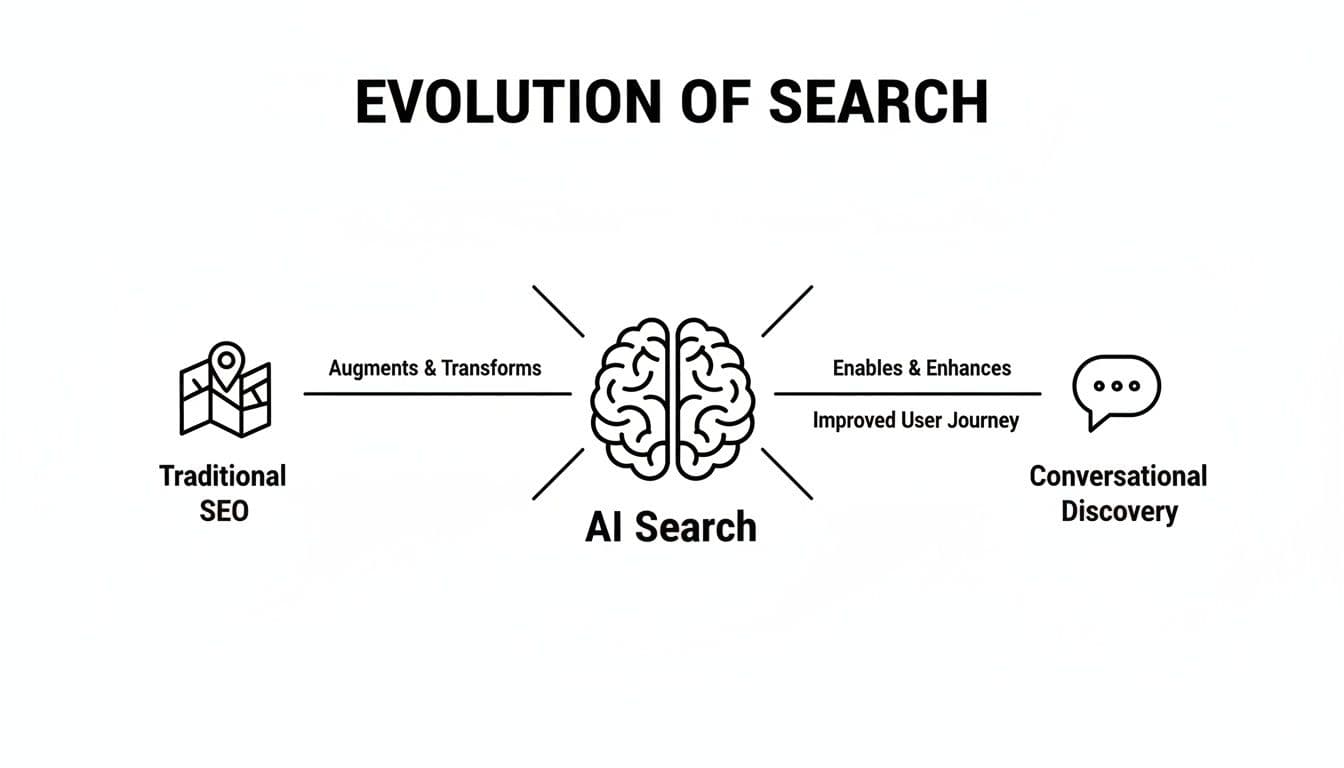
As you can see, AI search isn't replacing foundational SEO—it's building on top of it. It takes the outputs of traditional search and channels them into a direct, conversational experience for the user.
The Rise of the AI Research Assistant
Think of it this way: imagine you hired a brilliant research assistant. If you ask them a question, you don't want a long list of all the books they read. You want a concise, accurate summary that pulls the best insights from those books. That's exactly what an LLM does for the entire internet.
The technical term for this is Retrieval-Augmented Generation (RAG), but the concept is simple. First, the AI "retrieves" relevant information from its massive index of web pages. Then, it "augments" its own understanding with these new facts to "generate" a fresh, comprehensive answer.
Your content's new job is to be the most reliable, clearly-stated "fact" that this digital research assistant can find and trust. If your information is ambiguous, hidden in dense paragraphs, or unverified, the AI will simply ignore it in favor of a clearer source.
This has huge implications for how we need to structure and present information. The AI is actively scanning for content that is easy to parse, authoritative, and directly answers a user's question.
From Keywords to Contextual Authority
For years, SEO was a game of keywords. While keywords still have a place, the real key to achieving AI search visibility is building contextual authority. The AI isn’t just matching words; it's trying to understand concepts, entities, and the relationships between them.
This means your content must be:
- Declarative and Clear: Use straightforward language. AI models are trained to prioritize direct statements of fact over fluffy marketing copy.
- Structured for Machines: This is critical. Use proper headings (H2s, H3s), lists, and tables. This kind of formatting helps the AI "chunk" your content into bite-sized, usable pieces of information it can easily digest.
- Authoritative: Show your work. Back up your claims with data, original research, and clear sourcing. An AI is far more likely to cite a source that demonstrates deep, verifiable knowledge.
If you want a good parallel, look at App Store Optimization (ASO) strategies. ASO is all about sending the right signals to the App Store's algorithm to boost downloads. In the same way, AI optimization is about sending signals of trust, clarity, and authority to the LLMs.
Ultimately, your brand's visibility now depends on its ability to contribute valuable, verifiable information to the AI's knowledge base. Every article, blog post, and data sheet is a chance to prove your authority. The focus has shifted from winning a click to earning a citation.
Measuring Performance in the AI Search Era
You can't improve what you don't measure, and that's especially true for AI search visibility. The old SEO dashboard, with its familiar keyword rankings and click-through rates, is starting to look like a relic. In a world of AI-generated answers and zero-click searches, those traditional KPIs just don't tell the whole story anymore.
The game isn't about climbing a list of blue links anymore. It's about becoming a trusted source that AI models cite directly in their answers. This demands a fundamental shift in how we think about success—moving away from a pure focus on traffic and toward measuring our informational influence.
Redefining Your SEO Dashboard
The metrics that defined SEO success for the last two decades are quickly losing their punch. What good is a top keyword ranking if an AI Overview intercepts the user first? Who cares about a great click-through rate if your audience gets what they need without ever landing on your site?
This new reality requires a more nuanced way of tracking performance. We have to start measuring our brand's authority and direct presence within the AI-generated content itself.
Your new goal is to measure influence, not just traffic. Tracking how often your brand is cited as an authoritative source is the most critical indicator of success in the AI search era.
Core Metrics for AI Search Visibility
To get a real handle on your performance, your analytics need a serious upgrade. A new class of KPIs is emerging, designed to give you a clear picture of your brand's footprint inside conversational search engines.
Here are the essential metrics you should start tracking now:
- Citation Frequency: This is your North Star. It's a simple, direct count of how many times your domain is cited as a source in AI answers for your target topics.
- AI Share of Voice (SoV): This metric contextualizes your citation frequency. It calculates your brand's percentage of all citations for a specific query set compared to your competitors, showing you who truly owns the conversation in your niche.
- Source Authority Score: Think of this as a quality score for your citations. It's a composite metric that assesses how often your domain is used as a primary, foundational source for key topics, which signals deep trust from the AI model.
- Sentiment Analysis: It’s not just about getting mentioned; it's about how you're mentioned. This tracks whether your brand is referenced in a positive, neutral, or negative light within AI responses, helping you protect your brand's reputation.
Getting a grip on these KPIs is no longer optional. For a more detailed breakdown, check out our guide on how to track your brand's visibility in ChatGPT and other top LLMs.
The table below breaks down the fundamental shift from the metrics we used to rely on to the ones that matter today.
Traditional SEO Metrics vs AI Visibility Metrics
This transition highlights a move from measuring proxies for visibility (like rankings) to measuring direct influence (like citations).
The Fragmenting Search Market
This evolution in measurement is happening as the entire search market begins to fracture. For the first time in years, the old guard is facing a real challenge. Google's long-held dominance is showing cracks, with its worldwide market share dipping to between 89.34% and 90.83% in late 2023—the first time it's fallen below the 90% threshold since 2015.
At the same time, AI-native platforms are gaining ground with incredible speed. Challengers like ChatGPT now account for a staggering 17.1% of total digital queries and command an impressive 80.1% of the AI search engine market. You can explore more data on the changing search engine market share.
This data paints a clear picture: brands must adapt their measurement strategies for this new, fragmented reality. By adopting these new metrics, you can stop reacting to the past and start building a strategy for the future, ensuring your brand stays visible and influential wherever people are looking for answers.
Optimizing Your Content for AI Discovery
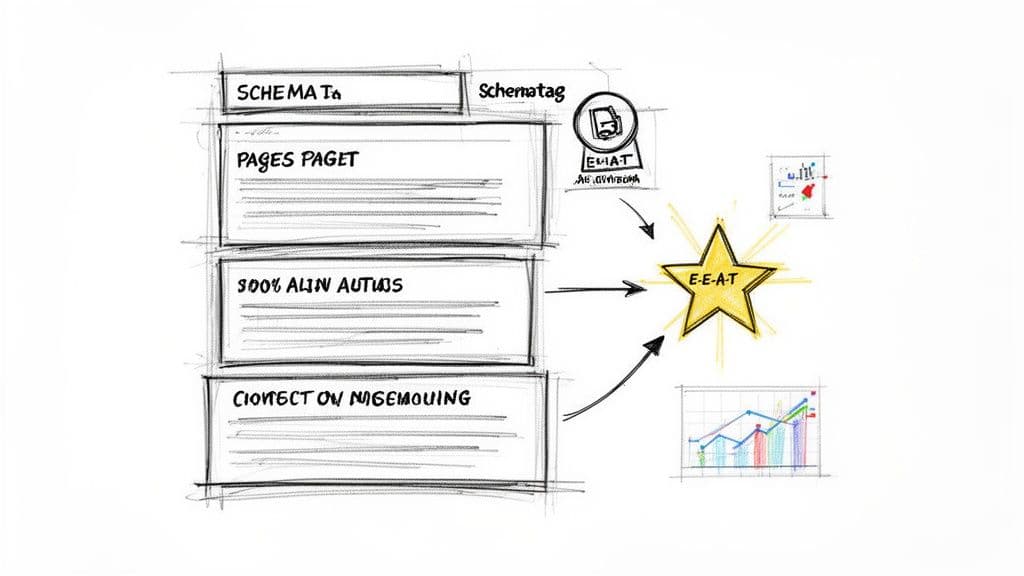
To really show up in AI-powered search, you have to think beyond just writing for human readers. The AI models acting as the new gatekeepers don't "read" like we do. They parse, categorize, and weigh your content based on signals of authority and clarity. Your job is to make it incredibly easy for an AI to find, trust, and ultimately cite your information.
It all starts with a renewed commitment to E-E-A-T—Experience, Expertise, Authoritativeness, and Trustworthiness. While these have been core SEO principles for a while, they've taken on a much more literal meaning for AI. An AI can't pick up on subtle brand cues to infer expertise; it needs cold, hard, machine-readable signals.
Building Trust with E-E-A-T Signals
Think of an AI as a painfully literal research assistant. It needs to see clear, verifiable proof of your authority before it will even consider your content a reliable source. If your content is vague or your claims are unsupported, the AI will simply skip over it for a source that offers more certainty.
Here’s how to translate E-E-A-T into a language AI can actually process:
- Experience: Attribute your content to authors with real-world, demonstrable experience. This means detailed author bios that link out to their professional profiles and other published work.
- Expertise: Go deep. Create comprehensive content that covers a topic from every angle. Building out topic clusters—a web of interlinked articles on a subject—is a fantastic way to establish your domain as the go-to resource.
- Authoritativeness: Don't just regurgitate information. Produce original research, compelling case studies, and data-driven reports. Content that brings new, verifiable information to the table is a goldmine for LLMs looking to provide unique insights.
- Trustworthiness: Back up what you say. Cite authoritative sources and use data to support your claims. A well-sourced article screams reliability to both users and AI models.
Structuring Content for Machine Comprehension
Beyond proving your authority, your content has to be formatted for easy digestion. AI models break down web pages into small, distinct chunks of information to piece together answers. Long, dense paragraphs are a killer for this process.
The principle here is simple: If an AI can't easily break your content down into distinct, factual statements, it's less likely to use it. Your formatting choices directly impact your visibility.
To get ahead, use clear, declarative statements that get right to the point. Answer questions directly and explicitly within your text, almost as if you're writing a Q&A. This approach perfectly mirrors the conversational nature of AI search and makes your content "snippable"—ready to be lifted directly into an AI-generated response. For a deeper look at this method, it's worth exploring the fundamentals of Answer Engine Optimization.
Leveraging Structured Data and Schema
Schema markup is probably your most powerful tool for boosting AI search visibility. It's essentially a layer of code that translates your content into a structured format that AI models can understand instantly. By using schema, you’re spoon-feeding the AI, removing any guesswork about what your content means.
For instance, you can use schema to clearly identify:
- FAQPage: This markup flags a list of questions and answers, making them prime candidates for AI to use in responses.
- Article: This defines the author, publication date, and headline, which reinforces your E-E-A-T signals.
- Organization: This provides clear, structured information about your company, helping build brand entity recognition.
This structured data acts as a cheat sheet for the AI, helping it process your information with far greater confidence and accuracy. And as AI search gets better at understanding different types of media, optimizing your video marketing strategies with similar structured data principles is becoming just as crucial for discovery.
The rise of AI-generated content in top search results has been explosive, jumping from just 2.27% in 2019 to 17.31% in 2023. This is a clear signal for brands to adapt, especially in B2B tech. A smart move is to focus on .com and .org domains, which AI models heavily favor—they make up 80.41% and 11.29% of ChatGPT citations, respectively. By building your content with these principles in mind, you’re positioning your brand not just to be found, but to be chosen as a trusted source in this new era of search.
Putting AI Visibility Strategies into Practice
Theory is one thing, but seeing how AI search visibility strategies actually work in the real world is where it all clicks. The fundamental shift is learning to treat AI models as a new, incredibly influential audience. You have to listen to what they're saying about you and then actively work to shape that conversation.
Let’s walk through a couple of realistic scenarios. These examples take the idea from an abstract concept and show you the direct business impact of managing your brand's presence in this new conversational search space.
Scenario One: The Cybersecurity Authority Play
Picture a B2B cybersecurity SaaS company that lives and breathes network security. Their marketing team starts using an AI visibility tool and quickly discovers a problem: competitors are consistently cited in AI answers for crucial, high-intent questions like "what is zero-trust architecture?" and "best practices for cloud security."
Their own brand is completely absent. To this growing audience, they might as well not exist.
So, they don't just write another blog post. They go all in, creating a definitive, comprehensive guide on zero-trust architecture. Crucially, they build it to be easily understood by AI:
- It uses clear, declarative headings like "Core Principles of Zero-Trust Security."
- It features a Q&A section with proper FAQ schema markup.
- Every claim is backed up with external data and their own internal case studies.
The result? Within weeks, things start to change. Their guide begins popping up as a primary source in AI-generated responses. This doesn't just drive traffic; it builds their authority and establishes them as a genuine thought leader in the eyes of users who see them as a trusted expert.
Scenario Two: Correcting the AI Narrative
Now for a different challenge. A well-established financial services firm notices their brand is getting mentioned in AI answers about retirement planning, but the information is wrong. The AI is pulling from old press releases and third-party articles, presenting outdated details about their investment products.
This is a huge problem. Instead of letting it slide, their team jumps into action. They pinpoint the key pages on their website that describe these products and give them a complete overhaul. They inject new data, clarify product features, and structure the information with clean headings and tables.
This is a critical defensive move in the age of AI. Your brand's reputation is now partially in the hands of language models. Proactively monitoring and correcting misinformation isn't just a good idea—it's essential brand management.
By refreshing their own content, they gave the AI models a newer, more authoritative source of truth. Before long, the AI-generated answers started to reflect the correct information, fixing the narrative and safeguarding their brand's reputation.
Tapping into Niche Opportunities
As the search market splinters, it creates both new threats and new openings. For B2B tech founders and growth leaders, this is especially true. While huge brands like Target and Walmart might dominate general AI citations (they appear in over half of all retail-related AI responses), smaller companies can still win.
The key is to target specific, informational queries where AI models excel at delivering detailed answers. You can learn more about the shifting market dynamics from StatCounter. This strategy allows nimble businesses to carve out authority and capture valuable mindshare in their niche, even without a massive marketing budget.
Essential Tools for the Modern SEO Toolkit
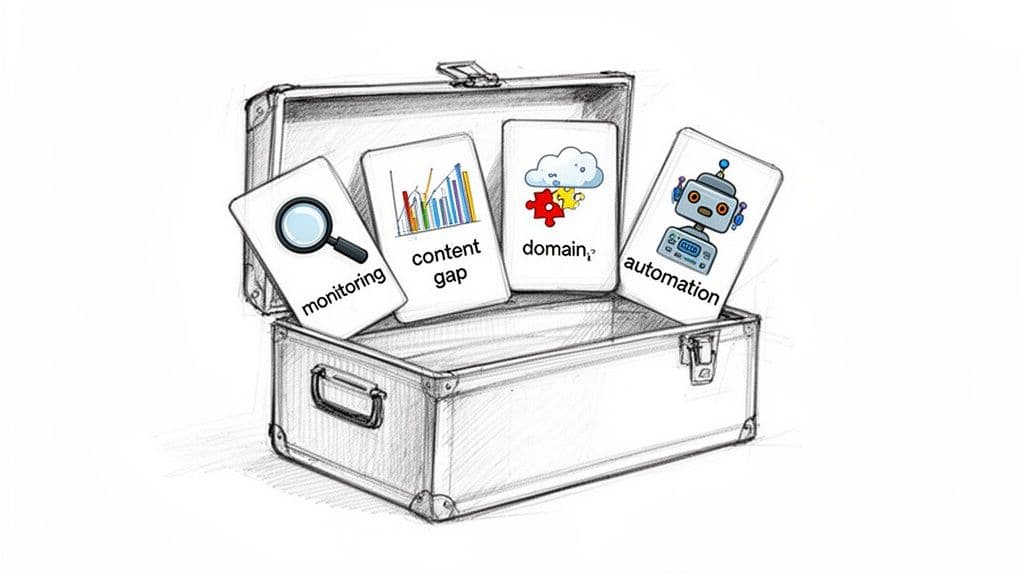
If you're trying to navigate this new world of AI-driven search with your old SEO toolkit, you're going to fall behind. The reality is that traditional platforms just aren't built for this; they can't see what's happening inside AI conversations. This is where a new breed of technology comes into play, designed specifically to monitor and improve AI search visibility.
These tools are built to automate what would otherwise be an impossibly manual job. The concept behind them is straightforward but incredibly effective. Platforms like Attensira, for example, let you plug in your domain and almost instantly start getting insights you can actually use, without needing a data science degree. This kind of accessibility is what allows marketing teams to finally get a handle on the fast-moving world of AI search.
Core Functionalities to Look For
When you start looking at tools to manage your AI search presence, you have to think beyond just keyword rankings. That's old news. A truly useful solution needs to be built from the ground up for the age of conversational search.
Here are the non-negotiables you should be looking for:
- Mention Tracking: Can the tool see where your brand is being cited across the big AI platforms like ChatGPT, Copilot, and Perplexity? This is the most basic, fundamental measure of your visibility.
- Content Gap Analysis: The platform should be able to analyze AI responses for your core topics and pinpoint where your competitors are getting mentioned and you aren't. This is where your biggest content opportunities are hiding.
- Source Authority Monitoring: It's not just about getting mentioned; it's about the quality of that mention. Look for metrics that show you whether you're being cited as a primary source or just a secondary reference.
These three features are the bedrock of any serious AI visibility strategy. They take a mountain of abstract data and turn it into a clear, actionable roadmap. To see how these features come together in practice, you can explore this breakdown of the best AI SEO software available today.
The Impact of Proactive Optimization
Jumping on these specialized tools isn't just about staying relevant—it's about carving out a massive competitive edge. The data we're seeing shows a clear and almost immediate payoff for brands that move quickly.
An AI visibility platform isn't just another analytics dashboard. It's an active intelligence system that helps you understand, shape, and ultimately win the conversation in your niche by showing you exactly where your brand stands in the AI's mind.
Brands that got in early with dedicated AI visibility tools have seen some stunning results. It’s not uncommon to see 25-40% lifts in share-of-voice within the first 60 days. This proves that with the right focus, you can make a huge impact in this space much faster than with traditional SEO. It all comes down to having the right tools for the job.
Your Questions About AI Search, Answered
Let's be honest, the shift to AI-driven search stirs up a lot of questions. This new reality challenges some of our most deeply-held SEO beliefs and forces us to look at online visibility in a completely new way. Here are some straightforward answers to the questions I hear most often.
How Is AI Search Optimization Different from Traditional SEO?
The core difference is the goal. Traditional SEO is a race to the top of a list of blue links. You’re fighting for a position. AI search optimization, on the other hand, is about becoming a citable, trusted source within a conversational, generated answer.
Think of it this way: SEO gets you on the bookshelf; AI optimization gets your specific sentence quoted in the research paper. Your content needs to be so clear, factual, and well-structured that an AI can confidently lift it and present it as part of a definitive answer. The focus shifts from just ranking to being featured directly within a generated response.
Can I Ignore AI Search and Just Stick to Classic Google SEO?
You could, but it would be a massive gamble. Google is already weaving AI Overviews into its main search results, and new tools like Perplexity are quickly becoming the first stop for people seeking information. For a growing number of users, their first encounter with your brand will be through an AI-generated summary.
If you’re not optimizing for this, you’re effectively letting the AI tell your story for you—or worse, leaving you out of the conversation entirely. This isn't some separate channel anymore; it’s becoming a fundamental layer of how people find things online.
Trustworthiness is everything. AI models are explicitly designed to find and prioritize information from sources they deem authoritative and reliable. So, what’s the single most important thing you can do? Consistently publish high-quality, expert-backed content that leaves no doubt about your expertise.
What’s the Single Most Important Factor for AI Search Visibility?
Building on that point, it all comes down to demonstrable authority. You need to build the kind of foundational trust that makes an AI comfortable citing you.
Every single piece of content you produce—from a deep-dive blog post to the most technical spec sheet—has to reinforce that you are an expert. It needs to provide clear, verifiable information that an AI can process with a high degree of confidence.
How Quickly Will I See Results from AI Search Optimization?
This is where things get interesting. Unlike traditional SEO, where you might wait months to see movement, the feedback loop with AI SEO can sometimes be much faster. Because AI models are constantly refreshing their data, a perfectly optimized piece of content can get picked up and featured in answers relatively quickly.
But don't mistake that for an easy win. While you might see some early successes, building a dominant and durable presence is still a long game. Quick wins are possible, but lasting AI search visibility is the result of a sustained commitment to quality and authority over the long haul.
Ready to take control of your brand's narrative in this new era of search? Attensira gives you the tools to monitor, analyze, and optimize your AI search visibility. Stop guessing and start influencing. Discover how Attensira can help you win the conversation.