
Discover the seo audit report format that guides traditional and AI-powered audits with actionable insights and a proven structure.
A truly effective SEO audit report format is more than a laundry list of technical errors; it's a strategic roadmap. It has to translate a mountain of complex data into a clear story that gets everyone, from the marketing team to the C-suite, on board. The best reports I've seen always strike a perfect balance between technical precision and high-level strategic insight, turning a simple diagnostic tool into a clear plan for the future.
Building Your Audit Report Foundation
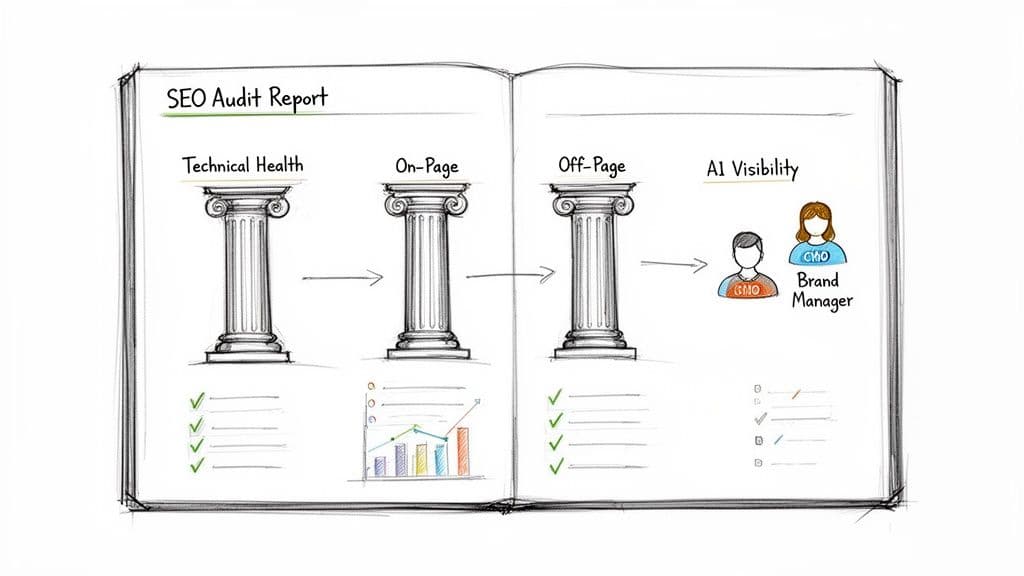
Think of your SEO audit report as the architectural blueprint for a skyscraper. You wouldn't just hand the construction crew a list of materials like "steel beams" or "concrete." That's useless without context. The blueprint shows how every single component connects to create a stable, functional building. It’s the same with a powerful report format—it has to connect the raw technical data to real business outcomes.
This is the difference between telling a CMO, "we have duplicate meta descriptions," and explaining, "we are missing out on valuable clicks for key commercial terms because our pages aren't compelling in search results, which is impacting lead generation." That simple shift in framing changes the entire conversation from small technical fixes to meaningful business growth. Suddenly, the value of your work is crystal clear.
The Four Pillars of a Modern Audit
Today, a truly comprehensive SEO audit report format stands on four interconnected pillars. If you ignore any one of these, you're leaving a massive blind spot in your online strategy.
- Technical Health: This is the bedrock. It's all about crawlability, indexability, site speed, and security. Bottom line: if search engines can't find and understand your site efficiently, none of the other work matters.
- On-Page Strategy: Here's where we look at the content and structure of individual pages. The goal is to make sure every page is perfectly aligned with what users are searching for and is optimized to rank.
- Off-Page Authority: This pillar is all about your digital reputation. We're primarily digging into your backlink profile and how your brand is being talked about across the web.
- AI Visibility: This is the new frontier. It’s a crucial new element that measures how your content is showing up in generative AI answers—an increasingly important source of information for users.
From Diagnosis to Actionable Strategy
Let's be clear: the whole point of an audit is to drive action. A well-structured report doesn't just dump findings on someone's desk; it prioritizes them. It has to guide stakeholders through the data, making it painfully obvious which recommendations are urgent and what kind of impact they'll have. You're not just a diagnostician; you're the strategist charting the course for what comes next.
While an audit is a deep, one-time analysis, it’s important not to confuse it with regular performance tracking. Our guide on what is an SEO report explains the difference between this kind of intensive audit and the ongoing monitoring you should be doing.
A great SEO audit report doesn't just list what's broken. It tells a story about opportunities—lost revenue to reclaim, new traffic to capture, and a stronger brand to build. It transforms data points into a compelling business case.
The Core Components of a High-Impact SEO Audit Report
A truly effective SEO audit isn't just one big document; it's a collection of focused analyses that, together, tell the complete story of your website's performance. Think of it like a thorough medical check-up. A good doctor doesn't just take your blood pressure. They look at your heart, lungs, nervous system, and more to get a full picture of your health. An SEO audit does the same for your website.
This approach gives every finding critical context. For example, a slow page speed (a technical issue) becomes a much bigger deal when you realize it's hurting a high-converting product page (an on-page problem). To build this complete diagnostic, a proper SEO audit report format needs to be organized around five core, interconnected components.
A well-structured report breaks down the complexity of SEO into manageable sections. Below is a table outlining these essential components, what they aim to achieve, the metrics you should be tracking, and some of the best tools for the job.
Core Components of a Comprehensive SEO Audit Report
Each of these components provides a unique lens through which to view your site's performance, but it's only when you combine their insights that you get a truly actionable strategy.
1. Technical SEO Health
This is the bedrock of your website. Technical SEO is all about making sure search engine crawlers can efficiently find, understand, and index your content. If this foundation has cracks, any amazing content or backlink strategy you build on top of it is doomed to fail. It’s like owning a beautiful retail store but keeping the front door permanently locked—nobody can get inside to see what you’re selling.
This part of the audit gets straight to the point, asking critical questions:
- Can search engines crawl the site without hitting dead ends or roadblocks?
- Is the site secure, fast, and easy to use on all devices, especially mobile?
- Are there confusing signals being sent, like duplicate content or incorrect indexing rules?
The key metrics to watch here are Core Web Vitals (LCP, INP, CLS), crawl error reports from Google Search Console, indexation status, and HTTPS security. Fixing these technical snags is almost always the first order of business, as they can stop your best work from ever being seen.
2. On-Page and Content Performance
If technical SEO makes sure the store is open for business, on-page and content analysis looks at the quality of the products on the shelves. This is where we dive into individual pages to see how relevant and valuable they are, and whether they truly match what users are searching for. It’s all about making sure that when someone lands on your page, they find exactly what they wanted, presented clearly and convincingly.
Here, you’ll be scrutinizing everything from title tags and meta descriptions to the actual depth and expertise shown in the content. This analysis helps uncover content gaps, pinpoint pages that are underperforming for their target keywords, and find opportunities to bolster E-E-A-T (Experience, Expertise, Authoritativeness, Trustworthiness) signals. For a more detailed walkthrough on this, our guide on how to do a website audit breaks it down step-by-step.
3. Backlink Profile Analysis
Your backlink profile is essentially your website’s reputation across the internet. Every link from another website is a vote of confidence, telling search engines your content is credible and worth paying attention to. But not all votes are created equal. One link from a major industry authority is worth infinitely more than hundreds of links from spammy, irrelevant sites.
A strong backlink profile is earned, not just built. It reflects the authority and value your content provides to others, acting as a powerful signal that your brand is a leader in its space.
This section of the report dissects the quantity and, more importantly, the quality of sites linking to you. It hunts for toxic links that could be dragging your rankings down, analyzes the anchor text being used, and measures your profile against top competitors to find new link-building opportunities.
4. User Experience Signals
Google cares more and more about user satisfaction. It’s no longer a guessing game—how people interact with your site is now a direct signal for rankings. This part of the audit zeroes in on metrics that tell us whether users are having a good experience or a frustrating one.
We’re looking at data points like bounce rate, time on page, and click-through rate (CTR) from the search results. A high bounce rate on a key landing page, for instance, screams to Google that users didn't find what they were looking for, which can cause your rankings to drop over time. This analysis connects the dots between technical performance and content quality by focusing on what real humans actually do on your site.
5. AI Visibility and Answer Engine Optimization
This is the newest frontier in SEO, and it’s becoming more critical by the day. With the rise of generative AI in search (think Google’s AI Overviews), being visible is no longer just about landing in the top ten blue links. It’s about becoming the source of truth that AI models cite in their answers.
This final piece of the audit evaluates your content’s “answer-readiness.” It checks for things like structured data (FAQ and How-to schema), clear question-and-answer formatting, and authoritative sourcing that AI can easily parse and trust. Specialized tools like Attensira are built to track how often your brand gets mentioned or cited in these AI-generated responses, giving you a clear metric for this new and vital channel. If you ignore AI visibility, you’re risking being invisible to a huge and growing portion of search users.
Getting Your Hands Dirty with a Technical SEO Health Check
Let's start with the absolute bedrock of your entire search strategy: technical SEO. I like to think of it as the plumbing and wiring of a house. It doesn't matter how amazing the interior design is if the lights don't turn on or the faucets don't work. The same goes for your website—if search engines can't efficiently crawl, understand, and index your pages, even the most incredible content will be dead on arrival.
This part of the audit isn't about ticking off a few boxes. It's a proper deep-dive diagnostic into the core infrastructure that holds up your digital presence. The goal is to make sure nothing is getting in the way of search engines accessing and ranking your content.
This flowchart really drives the point home. Technical analysis is the foundational pillar supporting everything else.
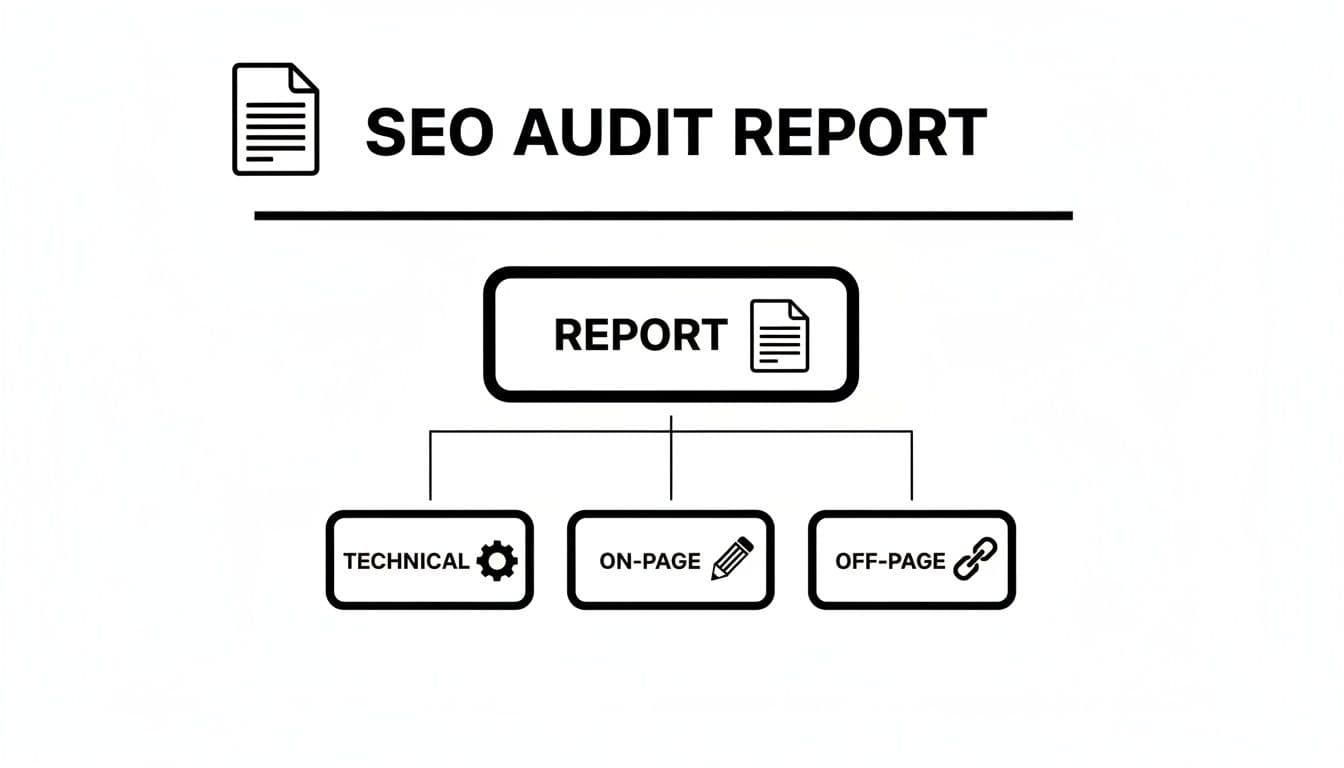
Without a solid technical base, you can pour all the money you want into on-page tweaks and link building, but the results will always be limited.
The Critical Areas to Put Under the Microscope
The mark of a great report is its ability to translate complex technical jargon into clear business impact. Don't just list a bunch of errors. Frame them as what they really are: roadblocks to revenue and a poor experience for your users.
You'll want to focus your investigation on these key areas:
- Site Speed and Core Web Vitals: These metrics have a direct line to both user experience and rankings. A slow site is frustrating, and it sends a clear signal to Google that your page isn't up to snuff.
- Crawlability and Indexability: This is all about making sure search engines can find your important pages. You'll be digging into
robots.txtfiles, XML sitemaps, and any crawl errors that pop up. - Site Security and Architecture: Having a secure site (HTTPS) is table stakes for building trust. Beyond that, your internal linking structure needs to be a logical roadmap that guides both users and crawlers through your content.
A technical SEO audit isn't about chasing a perfect score. It's about systematically removing the obstacles that prevent search engines from seeing and rewarding the value your website offers.
Fixing these foundational issues is almost always the first move in a successful SEO campaign. So many ranking problems that seem complicated are actually rooted in these basic technical mistakes. It’s why finding them is so vital and why it's worth understanding the most https://attensira.com/blog/common-seo-mistakes that audits tend to surface.
Turning Technical Data into a Compelling Story
The real skill here is connecting the dots between raw data and real-world outcomes. You can't just report the numbers; you have to tell the story behind them.
Core Web Vitals (CWV) are the perfect example. The big three—Largest Contentful Paint (LCP), Cumulative Layout Shift (CLS), and Interaction to Next Paint (INP)—are Google's way of directly measuring how a user feels when interacting with a page. They measure loading, interactivity, and visual stability.
We saw this play out in a big way during the 2023 Core Web Vitals rollout. Looking at aggregated Google Search Console data, sites that passed all three metrics—LCP under 2.5 seconds, CLS under 0.1, and INP under 200ms—saw a 15-20% bump in rankings within six months. That's how you turn a technical goal into a clear competitive edge.
Reporting on Indexation and Security
Beyond just speed, your report needs to answer a simple, crucial question: is your content even eligible to show up in search results? This is where your indexation analysis comes in.
You need to be on the lookout for critical, often invisible, issues like:
- Misused
noindextags: Are you accidentally telling Google to ignore your most important pages? - Canonicalization problems: Is duplicate content splitting your authority and confusing search engines?
- Crawl Errors: Is Google Search Console lighting up with 404s (Not Found) or 5xx (Server Error) issues?
Any one of these can quietly sabotage your traffic. For instance, I've seen a single misplaced noindex tag on a key category page cause thousands of product pages to vanish from the search results almost overnight. And when you're digging this deep, ensuring your analytics are accurate is key; there are some great resources out there for auditing Google Analytics 4 implementations.
Finally, site security via HTTPS is completely non-negotiable. It’s a confirmed (though minor) ranking signal, but more importantly, it's a massive trust factor for users. Modern browsers will flag any site without a valid SSL certificate as "Not Secure," which is a surefire way to kill user confidence and send your bounce rate through the roof. This is an easy win and a high-impact item to flag in any audit.
Auditing On-Page Elements and Content Effectiveness
If technical SEO is the foundation of your house, your content is everything inside it—the rooms, the furniture, the reason people want to visit. This is where you connect with your audience and convince search engines you’re worth their attention. Auditing your on-page elements is so much more than just checking if a keyword is in the title tag. It's about figuring out if your content actually works.
Think of every page on your site as a salesperson. Is it sharp, persuasive, and trustworthy? Or is it rambling, out-of-date, and confusing? This part of the SEO audit report format separates your content assets from your liabilities.
Analyzing Content Gaps and Performance
First things first: you need a clear picture of what’s working and what’s flat-out failing. This means digging into your performance data to find pages that are underperforming, decaying, or just plain missing. It’s like a treasure hunt, but for opportunities.
You’re trying to answer a few critical questions:
- Content Gaps: What high-value topics are my competitors owning that I haven’t even touched?
- Underperforming Content: Which pages are stuck on page two or three for important keywords? These are often just one good update away from page one.
- Content Decay: Which articles used to be winners but are now slowly losing traffic and rankings? They’re crying out for a refresh.
Getting these answers requires a solid, systematic look at the right metrics. To get a handle on what you should be tracking, our complete guide on essential content performance metrics is a great place to start.
Strengthening E-E-A-T and Topical Authority
Modern search engines—especially the AI-powered ones—are obsessed with content that screams E-E-A-T (Experience, Expertise, Authoritativeness, Trustworthiness). Your audit needs to be just as obsessed with evaluating it. This isn't just about what you say; it's about how you prove it.
Look for hard evidence on the page:
- Author Bylines: Are your articles written by credible experts with real-world experience and detailed bios?
- Supporting Data: Do you back up your claims with original research or links to authoritative sources?
- Unique Insights: Is your content just rehashing what everyone else is saying, or are you offering a unique perspective from firsthand experience?
A page with strong E-E-A-T doesn't just inform—it builds confidence. It shows both users and search engines that you're a reliable authority, making your content the go-to source in your niche.
This analysis will quickly show you where the weak spots are. For example, a blog full of anonymous articles is a huge red flag. A simple, actionable recommendation would be to add detailed author bios and link them to their professional profiles to instantly boost perceived authority.
Auditing for Structured Data and AI Visibility
In a world of AI-driven search, structured data isn't a "nice-to-have" anymore. It's a non-negotiable tool for helping search engines understand your content's context, making it eligible for rich results and AI-generated answers. Your audit has to pinpoint pages that are missing out on schema markup.
Some of the most common opportunities include:
- FAQ Schema: Perfect for pages that answer a list of common questions. It’s a great way to grab more SERP real estate.
- HowTo Schema: A must-have for any step-by-step guide. It breaks down the process for both people and machines.
- Review Schema: Essential for product or service pages. Nothing builds trust like seeing those little gold stars right in the search results.
Getting this right has a direct impact on your visibility in new search formats. In fact, industry analysis has drawn a clear line between structured, answer-first content and how well it performs in AI search. Recent audit data from 2025 shows that pages with concise answer blocks (40-60 words) placed right under question-based H2s grab 28% more featured snippets and AI Overviews. This, in turn, drives a 41% higher click-through rate for enterprise-level queries. You can explore more about these AI SEO audit findings. This data hammers home the need for a specific, answer-oriented content structure—a key thing to check in your audit.
From Data Dump to Action Plan: Presenting Your Findings
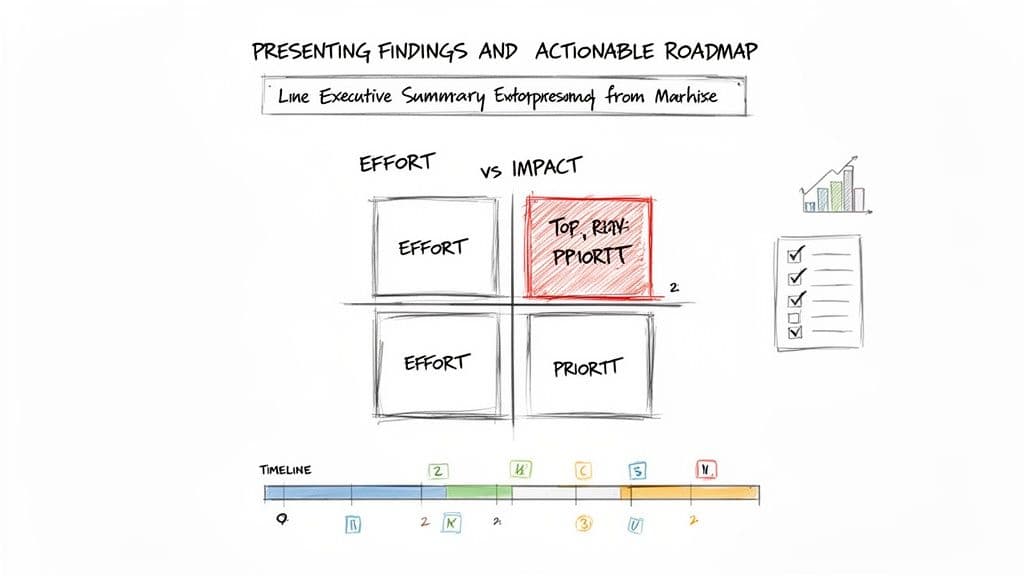
Let's be honest: a great SEO audit is wasted if it just sits in a folder. Stacks of raw data and technical jargon don't motivate anyone. What does? A clear story that connects your findings directly to business goals. This is where your SEO audit report format goes from being a simple health check to a strategic blueprint for growth. Your whole mission is to make the next steps feel both obvious and urgent.
Everything you’ve uncovered should funnel into a powerful executive summary. This isn't just a quick review; it's your pitch. You have to translate technical problems into tangible business impact. For instance, "multiple 404 errors on legacy product pages" doesn't land with much force.
But what if you reframe it? "We're losing an estimated $15,000 in potential monthly revenue because high-intent customers are hitting dead ends on our key product pages." Now you have their attention. That kind of reframing is what gets decision-makers on board.
Keep this summary tight. Stick to the top three to five most critical issues and spell out their consequences. This is your one shot to make a lasting impression and secure the budget and buy-in you need.
Prioritizing Your Recommendations: The Effort vs. Impact Matrix
After you’ve laid out the biggest problems, the first question from any executive is always the same: "Okay, so where do we start?" Handing them a long, unorganized list of fixes is the fastest way to cause analysis paralysis. You need to give them a clear, logical starting point.
This is where the Effort vs. Impact matrix shines. It's a simple but incredibly effective framework that helps everyone see the path forward. By sorting tasks into four quadrants, you make the strategy tangible.
- Quick Wins (Low Effort, High Impact): These are your no-brainers. Think fixing broken internal links pointing to major service pages or rewriting the title tags on your most important (but underperforming) blog posts. You tackle these first to build momentum and show immediate results.
- Major Projects (High Effort, High Impact): Here are the true game-changers. This bucket includes things like a full site migration or a ground-up content strategy overhaul. They require serious resources and planning, but they also deliver the biggest long-term wins.
- Fill-Ins (Low Effort, Low Impact): These are the "nice-to-haves" that you can chip away at when you have spare cycles. This might be cleaning up alt text on old blog images or standardizing URL conventions on minor sections of the site.
- Reconsider (High Effort, Low Impact): Steer clear of these. These are the tasks that eat up time and budget for very little return. They’re a distraction from the work that actually moves the needle.
This visual approach cuts right through the noise, letting stakeholders instantly understand the strategic priorities. It turns a scary to-do list into a smart, sequenced game plan.
Your audit's success hinges on turning complex data into a clear roadmap. The 'Effort vs. Impact' matrix is the bridge between analysis and action, helping stakeholders see not just what needs to be done, but why it matters and where to start.
Building the Roadmap with Timelines and Ownership
With your priorities locked in, the final piece is to build out a detailed implementation roadmap. This is the moment your audit evolves into a real project plan. A solid roadmap doesn't just list recommendations; it assigns clear accountability.
For every significant task, your report needs to spell out the specifics:
- Specific Action Item: What, exactly, are we doing? (e.g., "Implement FAQ schema on the top 10 service pages.")
- Designated Owner: Who is on the hook for this? (e.g., "Development Team Lead" or "Content Manager.")
- Estimated Timeline: When will this get done? (e.g., "Sprint 4 - Q3" or "By October 31st.")
- Success Metric: How will we measure success? (e.g., "Achieve rich snippets for 50% of targeted pages.")
Laying this out in a simple table or a timeline visualizes the work over the next few quarters. This structure brings total clarity, sets realistic expectations, and transforms your SEO audit report format into a powerful tool for change. It’s how you guarantee all your hard work translates into real, measurable results.
6. How AI Visibility Fits into Your SEO Audit
The classic "ten blue links" on a search results page? That's quickly becoming ancient history. With generative AI baked directly into search engines like Google, the entire game has changed. What it means to be truly "visible" online is fundamentally different now, and any modern SEO audit report format that ignores this shift is already obsolete.
Simply tracking where you rank for a keyword is like driving while looking only in the rearview mirror. The real priority today is figuring out how often—and how prominently—your content shows up in AI-generated answers, summaries, and conversational results. This means we have to look past our standard toolset and start thinking about content performance in a whole new way.
What is an AI Visibility Score?
To get a handle on this, we need a new metric. Let's call it an AI Visibility Score. Think of it as a simple measurement of how often AI models cite your brand and content as a trusted source when answering a user's query. It’s a direct reflection of your authority in the eyes of these new AI gatekeepers.
A low score is a major red flag. It means AI is ignoring your content and instead pointing your potential customers toward your competitors. This part of the audit is all about diagnosing why you're being overlooked and creating a clear strategy to become the go-to source for AI.
To do that, you have to understand the signals AI models are trained to look for:
- Structured Data: Are you using schema markup (like FAQ and HowTo) correctly? This gives AI the context it needs to understand your content quickly.
- Authoritative Sourcing: Is your content well-researched? Does it cite credible data and link out to other authoritative sources?
- Clear, Direct Answers: Is your content structured to be helpful? This often means putting concise answers right under question-based headings.
An AI visibility audit isn't just another technical checklist. It's a deep dive into whether your content is structured to be the most direct, trustworthy, and genuinely helpful answer out there. If it isn't, the AI will simply find content that is.
Auditing Your Content for AI-Readiness
Your audit needs to pinpoint the specific content gaps and structural problems holding back your AI visibility. This gets granular, involving a page-by-page review to assess what I call "answer-readiness."
For instance, you might have a fantastic, in-depth blog post that ranks well in the traditional sense. But if its key insights are buried deep within long, winding paragraphs, an AI model will likely skip right over it. It can't easily parse the main point.
Sometimes, the fix is surprisingly simple, like adding a quick summary box or a Q&A section right at the top. As AI continues to reshape the search landscape, knowing how to show up in features like AI Overviews is critical. This guide on Winning Google's AI Summaries and Overviews breaks down the mechanics beautifully.
By adding these checks into your process, the audit report you deliver will paint a complete picture of search performance. You can dig deeper into how to track and improve your AI search visibility with the right tools and strategies. This approach ensures your audit doesn't just solve yesterday's problems—it prepares the business for what's coming next.
Answering Your Top SEO Audit Report Questions
Even seasoned pros have questions about the audit process. Let's tackle some of the most common ones I hear, covering everything from timing and tools to communicating your findings in a way that gets results.
How Often Should I Really Be Doing an SEO Audit?
For most B2B companies, a full, deep-dive audit once a year is the right rhythm. Think of this as your annual physical—a comprehensive check-up on every aspect of your site's health.
But you can't just set it and forget it for 12 months. That annual review should be backed up by quarterly health checks. These are lighter, faster reviews focused on core technical vitals, keyword movement, and content performance.
Of course, you'll also need to run a mini-audit anytime something big happens, like a site migration, a major redesign, or after Google drops a significant algorithm update. This lets you spot and squash any new problems before they have a chance to hurt your performance.
What are the Must-Have Tools for a Serious Audit?
No single tool does it all. A truly effective audit relies on a toolkit where each platform brings its own specialty to the table, giving you a complete diagnostic picture.
- The Foundation: You can't do this job without Google Search Console and Google Analytics. They're free, they're from the source, and they are absolutely non-negotiable.
- Technical Crawling: For a deep, technical site analysis, you'll need a dedicated crawler. Screaming Frog or Sitebulb are the industry standards here.
- Competitive & Backlink Analysis: To understand your authority and track keywords against competitors, a tool like Ahrefs or Semrush is essential.
- AI Visibility: The game is changing. Specialized tools are now critical for seeing how you show up in generative search experiences.
How Can I Present My Findings to an Executive Who Isn't an SEO?
This is all about translation. Your job is to turn technical data into a compelling story about business outcomes—revenue, traffic, and leads. Forget the jargon.
Start with a sharp executive summary that highlights the top 3-5 findings, but frame them as business opportunities or risks. Instead of saying, 'We need to fix 404 errors,' you say, 'By restoring our broken pages, we can reclaim an estimated X% in lost traffic and build more trust with our users.'
Visuals are your best friend. Use simple charts to show trends and performance gaps. And always, always end with a clear, prioritized action plan. It should spell out the next steps, what resources are needed, and what business impact everyone can expect. This turns your seo audit report format from a simple document into a strategic driver for the whole company.
Ready to see how your brand appears in AI-driven search? Attensira provides the actionable insights you need to optimize content for the next generation of search. Discover your AI Visibility Score and start winning in generative search results. Learn more at Attensira.com.