Master brand sentiment analysis with our complete guide. Learn how to track, measure, and improve your brand's perception for better AI visibility and growth.
Brand sentiment analysis is the process of using AI and natural language processing to figure out the emotions—positive, negative, or neutral—tucked inside online conversations about your company. It’s like having a digital ear to the ground, helping you finally understand the why behind what people think of you.
Unlocking the Voice of Your Customer
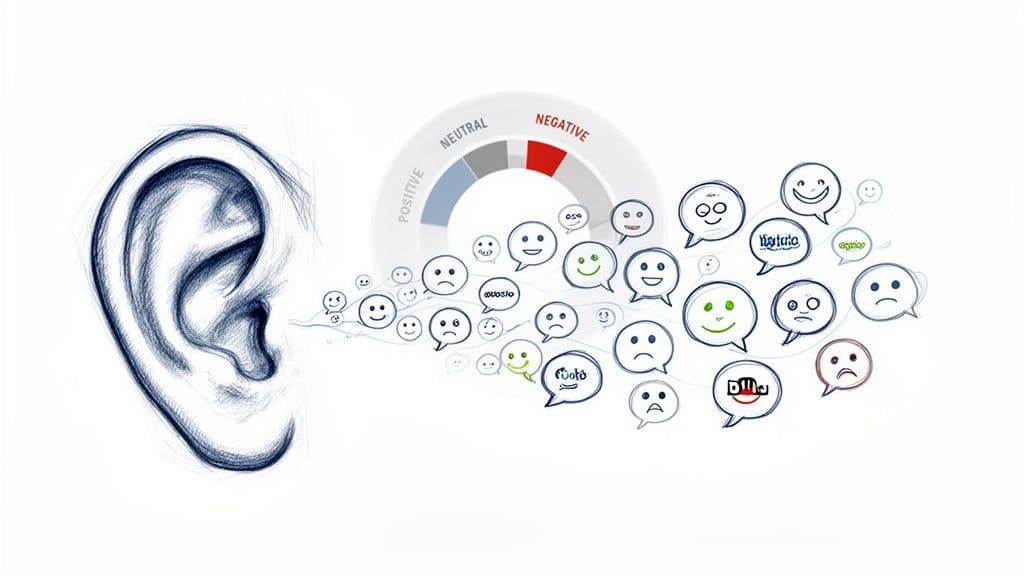
Think of every tweet, product review, and blog post mentioning your brand as a single whisper in a massive, noisy room. Individually, they’re just background chatter. But when you can tune into all those whispers at once, a clear, collective voice emerges. That's the real voice of your customer.
Brand sentiment analysis is the technology that lets you hear it. It goes way beyond just counting likes or five-star ratings to get at the heart of the feelings driving those conversations.
This isn't about simple keyword tracking. It’s about grasping the subtle context behind the words people use. A customer might mention your brand in what seems like a neutral comment, but the surrounding language could be dripping with sarcasm, simmering with frustration, or offering quiet praise. Trying to comb through this data by hand is a Herculean task, but modern AI-powered tools can process millions of these mentions in the blink of an eye.
Why Sentiment Analysis Is a Business Imperative
In an era where your online reputation can literally make or break you, truly understanding public perception is non-negotiable. The insights you pull from brand sentiment analysis have a direct, tangible impact on the most critical parts of your business.
- Brand Reputation Management: You can spot negative feedback the moment it appears and jump in before a minor complaint snowballs into a full-blown crisis.
- Customer Loyalty and Product Development: This gives your product teams a direct line to what customers actually think, pinpointing the specific features they love or the ones that drive them crazy.
- Enhanced AI Search Visibility: It helps you see how AI models like ChatGPT or Perplexity are summarizing your brand, exposing content gaps that could be tanking your visibility in AI-generated answers.
By analyzing sentiment, businesses transform a messy pile of unstructured customer feedback into a powerful business intelligence asset. It’s the difference between guessing what your audience thinks and knowing what they feel. That knowledge empowers you to make decisions that are not just strategic, but also genuinely empathetic.
The Evolution from Manual Tracking to AI Power
The market for this technology is exploding for a reason. The global sentiment analysis market is on track to hit **11.3 billion by 2026**, a huge leap from 3.8 billion in 2021. This incredible growth is driven by real results; a recent study found that 78% of marketers who use sentiment analysis reported that it led to sharper, more effective campaign targeting.
Not long ago, companies had to rely on slow, cumbersome methods like surveys and focus groups to get a pulse on public opinion. Today, sophisticated algorithms do the heavy lifting, sifting through massive datasets from social media, review sites, and even the new frontier of AI-generated content.
Getting a clear read on the positive, negative, and neutral mentions out there is the first step toward building a brand that's not just resilient, but truly responsive to its audience. For a deeper dive into these classifications, you can learn more about AI sentiment and sentiment scores in our detailed guide.
The Core Methodologies Behind Brand Sentiment Analysis
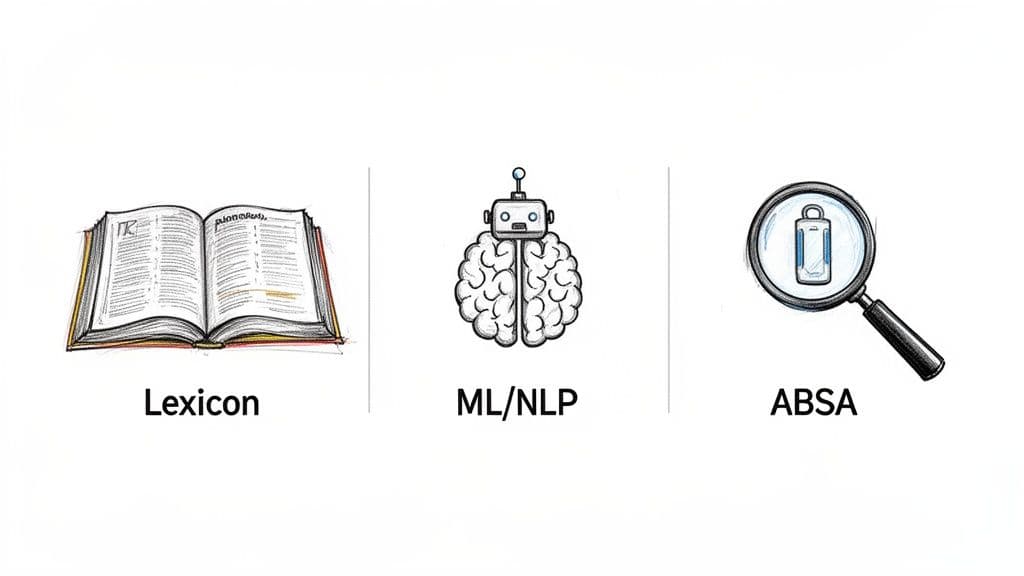
To really get what brand sentiment analysis can do, you need to look under the hood at the engines driving it. The technology has come a long way, evolving from simple word-counting to sophisticated AI that can pick up on subtle human emotions. Each approach offers a different lens for viewing the massive, ongoing conversation about your brand.
It all started with a pretty straightforward, rule-based system. While basic, this early method paved the way for the advanced AI techniques we rely on today.
1. Lexicon-Based Analysis: The Dictionary Approach
Think of this as trying to understand emotion with a giant "dictionary of feelings." This is the essence of lexicon-based analysis. Every word in the dictionary comes with a pre-assigned sentiment score—"excellent" might be a +1, while "terrible" is a -1.
The system just scans a piece of text, tallies up the scores, and spits out an overall polarity. It's fast and doesn't require a lot of computing power, making it decent for a quick, high-level sort of massive data volumes.
But here's the catch: it’s easily fooled by the quirks of human language.
- Sarcasm flies right over its head. A comment like, "Oh, great, another software bug," gets tagged as positive because of the word "great."
- Context is completely lost. The word "sick" could mean "ill" (negative) or "amazing" (positive), and a lexicon model has no way of knowing which one you mean.
It’s a functional starting point, but it just doesn’t have the nuance needed for truly accurate brand intelligence.
2. Machine Learning and NLP: The AI Apprentice
The next big leap forward is combining Machine Learning (ML) with Natural Language Processing (NLP). Picture this method as an AI apprentice that you train to become an expert analyst. Instead of handing it a dictionary, you feed it thousands—or even millions—of text examples that humans have already labeled as positive, negative, or neutral.
From this data, the model teaches itself to spot complex patterns, word associations, and contextual clues. It looks beyond single words to understand how entire phrases, sentence structures, and even punctuation shape the overall emotion. This is how it learns to detect sarcasm and handle ambiguity in a way rule-based systems never could.
This jump in sophistication is what makes modern brand sentiment analysis so incredibly valuable. Well-trained ML models can hit accuracy rates of 85-95%, turning messy, unstructured text into a reliable stream of business intelligence. The models do this by converting text into numerical vectors, a concept known as embeddings, which helps them mathematically grasp the relationships between words.
3. Aspect-Based Sentiment Analysis: The Magnifying Glass
While a good ML model can tell you if a comment is positive, Aspect-Based Sentiment Analysis (ABSA) tells you why. It’s like a magnifying glass, zooming in on the conversation to assign sentiment to specific features of your product or service.
Take this customer review: "The battery life is incredible, but the camera quality is a real letdown."
A standard sentiment tool might just call this "mixed" or "neutral." But ABSA breaks it down with precision:
- Battery Life: Positive
- Camera Quality: Negative
This is where sentiment analysis becomes a game-changer. You get highly specific, actionable feedback that your product, marketing, and customer service teams can actually use. You can finally stop guessing and start pinpointing which features people love and which ones are causing frustration.
To make these differences clearer, here's a quick comparison of the three core methodologies.
Comparison of Sentiment Analysis Methodologies
This table compares the core approaches to sentiment analysis, highlighting their mechanisms, best use cases, and limitations for business application.
Ultimately, moving from lexicon-based methods to ML and ABSA is like going from a blurry photograph to a high-resolution, interactive map. You don't just see the general landscape; you can zoom in on the specific details that matter most to your strategy.
Where to Find the Data That Matters for Sentiment Analysis
Your brand sentiment analysis is only as good as the data you feed it. Think of it like a detective building a case—relying on a single witness gives you a narrow, often biased, perspective. To truly understand what people think, you need to gather evidence from every corner where conversations about your brand are happening.
This means looking beyond just one channel and pulling together information from multiple sources. Each platform and interaction type reveals a different piece of the puzzle. Combining them is the only way to get a complete and accurate picture of public perception.
Social Media Platforms
Social media is the most obvious place to start. It’s a real-time, unfiltered stream of public opinion where customers, critics, and fans share their thoughts instantly. Platforms like X (formerly Twitter), LinkedIn, and Reddit each offer a unique window into these conversations.
- X (Twitter): Perfect for catching immediate, gut reactions to news, product launches, or service issues. Its sheer volume makes it a fantastic tool for spotting emerging trends.
- LinkedIn: Essential for B2B companies. This is where you’ll find insights into professional sentiment, your reputation within the industry, and how you stack up against competitors.
- Reddit: A goldmine for candid, in-depth discussions. Niche communities here often reveal highly specific pain points or features that users absolutely love.
This constant flow of data is incredibly valuable. In fact, the market for sentiment analysis within social media analytics hit 3,944.9 million in 2024** and is expected to explode to **17,048.5 million by 2030. This growth, detailed in research from Grand View Research, is driven by billions of daily mentions and shows just how critical this data source has become.
Customer Reviews and Support Channels
While social media gives you the broad strokes of public opinion, your own support channels and dedicated review sites offer structured, high-intent feedback. These sources are where you can dig into the nitty-gritty of the customer experience.
Sites like G2, Capterra, and Google Reviews are packed with detailed user feedback, often zeroing in on specific product features, usability, and the return on investment. Analyzing this data helps product teams decide what to build next and gives marketing teams powerful testimonials to work with. To really make sense of all this, many businesses are turning to advanced forms of conversation intelligence to transform raw customer interactions into clear, actionable insights.
The New Frontier: AI-Generated Responses
The newest and most critical data source to watch is the output from generative AI models like ChatGPT, Gemini, and Perplexity. These tools are quickly becoming the first stop for people looking for information, product summaries, and brand comparisons. How an AI describes your brand is now directly shaping public perception.
Imagine an AI model summarizing your brand as "a reliable but expensive solution." That simple phrase could influence thousands of potential customers before they ever visit your website. Ignoring this channel is like being blind to how a huge part of your audience is now discovering you.
Keeping an eye on this new landscape is no longer optional. You need specialized tools to track how your brand appears in AI responses, spot neutral or negative descriptions, and figure out what content gaps are causing them. This is a core part of any modern brand strategy. To get started, you can learn more about how to track brand mentions online across both traditional and AI-powered channels. By monitoring these AI-driven conversations, you can start shaping your narrative where it's beginning to matter most.
How to Implement a Brand Sentiment Analysis Workflow
Moving from theory to practice with brand sentiment analysis requires a clear, methodical plan. If you just dive in, you’ll quickly find yourself drowning in a sea of data with no real way to use it. A structured workflow is what turns a mountain of raw information into focused, relevant insights that actually drive business value.
For a B2B company, this isn't just about eavesdropping on social media. It's about building an intelligence engine. Let's walk through how to do it right, using a hypothetical B2B SaaS company, "Innovate Solutions," as our example.
Step 1: Define Your Objectives
Before you look at a single comment, you have to know what you’re trying to accomplish. A vague goal like “see what people think” is a recipe for useless data. Your objectives need to be specific, measurable, and tied directly to what the business cares about.
For Innovate Solutions, some sharp objectives might look like this:
- Gauge sentiment around their new "AutoPilot CRM" feature to see if the launch messaging is actually hitting the mark with sales managers.
- Benchmark brand sentiment against their main competitor, "ConnectSphere," to pinpoint where they’re winning and where they’re falling behind.
- Identify the top three customer service pain points mentioned in online reviews over the next quarter to guide their support team's training.
With clear goals like these, every other step—from choosing keywords to building reports—suddenly has a purpose.
Step 2: Identify Keywords and Topics
Now that you know why you're looking, it's time to decide what you're looking for. This means creating a comprehensive list of the words and phrases you need to track. Think of this as casting the right net to catch all the relevant conversations.
Innovate Solutions would start with the obvious:
- Brand Names: "Innovate Solutions," "InnovateSolutions"
- Product Names: "AutoPilot CRM," "Innovate CRM"
- Competitor Names: "ConnectSphere," "ConnectSphere CRM"
- Industry Terms: "sales automation software," "B2B CRM platforms"
This is a good start, but they also need to think about common misspellings or abbreviations. You don't want to miss a valuable piece of feedback because of a simple typo.
Step 3: Select Your Tools and Platforms
This is where the right technology makes all the difference. You need a platform that can pull data from all the right places and make sense of it. For any modern B2B brand, that means looking well beyond just social media feeds and review sites.
This process flow shows exactly why a comprehensive tool is non-negotiable. It needs to cover traditional sources as well as the critical new frontier of AI-generated content.
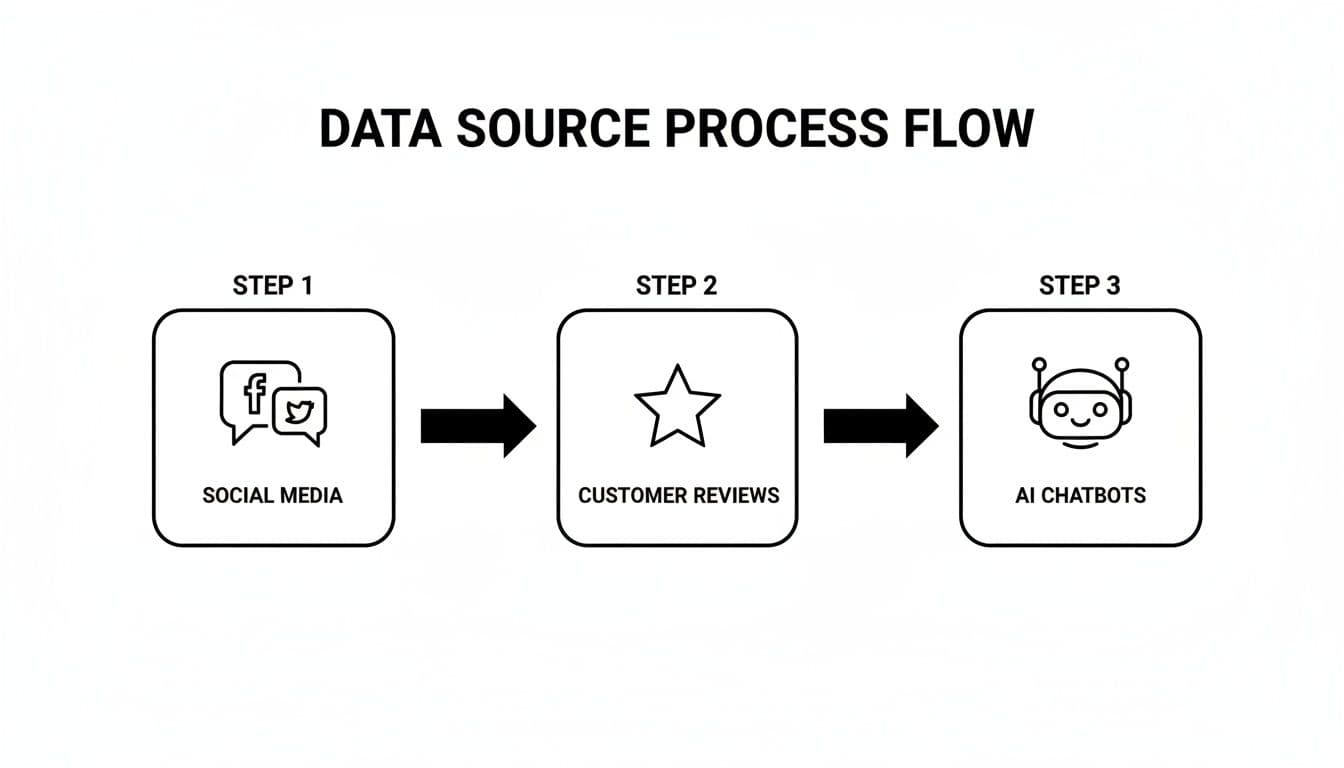
As you can see, a complete picture must include how your brand is being portrayed in AI chatbots—a source that is increasingly shaping buyer perceptions before they ever talk to a salesperson.
This is where a platform like Attensira becomes indispensable. It’s built not just to track the usual suspects but to specialize in monitoring how your brand and products show up in AI-generated answers. It's a critical, and often completely missed, data source. To learn more, check out our guide on AI brand monitoring.
Step 4: Collect and Analyze the Data
With your tool configured and keywords loaded, the data starts flowing in. The platform’s analysis engine will begin automatically tagging mentions as positive, negative, or neutral. This is where the heavy lifting happens.
Your job is to step back and look for the patterns. For example, Innovate Solutions might notice a sudden spike in negative sentiment. Digging in, they could find it has nothing to do with product quality but is entirely linked to a recent pricing change that's confusing customers.
This stage is all about connecting the dots. The goal isn't just to see the sentiment score; it's to understand the why behind it. A 30% increase in negative mentions is an alarming stat, but finding out that 90% of them are about a single, fixable bug is an actionable insight.
Step 5: Report and Act on Insights
All this work is for nothing if the insights stay locked in a dashboard. The final, most important step is sharing what you've learned with the right people, in a way they can actually use.
Innovate Solutions would create different reports for different teams:
- For Marketing: A report packed with positive testimonials about "AutoPilot CRM" that can be turned into powerful social proof for new campaigns.
- For Product Development: A concise summary of user feedback on a clunky UI element, complete with direct quotes that bring the problem to life.
- For Customer Service: A list of the most common, frustrating questions people are asking, so they can build out proactive support documentation.
By following this workflow, brand sentiment analysis stops being a passive listening exercise and becomes a strategic driver that sharpens your messaging, improves your products, and solidifies your place in the market.
Turning Insights Into Action and Improving AI Visibility
Gathering brand sentiment data is one thing; actually using it is another. The real magic happens when you translate those raw numbers and customer comments into decisive, strategic moves. Data that just sits on a dashboard is useless noise. It’s the actionable insights that sharpen your competitive edge, strengthen customer relationships, and, maybe most importantly, boost your visibility in the new world of AI-driven search.
This isn't some abstract exercise. It’s about matching specific scenarios with targeted solutions. Every signal from your audience, good or bad, is a clear instruction on what you need to do next.
Responding to Negative Sentiment Spikes
Let's say your monitoring tool flags a sudden 25% jump in negative sentiment over a 48-hour period. The knee-jerk reaction is often panic, but a structured response is far more effective. The first thing you need to do is diagnose the root cause with aspect-based analysis.
Is the negativity all focused on a specific product feature? A recent price hike? A marketing message that missed the mark? Once you figure out the "why," your action plan practically writes itself.
- Product Feature Backlash: If a new software update is causing widespread frustration, that insight goes straight to the product team. This isn't just complaining; it's valuable feedback that can drive immediate bug fixes or inform the entire next development sprint.
- Customer Service Gaps: Are people consistently mentioning long wait times or unresolved support tickets? That data is a clear mandate for your support leadership. The fix could be anything from creating new FAQ content and updating your knowledge base to rolling out new training for the team.
Leveraging Positive Sentiment Strategically
Positive sentiment isn't just a feel-good metric—it's a powerful asset you can put to work. When your analysis shows a feature that customers absolutely love, it’s a bright green light to amplify that message everywhere.
This is how you build marketing campaigns on a foundation of authentic social proof. You can pull direct quotes from glowing reviews and feature them in your ad copy, build out new case studies, or drop them right onto your landing pages. For more on this, check out these practical AI marketing strategies.
Brand sentiment isn't fluff—it’s a billion-dollar driver reshaping marketing strategies worldwide. Verified Market Research values the emotion recognition and sentiment analysis market at 34.71 billion in 2024**, surging to **113.32 billion by 2032. For CMOs, 78% better targeting via sentiment refines AI search visibility—a crucial advantage as platforms track brand mentions to plug content gaps.
Closing Content Gaps for AI Visibility
One of the most critical uses for modern brand sentiment analysis is optimizing for AI-powered search. When a tool like ChatGPT or Gemini generates a response about your brand, it’s essentially summarizing everything it can find online. If that summary comes out neutral, unflattering, or just plain incomplete, it's because you have a content gap in your digital footprint.
This is where specialized monitoring becomes so important. Using a platform like Attensira to track how your brand appears in AI-generated answers lets you pinpoint these weaknesses with incredible precision. For example, if an AI never mentions your industry-leading security features, it’s because there isn't enough clear, authoritative content online for it to synthesize.
The solution is targeted content creation. Once you spot a gap, you can produce AI-optimized content—think detailed blog posts, technical docs, or direct comparison pages—that specifically addresses what’s missing. This proactive approach helps you shape how AI models see your brand, solidifying your digital authority and making sure you’re the one controlling the narrative. You can learn more about this in our guide on AI search monitoring.
The Future of Brand Sentiment in an AI-Driven World
We've moved far beyond thinking of brand sentiment analysis as a simple social listening tool. It's no longer just a defensive tactic for reputation management. Today, it’s a proactive, strategic part of your arsenal, absolutely essential for navigating a world where AI is constantly shaping how people perceive your brand.
Understanding the emotion behind the conversation is now a core driver of business strategy, product innovation, and competitive advantage. And as the technology gets smarter, the insights will only get deeper.
Multimodal Analysis and Ethical AI
The next frontier is already taking shape. We're on the cusp of sophisticated multimodal sentiment analysis, where AI won’t just read text but will also interpret the tone of voice in a customer service call or the sentiment conveyed in a product review video. This gives you a much richer, more complete picture of how your audience actually feels.
At the same time, ethical AI is becoming non-negotiable. These systems process incredible amounts of data, so ensuring fairness, privacy, and transparency is critical. The brands that make ethical data handling a priority will build deeper trust—a powerful sentiment driver in its own right.
Shaping Your AI Narrative
The link between what people say about you online and your visibility in AI ecosystems is now direct and permanent. Every conversation, every review, every mention is a training signal for the large language models that are quickly becoming the world's go-to source for information.
Brand sentiment analysis isn't just about monitoring what's happening now. It's about actively shaping how your brand will be represented in the AI-generated search results and conversations of tomorrow. If you ignore it, you’re letting an algorithm control your story.
A Call for Proactive Stewardship
For B2B companies, this reality demands a fundamental shift in strategy. This is where tools like Attensira become indispensable, giving you the intelligence to not only see but also influence how your brand shows up in these new AI-powered channels.
The insights you gain aren't just for the marketing team anymore. They're critical for product development, sales enablement, and high-level corporate planning. The call to action for brand leaders, SEOs, and CMOs is clear: make brand sentiment analysis a foundational part of your growth strategy. The companies that master listening, understanding, and acting on the nuanced emotions of their audience are the ones that will lead the way.
Frequently Asked Questions About Brand Sentiment
It's only natural to have questions when you're digging into brand sentiment analysis. As this field becomes more critical for any serious marketing or brand strategy, it's important to get a real handle on what it can—and can't—do.
Let's cut through the noise and answer a few of the most common questions we hear.
How Accurate Is Brand Sentiment Analysis, Really?
This is the big one, and the honest answer is: it depends entirely on the engine under the hood.
Older, simpler systems that just tally up "good" and "bad" words from a dictionary (known as lexicon-based analysis) are often shaky. They might hit 60-70% accuracy but completely miss the point when it comes to sarcasm, complex phrasing, or industry-specific slang.
On the other hand, modern platforms powered by sophisticated Machine Learning (ML) and Natural Language Processing (NLP) are in a different league altogether. These systems are trained on massive amounts of real-world language, allowing them to grasp context and nuance. We're talking accuracy in the 85% to 95% range. For B2B brands, the gold standard is a tool that lets you fine-tune the model to your industry's unique vocabulary, which is how you get truly precise insights.
Can Sentiment Analysis Actually Predict Future Trends?
Absolutely. In fact, this is where sentiment analysis shifts from a reactive tool to a strategic weapon. You stop just listening to what people are saying and start anticipating what they'll do next.
When you track sentiment shifts over time and connect them to real-world events—like a new ad campaign or a rival's big announcement—you can start to see the writing on the wall. Imagine noticing a slow, creeping rise in negative chatter about a competitor's pricing. That's not just noise; it's a signal that the market is ripe for you to jump in and highlight your own value.
Think of it as an early warning system. A sudden spike in positive discussion around a new feature or technology can indicate future market demand, giving your product and strategy teams a valuable head start.
How Can a Small B2B Company Start with Sentiment Analysis?
You don't need a massive budget or a team of data scientists to get in the game. For smaller B2B companies, the key is to start smart and focused.
Begin with tools that already have sentiment features baked in—many social media management or PR platforms offer this, often with free or low-cost tiers. The trick is to avoid trying to boil the ocean. Zero in on what matters most, right now.
- Monitor Your Brand: Start by tracking your company name and your main products.
- Watch Your Competitors: Keep tabs on one or two of your closest competitors.
- Track Key Topics: Follow a handful of core industry conversations to get a feel for the bigger picture.
This targeted approach lets you get a feel for the data without getting overwhelmed. And when it comes to the new frontier of AI-driven search, specialized platforms are emerging that allow even small teams to see how their brand shows up in AI-generated answers, helping them spot content gaps without a huge upfront cost.
Ready to see how your brand is perceived in the AI-powered search landscape? Attensira provides the tools to monitor your AI visibility, identify content gaps, and generate optimized drafts to control your narrative. Take control of your AI presence today by visiting https://attensira.com.