Explore what is ai sentiment and what are sentiment scores? Learn how AI measures emotions in text to drive smarter business decisions.
At its core, AI sentiment analysis is about teaching computers to read between the lines—to understand the feelings and opinions tucked away in human language. The output of this process is a sentiment score, which is simply a number the AI assigns to quantify that feeling.
Think of it as a super-fast, incredibly perceptive assistant who can read a customer review and instantly tell you, "This person is happy," "This one is frustrated," or "This one is just stating a fact."
Unlocking the Meaning Behind the Words
Can you imagine trying to manually sift through thousands of social media comments, product reviews, and support emails every day? It’s not just impractical; it’s impossible. This is precisely why AI sentiment analysis is so valuable for any brand paying attention to its audience. It automates the monumental task of gauging public opinion in real-time.
But this isn't just about counting keywords. Old-school methods could tell you your brand was mentioned 1,000 times, but they couldn't tell you if people were praising it or complaining. Sentiment analysis reveals the how and why behind the mention, giving you the context that truly matters.
From Words to Numbers: The Role of Sentiment Scores
To make all that emotional data practical, the AI has to translate it into something we can measure. That's where sentiment scores come in.
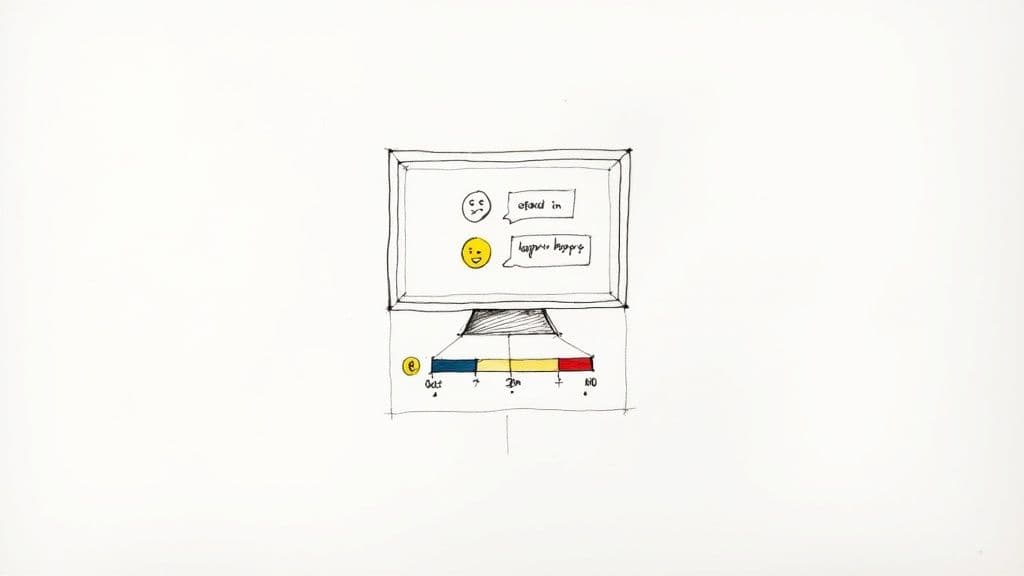
These scores are the numerical values that represent the emotional tone of a piece of text. The most common approach is a simple polarity scale: -1 for negative, 0 for neutral, and +1 for positive. More advanced models might use a wider range, like -100 to +100, to capture the intensity of the emotion.
For a quick reference, here are the core ideas we're working with.
Key Concepts at a Glance
This process effectively turns messy, unstructured feedback into clean, structured data that you can actually use. You can track trends, compare campaigns, and pinpoint problems with precision. If you want to dig deeper into its application, this guide on AI Sentiment Analysis for Customer Feedback offers some great insights.
By converting opinions into measurable metrics, businesses can finally understand the "why" behind customer behavior at scale, turning raw feedback into strategic intelligence. This capability allows companies to make data-driven decisions that directly impact customer satisfaction and brand perception.
How AI Learned to Understand Emotion
AI's ability to grasp human emotion didn't just appear out of nowhere. It's been a long, fascinating journey, starting with methods that now seem almost primitive. The earliest attempts at sentiment analysis were more like a crude word-matching game than a truly intelligent system, relying on what we call rule-based systems.
Think of it like a simple tally sheet. These early systems were fed lists of "positive" words ("love," "great," "excellent") and "negative" words ("hate," "poor," "awful"). When given a piece of text, the system would just count the good versus the bad words to spit out a score. It worked, sort of, but it had zero understanding of the nuances of human language.
A New Chapter: Learning from Data
The real breakthrough came with the advent of machine learning. Suddenly, we weren't just giving the computer a dictionary and a set of rigid rules; we were teaching it how to learn on its own. It was a fundamental shift, like going from memorizing a phrasebook to actually learning a language.
Developers began feeding AI models massive datasets—millions of product reviews, articles, and social media posts—all pre-labeled by humans as positive, negative, or neutral. By churning through this data, the AI started identifying the patterns, word combinations, and subtle cues associated with different feelings. This approach made sentiment analysis infinitely more flexible and accurate because the AI could adapt to new slang and evolving contexts without a programmer having to manually update its word lists.
Sentiment analysis, often called opinion mining, uses natural language processing (NLP) and machine learning to systematically identify and categorize opinions expressed in a piece of text. While its roots go back to the 1960s, the field truly took off in the 2000s with machine learning. For a deeper dive, you can explore the detailed history of text analytics.
Deep Learning and the Quest for True Understanding
Today, we're in the era of deep learning, which marks another monumental leap. Modern models like Google’s BERT and OpenAI's GPT series operate on a level that was pure science fiction just a decade ago. Using complex neural networks that mimic the structure of the human brain, these systems can process language with astonishing depth.
They can finally pick up on the subtleties that stumped older models. For example:
- Context: They know "sick" is a good thing in "that was a sick concert" but a bad thing in "I feel sick."
- Sarcasm: They can detect that "Great, another flight delay" is actually negative, despite the word "great."
- Nuance: They can tell the difference between mild frustration and outright rage.
This evolution—from simple keyword counting to deep, contextual comprehension—is what makes today's AI sentiment analysis so powerful. It’s not just a fancy new tool; it's the result of decades of work, giving us a way to finally interpret the true voice of the customer with incredible precision.
How AI Generates Sentiment Scores
Figuring out how an AI lands on a specific sentiment score can seem like a black box. In reality, it's a very logical, step-by-step process. Think of it like a chef meticulously following a recipe.
First, you gather your ingredients. For an AI, this means raw text data from all over the place—customer reviews, social media posts, support tickets, you name it. But you can't just throw everything into the bowl. The AI has to clean up this data in a stage called preprocessing, which is like sifting the flour. It gets rid of the junk like URLs, emojis, and special characters, and even corrects typos, so the model can focus on the words that actually matter.
With the ingredients prepped, the real cooking starts. The AI model gets to work analyzing the cleaned text to figure out the emotional tone and assign a score. The exact method it uses can vary quite a bit, depending on how sophisticated the tool is.
The Different Flavors of AI Analysis
Not all sentiment analysis tools are built the same. The way an AI is designed to understand human emotion has a massive impact on its accuracy and how deep its insights go. Over the years, we've seen three main approaches take shape.
- Rule-Based Systems: This is the old-school method. It works off a predefined dictionary where words get a positive or negative value (think "happy" = +1, "awful" = -1). The system just tallies up the scores in a sentence to get a final sentiment. It's simple, but it can miss a lot of nuance.
- Machine Learning (ML) Systems: These are much smarter. Instead of following rigid rules, they're trained on huge datasets of text that humans have already labeled. This teaches the AI to recognize the patterns, context, and word combinations that signal positive or negative feelings, making it far more flexible and accurate.
- Hybrid Systems: The best of both worlds. The most effective tools today often blend rule-based and ML approaches. They lean on machine learning for the heavy lifting and then apply specific, custom rules to handle things like industry jargon or unique brand names.
This infographic does a great job of showing how these models have progressed from basic, dictionary-based systems to the highly complex ones we have today.
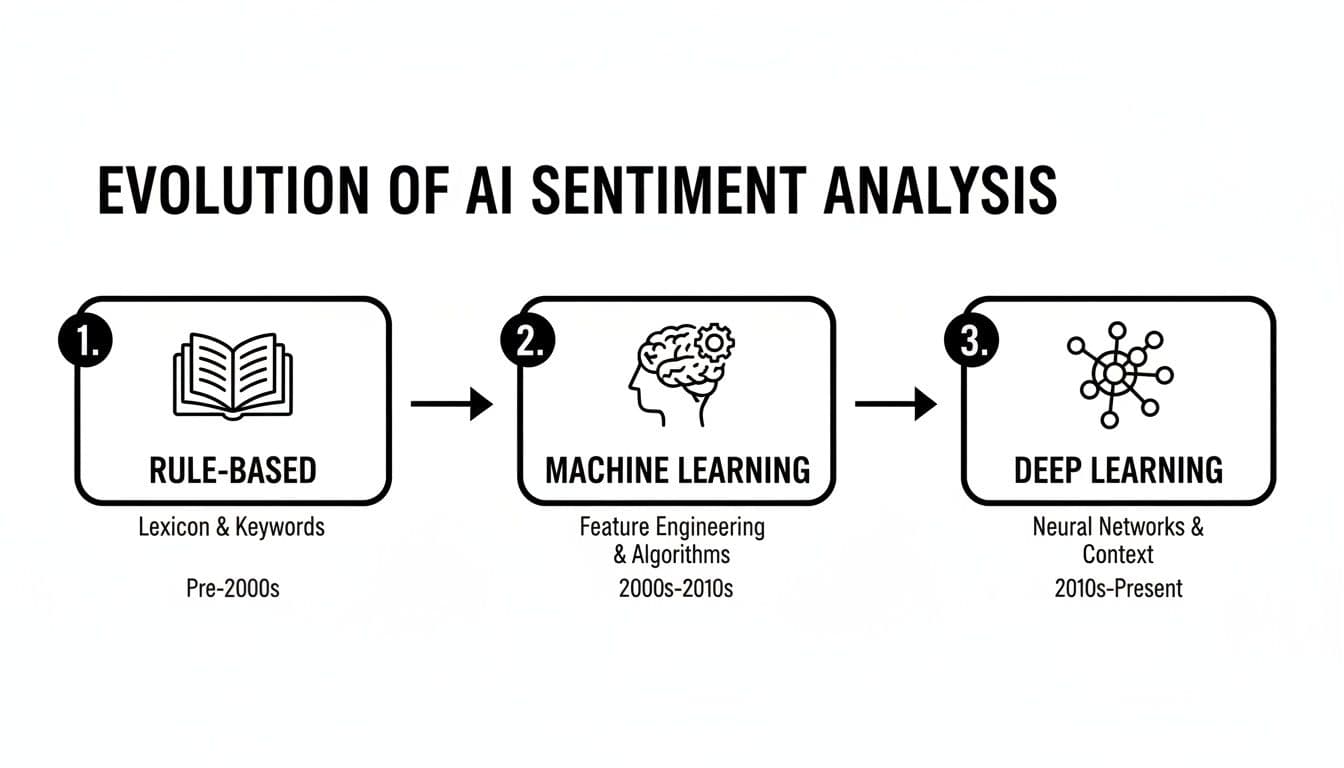
As you can see, we've moved from rigid systems to sophisticated neural networks that can actually grasp the subtleties of human language. Understanding how different advanced language models stack up is key, since their core design dictates what they're good at. For anyone interested in a deeper dive, this Claude vs ChatGPT comparison breaks down how different models handle specific language tasks.
Decoding What the Scores Actually Mean
So, the AI has done its work and spit out a number. What does it tell you? A simple positive, negative, or neutral tag is a good start, but a numerical score gives you a much clearer picture of the intensity behind the emotion.
A very common scale runs from -1 to +1. Here, -1 is intensely negative, 0 is perfectly neutral, and +1 is glowing with positivity. It's the difference between a satisfied customer (+0.2) and a raving fan (+0.7).
This level of detail is what makes sentiment scores so incredibly useful for business strategy. But we can go even deeper. The real magic happens with aspect-based sentiment analysis. Instead of giving a single score to an entire review, this approach pulls out opinions about specific product features or services.
For instance, take this review: "The battery life is amazing, but the screen is too dim." An aspect-based system would break it down like this:
- Battery Life: Positive (e.g., +0.9)
- Screen: Negative (e.g., -0.6)
This is where you move beyond just knowing if a comment is good or bad and get truly actionable insights. It lets a business know exactly what customers love and what’s driving them crazy.
How to Interpret Sentiment Scores for Business Growth
Getting a sentiment score is just the beginning. Seeing a high score like +0.8 feels good, but that single number is only a snapshot in time. The real magic happens when you stop treating it like a final grade and start seeing it as a dynamic signal from your audience.
Think of it like checking your company's stock price. One day's number is just noise. The trend line over a quarter, however, tells a story of growth, stability, or decline. Sentiment scores are no different. A steady climb might mean your latest marketing campaign is a hit, while a sudden nosedive can be the first red flag for a brewing PR issue.
This is why aggregating scores is so important. By pulling together data from thousands of mentions across social media, forums, and review sites, you get a much clearer, more reliable picture of your brand's health. You move from just reacting to single comments to proactively shaping your brand’s reputation.
The Story Behind the Numbers
A sentiment score is meaningless without its context. To make that data work for you, you have to understand the "why" behind the number. For example, if you just launched a new feature and see an average sentiment of +0.6 from Twitter mentions, that's a fantastic signal that the launch is going well.
But context is especially crucial for those tricky neutral scores.
A neutral score rarely means people don't care. It can signal a conversation where positive and negative opinions are canceling each other out, pointing to a divided audience. Digging into the specific comments is the only way to know for sure.
Knowing the difference is key. An audience with polarized opinions requires a completely different strategy than one that's simply unengaged.
A Practical Guide to Sentiment Score Ranges
To make this even clearer, let's break down what these scores actually mean in the real world. Think of a scale from -1 (very negative) to +1 (very positive). Here’s how you might interpret the different ranges.
Sentiment Score Ranges and Their Meaning
This table isn't a rigid rulebook, but it’s a solid starting point for turning abstract numbers into a concrete action plan.
Putting Interpretation Into Practice
To actually use this data, you need a repeatable process. For a great overview, check out these 5 steps to AI-powered sentiment analysis marketing, which offer a solid framework for getting started.
Here are a few ways you can begin turning your sentiment scores into growth:
- Segment Your Data by Source. Are your customers on Instagram happier than those on your support forums? The answer tells you where to adjust your tone and strategy.
- Measure Campaign Lift. Track sentiment before, during, and after a major marketing campaign. A clear jump in positive scores is hard evidence that your messaging resonated.
- Find Your Strengths and Weaknesses. Use aspect-based analysis to pinpoint which specific product features people love and which ones are causing headaches. This is a direct feedback loop for your product team.
At the end of the day, interpreting sentiment scores has become a non-negotiable part of modern brand management. It's a cornerstone of any effective AI brand monitoring strategy, giving you the ability to listen to the market at scale and make smarter decisions. You’re turning the collective voice of your customers into a measurable asset that drives real growth.
Real World Examples of AI Sentiment Analysis
It's one thing to talk about theories and scores, but the real magic of AI sentiment analysis happens when you see it at work in the wild. This isn't just an abstract idea; it's a powerful tool businesses are using every single day to get ahead. By looking past what customers are saying and digging into how they feel, companies can make much sharper, more informed decisions.
Let's walk through a couple of real-world scenarios to see how different industries are using sentiment analysis to find their competitive edge. These examples perfectly illustrate how a simple sentiment score can become a game-changing piece of business intelligence.
Retail Product Development and Refinement
Picture a major electronics company that just launched a new set of wireless earbuds. Sales look good, but thousands of reviews are flooding e-commerce sites and tech blogs. There's no way a human team can read and categorize all that feedback.
- The Challenge: The product team needs to figure out—fast—what people love and what they hate. This feedback is critical for planning the next product update and stamping out any urgent problems.
- The AI Solution: The company deploys an AI tool to run aspect-based sentiment analysis on every review. This system automatically sorts feedback into categories and assigns sentiment scores to specific features like "battery life," "sound quality," and "case design."
- The Result: The data immediately shows a trend. "Sound quality" is a big winner, with consistently high positive scores (averaging +0.8). But "connectivity" is a huge problem, with a deeply negative average score of -0.7. Armed with this data, the team can confidently prioritize a firmware update to fix the Bluetooth bugs, turning a potential PR disaster into a story about a responsive, customer-focused brand.
By analyzing sentiment at this micro-level, companies can turn a tidal wave of unstructured feedback into a clear, prioritized product roadmap.
Hospitality and Real-Time Customer Service
A global hotel chain is hyper-focused on protecting its brand reputation. They know that preventing a bad experience from becoming a scathing online review is everything.
- The Challenge: They need a way to monitor social media mentions in real time, instantly spotting guests who are having a bad experience while they're still at the hotel.
- The AI Solution: The chain sets up a social listening tool powered by sentiment analysis. The system is programmed to flag any mention of their hotel names that carries a negative sentiment and immediately alert the on-site manager of that specific property.
- The Result: A guest tweets, "So disappointed with the room service at [Hotel Name] in London. Waited over an hour." The AI flags this with a sentiment score of -0.9. The hotel manager gets an instant notification, finds the guest's room, and personally delivers a complimentary meal with an apology in under 15 minutes. The guest, blown away by the response, later updates their tweet to praise the hotel's incredible service. In one move, they turned a detractor into an advocate.
Understanding how people feel about your brand in public conversations is a modern business essential. As you think about these applications, it’s also helpful to explore how to see brand visibility in ChatGPT to get a fuller sense of your digital footprint. These examples show that the question of what is AI sentiment and what are sentiment scores? has powerful, practical answers that directly build customer loyalty and drive success.
Common Questions About AI Sentiment Analysis
Even once you have a good handle on what AI sentiment analysis is, practical questions always pop up when you start thinking about using it. Digging into these common queries helps set realistic expectations, showing you where the technology truly shines and where its limits still lie. Let's tackle some of the most frequent questions to round out your understanding.
How Accurate Is AI Sentiment Analysis, Really?
This is usually the first thing people ask, and for good reason. Modern AI models can often hit 80-95% accuracy, which sounds fantastic. But that number isn't set in stone.
An AI's performance can take a nosedive when it runs into sarcasm, niche industry jargon, or cultural slang it wasn't trained on. That’s why it's smarter to see sentiment scores as a powerful tool for spotting broad trends, not as a perfect judge of every single comment.
The best systems out there often use a hybrid approach, mixing machine learning with custom, human-defined rules. This lets them fine-tune performance for a specific brand or industry, getting much closer to the mark.
The goal isn't flawless interpretation of every comment. It's about getting a highly reliable, big-picture view of what your customers are thinking. This is what lets you make smart, strategic decisions based on a mountain of data you could never analyze by hand.
Can Sentiment Analysis Actually Understand Sarcasm?
For years, sarcasm was the Achilles' heel of sentiment analysis. Early, rule-based systems were completely stumped by it. A comment like, "Great, another hour on hold. Just what I wanted," would be tagged as positive simply because it contained the word "great."
Today's deep learning models are a whole different ballgame. By looking at the entire sentence and how the words relate to each other, a sophisticated AI can often pick up on the true negative meaning behind a sarcastic remark. It's not perfect, but this ability to understand context is a massive leap forward.
Even better, businesses can fine-tune these models on their own customer data. This helps the AI get much better at understanding the unique ways your customers talk, sarcasm and all.
What’s the Difference Between Sentiment and Emotion AI?
People often use these terms interchangeably, but they're not the same thing. Think of them as giving you insights at two different depths.
- Sentiment Analysis is all about polarity. It answers the "what" by sorting text into positive, negative, or neutral buckets. It’s your high-level summary.
- Emotion AI gets much more granular. It tries to pinpoint the specific feeling behind the words—joy, anger, disappointment, surprise. It answers the "why."
For example, sentiment analysis would tell you a review is negative. But Emotion AI could tell you why it’s negative. Was it driven by anger ("The product broke immediately!") or disappointment ("It just didn't live up to the hype")? That deeper detail gives you far more actionable information to actually improve the customer experience.
Understanding your brand's visibility in this new AI-driven environment is crucial. Attensira provides the tools to monitor how your brand appears across major AI platforms, offering actionable insights to optimize your content and stay ahead. Start tracking your AI presence today by visiting the Attensira website.