Master AI search engine optimization with this practical guide. Learn proven strategies to dominate AI-powered search and drive meaningful business results.
AI search engine optimization is all about shifting your content strategy to get your brand cited directly in the summarized answers that models like ChatGPT and Google's SGE spit out. It’s no longer about climbing a list of blue links; it's about becoming a primary, trusted source that AI systems rely on to construct their responses.
The New Search Landscape and Your Business

The entire process of how customers find information is undergoing a fundamental change. For years, SEO was a straightforward game: get your website to the top of the search results page. Think of it like being the first book someone sees in a library's card catalog. They still had to do the work of pulling the book off the shelf to find their answer.
But AI search works differently. It acts more like an expert research librarian. Instead of just pointing you to the best books on the shelf, it reads them all and hands you a concise, synthesized summary. This jump from a list of resources to a single, direct answer is quickly making the old SEO playbook obsolete. Visibility is no longer just about ranking—it's about being chosen as a source for the AI's final answer.
Why Your Old SEO Playbook Is Obsolete
This new reality is both a massive threat and a huge opportunity. If you don't adapt, your business risks becoming completely invisible as users lean more heavily on AI-generated summaries. The entire foundation of this new search world is built on advanced AI, especially the sophisticated large language model applications that drive these intelligent systems.
The real challenge for marketers now is ensuring their content is not just well-written, but also structured in a way that AI systems can easily understand and use. If your content isn’t aligned with what these assistants are looking for, it won't get included in the answer, no matter how "optimized" it is in the traditional sense.
This demands a completely new approach. Your content must be designed for machine comprehension just as much as for human readers. The need to adapt is immediate, as AI models are already fielding billions of queries every month. This even changes the game for paid strategies, a topic we explore in our guide on the emergence of ads in ChatGPT.
Gaining a Competitive Advantage in an AI-First World
Optimizing for this new world is the heart of AI search engine optimization. It’s about so much more than keywords. It’s about building deep authority, proving factual accuracy, and presenting your information with crystal clarity. The businesses that figure this out first will lock in a powerful competitive advantage.
This guide is your roadmap. We’ll walk through exactly how to:
- Build the kind of deep topical authority that AI models will recognize and trust.
- Structure your content so it can be easily parsed by machines.
- Measure success in a world where clicks and traffic are no longer the most important metrics.
By getting a handle on these principles, you can secure your brand’s relevance for years to come. You'll ensure you’re not just found, but are actually featured in the AI-powered answers of tomorrow.
Understanding the Shift From Keywords to Conversations
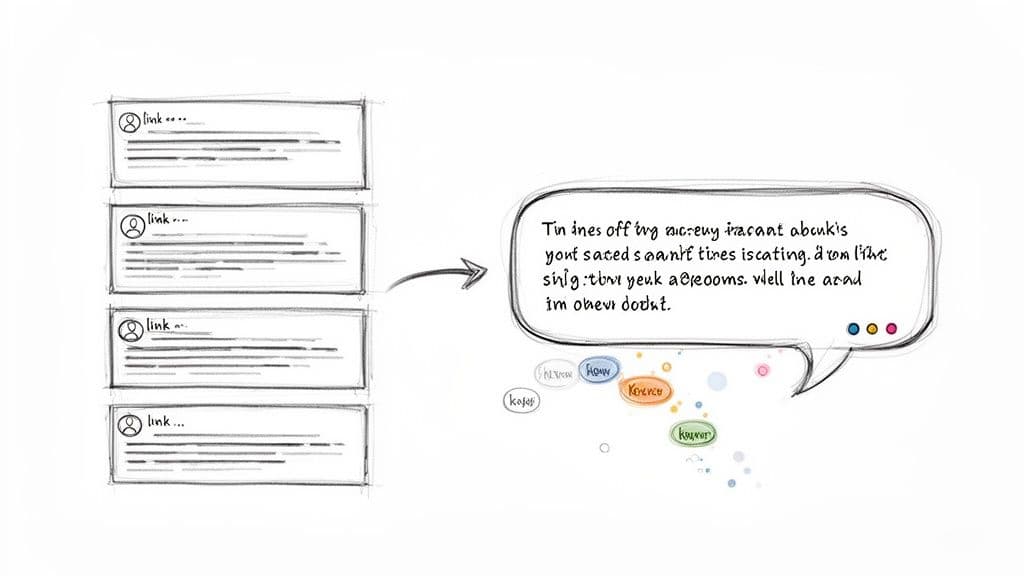
For a long time, SEO followed a pretty straightforward playbook. You did your keyword research, nailed your on-page technicals, and built some links. The whole game was about convincing search engines that your page was the most relevant match for a specific search term. It was a model that rewarded precision, often placing things like keyword density and backlink counts above all else.
But the arrival of AI-driven search has completely flipped the script. These newer, smarter systems don't just hunt for exact-match keywords. They're built to understand the user's underlying intent—the why behind the query. They connect concepts, interpret context, and deliver a direct, synthesized answer right on the results page.
This isn't just a small update. It's a seismic shift from optimizing for keywords to optimizing for conversations.
From a List of Links to a Direct Answer
Let's make this tangible. In the old days, a search like "best B2B marketing software" would give you a list of 10 blue links. It was then up to you to click through the different blog posts, review sites, and company pages to piece together an answer.
Today, an AI-powered search for that same query delivers something entirely different. Instead of just links, you get a direct comparative summary. The AI might instantly generate a paragraph outlining the top three platforms, maybe even with a neat table comparing their features, price points, and ideal users. This is the new reality of AI search engine optimization.
The goal is no longer to be the best link in a long list. It's to become a trusted source whose data and expertise are featured directly in the AI-generated answer.
This emerging discipline is what many of us now call Generative Engine Optimization (GEO). It's all about recognizing that the most valuable spot isn't the #1 ranking anymore; it's being cited inside the AI's summary. To do that, your content has to be so clear, authoritative, and well-structured that the AI chooses it as a foundational source for its response. This requires a much deeper focus on semantic meaning, which is why having a solid grasp of concepts like LSI keywords can give you a head start. If you're new to the topic, our guide on what are LSI keywords is a great place to begin.
Traditional SEO vs AI Search Engine Optimization
To really see how much the ground has shifted, it helps to put the two approaches side-by-side. The differences in strategy and focus are stark.
This comparison makes it clear: we're moving from a purely technical discipline to one that demands a more holistic, user-centric approach.
The New Metrics of Success
This fundamental change forces us to rethink what "success" even means. If users get what they need without ever visiting your website, what good are metrics like click-through rates (CTR) and organic traffic? They suddenly become far less reliable indicators of your brand's true visibility and influence.
The "zero-click search" isn't a new phenomenon, but AI has put it into overdrive. Today, an estimated 60% of all internet searches end without the user ever clicking through to a website. When AI-generated overviews are involved, about 26% of those searches are resolved right on the spot—a big jump from the 16% for traditional results.
This poses a real challenge for marketing teams who have spent years measuring SEO performance with website visits. The new scorecard for AI search engine optimization looks quite different:
- Brand Mentions: How frequently is your brand, product, or service named in AI answers?
- Inclusion Rate: For relevant queries, what percentage of AI summaries feature or cite your content?
- Share of Voice: How does your visibility within AI-generated results stack up against your direct competitors?
These KPIs measure your influence where it matters most—at the point of discovery, which is increasingly happening directly within the search results. The game has officially changed from driving clicks to earning citations.
Core Strategies for AI Search Engine Optimization
Moving from a keyword-first to a conversational mindset is the first major hurdle. Now, it's time to turn that new perspective into a concrete plan. Thriving in the world of AI search engine optimization comes down to getting four key pillars right. These aren’t just quick tricks or fleeting tactics; they represent a fundamental shift in how we need to create and structure information.
Think of it like this: an AI is an expert librarian building an answer for a patron. If you want that librarian to pull from your books, you need to make sure your collection is the most well-researched, clearly organized, and credible one on the shelf. These four strategies are your blueprint for building that library.
Build Deep Topical Authority
For years, a lot of SEO felt like a frantic race to get one perfect page ranked for one important keyword. AI search completely flips that script. It doesn't reward a scattered, wide-but-shallow approach. Instead, it heavily favors brands that can prove they have deep, comprehensive expertise on a particular subject. We call this topical authority.
To build it, you have to think beyond one-off articles and start creating interconnected content hubs. A content hub is simply a collection of content that covers a single, broad topic from every important angle, leaving no stone unturned.
For instance, rather than just writing a single article on "B2B Lead Generation," a powerful content hub would feature detailed, interlinked pieces on:
- Effective B2B lead nurturing workflows.
- In-depth comparisons of B2B marketing automation platforms.
- Step-by-step guides for executing LinkedIn lead gen campaigns.
- An analysis of the key metrics for measuring lead quality.
This approach sends a powerful signal to AI models that you aren't just another source; you are a genuine authority. It proves you've explored the nuances and can answer not just the user's first question, but all the follow-up questions they haven't even thought of yet.
Structure Your Content for Machine Readability
AI assistants don't "read" a page the way a person does. They parse it, systematically breaking down the content into structured data points to figure out what’s important and what’s true. A dense wall of unbroken text makes that job incredibly difficult, forcing the AI to guess at the key takeaways.
This is where structured data, also known as schema markup, becomes a game-changer. Schema is a vocabulary of code that acts like a set of super-descriptive labels for your content, explicitly telling search engines and AI what each part of your page is about.
Think of schema markup as the digital equivalent of labeling your files. A page without schema is like an unlabeled folder—the AI has to guess what's inside. A page with schema has clear labels like "Product," "Review," or "FAQ," making it easy for the AI to categorize and use the information with confidence.
Implementing structured data is one of the most direct ways to make your content AI-friendly. Using FAQPage schema, for example, makes it stunningly easy for an AI to lift those exact question-and-answer pairs directly into a generated response. You can dig into the full range of options at schema.org to find the right types for your content. This kind of deliberate AI content optimization ensures your expertise isn't just visible, but perfectly usable for AI systems.
Prioritize Factual Accuracy and Clear Sourcing
In the AI era, trust is the most valuable currency. Large Language Models are under enormous pressure to deliver accurate, reliable information and avoid embarrassing "hallucinations." Because of this, they are being trained to heavily prioritize sources that are transparent, well-researched, and clearly cite where their information comes from.
What does this mean for you? Vague claims and unverified statements will increasingly be ignored. Every piece of data you present needs to be backed up with credible proof.
Here’s how to put this into practice:
- Cite Your Sources: When you use a statistic or a critical fact, link directly to the original source, whether it's a research paper, a government study, or an industry report.
- Attribute Quotes: Always attribute quotes to the person who said them, including their name and title for context.
- Keep It Fresh: Make sure your content is regularly updated. Outdated information is a fast track to eroding trust with both users and AI models.
By building a reputation for accuracy, you signal to AI that your content is a low-risk, high-value source to use when constructing answers. For those looking for an edge, exploring the capabilities of an AI-driven SEO platform Outblogai can open up powerful new ways to maintain this level of precision across your content.
Write with Conversational Clarity
Finally, the way you write has never been more important. AI models are built to understand and generate human language. That means clear, direct, and conversational writing is far more effective than content overloaded with keywords or dry, academic jargon. The goal is to write as if you're answering a person's question directly.
Use short sentences. Break up your ideas into simple paragraphs. Use headings, bullet points, and numbered lists to make complex information easy to scan and digest. This isn't just good for your human readers; it's exactly what AI systems need to parse your content effectively.
For example, instead of a long, dense paragraph describing a product's features, lay them out in a clean, scannable bulleted list. That format makes the key information "snippable"—perfect for an AI to pull directly into a summary or a comparison table. When you adopt a clear, conversational tone, you are aligning your content with the fundamental nature of how modern search works.
Putting Your AI Visibility Strategy into Action
Knowing the theory behind AI SEO is one thing, but actually putting it into practice is a whole different ballgame. It's about moving from abstract concepts to a concrete workflow that connects your efforts to real results. You need a system to track your AI visibility, see where you're falling short, and take precise actions to fix it.
This whole process has to start with a baseline. You can’t improve what you don’t measure, right? So, the first step is getting a clear picture of where your brand stands today. By connecting your domain to a platform like Attensira, you can start monitoring mentions across key AI engines like ChatGPT and Perplexity, turning a vague idea of "visibility" into a hard-data dashboard.
Pinpointing Critical Content Gaps
Once you have data coming in, the real analysis begins. Let's say you run a B2B SaaS company that sells project management software. You log into your dashboard and discover that when users ask AI engines to compare the top tools, your main competitor gets mentioned 75% of the time. Your brand? It only shows up in 15% of the answers.
That’s not just a vanity metric—it's a direct threat to your market share. This single data point immediately flags a critical content gap. The AI simply doesn't see your brand as an authoritative answer for that high-intent query. Your mission is now crystal clear: create content that makes your brand impossible for the AI to ignore.
This is where a simple three-step process comes in, turning that visibility data into an actionable content strategy that hinges on Authority, Structure, and Clarity.
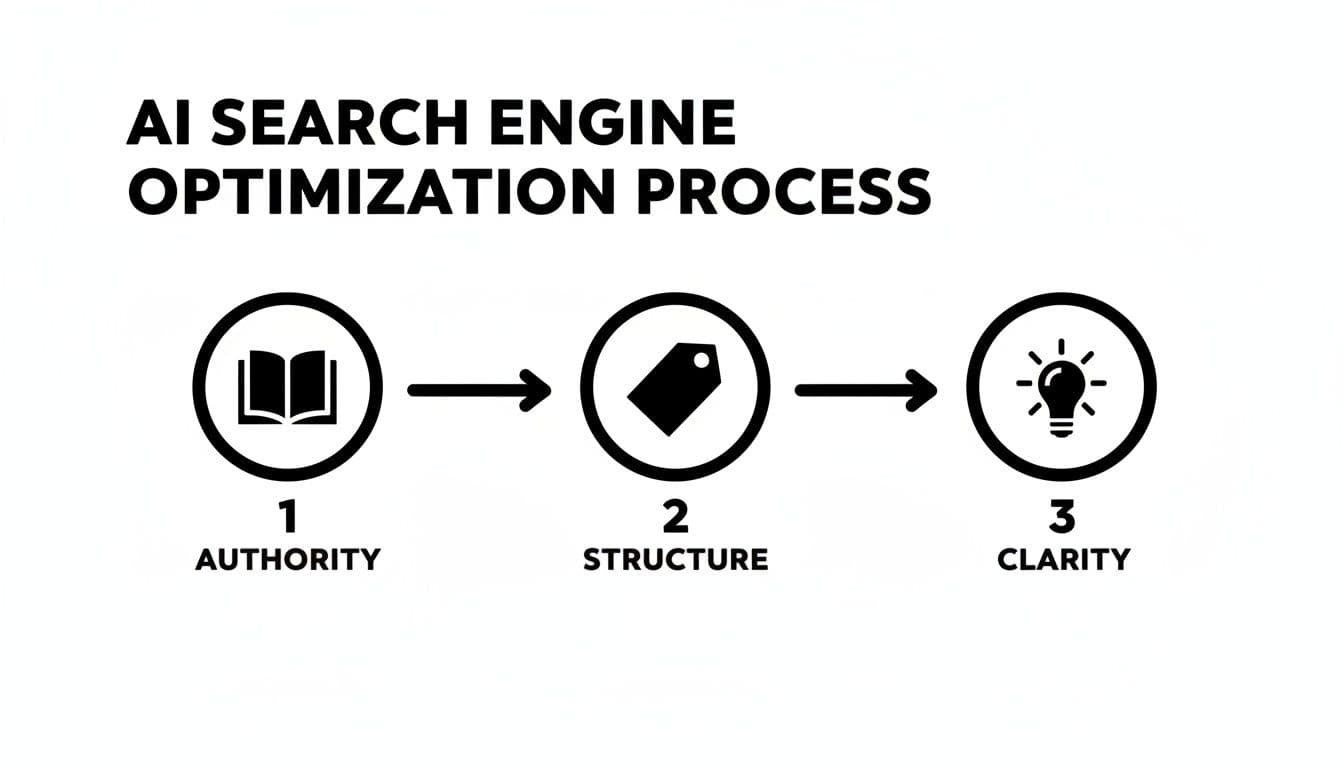
This workflow isn't complicated; it just visualizes the core steps for boosting your AI visibility, starting with building foundational expertise and ending with making sure your content is perfectly machine-readable.
Generating AI-Optimized Content to Fill Gaps
With the gap clearly identified, your next move is all about strategic content creation. Instead of just guessing what might work, you can lean on the insights from your visibility analysis to build out AI-optimized content briefs. For our project management software example, the obvious move is to create a definitive comparison guide.
This guide should be built to perform. That means it needs to:
- Directly Address the Query: The article should be structured around a direct comparison, with unambiguous headings like "Feature-by-Feature Breakdown" or "Pricing Tiers Compared."
- Leverage Structured Data: Use tables to cleanly compare features and schema markup to flag the page as a product review. This makes the information incredibly easy for an AI to parse and understand.
- Provide Verifiable Facts: Pack the content with specific data points, real customer testimonials, and links to credible third-party reviews to build trust and authority.
The real ROI of tracking your AI presence comes from this feedback loop. You monitor your visibility, identify a specific weakness, create highly-targeted content to fix it, and then measure the impact. This turns AI search engine optimization from a reactive task into a proactive growth strategy.
From Monitoring to Market Share Protection
This cycle—monitor, analyze, create—is how you defend and expand your digital territory in the age of AI. Each piece of AI-optimized content you publish becomes another authoritative source for generative engines to cite, systematically increasing your visibility and share of voice. It's not a one-and-done task but a continuous process that demands both strategic oversight and the right tools.
Of course, before you launch a full-scale content assault, it's smart to make sure your existing house is in order. A thorough review of your site can uncover foundational technical issues that might be holding you back. For a step-by-step approach, you can learn how to do a website audit to get your site ready for this new competitive arena.
By actively managing your presence in AI-generated answers, you’re moving beyond legacy SEO tactics. You’re building a resilient brand that can thrive as search behavior evolves, securing your spot in the conversations that matter most to your customers. That’s AI search engine optimization in practice—a direct line from insight to impact.
Measuring Success in an AI-Driven World
How do you actually prove your ai search engine optimization is working when the old rules no longer apply? For years, SEO success was a simple equation: more traffic plus higher rankings equaled a job well done. But we're entering a world where users get direct answers without ever needing to click a link, and those once-reliable metrics are starting to look like vanity numbers. They just don't tell the full story anymore.
Relying on website visits alone is like a retailer measuring success by only counting people who walk through the door, completely ignoring everyone who saw their product in a prominent window display and bought it online later. To get a real handle on ROI, we need a new way of thinking—a framework of KPIs built for the AI era. It’s time to shift our focus from clicks to citations and from traffic volume to brand influence within AI-generated answers.
This isn't just a future-gazing exercise; the shift is already well underway. A staggering 86% of SEO professionals have already folded AI into their daily work, and nearly 70% of businesses are seeing a better return on investment because of it. Why? AI brings speed and scale to content operations, with teams using it for everything from generating outlines (63%) and brainstorming ideas (60%) to handling on-page optimizations (52%). You can find the full research on these AI SEO statistics at semrush.com.
A New Framework of AI-Era KPIs
To justify your budget and show real progress, you have to track metrics that reflect your brand’s presence where discovery is actually happening now. These new KPIs paint a much more accurate picture of your performance.
- AI Visibility Score: Think of this as your foundational metric. It tracks how often your brand, products, or services get mentioned by AI platforms for your target queries. It’s a direct measure of whether AI engines see you as a relevant, authoritative voice.
- Share of Voice in AI: This KPI takes it a step further by benchmarking your visibility against your competitors. A high share of voice means you're not just showing up—you're dominating the conversation and getting cited more often than anyone else in your space.
- Sentiment Analysis: Getting mentioned is one thing, but how you're being mentioned is another. Sentiment analysis tools evaluate whether AI answers are framing your brand in a positive, negative, or neutral light, giving you critical insight into brand perception.
These metrics provide a far more nuanced understanding than a simple traffic report ever could. To really get to grips with evaluating your online presence, our guide on key content performance metrics is a great next step.
Tracing the Full Customer Journey
Perhaps the biggest puzzle in this new environment is figuring out where AI fits into the customer journey. A user might discover your brand in a ChatGPT summary, dig deeper on Perplexity, and then type your URL directly into their browser to make a purchase. Traditional last-click attribution models would completely miss AI’s crucial role in that initial discovery.
Tracking assisted conversions is key. This involves connecting the dots between a user's exposure to your brand in an AI response and their eventual conversion, even if they don't click a link immediately. It acknowledges that AI serves as a powerful top-of-funnel influence.
Modern analytics platforms are becoming indispensable for this kind of sophisticated tracking. They help piece together these fragmented user journeys, building a complete picture of how ai search engine optimization contributes to the bottom line. By embracing these new measurement strategies, you can finally move beyond outdated metrics and start proving the real, tangible value of your work.
Getting Your Brand Ready for What's Next in AI Search
The move toward AI-driven search isn't just a passing fad—it's a fundamental change in how people find information. To succeed, we have to look past the old SEO playbook and adopt a strategy that anticipates where search is headed. It’s not about just ranking on a results page anymore; it’s about becoming a trusted source that gets cited directly inside an AI’s answer.
This means you need to be laser-focused on building deep, provable expertise on your topics. You also have to structure your content so machines can easily understand it and ensure every claim you make is crystal clear and factually sound. These are the very signals AI models are designed to value.
Don't Wait to Adapt
Brands that hesitate to adjust their strategy are going to get left behind. We're already seeing a massive shift in user behavior. For instance, traffic from large language models shot up by an incredible 527% between 2024 and 2025. You can dig into these findings on AI search traffic at elementor.com. That number alone should tell you how quickly people are turning to AI for answers, making it urgent to adapt your approach right now.
The brands that will win in the coming years are those that build a strong foundation for AI visibility today. Proactive adaptation is the only way to secure long-term relevance and growth.
The goal has to shift from just chasing clicks to actually earning citations within AI-generated responses. Think of every article, every blog post, every piece of data you publish as a potential building block for an AI's answer. By focusing your efforts on authority, clarity, and structure, you’re doing more than just feeding an algorithm—you're securing your brand's place in the important conversations your customers are having. The time to start building for AI visibility is now.
Your Questions About AI SEO, Answered
Even for marketing pros who've been in the game for years, the shift to AI search engine optimization is stirring up a lot of new questions. Let's break down some of the most common ones to help you get a firm grasp on what's changing.
What’s the Real Difference Between AI SEO and Traditional SEO?
At its core, the difference is all about the finish line. Traditional SEO has always been a race to get your webpage ranked high enough on a results page to earn a click. It's about pulling people to your site.
AI search engine optimization, which you'll often hear called Generative Engine Optimization (GEO), plays a different game entirely. The new goal is to have your brand's expertise, data, and unique insights featured directly inside the AI-generated answer. It’s less about climbing a list of links and more about becoming a trusted source for the AI's summary.
How Can My B2B Company Get Started with AI Search Engine Optimization?
The most practical way to start is with an AI visibility audit. Basically, you need to see where you stand right now. Track how your brand, products, and key messages are showing up (or not showing up) in AI responses to the questions your customers are asking. This simple exercise will throw a spotlight on your biggest content gaps and show you where your competitors are getting ahead.
At the same time, start sharpening your content strategy. Focus on building out comprehensive, well-structured, and meticulously researched articles that cover your core topics inside and out. AI models are built to favor sources that feel authoritative and trustworthy, so this kind of foundational content is non-negotiable.
A lot of teams get stuck waiting for perfect data. My advice? Don't. Just start monitoring a handful of your most important queries to get a baseline. The insights from that small sample will give you more direction than waiting around for a complete picture ever will.
Are Keywords Still a Big Deal for AI SEO?
Yes, but not in the way we're used to. The old playbook of stuffing a page with exact-match keywords is officially obsolete.
The new focus is on topics and intent. AI search isn't just matching words; it's understanding concepts. This means your content needs to cover a subject from every important angle, answering the follow-up questions before they're even asked. This is how you build topical authority, and it's infinitely more powerful for AI search engine optimization because it proves your deep expertise—the very thing AI models are designed to find and cite.
Ready to see how your brand stacks up in the world of AI search? Attensira provides the tools to monitor your AI visibility, identify content gaps, and generate optimized content to secure your market share. Start tracking your AI presence today.