Master AI overview tracking to command brand visibility in the new era of search. This guide details the strategies, metrics, and tools you need to win.
So, what exactly is AI overview tracking? Think of it as the art and science of monitoring—and influencing—how your brand shows up in those AI-generated summaries at the top of search results. As search engines swap out traditional blue links for direct answers, keeping a close eye on your presence in these AI Overviews is no longer optional. It's become absolutely critical for staying visible and controlling your brand's story.
The New Search Landscape And Why AI Tracking Matters
The way people find information and discover brands has completely changed. We've gone from scanning a list of websites to having a conversation where an AI gives us the answer directly.
You can think of AI Overviews as your brand's new digital spokesperson. This spokesperson works around the clock on platforms like Google, telling potential customers who you are. If you're not paying attention to what it's saying, you're essentially letting an algorithm define your company's reputation, products, and value proposition. AI overview tracking is how you listen in, understand, and ultimately guide that conversation.
For any serious business, especially in the B2B space, ignoring this is a huge risk. A single negative or just plain wrong mention in an AI summary can torpedo your credibility in an instant. Worse yet, getting left out of a "best accounting software" or "top cybersecurity firms" overview means you're completely invisible when buyers are making their most important decisions. This new reality requires a real shift away from old-school SEO tactics.
The numbers here really drive the point home. The search market is massive, and AI's slice of the pie is growing at a staggering rate.
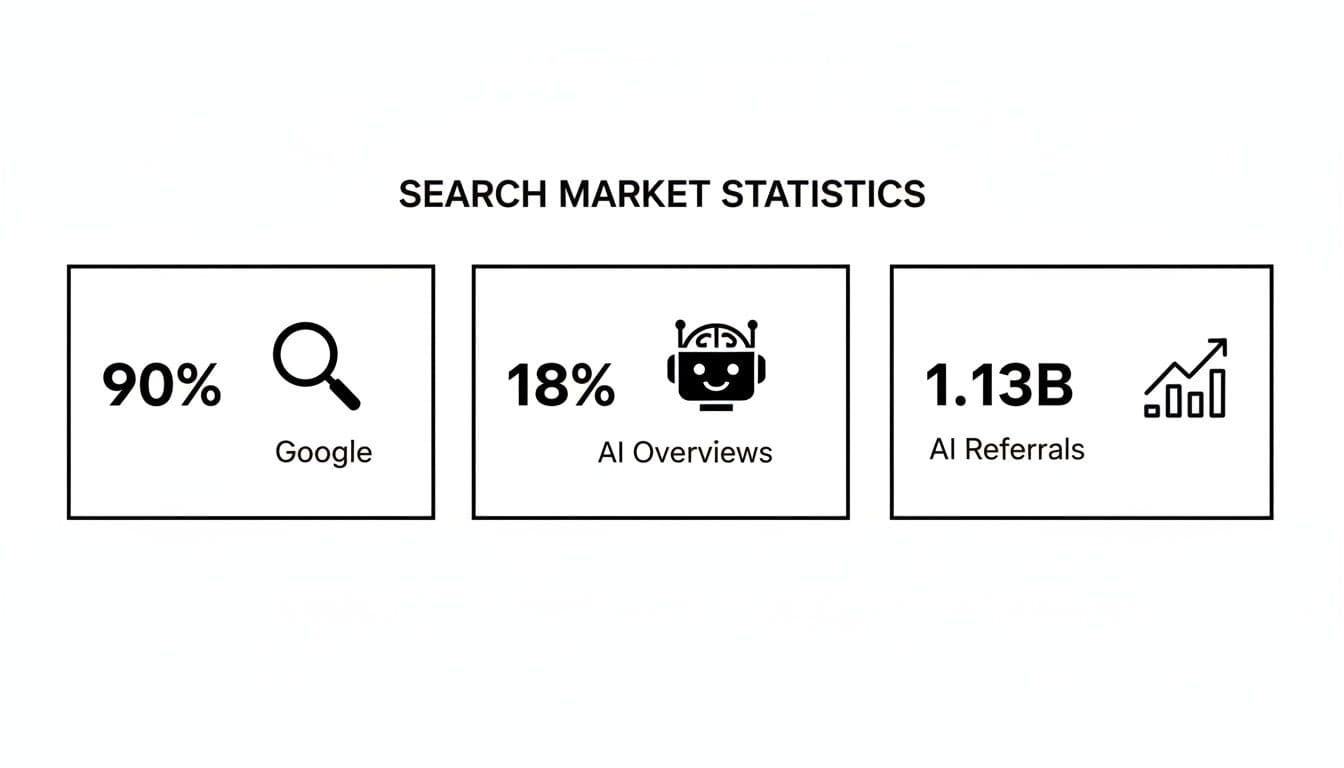
This isn't just a trend; it's a fundamental restructuring of how people get information. Google is still the main event, but AI-powered answers are becoming the star of the show.
From Keywords To Conversations
The old goal was simple: rank your page for a keyword. The new goal is much more nuanced: inform an AI's answer.
While Google still holds about 90% of the search market, its own AI Overviews are showing up more and more. At the same time, standalone AI platforms drove an incredible 1.13 billion visits in June 2025 alone. To keep up, it's becoming essential to use dedicated AI SEO automation tools that are built for this new world. Success now depends on deeply understanding what a user is truly asking for and then providing clear, authoritative information that an AI model can easily digest and trust.
A New Strategic Playbook
This isn't just a matter of updating a few blog posts. It demands a complete rethink of your entire digital visibility strategy. The recent introduction of ads into AI chat interfaces, which you can read about in our guide on how ads in ChatGPT are changing the game, adds another layer of complexity by blending organic and paid results in new ways.
To put it plainly, the rules have changed. The table below highlights the core differences between the old playbook and the new one.
Traditional SEO vs AI Overview Optimization
This table breaks down the fundamental shift in strategy, comparing the old focus of classic SEO with the new imperatives of optimizing for AI-driven search.
As you can see, success is no longer just about climbing to the top of the search results page. It's about earning a place within the answer itself.
Measuring Your Brand's AI Footprint
If you want to shape how your brand shows up in AI conversations, you first have to measure where you stand. Think of it as a digital health checkup for your brand. Instead of checking vital signs, you're tracking performance across the entire AI ecosystem—from Google's AI Overviews and Gemini to ChatGPT and Perplexity.
This is about much more than just counting mentions. AI overview tracking gives you a clear, numbers-based framework to understand your brand’s health and where you rank against the competition.
Core Metrics for AI Visibility
Measuring your AI footprint requires a different set of metrics than traditional SEO. These data points offer a complete picture of how AI models see and talk about your brand.
Here’s what you absolutely need to monitor:
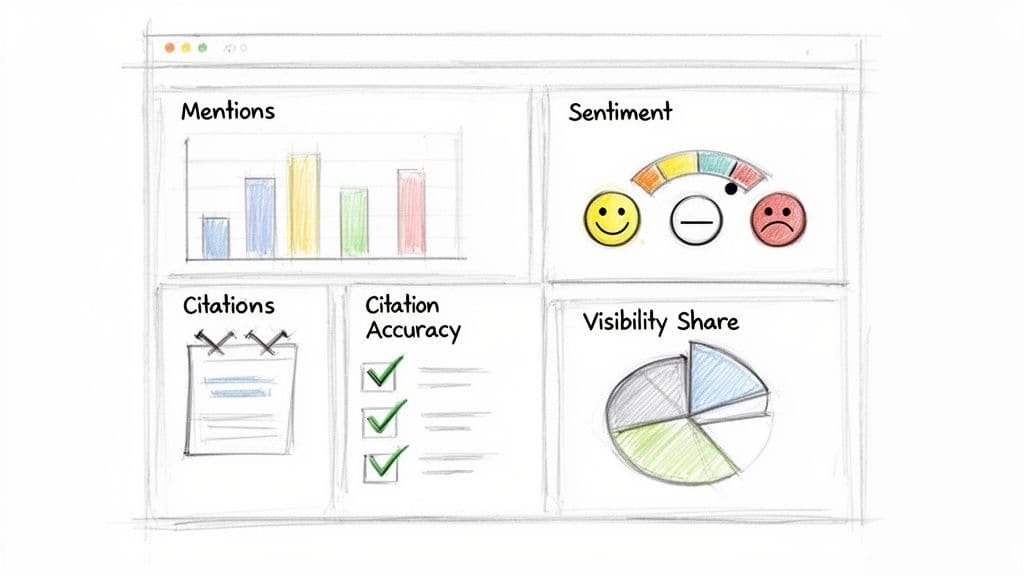
- Mention Frequency: The starting point. How often does your brand, product, or a key person get mentioned in AI answers for your most important business queries?
- Sentiment Analysis: This digs deeper than just a simple count. It gauges the tone of the mention—is it positive, negative, or neutral? A pattern of negative sentiment is an early warning sign of a reputation problem brewing inside these AI models.
- Citation Accuracy: Is the AI getting its facts straight? This metric is all about fact-checking the claims, figures, and product details in AI summaries to stop misinformation in its tracks.
- Source Attribution: What specific content is the AI pulling from? Tracking this shows you which of your pages are resonating with AI and which ones need more work.
Together, these metrics paint a detailed picture of your brand's position. They turn vague ideas like "brand presence" into hard data you can act on. By consistently keeping an eye on these areas, you can proactively track brand mentions online, not just on social media, but within the AI systems that are now shaping what your customers believe.
Defining Your Share of AI Voice
One of the most valuable concepts here is Share of AI Voice. It’s the modern equivalent of "Share of Voice" in advertising, measuring your visibility against your competitors for a specific set of search queries.
Share of AI Voice is the percentage of mentions and citations your brand gets in AI-generated answers for a specific keyword set, compared to the total mentions for all competitors in that same set.
Calculating this tells you exactly where you stand. For instance, if you and two competitors are the only brands mentioned for "best enterprise CRM software," and you get 40% of the mentions, that's your Share of AI Voice. Tracking this over time shows you if your efforts are successfully stealing the AI's attention away from your rivals.
The Importance of Competitive Benchmarking
Just tracking your own brand is only half the job. A solid AI overview tracking strategy has to include rigorous competitive benchmarking. By seeing how often your competitors are cited—and in what context—you can spot major opportunities and threats.
This analysis helps answer some critical business questions:
- Who is dominating the key conversations? Seeing who the leaders are for high-value queries tells you who to analyze and learn from.
- What content are AI models citing for them? This can reveal the content formats or topics that are working, giving you a blueprint for your own strategy.
- Are there gaps we can fill? If no one is getting mentioned for a relevant long-tail query, that's a wide-open opportunity to create authoritative content and own that space.
The flow of users through these new channels is undeniable. Recent data shows AI search referral traffic has exploded, driving over 1.13 billion visits in a single month—a staggering 357% jump from the previous year. This massive adoption proves that tracking your AI footprint isn't a future-proofing tactic anymore. It's a necessity for survival and growth, right now.
Choosing Your AI Visibility Tracking Method
Knowing what to track is one thing, but figuring out how to do it is where the real work begins. Your approach to tracking AI Overviews needs to fit your company's size, budget, and overall goals. This really boils down to two main paths: old-fashioned manual spot-checking or a more sophisticated, automated solution.
The choice you make isn't just a technical detail. It directly affects the quality of your insights, how deep you can go with your analysis, and frankly, how much time your team wastes on tedious tasks. For most companies, the shift from manual to automated isn't a choice—it's an inevitable evolution born from frustration and the need for reliable data.
The Limits Of Manual Tracking
Most people dip their toes in the water with manual spot-checking. This is exactly what it sounds like: you periodically type your keywords into Google, ChatGPT, or another AI tool and see if your brand pops up. It doesn't require any fancy software and seems cheap on the surface, but the cracks start to show almost immediately.
Think about a marketing manager at a growing tech company. Every week, she carves out a few hours to search her top 20 keywords across three different AI platforms. The results are all over the place. One day her brand is mentioned, the next it's gone. The answers change based on the user's location or the slightest tweak in phrasing. Not only is this a massive time sink, but the data she collects is anecdotal at best—far too shaky to base any real strategy on.
This approach is like trying to measure rainfall with a thimble. You'll catch a few drops, but you'll miss the bigger storm and completely misunderstand the weather patterns affecting your brand.
The biggest problem with manual tracking is that it just doesn't scale and it's not consistent. You simply can't monitor hundreds of keywords across different regions and AI models by hand. You're left with huge blind spots where you have no idea what's being said about you.
The Power Of Automated Solutions
This is where automated AI Overview tracking platforms come into the picture and change the game. These tools are built to systematically monitor your brand’s presence in AI-generated answers, doing it consistently and at a scale no human ever could. They tap directly into AI models or use advanced scraping techniques to pull reliable data.
Instead of random, hit-or-miss checks, an automated platform can:
- Track thousands of keywords at once across all the major AI engines and in different geographic locations.
- Provide consistent, historical data so you can spot trends, see if your content updates are working, and accurately calculate your Share of AI Voice.
- Analyze sentiment and context on the fly, flagging any negative mentions or misinformation that needs your immediate attention.
This level of detail transforms tracking from a guessing game into a precise science. To see how this fits into a wider strategy, it helps to understand what a good search visibility tracker should offer in a complete monitoring toolkit.
Making The Right Choice For Your Team
Choosing between a manual or automated system really comes down to where your organization is at and what you're trying to achieve. Exploring different options, including various AI-powered data solutions like Swordfish AI, can give you a better sense of the market and what's possible with advanced data collection.
To help you figure out the best path forward, here’s a quick comparison of the two methods.
Comparison of AI Tracking Methods
Ultimately, the right choice becomes clear when you weigh the pros and cons against your strategic needs.
For any serious B2B company looking to protect and grow its brand presence, the question isn’t if you should switch to an automated solution, but when. The sheer inefficiency and unreliable nature of manual tracking make it a dead end for any long-term growth strategy in an AI-first world.
Navigating the Hurdles in AI Tracking
While tracking your brand in AI Overviews opens up a new frontier for managing visibility, it’s not as simple as flipping a switch. This technology is brand new, constantly in flux, and brings a unique set of technical and ethical headaches that anyone in marketing or SEO needs to get their head around.
To really get a handle on your AI footprint, you have to accept these complexities right from the get-go. They affect everything from whether your data is accurate to how your brand is perceived, demanding a much more thoughtful approach than old-school SEO.
The Technical Tightrope
The biggest technical challenge comes from the very nature of Large Language Models (LLMs). These aren't neat, orderly databases; they're incredibly complex systems whose behavior can be maddeningly difficult to predict.
Here are the main technical snags you'll run into:
- The 'Black Box' Problem: LLMs are often a "black box." We can see the search query go in and the AI Overview come out, but the why—the exact reason one source was featured over another—is a mystery. Trying to reverse-engineer these new "ranking factors" is a world away from analyzing Google's traditional algorithm.
- Response Inconsistency: AI-generated answers can be all over the place. The same question might spit out different answers based on user location, search history, or even tiny tweaks to the phrasing. This makes consistent tracking nearly impossible without a systematic, automated way to do it.
- AI Hallucinations: The models can state blatantly false information with complete confidence. This is what's known as a "hallucination." An AI might misattribute a quote to your CEO, invent a product feature you don't offer, or just get the facts wrong, creating a brand misinformation fire that you have to put out.
These technical hurdles show exactly why manual spot-checking just doesn't work. It’s like trying to understand a shifting landscape by taking a single snapshot once a week—you completely miss the day-to-day changes that tell the real story.
Ethical and Reputational Risks
Beyond the code and algorithms, tracking AI brings some serious ethical questions to the table. These issues hit right at the heart of your brand’s integrity, customer trust, and even legal standing, which is why every CMO and founder should be paying close attention.
Sidestepping these landmines is just as important as optimizing your content. For more on this, our guide on common SEO mistakes explains how easily blunders can erode credibility—a lesson that's doubly true in the age of AI.
The key ethical considerations to keep in mind are:
- Data Privacy Concerns: The information used to train these AI models is scraped from the web, usually without anyone's permission. This has kicked off a huge debate about intellectual property and whether it's fair to use a company's proprietary content without credit or compensation.
- Misrepresentation Risk: An AI can summarize your carefully crafted content in a way that butchers its meaning. It might cherry-pick a statistic, strip away crucial context, or oversimplify a nuanced argument, accidentally twisting your brand’s message into something you never intended.
- Accountability and Correction: So, what happens when an AI gets something wrong about your brand? Who's responsible? Right now, there’s no clear process for getting misinformation corrected. The burden falls squarely on brands to constantly monitor what’s being said and push back with clear, authoritative content to set the record straight.
Getting through these hurdles requires a strategy that’s both technically smart and ethically grounded. It’s a balancing act between pushing for visibility and protecting the story your brand wants to tell.
How Attensira Delivers Clear AI Visibility
Knowing you have a blind spot in AI search is one thing. Actually fixing it is another entirely. This is where Attensira steps in, moving brands from a reactive, uncertain position to one of proactive control over their AI visibility. The entire platform is built to slice through the two biggest headaches: the chaotic, inconsistent nature of AI responses and the sheer scale of monitoring needed to keep up.
Forget tedious manual spot-checks that produce patchy, unreliable data. Attensira automates the whole thing. It systematically tracks your brand’s footprint across the major AI players—Google AI Overviews, Gemini, and ChatGPT—giving you a consistent, dependable stream of data on how you’re being talked about where it matters most.
From Data Points To Strategic Action
Attensira isn’t just another data-hoarding tool; it’s designed to turn that information into a real competitive edge. The platform pinpoints your content gaps and delivers insights that feed directly back into your marketing strategy. It doesn't just show you if you were mentioned—it tells you how you were mentioned, what sources were cited, and which competitors are showing up alongside you.
Here’s how Attensira translates raw data into smart, actionable intelligence:
- Automated Mention Tracking: It diligently monitors thousands of keywords across multiple AI engines, so you get instant alerts on new mentions, sentiment changes, and competitor movements.
- Content Gap Diagnosis: It flags high-value queries where your brand is completely absent, showing you exactly where to focus your content efforts for the biggest return.
- Competitive Benchmarking: It measures your Share of AI Voice against your main rivals, giving you a clear yardstick to measure progress and spot strategic openings.
This dashboard view gives you a perfect sense of how Attensira visualizes your AI presence and the competitive landscape.
The real power here is seeing your own performance and how it directly compares to competitors for critical search topics, all in one clean view.
A Real-World Success Story
To make this concrete, let's look at a B2B SaaS company in the CRM space. They had their traditional SEO down to a science but were flying completely blind when it came to AI-generated answers. Despite a huge investment in content, their brand was nowhere to be seen when potential customers asked AI models for "the best CRM software for small businesses."
After connecting their domain to Attensira, they uncovered a critical visibility gap. Within minutes, the platform confirmed they were invisible in AI summaries for their most valuable commercial queries, while two key competitors were consistently cited.
That discovery was a wake-up call. Armed with Attensira's insights, they dug into the specific content pieces the AI models were pulling from their competitors. They used these findings to completely overhaul their own content, focusing on creating clear, well-structured, and authoritative pages that answered user questions head-on. The results came quickly. Within weeks, they started showing up in AI Overviews for their target keywords, finally securing a seat at the table in these crucial conversations. Their story proves why mastering AI search visibility isn't just a "nice-to-have" anymore; it's a core business imperative.
Built For Brand Leaders, Not Data Scientists
One of the biggest hurdles to tracking AI visibility is the complexity. We designed Attensira to be powerful but incredibly intuitive, putting sophisticated brand intelligence in your hands without needing a Ph.D. in data science. The straightforward interface means brand managers and CMOs can get the answers they need to make smart decisions, fast.
This ease of use is vital in a market where AI is exploding. Think about it: platforms like ChatGPT see 5.8 billion monthly visits, and Google Gemini has seen 237% year-over-year growth. The sheer volume of AI-driven conversations is staggering. Attensira gives teams the ability to monitor this vast ecosystem effectively, especially as 35% of U.S. Gen Z turns to AI chatbots for information. By tracking your presence, you can fine-tune your content to win the higher engagement and conversions that come from these more detailed, conversational queries. If you want to grasp the scale of this shift, check out the latest AI chatbot market share statistics. Attensira gives you the tools to not just survive this change, but to lead it.
Your Action Plan for Mastering AI Overviews
If we've learned anything on this journey through AI search, it's these three truths. First, AI-generated answers aren't just a gimmick; they are the new normal for how people find things online. Second, the only way to safeguard your brand's voice in this new world is with consistent, methodical AI overview tracking. And finally, trying to keep up by hand is a losing battle—automated platforms give you a serious edge.
Knowing all this is one thing, but putting it into practice is what really counts. You now have the strategic thinking and the analytical perspective to make sense of this shift. It’s time to build a program that secures your brand’s visibility for the long haul. Here’s the blueprint for turning what you know into a process you can measure and repeat.
Launch Your Tracking Program Today
Getting started doesn't mean kicking off a massive, month-long project. A focused and systematic approach can deliver results surprisingly quickly. This checklist will walk you through the essential steps to get your AI overview tracking strategy off the ground right away.
Follow these steps to put theory into practice:
- Define Your Core Queries: Start by identifying the 20-30 most critical keywords that are the lifeblood of your business. This list should be a mix of high-intent commercial terms (like "best project management software"), problem-solving queries ("how to reduce customer churn"), and branded searches that include your top competitors.
- Establish Baseline Metrics: You can't measure progress without knowing where you started. For each of your core queries, take a snapshot of your current mention frequency, Share of AI Voice, and the general sentiment across Google AI Overviews, Gemini, and ChatGPT. This is your ground zero.
- Deploy an Automated Tool: Manually checking your rankings here and there is far too unreliable for making strategic moves. Hook up your domain to a dedicated platform like Attensira to put the monitoring of your core queries on autopilot. This is how you get consistent, trustworthy data without burning out your team.
The entire point of this initial phase is to stop guessing and start making data-driven decisions. An automated system creates the objective, continuous feedback loop you need to actually see if your content and SEO efforts are making a dent in the AI ecosystem.
Optimize, Measure, and Iterate
With your tracking system up and running, the real work begins—influencing your presence in AI answers. This isn't a "set it and forget it" task; it's a continuous cycle of tweaking, analyzing, and improving.
- Analyze Content Gaps: Dive into your tracking data to find the queries where your brand is either invisible or, worse, being misrepresented. These are your most urgent opportunities for content creation and optimization.
- Refine and Republish Content: Go back to your existing content and beef it up so it directly answers the user's question. Concentrate on clean structure, rock-solid factual accuracy, and sprinkling in unique data points that an AI model would find valuable enough to cite.
- Track Performance Over Time: Check in on your key metrics weekly. After you update a piece of content, look for an uptick in your mention frequency and Share of AI Voice. This iterative cycle is precisely how you build—and defend—your brand’s authority.
This action plan gives you the framework to take control of your brand's story in the age of AI. The only thing left to do is act on it. Connect your domain to Attensira today and take that first, critical step toward mastering your AI visibility.
Got Questions About AI Tracking? We've Got Answers.
As companies start wrapping their heads around AI overview tracking, a lot of practical questions pop up. It's new territory, after all. Here are the answers to some of the most common things we get asked.
How Often Should We Be Checking Our AI Visibility?
There's no single right answer here; the best cadence really depends on your industry and how aggressive your content strategy is.
For most brands, a weekly check-in on your main brand and product queries is a solid baseline. It’s frequent enough to catch new trends or any negative chatter before it gains traction. But if you're in a fast-paced field like tech or just launched a big campaign, you might want to ramp that up to 2-3 times per week to get faster feedback on what's working.
What Can We Do About a Negative Mention?
You can't just log in and delete a negative mention from an AI overview like it's a bad tweet. But you absolutely can influence and correct the narrative over time. The strategy is to publish a wave of high-quality, accurate, and positive content that outweighs the bad information.
Think of it as out-muscling a weak, incorrect signal with a much stronger, more authoritative one. When you create definitive guides, compelling case studies, or detailed fact sheets, you're feeding the AI models better, more trustworthy source material. Over time, this new content will push the old, inaccurate stuff out of the generated answers.
Isn't This Just Social Listening?
Not quite. While they both involve keeping an eye on brand mentions, their focus is completely different. Social listening is all about tuning into the public conversation on platforms like X, LinkedIn, or Reddit. AI overview tracking, on the other hand, is zeroed in on how your brand shows up in the answers generated by systems like Google AI Overviews, Gemini, and ChatGPT.
The real difference is the source. Social listening tracks human-to-human chatter. AI tracking monitors AI-to-human responses, which are built from a completely different set of inputs and algorithms.
How Long Does It Take to See Results?
Influencing AI is more like SEO than PPC—it's a long game that requires patience. Unlike paid ads where you see an immediate impact, shaping AI-generated answers is tied to the crawling and indexing cycles of the platforms themselves.
You can usually spot the first signs of movement within 4-8 weeks after publishing new, optimized content. But if you're trying to make a real dent in your Share of AI Voice for competitive keywords, you're likely looking at 3-6 months of consistent work. The trick is to keep producing great content and use AI overview tracking to measure your progress along the way.
Ready to stop guessing and start measuring how you really show up in AI search? Attensira gives you the automated tracking and competitive insights you need to win. Connect your domain in a few minutes and get a clear picture of where you stand.