
Stop guessing and start winning. This guide shows you how to build a data-driven SEO competitor report to uncover rivals' secrets and dominate the SERPs.
An SEO competitor report is really a strategic document. It's designed to break down what your rivals are doing in search so you can find their strengths, weaknesses, and—most importantly—opportunities you can jump on. Think of it less as a data dump and more as a roadmap for outranking them.
Why a Competitor Report Is Your New Strategic Blueprint

Just publishing good content and hoping for the best isn't a strategy; it's a surefire way to get left behind. The real edge comes from knowing exactly what your competitors are doing right, where they're dropping the ball, and how you can position your brand to win. This guide will show you how a modern SEO competitor report is so much more than a spreadsheet—it's a detailed blueprint for success.
This kind of analysis isn't just about collecting numbers. It's about turning that data into a concrete action plan. By systematically looking at what your competitors are up to, you can hit some major goals:
- Find Untapped Opportunities: You'll uncover high-value keywords your competitors are ranking for that you've completely overlooked.
- Sharpen Your Content Strategy: See what content formats and topics are actually connecting with your shared audience.
- Build a Better Backlink Profile: Pinpoint who is linking to your competitors and use that intel to build your own high-authority outreach strategy.
- Invest Your Resources Wisely: Stop guessing where to put your marketing budget and start making decisions backed by hard data.
The New Frontier: AI Visibility
And just when you thought you had it all figured out, the game is changing again. Any forward-thinking analysis now has to factor in visibility within AI-driven search results. It’s no longer a nice-to-have; understanding how your brand and your competitors show up in AI Overviews is critical for future-proofing your entire strategy.
To really get a handle on the competitive environment and inform your SEO, you first need to know how to conduct a comprehensive competitor analysis that covers all of these areas. Getting this foundation right is the first step toward building a report that actually drives growth.
Before we dive into the nitty-gritty of building your report, let's break down the essential components. This table gives you a quick overview of what turns a simple data sheet into a powerful strategic document.
Core Pillars of a Modern SEO Competitor Report
This framework isn't just about tracking metrics; it's about understanding the story they tell together. Each pillar gives you a different piece of the puzzle, helping you see the full picture of your competitive landscape.
The real purpose of a competitor report is to replace guesswork with certainty. It gives you a structured way to make smart decisions that directly boost your organic visibility and market share.
This move toward data-backed strategy is happening everywhere. Just look at the global SEO software market, which is essential for creating these reports. It exploded to USD 76.8 billion in 2024 and is forecast to reach a massive USD 299.6 billion by 2035. That kind of growth shows why businesses can't afford to ignore deep competitor analysis anymore.
Ultimately, a good report isn't a one-and-done document; it’s part of an ongoing process. You can learn more about what is competitive intelligence and see how it creates a feedback loop that keeps your brand sharp and ahead of the curve.
Pinpointing Your True SERP Competitors
The first—and biggest—mistake I see people make with an SEO competitor report is assuming their main business rivals are their main search competitors. They’re usually not. The company with that huge booth at your industry trade show might not be the one siphoning off your organic traffic.
Your real SERP competitors are the domains consistently showing up on page one for the searches that actually make you money. If you get this step wrong, your entire analysis is built on a shaky foundation, and you'll end up with a flawed strategy. The goal here is to figure out who Google thinks the authority is for your core topics, no matter what they sell.
Business Rivals vs. Search Opponents: There's a Big Difference
Let’s break it down. Your business competitors are the companies you’re up against in a sales pitch. Your SERP competitors, on the other hand, are anyone fighting you for the same digital shelf space. That's a much wider, and often surprising, group.
For instance, a B2B SaaS company selling CRM software knows its direct business threats are other CRM providers. But when they actually look at the search results for terms like "best crm for small business," a totally different picture emerges. They’ll find themselves competing with:
- Powerful Review Sites: We're talking about giants like G2, Capterra, and TrustRadius that dominate high-value commercial keywords with their endless comparisons and reviews.
- Major Industry Publications: Outlets like Forbes or TechCrunch carry immense authority and often rank for broad informational and commercial queries.
- Content-Heavy Affiliates: These are sites built to create expert-level content on a topic, making their money from affiliate links instead of a direct product.
- Consultants and Agencies: Solo experts and firms often publish incredibly detailed educational content that captures people looking for solutions to their problems.
Leaving these players out of your SEO competitor report is a massive blind spot. They are grabbing your audience's attention at critical moments in their journey.
A Practical Way to Find Your Real Competitors
Finding these competitors isn’t about guesswork; it’s about data. The whole process should be anchored to your core commercial keywords—the exact terms someone types in when they're getting ready to buy.
First, pull together a seed list of 10-15 of your most important "money" keywords. These are the phrases where a #1 ranking would be a game-changer for your business.
From there, it's a pretty straightforward process.
- Hit the SERPs: Open an incognito window and start searching for your seed keywords. Just manually jot down the top 10 domains you see popping up again and again.
- Find the Overlap: As you go through your keyword list, you’ll quickly notice the same domains showing up repeatedly. Those are your primary SERP competitors. A site that ranks for 8 out of 10 of your core terms is a much bigger threat than one that only appears once.
- Lean on Your SEO Tools: Pop your domain into a tool like Semrush or Ahrefs. Their organic competitor reports will instantly show you which domains share the most keyword rankings with you, often uncovering rivals you never even considered.
This methodical approach gets you out of the world of assumptions and into the reality of the search landscape. For a more detailed walkthrough, check out our complete guide on how to do competitor analysis in SEO.
Your report's accuracy completely depends on this initial step. Analyze the wrong competitors, and you'll end up chasing irrelevant keywords and copying strategies that have nothing to do with your real search environment.
By focusing on SERP overlap instead of brand recognition, you build a competitor list that truly reflects the challenges and opportunities in front of you. This precision is what turns a generic report into a strategic weapon.
Alright, once you’ve nailed down who your real SERP competitors are, the fun part begins. This is where we shift from just identifying rivals to actively investigating them. We’re about to gather the raw data that will become the foundation of your entire SEO competitor report.
A report without solid data is just a collection of opinions, and opinions don't drive strategy. Our goal is to build a case grounded in cold, hard evidence. This isn't about pulling every metric you can find; that's a recipe for analysis paralysis. Instead, we'll focus on the critical pillars that give you a complete picture of a competitor's SEO engine.
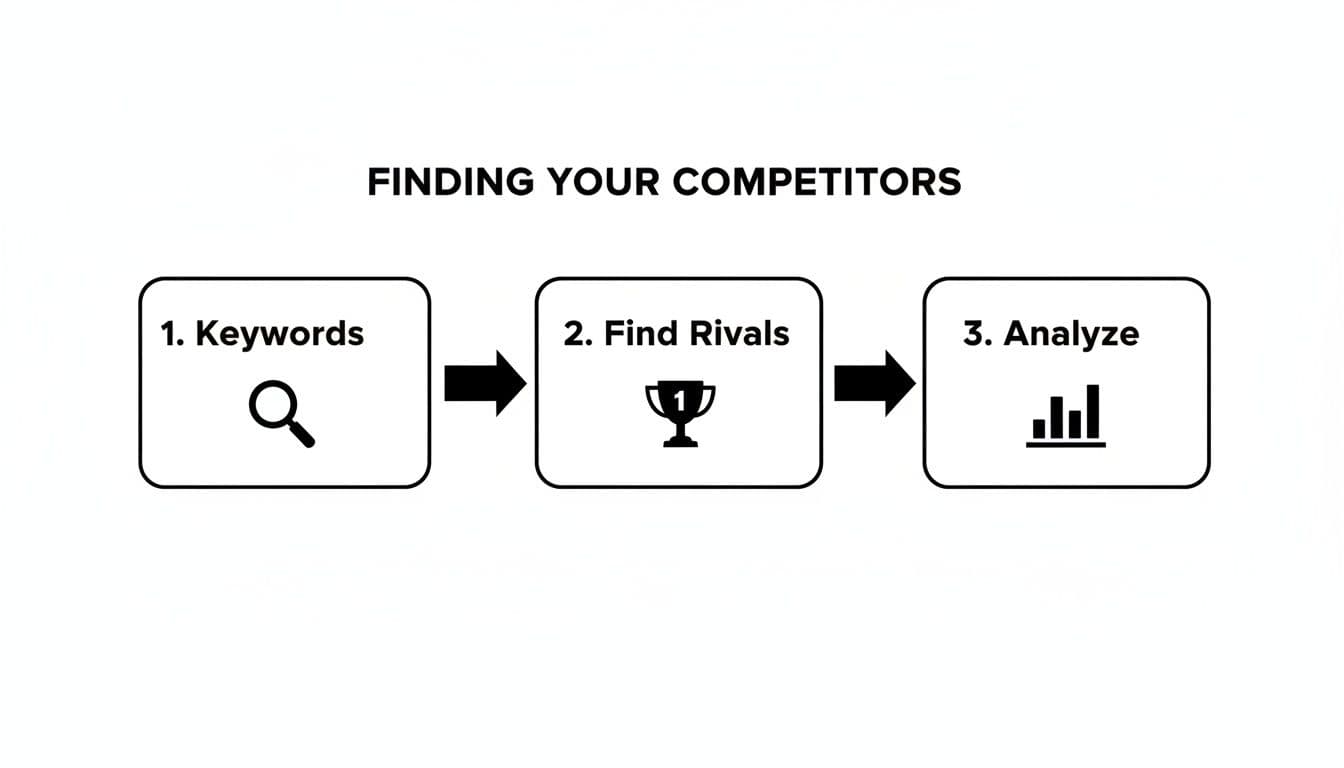
This simple loop—finding the keywords that matter, identifying who owns them, and then breaking down how they do it—is the core of all great competitive intelligence.
Start with the Keyword Gap
If there's one piece of data that offers an immediate, actionable win, it's the keyword gap analysis. This process shows you exactly which valuable keywords your competitors are ranking for, but you aren't. Think of it as a ready-made content roadmap, highlighting proven topics that you already know resonate with your target audience.
When you fire up a tool like Ahrefs or Semrush for this, you're hunting for that sweet spot: keywords with high relevance, decent search volume, and an achievable difficulty score. This is especially powerful for uncovering long-tail keywords—those longer, more specific phrases that often signal stronger buying intent and face less competition. In a crowded market, winning these battles is a game-changer.
Audit Their Backlink Profile
A competitor's backlink profile tells you everything about their authority and reputation online. But don't make the rookie mistake of just counting their referring domains. A truly insightful audit digs into the story behind their links.
For instance, I once had a client who was consistently being outranked by a competitor with fewer total backlinks. It didn't make sense on the surface. But a deep dive revealed they were landing high-authority links from top-tier industry publications at a rate of five new domains per month, while our client's link building was stagnant. That told us their off-page SEO was proactive and strategic, not just a numbers game.
When you audit their links, focus on these qualitative signals:
- Link Velocity: Are they earning new, quality links at a consistent clip? A sudden spike might point to a successful PR campaign or a killer piece of content.
- Topical Relevance: Are the links coming from sites within your industry? One relevant industry link is worth more than a dozen from random directories.
- Link Authority: Use metrics like Domain Rating (DR) or Domain Authority (DA) to gauge the actual power of the sites linking to them.
Analyze Their Top-Performing Content
Your competitors' most successful pages are a goldmine. By seeing which URLs pull in the most organic traffic, you can reverse-engineer their entire content strategy. Are their heavy hitters long-form guides, interactive tools, or detailed case studies?
If you find a competitor’s top five pages are all "how-to" guides, you know their strategy is built on top-of-funnel educational content. On the other hand, if their best pages are all product comparison articles, they're clearly going after bottom-of-funnel traffic that's ready to buy.
The goal here isn't to copy their content. It's to understand what formats and topics are winning in your space so you can create something demonstrably better.
This level of analysis is no longer optional. The SEO services market is projected to more than double, rocketing from USD 74.9 billion in 2025 to USD 148.86 billion by 2031. This growth is fueled by businesses scrambling for a competitive edge. While big companies drove the bulk of spending with USD 44.7 billion in 2024, it's the smaller, hungrier businesses that are growing the fastest by using these exact techniques to exploit gaps left by the giants.
Deconstruct Their On-Page SEO
Finally, it's time to get your hands dirty with a manual review of their highest-ranking pages. This is where you can uncover subtle but powerful on-page tactics. Don't just skim the article; pop open your browser's developer tools and inspect the code.
Pay close attention to how they handle:
- Title Tags & Meta Descriptions: Are their titles optimized and compelling? Do their descriptions have a clear call-to-action that makes you want to click?
- Header Structure (H1, H2s): Look for a logical hierarchy that structures the content and targets secondary keywords.
- Internal Linking: How do they pass authority between pages? A smart internal linking strategy is a huge factor in ranking.
- Schema Markup: Are they using structured data to snag rich snippets in the SERPs? This can have a massive impact on click-through rates.
Your Competitive Analysis Toolkit
To pull all this data, you'll need the right tools. Here’s a quick look at some of the best platforms and what they excel at, helping you build your perfect tech stack.
Each tool has its strengths, and combining insights from a couple of them often gives you the most complete picture.
Pulling all this intelligence together creates a comprehensive snapshot of your competitive landscape. This data is the foundation you’ll use in the next steps to build your strategic narrative and craft an action plan to win. For a deeper dive into these platforms, check out our complete guide on the best competitive analysis tools.
Analyzing Competitor Visibility in AI Search
Let's be honest: your standard SEO competitor report is already becoming a relic. As AI Overviews and conversational search start to dominate the SERPs, we're facing a massive shift. Just tracking keyword rankings is like watching the wrong game. The real action is now on a new battleground: AI visibility.
This is the next frontier of competitive analysis, and frankly, most reports are completely blind to it.
Understanding AI visibility means figuring out when and why your brand—or, more importantly, your competitor's brand—gets cited as a source in an AI-generated answer. These citations are the new "position zero." They carry immense authority and are often the first and last thing a user sees. Ignoring this is like building a backlink strategy in 2024 without ever looking at a site's authority. You're just missing the whole point.
Defining and Tracking AI Mentions
The first thing we need to do is build a framework for tracking this new kind of visibility. AI mentions are far more nuanced than a simple ranking. Your report needs to dig deeper than just a simple "yes" or "no" on whether a competitor was mentioned. The how is what matters.
For your most important commercial and informational queries, you should be asking these kinds of questions:
- Direct Citations: Which competitors are getting those coveted direct links inside an AI Overview?
- Implied Mentions: Is the AI summarizing content that is clearly pulled from a competitor's site, even if it doesn't drop a link?
- Negative Mentions: Are competitors showing up in a negative light or a comparison that you can use to your advantage?
- Complete Absence: Where are the ghost towns? For which critical queries are none of your competitors appearing, leaving a wide-open opportunity for you to swoop in?
Tracking AI visibility isn't just about playing defense; it’s an offensive strategy. It uncovers the gaps in an AI's knowledge that you can rush to fill, cementing your brand as the go-to source on your industry's most critical topics.
As search keeps evolving, getting a handle on Generative Engine Optimization (GEO) is becoming non-negotiable. This whole discipline is about optimizing content so AI models can find, understand, and cite it—which is exactly what we're trying to analyze here.
Using AI Insights to Drive Your Content Strategy
Collecting all this data is one thing, but the real magic happens when you turn those observations into an actual content plan. When your SEO competitor report shows a rival is constantly cited for a specific topic cluster, that's a huge clue. It tells you their content is structured in a way that AI models find credible and easy to digest.
This is where a platform like Attensira goes from a nice-to-have to an absolute necessity. It takes you from manually spot-checking a few queries to systematically tracking this visibility across the board.
This dashboard lets you monitor your AI visibility score and see how you stack up against your competitors over time. You can instantly spot trends, see who’s gaining momentum, and pinpoint the exact topics where you’re lagging. It turns a vague concept like "AI visibility" into hard data you can act on. By benchmarking with competitors, you can set tangible goals and build a strategy that actually works.
Your analysis of a competitor’s success in AI search should lead to two immediate actions:
- Optimize What You Already Have: Go back to your top-performing pages. How can you make them more appealing to AI? This usually means adding clear, bite-sized summaries, using structured data like FAQ schema, and making sure your facts and stats are laid out plainly and are easy to verify.
- Create New, AI-First Assets: If you spot a topic where your competitors are either weak or completely absent from AI results, that’s your opening. Create a new piece of content specifically designed to be an AI-friendly resource. Think factual accuracy, clear definitions, and a logical flow that answers a user's question directly and without fluff.
When you integrate AI visibility into your competitor analysis, you stop just reacting to what happened last month. You start positioning your brand for what's coming next, turning your report from a simple historical document into a strategic roadmap for the new era of search.
Turning Raw Data Into a Strategic Narrative
You’ve done the heavy lifting. The spreadsheets are brimming with keyword gaps, backlink profiles, and traffic estimates. But here’s the hard truth: a list of metrics is just noise. The most critical part of building an SEO competitor report is turning all that raw data into a story that demands action.
This is where you shift from analyst to strategist. Your audience, whether it's the CMO or the content team, doesn’t need another data dump. They need a clear, compelling narrative that explains what the numbers mean, why they matter, and exactly what to do next.
The real goal isn't just to present findings. It's to deliver sharp, prioritized recommendations that tie your analysis directly to business outcomes.
Crafting the Executive Summary
Every great report I've ever built starts with the conclusion. Before you even think about showing a chart, you need an executive summary that gives stakeholders the bottom line in less than 60 seconds. It has to be sharp, concise, and answer the big-picture questions immediately.
Think of it as the elevator pitch for your entire analysis. It should cleanly summarize the competitive landscape and state your top three strategic recommendations right up front.
A powerful executive summary doesn’t just state facts; it builds urgency. You need to frame your findings in a way that makes doing nothing feel like a huge missed opportunity or a significant risk. This is how you get buy-in from the get-go.
For instance, don't just say, "Competitor X has many backlinks." That's flat. Instead, frame it with strategic intent: "Competitor X's aggressive link building from industry publications is cementing their authority, posing a direct threat to our market share for high-intent keywords." See the difference? That version tells a story and implies a clear threat that needs to be addressed.
Building an SEO-Focused SWOT Analysis
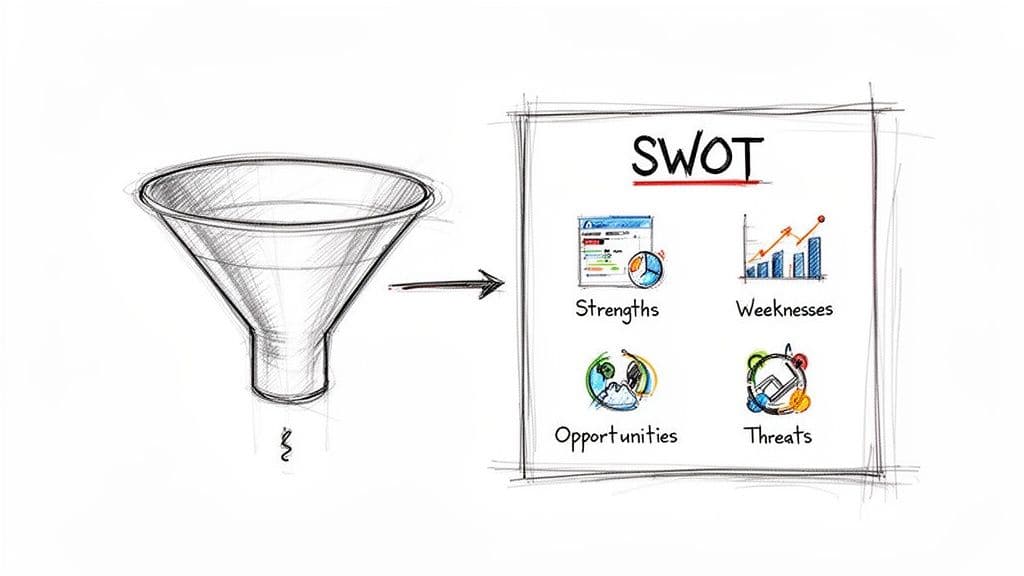
Once you have their attention, the SWOT analysis (Strengths, Weaknesses, Opportunities, Threats) is the perfect framework for organizing your detailed findings. It’s a language executives understand, translating complex SEO data into a familiar business context they can grasp instantly.
But this can’t be a generic business SWOT. Every single point needs to be backed by the specific SEO data you just collected.
- Strengths: What are we demonstrably doing better than our rivals?
- Example: "Our core product pages rank 15% higher on average than Competitor A's, thanks to our superior on-page optimization and faster load times."
- Weaknesses: Where are we falling critically behind?
- Example: "We have a massive content gap around 'enterprise integration solutions,' a topic cluster that drives an estimated $200k in monthly traffic for Competitor B."
- Opportunities: What untapped areas can we own?
- Example: "Neither of our top two competitors has any visibility in AI Overviews for 'B2B data security,' leaving a wide-open chance for us to become the cited authority."
- Threats: What’s on the horizon that could hurt us?
- Example: "Competitor C is acquiring high-authority backlinks at twice our monthly rate, which could push us off page one for our main commercial terms within six months."
This structure transforms a pile of data points into a strategic map. It shows exactly where to press your advantages, shore up defenses, and watch out for danger. If you want to dive deeper into structuring data-driven reports, check out our guide on search engine marketing reporting.
Visualizing Data to Make Your Points Stick
Let's be honest, people are visual. A well-designed chart can make a point in seconds that a dense paragraph takes minutes to explain. Don't just export the default graphs from your SEO tools—customize them to tell your story.
Highlight the data points that matter most. Use your brand colors for your own company and shades of gray for competitors. Even better, add annotations to charts that explain why a particular spike or dip is important.
Think about it: a simple line chart comparing organic traffic is just data. But a line chart with an annotation saying, "Competitor A's traffic surged here right after they launched their 'Ultimate Guide' content hub" becomes a story with a lesson.
In the cutthroat world of SEO, this level of detail is non-negotiable. Google's massive 90.83% global search engine market share makes it the battleground. This dominance is why it's so critical to pay attention to new features; 58.5% of US Google searches now result in zero clicks, often because of AI Overviews. This reality is forcing smart teams to audit how their rivals are optimized for these features. Tools like Attensira are built for this very purpose, tracking AI responses to show you how competitors are snagging those coveted spots.
By combining a sharp executive summary, a data-backed SWOT, and compelling visuals, your SEO competitor report evolves from a simple audit into a persuasive argument for a smarter, more agile, and ultimately winning search strategy.
Got Questions? We've Got Answers
Even the best competitor reports can spark a few questions. Let's tackle some of the most common ones that pop up once the data is in and you're ready to start planning your next move.
How Often Should I Be Doing This?
For a full-blown, deep-dive analysis, think quarterly. That's the sweet spot for most businesses. It gives you enough time to actually do something with the information—like building out a new content cluster or going after a specific keyword gap—and then measure the results. Running a massive report every month is a recipe for analysis paralysis, not action.
But that doesn't mean you go dark on your competition for three months. I always recommend setting up monthly "pulse checks" on a few critical metrics. It keeps you from getting blindsided.
- Top 10 Rankings: Keep a sharp eye on your main money-making keywords. Are your rivals creeping up or falling off?
- New High-Value Backlinks: Set up alerts in your SEO tool. When a top competitor lands a killer link, you want to know about it. It often signals a big new content push.
- Fresh Content: Do a quick scan of their blog and resources each month. It's a simple way to spot shifts in their strategy.
This mix of a deep quarterly review and light monthly check-ins keeps you informed and agile without drowning your team in spreadsheets.
What's the Single Most Actionable Metric to Focus On?
If you twisted my arm and made me pick just one, it would have to be the Keyword Gap. Hands down.
Sure, things like Domain Authority and total backlinks are important for the long game. But the keyword gap tells you exactly what to do right now. It's the shortest path from data to a tangible plan.
A keyword gap analysis is more than just a list of terms; it’s a market-validated content calendar handed to you on a silver platter. It shows you what your shared audience is actively searching for, what your competitors are winning with, and where you're not even in the game. It takes all the guesswork out of content planning.
Focusing here means every piece of content you create is strategically designed to capture existing search demand that your competitors are already profiting from.
How Can We Possibly Compete Against the Goliaths in Our Industry?
Going up against massive, big-budget competitors feels daunting, but it’s far from impossible. This is where you have to be smarter, not richer. Your SEO competitor report is the roadmap for that.
First off, stop trying to beat them on their high-volume, generic head terms. You won't win that fight today. Instead, your report will show you the treasure trove of long-tail keywords they're ignoring. These hyper-specific, lower-competition phrases are your way in.
Next, look at their top content with a critical eye. Is it a bit dated? Thin on real-world examples? Is the user experience clunky? Your job is to create something that is undeniably better—more comprehensive, more up-to-date, and genuinely more helpful. This is how you can start siphoning away their traffic and earning links over time.
Finally, look at where the puck is going. How is their visibility in AI Overviews? These newer SERP features are a great equalizer. An agile brand can often get cited and featured much faster than a slow-moving enterprise titan.
How Do I Prove This Whole Exercise Was Worth the Time?
You prove the ROI by connecting every insight to a real business outcome. It's all about establishing a clear "before and after" picture.
Before you implement a single recommendation, benchmark your current performance. Document your rankings, organic traffic, and conversion rates for the specific pages or keywords you're about to target.
Let’s say your report uncovers a keyword gap, and you create a new article to fill it. Here’s how you measure success:
- Track the SEO Impact: Over the next quarter, monitor the new article's keyword rankings and the organic traffic it brings in.
- Measure the Business Impact: Use analytics to track how many visitors from that specific article signed up for a demo, downloaded your guide, or subscribed to your newsletter.
The ROI is simply the value of those new leads and customers minus what it cost you to run the analysis and create the content. When you frame it this way, your SEO competitor report stops looking like a cost and starts looking like what it really is: a revenue-generating machine.
Stop guessing how your brand appears in AI search. With Attensira, you can track your AI visibility, analyze competitor mentions, and get actionable insights to optimize your content for the next generation of search. Get started today and build a strategy that puts you ahead.
Learn more at https://attensira.com.