Discover how to sell products on ChatGPT with our complete guide. Learn to master AI-driven sales through plugins, APIs, and content optimization.
Selling products on ChatGPT isn't some far-off concept; it’s happening right now. It means weaving your e-commerce operations directly into the AI using custom plugins, API connections, or smart content optimization. The goal is to let customers find, research, and buy your products all within a simple, natural conversation. You're essentially turning the AI itself into a dynamic new sales channel.
The New Conversational Marketplace

The conversation around selling products through ChatGPT has shifted from "what if" to "how to." This isn't just about sticking another chatbot on your website. It’s about viewing the AI as a genuine marketplace where millions of people are looking for solutions and recommendations every day. For brand managers and B2B leaders, turning a blind eye to this is like ignoring the rise of Google two decades ago.
This new commercial space requires a totally different playbook. Having the best product isn't enough anymore. Success now hinges on making that product discoverable and easy to purchase within an AI-powered dialogue. It’s the next critical battleground for brand relevance.
The Scale of the Opportunity
What really turns ChatGPT from a clever tool into a marketplace is its staggering user base. When a platform explodes to 100 million users in just two months, commerce is an inevitable and natural next step. We're already seeing its impact. In retail and CPG, an estimated 16% of customers now use ChatGPT at some point in their buying journey.
This huge, highly engaged audience is using the platform for everything from initial research to final comparisons. That creates a direct line from a user's question to your product. Your job is to be the answer when they ask.
The core shift is from searching for products to asking for them. Your brand needs to be part of the AI's vocabulary, ready to be recommended when a user expresses a need your product can solve.
How to Tap Into This Marketplace
So, how do you actually get started? You need a clear strategy that creates a direct path for the AI to find, understand, and present your products. It’s about making sure your offerings are not just mentioned, but shown in a way that makes a sale more likely.
Deciding on the right approach is the first big step. There are three primary ways to integrate your sales channels with the AI, each with its own set of trade-offs.
Core Strategies for Selling Products on ChatGPT
Each of these pathways—plugins, APIs, and content—has a role to play.
Plugins act like add-ons, giving ChatGPT real-time access to your product catalog, availability, and pricing. API integrations, on the other hand, offer more granular control, letting you build custom conversational assistants on your own digital properties.
And then there’s the foundation for it all: strategic content optimization. By publishing detailed, high-quality content about your products and industry, you essentially "teach" the underlying AI that your brand is an authority. This leads to more organic recommendations over time. You can even layer paid strategies on top of this, which you can learn more about in our guide on ads in ChatGPT.
Ultimately, meeting customers where they already are is the name of the game. By making your products visible and accessible inside this new conversational world, you position your brand as a modern, helpful solution—driving revenue and securing your relevance in an AI-first future.
Choosing Your AI Sales Channel
Moving from the big idea of a conversational marketplace to actually making it work means you have to make a smart decision right out of the gate: what's your entry point? To sell products effectively through ChatGPT, you have to pick the right channel. There are really three main ways to do this, and each one comes with its own set of benefits, costs, and technical headaches.
This isn't just about technology; it's a strategic move that dictates how customers will interact with your brand. Let's break down the options so you can figure out the best path forward.
The Direct Integration: ChatGPT Plugins
Think of a ChatGPT Plugin as giving the AI a new, specialized skill—your company’s skill. This is the most direct route for embedding your business right into the ChatGPT experience. When a user who has your plugin enabled asks a relevant question, ChatGPT can tap your service in real-time to pull live data.
This is a game-changer for businesses where timing is everything. For example:
- An online travel agency could build a plugin that lets users ask, "Find me flights to Tokyo next Tuesday," and get back live pricing and booking links on the spot.
- An e-commerce store could use a plugin to check real-time inventory or provide up-to-the-minute order tracking without the user ever leaving the chat.
The big win here is how smooth the experience is for the customer. They don't have to jump over to your website to get things done. But there's a catch: this path demands serious development resources and you have to get through OpenAI's review process, making it a pretty significant investment.
The Custom Experience: API Integrations
The second option is to use APIs from AI providers like OpenAI to build a custom conversational experience on your own turf—your website or app. Instead of putting your service inside ChatGPT, you're bringing the AI's intelligence to your own digital properties. This gives you total control over the branding, the user interface, and all the data that flows through it.
For instance, a B2B SaaS company could create a sophisticated bot on its pricing page. Powered by a large language model, this bot could handle complex feature questions, figure out what a prospect actually needs, and even schedule demos with the sales team. It's the perfect approach for brands that want to own the customer journey from start to finish. The trade-off? Much higher complexity and cost, since you're on the hook for the entire build and ongoing maintenance.
The core difference comes down to control versus reach. A plugin gets you inside a massive, pre-existing ecosystem. An API lets you build your own branded ecosystem. Your choice should reflect your strategy for acquiring and engaging customers.
The Foundational Layer: Strategic Content Optimization
The third and most accessible channel for everyone is strategic content optimization. This is the long game. It requires no direct technical integration with an AI platform. The whole point is to structure the content on your website so well that AI models, which are constantly learning from public web data, organically recognize your brand as an authority on certain topics.
When an AI sees your product pages, blog posts, and help guides as the most trustworthy source of information, it will naturally start recommending your products when users ask related questions. This is essentially conversational SEO.
A company selling ergonomic office chairs, for example, should be publishing deep-dive articles on "the real benefits of lumbar support" or "how to pick an office chair for chronic back pain." This builds topical authority, making it far more likely that ChatGPT will mention their products when someone is trying to solve their workspace problems.
This is by far the most cost-effective method and, frankly, it's the foundation for the other two. Even if you build a plugin, having great content ensures the AI actually understands the context and value of what you're offering. Knowing how different models think is also key; our deep dive on Claude vs. ChatGPT performance shows why a content strategy that considers multiple AIs is a smart move.
Comparing the Three AI Sales Channels
To make the decision a little clearer, here’s a quick breakdown of how these channels stack up.
Ultimately, these strategies aren't mutually exclusive. A mature brand might use content optimization to draw in users who are in the research phase, an API-powered chatbot on its site to convert them, and a plugin for post-purchase support. For a look at how this can work in a specialized industry, this AI Healthcare Assistant case study provides a great real-world example.
But for most businesses just getting started, focusing on content optimization first provides the strongest foundation for any future success in selling through AI.
Designing a Seamless Conversational Sales Funnel
So, you've picked your AI sales channel—a plugin, an API integration, or maybe you're focusing on content optimization. That's a great start, but the tech choice is just the beginning. Your real challenge is designing a customer experience that feels less like a clunky chatbot and more like talking to a helpful expert.
The whole point is to guide someone from a simple question to a finished purchase, all within the chat window, without it ever feeling forced. You have to get inside the user's head, anticipate their questions, and make the entire process feel completely natural. It's an art form.
This diagram breaks down how these different channels all funnel towards the same end goal: a sale.
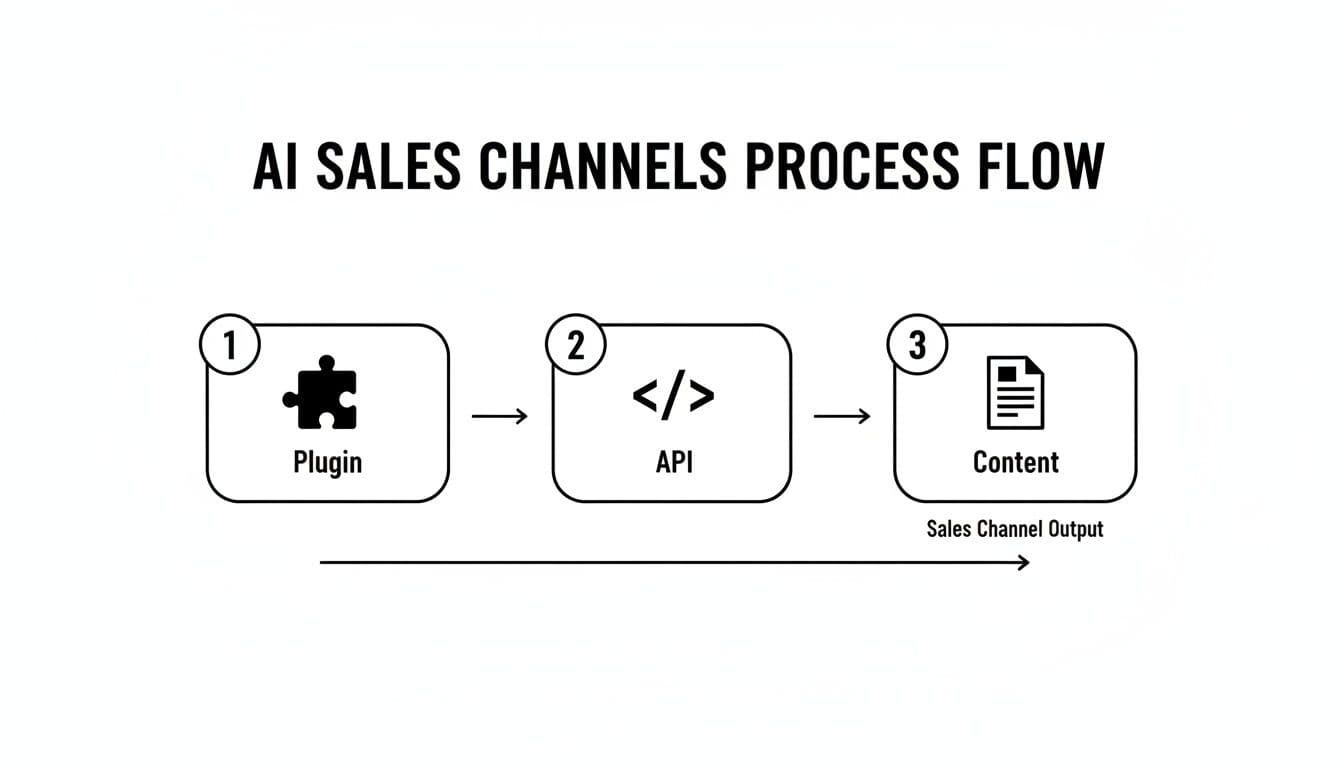
While each path has its own complexities, they all lead to the same destination.
Mapping the Conversational User Journey
Before you write a single line of code or a single prompt, you need to map out the entire user journey. Think of it like a conversation flowchart. What are the key moments in this interaction?
- Discovery: How does someone even find your product in a chat? It could be a direct query like, "find me hiking boots for wide feet," or something broader, like "what do I need for a week-long backpacking trip?"
- Evaluation: Once ChatGPT surfaces your product, the real questions begin. People will want to know about features, price, and how you stack up against the competition. Your system needs to have those answers ready.
- Purchase: This is the critical handoff from providing information to actually making the sale. How do you collect the necessary details and guide them to payment without friction?
- Post-Purchase: The conversation shouldn't just end at "thank you." What about order tracking, setup guides, or follow-up support questions? A great experience covers this too.
Imagine a company selling custom-printed t-shirts. Their flow would need to start with design ideas, walk the user through uploading art, picking sizes and colors, and then confirming everything before they even see a payment screen. Every step is a back-and-forth, not just filling out a form.
Crafting Language That Converts
The words you use are everything. Your tone has to be helpful and confident—guiding, not pushing. It’s about being an expert, not a classic salesperson. This is where mastering powerful persuasive writing techniques becomes a game-changer for building this new kind of sales funnel.
Don't overlook your own product descriptions. The AI is going to pull information directly from your site, so if your copy is flat and uninspired, the AI's recommendation will be too. We've seen this happen countless times. You can use our product description optimizer to make sure your copy is compelling and ready for an AI-driven world.
A truly great conversational flow doesn't just answer questions; it anticipates the next one. By proactively offering information and gentle nudges, you build the trust and momentum needed to make the path to purchase feel effortless.
Integrating Payments and Fulfillment
Now for the final, and often trickiest, piece of the puzzle: the transaction itself. The handoff from conversation to payment has to be absolutely seamless. A confusing or clunky checkout process will kill a sale faster than anything else.
Here are a few things we’ve learned are non-negotiable for a smooth transaction:
- Use Secure, Familiar Gateways: Always integrate with trusted names like Stripe or PayPal. This immediately gives users the confidence to enter their financial details.
- Minimize Data Entry: Pre-fill everything you can. If it’s a returning customer, make it a one-click process. For new folks, only ask for what is absolutely essential to complete the order.
- Provide Crystal-Clear Confirmation: The second the payment goes through, confirm the order right there in the chat. Give them an order number, an estimated delivery date, and a link to track their shipment.
This smooth blend of conversation and commerce is what separates a gimmick from a legitimate, high-performing sales channel. Focus on creating a journey that feels natural, helpful, and secure, and you'll be well on your way to turning casual AI inquiries into loyal customers.
Building Trust and Ensuring Transaction Security
Diving into conversational commerce is exciting, but it comes with serious responsibilities. When you decide to sell products on ChatGPT, you're not just moving items off a shelf; you're handling sensitive customer data in a completely new arena. Building user trust isn't a "nice-to-have"—it's the absolute foundation of your entire AI sales channel.
Let's be real: people are rightfully wary of sharing personal and payment details with an AI. One slip-up can shatter trust and tarnish your brand's reputation for a long time. That’s why you have to tackle data privacy and payment security head-on, right from the start.
Navigating Data Privacy and Compliance
When someone chats with your service via ChatGPT, their data passes through several systems. You have to be crystal clear about what you're collecting, why you're collecting it, and who sees it. This isn't just about ticking legal boxes; it’s about earning the customer's confidence.
Here are the big regulations you can't ignore:
- GDPR (General Data Protection Regulation): If you have customers in the EU, you're on the hook for their strict rules on data consent and user rights.
- CCPA (California Consumer Privacy Act): This gives California residents control over their personal info, including the right to see what you've collected and ask you to delete it.
Make sure your privacy policy is easy to find within the chat flow itself. Don't hide it in the fine print.
My advice? Always design for the most privacy-conscious user. Build your conversational experience assuming everyone is skeptical and give them transparent control over their data. It’s the fastest way to build a solid, trusting relationship.
Managing how your brand is perceived in this new space is also critical. The principles are similar to traditional digital reputation, and our guide on search engine reputation management has strategies that translate surprisingly well to AI interactions.
Implementing Secure Payment Processing
The moment a customer says "I'll take it" is where everything comes together. A clunky or insecure payment process will kill the sale instantly. Whatever you do, never try to build your own payment system or handle raw credit card numbers directly in the chat.
Think of your integration as a secure bridge to a proven, PCI-compliant payment gateway. It's the only responsible way to handle transactions.
How to Handle Payments Securely:
- Use Tokenization: Partner with a payment processor like Stripe or PayPal that uses tokenization. This genius process swaps sensitive card data for a secure, non-sensitive token, so the actual card number never touches your systems.
- Redirect to a Hosted Payment Page: The gold standard for security is to hand the user off to a secure, branded payment page hosted by your payment gateway. This keeps all sensitive data completely out of the chat environment.
- Communicate Clearly: Tell the user exactly what's happening. A simple message like, "To keep your information safe, I'm now opening a secure portal for you to complete your purchase," makes a world of difference in building trust.
By letting the experts handle the heavy lifting of payment security, you shield both your customers and your business from massive risk. It’s this meticulous approach that separates the successful AI sales channels from the ones that fizzle out.
To help you get started, here's a checklist to ensure you're covering all the essential security and compliance bases.
Implementation and Compliance Checklist
This checklist breaks down the critical steps for launching a secure and compliant sales channel on ChatGPT, covering everything from the initial technical setup to the final legal sign-off.
Working through this list methodically will give you the confidence that your new sales channel is built on a foundation of security and trust.
Optimizing Your Visibility with Attensira
So, you've built a ChatGPT plugin or hooked into the API. That's a huge step, but it’s really just the starting point. If you can't measure whether your brand is actually showing up in the AI's answers, you're essentially flying blind. This is precisely where a specialized platform like Attensira comes in, transforming the "black box" of AI conversations into a marketing channel you can actually measure and improve.
Success here isn't just about being technically available; it's about being recommended. You absolutely need to know if ChatGPT is suggesting your products when people ask relevant questions. Are you the go-to solution for key problems in your industry, or are you completely invisible? The answers to these questions define your real ROI.
Turning AI Responses into Actionable Data
Attensira was built to answer these critical questions. It systematically tracks your brand and product visibility within AI-generated text, giving you a clear dashboard showing how, when, and where your brand appears. This isn't about vanity metrics; it’s about uncovering strategic insights you can act on.
Imagine a B2B company selling project management software. With Attensira, they can monitor queries like "best software for agile teams" or "how to improve team productivity." The platform shows them if their product gets recommended, who the AI thinks their main competitors are, and which features it tends to highlight. That data is pure gold for refining their content and product marketing.
Or think about an e-commerce brand selling sustainable fashion. They could track mentions for terms like "eco-friendly clothing brands." If Attensira reveals their brand is consistently overlooked, it points to a massive content gap. That insight is a direct signal to create targeted articles and beef up product descriptions to match what the AI is looking for, ultimately leading to more organic recommendations.
This is what it looks like to get a clear, visual handle on your brand's presence over time.
A dashboard like this gives marketing leaders an at-a-glance view of brand mentions and sentiment, making it easy to spot trends and find areas that need work.
Why This Visibility Is Non-Negotiable
The stakes here are enormous. By June 2025, ChatGPT's dominance in B2C AI subscriptions hit 62.5% market share, completely dwarfing its competitors. With 35 million paying subscribers and daily queries soaring past 37.5 million, being invisible is not an option.
CMOs need to know where their products are vanishing in AI responses, especially as ChatGPT was already processing 2.5 billion prompts daily by August 2025. This is where monitoring becomes essential. Tools like Attensira track this enormous volume, spotting gaps and recommending the right tweaks to get maximum exposure. When you consider its 73.9% AI search market share, turning ChatGPT’s growth into your sales wins is a strategic imperative. You can dig into more of these numbers in this deep dive into ChatGPT's user statistics on Backlinko.
From Insights to Impactful Action
Attensira does more than just report data; it gives you the insights needed to make real improvements. Once you understand how the AI perceives your brand, you can stop guessing and start taking precise, data-driven actions.
The goal is to stop guessing what the AI wants and start giving it exactly the information it needs to recommend you. Attensira bridges that gap between your content and the AI's knowledge base.
Here’s how you can translate those insights into concrete results:
- Find Content Gaps: Pinpoint which user questions your brand fails to answer and create new content to fill those specific voids.
- Refine Product Messaging: See which features the AI values most? Update your product descriptions and marketing copy to emphasize those strengths.
- Track Competitor Performance: Understand which competitors keep getting mentioned, then analyze their content to figure out their strategy.
By continuously monitoring and optimizing, your content shifts from being a passive asset into an active driver of AI-led sales. For a more detailed walkthrough on putting this into practice, check out our guide on how to increase your brand visibility on ChatGPT. This approach ensures your effort to sell on ChatGPT isn't just a one-time project, but a constantly improving engine for growth.
The Future of Conversational Commerce is Now
We're moving past the initial "let's try this" phase of selling through AI. The strategies that actually work are crystallizing around a single, powerful idea: proactive visibility. You can no longer just react to market shifts. Success means deliberately weaving your brand and products into the AI's core knowledge. This is done through a smart combination of direct integrations and optimizing your foundational content.
This isn't some far-off trend. The AI-driven marketplace is here, and your visibility within it is quickly becoming as vital as your Google ranking. Your customers are already asking AI for solutions—solutions your products provide. The only question left is whether they’ll find you. Getting this right requires a consistent, analytical approach to managing your presence in this new channel.
Think "AI-First"
Adopting an "AI-first" mindset means you stop treating these platforms as a novelty and start seeing them as a primary channel for finding and engaging customers. The data backs this up. Since its launch, ChatGPT's business impact has been undeniable. Early adopters are seeing real gains; for example, customer service agents using it are resolving 13.8% more tickets per hour.
This isn't just about internal efficiency. The user adoption rates are staggering. The platform is becoming a daily tool for both consumers and business professionals. We saw this with ChatGPT Enterprise, which exploded from 150,000 users to 600,000 in just four months at the start of 2024. As this user base grows, embedding your products into their conversational workflows gives you a massive competitive edge. You can dig into more of these numbers and their impact in this user growth analysis from Exploding Topics.
The future of commerce is conversational. The brands that win will be those who become the AI's most trusted, go-to answer. It’s not about just getting mentioned; it’s about being recommended with authority.
To really navigate this new terrain, you have to measure what you're doing. This is where tools like Attensira become indispensable. You can track your brand's visibility inside AI responses, spot critical content gaps, and tune your strategy based on real data, not guesswork. This lets you adapt as the AI models evolve, making sure your brand doesn't just show up, but actually thrives. The time to build your conversational commerce engine is now.
Frequently Asked Questions
Jumping into a new sales channel like ChatGPT always surfaces a lot of questions. I hear the same ones from most business leaders trying to figure this out: What does it actually take? How much will it cost? And how do we even know if it's working? Let’s get you some direct answers.
We'll cut through the noise and talk about the real-world skills you need, the smartest place to start, and how to prove this conversational marketplace is worth your investment.
Do I Need to Be a Developer to Sell on ChatGPT?
Not at all. This is probably the biggest misconception out there.
Sure, if you want a fully custom API integration, you'll need someone who can code. But other routes are wide open. Building a basic ChatGPT Plugin is getting more accessible by the day, thanks to better tools and documentation from OpenAI.
But honestly, the most effective and accessible strategy is content optimization. It requires zero coding. You're just strategically refining the content you already have—product descriptions, blog posts, help docs—so ChatGPT can find it and recommend your products naturally. Think of it as teaching the AI about your brand, not building an application from scratch.
What Is the Most Cost-Effective Way to Start?
Without a doubt, start with content optimization. It’s the most budget-friendly way to get your products showing up in ChatGPT because you're working with assets you already own. It's an incredibly efficient use of your resources.
You're simply tweaking your existing content to answer the kinds of questions your customers are asking the AI.
By focusing on your content first, you're laying the foundation for AI visibility without the heavy upfront cost of a technical build. You start capturing organic recommendations right away, which gives you a clear path to justify scaling up to a Plugin or API integration down the road.
You can take the revenue from that initial organic lift and reinvest it into those more direct integrations. It's a pragmatic, scalable way to get into conversational commerce without a huge initial gamble.
How Can I Actually Measure ROI from ChatGPT?
How you track your return really depends on which path you take.
If you go with a direct integration like a Plugin or a custom API, measurement is pretty straightforward. You can use unique tracking parameters and UTM codes to monitor sales and leads coming from the AI, just like you would with any other digital marketing channel.
But for the organic visibility you get from content optimization, you have to measure the correlation. This is where having a dedicated platform is non-negotiable.
When you use a tool to monitor every time your brand or products get mentioned in AI responses, you can directly connect that lift to real business results. You’ll want to look for corresponding bumps in:
- Direct traffic to your website
- Branded search volume (people looking you up on Google)
- Conversion rates for the specific products the AI mentions
This data gives you the hard proof you need to quantify the impact and show that optimizing for conversational AI actually moves the needle.
Ready to stop guessing and start measuring your brand's visibility in AI conversations? Attensira provides the actionable insights you need to optimize your content, track your performance, and turn AI into a measurable sales channel. Get started today with Attensira and see what you've been missing.