Discover the winner in our Claude vs ChatGPT analysis. This guide covers performance, use cases, and pricing to help you choose the right AI.
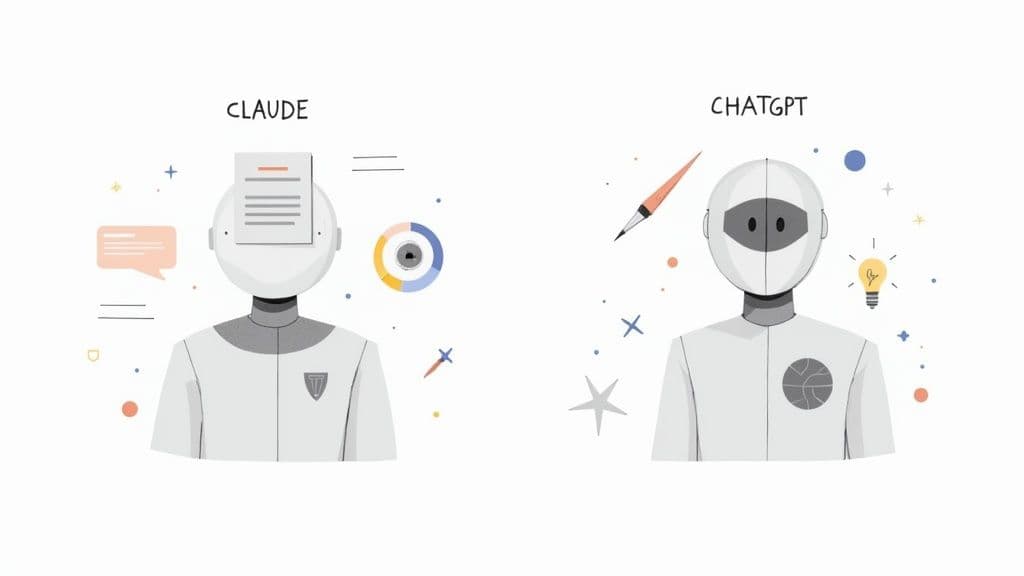
When you get down to it, the real difference in the Claude vs. ChatGPT debate comes down to specialization versus versatility. ChatGPT has a clear edge in creative content generation and is incredibly accessible, making it the default tool for brainstorming and a huge range of writing tasks. Claude, on the other hand, is the specialist for digesting enormous documents and maintaining a safer, more predictable conversational style. That makes it a better fit for many enterprise and research scenarios.
The AI Showdown An Executive Summary
Picking between Claude and ChatGPT isn't about crowning a single winner. It’s about matching the right tool to the job at hand. Each model was built with a different philosophy, and that DNA directly shapes its performance, making one far more suitable for certain workflows than the other. This guide digs into the details to help you make a smart call based on what you actually need to accomplish.
We're going to move past the simple feature lists you see everywhere else. Instead, we’ll explore the nuances that truly define each AI—from their core architecture and performance on specific benchmarks to practical, real-world use cases that put their strengths and weaknesses on full display.
Claude vs ChatGPT At a Glance
Before we get into the weeds, a high-level overview can help set the stage. This table breaks down the key differentiators, giving you a quick reference for the more detailed comparison that follows. Think of it as the core of the Claude vs. ChatGPT discussion, highlighting the main trade-offs you'll be making.
This table brings the central theme into focus: Claude is the specialist built for deep, context-heavy work, while ChatGPT is the powerful generalist ready for an incredibly broad array of applications. This distinction is key.
The decision between Claude and ChatGPT often boils down to a simple question: Do you need a meticulous research assistant capable of digesting a novel in one go, or a dynamic creative partner for rapid idea generation?
Understanding that fundamental difference is the first step. In the sections that follow, we’ll build on this foundation, arming you with the detailed insights needed to pick the right model for your projects. We'll look at everything from their underlying architectures to how they stack up in real-world performance tests, giving you a complete picture of the Claude vs. ChatGPT landscape.
Understanding the Core Architectures and Philosophies
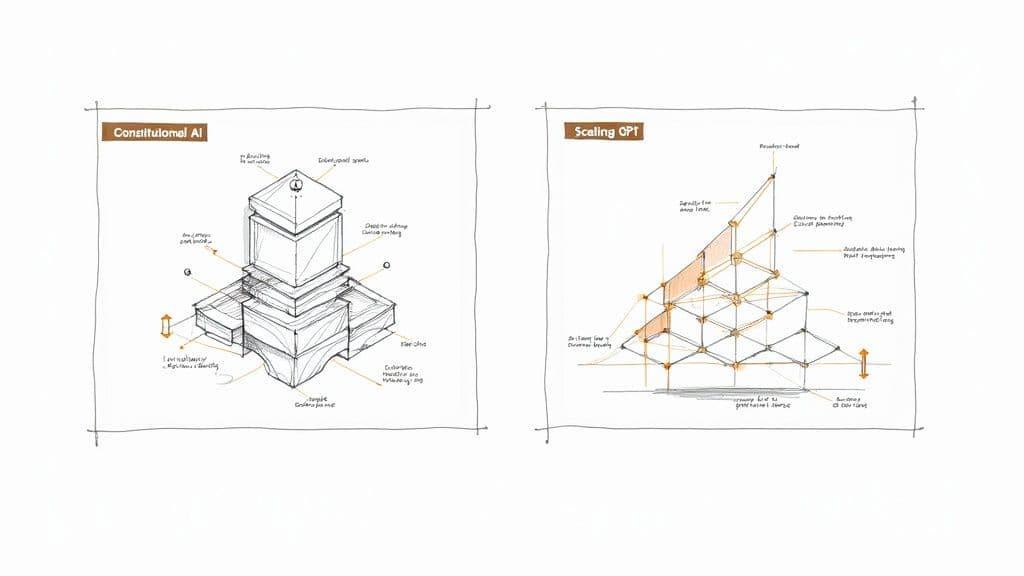
To really get to the heart of the claude vs chatgpt comparison, you have to look under the hood. Their foundational designs aren't just technical details; they're the product of two very different philosophies. These core principles directly shape how each model behaves, its tone, and what it’s ultimately good at.
OpenAI’s whole game with the GPT series, all the way up to GPT-4o, has been about scaling up for maximum performance across the board. The goal was pretty clear: build a powerful, do-it-all generalist. They accomplished this by feeding the model an absolutely colossal amount of diverse data, teaching it to spot and reproduce nearly any pattern in human language and logic.
This "bigger is better" mindset is why ChatGPT feels like such a Swiss Army knife. It can jump from writing a short story to debugging Python without skipping a beat. The architecture is fine-tuned for that kind of flexibility, ready to adapt to an endless stream of prompts. If you're curious about how it juggles all that information, our guide on how ChatGPT indexes content digs into its operational mechanics.
The Constitutional AI Framework of Claude
Anthropic went down a completely different road. With Claude, they baked safety and ethical alignment into its DNA from day one, using a framework they call Constitutional AI (CAI). This isn't just a simple content filter tacked on at the end; it's a fundamental part of how the model learns.
The process has two main stages: supervised learning and reinforcement learning. First, the model generates responses. Then, it critiques and rewrites them based on a "constitution"—a set of principles drawn from sources like the UN Declaration of Human Rights. In essence, the model learns to be helpful and harmless on its own, without a human looking over its shoulder every time.
This built-in ethical compass is why Claude often comes across as more cautious and reliably polite. It’s designed to push back on harmful requests and explain its reasoning, making it a much safer bet for businesses where brand safety and predictability are non-negotiable.
OpenAI’s Focus on Scaled Capability
In contrast, OpenAI has been laser-focused on pushing the limits of what's possible through sheer scale. Their bet, which has paid off handsomely, was that as you pump up a model's parameters and training data, its capacity for reasoning, creativity, and problem-solving skyrockets. ChatGPT is the poster child for this approach.
Of course, OpenAI has its own safety protocols, primarily using Reinforcement Learning from Human Feedback (RLHF). But its core design still prioritizes raw performance across a huge range of tasks. This leads to a model that’s often more daring and willing to take a swing at abstract or ambiguous prompts compared to Claude.
The trade-off? A personality that can feel a bit less consistent. The "ChatGPT voice" can sometimes sound generic, and you might need to nudge it with specific instructions to keep it from getting too flowery. But for anyone who needs a powerful and adaptable creative partner, that versatility is exactly what makes it so valuable.
Here’s how these fundamental differences stack up:
Ultimately, the architectural face-off in claude vs chatgpt is a story of safety-by-design versus performance-by-scale. Understanding this distinction is the key to picking the right tool, as it dictates their strengths, weaknesses, and the entire experience of using them.
When you look at Claude and ChatGPT in the market, you're really seeing two completely different game plans unfold. It's the story of the undisputed heavyweight champion versus a highly skilled, strategic challenger. The numbers and their target audiences tell you everything you need to know.
ChatGPT, powered by OpenAI, absolutely blasted onto the scene and never looked back. It had a massive first-mover advantage, and now, for many people, the term "AI chatbot" is synonymous with "ChatGPT." This isn't just a feeling; the data shows a level of market dominance that's hard to overstate.
ChatGPT's Unrivaled Market Leadership
By being the first to truly capture the public's imagination, ChatGPT built a user base that most competitors can only dream of. Its brand recognition alone is a powerful engine for growth, pulling in a constant stream of new users and cementing its status as the default AI tool for millions.
This creates a powerful cycle. More users mean more data, which OpenAI feeds back into its models to make them better, which in turn attracts even more users. It’s a classic network effect in action.
The key to ChatGPT's staying power is how deeply it has woven itself into daily life, for both casual users and professionals. People use it for everything from polishing an email to debugging code, making it an essential utility for a huge range of tasks.
The statistics are staggering. ChatGPT controls about 60.5% of the global AI chatbot market share as of July 2025. In North America, its grip is even tighter, at an incredible 80.24% market share. This isn't just a paper majority; it translates to real-world usage, with the platform seeing over 400 million weekly active users in early 2025.
Claude's Strategic Enterprise Focus
While ChatGPT went for mass appeal, Anthropic played a different hand with Claude. They’ve gone deep, not wide, zeroing in on the enterprise market. Instead of chasing raw user counts, Claude is marketed as the safer, more dependable choice for businesses where things like compliance, data security, and predictable outputs are non-negotiable.
And that strategy is working. Claude is quickly becoming a favorite in fields like law, finance, healthcare, and academic research. These are industries that handle massive, sensitive documents and can't afford the risks of an unpredictable AI. For another look at how different AIs compare, check out our analysis of Perplexity AI vs ChatGPT.
Its reputation for constitutional AI and its massive context window have made it the go-to for companies building AI into their mission-critical workflows. This focus on high-stakes business problems gives Claude a solid, defensible position in a very noisy market.
To get a sense of Claude's growing footprint, you can look at what people are saying online. Using one of the available Claude mentions tracker tools offers a great window into its adoption and public perception.
Ultimately, ChatGPT’s dominance comes from its broad, do-anything appeal, while Claude’s rising influence is the result of a deliberate, enterprise-first strategy. It’s a classic case of one tool aiming to be for everyone, and the other aiming to be the absolute best for a specific, high-value audience.
Comparing Performance Benchmarks and Capabilities
This is where the rubber meets the road. Forget the high-level architecture for a moment; how these models actually perform on real-world tasks is what truly matters. The practical differences in the Claude vs ChatGPT debate become incredibly clear when you push them on specific jobs, from dissecting dense documents to generating creative code.
While ChatGPT is the household name with massive user numbers, Claude has been quietly and effectively carving out its territory, especially in the business world. This chart paints a clear picture: ChatGPT has broad market appeal, but Claude is making serious inroads where it counts for enterprises.
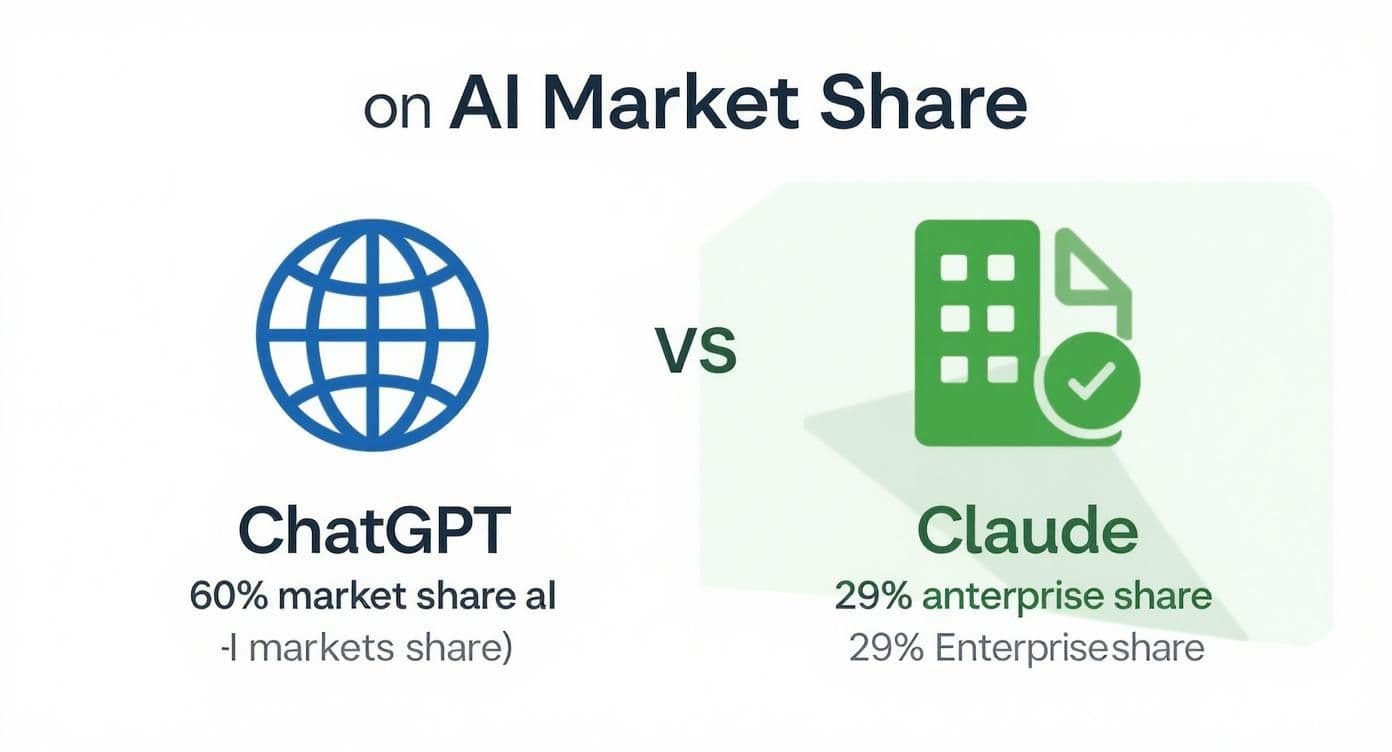
What we're seeing is a classic tale of two go-to-market strategies. ChatGPT is aiming for widespread consumer adoption, while Claude is laser-focused on winning over high-value business and enterprise clients.
Context Window and Document Analysis
If there's one feature that gives Claude a knockout advantage, it's the sheer size of its context window. The latest models can handle up to 1 million tokens, which translates to about 750,000 words. This isn't just an incremental improvement; it fundamentally changes what's possible.
Think about it. You can drop an entire novel, a massive annual financial report, or a complex codebase into a single prompt. Claude can ingest the whole thing and analyze it without forgetting what was said on page one. This makes it the undisputed king for tasks like:
- Summarizing extensive research papers: Distill the key findings from dense academic work in minutes.
- Analyzing legal contracts: Pinpoint specific clauses, risks, and obligations across hundreds of pages.
- Reviewing complex codebases: Get a high-level understanding of dependencies and logic within a huge software project.
ChatGPT's context window is certainly nothing to scoff at, reaching up to 400,000 tokens (around 300,000 words). But when the task demands a sustained analysis of a massive volume of text, Claude's capacity gives it a decisive edge.
Creative and Technical Writing
When you switch gears from analyzing to creating, the Claude vs ChatGPT dynamic often flips. ChatGPT tends to show more versatility and creative spark. Having been trained on an incredibly diverse swath of the internet, it's a master mimic, capable of adopting a huge range of styles, tones, and formats.
This makes ChatGPT my go-to tool for:
- Brainstorming and ideation: It’s a fantastic creative partner for generating novel concepts and kickstarting outlines.
- Marketing copy and social media content: It can quickly spin up varied and engaging text for different platforms.
- Drafting diverse content formats: From video scripts to poetry to technical articles, its range is just phenomenal.
Claude, on the other hand, often produces writing that feels more natural and, well, human. Its outputs tend to avoid the slightly robotic or overly formal tone that can sometimes plague AI-generated text. If your priority is a helpful writing assistant that polishes prose with a consistent and less jargon-heavy voice, Claude is a fantastic choice. If you're curious how it fares against other specialized models, our comparison of Perplexity vs Claude offers more insight.
Logical Reasoning and Problem Solving
Both models have become impressively good at logical reasoning, but their approaches are different. ChatGPT, especially with the GPT-4o model, has demonstrated incredible skill in multi-step reasoning. It has an uncanny ability to "think" through a problem, breaking it down into logical steps to reach a conclusion.
This makes it highly effective for abstract thinking and layered problem-solving. The big caveat, however, remains its tendency to hallucinate. You still have to double-check its work, as it can confidently invent facts.
Key Insight: Claude’s Constitutional AI framework makes it inherently more cautious. It’s less likely to make things up, which makes it a more reliable choice for any application where factual accuracy is non-negotiable, even if it sometimes plays it safe and defers on highly ambiguous prompts.
This reputation for reliability is fueling Claude's enterprise growth. As of Q2 2025, Claude 3.5 has shot past 30 million monthly active users. More importantly, its slice of the enterprise AI assistant market has jumped from 18% in 2024 to 29% in 2025, showing just how quickly businesses that value accuracy are adopting it.
Code Generation and Interpretation
For developers, the right choice really depends on the task at hand. ChatGPT's Code Interpreter is a powerhouse. It’s a fully integrated tool that can execute Python, analyze data, and generate charts right in the chat window. This makes it an unbelievably versatile sidekick for debugging, quick data analysis, and rapid prototyping.
Claude is also a formidable coding partner, and its massive context window gives it a unique advantage when working with large codebases. It truly excels at grasping the entire architecture of a project and answering high-level questions about how different parts connect. For those interested in its evolving agentic capabilities, it’s worth reading about Anthropic's new multi-session Claude SDK. This technology enhances its ability to manage complex tasks over multiple interactions, making it an even more powerful tool for developers.
Choosing the Right AI for Your Workflow
Benchmarks and technical specs are great for a lab, but the real test in the Claude vs. ChatGPT showdown is how these tools perform in the wild—your daily workflow. The "better" AI isn't the one with the highest score on a leaderboard; it's the one that feels like a natural extension of your own skills and makes your job easier.
To get past the abstract feature lists, let's break this down by looking at specific professional scenarios. Think of this as a practical guide to picking the right tool for the job.
When to Choose Claude
Claude’s massive context window and its focus on safety aren’t just features; they are foundational strengths. This makes it the clear winner for professionals who need to dive deep into dense, complex documents where accuracy and context are non-negotiable.
Here are a few situations where Claude is the obvious choice:
- Legal Document Review: Imagine a paralegal needing to find every reference to a specific person across a 500-page discovery document. You can drop the whole thing into Claude and ask it to summarize depositions or track mentions without it losing track of details from page one.
- Financial Report Analysis: An analyst can upload five years of annual reports and instruct Claude to chart revenue growth, flag recurring risks from the footnotes, and synthesize management's commentary. Its precision is purpose-built for this kind of granular work.
- Academic and Scientific Research: A researcher struggling with a literature review can give Claude a dozen academic papers and ask it to synthesize the key findings or identify gaps in the research. Its ability to connect dots across a vast body of text is a game-changer.
- Medical Record Summarization: A clinician can use Claude to condense a long patient history, pulling out the most critical information for a consultation. Its safety-first design gives you confidence when handling sensitive data.
The bottom line is this: If your primary job is to pull precise, reliable insights from large volumes of text, Claude's architecture gives it an undeniable edge. It’s the trusted specialist for high-stakes professional analysis.
On top of that, its writing style often feels more natural and less robotic, which is a big plus when you need to polish professional communications like internal reports or client-facing updates.
When to Choose ChatGPT
ChatGPT’s sweet spot is creative generation and multi-tool versatility. It excels when you need to create something from scratch, brainstorm ideas, or switch between different types of tasks quickly. Its powerful built-in tools, like image generation and code execution, make it an incredible all-in-one productivity hub.
You’ll find yourself leaning on ChatGPT for workflows like these:
- Content Marketing and SEO: A content strategist can use it to brainstorm a dozen blog post ideas, generate outlines for each, and then draft social media copy to promote them. It's an engine for creating a high volume of diverse content fast.
- Rapid Software Development and Prototyping: A developer can use the Code Interpreter to analyze a dataset, write a Python script to clean it up, and then debug the code—all in one seamless conversation. It drastically speeds up the coding cycle.
- Sales and Marketing Outreach: A sales rep can ask ChatGPT to craft personalized email templates for different customer segments, fine-tuning the tone from formal to casual. It’s a master at generating persuasive copy on the fly.
- General Problem-Solving and Ideation: When you're stuck on a problem and just need a brainstorming partner, ChatGPT is your go-to. It can pull from its vast knowledge to connect unrelated concepts and suggest creative solutions you hadn’t considered.
Ultimately, ChatGPT is king when your goal is generating new content from a prompt, not analyzing an existing document. It's the ultimate Swiss Army knife for creators, marketers, and developers who need to be agile and produce a wide variety of work. This is the clearest dividing line in the Claude vs. ChatGPT debate.
A Look at Pricing: From Casual Use to Enterprise Scale
When you're deciding between Claude and ChatGPT, the price tag is often a major factor. Their models cater to everyone, from someone just experimenting with AI to businesses integrating it into their core products. Both start with a solid free offering, but the real differences show up in their paid plans and API costs.
For a single user, the choice is pretty simple. Both Claude Pro and ChatGPT Plus hover around the $20 per month mark. Paying for either gets you past the usage limits of the free versions, speeds up response times, and gives you first dibs on the newest models like Claude 3.5 Sonnet or GPT-4o. The best one for you really depends on what you do. If you're constantly analyzing dense documents, Claude's strengths might be worth it. If you need an all-in-one creative tool with image generation (DALL-E 3) and data analysis, ChatGPT has the edge.
The Developer's Dilemma: API and Token Costs
For developers and businesses, the conversation shifts entirely to API access, where you pay for what you use. Both OpenAI and Anthropic use a token-based system, billing you for the amount of text you process—both what you send in (input) and what you get back (output). It's a flexible model, but it means you have to keep a close eye on your spending.
Not all models are priced equally, which is where things get interesting. A top-tier model like Claude 3 Opus, designed for complex reasoning, will cost you more per token than a workhorse model like Claude 3.5 Sonnet, which is built for speed and efficiency. The same logic applies to OpenAI's lineup, where GPT-4o carries a higher price than older or smaller models. This tiered structure lets you pick the right tool for the job, balancing raw power with your budget.
One of the biggest things to consider here isn't just the price per token, but the ecosystem around the API. OpenAI has been in the game longer, so its developer community is massive, and you'll find tons of existing integrations and support. Anthropic is catching up fast, though, with great documentation and a growing list of partners that make plugging Claude into your workflow much easier than it used to be.
Your decision usually boils down to a practical trade-off:
- Need to process a ton of data without breaking the bank? A more economical model like Claude 3.5 Sonnet is likely your best bet.
- Working on something where accuracy and reasoning are non-negotiable? It's probably worth paying the premium for a flagship model like GPT-4o or Claude 3 Opus.
The only way to know for sure is to get your hands dirty and test both APIs with your actual data and use case. API pricing changes, so always check the official pricing pages for the latest numbers. This kind of real-world test is the best way to find a solution that delivers the performance you need at a cost you can live with.
Claude vs. ChatGPT: Your Questions Answered
When you're trying to pick the right AI tool for the job, the Claude vs. ChatGPT debate can get pretty specific. Let's clear up a few of the most common questions I hear from people trying to make a smart choice.
Which AI Should I Use for Creative Writing?
While you can get great results from both, I generally find that ChatGPT has the upper hand for most creative writing projects. Its training data is so vast and varied that it has an uncanny ability to jump between different writing styles, spin up wild ideas from scratch, and tackle all sorts of content formats.
If you're drafting a short story, brainstorming ad copy, or just exploring a new concept, ChatGPT is a fantastic starting point. Where Claude really shines, though, is in refining and polishing. It's brilliant at taking a rough draft and giving it a more natural, human-like voice.
Is Claude Really Safer for Business Use?
Yes, for businesses where brand safety and compliance are non-negotiable, Claude is arguably the safer bet. This comes down to how it was built. Anthropic designed Claude around a framework they call 'Constitutional AI', which essentially bakes safety rules and ethical principles directly into the model's core.
This approach means Claude is fundamentally less prone to generating toxic, biased, or off-brand content. For any organization that needs a predictable and reliable AI partner, this built-in safety mechanism is a major advantage compared to models that depend more on filters applied after the fact.
Can Both Models Handle Images and Documents?
Both Claude and ChatGPT are more than just text generators; they have powerful multimodal skills. You can drop in images, charts, and dense documents, and both will do a good job of interpreting them.
The key difference is in the scale and application. Claude’s massive context window makes it the go-to for deep analysis of very long documents. Think about feeding it an entire annual financial report or a complex legal contract for a summary—that's where it excels. On the other hand, ChatGPT-4o delivers a more fluid, real-time experience with its voice and vision features, making it perfect for quick, interactive tasks.
Gain a competitive edge by understanding how your brand appears in AI-driven search. Attensira offers the tools to track your AI visibility, identify content gaps, and optimize your strategy for the next generation of search. Discover how you're seen and start optimizing today at https://attensira.com.