Discover how to prepare for ChatGPT ads with our definitive guide. Learn B2B strategies for auditing, goal setting, and creative to master AI search.
Getting ready for ads on platforms like ChatGPT isn't just about learning a new interface. It's a complete shift in thinking, moving away from old-school keyword strategies and toward a more fluid, conversational, and data-driven game plan. This means you need to start by auditing your current AI visibility, figuring out AI-specific KPIs, and learning how to craft creatives that feel like natural conversation—all to match how these new systems work.
The Inevitable Shift to AI Ads and Why It Matters Now
The ground is shifting under our feet. Traditional search is slowly but surely giving way to conversational AI, and for B2B companies, this isn't just another passing trend. It's a fundamental change in how your future customers will find you. Buyer behavior is evolving fast, moving from simple keyword searches to complex, conversational discovery where users ask detailed questions and expect genuinely helpful answers.
This new reality demands a new mindset. Instead of obsessing over keyword rankings, the goal is to become the recommended solution within an AI-generated response. Preparing for ads on platforms like ChatGPT is a critical strategic move. Don't think of it as a technical task; see it as a race to secure your market share for years to come.
Understanding the Urgency
The sheer scale and speed of AI adoption are hard to ignore. ChatGPT's growth is a perfect example of why brands must get ready for AI-driven advertising opportunities now. After launching in November 2022, it hit 1 million users in just 5 days. Fast forward to July 2025, and it boasts 800 million weekly active users who generate over 2.5 billion prompts every single day.
These numbers paint a very clear picture for B2B enterprises: your customers are already there, using AI to get information and make buying decisions. If you're not visible, you're invisible.
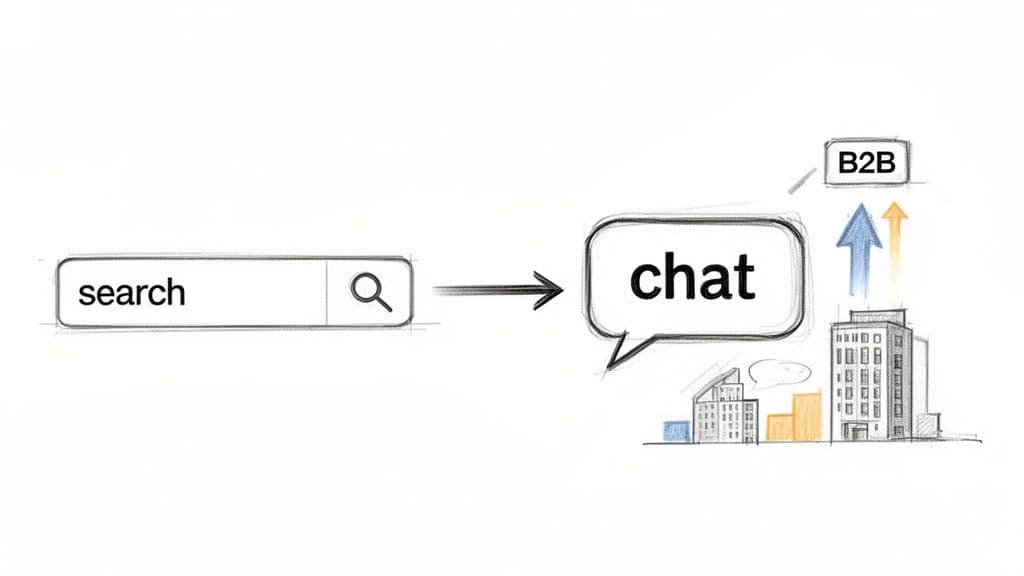
This diagram helps visualize the evolution from the search we all know to the AI-powered advertising we're heading toward.
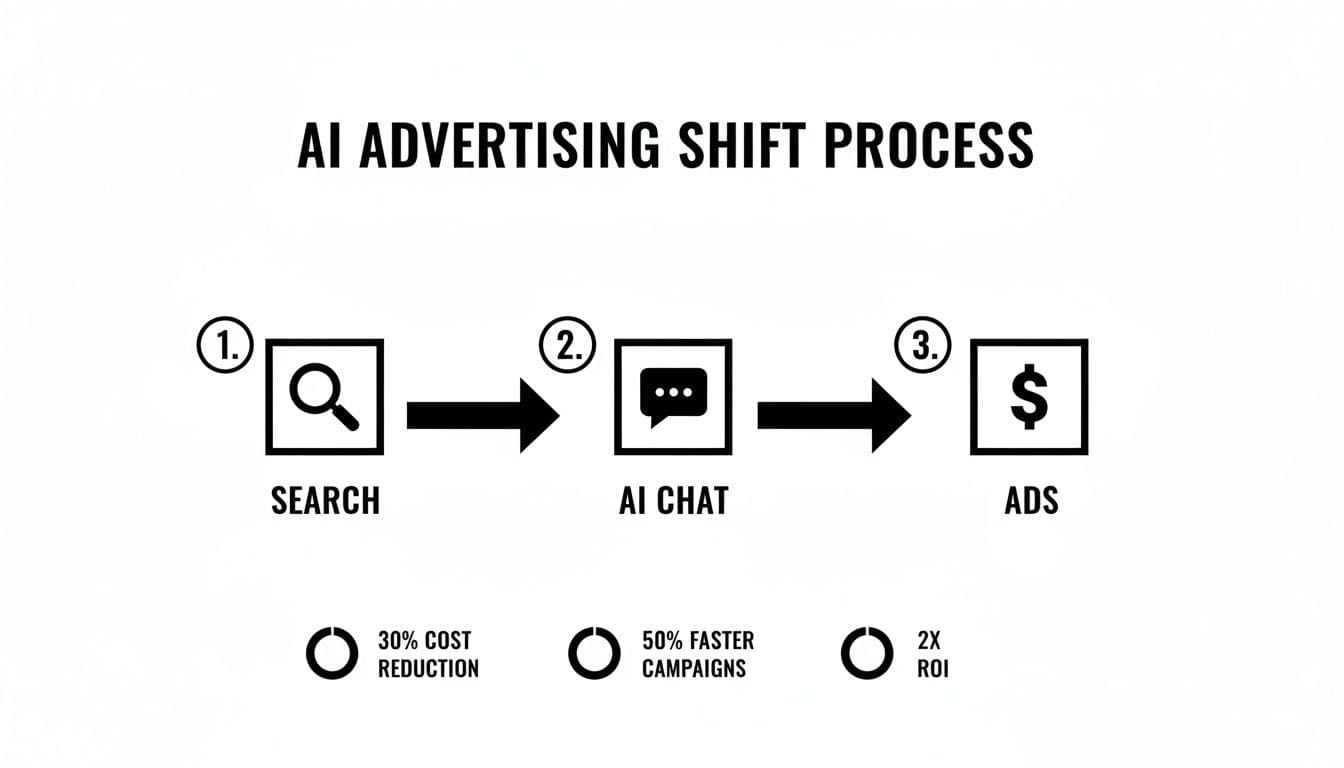
The flow is logical: from search to AI chat, and ultimately, to integrated ads. It’s all moving toward a more interactive and personalized way to connect with audiences.
The old playbook for search engine dominance is becoming outdated. Succeeding in this new AI-driven environment requires a strategic pivot.
Key Shifts from Traditional SEO to AI Visibility
This transition is less about incremental tweaks and more about a wholesale change in how we approach digital presence.
Why Early Preparation Is a Competitive Advantage
If you wait for an official ad platform to launch, you’re already behind. The companies that are acting now are the ones who will build a massive head start.
Getting ready early means taking a few practical steps:
- Establish a Baseline: First, you have to know where you stand. How often is your brand mentioned in relevant AI-generated answers? Is the information accurate? Is it positive?
- Identify Content Gaps: Pinpoint the queries where your competitors get a shout-out but you don't. These gaps are your low-hanging fruit—clear opportunities to create targeted content and optimize existing assets.
- Build Foundational Trust: AI models are designed to trust credible, authoritative sources. By creating high-quality, well-structured content today, you’re essentially training the AI to see your brand as a reliable resource. This groundwork is invaluable, and it happens long before you spend a single dollar on ads. To learn more, check out our guide on the emergence of ads in ChatGPT and what it means for your business.
The real work in preparing for ChatGPT ads isn’t about mastering a new ad tool. It’s about completely re-aligning your content and data strategy to win in a world where the search engine is a conversational partner, not just a list of blue links.
This foundational effort ensures that when AI ad platforms are fully rolled out, you won't be scrambling to catch up. You’ll be positioned as a trusted entity, ready to capitalize on a whole new way to engage customers and drive growth. The time to start was yesterday. The next best time is now.
Before you even think about putting a dollar into ChatGPT ads, you have to know where you stand. Jumping in without a clear picture of your current AI footprint is like navigating a new city without a map—you'll waste a lot of time and money going in circles. The first, most critical step is to get a baseline. You need to audit your brand's visibility in AI-generated answers right now. This isn't just a box to check; it’s the bedrock of your entire strategy.
Start by rolling up your sleeves and manually asking questions on platforms like ChatGPT. Put yourself in your customer's shoes. What would they ask? This isn't just about plugging in your brand name; you need to dig deeper.
Getting Your Hands Dirty with Manual Queries
To really understand how the AI sees you, you need to probe it from a few different angles. This will tell you not just if you're being mentioned, but how and in what context.
- Brand-Focused Questions: Start with the obvious. "What is [Your Brand Name]?" or "Who are the top companies for [Your Service]?" This gives you a quick read on the AI's direct perception of your brand.
- Problem-Focused Questions: This is where the gold is. Think about the pain points your customers have. A CFO, for example, isn't searching for your software by name; they're asking, "What's the best way to automate our AP process?" The answers to these questions reveal who the AI considers a real solution provider.
- Competitor-Focused Questions: Time to do some opposition research. Ask things like, "How does [Your Brand] compare to [Competitor]?" or "What are some alternatives to [Competitor Brand]?" You'll learn a ton about the perceived strengths and weaknesses in your market.
As you collect these responses, read them with a critical eye. Is the information correct? Is the tone positive or negative? A factually incorrect mention can be just as harmful as being ignored completely.
Your organic AI footprint is the training ground for future ads. If AI models don't already see you as a credible answer to a user's problem, paying for placement is going to be a tough, uphill climb.
This manual approach gives you a great initial snapshot, but you'll hit its limits fast. AI responses are constantly changing as the models get updated. What you find today could be totally different next week, which makes it impossible to track progress or keep a consistent eye on competitors at scale.
For a more in-depth look at this, you can learn more about AI overview tracking and its importance.
Moving from Spot-Checks to a System
To build a real, repeatable strategy, you need to automate. This is where you move from one-off checks to an ongoing intelligence-gathering machine. Platforms like Attensira are built for this, systematically tracking your brand’s mentions and visibility across different AI models over time.
Automated tracking lets you benchmark your performance against your direct competitors. You can see, with hard data, exactly where you’re winning and where you’re getting left out of the conversation.
Suddenly, you can spot the content gaps that are costing you. If a competitor consistently shows up for "best enterprise cybersecurity solutions" and your brand is nowhere to be found, you have a clear mandate. That’s your cue to create content that directly targets and fills that void. It gives your content and SEO teams a tangible, data-backed starting point.
The sheer scale of ChatGPT usage makes this audit urgent. It’s not a niche tool anymore. 32% of American travelers use it for trip planning. Key B2B sectors are jumping in, too, with adoption at 9% in automotive, 8% in B2B SaaS, and 7% in advertising.
With users spending an average of 8 minutes per session and the platform holding a massive 61.3% of the AI search market share, you can't afford to be invisible here.
Defining Your Goals and KPIs for AI-Driven Campaigns
Once you’ve taken stock of your current AI footprint, the next logical question is: what does success actually look like here? Just showing up in AI answers isn't a strategy—it's a starting point. To get ready for what’s coming with ChatGPT ads, you have to move past vanity metrics and set clear, measurable goals for this new conversational channel.
Vague objectives like "increase brand awareness" are too fuzzy to be useful. Your goals need to be specific and tied directly to real business outcomes. This means focusing on primary wins, like generating qualified leads from AI responses, boosting your brand mentions in high-intent conversations, and solidifying your company as the go-to answer for the problems your customers are trying to solve.
The financial momentum behind these platforms really lights a fire under this. ChatGPT's revenue is on a rocket ship trajectory, projected to soar from 0.73 million** in May 2023 to over **108 million by March 2025. This kind of explosive growth is a huge incentive for them to build out sophisticated ad products. For B2B companies, where firms using GPT tech are already seeing revenue bumps between 3-15%, getting ahead of the curve is a smart play. You can see more stats on ChatGPT's commercial potential to get a sense of what's coming.
From Traditional Metrics to AI-Centric KPIs
Your standard marketing KPIs are a good foundation, but they need an AI-specific lens. Think of it as evolving your measurement framework. You have to account for a new kind of interaction that happens before a user ever clicks a link or lands on your site.
Here are the key metrics that truly matter in this new world:
- Share of AI Voice: This is the direct equivalent of Share of Voice, but for AI. It tracks how often your brand is cited in relevant AI answers compared to your competitors. A higher share means you’re seen as a bigger authority.
- Click-Through Rate (CTR) from AI Links: When an AI model drops a link to your site in its response, what percentage of people actually click it? This is a direct signal of how relevant and compelling your placement is.
- Conversion Rate from AI-Referred Traffic: Of the people who do click through from an AI response, how many of them take the action you want—like booking a demo or downloading a guide? This is where you connect AI visibility to actual leads.
- Sentiment Score: This qualitative metric is crucial. It tells you how you're being mentioned: positively, neutrally, or negatively. Consistently positive sentiment suggests the AI views your brand in a good light.
These KPIs give you a concrete way to measure progress and justify the work you're putting into AI optimization, long before an official ad platform even rolls out.
Tying AI Goals to Your Bigger Business Objectives
The real magic happens when you connect these AI-centric KPIs back to your company's core business goals. An isolated metric is just a number. A connected metric tells a story about growth and ROI.
Let’s walk through a real-world example. Imagine a B2B SaaS company that sells accounts payable automation software. Their main goal is to get more qualified leads from mid-market companies.
Business Objective: Increase qualified demo requests by 20% in the next quarter.
To make that happen, they can set specific AI goals that feed directly into that larger objective. Their strategy is to become the top recommendation whenever a potential customer asks a problem-focused question.
Here’s what their AI-centric goals might look like:
- Dominate Share of AI Voice: Achieve a 30% Share of AI Voice for queries like "best AP automation software for NetSuite" within the next 60 days.
- Drive High-Intent Traffic: Generate 500 qualified site visits per month from links embedded in AI answers to problem-solving questions.
- Convert That Traffic: Hit a 5% conversion rate on their dedicated landing page for visitors arriving from AI-generated links.
This approach turns abstract prep work into a concrete, measurable plan. Each AI-specific goal is a stepping stone toward the bigger business win, creating a clear line from a conversational query all the way to revenue. For a broader look at this, check out our guide on measuring marketing campaign effectiveness.
By setting these kinds of goals now, you’re building the measurement framework you'll need to prove ROI and make smart decisions when it’s time to actually put money into ChatGPT ads.
4. Crafting Creatives for a Conversational World
Advertising inside an AI conversation demands a completely different creative playbook. The old, keyword-stuffed, click-driven ad copy that works for traditional search feels jarring and unnatural here. To get any traction, your messaging has to adapt to a world where ads are part of an ongoing, helpful dialogue.
This means shifting from rigid ad text to natural, useful language that aligns with how AI models generate their responses. It’s less about shouting your features from the rooftops and more about becoming part of the solution the user is actually looking for.
The New Rules of Ad Copy
In a conversational setting, the best ads don't feel like ads at all. They come across as a helpful extension of the conversation, offering a clear next step or a valuable piece of information. The goal is to provide content that an AI would be proud to recommend because it genuinely helps the user.
This approach requires a subtle but significant change in how you write. Forget pure persuasion and prioritize clarity, utility, and context. The language needs to be direct, simple, and stripped of the usual marketing jargon.
Ad Creative Transformation for AI Platforms
The shift from interruptive messaging to integrated, helpful content requires a fundamental change in how we approach creative. It's about moving from a "buy now" mentality to a "here's how this helps" mindset.
The table below breaks down the core differences between the old and new ways of thinking about ad creatives.
This transformation isn't optional. AI models are designed to prioritize information that is trustworthy and directly relevant to a user's query. Generic, high-pressure ad copy will almost certainly be ignored by both the AI and the user.
The most effective creative for ChatGPT ads won't have the catchiest slogan. It will be the one that provides the most direct, verifiable, and useful answer to the user's underlying problem.
Prompt Engineering for Advertisers
Thinking like a prompt engineer gives you a massive advantage when preparing for ChatGPT ads. It's all about structuring your core message so that it becomes the most logical and helpful response for an AI to surface when it encounters a relevant user query.
Let's say your customer asks, "What's the best way to reduce manual data entry for my finance team?"
- Ineffective Ad Copy: "The #1 AI-Powered Data Solution! Unbeatable Prices! Sign Up Now!" This copy is generic, full of hype, and completely ignores the user's specific problem. It screams "ad."
- Effective Ad Copy: "For finance teams looking to reduce manual data entry, our platform automates invoice processing and syncs directly with your existing ERP, saving an average of 20 hours per week." This response is specific, data-backed, and directly addresses the user's pain point.
The second example works because it's framed as a solution, not just a product. It uses verifiable data ("20 hours per week") to build trust with both the user and the AI model. To really get good at this, a solid understanding of What is Prompt Engineering is essential.
Building Trust with Factual Content
In a conversational AI environment, trust is the only currency that matters. AI models are trained on vast amounts of data and are getting much better at identifying and prioritizing information from authoritative, credible sources. This means your ad creatives—and the landing pages they link to—must be grounded in cold, hard facts.
Forget making broad, unprovable claims. Focus on providing concrete evidence of your value.
- Use Specific Numbers: Don't just say your product is "fast." Say it "reduces processing time by 40%."
- Cite Case Studies: Instead of a generic testimonial, frame it as a measurable outcome: "A mid-market manufacturing client reduced their error rate by 92% using our system."
- Provide Clear Use Cases: Show, don't just tell. Explain exactly how your product solves a specific problem for a specific type of user.
This fact-based approach does two things. First, it makes your message far more compelling to a discerning B2B audience. Second, it provides the AI with the structured, verifiable data it needs to confidently recommend your solution. This is a crucial part of knowing how to prepare for ChatGPT ads, and our guide to effective web content creation offers more strategies to build that foundation of trust.
Building Your Technical and Measurement Infrastructure
Even the most brilliant creative and well-defined goals will fall flat without a solid technical foundation to track what’s actually working. As you get ready for ads on platforms like ChatGPT, building the right measurement infrastructure now is non-negotiable. It’s the only way to ensure that when this new traffic starts flowing, you can accurately measure its impact from day one instead of scrambling to make sense of messy data later.
This isn’t about some massive, expensive IT overhaul. It’s about methodically putting a few key systems in place—website tagging, analytics configuration, and structured data—to create a clean, reliable data pipeline. Think of it as laying the plumbing for your future AI ad campaigns; you have to get the pipes right before you turn on the water.
Mastering Traffic Attribution with UTMs
When traffic from an AI-generated answer lands on your site, how will you know where it came from? If you don't tag it properly, that valuable traffic will likely get dumped into the "Direct" or "Referral" bucket in your analytics. Good luck proving ROI with that. This is where Urchin Tracking Module (UTM) parameters become your absolute best friend.
One of the most practical things you can do today is establish a standardized UTM convention. It’s a simple set of tags you add to your URL that tells analytics platforms exactly where a visitor originated. It's a small detail that makes a huge difference.
For a future ChatGPT ad, a solid UTM structure might look something like this:
utm_source=chatgpt: Clearly identifies the platform.utm_medium=sponsored_responseorcpc: Specifies the type of traffic.utm_campaign=q1-2026-product-launch: Groups all traffic under a specific initiative.utm_content=solution-focused-prompt: Helps you differentiate between ad creatives or prompts.
By defining and documenting these conventions now, your team will be ready to implement them consistently the moment an AI ad platform goes live. This simple discipline ensures every click is attributed correctly, giving you clean data to analyze performance from the get-go.
Configuring Analytics for a New Reality
Once your UTM strategy is locked in, the next step is to get your analytics platform—like Google Analytics 4 (GA4)—ready to recognize and properly categorize this new traffic. The best way to do this is by creating a custom channel grouping specifically for AI-driven traffic.
This lets you see "AI Search" as its own distinct channel, right alongside "Organic Search," "Paid Search," and "Social." For example, you could set up a rule that says any traffic where utm_source=chatgpt gets automatically sorted into your new "AI Search" channel.
Without proper analytics configuration, you'll be flying blind. Setting up custom channels for AI traffic in advance is the difference between having actionable insights and a pile of unclassified data on launch day.
This proactive setup means your reports will be clean and intuitive from the start. You'll be able to directly compare how your AI ad efforts stack up against other channels, measuring everything from bounce rate to conversion value without having to manually wrestle with the data.
The Critical Role of Structured Data
Beyond just tracking clicks, there’s a deeper technical layer that influences both your organic AI visibility and your future ad effectiveness: structured data, also known as schema markup. This is essentially a vocabulary of tags you add to your website's HTML that explicitly tells AI models what your content is about.
While the SEO world has used schema for years to get those nice rich snippets in Google, its importance is magnified for AI. An AI model doesn't just "read" your product page; it parses the underlying data. Schema markup translates your content into a language machines can instantly understand.
For example, you can use schema to clearly define:
- Product Details: Price, availability, and model numbers.
- Company Information: Your official name, logo, and contact details.
- FAQs: Specific questions and their corresponding answers, making them perfect for an AI to "snip" for a direct answer.
Implementing robust schema markup helps AI models trust the information on your site. That trust is a prerequisite for both being included in organic responses and for serving relevant, context-aware ads. AI systems prioritize clarity and confidence; structured data delivers both. This technical groundwork is a core part of learning how to prepare for ChatGPT ads, and you can find more strategies in our guide to the best LLM tracking tools to monitor AI search.
Optimizing Performance and Staying Ahead of the Curve
Getting your ads ready for a platform like ChatGPT isn't a one-and-done task. The strategies that crush it on launch day could be obsolete in a few months as AI models evolve and user search habits change right along with them. To win here, you have to commit to constant monitoring, relentless testing, and quick adaptation.
Treat your AI advertising strategy like a living document, not a stone tablet. You’re aiming to build a feedback loop where real-world performance data directly informs your next move. This keeps you ahead of competitors who are still reacting to yesterday's news.
Embrace Continuous A/B Testing
Systematic testing is the engine that drives optimization. When we're talking about AI-driven ads, this means going way beyond just tweaking ad copy. You need a structured framework to test every component and figure out what actually connects with people in a conversational format. The key is to isolate variables so you can get clean, actionable data.
Your testing roadmap should be packed with experiments like these:
- Prompt Variations: How does different phrasing in your ad creative affect where the AI places you and how users engage? Test a prompt that agitates a pain point against one that leads with a key benefit.
- Landing Page Experience: Send half your AI traffic to a standard product page and the other half to a landing page built specifically for this audience. See which one actually drives more conversions.
- Call-to-Action (CTA) Language: Does a direct CTA like "Book a Demo" outperform a softer, more educational one like "See How It Works"? The conversational context of AI often rewards a less aggressive approach.
Keep a Close Watch on the Shifting AI Landscape
The AI environment is anything but static. You can't assume what works today will still be effective tomorrow. Consistent monitoring is your best defense against getting caught flat-footed by an algorithm update or a shift in the conversation. This means you have to regularly check how AI models are responding to your target queries to spot changes in tone, accuracy, or even which competitors they mention.
I can't stress this enough: a monthly AI visibility review is essential. This isn't just about checking your own brand mentions. It’s about spotting emerging content gaps and identifying new competitors elbowing their way into the conversation before they become a real problem.
This regular check-in is what gives you the agility to adapt on the fly. If an AI suddenly starts referencing a competitor’s new whitepaper for a keyword you own, that’s your cue to create a better, more comprehensive resource—fast. Using a platform like Attensira helps you track these shifts, turning mountains of raw data into a clear strategic directive.
Common Questions About Advertising on ChatGPT
As we get closer to the reality of advertising on platforms like ChatGPT, a lot of practical questions are coming up. B2B leaders, in particular, are trying to figure out how to approach this new frontier. Here are some of the most common ones I've been hearing, along with some straight answers based on what we know so far.
What Should We Expect for Initial Ad Costs?
While nothing is set in stone, new ad platforms almost always launch with lower costs. There's just less competition at the start.
My advice? Be smart and start small. You don't need a massive budget to learn. Carve out an experimental fund—maybe 5-10% of your total paid media spend—specifically for these early tests. The goal isn't to hit a home run on day one, but to gather real performance data you can build on.
Should We Pull Budget from Google or Facebook for This?
Definitely not. Don't gut your proven, high-performing channels for something untested. Think of this as a pilot program, not a replacement strategy.
Run your ChatGPT ad tests for at least one full quarter. This gives you enough time to gather meaningful data and establish some initial benchmarks. Once you have that, you can compare its cost per conversion and, more importantly, the quality of leads against what you're seeing on Google and Meta. Only then should you consider shifting any significant budget.
The goal is to gather data, not to gamble. Prove the value of this new channel with a controlled test before you scale your investment.
Isn't This Just a New Form of AI SEO?
That's a great question, and it highlights a crucial distinction. They are two sides of the same coin, but they are not the same thing.
- AI SEO (Organic): This is all about creating authoritative, well-structured content that AI models naturally want to cite in their answers. You're earning your spot by being the best, most relevant source of information.
- ChatGPT Ads (Paid): This is about paying for placement within those AI-generated responses. It gives you direct control over your message and guarantees visibility where you want it.
A truly effective strategy will lean on both. Your organic AI presence builds the foundational trust and authority that makes your paid ads feel more credible and less intrusive when they do appear. They work together.
Ready to see how your brand currently stacks up in AI conversations? Attensira provides the tools to audit your AI visibility, track competitors, and identify content gaps so you're prepared for what's next. Get your baseline at https://attensira.com.