

Discover how to scale your B2B SEO strategy with automated content creation. This guide covers the tech, risks, and a clear roadmap for measurable success.
What if you could produce a year's worth of highly targeted, data-backed content in just a few weeks? That's the game-changing promise of automated content creation for B2B enterprise SEO. This isn't about replacing human strategists with robots; it's about arming them with incredible speed and precision.
The New Reality of B2B Content at Scale
The sheer demand for hyper-personalized content across countless platforms has made manual creation completely unsustainable for large B2B companies. Customers now expect tailored insights and solutions at every turn, and scaling that level of detail is a massive operational headache. This is exactly where automation steps in to rewrite the rules.
Think of it this way: a master architect could sketch a single building by hand, but to design an entire city block, they'd use advanced software. The human vision, creativity, and strategy remain the most critical part of the process. The architect still decides on the style, function, and overall layout. The software just handles the tedious, repetitive drafting work, allowing for a scale and speed that would otherwise be impossible.
The Forces Driving Adoption
Several powerful trends are pushing B2B enterprises toward automated content creation:
- Intense Market Demand: B2B buyers consume more content than ever before on their path to purchase. This requires a constant stream of material that addresses their very specific needs and questions.
- The Rise of AI Search: Search engines are becoming answer engines. Winning in this new environment means building huge libraries of clear, factual content that AI models can easily understand, reference, and cite.
- Economic Pressure: The mandate to "do more with less" never goes away. Automation provides a direct route to cutting operational costs while significantly boosting content output.
This perfect storm of market pressure and new technology has created a massive incentive to adapt. The global market for AI-powered content creation has exploded from USD 2.15 billion in 2024 to a projected USD 10.59 billion by 2033, which is a staggering compound annual growth rate of 19.4%. Early adopters are already seeing up to a 40% reduction in content costs as AI tools help with everything from editing to personalization. You can dig deeper into this growth in this AI-powered content creation report.
At its core, automated content creation is a strategic response to a simple truth: to win in B2B SEO today, you must achieve both quality and quantity. The companies that master this balance will own the conversation in their industries.
This evolution is about more than just churning out blog posts. It’s about building a complete ecosystem of interconnected content that establishes deep topical authority and captures very specific, high-value audiences. When executed properly, this scaled approach amplifies other distribution tactics. For example, check out these insights on the role of content syndication services to see how you can get more mileage out of the content you create. For B2B marketing leaders aiming for market dominance, mastering this new operational model is no longer optional.
How Automated Content Creation Actually Works
Forget the image of a "robot writer" hunched over a keyboard. A better way to think about automated content creation is to picture a sophisticated, high-speed bottling plant. This isn't about conjuring content from thin air; it’s a methodical process that turns raw data into polished, ready-to-publish assets. And like any good recipe, it all starts with the right ingredients.
The fuel for this entire engine is structured data. This is the pure, high-quality liquid in our bottling plant analogy—it could be anything from product specs and financial reports to customer reviews and performance metrics. The critical factor is that the information is organized, consistent, and machine-readable. This data forms the factual bedrock for every single piece of content the system produces.
The Core Technology Engine
With the data ready, the real work begins. The core technology at play is Natural Language Generation (NLG), a specific branch of AI focused entirely on turning structured data into text that sounds like a human wrote it. In our plant, NLG is the advanced machinery that fills, caps, and labels every bottle with incredible speed and precision.
An NLG system doesn't just guess at what to say. It meticulously analyzes the input data to spot key insights, patterns, and relationships. From there, it uses complex algorithms and pre-set rules to build sentences and paragraphs that are not only grammatically sound but also factually tethered to the source data.
This diagram shows how human strategy is the guiding force behind AI execution, allowing you to scale content production without sacrificing control.
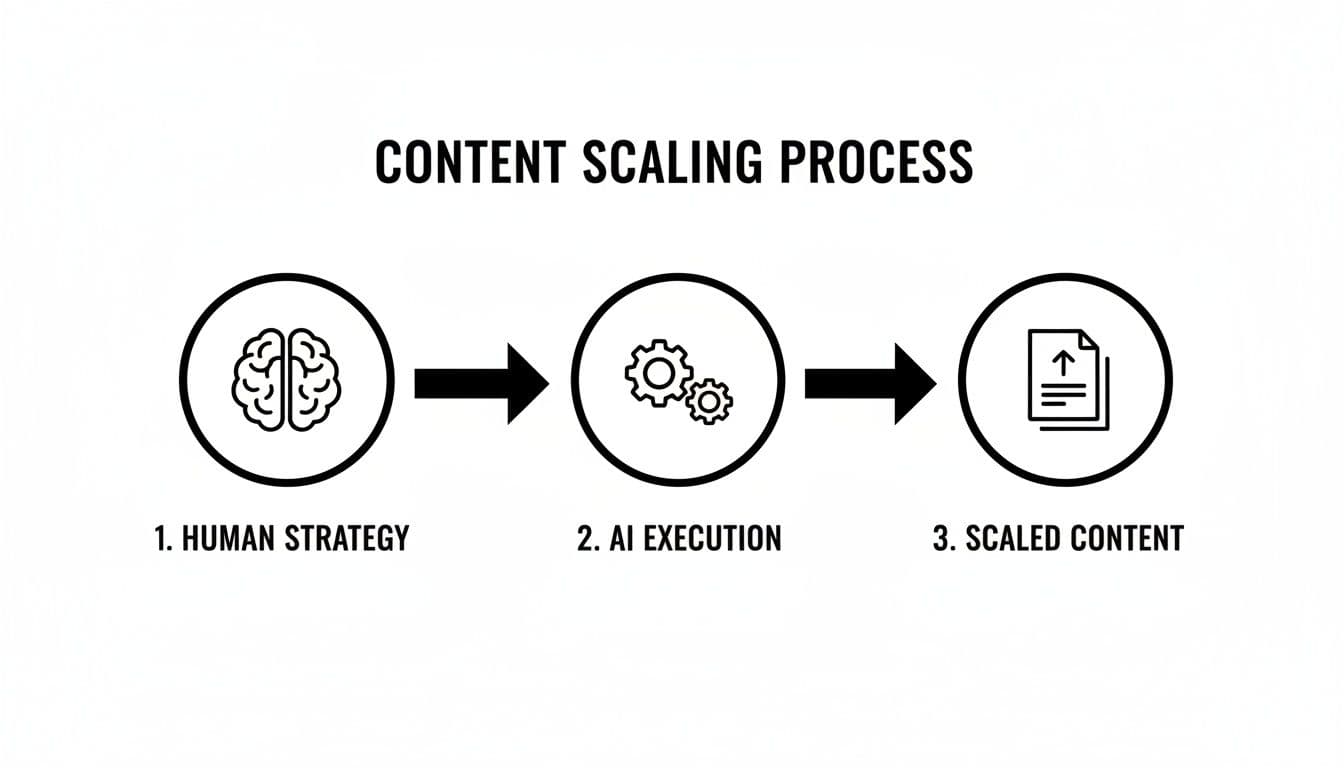
As you can see, automation acts as an accelerator for a human-led strategy, not as a replacement for it.
From Raw Text to Polished Content
Once the NLG engine generates the text, it's poured into content templates. Think of these as the unique bottle designs in our analogy. They provide the structure, style, and branding for the final piece, dictating everything from headline formulas and paragraph breaks to the placement of calls-to-action. This ensures every asset is perfectly on-brand, even when produced by the thousand. To get a better handle on the outputs, it helps to understand what is AI-generated content and the different models behind it.
This tight integration of data, AI, and templates is what delivers perfectly packaged content at a scale that's impossible to achieve manually. The entire workflow follows a clear, repeatable path.
A typical automated content creation process breaks down into four key stages:
- 1. Data Sourcing and Preparation: It all starts with gathering and cleaning structured data from sources like internal databases, analytics platforms, or market research reports.
- 2. AI Processing and Generation: The prepared data is fed into the NLG model, which analyzes it and produces a first draft based on the insights and patterns it finds.
- 3. Template Integration: The raw text from the AI is then mapped onto pre-designed content templates that govern the final look, feel, and structure.
- 4. Human Review and Refinement: This is arguably the most important step. A human editor or subject matter expert reviews the automated draft for accuracy, tone, and overall quality, making final tweaks to ensure it hits the mark.
The human-in-the-loop isn't a bottleneck; it’s a quality gate. It’s what ensures the speed of automation is matched with the nuance, strategy, and expertise that only a person can provide.
This blend of machine efficiency and human oversight makes automated content creation a game-changer for B2B enterprises. The ecosystem of tools enabling this is vast; for instance, exploring various social media automation tools can give you a sense of how different platforms solve specific automation challenges. In the end, this structured approach takes the mystery out of the process, turning it from a "black box" into a controllable and incredibly effective content production engine.
Weighing the Strategic Benefits and Critical Risks
Think of adopting automated content creation like adding a turbocharger to your B2B marketing engine. It can deliver incredible speed and power, opening up strategic possibilities you couldn't reach before. But if you just floor it without knowing how to handle that power, you risk blowing the engine and causing a lot of damage. You have to be smart about it.
The most obvious win is unprecedented scale. Imagine being able to spin up thousands of hyper-targeted landing pages, each one speaking directly to a specific industry, job title, or long-tail search query. That’s a level of granularity that’s simply impossible with a purely manual workflow. It’s how you build massive topical authority and capture those valuable niche audiences with surgical precision.
This scale has a direct, positive impact on efficiency. When you automate the heavy lifting of drafting, you free up your seasoned experts to do what they do best. Instead of churning out basic descriptions, they can focus on high-value work: strategy, creative ideation, and adding that final, human touch that makes content truly great. This doesn't just speed up production; it brings down your cost-per-asset, making your entire marketing budget work harder.
The Clear Advantages for B2B SEO
For anyone in B2B and enterprise SEO, the benefits here aren't just nice-to-haves; they tie directly to the metrics that matter.
- Massive Topical Authority: When you can systematically cover every angle of a topic, you send a powerful signal to search engines that you are the definitive source. This can lift rankings across your entire domain.
- Deep Personalization: Automation lets you stop creating one-size-fits-all content. You can have a unique page explaining a software feature's value to a CFO in finance, a plant manager in manufacturing, and a compliance officer in healthcare.
- Speed to Market: See a new market trend? Need to respond to a competitor's move? You can generate and launch relevant content in days, not months, seizing opportunities before they pass.
Of course, once you start producing content at this velocity, you need a robust way to measure what's working. To get a handle on this, it's worth digging into the right content performance metrics that reveal the true impact of your efforts.
The real strategic advantage here isn’t just about making more content. It’s about making more of the right content, faster and more efficiently than anyone else in your space.
Navigating the Critical Risks
But this power comes with some serious strings attached. The most immediate danger is a nosedive in content quality. If you lean too heavily on the machine without enough human oversight, you'll end up with a sea of generic, soulless content. It might tick a keyword box, but it won't connect with a human reader, and it will slowly erode your brand's credibility.
Another huge risk is the potential to amplify factual inaccuracies at an alarming scale. If your source data has an error or the AI model misinterprets a key fact, you could inadvertently publish thousands of pages with the wrong information. The fallout from this—from shattered customer trust to potential legal headaches—is a nightmare to clean up.
Finally, and perhaps most importantly, is the risk of losing your authentic brand voice. Your unique perspective, tone, and personality are what set you apart. If all your content starts sounding like it was written by the same generic robot, you dissolve the very thing that makes your audience connect with you in the first place.
Automated Content Creation for B2B SEO: A Strategic Analysis
To make a sound decision, you need to see both sides of the coin. Here’s a clear breakdown of the high-level trade-offs you're facing.
Ultimately, a successful strategy is all about embracing the benefits while building strong guardrails to contain the risks. It demands a shift in mindset—from being a pure content creator to a strategic overseer. The goal is to make technology serve human expertise, not the other way around. Without that balance, the promise of scale can quickly become a very real liability.
Building Your Content Governance Framework
Trying to scale automated content without a solid governance framework is a lot like running that high-speed bottling plant with the quality control team on vacation. It might work for a little while, but sooner or later, a bad batch is going to get out and do some real damage to your brand. A proper framework is your non-negotiable quality guarantee, ensuring every single piece of content meets your standards.
The heart of any smart automation strategy is the Human-in-the-Loop (HITL) model. This isn't about micromanaging the machine; it’s about creating strategic checkpoints where human expertise makes the final call. Think of automation as the world’s most efficient assistant, not the author. Your team’s job evolves from grinding out content to providing strategic oversight, quality control, and that final creative polish.
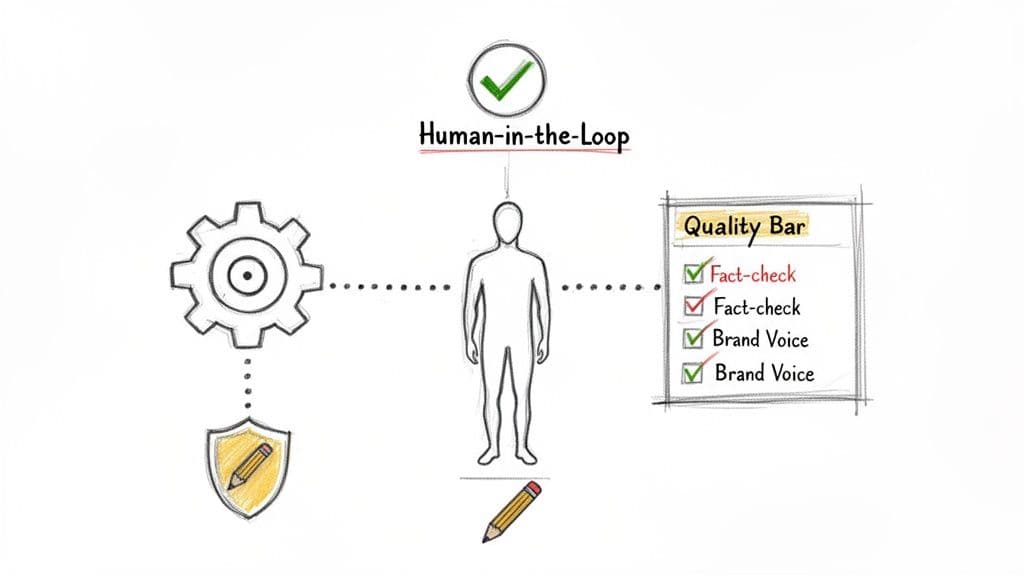
This approach creates a powerful partnership: technology delivers the scale, and your people provide the nuance, judgment, and final sign-off.
Defining Your Quality Bar
First things first: you have to define what "good" actually means. This quality bar becomes a simple, clear checklist that every piece of content—no exceptions—must pass before it sees the light of day. It’s the single source of truth that gets your team and your AI tools all on the same page.
Your quality bar needs to cover the fundamentals:
- Factual Accuracy: Are all claims, stats, and data points 100% correct and verifiable?
- Brand Voice & Tone: Does this sound like us? Is the personality right?
- Readability & Structure: Is it easy to read? Is the formatting clear and logical for our audience?
- SEO Optimization: Does it hit all the technical SEO marks, like proper headings and meta tags?
- Helpfulness: Does this piece genuinely solve the user's problem or answer their question?
Getting these standards documented is critical. It's also worth thinking about how this framework fits into your company's bigger picture of enterprise content management solutions, which helps maintain consistency across every asset you produce.
Establishing Editorial and SEO Guardrails
Once you know what quality looks like, you need to build the processes to enforce it. This means setting up clear editorial and technical SEO guardrails that steer the entire content creation process.
Your editorial workflow needs clear ownership. Assign specific people to be the final reviewers and fact-checkers for different types of content. That accountability is what keeps the subtle mistakes or awkward phrasing that AI can produce from slipping through.
At the same time, you need technical guardrails. These are the rules and prompts that ensure every article is structurally sound for search engines. This means instructing the AI to use a specific heading structure (H1, H2s, H3s), weave in keywords naturally, and write optimized meta descriptions and titles from the get-go.
Governance isn’t about slowing down automation; it’s about making it safe to go fast. It transforms automated content creation from a high-risk gamble into a predictable, scalable, and powerful engine for growth.
The market is already moving in this direction. Cloud-based AI content platforms are on track to capture around 65% of the market share by 2035, growing at a steady 17.28% each year. This shift away from complicated on-premise systems shows that businesses want scalable, manageable solutions, a trend detailed in this AI-powered content creation market analysis.
Infusing Brand Voice at the Prompt Level
Finally, let’s talk about your most valuable asset: your brand voice. To protect it, you have to build your brand guidelines directly into your AI prompts. Don’t just ask the AI for an article; tell it how to write that article.
Give it specific, detailed instructions like:
- Tone: "Write in a professional yet approachable tone. Avoid overly technical jargon."
- Perspective: "Write from the perspective of an expert advisor helping a new client."
- Formatting: "Use short paragraphs, no more than three sentences. Use bullet points for any lists."
When you embed these rules into the initial command, you guide the AI toward a first draft that already feels like your brand. This drastically cuts down the editing time for your team and makes the entire Human-in-the-Loop process that much more efficient.
Optimizing Content for AI-Powered Search
The old SEO playbook is quickly becoming outdated. For decades, the goal was simple: get to the top of the search results. But now, the game has changed. The new objective isn't just about ranking on a list; it's about becoming the direct, cited source in an AI's answer. This shift demands we rethink our entire approach to content and how we measure success.
Success is no longer a simple matter of keyword density. It's about convincing AI models that your content is the most reliable, authoritative source on a given topic. These models are built to hunt down and synthesize the clearest, most fact-dense information they can find. Your automated content creation process has to be fine-tuned to generate material that's dead simple for a machine to parse, trust, and cite.
This means putting a premium on clarity and factual accuracy. Structure your content with clean, logical headings and short paragraphs. Frame your information as direct answers to specific questions. Think of it like you're writing a briefing for a very literal-minded AI assistant—the easier you make its job, the more it will rely on you.
Introducing AI Search Visibility
To compete in this new arena, we need a new scorecard. This is where AI Search Visibility comes in. It’s a metric designed to track how often your brand gets mentioned or cited in the answers churned out by AI search tools and chatbots. It's the new share of voice, built for the age of conversational AI.
Trying to track this manually is a fool's errand. This is why specialized platforms are becoming so important. Tools like Attensira are designed specifically to monitor your brand’s footprint in AI-generated answers, giving you a real-time view of your performance.
These platforms help you answer the questions that now matter most:
- Brand Presence: How often is our brand showing up in AI responses for our key topics?
- Competitor Benchmarking: Which of our competitors is winning the AI conversation in our niche?
- Content Gap Analysis: What questions are AI models answering with competitor content that we should be owning?
This kind of data gives you an actionable roadmap. You can stop guessing what might work and start knowing precisely which content gaps you need to plug to grow your AI Search Visibility.
Redefining Your KPIs
As your strategy evolves, your KPIs have to keep pace. Traditional metrics like organic traffic and keyword rankings still have their place, but they don't paint the full picture anymore. To truly understand your performance in an AI-first world, you have to expand your dashboard.
Your new KPIs should directly measure your influence on the AI-driven conversation.
The goal is to make your brand synonymous with expertise in your field—not just for human searchers, but for the AI models that are increasingly becoming their guides.
To build and maintain this authority, your automated content has to come across as authentic and trustworthy. It helps to understand the techniques behind making AI-generated text sound natural. Learning about the various undetectable AI tools to humanize text can offer useful insights into building credibility and avoiding a robotic feel. Furthermore, a deeper look into the nuances of AI content optimization shows exactly how to structure your content for both machines and people.
By focusing on these new metrics and optimization methods, you can build a powerful automated content creation engine—one designed not just for today's search algorithms, but for the answer engines of tomorrow.
Your Step-by-Step Implementation Roadmap
Jumping from strategy to execution can feel daunting. The idea of implementing automated content creation across an entire enterprise is a huge project, but you don't have to boil the ocean. By breaking it down into a clear, phased roadmap, the process becomes manageable, controlled, and far less risky.
This plan pulls together everything we've discussed into a practical, step-by-step guide. It's designed to help you start with a confident first step and scale up intelligently.
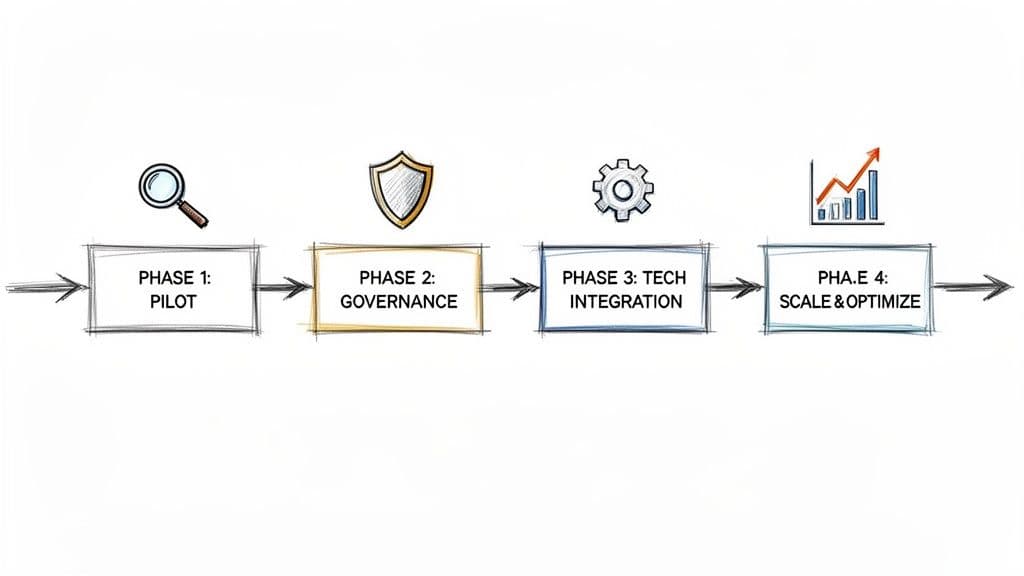
Think of it like building a house. You pour a solid foundation before you even think about putting up the walls. Each phase here builds on the last, ensuring your long-term efforts are stable and successful.
Phase 1: The Pilot Program
First things first: prove the concept. You need to run a small, controlled experiment to see how this works in your world. A pilot program lets you test your workflows, get some initial data, and build buy-in from stakeholders—all without overhauling your entire content operation.
Pick a low-risk, high-volume content type where you already have plenty of structured data. Good candidates include:
- FAQ Pages: Generating comprehensive answers to common customer questions.
- Product Descriptions: Creating consistent, on-brand descriptions for a single product category.
- Glossary Entries: Defining key industry terms to build out your topical authority.
The main goal here isn’t massive output; it’s learning. Document everything. Track how well your prompts perform, how long the editorial review takes, and what the initial results look like. These notes become your first real benchmarks.
Phase 2: The Governance Model
Once you've proven the potential with a successful pilot, it’s time to build the guardrails. This is where you formalize your quality standards and set up that critical Human-in-the-Loop (HITL) framework we covered earlier. Don't skip this. Scaling without clear governance is a surefire way to publish a flood of low-quality, off-brand, or just plain wrong content that can tank your reputation.
Your governance model is the single most important factor separating a successful automation strategy from a failed one. It ensures that speed and scale never come at the expense of quality and trust.
In this phase, you’ll define and document exactly what "good" looks like. Assign clear ownership for who reviews, edits, and fact-checks the content. Then, codify your brand voice guidelines so they can be built directly into your prompts. This framework is the official rulebook for everything that follows.
Phase 3: Technology Integration
Now you're ready to choose your tools and plug them into your existing systems. The key is to select a tech stack that actually matches your goals. You might need a powerful NLG engine for data-driven reports or a specialized platform like Attensira to monitor your AI Search Visibility.
The goal isn't just to find the most powerful tool, but the one that fits. Look for solutions that integrate smoothly with your CMS, project management software, and other core systems. The less friction for your team, the better.
Phase 4: Scale and Optimize
With a proven workflow, strong governance, and the right tech in place, you’re finally ready to open the throttle. Start expanding your automated content creation program into more strategic and valuable areas of the business.
This isn’t a "set it and forget it" process. It's a continuous loop of creation, measurement, and refinement. Dig into the performance data to see which content types are hitting the mark and double down on what works. Constantly A/B test your prompts, experiment with different templates, and refine your formats to maximize your SEO impact and keep your audience engaged.
Frequently Asked Questions
When you start digging into automated content creation, a few key questions always come up—usually around quality, SEO, and what this all means for content teams. Let's tackle the most common ones head-on so you can get a clearer picture of how this technology really works.
Can Automated Content Creation Hurt My SEO Rankings?
It absolutely can, but only if you do it badly. Google doesn’t care if content is written by a human or an AI; it only cares if the content is helpful, reliable, and high-quality. If you're just pumping out unedited, spammy AI drafts, you're going to see your rankings tank.
But when done right, it's a different story. Content produced with AI assistance—that is then carefully reviewed, edited, and fact-checked by a human expert—can be a massive boost for SEO. It lets you build out your topical authority and go after thousands of long-tail keywords at a scale that would be unthinkable for a purely manual team. It all comes down to having a solid governance framework in place.
What Is the Difference Between Automated Content and Programmatic SEO?
This is a common point of confusion. The two work hand-in-hand, but they are distinct concepts.
Programmatic SEO is the strategy. It’s about using data to systematically create a huge number of pages targeting very specific, long-tail search queries. Think of something like "best CRM for real estate agents in Florida."
Automated content creation is the technology that helps you execute that strategy. It’s the engine that produces the actual words for all those pages. You could technically run a programmatic SEO playbook with a team of human writers, but automation is what makes it truly scalable and efficient.
Think of it like this: Programmatic SEO is the architectural blueprint for building a thousand houses. Automated content creation is the set of power tools that lets you build them all quickly and to a consistent standard.
Will AI and Automation Replace Human Content Creators?
It’s far more likely to change the job, not eliminate it. The role of the content creator is evolving. Automation is fantastic at processing data, working at incredible speed, and handling repetitive tasks. Humans, on the other hand, are indispensable for strategy, creativity, critical thinking, and weaving a compelling story.
The future here is a partnership. Content professionals are already shifting away from writing every single word from scratch and moving toward higher-value strategic work. Their job is becoming more about:
- Directing AI tools with smart prompts and detailed creative briefs.
- Editing and fact-checking AI drafts to ensure accuracy and quality.
- Injecting brand voice, empathy, and unique human insights into the final product.
This collaboration allows your team to stop sweating the small stuff and focus their expertise where it has the biggest impact. Automation becomes a powerful assistant that amplifies their strategic value, not a replacement for their talent.
Ready to see how your brand stacks up in the new world of AI-powered search? Attensira provides the tools you need to monitor your AI Search Visibility, identify critical content gaps, and optimize your strategy for what's next. Learn more at attensira.com.