


Explore what is AI generated content and its impact on SEO. Learn how AI creates content and the best practices for using it to grow your brand's visibility.
At its most basic level, AI-generated content is anything—text, images, video, or even audio—that's created by a machine instead of a person. It’s what you get when you prompt an algorithm to write a blog post, design a logo, or compose a piece of music.
You can think of these AI systems as incredibly well-read digital assistants. They’ve been trained on a massive chunk of the internet, absorbing styles, facts, and patterns from human-created works to fulfill your requests.
Defining the New Digital Creator
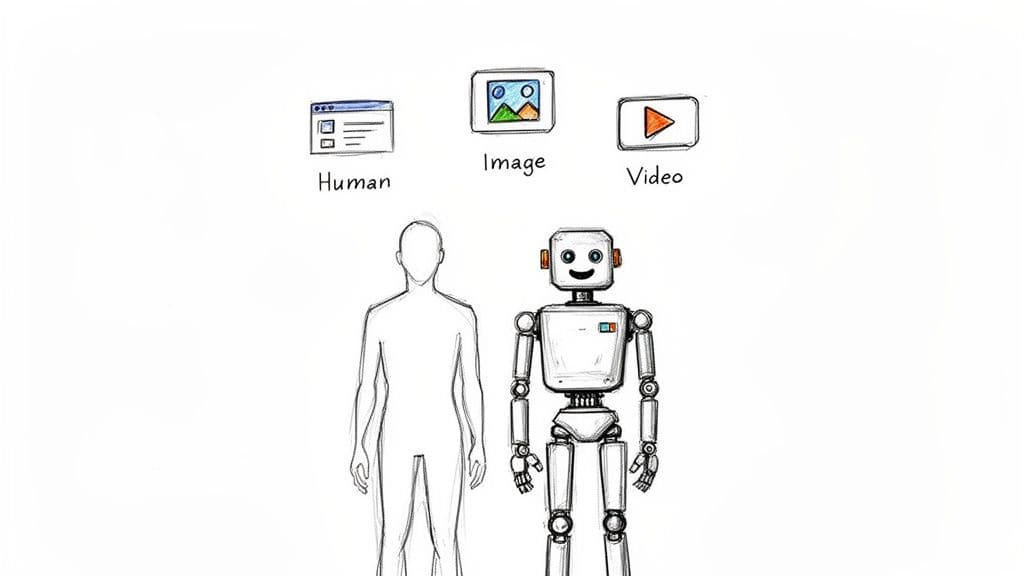
To really get a handle on what AI generated content is, you have to see it as a fundamental change in how things are made. Instead of a person painstakingly typing every word or drawing every line, a sophisticated algorithm does the initial creative work.
This isn't just a random output. It’s the result of powerful machine learning models—especially Large Language Models (LLMs) for text and generative models for visuals—that have been trained on vast datasets of human content. They learn the rules of language, the principles of design, and the structure of a good story. When you give them a prompt, they draw on that deep well of knowledge to build something new that fits your instructions.
The Foundation of AI Creativity
It’s a lot like training an apprentice. If you show a junior writer a thousand great blog posts, they’ll eventually pick up on what makes them work. AI models do the same thing, but at a speed and scale a human could never match. This capability is quickly becoming a key part of how modern businesses and marketing teams operate.
The real draw here is efficiency. Suddenly, companies can produce drafts for blog posts, social media updates, and ad campaigns in a fraction of the time. This frees up human teams to focus on high-level strategy and adding that final creative touch, rather than staring at a blank page. It’s forcing a total rethink of content workflows everywhere.
The real game-changer is not just automation but augmentation. AI acts as a creative partner, handling the initial draft or design and allowing human experts to provide the final polish, strategic insight, and authentic voice.
To get a clearer picture, let's break down the most common types of AI content and where they fit in a business setting. The table below gives a quick overview before we dive deeper into the technologies that power them.
Types of AI Generated Content and Their Business Applications
This table summarizes the main categories of AI-generated content and highlights some of their most popular applications in the business world.
As you can see, AI is no longer just a tool for text. It's a versatile creator capable of producing a wide range of media, each with its own set of practical uses.
How AI Actually "Learns" to Create Content
When we talk about artificial intelligence "learning," it's easy to picture a human brain at work. But that's not quite right. AI's ability to create content isn't about understanding or consciousness; it's about mind-bogglingly advanced pattern recognition.
Think of it less like a thoughtful author and more like a master statistician. It’s been fed a library bigger than any human could ever read and has learned to predict the most probable next word, pixel, or sound with stunning accuracy.
At its core is a process called machine learning. Instead of a developer hand-coding rules for grammar or art, they give a model billions of examples—articles, books, images, and videos scraped from the internet. The model sifts through this massive dataset on its own, identifying incredibly subtle patterns and connections we might never notice. It's this training that lets AI generate content that feels natural and makes sense in context.
The Engine Room: Large Language Models
For text-based AI, the star of the show is the Large Language Model (LLM). You know that autocomplete feature on your phone? An LLM is like that, but on a cosmic scale. Its fundamental job is to predict the next word in a sentence. After training on trillions of words, it gets incredibly good at handling grammar, style, tone, and even abstract ideas.
When you give an LLM a prompt like, "Draft a professional email about a project delay," it springs into action:
- Tokenization: First, it chops your prompt into manageable pieces called tokens (which can be whole words or parts of words).
- Pattern Matching: It then dives into its massive internal network, looking for patterns linked to phrases like "professional email," "project," and "delay."
- Probabilistic Generation: Finally, it starts building a response, one token at a time. Each new token is chosen because it's the most statistically likely one to follow the last, based on all the human writing it has analyzed.
This process is also why different AI models give you different results. Each has a unique architecture and was trained on a slightly different dataset, giving it a distinct personality. Comparing models is crucial, and you can see a detailed breakdown of how assistants like Claude and ChatGPT stack up at https://blog.attensira.com/claude-vs-chatgpt.
The magic of an LLM isn't that it understands your request. It's that it has analyzed so much human language that it can flawlessly mimic the structure and flow of what a human would likely write in response.
From Pixels to Soundwaves: Creating Visuals and Audio
When it comes to images, video, and audio, AI uses different kinds of generative models, but the core idea is similar. Two of the most common are Generative Adversarial Networks (GANs) and Diffusion Models.
A GAN works by pitting two neural networks against each other in a creative duel.
One network, the Generator, tries to create new images from scratch. The other, the Discriminator, acts as a judge, trying to spot whether an image is real (from the training data) or a fake made by the Generator. This constant competition pushes the Generator to produce images that are more and more realistic until it can regularly fool the Discriminator.
Diffusion models take a different route. They start by taking a real image and slowly adding digital "noise" until it's just static. The AI is then trained to reverse this process perfectly. Once it masters how to remove the noise and rebuild the original picture, it can start with pure noise and shape it into a brand-new image based on a text prompt. It's this elegant process that powers many of today's most popular AI image generators.
Ultimately, knowing how to leverage advanced data analysis and the principles of AI in predictive marketing analytics is fundamental to getting these models to produce truly effective, strategic content.
The Unstoppable Rise of AI in Content Creation
The idea of AI creating content isn't some far-off prediction anymore; it's what’s happening right now in businesses of every kind. What used to be a niche tech curiosity has quickly become a core part of how marketing, media, and e-commerce teams get their work done. We’re not just talking about automating a few tasks—this is a fundamental shift in how brands talk to their customers, get their message out at scale, and keep people engaged.
For any business leader, getting a handle on this trend is non-negotiable. The explosion of generative AI tools has created a stark dividing line. On one side are the companies adapting and pulling ahead, and on the other are those getting left behind. Putting AI to work is now simply a competitive must-have for staying efficient and relevant.
The New Competitive Edge
So, what's driving this massive shift? It boils down to the relentless pressure on businesses to churn out high-quality, personalized content on a scale that was impossible just a few years ago. Relying purely on manual creation, while crucial for strategy and a final human touch, often turns into a major bottleneck. It slows down campaigns and limits how far your message can actually go.
Generative AI tackles this problem head-on by turbocharging the early stages of content creation. It can spit out blog post drafts, dozens of ad copy variations, or unique images in minutes, not days. This frees up your human teams to do what they do best: focus on high-level strategy, polish the final product, and inject that nuanced brand voice that actually builds trust with an audience.
This infographic lays out the incredible growth, adoption rates, and productivity gains that are fueling the AI content market.
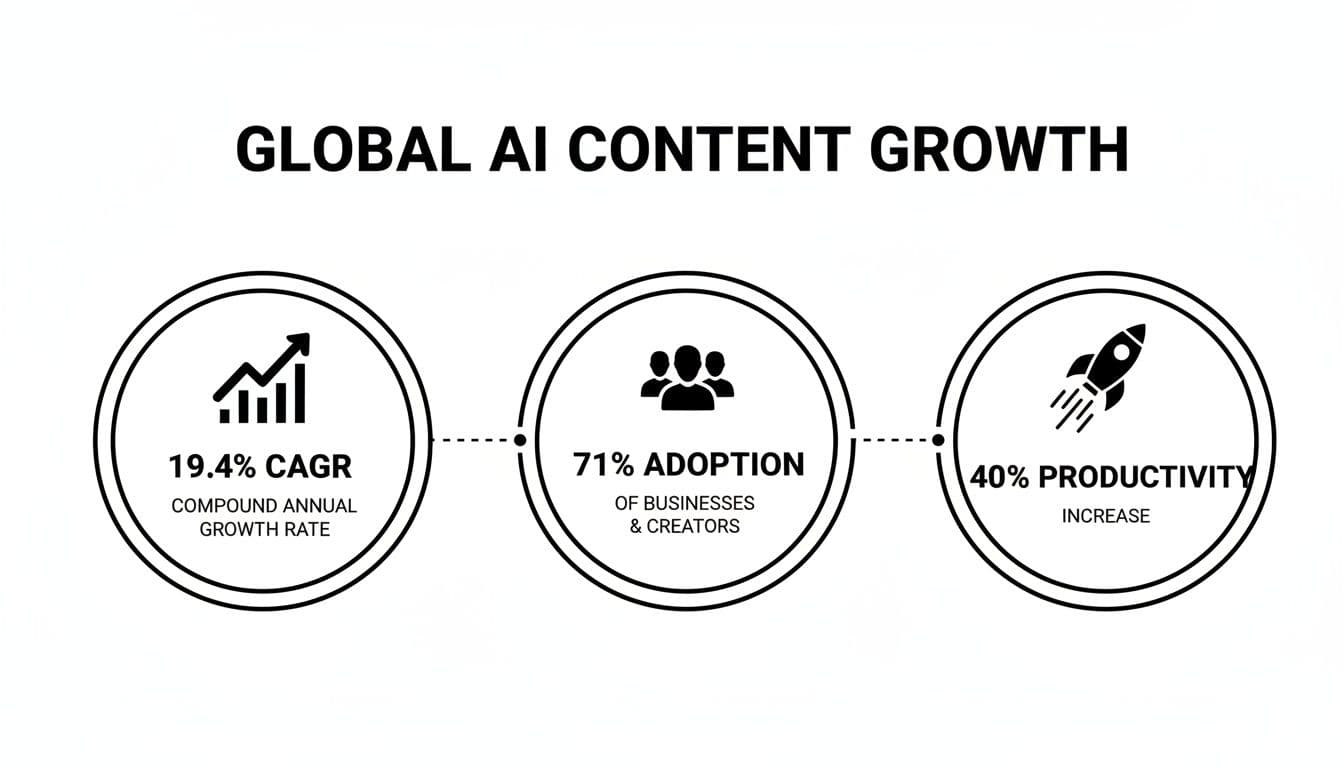
The data makes it crystal clear: AI isn't some passing fad. It's a dominant force, and its high adoption rates are directly translating into major productivity wins for companies everywhere.
A Market in Hyper-Growth
The numbers behind this movement are pretty staggering. They paint a vivid picture of a market that's not just growing, but exploding.
The market for AI-powered content creation was valued at 2.15 billion in 2024**. Projections show it rocketing to **10.59 billion by 2033, which is a compound annual growth rate of 19.4%. This insane growth is being fed by a massive surge in adoption. A whopping 71% of organizations now use generative AI in their content workflows—a huge jump from just 33% in 2023. And these aren't just vanity metrics; employees are reporting an average productivity boost of 40% when they use AI tools to help with their work.
This isn't just growth; it's a fundamental market transformation. Companies are moving past experimentation and are now building core business processes around AI-generated content to achieve measurable gains in speed and output.
Of course, this widespread integration brings its own set of challenges. As the web fills up with synthetic media, people are getting savvier and more skeptical. Questions about authenticity and trust are more important than ever. The rising demand for specialized AI Content Creation services shows that you need real expertise to navigate this new landscape effectively.
The real trick for brands today is finding that sweet spot between AI-driven efficiency and human-led authenticity. Success isn't just about buying the tools; it’s about mastering a new way of working that uses AI's power without losing the trust and unique perspective that only a human can bring.
How AI Content Is Reshaping SEO
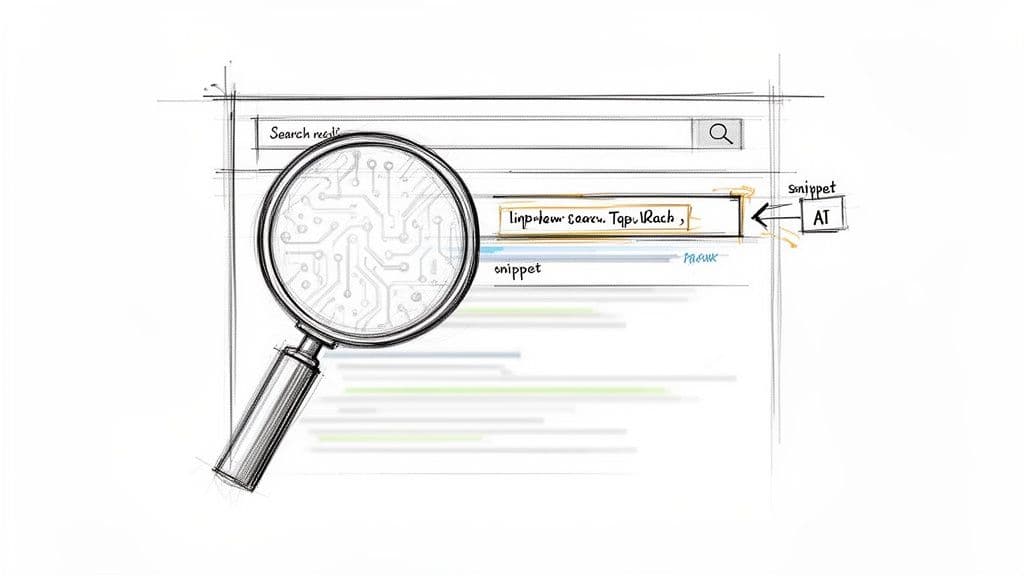
The bond between content and search engine optimization is undergoing its biggest shake-up in a decade, and artificial intelligence is the cause. Search engines have moved beyond being simple digital librarians, passively indexing information. Now, they are becoming active synthesizers.
Features like AI-powered summaries and generative overviews are rapidly becoming the first thing a user sees. This one change completely alters how people find brands and get answers, forcing businesses to rethink their entire SEO playbook. We now have to optimize for two audiences at once: our human readers and the AI algorithms that are the new gatekeepers to visibility.
The New Search Landscape
Search is no longer a static list of blue links. It’s becoming a conversation. Instead of sifting through multiple websites, users get direct, AI-compiled answers right on the results page. This isn't a distant future, either—by 2027, it's predicted that 40% of adults will use searches with generative AI summaries every single day.
The implications for brand visibility are massive. If your content isn’t picked up and featured in these AI-generated answers, you might as well be invisible to a huge and growing part of your audience. The goal is no longer just ranking on page one; it's about becoming a cited, trusted source within the AI's response itself.
The core challenge for modern SEO is ensuring your brand's expertise is recognized and featured by AI-driven search engines. This requires a strategic pivot from merely targeting keywords to building a comprehensive content ecosystem that AI models deem trustworthy and valuable.
This new reality demands a far more sophisticated strategy. Success now hinges on understanding how AI models process information and structuring your content to meet their specific needs. To learn more about the tactics involved, our complete guide on AI search optimization breaks down the exact steps you need to take.
Data-Driven Results of AI in SEO
Putting AI to work in an SEO strategy isn't just theory; it's already producing real-world business results. Companies are seeing major performance lifts by using AI to automate and sharpen their optimization workflows. The ability to analyze keyword opportunities, generate content outlines, and run technical audits at a scale that was previously unimaginable is creating a serious competitive edge.
The data backs this up. A recent report showed that 65% of businesses saw improved SEO performance after bringing AI tools into their marketing stack. Even more telling, companies using AI-assisted SEO strategies attract an average of 24% more organic traffic than those sticking to purely traditional methods. These gains come from AI’s ability to handle the heavy lifting, freeing up marketing teams to focus on big-picture strategy and creative work. You can explore more of these findings in this comprehensive report on AI marketing statistics.
This isn't just about working faster. It's about adapting to how people find information now. As more users turn to generative AI for quick answers, the brands that have optimized for this new medium will capture the lion's share of attention.
A Comparison of SEO Approaches
To truly grasp the impact, it’s helpful to compare how AI changes the day-to-day work of SEO. The traditional, manual process is often slow and requires a ton of resources. In contrast, an AI-assisted strategy brings speed, scale, and a level of data-driven precision that was impossible before.
This table highlights the key differences and advantages of integrating AI into a modern SEO strategy.
Comparing Traditional SEO vs AI-Assisted SEO
This comparison shows a clear evolution in the field. By taking over the repetitive and analytical chores, AI empowers SEO professionals to think and act more strategically. It allows them to concentrate on what really matters: building a strong brand narrative and demonstrating the deep E-E-A-T (Experience, Expertise, Authoritativeness, and Trustworthiness) that both users and search algorithms value most.
A Practical Framework for Using AI Content
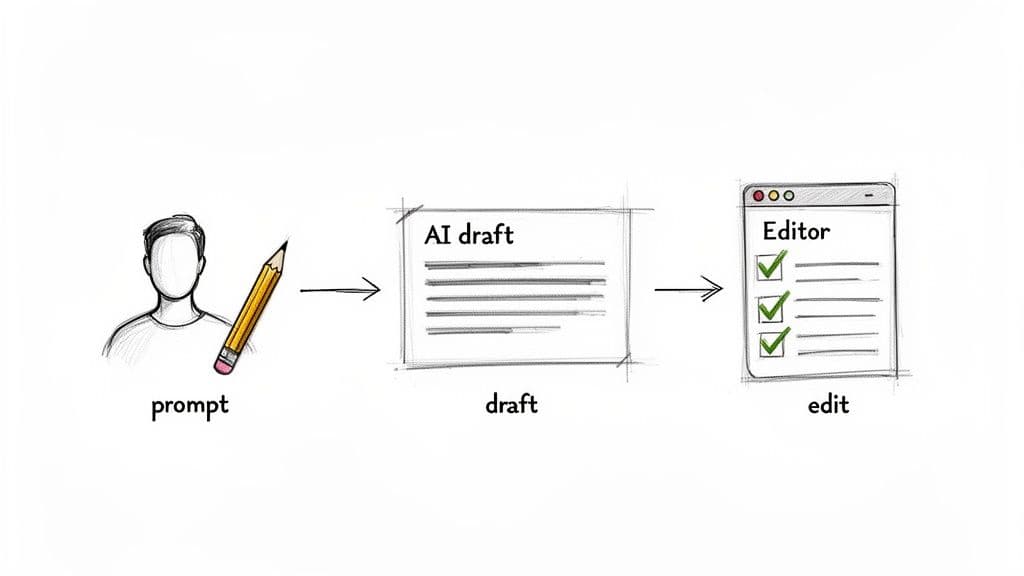
Knowing what AI content is and how it works is just the start. The real challenge—and the greatest opportunity—lies in building a smart, repeatable process to use it effectively without getting burned by its weaknesses.
Let’s be clear: just hitting "generate" and pasting the output is a terrible strategy. It’s a fast track to creating generic, often inaccurate content that can actively harm your brand’s credibility.
The key is to treat AI not as an author, but as a hyper-efficient assistant. This means putting a human-in-the-loop workflow at the center of your strategy. The AI does the heavy lifting, but your human experts provide the crucial oversight, creativity, and strategic thinking that actually resonates with people.
The Human-in-the-Loop Workflow Explained
At its heart, this is a partnership. A human expert guides the AI with specific instructions, the AI generates a first draft, and the human then steps in to refine, fact-check, and align the content with business goals.
Here’s what that looks like in practice:
- Strategic Prompting: This is where human expertise shines. Instead of a vague request, an expert crafts a detailed prompt outlining the target audience, tone of voice, key talking points, and—just as importantly—what to avoid.
- AI-Powered Generation: Armed with these instructions, the AI creates a structured draft. This could be anything from a blog post outline to a set of social media captions. Its job is to build a solid foundation, fast.
- Human Review and Refinement: This part is non-negotiable. A subject matter expert or a skilled editor scrutinizes the AI's output, checking for accuracy, tone, and whether it truly reflects the brand’s voice.
- Value-Add and Enhancement: Now, the human expert adds the magic. They weave in unique insights, personal stories, proprietary data, and nuanced arguments—all the things an AI can't invent because it lacks real-world experience.
- Final Polish and Publication: The content gets a final proofread before it goes live, ensuring it’s not just good, but professional and genuinely helpful.
Establishing Your AI Content Guardrails
To make this system work, you need to set clear rules for how your team uses AI. These guardrails ensure every piece of content is consistent and protects your brand’s reputation.
Start by defining your brand voice in a way an AI can understand. Don't just say "friendly"; provide concrete examples of phrasing, a glossary of approved terms, and a list of words to avoid. Lay out exactly how you want information structured.
The goal is to train your team to prompt the AI so effectively that its initial output is already 80% aligned with your brand's unique style. This minimizes the time spent on basic edits and allows your experts to focus on adding high-level value.
You also need an ironclad fact-checking process. AI models are notorious for "hallucinating"—presenting false information as fact with unnerving confidence. Your workflow must include a mandatory step where every claim, statistic, and data point is checked against reliable, primary sources.
Prioritizing E-E-A-T in Every Piece
In an era of AI-generated text, Google's E-E-A-T guidelines (Experience, Expertise, Authoritativeness, and Trustworthiness) are more critical than ever. This is how you separate your content from the noise.
Here are a few ways to bake E-E-A-T into your workflow:
- Incorporate First-Hand Experience: Direct your human editors to inject personal anecdotes, case studies, or practical examples that prove you’ve actually done what you’re talking about. An AI can summarize a topic; it can't share a lesson learned on the job.
- Cite Authoritative Sources: Back up your claims by linking out to credible, primary sources. This builds trust with readers and signals authority to search algorithms. To learn more about how these models process information, you can read our breakdown of how ChatGPT indexes content.
- Showcase Human Expertise: Make sure every piece of content is reviewed by a qualified expert. Adding detailed author bios that list credentials and relevant experience is a simple but powerful way to build trust.
By embedding these practices into your process, you move beyond just "making content." You use AI's speed to produce work that is not only well-written but also deeply credible and strategically aligned with your brand.
Navigating the Future of AI-Driven Content
The pace at which AI-generated content is developing is writing a completely new playbook for digital communication. We’re fast approaching a point where hyper-personalized user experiences, once a luxury reserved for companies with huge resources, can be rolled out on a massive scale. AI is getting good enough to create content so finely tuned to an individual's needs that it feels like a personal conversation.
But this speed comes with its own set of problems. As synthetic media gets more and more convincing, the distinction between what a human created and what a machine generated is starting to evaporate. This brings up serious questions about authenticity and makes it easier than ever for misinformation to spread. For brand managers and SEO professionals, this means the ground is shifting under their feet; confirming the source and credibility of information is no longer straightforward.
Adapting to a Synthetically Generated World
The sheer amount of AI content being produced is fundamentally changing the internet. Some experts are even predicting that as much as 90% of online content could be synthetically generated by 2026. This isn't just a small shift; it's a tidal wave. You can read more about what's driving these numbers in The Living Library's in-depth analysis.
For any business trying to stay afloat, this reality calls for a two-part strategy:
- Offense: This means using AI tools to your advantage. You can scale up content creation, pinpoint new audience segments, and personalize marketing campaigns with a level of accuracy that was unimaginable just a few years ago.
- Defense: This is about protecting your brand. It involves setting up strict verification processes, doubling down on genuine human expertise, and building a brand so reliable that it becomes a signal in all the noise.
The New Mandate for Brand Authority
In this new environment, your brand's authority is everything. AI is great at generating text and images, but it can’t fake lived experience, deep-seated expertise, or the hard-won trust that comes from delivering real value time and time again. Those human elements are becoming the most powerful differentiators.
The future of content isn't a battle of human versus machine. It is a competition for trust. The brands that will win are those that masterfully blend AI's efficiency with unwavering human authenticity and verifiable expertise.
Ultimately, navigating this future isn't about fighting the change—it's about steering it. It requires a solid commitment to ethical practices, a sharp focus on adding unique human value, and a clear vision for how to protect your credibility.
Tools like Attensira were built for this new landscape. They help you keep an eye on how your brand is being represented in AI-generated search results and make sure your message is coming through loud and clear. By staying informed and being willing to adapt, you can secure your brand’s place not just as another content producer, but as a trusted authority in the age of AI. The key is to start now.
Your AI Content Questions, Answered
As you start working with AI, you're bound to have some questions. It's a new frontier for many, and it’s smart to be curious about the rules of the road. Let's tackle a couple of the most common ones we hear.
Does Google Penalize AI-Generated Content?
This is the big one, and the short answer is no. Google doesn’t automatically penalize content just because AI had a hand in creating it. What they care about is quality.
Their whole system is built around rewarding content that delivers on E-E-A-T (Expertise, Experience, Authoritativeness, and Trustworthiness). Whether a human, an AI, or a human-AI team produced the content is irrelevant if it genuinely helps the reader.
The real red flag for Google isn't AI—it's content created only to rank in search results instead of helping people. That's what trips their spam policies.
So, the goal remains the same as it's always been: create valuable, original, people-first content. The tool you use to get there doesn't matter as much as the final result.
Is AI Content Considered Plagiarism?
Not in the classic sense. Plagiarism is lifting text directly from a specific source and passing it off as your own. AI models don't do that; they generate entirely new sentences based on the patterns they learned from massive datasets.
But that doesn't mean you're completely in the clear. The risk shifts from direct copying to creating something that feels generic or accidentally mirrors existing information too closely. This is where human oversight becomes non-negotiable.
A solid workflow should always include:
- Fact-checking: AI can and does make things up. Every claim, number, and statistic needs to be double-checked against a reliable source.
- Editing for originality: This is your chance to inject your unique perspective, brand voice, and real-world experience into the draft.
- Adding unique value: Make sure the finished piece offers an angle or an insight your audience can't get anywhere else.
Without a human guiding the process, you just end up with bland, forgettable content that doesn't perform.
Keeping your brand visible in this new AI-driven search world is a major challenge. Attensira gives you the tools to track how your content shows up in AI answers, providing the insights you need to refine your strategy and make sure your voice is heard. See how it works and take control of your AI visibility at https://attensira.com.


