



Discover how B2B content syndication services can scale your reach, generate qualified leads, and boost marketing ROI. Learn expert strategies today.
You've poured resources into creating a fantastic piece of content, but what happens after you hit "publish"? Letting it sit on your blog is like writing a masterpiece and then tucking it away in a drawer. This is where content syndication services come in—they're the key to getting your best work in front of the people who actually need to see it.
Essentially, these services act as your content's distribution partner, placing it on established third-party websites, newsletters, and resource hubs where your ideal customers are already spending their time.
How Content Syndication Puts Your Message on a Bigger Stage
Let's use an analogy. Imagine your latest in-depth whitepaper is a keynote speech at a conference. If you only deliver it on your own stage (your website), you're limited to the audience you can personally attract.
A content syndication service is like being invited to speak on the main stage at dozens of major industry events. You're tapping into massive, pre-built audiences who are already there and eager to learn about your area of expertise.
This isn't just about reposting your blog articles. It's a strategic play for lead generation and brand building. By working with a network of publishers, these services get your valuable assets in front of professionals who are actively researching the very problems you solve. To get the full picture, it helps to understand the broader context of powerful content distribution strategies, as syndication is a critical component of that bigger puzzle.

What Do These Services Actually Do?
At its core, syndication is about getting tangible business results without having to build a new audience from the ground up for every campaign. It’s a shortcut past the slow, arduous process of organic audience growth.
A good service focuses on a few key functions that drive real-world outcomes.
To make this clearer, let's break down the essential components of a comprehensive B2B content syndication service and the direct impact each one has on your business goals.
Core Functions of a B2B Content Syndication Service
By managing these components, a syndication partner doesn't just amplify your content—they turn it into a reliable engine for growth.
The real power of content syndication is that it shifts your focus from just creating great content to strategically placing it where it can generate the most significant business impact. It’s about turning your expertise into a consistent and scalable source of qualified leads.
Let's get past the basic definitions. The real power of content syndication is what it does for your bottom line. If you’re a CMO or Head of Growth, you know it’s not enough to just get more eyeballs on your content—you need to systematically fuel the revenue engine.
This is where syndication shines. It directly solves one of the biggest hurdles B2B companies face: getting your best, most valuable assets in front of buyers who are actually in the market to buy, and doing it at scale.
When you place your best whitepapers, webinars, and research on trusted third-party sites, you’re not just hoping for the best. You're building a reliable pipeline of marketing-qualified leads (MQLs). These aren't random visitors; they are professionals actively looking for solutions, showing clear intent by downloading and engaging with your material.
Fueling the Lead Generation Pipeline
At its core, most content syndication services are designed to fill the top of your sales funnel with high-quality prospects. This isn't a spray-and-pray awareness play; it's a precision instrument. It takes your gated content and delivers it straight to professionals who fit your ideal customer profile—right down to their job title, industry, and company size.
This targeted approach is why MQL-to-SQL conversion rates are often so much higher. The global content syndication market has already ballooned to USD 1.82 billion, which tells you just how effective it is. In the B2B world, the numbers speak for themselves: 58% of companies report inquiry-to-MQL conversion rates over 15% for leads coming from syndication. Discover more insights about the B2B content syndication market. This kind of data is exactly why leaders are pouring more budget into this strategy for predictable growth.
Syndication transforms your content from a passive asset into an active lead generation machine. It’s the difference between waiting for buyers to find you and strategically placing your expertise directly in their path.
Enhancing Brand Authority and SEO
Beyond the immediate leads, syndication is a long-term play that builds brand equity and boosts your search engine ranking. When your content shows up on respected industry publications, your brand is instantly elevated. You’re no longer just another voice in the crowd; you're a definitive thought leader. That association builds trust with potential customers long before they ever land on your website.
On the SEO front, good syndication partners know how to protect your original content. They use canonical tags (rel="canonical"), which are basically little signposts that tell Google your website is the original source. This is critical because it prevents duplicate content penalties and makes sure all that SEO juice flows back to your domain. B2B growth often requires deep market intelligence, which is where specialized tools for B2B market and lead generation come in to complement these marketing efforts.
The process creates a powerful web of backlinks from high-authority sites, signaling to search engines that your content is credible and important. Over time, this strengthens your domain authority and improves organic rankings, delivering a clear, sustainable return on your investment.
Choosing Your Syndication Strategy
Deciding on the right content syndication approach isn't a simple choice; it really depends on what you're trying to accomplish, how much you can spend, and the team you have to work with. The path you take directly shapes the speed and scale of your results. It's a bit like choosing how to travel—sometimes you need the speed of a plane, other times the scenic route of a road trip is better.
Generally, your strategy will fall into one of three buckets: paid, organic, or owned syndication. Each one serves a different purpose, and the best choice for you boils down to a fundamental question: are you chasing immediate leads, or are you playing the long game to build brand authority?
This decision tree illustrates how to pick the right path based on your primary goal.
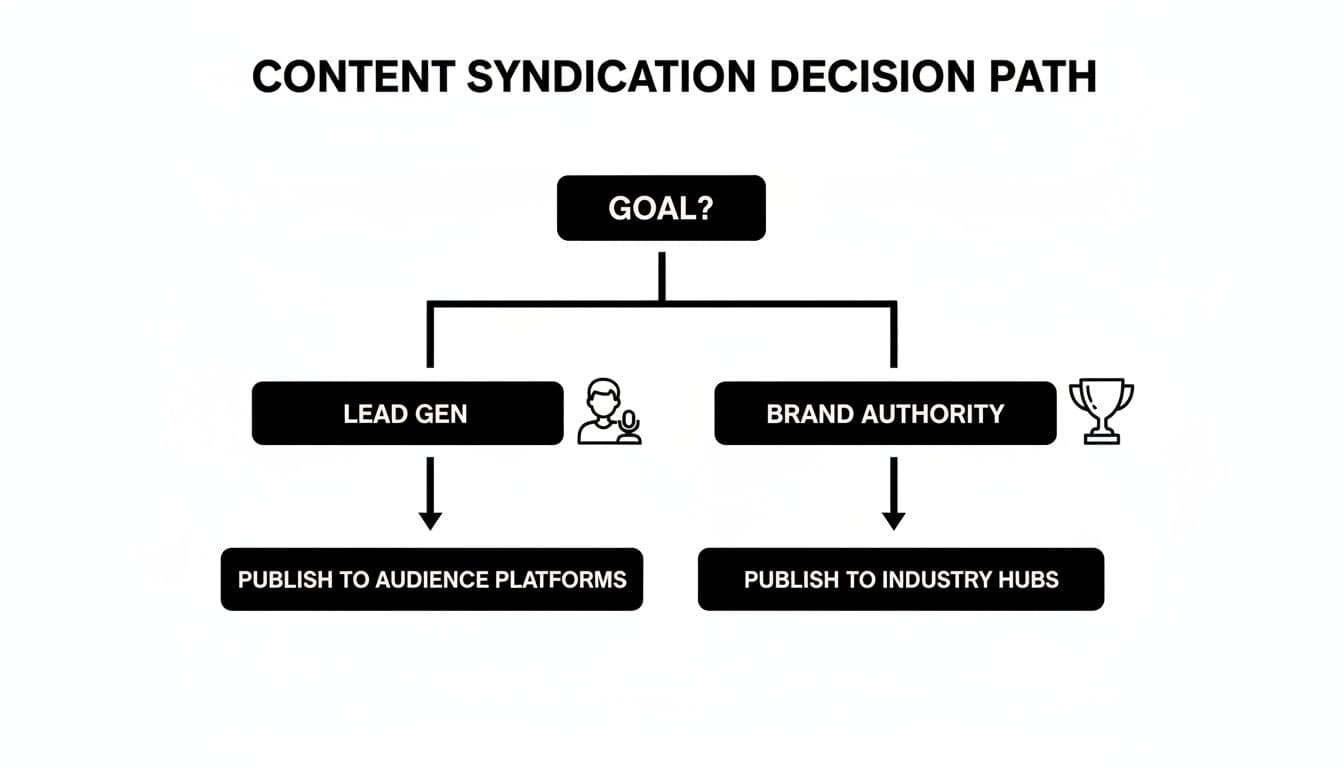
As you can see, there's a clear split. If you need to fill your pipeline with leads now, paid channels offer the most direct route. But if your focus is on becoming the go-to name in your industry, organic and owned efforts are where you'll build that lasting credibility.
Paid Syndication Channels
Think of paid syndication as the express lane to your target audience. When you work with content syndication services, you're paying for guaranteed placement on well-known publisher networks. This model is all about speed and precision, letting you zero in on specific job titles, industries, and company sizes.
This is an incredibly effective way to generate MQLs because you're putting valuable, gated content directly in front of a pre-qualified audience. Yes, it costs money, but when your main goal is hitting lead volume targets, the ROI is usually a no-brainer.
Organic and Owned Syndication
Organic syndication is built on relationships and earned trust. This is where you see guest posting on respected industry blogs or setting up content-sharing partnerships with non-competing businesses. It's a slower burn, for sure, but the reward comes in the form of high-authority backlinks and a serious boost to your brand's credibility. It's less about a flood of immediate leads and more about cementing your status as a thought leader.
Owned syndication is a bit different. Here, you're republishing your own content on platforms where you have a profile, like LinkedIn or Medium. The big win is tapping into their huge, built-in audiences to get more eyeballs on your work without spending a dime on media.
Both of these methods are essential for building a brand that lasts. They are cornerstones of a solid marketing plan. You can see how they fit into the bigger picture by exploring how to develop a content marketing strategy that pulls all these channels together.
To help you weigh your options, this table breaks down the key differences between the three models.
Comparing Paid vs Organic vs Owned Syndication
Ultimately, the smartest B2B marketers don't just stick to one lane. They create a powerful mix of paid, organic, and owned strategies. This balanced approach is what drives both immediate pipeline growth and the sustainable, long-term authority that defines market leaders.
High-Impact Content Formats for Syndication
Your success with content syndication services hinges on what you’re actually syndicating. It’s a simple truth: some content formats are just built better for distribution on other platforms, especially when your goal is to generate real leads.
You have to think about distribution from the get-go. Imagine your content is bait on a hook. A simple blog post might get a few curious nibbles, but a deep-dive research report? That's the high-value lure that makes a prospect willing to hand over their contact details. It's a fair trade of value.

Prioritizing High-Value Gated Assets
When direct lead generation is the name of the game, nothing performs quite like in-depth, gated content. These assets offer so much value that they justify the "cost" of a prospect's email address. They are the true workhorses of any B2B syndication strategy.
- Whitepapers and eBooks: Perfect for digging into complex industry challenges and subtly positioning your company as the solution. They build serious authority and are magnets for high-intent leads.
- Original Research Reports: Nothing screams "expert" like unique data. These reports are incredibly powerful because they offer insights no one else has, making them prime for sharing and establishing your brand as a go-to thought leader.
- Webinars and On-Demand Videos: A live webinar gives you a direct, interactive channel to your audience. Once recorded and syndicated, that same webinar becomes an evergreen lead-gen machine that works for you around the clock.
The best syndicated content solves a specific, urgent problem for a niche audience. It's more than just information; it’s a professional toolkit that someone is happy to trade their contact information for.
The Undeniable Power of Video
Video isn't just another format; it's become the main event. It grabs attention in a way text can't and makes complicated ideas easy to understand. Considering video is projected to make up 82% of all internet traffic, ignoring it is no longer an option.
The engagement numbers speak for themselves. On LinkedIn, for example, videos are a staggering 20 times more likely to be shared than simple text posts. Short-form video is especially hot, with 21% of marketers saying it delivers their best ROI. For B2B companies, this means putting video first—from quick tutorials to detailed expert interviews—is essential for getting the most out of syndication. You can dive deeper into the latest trends in content syndication to see just how dominant it has become.
Picking the right format is the difference between your content being seen and your content getting results. By focusing on these high-impact assets, you can transform your syndication program from a hopeful experiment into a reliable engine for growth.
How AI Is Transforming Content Syndication
Content syndication is in the middle of a major upgrade, and it's all thanks to artificial intelligence. For years, the old-school approach felt like a guessing game. You'd make some educated guesses about where your audience might be, push your content out, and hope for the best. AI is changing all of that, turning simple distribution into an intelligent, predictive system that cuts out the guesswork and drives real impact.
AI-powered platforms can chew through enormous amounts of data to pinpoint the ideal audience and the perfect publication for every single piece of content you create. This is a game-changer for campaign performance. It ensures your message lands in front of the professionals who are most likely to care, listen, and act. We're talking about a level of detail that goes far beyond just matching a topic; it's about aligning your content with the specific, nuanced interests of a publication's readership.

Predictive Targeting and Personalization
One of the biggest ways AI is shaking up content syndication services is through personalization at a massive scale. Think about it: what if an AI could automatically tweak the introduction of your latest whitepaper to speak directly to ten different industry verticals or job titles? A few years ago, that kind of hyper-customization would have been a logistical nightmare. Today, it’s quickly becoming the new standard.
By predicting which audiences will respond best, AI helps you put your budget where it will have the most effect. It makes workflows smoother, sharpens targeting, and automates distribution in ways we couldn't have managed manually. For example, a HubSpot case study found that an AI-driven syndication campaign helped one B2B company boost its qualified lead generation by 40% simply by refining its targeting. With the content marketing market expected to hit $2 trillion globally by 2032, AI's role is only going to grow. You can learn more about how AI is changing syndication trends on Syndiq.io.
This isn't just a trend; it's a fundamental shift toward more efficient, scalable, and data-driven syndication that delivers a superior return on investment. AI turns syndication from a broadcast into a precision-guided conversation.
Streamlining Campaign Optimization
AI’s job isn’t done once the content is placed. It's also critical for optimizing the campaign as it runs. These systems analyze performance data in real time—tracking click-through rates, engagement times, and conversions—and can make automatic adjustments on the fly. If one channel isn't pulling its weight, the AI can shift the budget to platforms that are performing better, all without a human needing to step in.
This constant feedback loop makes sure your investment is always working as hard as it possibly can. For tech founders and B2B leaders, this means you’re no longer waiting for quarterly reviews to make changes; you're refining your campaigns in real time. That kind of agility is a massive competitive advantage. For a closer look at this process, check out our guide on AI content optimization. Ultimately, using AI-driven services helps companies scale their personalized outreach while keeping the sharp targeting needed to hit strong conversion goals.
Maximizing Your Syndication Campaign ROI
Throwing content out there and hoping for the best isn't a strategy. To get a real return on your syndication investment, you need a solid game plan, and it all starts with defining what success actually looks like for you.
Are you playing the numbers game, trying to generate a high volume of top-of-funnel leads? Or is the goal more about planting your flag as the go-to expert in a specific niche? Your answer changes everything about how you approach the campaign.
Once your goals are set, it's time to choose your partners wisely. Don't get star-struck by huge audience numbers. Instead, dig into their demographics and engagement metrics to see if their audience is your audience. A smaller, laser-focused group of readers is always better than a massive, indifferent crowd.
Protecting Your SEO Foundation
Here’s something that can trip up even experienced marketers: duplicate content. When you republish your work across the web without the right precautions, you risk confusing search engines and tanking your own SEO rankings.
Luckily, there's a straightforward fix, and it's non-negotiable.
The rel="canonical" tag is your best friend in content syndication. By making sure your partners add this tag to their version of your article—pointing back to your original post—you're sending a clear signal to Google: "This is the original. All authority and link equity belong here."
This simple line of code prevents SEO penalties and ensures all the backlinks and social buzz from the syndicated piece actually benefit your website.
Tracking the Metrics That Matter
Impressions and clicks are fine, but they don't pay the bills. The true test of your content syndication services is how effectively they feed your sales pipeline. To get a clear picture of your ROI, you need to focus on the numbers that really count.
Here are the key metrics to obsess over:
- Cost Per Qualified Lead (CPQL): How much are you spending to get a lead that your sales team will actually talk to?
- Lead-to-Opportunity Conversion Rate: What percentage of those leads are turning into legitimate sales opportunities?
- Pipeline Contribution: How much potential revenue can you trace directly back to your syndication efforts?
Keeping a close eye on these KPIs allows you to double down on what's working, cut what isn't, and clearly demonstrate the value your campaigns are bringing to the business. To go a level deeper, it’s worth learning more about the core content performance metrics that truly move the needle.
Common Questions About Content Syndication
Even with a solid plan, getting started with content syndication often brings up a few key questions. It's completely normal to have concerns, especially around things like SEO and proving the investment was worth it. Let's tackle these head-on so you can move forward confidently.
"Will This Hurt My SEO?"
This is easily the most common question I hear. It’s a smart one, too, since everyone knows search engines aren't fans of duplicate content. The good news is that this is a long-solved issue.
Any professional content syndication service worth its salt uses a canonical tag (rel="canonical") on every piece of republished content. Think of this tag as a little signpost that points back to your website, telling Google and other search engines, "Hey, the original, definitive version lives over here!" This simple piece of code ensures all the SEO juice—the authority and link equity—flows directly back to your domain. No penalties, just benefits.
"How Do I Actually Measure the ROI?"
Another big one is figuring out the real return on investment. If you're just looking at vanity metrics like impressions or clicks, you're missing the point. For a B2B business, the only thing that truly matters is how syndication feeds your sales pipeline.
To get a clear picture, you need to track the metrics that connect marketing effort to business results.
- Cost Per Lead (CPL): This is your baseline. How much did it cost to get that new name into your system?
- Lead-to-MQL Conversion Rate: This one is crucial for gauging lead quality. What percentage of the leads you generated were good enough to pass along to the sales team?
- Pipeline Contribution: This is the ultimate proof. How much potential revenue in your sales pipeline can you directly attribute to this syndication campaign?
By connecting your campaign data to your CRM, you can draw a straight line from your syndication spend to the sales opportunities it created. That's how you prove its impact.
"Isn't This Just a Fancy Term for Guest Posting?"
It's easy to see why people get these two mixed up. Both involve getting your content on other websites, but their goals and mechanics are completely different.
Guest posting is a very manual, one-to-one activity. You write a brand new, original article specifically for one publication. The main goal is usually to build your brand's authority and hopefully score a valuable backlink.
Content syndication, on the other hand, is all about scale. You take one piece of proven content and distribute it across a whole network of sites at once. The primary objective here is massive reach and generating leads in a predictable, repeatable way.
Think of it this way: guest posting is like a carefully aimed rifle shot, while syndication is like casting a wide, yet targeted, net.
Ready to see how your brand stacks up in the world of AI search? Attensira provides the critical insights you need to optimize your content and dominate your niche. Start tracking your AI visibility today.


