
Discover how ai seo software boosts brand visibility with data-driven insights, practical features, and measurable business impact.
So, what exactly is AI SEO software? Think of it as the next generation of search engine optimization tools. These platforms use artificial intelligence to do more than just track keywords; they automate complex tasks, predict market trends, and help you fine-tune your entire marketing strategy.
Instead of just telling you where you rank, this software analyzes huge amounts of data to find hidden content opportunities and, crucially, monitors how visible your brand is inside AI-generated search answers.
The Shift to AI-Powered Search and SEO
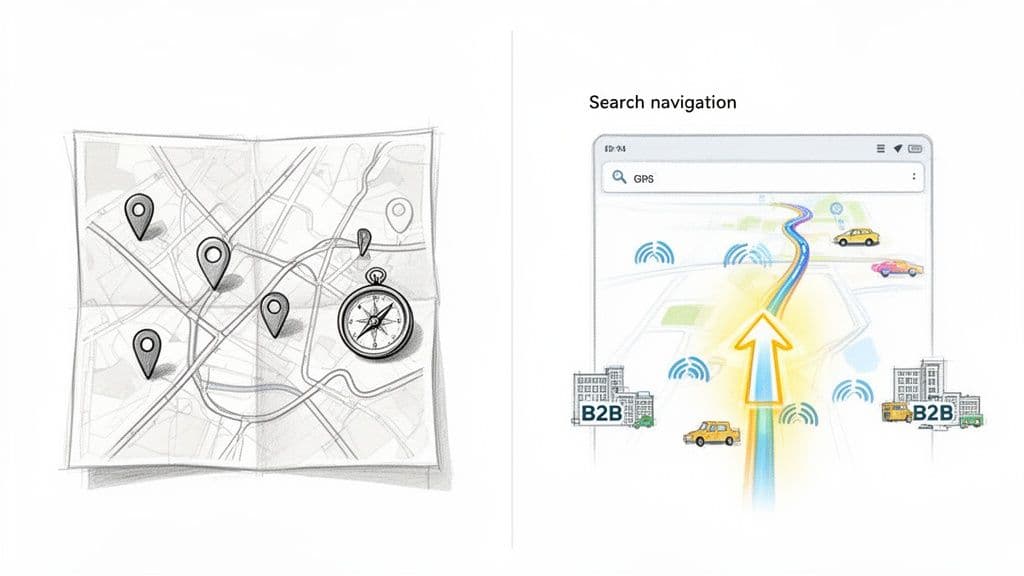
The rapid move toward AI SEO software marks a major change in how businesses think about their online presence. For years, traditional SEO felt like trying to navigate a new city with a paper map. You had your landmarks—keywords and backlinks—and you plotted a course based on what you knew. It worked, but it was slow and reactive.
In contrast, AI SEO software is your GPS. It doesn't just show you the main roads. It constantly analyzes live traffic, predicts potential gridlock (think algorithm updates or a competitor’s big move), and finds smarter, faster routes to get you where you need to go. That predictive power is the real game-changer.
To really grasp this evolution, let's compare the old and new ways of working. The following table breaks down the fundamental differences between the traditional, manual approach and the automated, predictive strategies that AI enables.
Traditional SEO vs AI-Powered SEO
This table really highlights the core change: we're moving from looking in the rearview mirror to seeing what's coming up on the road ahead.
From Reaction to Prediction
At its heart, this entire shift is about moving from a reactive to a predictive mindset. B2B companies can no longer afford to wait for traffic to drop before they fix something. You need a system that sees market changes coming and flags opportunities before everyone else does. This is especially true now that search engines are delivering direct AI answers, making those classic blue-link rankings less and less important.
The market’s explosive growth tells the story. The global AI-powered SEO software market is projected to jump from USD 3.98 billion in 2025 to an incredible USD 32.6 billion by 2035, riding a compound annual growth rate of 23.4%. The demand is clearly there.
A New Definition of Visibility
Online visibility isn't just about landing in the top 10 search results anymore. In a world of AI-generated responses and conversational queries, winning means your brand gets cited, recommended, and featured directly in the answers people see. The goal is to become an authority source that AI models actually trust.
The ultimate goal has shifted from simply ranking for a keyword to becoming the answer itself. AI SEO software provides the business intelligence needed to understand where your brand is—and isn't—appearing in these crucial new formats.
This new reality requires a completely different way of measuring success. Tracking how often your brand appears in AI answers is the new baseline. You can learn more about how to do this with AI search monitoring to get a handle on this new type of visibility.
Ultimately, this software isn't just another tool in the marketing stack; it's a critical business intelligence platform. For B2B brands, it provides the data-driven foresight to not just keep up, but to lead in an environment where AI is the new gatekeeper. Making this transition isn't just a good idea—it's essential for staying relevant.
How AI Is Fundamentally Changing Brand Visibility
Let's face it: the digital storefront for your brand is no longer a simple list of ten blue links on a search results page. AI-powered search is completely rewriting the rules for what it means to be "visible" online. The goalposts have moved—it's no longer about just ranking high, but about becoming the direct source for an AI-generated answer.
This isn't just a minor tweak to the algorithm; it's a deep, structural shift in how people find information. Instead of sifting through websites, users are getting instant, summarized answers from AI. If your content isn't the raw material for those answers, you’re on a fast track to becoming invisible to a huge chunk of your audience.
The New Search Landscape: AI Overviews and Conversational AI
Think of traditional search like a library's card catalog. You look up a topic, and it points you to the right shelves (websites) where you have to go find the information yourself. It works, but you're doing all the legwork of opening each book and piecing things together.
AI Overviews and conversational search are a whole different ballgame. They’re like having a conversation with an expert librarian. You can ask a complicated question, and instead of just pointing you to the shelves, the librarian consults several key sources, synthesizes the best information, and gives you a direct, well-rounded answer, often citing the most helpful books. That's what’s happening in search right now.
Your new mission is to become one of those "most helpful sources." Visibility isn't about being on the shelf anymore; it's about being the authority the librarian trusts and quotes directly.
This shift raises the stakes enormously. If you aren't cited in that AI-generated summary, the user might never even scroll down to the traditional results where your website is listed. They got their answer and moved on. This is precisely the challenge that modern AI SEO software is designed to tackle.
From Keywords to Intent-Driven Conversations
What’s driving this change? We're moving away from simple keyword searches and toward complex, conversational questions. People aren't just typing "best project management software" anymore. They're asking things like, "What's the best project management software for a remote team of 20 that needs to integrate with Slack and has strong reporting features?"
AI is perfectly suited to understand the nuances and intent behind a detailed question like that. To show up, your content has to evolve. It must:
- Provide Direct Answers: Your content needs to tackle the specific, long-tail questions your audience is really asking, clearly and concisely.
- Demonstrate Authority: It has to be comprehensive, well-structured, and written in a way that an AI can easily parse and trust for accuracy.
- Cover Semantic Topics: Forget obsessing over a single keyword. You need to build out content clusters that explore a topic from every possible angle, proving your expertise.
This new conversational dynamic forces a pivot in content strategy. The focus has to shift from targeting keywords to answering questions. The brand with the clearest, most authoritative answers wins the feature.
Why Old SEO Metrics Are No Longer Enough
Clinging to traditional metrics like keyword rankings can give you a false, and frankly dangerous, sense of security. Sure, you might rank number three for a major keyword. But if an AI Overview sits above that ranking, answering the user's question by pulling information from your competitors, your #3 spot generates zero traffic and zero visibility. It’s a vanity metric.
Adapting to this new ecosystem is a matter of survival. You need a way to measure what actually matters now: your brand’s presence inside AI-generated responses. This is where AI SEO software becomes non-negotiable. It gives you the intelligence to see where you're being mentioned, where your competitors are showing up instead, and what content gaps you need to fill before your brand fades into the background of this new AI-driven world.
2. Evaluating the Core Features of AI SEO Software
Picking the right AI SEO software is a bit like outfitting a workshop for a high-stakes project. You need specialized tools for specific jobs—a screwdriver won't do the work of a wrench. The key is to match the software's capabilities to your actual strategic goals, not just get dazzled by a long list of features.
A smart way to approach this is to group features by the business outcomes they help you achieve. This framework helps you build a strategy where every tool has a purpose, moving you from drowning in data to making sharp, forward-thinking decisions. Let’s break down the must-have capabilities into four core, outcome-driven categories.
Visibility and Mention Tracking
First things first, you have to know where your brand stands in this new AI-driven search world. Visibility isn't just about your rank on a results page anymore. It’s about where you’re mentioned, cited, and recommended inside the AI-generated answers people see first.
Any effective software needs to deliver rock-solid tracking for:
- Brand Mentions: Keeping a running tally of how often your company, products, or key people are named in responses from major AI models.
- Competitor Benchmarking: Sizing up your competitors’ visibility to see who AI engines currently view as the authority in your field.
- Share of Mention: Calculating your brand’s percentage of total mentions for a specific topic, giving you a clear metric for market leadership.
This data becomes your new baseline. It answers the fundamental question: "Are we even in the conversation?" Without it, you're flying blind.
This diagram shows just how much the game has changed, with brand visibility now flowing directly from AI answers down to the traditional links we're used to.
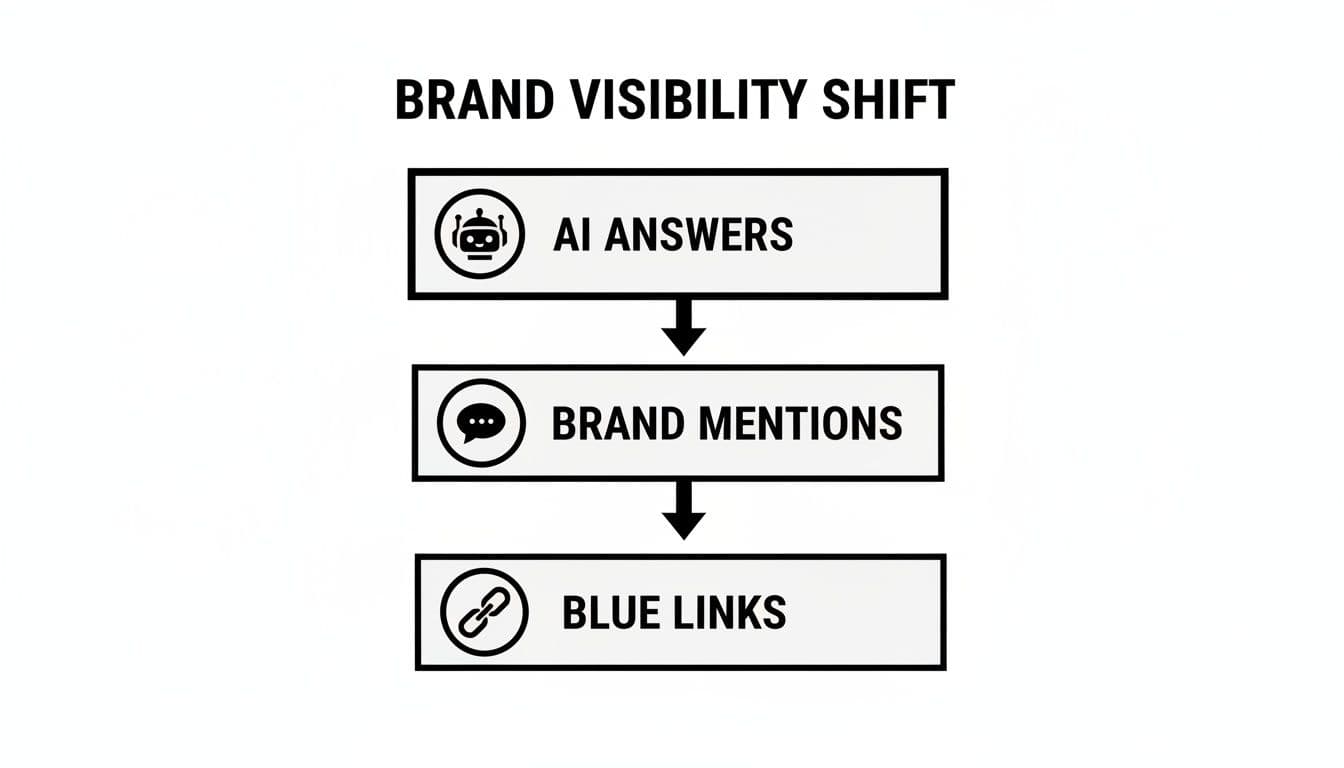
It’s crystal clear from this flow that getting mentioned in an AI answer is now the top prize. It shapes a user's perception before they even think about clicking a link.
Content Opportunity Analysis
Once you know where you are, the next logical question is why. This is where content opportunity analysis comes into play. The best AI SEO software goes far beyond basic keyword research to pinpoint the exact questions your audience is asking—the ones your content is completely missing.
Think of it as a strategic map that highlights unmet user needs. The software sifts through millions of queries and conversational prompts to find high-intent questions that don't have good answers yet. It identifies the gaps between what people desperately want to know and what you've actually published. This is absolutely critical for creating content that doesn't just rank but genuinely connects and builds authority.
An AI platform might show you that while your site is full of content on "cloud data security," your audience is actually asking, "What are the best practices for securing multi-cloud environments for fintech startups?" Answering that specific question is how you earn the mention.
This kind of targeted insight ensures your content efforts are focused on high-impact areas, letting you close the gaps your competitors are probably overlooking. It's about surgical precision, not a shotgun approach.
AI-Optimized Content Creation
Knowing what to write is half the battle. The other half is creating it in a way that AI models can easily digest and trust. This is where AI-optimized content creation tools become essential. As you look into the core features of AI SEO software, it's a good idea to check out some of the best AI content creation tools out there, since this capability is a huge piece of the modern SEO puzzle.
These features don't just write for you; they're more like a co-pilot, making sure your content is structured for success. You can get a much deeper look in our guide to https://attensira.com/blog/ai-content-optimization.
Key functions to look for include:
- Structuring for Readability: Automatically formatting articles with clear headings, short paragraphs, and lists that AI models love to use as sources.
- Semantic Keyword Integration: Suggesting related concepts and terms to build true topical authority, leaving simple keyword stuffing in the dust.
- Draft Generation: Creating solid first drafts based on the opportunity analysis, which your human experts can then polish with their unique insights and brand voice.
The adoption of AI in SEO is a tidal wave reshaping the competitive landscape. Surveys show 75% of marketers already use AI for everything from analytics to content creation. On top of that, 82% of enterprise SEO specialists are planning to increase their investment in AI tools, because they know it gives them a serious edge.
Predictive Performance Forecasting
Finally, the most sophisticated AI SEO platforms offer something that feels like a crystal ball: predictive performance forecasting. These tools use machine learning models to estimate the potential business impact of your SEO work before you invest the time and resources.
By analyzing historical data, market trends, and your competitors' positioning, these tools can model potential outcomes, such as:
- The likely increase in brand mentions from a new content series.
- The estimated traffic lift you'd get from closing a specific content gap.
- The projected number of leads from improving your visibility on a key topic.
This capability completely transforms SEO from a reactive marketing task into a strategic business driver. It gives you the power to build a data-backed business case for your plans, prioritize the projects with the highest expected ROI, and set performance targets that are actually realistic. It’s the ultimate tool for aligning your SEO strategy with the company's bottom line.
How to Implement Your AI-Powered SEO Strategy
Getting started with AI SEO software isn't about flipping a switch and hoping for the best. It’s a process of weaving a new layer of intelligence into your marketing operations. The idea is to move from theory to real-world results as quickly as possible, focusing on a few immediate wins to build momentum.
This whole process has to start with a clear, data-backed picture of where you stand right now. Without a solid baseline, you're just guessing—and you'll have no way to prove your new strategy is actually working.
Establish Your Visibility Baseline
Before you can map out where you’re going, you have to know exactly where you are. The first step is to run a thorough audit of your brand’s current visibility in these new AI-driven search environments. This goes way beyond a traditional keyword ranking report.
You need to answer a few critical questions about your brand's presence in this new arena:
- Where are we mentioned? Pinpoint which AI platforms are citing your brand and, just as importantly, in what context.
- Who is getting cited instead? See which competitors are dominating the conversation for your most important topics.
- What is our share of mention? You need to quantify your visibility against the competition to set a realistic benchmark for growth.
This initial audit gives you the foundational data you need to set clear goals. Our guide on how to do a website audit can walk you through structuring this analysis, making sure you cover all the bases of your current digital footprint. Once that baseline is locked in, you can move on to automating the tracking.
Shift to a Data-Informed Workflow
A successful rollout takes more than just new software; it requires a bit of a culture shift. Your content creation process needs to evolve from being purely creative and gut-driven to being data-informed and AI-assisted. In other words, your content calendar should no longer be based on guesswork.
AI-driven insights should directly shape your topic priorities. By showing you the exact questions your audience is asking and highlighting where your competitors are falling short, the AI SEO software gives you a clear roadmap for what to create next.
This shift empowers your team to move with precision, investing resources in content that is mathematically more likely to capture visibility and drive business results, rather than relying on gut feelings alone.
The data backs this up. A huge 86% of SEO professionals have already started weaving AI into their workflows. 67% of them say automating tedious tasks is the biggest win, and 65% of businesses are reporting tangible SEO improvements after bringing AI on board. Learn more about how AI is reshaping SEO strategies and business outcomes.
Launch a 90-Day Pilot Program
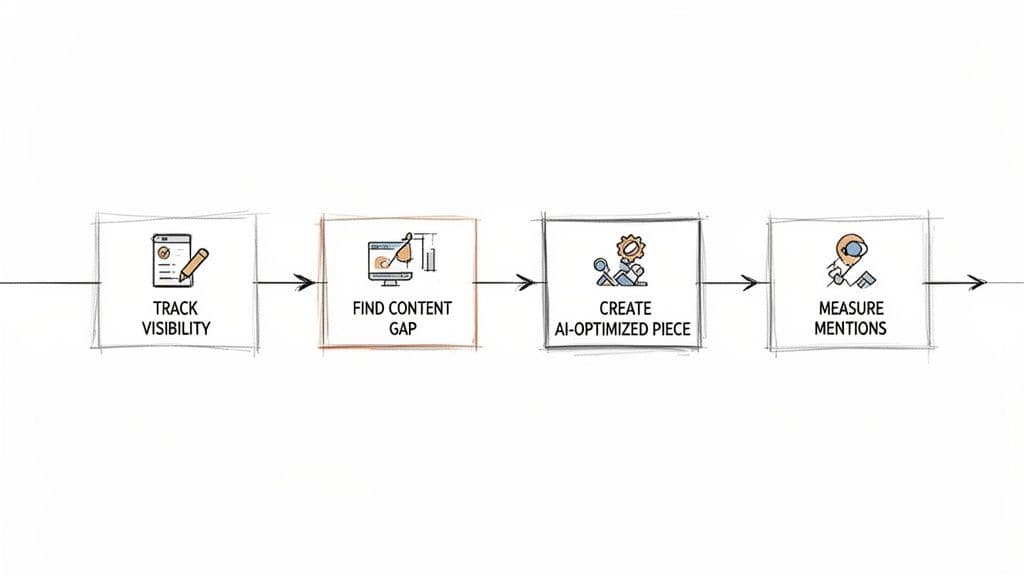
To prove the value and get everyone on board, launch a focused 90-day pilot program. This lets you test the effectiveness of your AI SEO software on a manageable scale before committing to a full rollout. The program should follow a clear, four-step process designed to deliver a measurable result.
Here’s a simple action plan for your first 90 days:
- Days 1-15: Track Initial AI Visibility. Use your software to log your baseline brand mentions and share of mention for one specific, high-value topic.
- Days 16-30: Identify a Critical Content Gap. Use the platform’s opportunity analysis to find a crucial user question that your current content doesn’t answer, but a key competitor does.
- Days 31-60: Create and Deploy an AI-Optimized Asset. Develop a single, high-quality piece of content—like a detailed guide or a deep-dive blog post—specifically built to fill that gap.
- Days 61-90: Measure and Report the Impact. Continuously track your visibility metrics for that topic. At the end of the 90 days, measure the change in brand mentions and share of mention that came directly from your new content piece.
This pilot gives you a clear, defensible case study that proves the ROI of an AI-powered approach.
Measuring the ROI of Your AI SEO Efforts
Let's be honest. When you're considering a big investment like AI SEO software, the C-suite isn't just curious about features. They want to know the return. The big question is always, "What's the ROI?"
To answer that, we have to look beyond the old-school SEO metrics. Things like keyword rankings and raw organic traffic just don't tell the whole story anymore. In a world where getting featured in an AI answer is the new top spot, we need a better way to measure what actually matters and prove the value of our work.
Shifting to Outcome-Focused Metrics
To truly grasp the impact of your AI SEO strategy, you have to connect your efforts directly to business outcomes. It’s about tracking the KPIs that show you’re not just ranking, but actually winning the conversation where it matters most now.
Here are three key metrics you should start tracking right away:
- Share of Mention: Think of this as your new market share. It’s a simple measure of how often AI engines cite your brand for your target topics compared to everyone else. When this number goes up, your authority is growing.
- Content Gap Closure Rate: This KPI shows how quickly your team is acting on the content opportunities the software uncovers. It’s a direct measure of your team's agility and how fast you’re responding to what your audience is asking for.
- Reduced Content Production Time: Time is money. You can put a hard dollar value on efficiency gains by tracking the hours saved on tedious tasks like research, outlining, and drafting.
These aren't just vanity metrics; they provide concrete proof that your strategy is working. For a more detailed look at modern reporting, our guide on what is an SEO report is a great resource.
A Straightforward ROI Calculation Framework
Calculating the ROI for AI SEO doesn't need to be a complex affair. A simple, clear formula can build a powerful business case that any stakeholder will understand. It’s all about combining the value of your newfound visibility with the savings from smarter workflows.
The core formula is: (Value of Increased Visibility + Automation Savings) - Software Cost = ROI.
Let’s break that down:
- Value of Increased Visibility: Start by assigning a monetary value to a brand mention in an AI answer. Treat it like a high-value lead or a top-tier backlink—because that's what it is.
- Automation Savings: Tally up the employee hours saved by letting the AI handle the heavy lifting of research, analysis, and content creation.
- Software Cost: This one's easy—it's simply what you pay for the platform.
Understanding the fundamentals of how to calculate marketing ROI is a great starting point, as these same principles apply directly to your AI SEO initiatives. This framework gives you the numbers you need to build a rock-solid business case.
And the data backs this up. A surprising 70% of businesses are already reporting a higher ROI from their AI-powered SEO. The AI SEO tool market itself is exploding, projected to hit USD 52.39 billion by 2032 on the back of a 15.9% compound annual growth rate. This isn't a passing trend; it's a fundamental shift, making it essential to track these new metrics to prove the incredible return on your investment.
Common Mistakes to Avoid on Your AI SEO Journey
Bringing AI SEO software into your workflow is a huge leap forward. But like any powerful tool, its real value depends entirely on how you wield it. Just flipping on the automation and walking away is a surefire way to get lackluster results. If you want to see real, sustainable growth, you need to sidestep a few common pitfalls that can trip you up right from the start.
The single biggest misstep is thinking of AI as a replacement for human strategy, rather than seeing it as a seriously powerful assistant. Leaning too heavily on automation without a guiding hand at the wheel often produces content that’s generic, off-brand, or just plain disconnected from what your audience actually needs. AI is phenomenal at crunching data and spinning up drafts, but it can’t replicate your brand’s unique voice or the deep, lived-in knowledge of your subject matter experts.
Ignoring the Human Element
It’s tempting to fall into a "set it and forget it" mindset. You let the software churn out content and figure the job is done. But that approach misses the entire point. The most incredible results happen when human expertise and machine efficiency work in tandem.
The goal of AI SEO software isn't to take your team out of the equation. It's to free them from the grind of repetitive, data-heavy work so they can focus on high-level strategy, creativity, and adding that irreplaceable human touch.
Without that balance, you end up with content that might check all the technical SEO boxes but completely fails to forge a real connection with your customers. For a closer look at these kinds of missteps, check out this guide to common SEO mistakes that are just as relevant today.
Sacrificing E-E-A-T for Speed
In the mad dash to publish more, faster, it's all too easy to let the core principles of E-E-A-T (Experience, Expertise, Authoritativeness, and Trustworthiness) fall by the wayside. AI-generated content, left unvetted, often lacks the personal experience and deep expertise that both people and search engines have come to demand.
To keep this from happening, your review process needs to be ironclad:
- Fact-Checking: An actual human expert must verify every claim, statistic, and data point the AI produces. No exceptions.
- Adding Experience: Weave in personal stories, specific case studies, and real-world examples that only your team can bring to the table.
- Authoritative Review: Make sure a subject matter expert signs off on every single piece of content before it ever sees the light of day.
This hybrid approach ensures your content is not only ready for AI-driven search but also builds the kind of trust that turns readers into customers.
Focusing Only on Content Generation
Another classic mistake is getting so wrapped up in creating content that you forget to measure the one thing that truly matters: visibility. It's easy to get swept up in the thrill of publishing articles at an incredible pace, but if you aren't tracking how often you appear in AI answers, you’re flying blind.
Success isn't about how many blog posts you can pump out. It’s about increasing your brand's Share of Mention for the topics that define your business. The whole point of using AI SEO software is to get intelligence on where your brand is showing up in AI-generated responses—and, just as importantly, where it isn't. Make visibility tracking your North Star, and you'll know for certain that your efforts are making a real impact.
Answering Your Questions About AI SEO Software
It's natural to have questions when a technology shifts the ground beneath your feet. As marketing leaders and their teams start digging into AI SEO software, a few key questions pop up again and again. Let's tackle them head-on so you can make smarter decisions about how to win in this new search landscape.
Getting these answers right isn't just about understanding a new tool. It’s about fundamentally rethinking what "visibility" means when AI is the one providing the answers.
Is AI SEO Software a Replacement for Human SEO Experts?
Not at all. Think of it less as a replacement and more as a powerful force multiplier for your team. This software is like an incredibly smart co-pilot for your SEO pros.
It takes on the mind-numbing, time-consuming work of data crunching, deep research, and constant monitoring. That frees up your human experts to do what they do best: think strategically, interpret complex insights, and craft creative campaigns that AI simply can't. The real magic happens when human ingenuity is amplified by machine-scale analysis.
The goal isn't replacement; it's augmentation. The true value comes when your strategists use AI-driven data to make better, faster decisions.
How Does AI SEO Software Handle the Rise of Zero-Click Searches?
This is exactly the problem this kind of software was built to solve. Zero-click searches, where users get their answer directly from an AI Overview without ever visiting a website, are a massive blind spot for traditional SEO tools. If you're only measuring clicks, you're missing a huge piece of the puzzle.
AI SEO software shifts the focus to a new, more relevant metric: brand mentions within AI answers. It’s engineered to help you win visibility inside the AI’s response, making your content the source of truth even if no one clicks through. This is a critical pivot—from just chasing clicks to building real influence and authority.
This isn't a distant problem, either. Gartner predicts a staggering 25% drop in traffic from traditional search by 2026. This is where a platform like Attensira becomes indispensable, giving B2B teams effortless domain tracking and AI-optimized content recommendations to close visibility gaps on major AI engines. You can find more analysis on how AI SEO tracking tools are adapting to new search behaviors.
Ready to see how visible your brand is in the new world of AI-driven search? Attensira provides the critical intelligence you need to measure, manage, and multiply your presence in AI answers. Start tracking your AI visibility today.