Discover perplexity vs. google: how AI-powered search reshapes SEO, content strategy, and brand visibility for B2B brands.
The fundamental difference between Perplexity and Google comes down to this: Perplexity is an AI-native answer engine. It digests information and gives you a direct, cited answer. Google, on the other hand, is a classic link-based search engine that ranks web pages for you to sift through.
What you choose really depends on what you need at that moment—a quick, consolidated answer or a broad set of resources to explore on your own.
The Evolving Landscape of Digital Search
The way we find information online is in the middle of a massive shake-up. For decades, Google’s model was the gold standard: index the entire web and serve up a list of blue links. This setup casts the user in the role of a researcher, responsible for clicking through various sources to assemble their own understanding. It’s a system built for discovery and exploration, and it has defined how we’ve navigated the internet for a generation.
But a new model is quickly emerging, led by platforms like Perplexity AI. Instead of handing you a map and wishing you luck, Perplexity acts more like a research assistant. It directly answers your questions by synthesizing information from multiple live sources and presents a single, easy-to-read summary with all its sources clearly cited. This isn't just a tweak to the old model; it's a complete reimagining of what a search is supposed to do.
This move from a "search engine" to an "answer engine" has serious implications for B2B leaders and marketers. The old playbook that got you to the top of Google won’t necessarily work on an AI-driven platform. Getting a handle on this dual-platform world is now essential for any business looking to grow.
A New Contender Gains Ground
You can’t ignore the momentum here. Perplexity AI's growth has been staggering, jumping from 500 million total queries in all of 2023 to 250 million queries in just one recent month. While Google's desktop traffic saw a modest 1.4% year-over-year increase, Perplexity's traffic shot up by 42%. That’s a clear signal that user habits are changing. You can see more on these search trends from Neowin.
The core conflict is no longer just about which platform is "better," but about which model best serves a specific user need—direct answers versus broad exploration. Optimizing for one no longer guarantees success on the other.
This table breaks down their fundamentally different approaches:
This new dynamic means brands have to start thinking about a new frontier of AI search engine optimization, creating content that isn't just designed to rank, but also to be cited.
Comparing Foundational Search and Answer Models
To really get to the heart of the "Perplexity vs. Google" debate, we have to look past the user interface and dig into their core philosophies. Google’s entire empire is built on a foundation of indexing the web, a process it has refined for over two decades, starting with the legendary PageRank algorithm. Think of it as the world’s most sophisticated library card catalog.
When you type a query into Google, it’s not scouring the live web for an answer. Instead, it’s lightning-fast at sorting through its own pre-compiled index of trillions of pages. It relies on hundreds of ranking signals—things like domain authority, backlinks, and user engagement—to serve up a list of what it considers the most credible sources. The whole experience is designed for exploration; you click the links and piece together the answer yourself.
Perplexity, on the other hand, was built from the ground up as an AI-native answer engine. It's less of a catalog and much more like a personal research assistant. When you ask a question, Perplexity’s AI agents actively browse the web in real time, hunting down the most current and relevant information for that specific query.
It then pulls data from multiple sources and synthesizes it into a single, cohesive summary. This model doesn't just rank links; it bypasses that step entirely to focus on direct information retrieval and synthesis. This changes the entire dynamic from a journey of exploration to a direct conversation.
From Indexing to Synthesizing
The fundamental difference comes down to their primary product. Google’s main offering is a ranked list of links. Even with the introduction of AI Overviews, those are just a summary layer placed on top of its existing index. It gives you potential sources and lets you do the work.
Perplexity’s main product is the synthesized answer itself. The sources are treated more like footnotes, there for you to verify the information. This represents a huge shift from being an information-pointer to an information-processor.
The crucial distinction is this: Google indexes the web to help you find information, while Perplexity queries the web to give you an answer. This architectural difference dictates everything from result format to user intent.
This infographic does a great job of visualizing this shift from the old keyword-matching model to the new AI-powered approach.
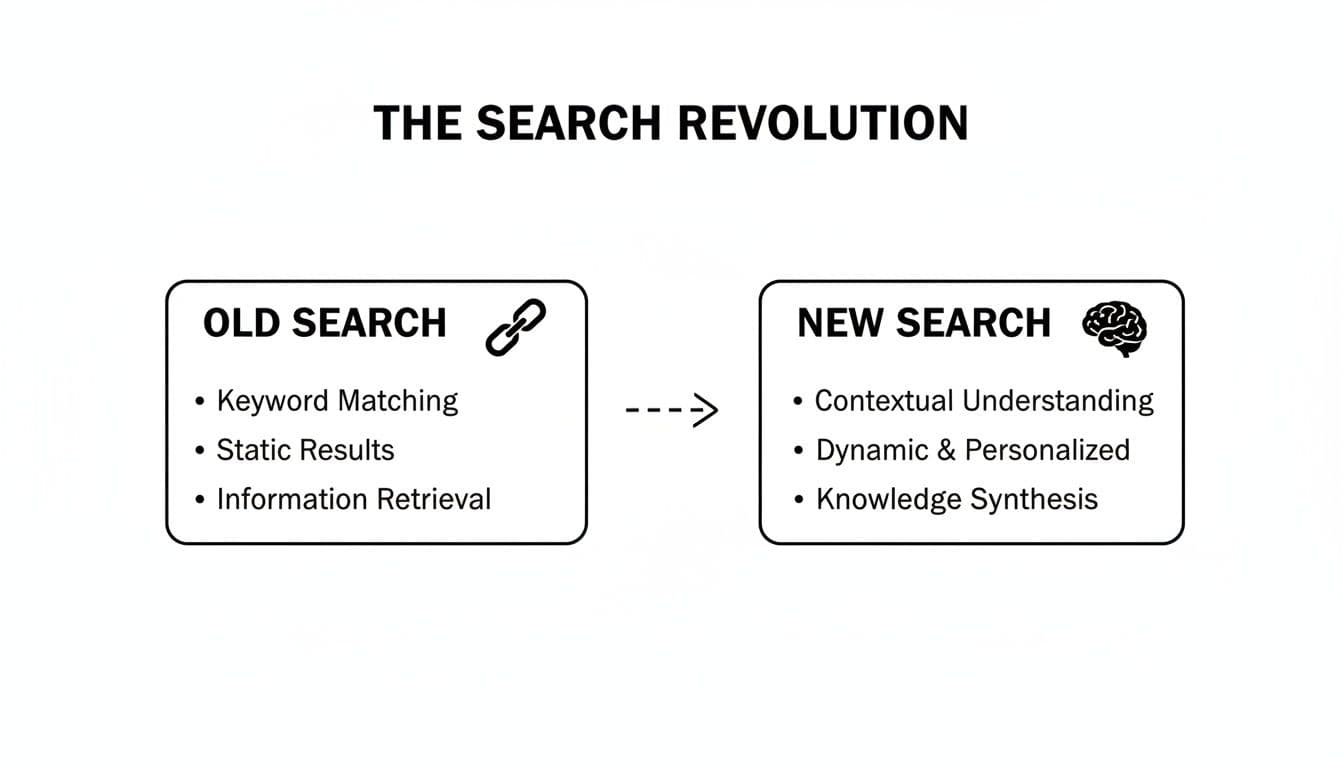
You can clearly see the contrast between the old way of sifting through a sea of blue links and the new model of getting a direct, synthesized answer. This is the central tension in the Perplexity vs. Google comparison.
A Breakdown of Core Architectures
Understanding how these engines are built is the key to figuring out how to adapt your content strategy. The table below lays out the foundational differences in how each platform processes your request and delivers information.
Core Model Comparison: Google vs. Perplexity
This split in architecture isn't just a technical footnote; it fundamentally changes the game for anyone creating content online. To get a better grasp of the technical side, it's useful to understand how AI checkers work, including perplexity analysis, as these tools face similar challenges in validating information from various sources.
The models driving platforms like Perplexity belong to a growing family of conversational AIs. If you're interested in a deeper dive into the specific language models themselves, you can learn more in our guide comparing Claude vs ChatGPT. Ultimately, Google's move with AI Overviews feels like an attempt to bolt an answer-engine feature onto its search-engine body, whereas Perplexity was born with synthesis in its DNA.
How Result Quality and User Experience Stack Up
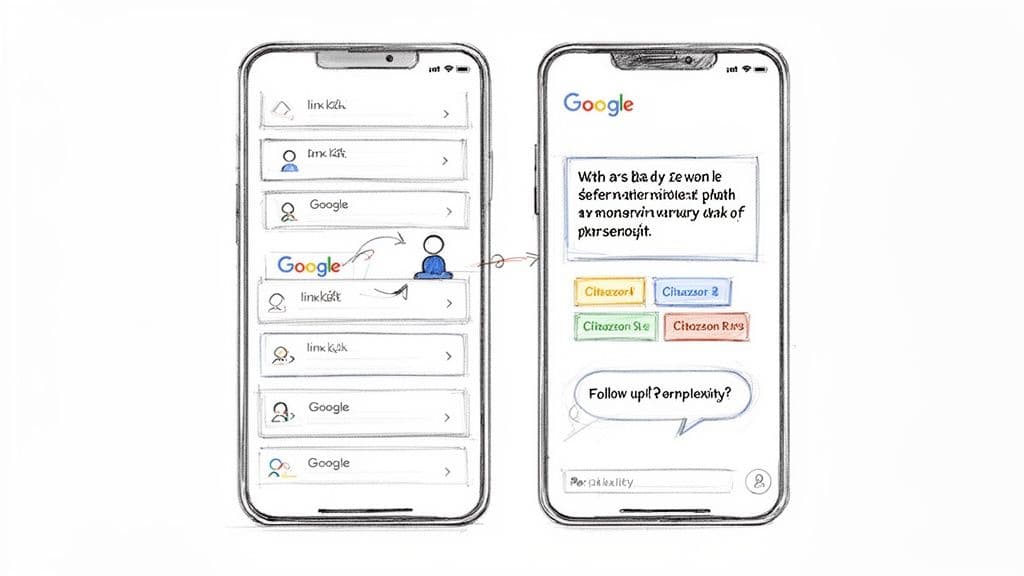
All the technical differences between Google and Perplexity really boil down to one thing: how they affect the person on the other side of the screen. The quality of the results and the way they're presented cater to completely different user needs. This is where the whole "Perplexity vs. Google" debate moves from theory to the practical reality of which tool you'd actually use for a specific task.
Google’s search results page is a mix of old and new. You still get the classic list of ten blue links, but now they're blended with AI Overviews and featured snippets. This layout works well for broad, exploratory searches where you might not know exactly what you're looking for. It’s like a buffet—you get a little bit of everything, and you can decide what to dig into.
Perplexity, on the other hand, is all about speed and clarity. It gives you one synthesized answer designed to resolve your query on the spot. This directness is its main selling point, especially for fact-finding missions where you just need a trustworthy answer without having to click through a bunch of different sites.
Where Trust and Citations Come Into Play
How each platform handles its sources is a major point of difference. Google’s AI Overviews often present a summary without clearly attributing where each piece of information came from. The sources are there, but they're usually tucked away in a separate carousel, which disconnects the claim from its origin.
Perplexity handles this much differently by baking citations directly into its answers. Every key point is tied to a numbered, clickable footnote that takes you right to the source. This transparency is a huge trust-builder. It also turns Perplexity into a serious research tool, letting you easily verify information and explore the original content.
This is a game-changer for B2B professionals who need to back up their decisions with hard data. Perplexity's approach makes it a more reliable choice when source credibility is everything. It's a subtle but powerful part of the overall user experience optimization, giving users the confidence to trust what they're reading.
Encouraging a Deeper Conversation
The user's journey looks very different on each platform. Google often leads to "pogo-sticking"—you click a link, check it out, and immediately hit the back button to try another one. It’s a repetitive process of trial and error.
Perplexity aims for a more focused, conversational experience. Once it delivers an answer, it immediately suggests a few relevant follow-up questions. This simple feature can turn a quick search into a full-blown dialogue, letting you drill down into a topic without ever leaving the page.
This is a fundamental shift in user interaction, moving from "bouncing" between sites to "engaging" in an evolving conversation. A successful search is no longer about how many links you click, but how much you understand by the end.
This conversational style has a clear impact on user behavior. On average, Perplexity users spend a remarkable 23 minutes and 10 seconds per session, which is miles ahead of typical Google interactions. This level of engagement points to a smaller but incredibly loyal user base that prefers the platform's ability to support a deep dive into a topic. You can see more on this in a detailed analysis of search engine engagement metrics, which highlights a clear preference for in-depth, conversational research over quick, transactional searches.
Evaluating Speed and Performance for Professionals
In any professional setting, time is money. Every second spent waiting for a search engine to load or digging through a list of blue links is a second you're not spending on something more important. That’s why the speed difference between Perplexity and Google isn't just a minor detail—it's a critical factor, especially when you’re wrestling with complex research questions.
Google's system is a beast, but that complexity comes at a cost. When you hit enter, it's not just finding links. It’s simultaneously digging through its gigantic index, running its ranking algorithms, building the traditional search results page, and then, on top of all that, generating a separate AI Overview. It’s a multi-threaded process that, while thorough, inherently bogs things down.
Perplexity, on the other hand, is built for a single, focused task: real-time synthesis. Its AI model queries the web with a clear mission—find the data, stitch it together into a coherent answer, and deliver it with citations, fast. It doesn't waste resources building a full-blown search results page alongside its primary answer.
The Decisive Edge in Complex Queries
You really see the performance gap widen when you move beyond simple questions and get into high-intent, decision-making research. Take a query like, "Compare the top three CRM platforms based on API integration capabilities for e-commerce." Google’s job is to give you a broad set of results to explore on your own. Perplexity is engineered to cut straight to the chase and give you that direct, comparative summary.
For a time-strapped executive or product manager, the difference between a three-second and a six-second response is significant. Perplexity’s performance advantage offers a real competitive edge for professionals who require reliable insights without delay.
This isn’t just a feeling; the data backs it up. Analysis shows Perplexity's focused model often delivers answers to complex queries up to 2x faster than Google. In my own hands-on testing, Perplexity could break down intricate topics—like comparing climate policies across different continents—in under two seconds. Google’s AI Overview often took nearly double that time. For a query on public health travel guidelines, Perplexity synthesized data from major health organizations with citations in just 1.8 seconds, while Google clocked in at 3.7 seconds. You can dive into the specifics of these performance benchmarks and their methodology.
Why This Matters for Your Workflow
This speed difference fundamentally changes how you can use a search tool. Instead of blocking off time for "research," you can get near-instant answers to tough questions as they pop into your head. It makes data-driven decisions feel more fluid and less like a chore. For those moments when you need a reliable insight right now, that speed makes Perplexity an indispensable tool.
How to Adapt Your Content Strategy for AI Search
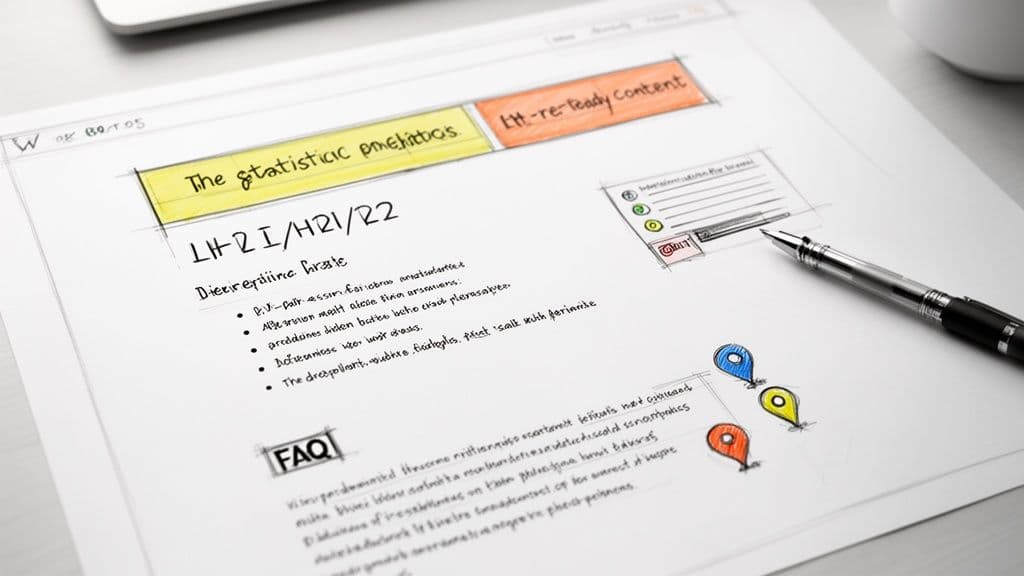
Knowing the difference between Perplexity and Google is one thing. Actually turning that knowledge into a content strategy that works for both is the real challenge. To succeed, we need to move beyond traditional SEO tactics that are laser-focused on ranking.
The new goal is what I call AI visibility optimization. This isn't about just showing up in a list; it's about structuring your content so that it becomes a citable, authoritative source for answer engines like Perplexity. It’s less about gaming an algorithm and more about creating content with uncompromising clarity and utility. Perplexity doesn't rank your page—it pulls specific facts, figures, and quotes directly from it to build its answer.
Structuring Content to Be Cited
To win in this new environment, you need to make your content as easy for a machine to parse as it is for a person to read. This means thinking like an architect, building your content with a clear structure that prioritizes factual density. You have to lay out your key information so an AI agent can quickly find it, trust it, and weave it into a synthesized answer.
Here are a few practical ways to do this:
- Lead with the Data: Put your most critical statistics, findings, or conclusions right at the top of the article or section. Don't make the AI (or the reader) hunt for the key takeaway.
- Write Obvious Headings: Use descriptive H2s and H3s that clearly signpost what's in each section. An AI will get much more value from "Key Performance Metrics for SaaS Companies" than a vague title like "What to Track."
- Use Structured Formatting: Lean heavily on bullet points, numbered lists, and tables. These formats are incredibly easy for AI to parse and are often lifted directly into its summarized answers.
- Bring Your Own Data: The most powerful content you can create for an answer engine is original research. Industry reports, survey results, or detailed case studies with hard numbers make you an essential source that can’t be ignored.
Taking this methodical approach to expert web content creation helps ensure your insights aren't just discoverable, but are actively used and attributed to you.
An Example of AI-Ready Content
Let's say you're writing a post about the benefits of a B2B software platform. A classic SEO approach might weave keywords into a long-form narrative. An AI-optimized approach is far more direct and scannable.
Look at the difference in how a key section could be structured:
Traditional SEO Structure: "Our software offers numerous advantages that can help businesses scale. By integrating our platform, companies have found that their teams become more efficient. For example, one client told us they saw a significant improvement in their project completion times, which ultimately boosted their bottom line and allowed them to take on more clients than ever before."
AI-Optimized Structure:
Measurable Performance Improvements
Our platform delivers quantifiable results across key operational areas:
- Productivity Increase: Clients report an average 27% increase in team productivity within the first quarter of implementation.
- Reduction in Project Overruns: Project completion times improve by an average of 15%, minimizing costly delays.
- Increased Revenue Capacity: Enhanced efficiency allows teams to manage 30% more projects without additional headcount.
The second version is built for citation. It hands the AI clean, specific data points that can be extracted and attributed directly back to your brand, which immediately boosts your authority.
The real objective of AI visibility is to stop being just another link on the results page and start becoming an integral part of the answer itself. Your brand name becomes the source, not just an option.
How to Measure Success in the Age of Answer Engines
Of course, these efforts are meaningless if you can't measure them. While traditional metrics like organic traffic and keyword rankings are still vital for Google, tracking your footprint on Perplexity requires a different mindset. Here, success isn't just about clicks—it's about citations.
This is exactly what platforms like Attensira are built for. You can monitor how often your content is being cited in AI-generated answers, see every mention of your brand, and pinpoint content gaps where your competitors are being referenced instead. This data lets you sharpen your content strategy, focusing on topics where you can build undeniable authority and become the go-to source for AI-powered search.
Choosing the Right Tool for the Right Task
The whole "Perplexity vs. Google" debate misses the point. It's not about one platform replacing the other. The real shift is that we now live in a dual-platform world, and smart professionals need to think that way. The question isn't "Which is better?" but "Which tool is right for this specific job?"
Choosing correctly boils down to understanding what each platform was built to do. Google is still the king of broad discovery. Think of it as wandering through a massive, well-organized library—it’s perfect when you're just exploring a topic or trying to find a specific website.
Perplexity, on the other hand, is built for deep, focused inquiry. It's more like having a dedicated research assistant who can digest a pile of documents and give you a concise, fact-checked briefing. You use it when you have a specific question and need a reliable, synthesized answer without having to piece it together yourself.
Situational Recommendations for Your Workflow
Let's make this practical. We need to move beyond abstract ideas and look at how this plays out in the daily grind of a B2B professional. The key is matching the tool to what the job needs: speed, depth, or a particular type of answer. Getting this right will make you far more efficient and the insights you gather much stronger.
This principle of picking the right tool for the job isn't unique to search engines. It's the same logic behind understanding the nuances between input methods like Voice Typing Vs Dictation. You wouldn't use a discovery engine for deep synthesis, just as you wouldn't use dictation for writing code.
The core idea here is that the search landscape is no longer a one-horse race. Brands that want to grow and stay competitive have to play to the strengths of each platform.
This means you have to consciously break the habit of defaulting to one tool. Instead, you need to make a strategic choice based on your immediate goal.
A Quick Reference for Use Cases
This table is designed to be a simple decision-making guide for your daily workflow. It lays out clear, situational advice on when to fire up Perplexity and when it makes more sense to stick with Google.
At the end of the day, weaving both platforms into your workflow isn’t a compromise—it's a strategic advantage. As AI continues to change how we access information, understanding these differences is what will keep you ahead of the curve. This dual-platform reality also shines a light on the need for specialized tools, and for anyone serious about optimizing their brand's visibility, figuring out the best AI SEO software is a logical next step.
Answering Your Questions
As AI search begins to reshape how we all find information, it's natural for businesses and marketers to have a few questions. Getting a handle on the subtle but important differences between these platforms is the key to adapting your strategy without missing a beat. Let's tackle some of the most common questions about the Perplexity vs. Google dynamic.
Does Traditional SEO Still Matter with AI Search?
Absolutely, but its center of gravity is shifting. Foundational SEO concepts like domain authority still carry a lot of weight on Google, but winning on Perplexity requires a much sharper focus on structured, fact-rich content that an AI can easily pull from and cite.
The game is changing from 'optimizing to rank' to 'optimizing to be cited.' This puts a bigger premium than ever on high-quality, user-focused content, because that’s what ultimately serves both platforms well.
Can Perplexity Replace Google for B2B Research?
It's not a complete replacement, but it's a powerful new tool for specific kinds of research. Perplexity is fantastic for deep, factual dives where you need to synthesize information from multiple places into one concise, well-sourced answer. It cuts through the noise.
That said, Google is still the king of broad discovery, finding a specific company's website, or running local searches. The smartest B2B approach is to use Perplexity as a precision research assistant and Google as your go-to discovery engine.
How Can I Track Brand Visibility on Perplexity?
This is where things get tricky. Traditional analytics aren't built to track citations inside an AI-generated summary, so you'll need specialized tools.
This new measurement challenge highlights a critical gap for brands. Success is no longer just about traffic; it's about being the cited authority within an AI's answer, a metric that standard dashboards completely miss.
New platforms are coming online specifically to monitor how your brand and content get referenced in AI responses. These tools can show you which of your pages are being used as sources, giving you the insights needed to boost your citation rate in this new environment.
Keeping an eye on your brand's presence in AI-generated answers is no longer a nice-to-have; it's essential. With a platform like Attensira, you can track every citation, spot content gaps where competitors are getting sourced instead of you, and get clear, actionable insights to become the go-to authority for answer engines. Find out how your brand really shows up on platforms like Perplexity by visiting Attensira's website.