Master Claude engine optimisation with this guide. Learn actionable strategies to boost brand visibility and drive growth in AI-powered search.
Claude Engine Optimisation (CEO) is all about getting your brand’s content cited and recommended by Anthropic’s Claude AI. It’s a completely different game than traditional SEO. Instead of just targeting search engines, CEO focuses on making your content so authoritative and trustworthy that Claude’s language model actively chooses it to build its answers. For any B2B brand trying to stay visible today, this has become an essential new discipline.
Why Claude Engine Optimisation Is Your New Competitive Edge
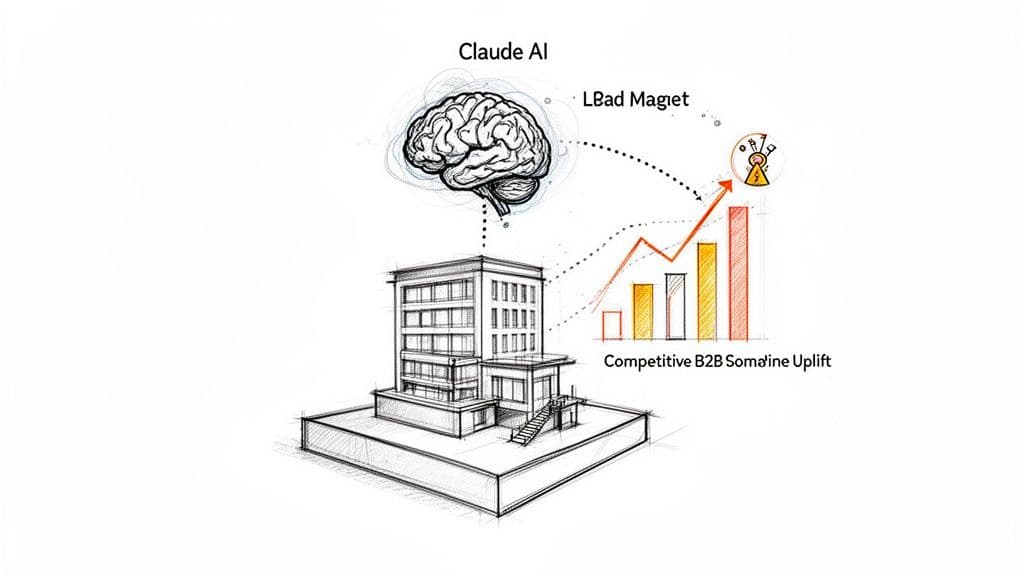
The move from keyword searches to conversational AI queries isn't some far-off trend—it’s happening right now, and it's changing how B2B buyers discover new solutions. If you don't adapt, you risk becoming invisible. Claude Engine Optimisation isn't about small content tweaks; it’s a total shift in how you demonstrate your value to the AI that now stands between you and your customers.
This is especially critical in the enterprise world. Claude holds a significant 29% share of the enterprise AI assistant market. On top of that, 70% of Fortune 100 companies are already using it in their workflows. What this means for B2B brands is that your next major lead probably isn't just Googling—they're asking Claude for direct recommendations.
From Keywords to Authority
We've spent years obsessing over keywords, backlinks, and engagement signals for SEO. Claude operates on a different set of rules. Its design, grounded in what's known as Constitutional AI, means it gives preference to content that is:
- Factually Accurate: It hunts for data-backed claims and verifiable sources.
- Structurally Clear: Content with a logical flow and obvious headings is far easier for the model to understand and use.
- Semantically Rich: It goes way beyond keywords to grasp the real meaning and the relationships between ideas in your text.
Here's a real-world example I've seen play out: A cybersecurity SaaS company couldn't figure out why their qualified leads were drying up. It turned out their target audience—CTOs—had started using Claude for initial research. Because the company's website was filled with high-level marketing copy, Claude consistently ignored it. Instead, it cited a competitor’s in-depth technical whitepapers, viewing them as more authoritative. That's CEO in action.
The Broader AI Optimisation Landscape
Getting your content ready for Claude is just one piece of a much larger puzzle. To get a feel for the entire field, it’s worth exploring the concepts behind AI Search Optimization. The fundamental idea is always the same: start treating the AI model as your primary audience. The strategies in this guide are simply a focused application of that new mindset, zeroing in on what makes Claude tick. If you're looking for a wider view, you might also find our overview on what Generative Engine Optimisation means for brands helpful: https://attensira.com/blog/generative-engine-optimisation.
How Claude Actually Thinks and Selects Information
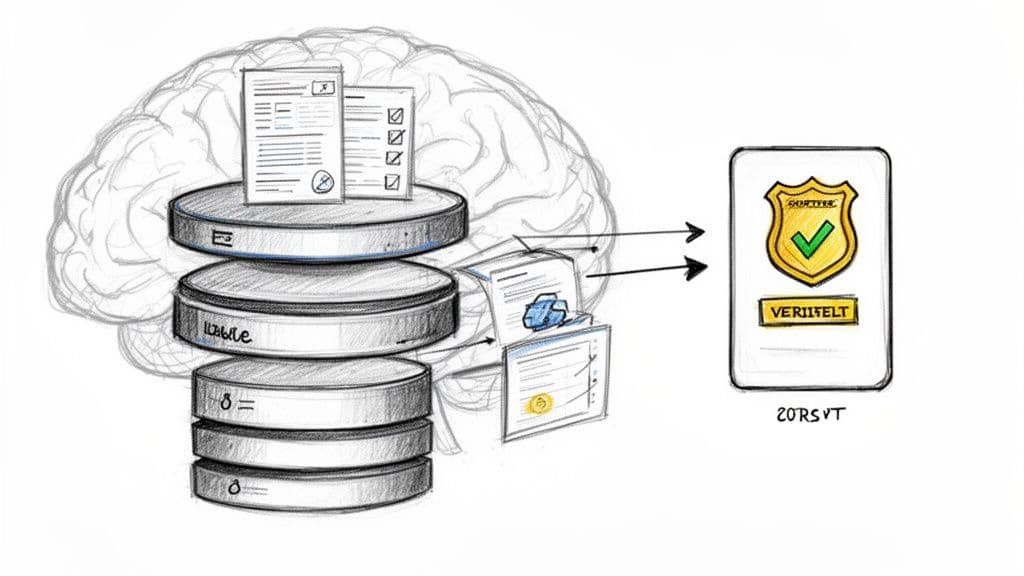
To really get anywhere with Claude, you first have to understand how it sees the world. It’s a completely different beast from a traditional search engine that cares about backlinks and keyword density. Claude’s entire model is built on a foundation of Constitutional AI, which is its internal compass for creating responses that are helpful, harmless, and honest.
This isn’t just some philosophical fluff; it directly shapes which sources it trusts and uses. The model actively looks for and prioritizes content demonstrating authority, factual accuracy, and clarity. It’s far less interested in a blog post with slick marketing copy than it is in a well-structured technical whitepaper loaded with verifiable data.
Think of it as the difference between a casual chat and a formal research report. Claude is a meticulous researcher, and it will almost always favor the source that provides the most reliable, well-documented information to build its answers.
The Shift from Keywords to Citable Authority
Traditional SEO is a game of ranking. Getting your content surfaced by Claude is a game of being cited. The goal isn't just to be seen, but to become such an indispensable source that the AI trusts your information enough to reference it directly. This demands a fundamental change in how you approach content.
For instance, instead of stuffing a product page with keywords, a far better strategy is to offer a detailed, factual breakdown of features, specifications, and use cases, all supported by hard numbers. This kind of structured, unambiguous information is exactly what Claude needs to generate a helpful and accurate summary for a user.
To do this well, it helps to anticipate the kinds of key questions to ask AI that unlock deeper insights. By thinking about the complex queries users will pose, you can structure your content to provide the definitive answers Claude is hunting for.
Why Structured and Database-Driven Content Wins
I've noticed that Claude has a clear preference for content that reads more like a database entry than a narrative blog post. Information that is neatly organized, clearly labeled, and easy for a machine to parse wins every single time.
For B2B brands, this is a huge opportunity. Here’s where to focus:
- Product Specifications: Detailed tech specs, compatibility lists, and performance metrics are absolute goldmines for Claude.
- Case Studies: Data-driven case studies with unambiguous metrics (e.g., "reduced customer overhead by 32%") are highly citable.
- Whitepapers and Research: In-depth reports and academic-style papers instantly establish you as a credible authority.
- Clearly Defined FAQs: Answering specific questions directly and concisely makes your content an easy, go-to source for the AI.
Since its release in March 2023, Claude has quickly cemented its role as a serious tool for business. Its user base exploded by +620% year-over-year into 2025, making optimization critical. For B2B audiences, reliability is everything—hallucination rates dropped by roughly 20% between the v2 and v3 models, and JSON output accuracy hit 95%, making it a trusted source for complex business queries.
My biggest takeaway from watching Claude's behavior is that it loves what many marketers would call "boring" content. The straightforward, data-heavy documentation that often gets overlooked is precisely what the model finds most useful. It's an engineer's AI, and it respects content built with an engineer's mindset.
It's also useful to see how Claude stacks up against other models in this space. Understanding its distinct approach can help you fine-tune your strategy. We dive deeper into this in our comparison of Perplexity vs Claude for B2B research, which highlights the unique attributes you need to target.
Once you have a grasp of how Claude processes information, the next logical step is to create content that speaks its language. This isn't about gaming an algorithm; it's about shifting your entire content strategy to prioritize clarity, precision, and structure.
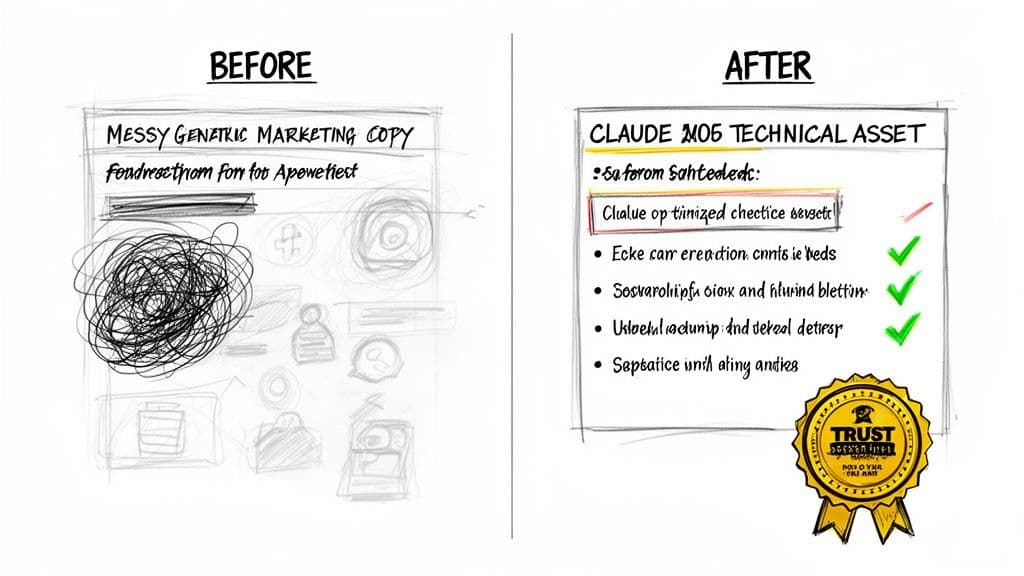
The goal here is to make your content so fundamentally reliable and well-organized that Claude views it as a go-to source. Forget persuasive fluff and vague marketing claims. To win in this new landscape, you need to write for precision. Think unambiguous language, verifiable data, and a logical flow that essentially hands the AI the exact information it's looking for.
Go All-In On E-E-A-T
The E-E-A-T framework—Experience, Expertise, Authoritativeness, and Trustworthiness—isn't just a guideline for traditional SEO anymore. For an AI like Claude, it's a critical set of signals it actively seeks out to verify that your content is more than just noise.
Here's how to put E-E-A-T into practice for Claude:
- Quantify Everything: Don't just claim your software is "efficient." Prove it. A statement like, "Our platform reduces data processing time by an average of 42%," is concrete and citable.
- Back Up Your Claims: Every significant assertion should be linked to its primary source, whether that's original research, a data report, or technical documentation. This is a massive trust signal.
- Showcase Your Experts: Content needs to be backed by real people with real credentials. Author bylines should include their titles, experience, and even links to their professional profiles. This tells the AI that the information comes from a credible human source.
This isn't just theory. We've seen that simply including clear citations and statistics can boost a website's visibility in AI-generated answers by over 40%. Every data point and expert byline you add builds a stronger foundation of trust with the model.
Prioritize Radically Clear Language
Claude takes things literally. It isn't wired to decode clever marketing slogans or interpret nuanced prose. Your biggest advantage is writing with such extreme clarity that there's zero room for misinterpretation.
Let's look at a typical B2B product description. The old way relied on benefit-driven language. The optimized way prioritizes explicit facts that an AI can parse and repeat.
The Old Way (Generic & Vague):
"Our revolutionary platform empowers your team to work smarter, not harder. Streamline your workflows and unlock unprecedented productivity with our intuitive, next-generation solution."
This kind of copy is practically invisible to an AI. It's filled with empty, unprovable claims like "revolutionary" and "unprecedented."
The Claude-Ready Way (Specific & Factual):
"Our workflow automation platform is designed for engineering teams of 50 or more. It integrates directly with Jira, GitHub, and Slack via API. Key features include automated ticket assignment, which reduces manual workload by 15 hours per week per team, and a real-time analytics dashboard for tracking project velocity."
See the difference? This version is packed with concrete details, names specific tools it integrates with, and provides a hard metric. It's factual, structured, and perfect for Claude to use when comparing solutions. For a more detailed walkthrough of this transformation, our guide on AI content optimization breaks it down even further.
Make Your Content Easy to Scan—For Machines
The structure of your page is just as important as the words on it. A logical hierarchy using H2s and H3s acts as a signpost for Claude, helping it understand how different pieces of information relate to one another.
One of the most common mistakes I see is burying key product specs deep inside a dense paragraph. Claude is far more likely to pull data from a clean bulleted list or a table than to hunt for it in a wall of text. You have to make your most important facts impossible to miss.
To help you put this into practice, here is a quick checklist comparing old habits with the new rules for Claude.
Claude Content Optimisation Checklist
By consistently applying these structural and linguistic principles, you're doing more than just publishing content. You're building a library of authoritative, machine-readable assets. You're creating a knowledge base that Claude will not only trust but will actively recommend to its users.
Winning With Semantic SEO and Structured Data
If you really want to get ahead in Claude Engine Optimisation, you have to go deeper than just clear content. The next step is to teach the AI not just what your content says, but what it means. This is the whole point of semantic SEO—structuring your information so precisely that Claude can pull it directly into its knowledge base.
It’s the difference between being a footnote and becoming a foundational source in the AI's understanding.
This isn't about finding a loophole in an algorithm. It's about giving Claude a clear, machine-readable blueprint of your expertise. When you translate your brand’s value into a language machines understand, you take the guesswork out of the equation. You're essentially handing the AI a pre-verified, perfectly organized file on your products, services, and authority.
Building Your Semantic Topic Model
Before you even think about code, you need a map. A semantic topic model is that map. It lays out all the concepts related to your core business, going way beyond a simple list of keywords. The goal is to create a dense web of interconnected ideas that blankets your entire niche.
Take a B2B SaaS company that sells project management software. They shouldn't just be targeting "project management tools." Their model needs to connect all the related dots:
- Core Functionality: Gantt charts, Kanban boards, resource allocation, time tracking.
- Customer Pains: Missed deadlines, budget overruns, team collaboration issues.
- Integrations: Jira, Slack, GitHub, Google Workspace.
- Methodologies: Agile, Scrum, Waterfall, PRINCE2.
By building out content that speaks to each of these points, you create a rich, interconnected information hub. This signals to Claude that you’re not just another vendor; you're a definitive authority on the entire subject. To get a better handle on how related terms strengthen your content, our article on understanding what LSI keywords are is a fantastic resource.
Implementing Schema for Machine-Readable Context
Once your topic model is solid, structured data (Schema.org) is how you communicate it to machines. Schema is a vocabulary of tags you add to your HTML that gets rid of all ambiguity, explicitly telling AI models what your content is about.
Instead of hoping Claude figures out that a page describes a software product, you can use Product schema to label its name, features, pricing, and reviews. This is easily the most powerful technical move you can make in your optimisation efforts.
In my experience, B2B brands that implement detailed Service and Product schema see their key business information—like pricing tiers and integration partners—reflected with almost 100% accuracy in AI responses within weeks. It's a direct line of communication to the model.
Key Schema Types for B2B Brands
While there are hundreds of schema types out there, a few are absolutely essential for proving your authority to Claude. To get the biggest impact quickly, start with these three.
ProductSchema: Use this to define every last detail of your offerings. Make sure to include properties forname,description,brand,aggregateRating, andoffers(to specify pricing). This helps Claude nail answers to questions like, "What are the pricing plans for [Your Product]?"ServiceSchema: If you offer services, this one is non-negotiable. Define theserviceType,provider, andareaServed. It’s invaluable for consultants, agencies, and any service-based software company.FAQPageSchema: This is one of the easiest and fastest wins. Just mark up your frequently asked questions page with this schema. You’re essentially feeding Claude a list of pre-approved questions and answers, making it incredibly simple for the AI to use your content to resolve user queries accurately.
The data makes a strong case for this strategy. Claude Engine Optimization is already reshaping B2B digital strategies, with the model holding a 3.2% global share among AI assistants. We're seeing that content optimized with these structured approaches scores 22.3% higher in AI visibility than unoptimized content. Claude’s recommendation algorithm clearly favors data-rich, authoritative sources, preferring structured information over standard web copy. You can find more on how Claude is influencing B2B strategies at wellows.com.
A Mini-Case Study in Action
Let's look at a real-world example. A B2B software company specializing in API security had a website full of great marketing copy, but it was vague on the technical specifics. When users asked Claude about them, the responses were generic and often missed crucial details about their platform's compatibility.
So, they rolled out a two-part structured data plan:
- First, they marked up their main product page with detailed
Productschema, explicitly listing every supported API protocol (REST,GraphQL,SOAP) and security certification (SOC 2,ISO 27001). - Second, they built a new FAQ page addressing common technical questions and marked it up with
FAQPageschema.
The result? Within a month, queries to Claude like "API security tools that support GraphQL" started featuring their product with pinpoint accuracy. The AI stopped guessing and started citing the precise, structured data they provided. This led to a measurable jump in qualified traffic from users with very specific technical needs, proving the direct business impact of this kind of technical SEO.
How to Monitor and Operationalize Your CEO Strategy
Even the most brilliant strategy for Claude engine optimisation is just theory until you can measure its real-world impact. To get results, you need to move from a great idea to a sustainable, repeatable workflow—one that turns data-driven insights directly into action.
This isn't about a one-off project. It’s about building a living, breathing business process. You’re creating a feedback loop: monitor performance, find the weak spots, implement fixes, and measure again. Think of it as integrating AI monitoring right into your content marketing calendar, making it a core function of your team.
Without this operational rigor, even your best content and structured data will get stale as AI models evolve. But with a consistent process, your efforts will compound, building a serious competitive advantage over time.
Establishing Your Monitoring Framework
First things first: you need visibility. You can’t optimize what you can’t see. Your traditional analytics tools, built for human web traffic, are completely blind to how AI models like Claude are interacting with your content behind the scenes.
This is where specialized platforms come in. A tool like Attensira is designed specifically to track your brand’s presence within generative AI responses. Connecting your domain gives you an immediate baseline, showing you exactly where you stand before you touch a single line of code or content.
With the right tool, you can start tracking the metrics that actually matter for Claude:
- Brand Mention Frequency: How often does Claude mention your brand, products, or services for your most important queries?
- Sourcing Patterns: Is Claude citing your website directly, or is it pulling its facts about you from third-party sites you don't control?
- Response Sentiment: Are the mentions positive, negative, or just neutral? More importantly, are they accurate?
- Competitive Benchmarking: For the queries that drive your business, how does your visibility stack up against your direct competitors?
Having this data is the difference between guessing and knowing. It pinpoints precisely where your content is falling short and where your biggest opportunities are waiting. For a deeper dive, our guide on AI search monitoring lays out a more detailed framework.
Creating an Actionable Feedback Loop
Once you have monitoring in place, the real work begins. The data you're collecting is the fuel for a powerful feedback loop that drives continuous improvement. This is the core workflow that makes CEO manageable and repeatable for your team.
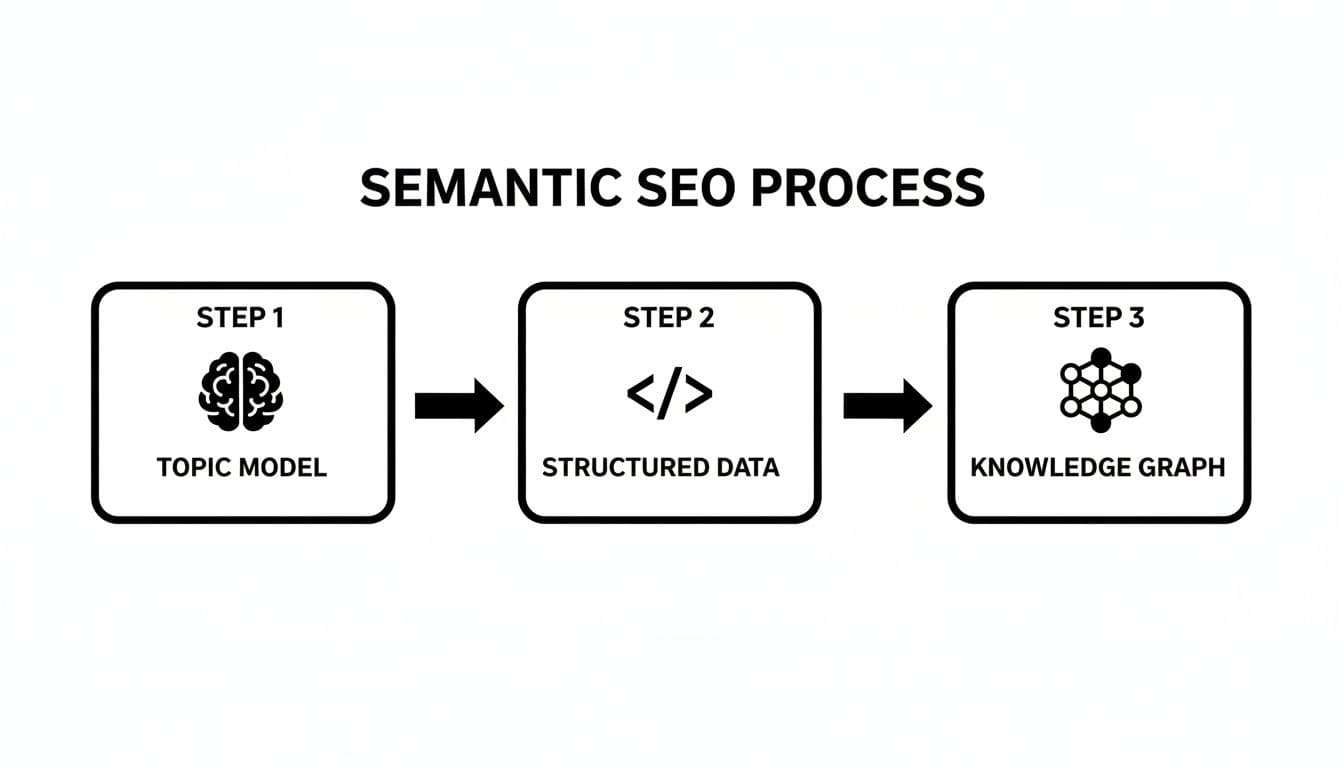
As this process shows, effective optimization starts with a deep, semantic understanding of your topic. You then translate that understanding into machine-readable structured data, which ultimately influences the AI's knowledge base.
You can break this entire cycle down into four distinct, ongoing phases.
- Monitor and Analyze: Use your monitoring platform to actively track how Claude answers queries relevant to your business. Look for inaccuracies, content gaps, or moments when a competitor gets cited instead of you. You might discover Claude is misstating your pricing because it’s pulling from an outdated review site.
- Identify and Prioritize: Not all issues are created equal. Based on your analysis, decide what's most critical. An inaccurate product description that could kill a sale is a high-priority fix. A missing brand mention in a broad, top-of-funnel query might be a lower priority.
- Generate and Optimize: Now it's time for content. Use your findings to update existing pages or create entirely new, optimized assets. If Claude is citing old pricing, update your pricing page and implement
Offersschema. If a key feature is missing, add a detailed, factual description to your product page. - Deploy and Measure: After you publish the changes, go right back to your monitoring tool. Track the same queries to see if your fixes worked. You’re looking for a measurable improvement in the accuracy, sentiment, and frequency of your brand mentions.
By adopting this cycle, you transform CEO from an abstract concept into a series of clear, actionable tasks. It becomes a routine part of your content strategy, just like keyword research or CRO. This operational discipline is what separates the brands that will thrive in the AI era from those that get left behind.
Answering Your Questions About Optimizing for Claude
As we all start to wrap our heads around this new landscape, a lot of practical questions pop up. Moving from theory to a real, working strategy for Claude engine optimisation means getting into the weeds. Let’s tackle some of the most common questions I hear from brand managers and SEO pros trying to adapt.
The biggest mental shift is this: you're no longer just trying to please a web crawler. You're aiming to become an unimpeachable, citable source of truth for a language model. It's less about stuffing keywords and more about building genuine authority.
How Is Claude Engine Optimisation Different From Traditional SEO?
This is the big one. Traditional SEO is a game of keywords and backlinks, played for search engines like Google. Claude Engine Optimisation (CEO), on the other hand, is all about authority, structured data, and semantic meaning.
Claude’s engine heavily favors structured databases and verified sources over the wild, open web. So, your goal isn't just to rank for a keyword; it's to become the trusted entity that Claude cites on a specific topic. The focus moves from driving traffic volume to increasing your reference rates—how often your brand is mentioned correctly in AI answers. It's a fundamental switch from a keyword game to an authority game.
What Are the First Steps to Start Optimising for Claude?
You don't need to boil the ocean. The best way to get started is with a focused, high-impact approach on your most valuable assets.
- Audit Your Core Content: Take a hard look at your key product pages, service descriptions, and whitepapers. Is the language direct and unambiguous? Is every claim backed up with a clear data point?
- Implement Basic Schema: Get started by adding structured data (using Schema.org) to your
Organization,Product, andServicepages. This is the most direct way to hand-feed Claude accurate, machine-readable facts about your business. - Establish a Baseline: Before you change anything, you need to know where you stand. Use a dedicated tool to see how you currently show up in Claude. This gives you a starting point and usually reveals the most obvious low-hanging fruit.
My advice? Start with a single page—your main product or service offering. Getting one page perfectly optimized with clean data and solid schema will teach you far more about what works than spreading your efforts thinly across a dozen pages.
How Do I Measure the ROI of Claude Engine Optimisation Efforts?
Measuring the return on investment here requires a different set of metrics. Forget tracking just organic traffic and keyword rankings; we need to look at AI-specific indicators.
Your main success metric is the frequency and accuracy of your brand mentions when users ask Claude relevant questions. Every time your brand is cited positively and correctly, that's a direct win. Downstream, you can also analyze whether leads coming from AI-driven platforms are more qualified and convert at a higher rate. This often suggests they received high-quality, accurate information before they ever clicked through to your site.
Can I Use AI to Help with My Claude Optimisation Strategy?
Absolutely. In fact, trying to do this without AI is like trying to build a house without power tools. Manually tracking your brand mentions, finding content gaps, and writing perfectly optimized copy is not only slow but also incredibly error-prone.
AI-powered platforms are built for this. They can monitor your visibility across different AI models, see what your competitors are doing, and even help you draft new content that’s already shaped for Claude's engine. Think of AI as your indispensable analyst and drafting assistant. Your human expertise is still needed to guide the strategy, nail the brand voice, and ensure everything you put out is authentic.
Ready to see how your brand really appears in Claude's responses? Attensira gives you the visibility and tools to monitor your AI presence, pinpoint content gaps, and sharpen your strategy. Connect your domain and start tracking your performance today at https://attensira.com.