
Discover ai visibility for fintech: audit, optimize, and strategize to attract B2B clients with AI-driven search.
When we talk about AI visibility in fintech, we're talking about a very specific goal: making your company's content the go-to, trusted source for AI search engines and chatbots. This isn't just a new coat of paint on traditional SEO. It's about positioning your brand as the definitive answer when a B2B decision-maker asks a critical question.
Why AI Visibility Is the New Frontier for Fintech Growth
Let's be blunt: the way B2B buyers find and vet financial technology has completely changed. CFOs, compliance officers, and finance managers aren't just sifting through Google search results anymore. They're asking detailed, conversational questions to AI assistants like ChatGPT and getting direct answers from Google's Search Generative Experience (SGE).
This seismic shift is both a huge risk and an even bigger opportunity. If your fintech company isn't showing up in these AI-driven conversations, you're becoming invisible to a fast-growing slice of your ideal customer base. Old-school SEO, which was all about getting a link to rank, simply isn't enough. The new endgame is to become the cited authority inside the AI's direct response.
From Search Ranking to Answer Engine Authority
Think about the difference. A high-ranking blog post is a suggestion from a list. An AI citation is a direct recommendation.
When an AI model fields a query like, "What are the best platforms for automating accounts payable audits?" it pulls information from sources it considers the most credible. Being one of those sources puts your brand right in front of a high-intent buyer at the exact moment they're looking for a solution.
The real objective of AI visibility is to elevate your brand from just another search result to the verified source material for AI-generated financial advice. It's the difference between being a book on the library shelf and being the expert quoted in the final report.
This kind of authority is built on a few key pillars that AI models are trained to look for:
- Factual Accuracy: Your content needs to provide clear, verifiable data that an AI can easily understand and trust. No fluff.
- Structured Content: Using organized formats, like schema markup, is crucial. It explicitly tells AI models what your services do and who they're built for.
- Demonstrated Expertise: You have to showcase deep domain knowledge. This means publishing detailed whitepapers, insightful case studies, and content from authors with real credentials (E-E-A-T).
- Third-Party Validation: AI models heavily weigh mentions and citations from reputable financial news sites and respected industry reports.
The Tangible Impact on Lead Generation
Getting AI visibility right has a direct and measurable impact on your pipeline. When your content is the bedrock for an AI's answer, you essentially control the narrative around complex financial challenges and frame your product as the obvious solution.
The leads that come from these interactions are often much more qualified. Why? Because they've already been educated by content that's been shaped by your expertise. They aren't just clicking a random link; they're acting on a recommendation from an AI they trust.
You can learn more about specialized visibility strategies for the financial sector and see how this works in the real world. For any fintech firm looking to grow, becoming the definitive answer that AI provides isn't just a marketing tactic—it's a core business strategy.
Establishing Your Baseline in the AI Ecosystem
Before you can really move the needle on your AI visibility for fintech, you first need a brutally honest picture of where you stand right now. Just running a few brand searches on your favorite AI chatbot won't cut it. What you need is a systematic audit to map your footprint across the entire AI ecosystem—a process that's less about vanity and more about gathering real-world competitive intelligence.
The goal here is simple: understand how today's AI models perceive your brand, your products, and your position in the market. You have to get out of your own head and start thinking like your ideal customer. That means probing these AI tools with the specific, nuanced questions a CFO, a compliance officer, or a tech lead would actually ask when they're evaluating solutions.
Probing for Actionable Insights
To get a true baseline, you’ll need to test a wide range of prompts across multiple AI platforms. Don't just stick to one. Your queries should cover several key categories to build a complete, 360-degree view of your visibility.
Here are a few practical examples that I’ve seen fintech CMOs use to get started:
- Service-Specific Queries: "List the top three platforms for AI-driven accounts payable automation for mid-sized enterprises." This is a gut check to see if you even show up for your core offerings.
- Competitor Comparison Prompts: "Compare [Your Company Name] versus [Competitor A] for fraud detection capabilities." This is where you find out how AI positions you against your direct rivals—the results can be eye-opening.
- Pain-Point Exploration: "How can a B2B SaaS company reduce cross-border payment friction?" This tests whether your thought leadership content is actually being sourced as a solution to common industry problems.
- Leadership and Brand Voice: "What is the industry perspective of [Your CEO's Name] on the future of embedded finance?" This helps gauge the influence and visibility of your key executives.
This process is about moving a potential customer from initial discovery in an AI chat all the way to becoming a qualified lead.
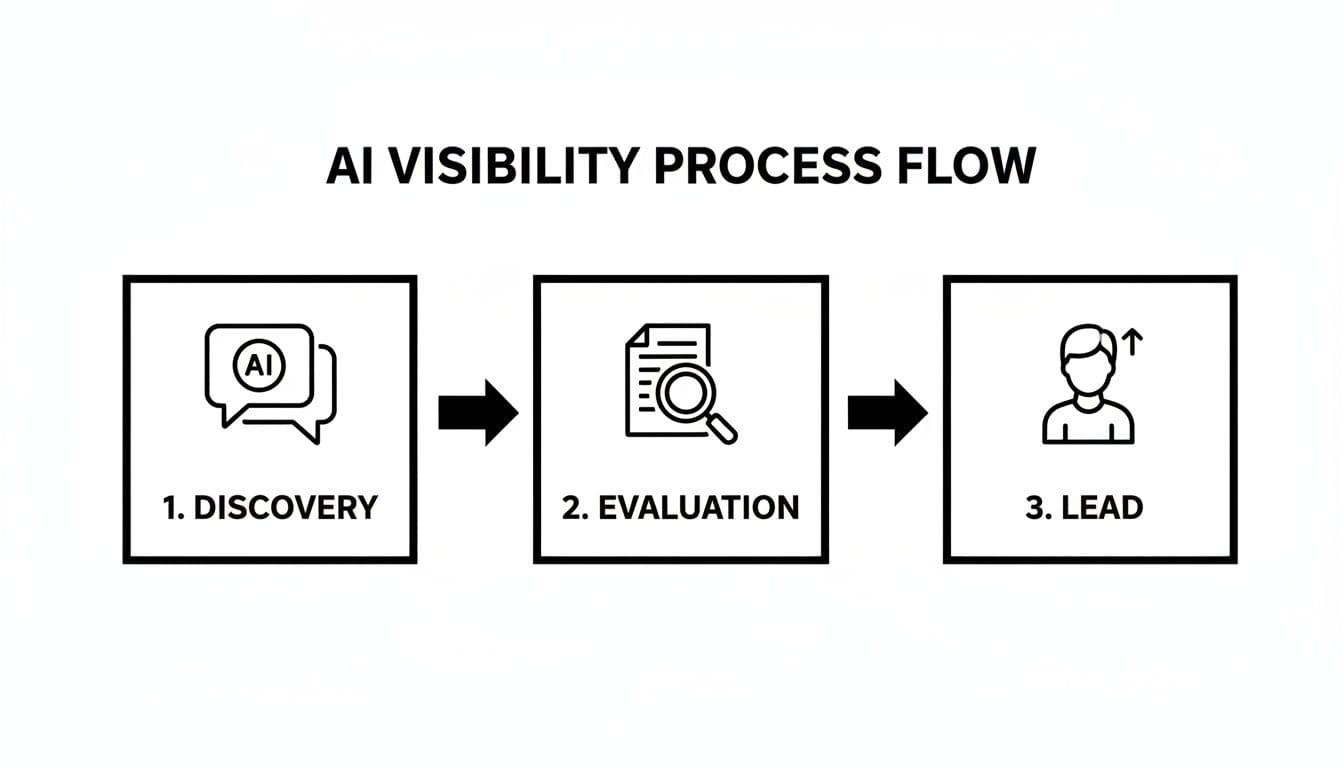
As you can see, visibility is just the starting line. The quality of information presented during that evaluation phase is what truly convinces a prospect to take the next step and engage with your team.
Moving from Manual Checks to Systematic Monitoring
Doing these checks by hand is a good start, but it’s not a scalable strategy. For that, you need a dedicated monitoring system. This is where tools built specifically for tracking AI visibility become indispensable, automating the tedious process of querying dozens of prompts across multiple AI platforms, archiving the responses, and flagging changes over time.
With an automated approach, you can consistently track the metrics that matter. You’ll know precisely when your brand is mentioned, how accurately your services are described, and whether the sentiment is positive, neutral, or negative. It turns a frustrating guessing game into a repeatable, data-backed process.
The global AI fintech market is projected to surge to approximately $99.09 billion by 2031, which represents a compound annual growth rate of 22.04%. This kind of explosive growth is exactly why mastering visibility on these new platforms is no longer optional—it's where your future clients are making their decisions.
Building Your Comprehensive Baseline Report
Once you've gathered this initial data, the next move is to consolidate everything into a comprehensive baseline report. This document becomes the foundation for your entire AI visibility strategy.
A solid baseline report should clearly outline:
- Brand Mention Frequency and Context: How often are you showing up? And when you do, is the context accurate and aligned with your core messaging?
- Competitive Share of Voice: When key industry topics are discussed, who gets mentioned most? This will quickly tell you who your real rivals are in the AI space.
- Identified Content Gaps: Which critical questions return answers that either ignore your brand or, even worse, feature a competitor? This list becomes your immediate content creation roadmap.
- Sentiment Analysis: Are you being associated with positive outcomes and innovation, or are you linked to problems and outdated tech?
A thorough baseline audit does more than just count mentions. It reveals the narrative that AI models have pieced together about your company from public information—and tells you whether that’s the story you want your prospects to hear.
Armed with this foundational data, you are no longer operating in the dark. You have a clear map of your strengths, your weaknesses, and the specific opportunities you need to seize to win in this new era of AI-driven discovery. If you're curious about where you stand, you can even get a quick read with an AI Readiness Score tool.
Optimizing Your Digital Assets for AI Consumption
Let's get one thing straight: AI models don't read your content like a human does. They parse it. They're on the hunt for structured data, hard facts, and clear signals of authority to build their answers. This is a critical distinction, and it means your white papers, case studies, and blog posts probably need a serious tune-up for AI visibility for fintech. This isn't about creative writing; it's about machine-readable precision.
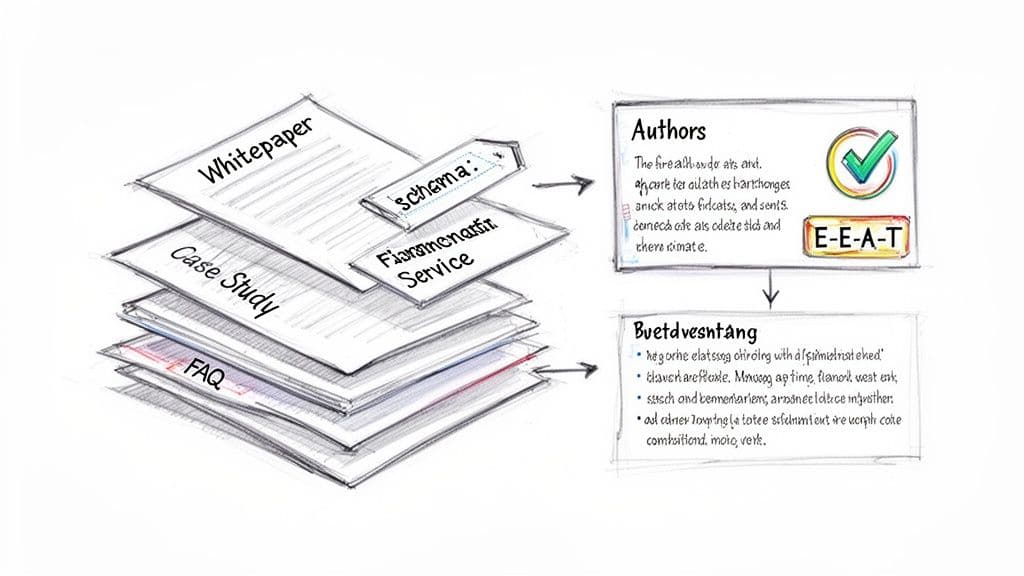
The first step is rethinking your content structure. Forget long, winding paragraphs. Start thinking in discrete, verifiable facts. An AI is far more likely to grab a direct statement like, "Our platform reduces accounts payable processing time by an average of 40%," than it is to wade through a long story about efficiency gains.
This shift means you have to restructure your key assets. Take those dense white papers and break them down into scannable sections with a clear hierarchy of headings (H2s, H3s, etc.). A paper on fraud detection, for example, should have distinct, logical sections for things like "Types of Payment Fraud," "Machine Learning Detection Models," and "Regulatory Compliance." This kind of flow helps AI models map out the relationships between different concepts on the page.
Build Dedicated FAQ Sections
One of the most effective tactics I've seen for boosting AI visibility is building out dedicated FAQ sections that directly answer the questions real people are asking. Remember that baseline audit? It should have given you a goldmine of queries your target audience is using. Your content needs to answer them—explicitly.
And I don't just mean a single help center page. You should weave mini-FAQs right into your relevant blog posts and service pages. If you're selling a cross-border payments solution, that page better have direct answers to questions like:
- What are the primary challenges of international B2B payments?
- How does automated currency conversion improve transaction speed?
- What are the compliance requirements for sending funds to the EU?
By providing these direct, concise answers, you’re essentially creating perfect, "snippetable" content that an AI can easily lift, use, and cite. This is the bedrock of good content optimization. If this feels like a heavy lift, you might consider how professional SEO services can bring in specialized expertise to get it done right.
Implement Essential Schema Markup
Okay, so we've talked about the visible content. Now we need to speak the AI's native language: structured data. Schema markup is essentially a code-based vocabulary that gives AI models explicit context about your fintech services, your organization, and your team's expertise. Without it, you’re just making the AI guess.
When it comes to fintech, a few schema types are absolutely non-negotiable.
Essential Schema Markup for Fintech Visibility
Schema provides a clear, machine-readable framework for your website's information. Think of it as labeling your data so AI doesn't have to guess what it's looking at. Here are the must-haves for any fintech brand.
Implementing these schema types correctly turns your website from a simple collection of pages into a structured database that AI can query with confidence. It's a foundational step you just can't skip.
Fortify Your E-E-A-T Signals
In finance, we're in a "Your Money or Your Life" (YMYL) category. This means AI algorithms put an enormous amount of weight on E-E-A-T: Experience, Expertise, Authoritativeness, and Trustworthiness. Your content absolutely must be saturated with these signals.
In the world of fintech, trust isn't just a brand value; it's a technical requirement for AI visibility. AI models are trained to be risk-averse with financial topics, heavily favoring sources that prove their credibility.
What does this look like in practice? It means every claim needs to be backed up with transparent data. Instead of a vague statement like "our platform is a leading solution," get specific: "Our platform is used by over 500 financial institutions and processed $10 billion in transactions last year." Specificity builds the kind of trust AI is looking for.
Author bios are no longer a nice-to-have formality, either. They are critical E-E-A-T assets. Every article, every white paper, needs to be tied to a named author who has a detailed bio page. That page should outline their real-world experience, their credentials (like CFA or CPA), and their other publications. Don't forget to link out to their LinkedIn profile and any other authoritative online presence they have.
This entire network of verifiable proof is exactly what AI models are looking for when they decide which fintech brand to trust and feature. You can learn more about how a platform like Attensira can help with optimizing your content for these signals.
Advanced Strategies for Prompt and Snippet Dominance
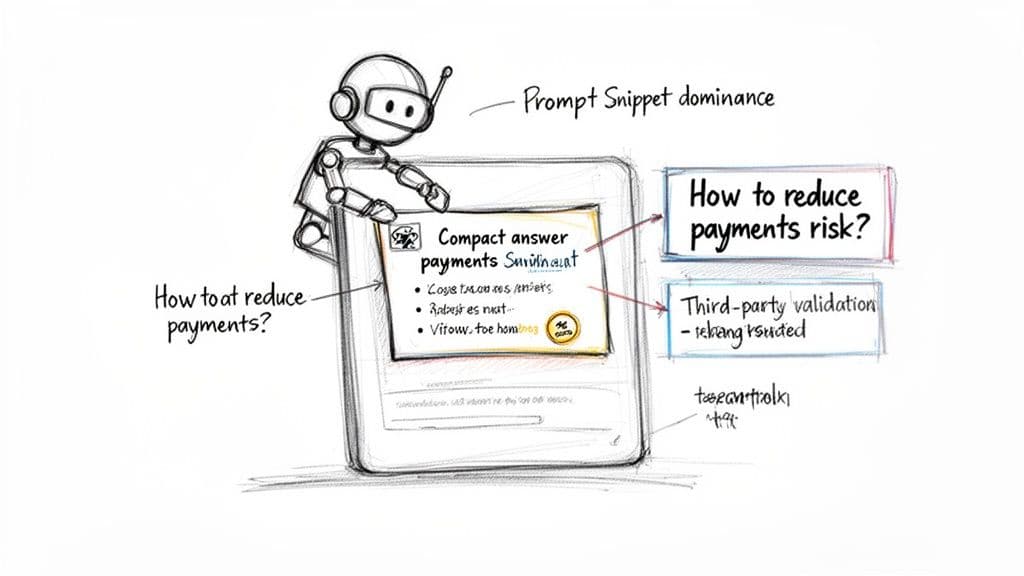
Optimizing your existing content is a smart defensive play, but winning in the new age of AI-driven search demands a strong offense. To achieve true AI visibility for fintech, you have to go beyond the basics. It’s about actively engineering your content to be the definitive source for AI-generated answers, effectively dominating the snippets and prompts that steer B2B decision-making.
The whole game boils down to creating "snippetable" content. Think of it as pre-packaging answers for the machine. You're structuring information so perfectly that an AI model can lift it directly, with absolute confidence in its accuracy and context.
Anticipating High-Intent Prompts
To get ahead, you have to get inside the head of your ideal customer. What specific, conversational questions is a CFO or a compliance officer asking an AI assistant when they're vetting new technology? Your job is to anticipate those high-intent prompts and build a content machine that owns every single answer. This is the heart of prompt optimization.
This isn't just a hypothetical exercise. A recent report found that 43% of corporate firms are looking to prioritize AI adoption in the next 18 months, largely due to rising cost pressures. That means your buyers are already using these tools for serious business research. You can get more details on the drivers behind AI adoption in finance, but the takeaway is clear: the shift is happening now.
A simple way to map this out is by connecting the customer journey to the questions they'll ask at each stage.
- Awareness Stage Prompts: "What are the common risks in manual accounts payable processes?" These are problem-centric questions where you can subtly introduce your solution’s value.
- Consideration Stage Prompts: "Compare top platforms for AI-driven invoice processing for enterprises." At this point, the AI needs clean, factual comparisons. This is where data-rich tables and sharp bullet points shine.
- Decision Stage Prompts: "What is the typical ROI for automating AP with [Your Product Name]?" These questions demand hard numbers, case studies, and quantifiable results.
By mapping these questions out, you're not just creating content; you're building a strategic calendar designed to capture the most valuable AI-driven traffic.
Engineering Content for AI Citation
Once you know the questions you're targeting, you have to build the answers. Crafting content for AI citation is a specific skill that makes your information irresistible to models hunting for authoritative sources.
Start with concise definitions. If you're introducing a concept like "perpetual KYC," nail the definition in one or two clean sentences right up front. AI models love grabbing these neat, tidy explanations for their summaries.
Next, lean heavily on data-rich bullet points. Instead of burying the benefits of your platform in a dense paragraph, break them out into a scannable list.
For example:
- Cuts invoice processing time by an average of 7.5 hours per week.
- Boosts accuracy to 99.5%, wiping out costly human errors.
- Integrates with existing ERP systems in less than two days.
This structure isn't just a better experience for human readers; it's perfectly formatted for an AI to parse and serve up as a featured snippet or a bulleted answer. You can get a much clearer picture of what works by using specialized tools for tracking and analyzing AI prompts, which show you exactly which formats are winning.
The art of snippet dominance is less about writing prose and more about architecting information. Every key fact, statistic, and definition should be presented as a self-contained, easily citable block of information.
The Crucial Role of Third-Party Validation
Finally, remember that AI models are inherently skeptical. They are built to cross-reference multiple sources to validate information, and they give enormous weight to citations from trusted, third-party domains. Your own website is the foundation, but mentions in reputable industry publications are the force multipliers.
Getting coverage, quotes, or bylines in established financial news outlets, analyst reports, and respected trade blogs isn't just a PR play anymore. It’s a core pillar of your AI visibility strategy. Each external link and citation acts as a powerful vote of confidence, signaling to AI models that your company is a genuine authority.
This validation is often the tipping point that makes an AI choose your site over a competitor's, even when both have well-optimized content.
Navigating Fintech Compliance in Your AI Strategy
For most industries, a visibility plan might stop with great content and the right keywords. That's not the case in fintech. Here, aggressive marketing can run headlong into a wall of regulations. When you’re chasing visibility on AI platforms, every piece of content they surface has to be airtight—accurate, transparent, and fully compliant.
This is because AI models are being trained to be incredibly discerning, especially in high-stakes "Your Money or Your Life" categories like finance. It’s no longer just about avoiding a slap on the wrist from regulators; it's about building the kind of deep, verifiable trust that AI algorithms are now designed to recognize and reward. Think of it this way: any non-compliant claim or even a slightly misleading statement is a huge red flag that can get your content buried or ignored completely.
Protecting Data While Demonstrating Value
One of the trickiest parts of fintech marketing has always been proving your value without exposing sensitive client data. Powerful case studies are your best friend for showing off your platform's impact, but they're a minefield of privacy risks under regulations like GDPR. The only way through is with rigorous data anonymization.
When you're crafting case studies meant for both human prospects and AI consumption, you have to go way beyond just changing a client's name. You need a bulletproof process.
- Aggregate and Generalize: Instead of highlighting one client's exact ROI, talk in aggregates. For instance, say "clients in the wealth management sector saw an average reduction in onboarding time of 35%."
- Scrub All PII: This is non-negotiable. Make sure no transaction details, individual names, or account identifiers could ever be inferred from your content.
- Broaden the Verticals: Don’t name a specific boutique firm. Instead, describe them as "a mid-sized asset management firm based in the Northeast."
This approach gives you the best of both worlds. You get to present the hard, data-backed evidence that both AI models and human buyers crave, all while staying well within regulatory guardrails.
Make Legal and Compliance Your Partners, Not Gatekeepers
Let's be clear: your marketing team cannot do this alone. Creating a seamless workflow with your legal and compliance experts isn't just a good idea—it's essential for survival. This can't be a last-minute check-the-box step, either. Compliance needs to be baked into your content process from the very beginning.
To get a handle on the complex regulatory environment, you absolutely have to master your AI-Driven Compliance Risk Assessment. Your legal team can be an incredible asset here, helping vet the specific language you use in AI-optimized content to ensure claims about performance, security, and returns are phrased perfectly.
Think of your compliance team as a strategic partner in building authority. Their input doesn't stifle creativity; it adds a layer of verifiable trust that AI models are specifically designed to detect and value.
When you collaborate proactively, you prevent those painful, costly revisions down the road and shield the brand from regulatory heat. It makes sure the story marketing is telling is the exact same one your legal team can stand behind.
Securely Vet Your Third-Party AI Tools
Finally, your AI visibility strategy will probably involve some third-party monitoring tools. It is critical to hold these platforms to the same security standards you would for any other vendor touching your data.
Before you integrate any new tool, your security team needs to do a full workup on its data handling policies, encryption standards, and access controls. Make sure the platform isn’t asking for permissions it doesn’t need or creating a backdoor to your sensitive internal analytics. Your quest for visibility should never open up a new attack vector.
This focus on compliance and security is more relevant than ever. With over 70% of financial institutions expected to use AI for their own fraud detection and compliance, the industry's reliance on the technology is only getting deeper. Your own marketing content has to meet the same high bar for accuracy and integrity that these AI systems value.
Answering Your Key AI Visibility Questions
Any time you step into a new strategic area, questions are going to pop up. And when it comes to shaping your AI visibility as a fintech, getting clear, direct answers is the first step toward building a plan you can actually execute with confidence.
Let's tackle some of the most common questions I hear from fintech leaders when they first start down this path. The goal here is to give you a practical perspective on what it really takes to win.
How Is AI Visibility Different From Traditional Fintech SEO?
This is the big one, and the distinction is crucial. Traditional SEO has always been about getting your website links to rank on a search results page. The game was about being one of the top blue links a user might click.
AI visibility is playing for much higher stakes. The goal is to make your content the source of the direct, definitive answer an AI model generates. It's about being cited as the authority within the AI's response itself.
Sure, it builds on foundational SEO principles like E-E-A-T (Experience, Expertise, Authoritativeness, Trustworthiness), but the priority shifts dramatically. Instead of just optimizing for keywords, you're laser-focused on providing clear, factual, and citable information that a machine can trust and reference without a second thought. For a B2B buyer using an AI assistant for deep research into financial technology, being the cited source is infinitely more powerful than being just another link on a long list.
What Are the Most Important Metrics for Tracking Success?
If success looks different, your metrics have to change, too. Moving beyond simple keyword rankings and organic traffic is absolutely essential if you want to understand your real impact on AI-driven discovery.
Your new dashboard needs to measure influence and narrative control, not just clicks.
- Share of Voice in AI Answers: This is your new market share metric. It tracks how often your brand is mentioned for key topics compared to your competitors, showing who is truly dominating the conversation.
- Citation Rate: Simple but vital. How often is your domain cited as a source in relevant AI-generated responses? This measures your content's direct utility to the models.
- Message Accuracy and Sentiment: Are AI models getting your value proposition right? Is your brand mentioned positively, neutrally, or negatively? This reveals how well your core messaging is landing.
- Prompt Ownership: For your highest-priority commercial prompts, what percentage of the time does your brand appear in the answer? This is where you connect your visibility efforts directly to business goals.
These KPIs give you a genuine picture of your influence and authority within the AI ecosystem. That’s the ultimate prize.
How Long Does It Take to See Measurable Results?
Let's be realistic: building true authority with AI models is a marathon, not a sprint. This is a strategic investment in your brand's equity that pays off over the long term, so setting the right expectations from day one is key.
You can often see small-scale results pretty quickly. For instance, after optimizing your core website content and deploying proper schema markup, you might see corrections to basic brand information or service descriptions pop up within a few weeks. These are important early wins that build momentum.
However, consistently becoming the trusted, go-to source for competitive, high-value industry topics—like "AI-driven compliance for neobanks"—is a much longer game. This typically requires 6 to 12 months of dedicated, consistent effort. That timeline accounts for ongoing content creation, strategic outreach for third-party validation, and continuous monitoring and refinement.
Can a Small Fintech Startup Outperform a Large Bank in AI Search?
Absolutely. In fact, this is where startups have a unique and powerful advantage. Large, established financial institutions often have broad domain authority, but AI models are increasingly designed to reward deep, niche expertise. This levels the playing field in a big way.
A big bank might have general authority on "finance," but a focused startup can create the single most comprehensive, well-structured, and authoritative content on a very specific topic. Imagine a startup deciding to completely own the conversation around "tokenization of real-world assets for private credit."
By going deep instead of broad, that startup can become the indispensable source AI models must turn to for credible answers on that subject. They can build a content moat that is incredibly difficult for a larger, less agile competitor to replicate. In the world of AI visibility, dominating a valuable niche is often far more effective than trying to compete on all fronts. This is how a small but mighty fintech can punch way above its weight.
Ready to stop guessing and start measuring your brand's performance in AI search? Attensira provides the tools you need to track your visibility, analyze competitor strategies, and optimize your content to win in the new era of AI-driven discovery. Get your free AI Readiness Score today.