Discover how ai search optimization agency los angeles can boost ROI with proven strategies. Learn to set goals, ask the right questions, and hire smarter.
Finding the right AI search optimization agency in Los Angeles isn't just about planning for the future anymore.It’s a critical move for staying relevant and growing right now. The way your customers find you is changing fast, with AI assistants becoming their go-to source for answers. If you’re not showing up in those AI-generated results, it's hitting your bottom line whether you see it yet or not.
Why Los Angeles Businesses Need to Get Serious About AI Search Visibility

The entire foundation of digital marketing is shifting, and businesses in Los Angeles are right at the heart of it. We're all used to the classic customer journey: they type a query into Google, click a link, and land on a website. But that’s being replaced by something more direct—conversational questions fired at AI answer engines like ChatGPT, Perplexity, and Gemini.
This isn't just another algorithm update. It's a complete overhaul of how people discover information.
For a cutthroat market like L.A., where you fight for every single customer, this change has very real consequences. Traditional SEO is still vital, of course, but it’s no longer the whole story. You can be sitting at the top of Google’s search results but be completely invisible when an AI pulls together an answer for a potential customer.
The Real-World Impact on L.A. Companies
Let’s think about a B2B tech firm in Downtown L.A. They’ve relied on a solid SEO strategy for years, and it's always brought in a steady flow of good leads. But over the last quarter, they’ve seen a 15% dip in inquiries. Their keyword rankings haven’t budged, and their organic traffic looks fine in the analytics reports. So what gives?
What they can’t see is that a growing chunk of their audience—product managers, CTOs, decision-makers—has started using AI for their initial research. Instead of wading through pages of search results, they’re asking things like, "What are the top enterprise software solutions for logistics management based in Southern California?"
If your company's data, expertise, and brand aren't being cited by these AI models, you simply don't exist in these critical conversations. This is where market share starts to quietly disappear.
The Clock is Ticking on AI Search Optimization
This isn't some far-off problem. This shift in user behavior is happening incredibly fast. The 2025 Previsible AI Traffic Report shows that traffic from large language models has exploded, jumping 527% year-over-year. That kind of acceleration signals a fundamental change in how people find what they’re looking for, making it urgent for businesses to adapt.
For any business operating in Los Angeles, this means a few things:
- Your Lead Funnel is Changing: Potential clients are getting direct answers, completely bypassing the traditional website visit. Being in that answer is the new conversion.
- Brand Authority Has a New Meaning: AI models build their answers by referencing sources they deem trustworthy and authoritative. The new goal is to become one of those primary sources.
- Your Competitors Are Already Moving: The early adopters of AI search optimization are scooping up the visibility your business is losing. In a crowded market like this one, that advantage adds up fast.
Ignoring your visibility in AI search today is like ignoring mobile optimization ten years ago. It’s a mistake that will cost you relevance and, ultimately, revenue. Before diving deep into AI, it's wise to ensure your foundational online presence is solid. Our comprehensive local SEO checklist is a great place to start.
From there, working with a specialized AI search optimization agency in Los Angeles is the surest way to secure your brand's place in this new reality.
Know What You Want: Defining Success in AI Search
Before you even think about interviewing an AI search optimization agency in Los Angeles, you have to know what you’re trying to accomplish. If you don’t have a crystal-clear picture of what success looks like, you’re just hiring a pilot without giving them a destination. The goal isn’t vaguely to "show up in AI." It’s about strategically owning the exact conversations that drive revenue.
Vague goals like "increase brand awareness" just won't cut it here. Your objectives need to be built for the reality of AI-powered search. This means thinking past traditional SEO metrics and zeroing in on what actually moves the needle for your business.
It's About Influence, Not Just Rankings
The first mental shift you need to make is from "rankings" to "influence." In the world of AI search, winning means your brand becomes the trusted source that large language models cite when they answer a user's question. This requires a much more sophisticated approach to setting goals.
Here are a few powerful, actionable goals you should be thinking about:
- Own High-Intent AI Answers: Set a target to have your company named when people ask buying questions, like, "What are the best B2B SaaS solutions for supply chain management?"
- Become the Definitive Source: The goal here is for AI engines to point directly to your service pages as the primary source of truth for key topics in your industry.
- Systematically Displace Your Competitors: Pinpoint the important industry summaries where your competitors are getting featured. Then, set a clear goal to replace their talking points with your own expertise.
These kinds of objectives are concrete. They’re directly tied to capturing market share in this new channel, and they give any potential agency a clear brief to work from.
Your New Scorecard: KPIs for the AI Search Era
Once your high-level goals are locked in, you need to define the Key Performance Indicators (KPIs) you'll use to measure progress. These aren't the same metrics you're used to seeing in a standard SEO report. For a deeper dive, it's worth taking time to learn more about tracking modern SEO visibility and search metrics to see just how much the landscape has shifted.
Your AI search KPIs should give you an undeniable view of your brand’s authority and influence.
An effective AI search strategy isn’t measured by how many keywords you rank for, but by how often your brand is the answer. This distinction is everything when it comes to understanding ROI and guiding your agency's work.
Any top-tier AI search optimization agency in Los Angeles will be obsessed with helping you track and improve these specific data points.
Key AI Search Metrics to Obsess Over
- Share of AI Voice: Think of this as market share for AI conversations. It’s the percentage of times your brand is mentioned in AI-generated answers for your target queries versus your competitors. This is the ultimate visibility metric.
- Citation Frequency: This counts how often AI models link to or mention your website as a source. A higher count is a direct signal of trust and authority.
- Sentiment Analysis: It’s one thing to get mentioned, but it’s another to know how you’re being talked about. This KPI tracks whether your brand is portrayed positively, neutrally, or negatively in AI responses.
- Answer Accuracy: This is a proactive one. It involves keeping an eye on AI answers for any factual errors related to your brand or industry. You then create content to correct the record, further establishing your company as the reliable source.
Platforms like Attensira are built specifically to benchmark these metrics. When you have this data before you even talk to agencies, you’re starting the conversation from a position of incredible strength. You can hand them a clear baseline and ask, "How, specifically, are you going to move these numbers?" This data-first approach turns your search for an agency from a shot in the dark into a truly strategic decision.
How to Properly Vet a Los Angeles AI Search Agency
Finding the right AI search optimization agency in Los Angeles is a whole different ballgame than hiring for traditional SEO. Let's be honest—a lot of firms are just slapping an "AI" label on their old SEO packages. Your job is to see through the hype and find a partner who truly gets this new landscape.
This isn’t about falling for a slick sales deck. It's about getting your hands dirty, digging into their methods, challenging their tech, and demanding proof that they know how to influence AI-generated answers, not just rank web pages.
Analyzing Case Studies for True AI Impact
First things first, tear their case studies apart. A portfolio packed with the usual SEO wins—better keyword rankings, more organic traffic—is table stakes. It’s not enough anymore. You need to see cold, hard evidence that they can make a dent in models like ChatGPT, Gemini, and Perplexity.
Here’s what you should be hunting for:
- Real AI Metrics: Do their reports mention things like "Share of AI Voice" or "Citation Frequency"? If all you see are standard SEO KPIs, it’s a sign they’re still playing the old game.
- Before-and-After AI Snapshots: A great case study will literally show you the receipts. They should have screenshots of what an AI chatbot said before they started, and then clear examples of how their client is featured after their work kicked in.
- A Clear Strategic Story: The case study needs to tell you why they did what they did. Did they spot a competitor owning the AI conversation and build a plan to take that spot? Did they find factual errors about their client and successfully get them corrected?
A case study that just vaguely claims "improved AI presence" without proof is a massive red flag. You want an agency that measures what actually matters in this new world.
Scrutinizing the Technology Stack
An agency’s tech stack tells you everything about how seriously they take AI search. If they’re still leaning on the same old SEO tools from five years ago, they are not equipped for what’s coming. When you talk tech, you need to understand how they’re gathering intel and measuring results.
Don’t be shy; ask them directly:
- What platforms are you using to track our brand mentions and citations across the major LLMs?
- How are you monitoring our competitors' visibility inside generative AI answers?
- Can you show me your process for finding the content gaps that these AI models are trying to fill?
This is where specialized tools like Attensira come in. They’re built specifically to provide the data needed to create and run a genuine AISO strategy. An agency that has invested in modern, AI-focused analytics is putting its money where its mouth is.
The right tech stack isn't just for pulling reports; it's for finding openings. A sharp agency uses its tools to spot strategic opportunities—like topics where AI models are hesitant—and then crafts content to become the authority.
If you want a broader framework for evaluating partners, this guide on how to choose a digital marketing agency offers a solid checklist that’s useful beyond just the AI search niche.
The Litmus Test: A Deep Dive into Their Process
Okay, the final piece of the vetting puzzle is getting a handle on their strategic process. This is where you separate the button-pushers from the real strategists. A legitimate AI search optimization agency in Los Angeles won’t just talk about "making content." They’ll walk you through a data-backed cycle of analysis, execution, and measurement.
This decision tree illustrates how your specific business goals should dictate the entire strategy.
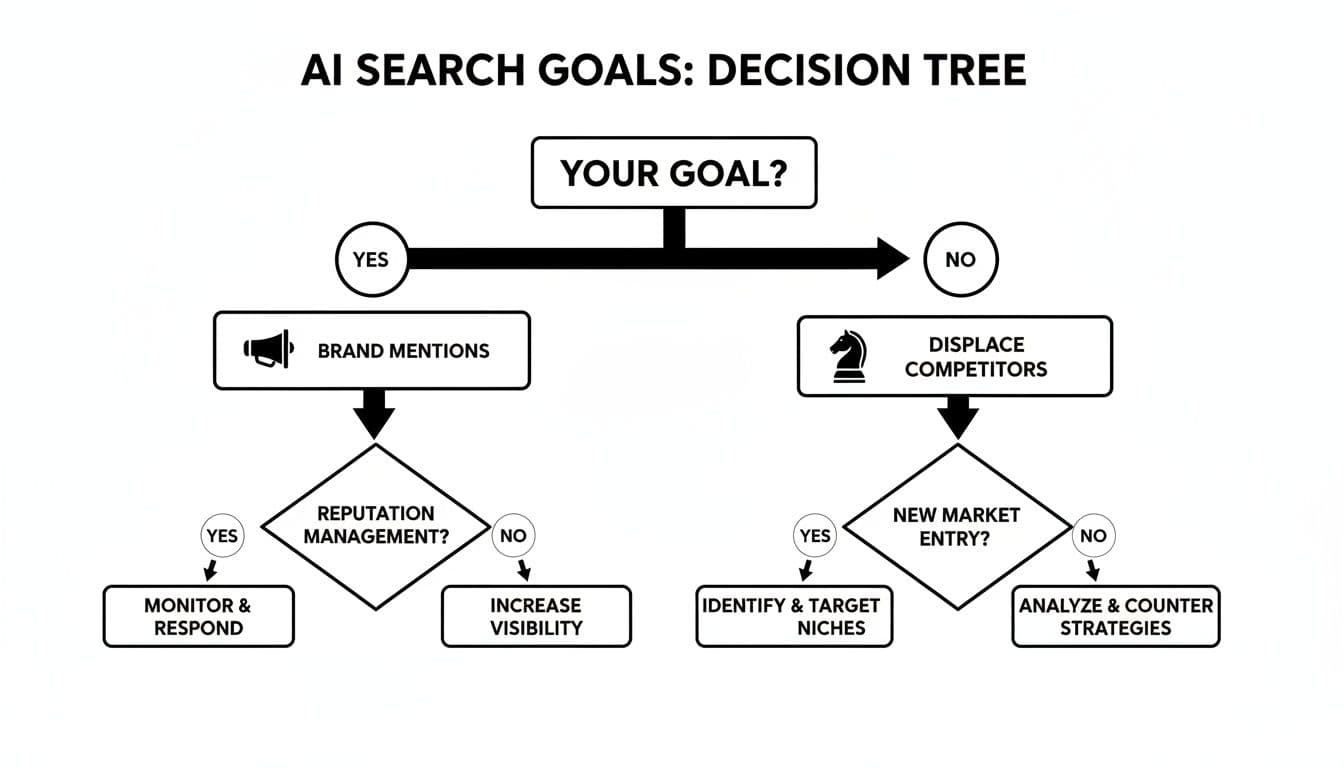
Whether your goal is simply to get your brand mentioned more often or to actively displace a competitor from the top AI answers, the agency's methodology has to be tailored. A one-size-fits-all approach just won't cut it.
They need to clearly explain their playbook for a few key areas:
- Auditing and Benchmarking: How will they figure out where you stand right now in the AI ecosystem before a single dollar is spent?
- Entity Optimization: What’s their method for cementing your brand as a trusted entity in the "mind" of an AI? This goes way beyond keywords.
- Content Strategy: How do they decide what content to create or update so it has the best shot at being cited by an LLM?
- Reporting and Adaptation: How often will you see reports on AI-specific KPIs, and how does that data actually change their strategy month to month?
A confident, experienced agency will welcome these tough questions. They'll have sharp, detailed answers that are clearly part of a repeatable process. If you get vague, hand-wavy responses, it’s a clear signal they don’t have the specialized expertise you need.
And for those thinking beyond the LA market, you might find our guide on vetting an AI search optimization agency in Canada useful for comparison.
AI Search Optimization Agency Evaluation Checklist
To help organize your thoughts, use a structured checklist. This isn't just about ticking boxes; it's about systematically comparing how different agencies stack up on the things that truly matter for AI search success.
This checklist forces a direct comparison and helps you move past the sales pitch to see which agency has the genuine capability to deliver results in this new and critical channel.
Key Questions That Reveal True Expertise
Once you have a shortlist of agencies, it's time to dig deeper. Asking boilerplate questions like, "What's your process?" will get you a polished, rehearsed sales pitch. To find a real partner, you need to ask questions that force them off-script and reveal how they actually think.
The aim here is to separate the agencies that just talk about AI search from those who genuinely understand it. A top-tier AI search optimization agency in Los Angeles will have specific, data-backed answers that showcase a sophisticated grasp of this new discipline.
Probing Their Strategic Acumen
Start by seeing if they can connect AI visibility to real business goals. This is a common stumbling block; many agencies get stuck on vanity metrics and can't draw a straight line to revenue. Their ability to bridge this gap is a massive tell.
Push them past the fluff with questions like these:
- "Walk me through an example where you improved a client's visibility in AI answers. How did you specifically tie that work to their core business goals, like generating leads or increasing sales?"
- "What's your methodology for finding the most valuable conversational queries for a business in our industry? How do you decide which AI-driven conversations are worth targeting first?"
- "How do you measure the ROI of AI search optimization beyond just brand mentions? What specific metrics are you tracking?"
A real expert will talk about things like Share of AI Voice, sentiment analysis within AI-generated responses, and tracking how citations from AI answers lead to actual conversions. If their answers keep circling back to traditional SEO metrics, that's a red flag.
Digging into Technical and Tactical Knowledge
Next, you have to validate their technical chops. AI search optimization isn't a one-size-fits-all game. The Large Language Models (LLMs) that power platforms like ChatGPT, Perplexity, and Gemini all have unique algorithms and pull data from different places. A competent agency gets these nuances.
Explore their tactical approach with a few sharp queries:
- "How do you tailor your content and data strategies for different LLMs? For instance, how would your game plan for influencing Gemini differ from your approach for Perplexity?"
- "What does your 'AI visibility audit' process look like? What specific tools are you using to benchmark a client’s current position against their competitors?"
- "Explain your strategy for entity optimization. How do you ensure an AI model correctly understands who our company is, what we do, and why we're an authority?"
A truly proficient agency won't just talk about creating content; they'll discuss building a comprehensive knowledge graph around your brand. This involves structuring data, securing authoritative citations, and ensuring factual consistency across the web to make your brand an undeniable source of truth for AI models.
If their answers sound like a recycled SEO content strategy, they probably don't have the specialized skills this work demands. For a look at how vetting differs in another major market, our guide to finding an AI search optimization agency in London offers some valuable cross-market insights.
Identifying Potential Red Flags
Asking the right questions is only half the battle. You also have to listen for the wrong answers. Certain responses can immediately signal a lack of deep expertise or a reliance on old, ineffective methods. Keep your ears open for these warning signs.
Common Red Flags to Watch For
- Over-reliance on Traditional SEO Metrics: If they keep steering the conversation back to keyword rankings and organic traffic, they might not understand the specific KPIs for AI search.
- Vague Methodologies: Be wary of anyone hiding behind a "secret sauce" or a "proprietary process" they can't explain in plain English. A confident expert is transparent.
- Lack of a Clear Reporting Structure: Ask for a sample AI visibility report. If they show you a standard SEO dashboard with a new label, they aren't tracking what really matters.
- No Mention of Different LLMs: Treating every AI platform as if it's the same is a clear sign of surface-level knowledge. They should be able to articulate the distinct character of each major AI answer engine.
Ultimately, your goal is to find an AI search optimization agency in Los Angeles that thinks more like a data-driven PR firm for the AI era and less like an SEO shop from five years ago. Their answers should give you the confidence that they have the deep, specialized expertise to make your brand the definitive answer in your space.
Integrating Your New Agency for Maximum Impact
You’ve signed the contract with your chosen ai search optimization agency in Los Angeles. It’s a big step, but this isn't the finish line—it’s the starting block. What happens next, in the first few weeks, will set the tone for the entire relationship.
A clunky, disjointed onboarding process creates friction and wastes precious time. But when you treat your new agency as an extension of your own team from day one, you build momentum that can produce powerful, immediate results. The goal is to create a seamless partnership where everyone operates from a single source of truth, focused squarely on driving real ROI.
Laying a Foundation with Shared Data
The fastest way to get your new agency up to speed is to give them the keys to your data. Don't make them spend the first month on a painstaking discovery phase, manually piecing together your AI search footprint. You can short-circuit that entire process.
By plugging them directly into a platform like Attensira, you give them an instant, comprehensive view of your baseline metrics. They can immediately see your current Share of AI Voice, size up the competition, and spot content gaps that need attention. This simple move transforms their first few weeks from a slow-drip data-gathering exercise into a rapid-fire strategy session.
Think of it this way: Your new agency partnership is an investment. Giving them day-one access to your data stack is the single best way to maximize its early returns. They can start executing winning strategies in days, not months.
This immediate access does more than just save time. It signals trust, establishes transparency, and aligns both teams around the same set of challenges and opportunities right out of the gate.
A Practical Onboarding Roadmap for Fast Action
A well-structured onboarding process is less about formal introductions and more about practical integration. It's about getting your agency’s hands on the tools they need to start delivering value.
Here's a simple roadmap to make sure your new partners hit the ground running:
- Immediate Tool Access: Don't wait. On their first official day, grant them logins to Google Analytics, Search Console, your CRM, and—most importantly—your AI visibility platform like Attensira.
- Schedule a Data Deep-Dive: Your first big meeting shouldn't be a generic kickoff call. Make it a workshop. Dive into the data together, review your AI performance benchmarks, and agree on the highest-priority queries to tackle first.
- Establish a Communication Rhythm: Set up a shared Slack or Teams channel for quick, daily communication. A bi-weekly strategy call is perfect for keeping everyone aligned on the bigger picture. The key is consistent, easy communication.
- Co-Create a 90-Day Plan: Work with your agency to build a concrete, measurable action plan for the first three months. Define what success looks like. This could be anything from increasing citations for a key service by 15% to displacing a specific competitor in two high-value AI answers.
This platform, shown in the screenshot below, provides the kind of unified dashboard that can serve as the command center for your collaborative efforts.
When both your team and your agency are looking at the same dashboard, strategy discussions become far more productive and grounded in reality.
Measuring Success as One Team
Success isn't "their" metric—it's a shared one. The KPIs you defined when setting your goals are now the scorecard for the partnership. The reports your agency delivers should speak directly to these numbers, offering a clear and honest look at what’s working and what isn’t.
And remember, all this strategic work needs to be built on a solid technical foundation. If you haven't done one recently, it's wise to learn how to do a site audit or have your new agency kick things off with a thorough technical review. It ensures you aren’t building your strategy on shaky ground.
Ultimately, bringing on a top ai search optimization agency in Los Angeles is about creating a symbiotic relationship. By empowering them with data, setting up clear processes, and focusing on shared goals from the very start, you turn a simple vendor agreement into a powerful growth engine for your business.
Your Top Questions About AI Search Optimization Answered
The shift to AI-driven search is happening fast, and it’s kicking up a lot of questions. For most business leaders I talk to in Los Angeles, this new world feels both critically important and incredibly confusing. Let's cut through the noise and get to some direct, practical answers for the most common questions I hear.
These aren't just hypotheticals. They're the real-world concerns from companies on the ground, figuring out how to adapt and win right now.
What’s the Real Difference Between SEO and AI Search Optimization?
This is the big one, and it gets to the heart of the strategic shift. Traditional SEO has always been about getting your webpages to rank on Google. You fight for that top spot so someone clicks a link and lands on your site.
AI Search Optimization (AISO) plays a different game. The goal isn't just a click—it's to get your brand, your data, and your expertise featured directly inside the AI's generated answer. You want to become the trusted source the AI model quotes.
Now, a strong SEO foundation is still non-negotiable. A technically sound website and high-quality content are table stakes. But AISO requires a completely different layer of strategy on top of that.
It's a laser focus on:
- Structured Data: You have to make it dead simple for AI models to read, understand, and categorize your information. Think of it as labeling your data for machines.
- Factual Accuracy: Every single claim on your site must be verifiable and easy to cite. AI models are getting ruthless about penalizing ambiguity or unproven statements.
- E-E-A-T Signals: Your entire digital footprint needs to scream Experience, Expertise, Authoritativeness, and Trustworthiness.
An expert AI search optimization agency in Los Angeles gets these nuances. Their strategies are built for this new reality, going far beyond old-school keyword rankings.
How Long Until We See Results from an Agency?
Every business needs to know when they'll see a return, and that’s a fair question. With traditional SEO, you're often told to buckle in for a 6-to-12-month journey before you see significant movement.
AISO can often deliver early wins much faster, sometimes within 2-4 months.
Why the quicker feedback? AISO often starts by optimizing your existing, authoritative content with citable facts and a clearer structure that AI models can digest and adopt almost immediately. I've seen cases where simply correcting a factual error or adding a crucial statistic gets a client cited in AI answers in just a few weeks.
But let's be realistic. Getting a few mentions for niche, long-tail questions is an early win. Becoming the dominant, go-to source for broad industry topics is a long-term commitment. That takes sustained, strategic effort.
Any credible agency will give you a phased roadmap. It should have clear, tiered goals for both the quick wins and the long-term dominance you're after.
Should We Manage AI Search Optimization In-House or Hire an Agency?
It’s tempting to think about keeping AISO in-house, but the practical challenges are huge. The technology and best practices are literally changing by the week as AI models update their algorithms.
An internal team would need:
- Dedicated Resources: This isn't a side project. You'd need at least one person focused almost exclusively on AISO.
- Specialized Tools: You can't fly blind. Subscriptions to AI visibility tracking platforms are essential for measurement.
- Deep Expertise: This is a brand-new discipline. Staying on top of it requires constant learning and immersion.
For the vast majority of businesses, bringing in an AI search optimization agency in Los Angeles is simply the smarter, more efficient path. They bring the focused knowledge, the tech stack, and the experienced team needed to get the job done right, letting your people focus on what they do best.
A hybrid model is often the sweet spot. Your in-house team can use a platform like Attensira to monitor performance and collaborate directly with your agency partner. This creates a powerful partnership built on shared data and aligned goals.
What Budget Should We Expect for an AI Search Agency in Los Angeles?
Let's talk money. AISO service costs really depend on the scope of work, how competitive your industry is, and the agency's level of expertise.
In a competitive market like Los Angeles, you should expect comprehensive retainer agreements to start in the low thousands of dollars per month. For large companies or those in fiercely contested sectors, that number can scale up significantly.
The key is to frame this as an investment, not a cost. This is rapidly becoming a primary channel for customer acquisition. When you're looking at proposals, zero in on the strategic value and potential ROI, not just the monthly fee. A top-tier agency will provide a detailed scope of work with clear deliverables tied directly to the AI-specific KPIs we've discussed.
Ready to make your brand the definitive answer in your industry? Attensira provides the data and insights you need to build a winning AI search strategy. Learn more about Attensira and start tracking your AI visibility today.