Discover how CMOs vet and hire a top ai search optimization agency london. This guide covers briefs, KPIs, and red flags for maximizing ROI.
The ground is moving beneath our feet. For years, we've all played the same SEO game, but the rise of AI-driven search is changing the rules entirely. If you're a CMO in a cut-throat market like London, this isn't just another trend to watch. It's a seismic shift in how people discover your brand, making a dedicated AI search optimization agency less of a luxury and more of a necessity.
Why You Should Be Looking for an AI Search Optimization Agency, Not Just an SEO One
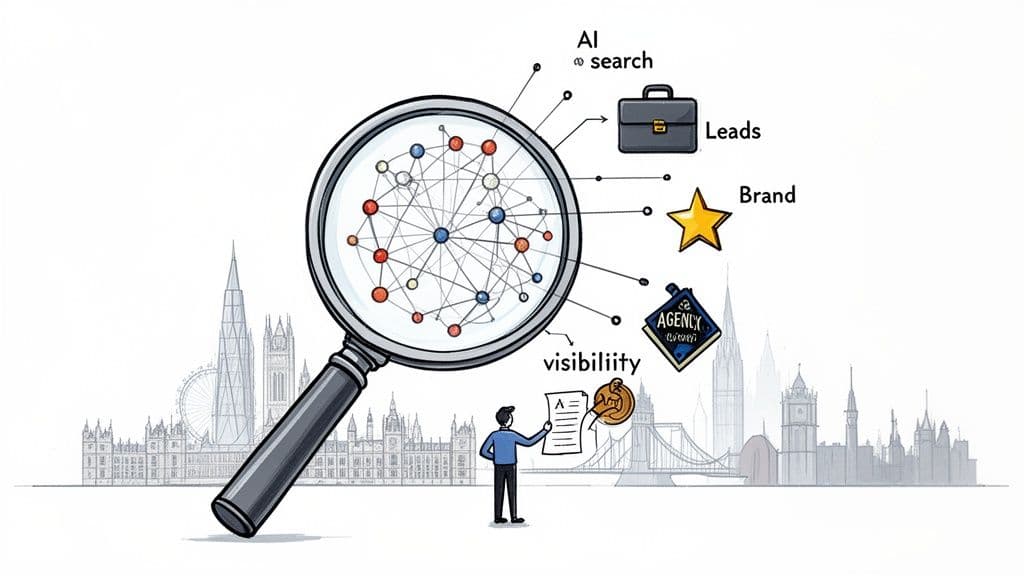
The conversation has moved beyond simply ranking on a page of blue links. Now, it’s about becoming the authoritative source cited directly within an AI-generated answer. For any marketing leader, particularly in a dense hub like London, this completely reframes what "search visibility" even means.
Ignoring this isn't a small mistake; it's a direct threat to your pipeline and market share. As your audience starts asking AI for complex recommendations, your brand's future depends on being mentioned, cited, and validated by these new digital gatekeepers.
The Case for Bringing in a Specialist
Trying to shoehorn AI search tasks onto your current SEO team is a recipe for frustration. It's a fundamentally different discipline. This isn't just "SEO 2.0"; it requires a unique blend of technical SEO, deep knowledge of large language models, entity optimization, and advanced data structuring.
I've seen many companies weigh the pros and cons of in-house vs. agency models for new functions. A specialized AI search agency brings a few things to the table that are incredibly difficult to replicate internally:
- Deep, Focused Expertise: Their world revolves around mastering how platforms like Perplexity, ChatGPT, and Gemini surface information. It’s their entire focus, not a side project.
- Purpose-Built Tech Stacks: They come equipped with proprietary tools and analytics platforms designed specifically to track and measure performance in this new ecosystem.
- Cross-Industry Intelligence: Working with multiple clients gives them a bird's-eye view of what’s actually working, offering strategic shortcuts your team would have to learn through painful trial and error.
This kind of specialization is what separates the winners from the losers in a new channel. You can get a better handle on the basics by reading our guide to AI search.
The Numbers Don't Lie
If you're still on the fence, just look at the market projections. The global AI search engine market was already valued at USD 16.28 billion in 2024. It's expected to rocket to USD 50.88 billion by 2033, reflecting a compound annual growth rate of 13.6%. This isn't a fad; it's a massive, permanent change in how people find information.
Partnering with an AI search optimization agency isn't about jumping on a trend anymore. It’s a defensive—and offensive—strategic move to future-proof your customer acquisition and ensure your brand remains visible in the next era of search.
Finding and Shortlisting the Right London Agencies
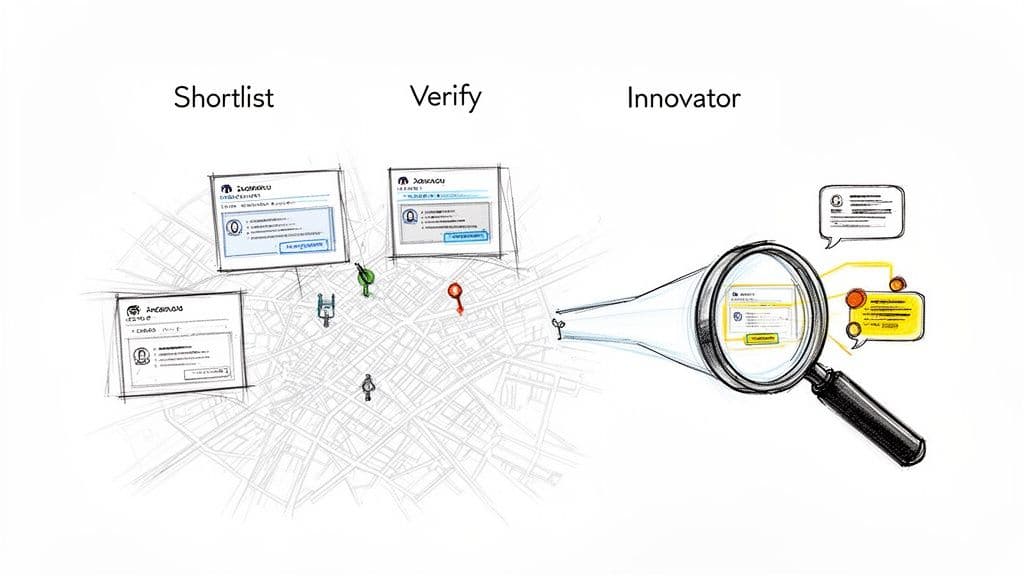
Finding a genuine partner in AI search optimization starts with looking in the right places. A quick Google search for an ai search optimization agency in London is tempting, but you'll likely just find the agencies best at traditional SEO for themselves. The real experts, the ones actually pioneering new methods, are usually found through more deliberate channels.
Think of your initial search as an investigation. You need to go where the real practitioners are. I've found the best leads by looking at speaker lists for London tech conferences or seeing who's active in niche marketing forums. These are the places where people share genuine insights, not just polished sales pitches.
The real challenge is separating the true innovators from the agencies that have just slapped "AI" onto their old service descriptions. A quick glance at their blog or case studies is revealing. Are they talking about entity optimization, knowledge graphs, and AI-driven visibility? Or is it just the same old SEO with a new buzzword?
Building Your Initial Longlist
At this early stage, the goal isn't deep analysis. It's about gathering a solid longlist of 8-10 potential agencies to screen.
You'll find the best candidates by exploring a few key avenues:
- Industry-Specific Networks: An agency that's already navigated the complexities of B2B SaaS will hit the ground running for you in a way a generalist simply can't. Look within your own sector first.
- Tech Community Referrals: Some of the most honest feedback I've ever received has come from private Slack and LinkedIn groups for CMOs. A recommendation from a trusted peer is worth its weight in gold.
- Thought Leadership: Don't just look for company names; look for individuals. Who is consistently publishing smart, forward-thinking content on AI search? The agencies they work for are often leading the charge.
This approach helps you find agencies that are truly invested in the space. For a more objective measure, you can also use platforms that track performance data. For example, you can review the UK agency leaderboard on Attensira to see who is actually delivering visibility.
Screening and Creating the Shortlist
Now that you have a longlist, it's time to get methodical and trim it down to your final 3-5 contenders. This is where you apply a much stricter filter, cutting through the marketing fluff to find agencies that align with your strategic goals. Your screening checklist is your gatekeeper here.
The single most important task at this stage is to verify every claim. An agency might talk a big game about AI, but their case studies need to show a direct line between their AI strategies and real business outcomes, like a measurable lift in brand mentions within AI-generated answers.
Here’s a practical checklist I use to evaluate agencies:
- Check Their Technical Chops: Who is actually on their team? I look for data scientists, machine learning specialists, and technical SEOs with deep experience in structured data. If these roles aren't present, they're not a true AI search agency.
- Scrutinize Their Testimonials: "They were great to work with" is useless. I want to see specific, AI-related results. A quote like, "They increased our visibility in generative AI results by 40%" tells me they understand what matters.
- Test Their Own Visibility: This one is simple but powerful. Go to a platform like Perplexity or ChatGPT and ask questions about their services. If an agency can't get itself found in AI search, that's a massive red flag.
Following this structured process saves an incredible amount of time. It ensures that by the time you're ready to send out an RFP, you're only talking to partners who have already demonstrated they have the right expertise.
Crafting a Brief That Attracts Elite AI SEO Talent
Throwing a generic, copy-pasted Request for Proposal (RFP) out into the world will only get you generic, copy-pasted replies. If you want to grab the attention of a top-tier AI search optimization agency in London, your brief needs to be a strategic document, not just a shopping list of services. It’s your first signal that you understand the fundamental shift in search and are looking for a true partner, not a simple vendor.
Think of your brief as the first, most crucial filter in your hiring process. The best agencies are selective. They want to sink their teeth into interesting, complex challenges with clients who are genuinely serious about growth. A sharp, well-thought-out brief proves you’ve done your homework and are ready for a sophisticated conversation.
Beyond Standard Business Goals
Of course, your brief needs the basics. Cover your company background, high-level business objectives (like increasing qualified leads by 20%), and who your target audience is. But to really hook an AI search specialist, you need to go deeper and frame your challenges in the language of modern search.
Don't just say, "we want to rank higher." That’s old-school thinking.
Instead, frame the problem around AI-driven visibility. For example: "Our primary challenge is our near-zero visibility in AI-generated answers for key commercial queries related to our core SaaS offering." This one sentence immediately tells a prospective agency that you’re focused on the right problem for today and tomorrow.
A brief that talks about entity optimization, knowledge graph integration, and brand mentions in AI responses will instantly cut through the noise. It proves you're not just looking for traditional SEO with a new label; you're seeking a partner to navigate this new search ecosystem.
This level of detail shows you're a sophisticated buyer. More importantly, it forces agencies to ditch their standard SEO pitch decks and respond with a genuinely tailored strategy. You’re not just buying a service; you're looking for a bespoke solution to a complex, modern marketing problem.
The Anatomy of a High-Impact Brief
To get the results you want, structure your brief to provide total clarity while demanding strategic thinking from anyone who responds. This approach saves everyone time and ensures the proposals you get back are actually comparable. Aim for comprehensive but concise.
Here are the essential components to include:
- Current Performance Benchmarks: Be transparent. Share current organic traffic, keyword rankings for your most important terms, and—if you have it—any initial data on your visibility in AI search.
- Specific AI Visibility Challenges: Get granular about the problem. For instance, "Competitor X is consistently cited as the authority in AI responses for 'best enterprise CRM software,' while our brand is completely absent."
- Technical Environment Overview: Let them know what they’d be working with. Mention your CMS, any marketing automation platforms like HubSpot, and your analytics stack. This helps them understand the technical constraints and opportunities from day one.
- Team Structure and Resources: Who will be their main point of contact? Do you have in-house content writers or developers they can work with?
- Budget and Timeline: Be upfront about your budget range and when you’d like to kick things off. This stops everyone from wasting time on proposals that are misaligned with your financial or operational realities.
Before you even start drafting, it helps to know where you stand. You can get a clear picture by understanding your AI readiness score, which provides powerful context to include in your brief.
Asking Questions That Reveal True Expertise
The questions you ask are the most powerful part of your brief. They are your primary tool for separating the true experts from the pretenders who just added "AI" to their homepage. Ditch generic questions like "What's your process?" and instead ask pointed, challenging questions that require a deep understanding of AI search mechanics.
The table below gives you a checklist of critical questions to include in your brief. They’re designed to differentiate the agencies that genuinely understand this new landscape from those who are just talking a good game.
Essential RFP Questions to Evaluate Agency AI Expertise
A checklist of critical questions to include in your brief to differentiate genuinely skilled AI SEO agencies from traditional ones.
Asking these kinds of questions forces agencies to demonstrate their expertise. Their answers will tell you everything you need to know about their strategic depth and whether they're the right partner to help you win in the age of AI search.
Vetting Agency Pitches and Spotting Red Flags
Once the proposals start hitting your inbox, the real work begins. Moving from a slick PDF to a genuine strategic partner means you have to dig much deeper than a simple credentials check. This is your chance to dissect their methodology, challenge their assumptions, and really probe for the expertise that separates a true AI search optimization agency in London from a traditional firm with a fresh coat of paint.
The pitch itself is your first real look at how they think. Pay close attention to how they frame the problem. Do they immediately zero in on the specific challenges you laid out in your brief, showing they've actually done their homework? Or do they kick things off with a generic presentation about how great they are? The best agencies make the conversation about you from slide one.
Deconstructing the Agency's Methodology
A strong pitch will spend a lot of time on the how—their proposed strategy—not just on their past wins. This is where you get under the hood. They need to be able to lay out a clear, logical plan that connects every proposed activity directly back to your business goals.
Listen for how they talk about specific concepts:
- Entity Optimization: How, exactly, do they plan to build out your brand's "entity" and establish its authority within knowledge graphs? A good answer should involve specifics like structured data, ensuring information consistency across platforms, and forging connections to other authoritative sources.
- Content for AI Ingestion: Ask them to explain the difference between writing content for people and structuring it for AI. They should be talking about things like factual density, clear sourcing, and using formatting that makes it easy for large language models to parse and cite your information.
- Tracking and Measurement: How are they going to measure success beyond website traffic? You're looking for KPIs like "Share of Voice in AI Answers," "Brand Mentions," and "Citation Frequency." If their proposed dashboard looks like something straight out of a 2018 SEO report, that's a problem.
Getting this deep into their methodology is crucial. The wider SEO services market is exploding and projected to hit USD 203.83 billion by 2030. In a hyper-competitive market like London, an agency has to prove they're genuinely ahead of the curve, not just riding the wave. You can read the full research about SEO market growth to get a sense of the scale here.
Identifying Critical Red Flags
Just as important as finding the right fit is spotting the warning signs of a bad one. In a field that’s changing this fast, plenty of agencies are making promises they simply can't deliver on. Your job during this vetting stage is to be a healthy skeptic.
A classic red flag is an over-reliance on jargon without any real substance. If an agency can't explain a concept like "semantic optimization" in plain business terms, they probably don't understand it well enough to execute it for you.
Keep an eye out for these tell-tale signs:
- Guaranteed Rankings in AI Answers: This is the biggest warning sign of all. No one can guarantee a specific outcome in AI-generated results. The entire game is about influencing outcomes and increasing probability, not locking in a number-one spot.
- Vague or "Black-Box" Methods: Be wary if an agency gets cagey about their process, calling it "proprietary." A real partner will be transparent about their strategies and should be eager to educate your team on what they're doing and why.
- A Focus on Clicks Over Citations: An agency that's still singularly focused on driving website clicks may not have grasped the "Great Decoupling"—the new reality where your brand's visibility in AI answers can soar even as direct traffic from search engines plateaus or declines.
- Dismissing AI Hallucinations: A knowledgeable agency will have a clear strategy for monitoring and addressing instances where AI misrepresents your brand. If they brush off this concern, they lack crucial, real-world experience. It's vital to learn more about AI hallucination in our article to fully grasp this risk.
Ultimately, a confident and competent agency will welcome your toughest questions. They’ll have data to back up their claims and case studies that show a clear, repeatable process. If an agency gets defensive or evasive when challenged, they're probably not the partner you want navigating this complex new terrain. Your final decision should rest on the evidence of their strategic depth, not the polish of their sales pitch.
Structuring a Pilot Project and Defining Success
Diving into a long-term retainer without a test run is a massive gamble. A well-designed, 90-day pilot project is your best bet for pressure-testing an agency’s real-world capabilities, their strategic chops, and whether you can actually work with them before locking into a multi-year contract. It’s how you get past the slick pitch deck and see what they can actually deliver.
The secret to a successful pilot is a narrow but high-impact scope. Don't spread the agency thin across your entire digital footprint—that's a surefire way to get murky, inconclusive results. Instead, focus their expertise on one specific, measurable goal that can act as a reliable indicator of their long-term potential.
Defining a High-Impact Scope
Resist the temptation to have them fix everything at once. A laser-focused pilot lets you draw a straight line between their actions and your results. You can isolate their work and attribute outcomes directly, something that becomes nearly impossible once they're involved in a full-scale engagement with multiple moving parts.
Think of the pilot as a controlled experiment. Here are a few ideas for a tight, impactful scope:
- Target a Core Service Line: Challenge them to boost AI visibility for one of your main B2B services, especially if you're up against tough competition right here in London.
- Support a New Product Launch: Have them build authority and presence for an upcoming product, with the goal of becoming the go-to source in AI-generated answers.
- Own a Commercial Keyword Cluster: Pick a small, high-intent group of commercial queries and task the agency with improving your brand’s citation frequency and sentiment in AI responses.
This approach gives you a clean data set to judge their performance without the noise from a dozen other marketing initiatives.
The flowchart below breaks down the mindset you need for this vetting process—it’s all about investigating their claims, asking the right questions, and identifying what actually works.
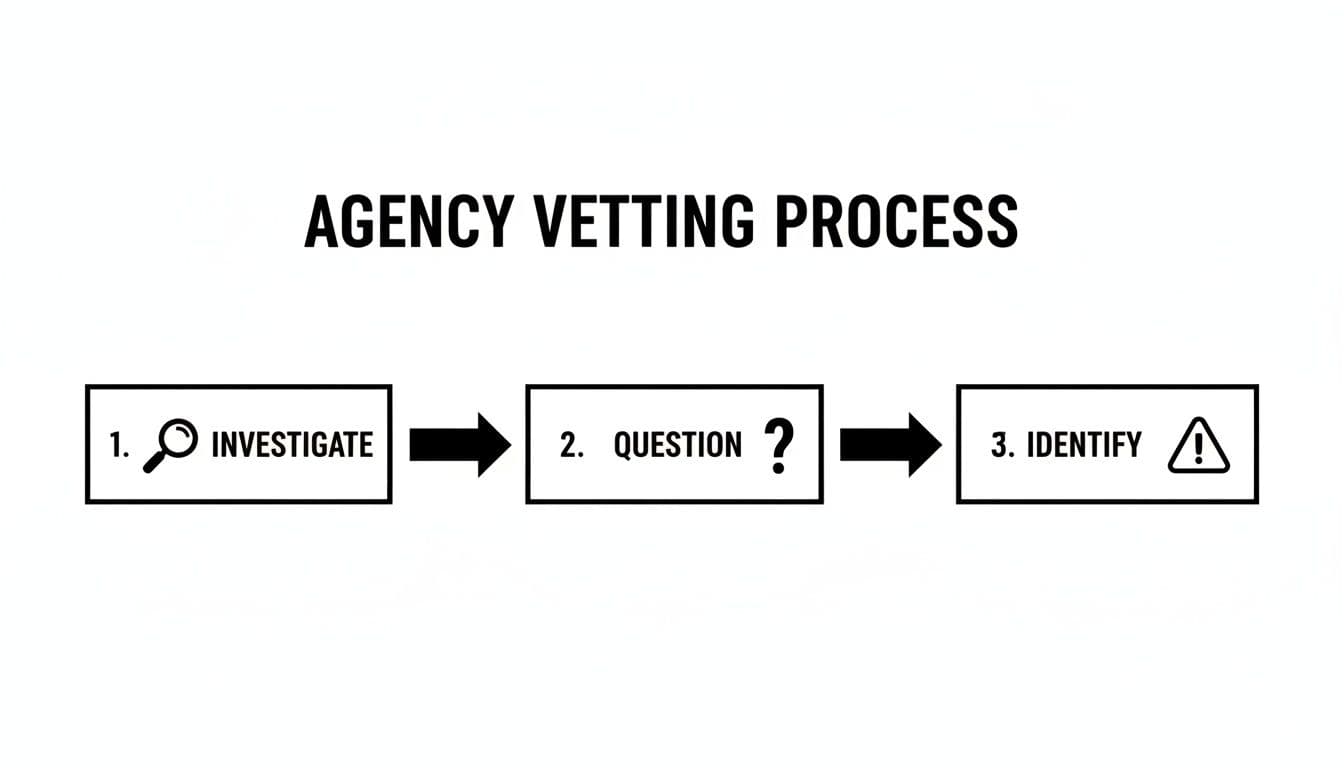
This methodical approach is crucial. It ensures you’re making a decision based on concrete evidence, not just a good sales pitch.
Moving Beyond Traditional KPIs
Success in AI search just looks different. Metrics like organic traffic and keyword rankings aren't obsolete, but they don't paint the full picture anymore. If an agency's success metrics are still stuck in 2018, that's a problem. They're missing the point.
The real game is influencing the conversations happening inside AI models. And the traffic that comes from these platforms is incredibly valuable. One recent study found that visitors arriving from large language models convert 4.4 times better than traffic from traditional organic search. More specifically, traffic from platforms like ChatGPT can hit conversion rates as high as 15.9%—a world away from Google's typical 1.76% organic average.
This data is exactly why your pilot KPIs need a serious update.
The goal isn't just to be found anymore; it's to be the answer. Measuring brand mentions, citation quality, and share of voice in generative answers gives you a much truer read on an agency's impact on your authority and, ultimately, your revenue.
Establishing AI-Centric Success Metrics
For your 90-day pilot, you must insist on a dashboard that tracks these forward-looking KPIs. Any expert ai search optimization agency in London worth its salt should be excited to report on these metrics; it shows they actually get where search is heading.
Your pilot dashboard absolutely needs to include:
- Brand Mentions in AI Responses: The raw count of how often your brand is named in answers related to your target queries.
- Share of Voice in Generative Answers: A percentage showing how often you're mentioned versus your key competitors for the same queries.
- Citation Quality and Sentiment: An analysis of how your brand is being talked about. Are you being positioned as an authority, a market leader, or just another option?
- Click-Through Rate from Citations: When a source link appears in an AI answer, what percentage of people are actually clicking through to your site?
Here’s a crucial tip: use a neutral, third-party platform to track this. Relying only on the agency's self-reported numbers is asking for biased data. A tool like Attensira provides an objective, unvarnished view of their performance, validating the real-world impact they're having. This approach also helps you calculate the potential ROI of your investment with much higher confidence. This impartial data should be the final word on whether you extend the partnership.
Answering Your Questions About AI SEO Agencies
As you get closer to a decision, the practical questions always start to bubble up. Hiring an AI search optimization agency in London is a serious investment, and you need total clarity on the operational and financial side of things before you sign anything.
Let's cut through the noise and tackle the common questions that pop up at this final stage. These are the straight answers you need to sort out budgets, set timelines that make sense, and figure out how a new agency will fit in with your current team.
What’s a Realistic Budget for a London Agency?
Right off the bat, you should expect a higher price tag for a comprehensive AI search strategy in a competitive market like London than you would for traditional SEO. You're not just paying for someone's time here; you're paying for a highly specialized skillset and access to advanced, often proprietary, tech. If you see a price that seems too good to be true, it probably is. Proper AI search optimization demands a significant investment in senior talent and sophisticated tools.
For B2B companies, pilot projects usually start somewhere in the £5,000 to £10,000 per month range. Full-blown enterprise retainers, which cover a much wider scope and have more aggressive goals, will often land between £10,000 and £25,000+ a month.
The smartest way to look at it is to focus on the potential ROI you’ll get from high-converting traffic referred by AI, not just the monthly fee.
How Soon Can We Expect to See Results?
Let's be clear: AI search optimization is a marathon, not a sprint. It's a long-term strategic play. While you might see some quick wins from foundational technical fixes, making a real, tangible impact on your brand's visibility in AI responses takes time and consistent effort.
Any agency promising you page-one visibility in AI answers within 30 days is waving a massive red flag.
Here’s a more realistic timeline:
- Months 1-3: This initial period is all about deep research, technical audits, and building out your brand’s foundational authority. You'll see a lot of activity, but don't expect major shifts in your core KPIs just yet.
- Months 3-6: You should start to see some movement in leading indicators. This is often when you'll notice an initial uptick in brand mentions and citations in AI-generated answers for more specific, long-tail queries.
- Months 6-9: This is typically the window where measurable business results start to show up—things like a clear increase in qualified leads from AI platforms or a better share of voice for your key commercial terms.
A good agency will manage your expectations from day one with a phased roadmap. For anyone looking to brush up on broader search optimization principles, particularly how they apply to audio, there are some great insights on Podcast SEO that are worth a read.
How Does This Integrate with Our Existing Teams?
The best AI search agency won’t operate in a silo. They should act as a strategic partner, augmenting and elevating what your marketing teams are already doing. They bring a new layer of specialized intelligence to the table—they’re not here to replace your in-house talent.
A top-tier agency doesn't just deliver reports; they integrate into your workflows. They should function as an extension of your team, providing the strategic guidance and data that makes your internal teams more effective.
When it’s working well, the integration looks something like this:
- Working with In-House SEO: The agency collaborates with your SEO team to make sure all the foundational technical stuff, like site speed and schema markup, is perfectly tuned for AI crawlers.
- Empowering the Content Team: They’ll feed your content creators data-driven insights on which topics to cover, the exact questions to answer, and how to structure content so AI can easily ingest and understand it.
- Informing Broader Marketing Strategy: The insights they uncover from AI search can reveal emerging customer pain points and new market trends, which is pure gold for your product marketing and demand gen teams.
This kind of collaborative approach ensures every marketing activity is pulling in the same direction, building a unified, authoritative brand presence across every search platform, both old and new.
Ready to see how your brand stacks up in the new era of AI search? Attensira gives you the unbiased data you need to track your visibility, measure agency performance, and prove the ROI of your investment. Get a clear picture of your AI presence and start making smarter strategic decisions today at https://attensira.com.