How to increase b2b sales: Master demand gen, enablement, and retention with proven frameworks for faster revenue.
If you want to increase B2B sales, you can't just do more of the same. The old playbook of broad outreach is broken. Real growth today comes from being smarter and more surgical—embracing a digital-first mindset, zeroing in on the right audience, and using AI-driven insights to outmaneuver the competition.
The battle isn't for market growth anymore; it's for market share.
Navigating the New B2B Sales Landscape
Let's be honest: the B2B sales environment has fundamentally changed. Buyers are more risk-averse, budgets are under a microscope, and nearly the entire research process happens online before a salesperson ever gets involved. This isn't a temporary trend. It’s the new reality, and it demands a far more intelligent approach.
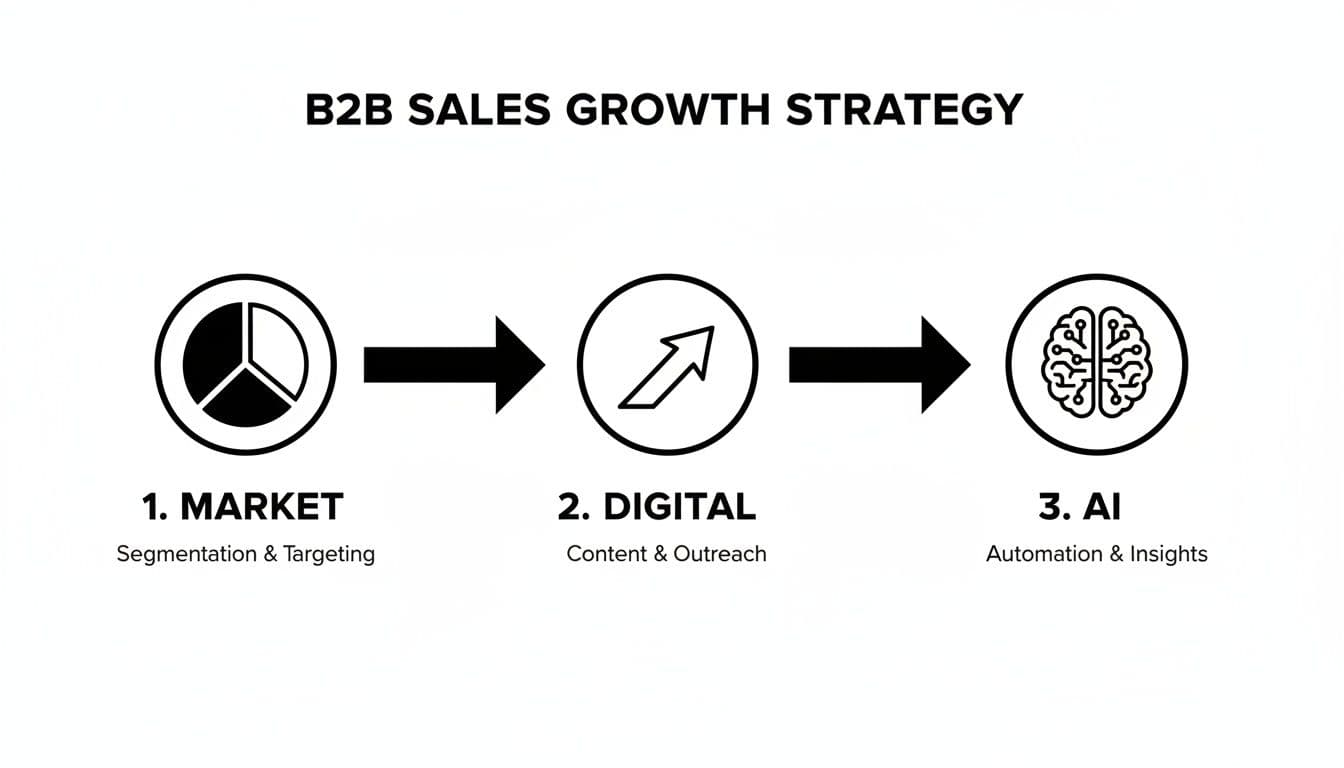
Your strategy needs to mirror this evolution, moving from market awareness to digital execution and, finally, to AI-powered optimization to find and win the best deals.
The numbers don't lie. The total U.S. B2B market is on track to hit a staggering $15.12 trillion by 2025. But here's the critical part: projections show that 56% of that revenue will come through digital channels. That’s a massive leap from just 34% back in 2021.
We've seen it firsthand—companies that invest in a solid online presence are reporting an average revenue increase of 41%. The message is loud and clear: digital is where you win.
The real challenge now isn't just about selling a great product. It's about aligning your entire sales motion with how modern buyers actually make decisions. If your team isn't showing up where your prospects are doing their homework, you're invisible.
The Pillars of a Modern B2B Sales Strategy
So, where do you start? To effectively increase B2B sales, your game plan needs to be built on a few core pillars. These aren't just siloed tactics; they form a connected framework that supports every other action we'll cover. Building a cohesive B2B marketing strategy is the foundation for everything that follows.
This table breaks down the essential components that every modern sales organization needs to master.
Core Pillars of Modern B2B Sales Growth
A summary of the essential components required to increase B2B sales in the current digital landscape.
Think of each pillar as a building block. Get them right, and you'll have a powerful, self-reinforcing system for growth. Mastering these pillars is how you overcome the most common https://attensira.com/blog/b-2-b-marketing-challenges and build a truly resilient sales engine. It’s the difference between just playing the game and actively shaping the outcome.
Building Your Foundation with a Precise ICP
Before you even think about building a sales playbook or launching a campaign, you have to nail the answer to one question: who are you actually selling to? If your answer is "mid-market tech companies," you're already behind. High-growth B2B sales don't happen by accident; they're the result of a fanatical focus on a specific Ideal Customer Profile (ICP).
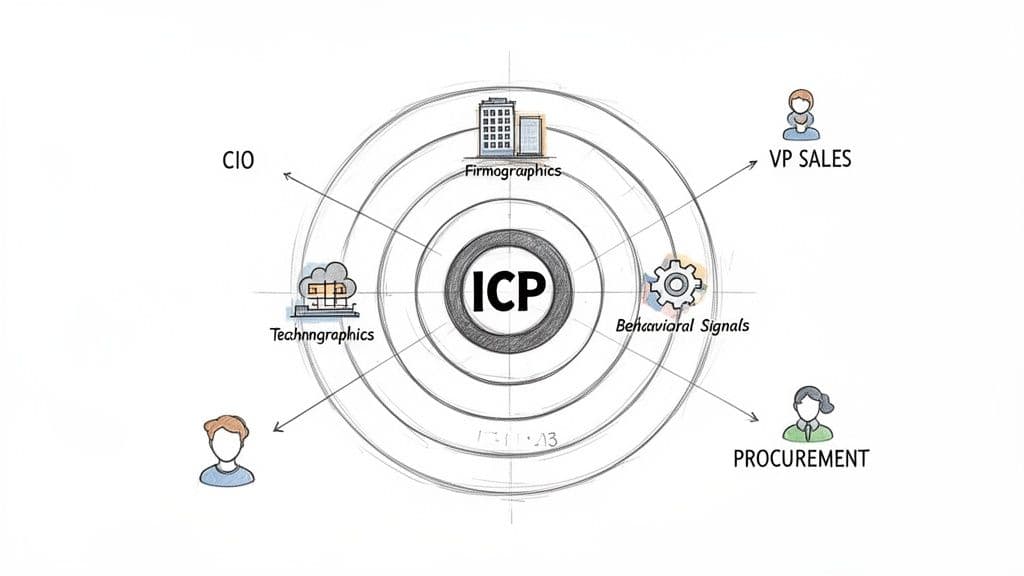
Think of it this way: an ICP isn't just a vague description of an industry. It's a crystal-clear, data-backed definition of the exact type of company that gets the most value from your product. This is your blueprint. Without it, you're just casting a wide, expensive net. With it, you're spearfishing for the accounts that are most likely to close, stick around, and grow. The very first step is learning how to define your Ideal Customer Profile.
Forget guesswork. The best place to start is by looking in the mirror. Your CRM and product analytics are a goldmine of truth. Dig in and find your absolute best customers—the ones with the highest contract value, the shortest sales cycles, and the happiest users. That's your starting point.
Moving Beyond Firmographics
The natural starting point is always firmographics, but that’s just table stakes. These are the basic, top-level details about a company. They're essential, but they're not enough to give you a real edge.
- Industry and Vertical: Don't just say "SaaS." Get specific. Is it "B2B SaaS for HR tech" or "Fintech infrastructure"?
- Company Size: Is your sweet spot a 50-person startup or a 5,00-employee enterprise? Define this by both headcount and annual revenue.
- Geography: Where are these companies based? This impacts everything from legal compliance to the cultural nuances of your outreach.
Firmographics tell you what the company is, but not why they might be ready to buy from you. That's where you need to layer in deeper signals that turn a good ICP into a truly effective one.
A well-defined ICP is more than a targeting tool; it's a filter for your entire sales and marketing operation. It ensures every dollar spent and every hour invested is aimed at accounts with the highest probability of closing and becoming long-term partners.
Layering in Technographic and Behavioral Data
To really sharpen your aim, you need to know what technology your prospects are using and what they're doing. These signals are powerful indicators of need, budget, and—most importantly—intent.
Technographic Data is all about the tech stack. For instance, if your product has a killer integration with Salesforce, then targeting companies that already use it just makes sense. The conversation is instantly warmer. Are they using a competitor's tool? Even better. That tells you they already have a budget and understand the problem, which is a perfect opening for a displacement play.
Behavioral Signals are where things get really interesting. These are actions that scream "I'm in the market."
- Are they repeatedly visiting your pricing page?
- Did three people from the same account just attend your webinar on Q3 planning?
- Did you spot a job posting on their site for a "Head of Sales Enablement"—the exact role your tool empowers?
When you combine all three data types, you get a dynamic, three-dimensional picture. You’re no longer targeting "mid-sized tech companies." Now, you're targeting "mid-sized tech companies in North America, using HubSpot, who just downloaded our case study and are hiring a new RevOps leader." That kind of specificity is what separates a struggling sales team from an efficient one.
Defining Key Personas
Once you've identified the right companies, the final piece of the puzzle is finding the right people inside them. You need to map out the key personas involved in a typical buying decision. Spoiler: it's rarely just one person.
- The Champion: This is your internal advocate. They feel the pain your product solves every day and will fight for you in meetings you're not invited to.
- The Economic Buyer: This person holds the purse strings (think CFO or a VP). They care about ROI, TCO, and the bottom-line business impact.
- The Technical Buyer: This is the gatekeeper (often a CIO or Head of IT) who needs to know your solution is secure, compliant, and won't break their existing tech stack.
For each of these personas, you should know their unique goals, challenges, and what triggers them to look for a solution. Getting this right helps you tell a story that resonates with each stakeholder. A strong narrative is core to a great brand, and you might find some useful frameworks for this in our guide to crafting a brand positioning statement.
Remember, your ICP should be a living document. Review it every quarter, and refine it based on your wins and losses. This constant tuning is what keeps your sales engine running at peak performance.
Driving Demand with an Omnichannel Engine
Once you’ve nailed down your Ideal Customer Profile, your focus shifts to feeding the pipeline. This isn't about running a few disparate campaigns; it's about building an omnichannel demand generation engine designed to meet your ideal buyers exactly where they are. A siloed approach just doesn't work in today's market.
The data backs this up in a big way. Buyers who engage with a company across multiple channels deliver up to 30% higher lifetime value. Think about it: the modern B2B buyer is active on 10 or more channels while researching a purchase, and a staggering 73% of them expect you to be there, too. Get this right, and the results are dramatic—companies with a strong omnichannel game see nearly 179% faster revenue growth than those stuck in a single-channel mindset.
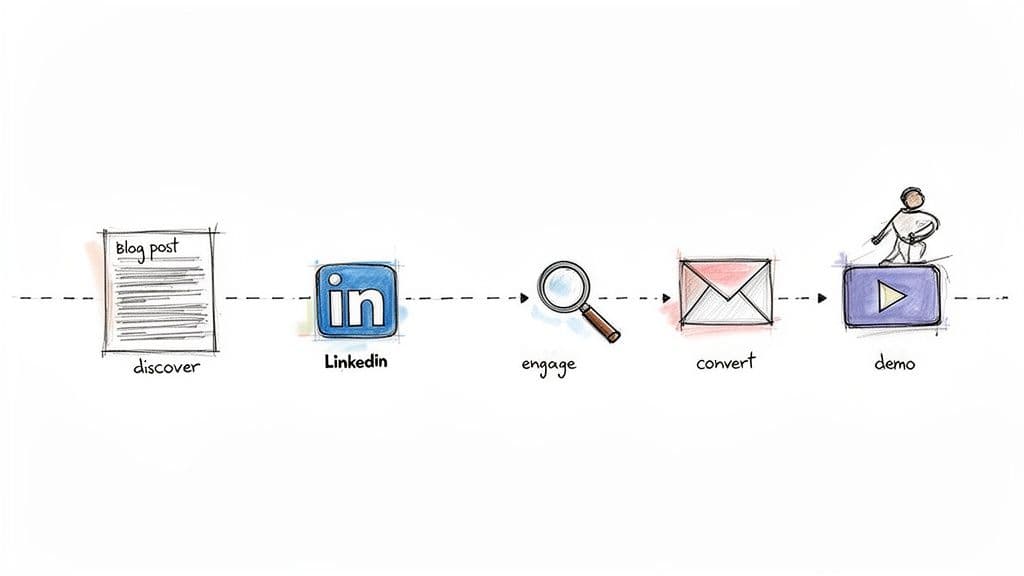
The goal is to orchestrate a fluid experience across every interaction, from the first blog post they read to the final demo they see. Every touchpoint should feel connected.
Layering Your Demand Generation Tactics
A truly effective demand engine is never built on a single activity. It’s a strategic blend of broad awareness plays and hyper-targeted outreach, with each component strengthening the others to capture attention at every stage.
Here's how the layers typically work:
- Broad Content Marketing: This is where you build your reputation. High-quality blog posts, deep-dive whitepapers, and expert-led webinars establish your company as a genuine authority. You're not selling; you're educating and solving problems for your audience, earning their trust long before they’re even thinking about a demo.
- Account-Based Marketing (ABM): For those high-value accounts you identified in your ICP, a one-size-fits-all approach is a waste of resources. ABM treats each target account as a unique market. This means sales and marketing work together on highly personalized campaigns, using everything from custom ads and direct mail to content written specifically to address that company's pain points.
- Strategic Paid Media: Paid channels like LinkedIn Ads or Google Search Ads are your amplifiers. They give you the power to intercept active buying intent and place your message right in front of a specific audience. I’ve seen this work best when used to promote top-performing content and drive qualified traffic to very specific landing pages.
This combination ensures you’re actively creating and capturing demand, not just passively waiting for leads to find you. To get even more mileage from your best assets, it's also smart to look into how content syndication services can expand your reach.
Creating a Cohesive Customer Journey
The real impact comes when these channels flow together. Let's walk through a scenario to see how this looks in the real world and how it directly helps to increase B2B sales.
Imagine a Director of Operations at a target manufacturing company. She’s actively looking for ways to get her team running more efficiently.
Her journey might start with a simple Google search, where she finds a comprehensive blog post you wrote about "Operational Bottlenecks in Manufacturing." It's valuable, speaks directly to her problem, and she makes a mental note of your brand.
A few days later, she’s scrolling through her LinkedIn feed. She sees a sponsored post from your company promoting a case study on how a similar firm boosted efficiency by 25%. The brand is familiar, so she clicks and downloads it.
That action triggers a targeted, automated email sequence. But the first email isn't a pushy sales pitch. Instead, it invites her to an upcoming webinar on "Scaling Operations with Lean Principles." It’s another point of value, not a hard sell.
Finally, after she attends the webinar, an SDR sends a personalized email. The rep references her company's specific challenges (gleaned from her content consumption) and invites her to a brief, no-pressure consultative call.
In this example, every touchpoint builds on the last. The buyer's experience is cohesive and value-driven, not salesy. This consultative approach transforms a cold lead into a warm, qualified opportunity by guiding them through their own learning process.
This seamless flow is what sets high-performing sales organizations apart. It demonstrates that you understand the buyer's world and are there to help, not just to sell. It's this intelligent orchestration that ultimately fuels a predictable and scalable B2B sales pipeline.
Turning Leads into Real Opportunities: The Messy Middle Funnel
Getting a steady flow of new leads feels like a win, but it’s a hollow victory if those leads don't translate into actual business. The truth is, that's just the starting line. Where the real work begins—and where many B2B sales strategies crumble—is in the middle of the funnel.
This is where you bridge the gap between initial interest and a genuine sales opportunity. Without a disciplined process here, you're just burning through marketing dollars and frustrating your sales team with a pipeline full of unqualified prospects. The key to boosting B2B sales isn’t just more leads; it’s a rock-solid, data-backed system for qualifying them.
It means you stop tossing every form fill over the fence to your account executives. The best sales organizations create a dedicated workflow for their Sales Development Reps (SDRs) and equip them with proven qualification frameworks. The entire point is to sift the curious browsers from the committed buyers, so your closers only spend time on deals that have a real shot.
This transition is a delicate dance, a mix of structured process and human skill. Nailing it is what separates the top performers from the rest of the pack.
Designing the SDR Workflow
Think of your SDR team as the gatekeepers of your pipeline. Their job isn’t to close deals; it's to determine if a deeper conversation is even worth having. To do that right, they need a structured process that tells them which leads to prioritize and how to engage them.
This starts with implementing a lead scoring model right inside your CRM. This system automatically assigns points to leads based on who they are and what they do.
- Firmographic Fit: Does this lead's company line up with your Ideal Customer Profile (ICP)? Think industry, company size, and geography.
- Behavioral Signals: Did they just download your most important whitepaper? Have they been poking around your pricing page? Did they request a demo? These are strong buying signals.
- Engagement Level: Are they opening your emails and clicking the links inside?
When a lead’s score hits a certain threshold—say, 100 points—they are automatically flagged as a Marketing Qualified Lead (MQL). This MQL is then immediately routed to an SDR for follow-up. This data-first approach ensures your team’s effort is always aimed at the most promising accounts.
Adopting a Consultative Qualification Framework
Once an SDR gets a hot lead, their job is to qualify it with a consultative lens. This means they need to be trained to diagnose business pain long before they ever start talking about your product's features.
A powerful framework we see work time and again is MEDDIC (Metrics, Economic Buyer, Decision Criteria, Decision Process, Identify Pain, and Champion).
MEDDIC fundamentally changes the conversation. It forces your reps to act more like business consultants than salespeople. Instead of launching into a pitch, they ask sharp, targeted questions to uncover the prospect's reality.
For example, an SDR using MEDDIC wouldn’t just ask, "Are you having problems?" They'd dig much deeper to get to the quantifiable impact of that problem.
A Glimpse into a MEDDIC Discovery Call
- Metrics: "You brought up production delays. How are you measuring that today, and what's the financial cost to the business for every day you're delayed?"
- Identify Pain: "What are the ripple effects of these delays on your team? What about on your customers?"
- Economic Buyer: "Who in the organization ultimately feels the P&L impact from these production numbers?"
By asking questions like these, the SDR isn't just checking a box. They are building a business case for your solution from the very first touchpoint. This process of uncovering and quantifying pain is a cornerstone of effective conversion rate optimization best practices.
From First Touch to Discovery Call
Great outreach is about being persistent without being annoying. It's a multi-touch, multi-channel cadence that respects the buyer's time but adds a little value with every single interaction.
A simple but effective cadence might look something like this:
- Day 1: Send a personalized email referencing a specific trigger (like a webinar they attended), followed by a brief, value-focused phone call.
- Day 3: Connect on LinkedIn with a short, non-salesy note.
- Day 5: Follow up with another email, this time sharing a relevant piece of content, like a case study from their industry.
- Day 7: Place another call, but this time, focus on a different potential pain point you've identified.
The goal through all of this isn't to sell the product—it's to sell the next meeting. Once a lead is qualified through a framework like MEDDIC and shows clear interest, they become a Sales Qualified Lead (SQL). At that point, they're handed off to an Account Executive for a full discovery call or demo, complete with all the crucial context the SDR has already gathered. This seamless handoff is what allows your closers to walk in and win.
Closing More Deals with Strategic Sales Enablement
Once an SDR qualifies a lead and hands it off, the real closing process begins. This is where your Account Executives (AEs) step into the spotlight, and it’s a moment that can make or break a deal. The key is shifting them from product presenters into indispensable advisors, and that's exactly what strategic sales enablement does.
It's about arming your team with the right assets and arguments to anticipate objections, prove undeniable value, and guide a prospect confidently to a signature. Without this support, your AEs are essentially flying blind, relying on charm instead of concrete evidence.
Arming Your Sales Team with Proof
To navigate the final, complex stages of a B2B sale, your team needs a whole lot more than a slick pitch deck. They need cold, hard proof that your solution delivers on its promises and that the investment is a no-brainer. I've found that three core assets are the absolute foundation of any high-performing enablement toolkit.
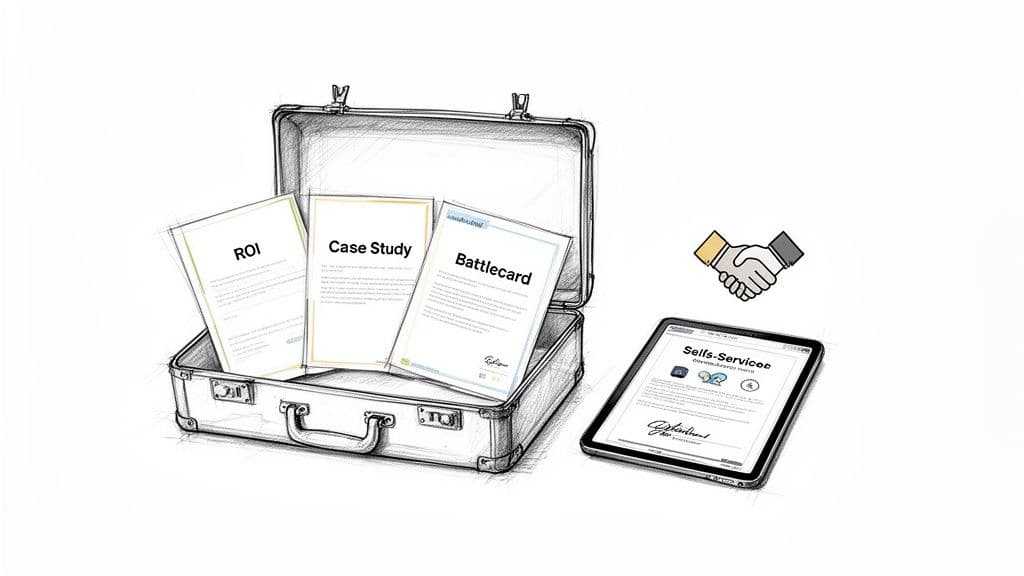
- Compelling Case Studies: A good case study tells a story. It details a specific customer's pain point, shows how your solution addressed it, and—most critically—highlights the quantifiable results. Use real numbers, direct quotes, and tangible outcomes to build the credibility your AEs need.
- ROI Calculators: Sooner or later, the CFO or economic buyer will get involved, and they speak in numbers. An ROI calculator is a deceptively simple tool that allows your AE to plug in a prospect’s own data—like current costs or team size—and instantly project the financial return. It transforms the conversation from a cost to an investment.
- Competitive Battlecards: Your team will go head-to-head with competitors. It's inevitable. Battlecards give them a quick-reference guide to your key differentiators, your competitors' known weaknesses, and pre-vetted responses to common objections. This ensures they control the narrative instead of reacting to it.
Equipping your sales team with these assets is non-negotiable. It shifts the conversation from "What does your product do?" to "How will your product solve our specific business problem?" It’s the fastest way to build confidence and accelerate decisions.
Mastering the Psychology of B2B Pricing
After you've successfully demonstrated value, the conversation naturally turns to price. How you frame that number is just as important as the price itself. The goal isn't to be the cheapest—it's to anchor your cost directly to the value you’ve just proven. This is where many deals needlessly stall.
A common mistake is presenting a single, take-it-or-leave-it price. A much smarter approach is to create tiered offerings. Doing so reframes the decision from a "yes/no" question into a "which option is best for us?" discussion.
For example, your tiers could look something like this:
- Essentials Tier: Solves the core problem for smaller teams or those with limited budgets.
- Professional Tier: Adds advanced features needed by growing companies scaling their operations.
- Enterprise Tier: Offers custom integrations and dedicated support for large-scale, complex deployments.
This strategy does two crucial things: it provides a clear entry point for prospects at different budget levels and creates a natural pathway for future upsells and expansion revenue. This kind of strategic content is a core part of building a high-performing sales motion. To learn more, check out our guide on B2B content marketing best practices.
The Rise of Digital and Self-Service Sales
The relentless push for digital efficiency has fundamentally changed how B2B buyers operate. For sellers, this isn't a threat; it's rocket fuel for growth. The global B2B e-commerce market is projected to grow from 32.11 trillion** in 2025 to over **36 trillion by 2026.
Buyer trust in digital channels is soaring. An incredible 73% of buyers are now comfortable making purchases over $50,000 through self-service channels. Since 2020, over 90% of B2B firms have embraced virtual sales models, and companies launching online portals are seeing an average revenue jump of 41%.
This digital shift doesn't make your AEs obsolete—it makes them more valuable. By offering self-service portals for simpler transactions or repeat purchases, you free up your senior sales talent to focus their energy on high-value, complex deals. It allows buyers to move at their own pace and lets your team operate at maximum efficiency, accelerating the entire sales cycle.
Common Questions When Scaling B2B Sales
Even the best-laid plans run into real-world questions. As you start putting this framework into action, you’re bound to hit a few practical hurdles. I’ve seen it happen time and again.
This section tackles some of the most frequent questions sales leaders ask when they’re trying to build a high-growth sales engine.
Think of this as a quick-reference guide for those moments you need a straight, actionable answer, whether you're trying to justify your budget or pick the right technology.
How Much Should We Really Be Spending on Sales and Marketing?
This is the million-dollar question, isn't it? The honest answer is: it depends entirely on your funding and growth ambitions. There’s no magic number, but there are some very clear benchmarks we can look at.
Recent industry data on private B2B SaaS companies paints a picture of two different worlds. Bootstrapped companies, which have to keep a close eye on the bottom line, tend to have a total spend around 95% of their Annual Recurring Revenue (ARR). They're operating at or very near profitability.
On the other hand, you have equity-backed companies. They’re playing a different game, often prioritizing aggressive market capture. Their median total spend is 107% of ARR, meaning they are intentionally running at a loss to fuel rapid growth.
The bottom line: Your budget is a reflection of your strategy. Bootstrapped businesses must chase efficiency, while VC-backed firms are paid to invest in growth, even if it means short-term losses.
To get more granular, here’s a typical breakdown of departmental spend as a percentage of ARR:
- Sales: 13%
- Marketing: 8%
- Research & Development: 22%
- General & Administrative: 14%
Notice that product development (R&D) often gets the biggest slice. Sales and marketing are a major investment, but it's part of a larger picture. Use these numbers as a sanity check for your own allocation.
How Do I Choose the Right Sales Tech Stack?
Building a tech stack isn't about collecting shiny new toys. It’s about methodically solving problems for your sales team. A tool is only useful if it removes friction from your actual workflow.
Before you even look at a demo, map out your entire sales process. Where are things breaking?
- Is your team wasting hours on manual data entry?
- Are they guessing which leads to call first?
- Are promising conversations going cold from a lack of follow-up?
The answers point you directly to the tools you need. For most B2B teams, a powerful, yet simple, stack covers these bases:
- Customer Relationship Management (CRM): This is your foundation. A CRM like Salesforce or HubSpot acts as the brain of your sales operation, giving you a single source of truth for every customer interaction.
- Sales Intelligence & Prospecting Tools: You need to find the right people and know what to say. Tools like LinkedIn Sales Navigator or ZoomInfo give your reps the data they need for sharp, personalized outreach.
- Sales Engagement Platform: Consistency is everything in sales. Platforms like Outreach or Salesloft automate and track outreach sequences across email, phone, and social, making sure no lead gets left behind.
- AI Visibility Platform: With buyers increasingly using AI for discovery, you have a massive blind spot if you don't know how you're showing up. A tool that monitors your visibility in AI responses is becoming essential for staying competitive.
The real magic happens when these tools are integrated. Data should flow seamlessly, eliminating busy work and giving your reps a complete picture of every prospect.
What Is the Most Important Metric for B2B Sales Growth?
Everyone tracks revenue growth and customer acquisition cost (CAC), and for good reason. But if you want a single metric that truly diagnoses the health and efficiency of your entire sales pipeline, look no further than Sales Velocity.
Sales velocity tells you how fast you're making money. It measures the speed at which you move deals through your pipeline from lead to close.
The formula is a powerful one:
(Number of Opportunities x Average Deal Size x Win Rate) / Length of Sales Cycle
This metric is so valuable because it forces you to analyze the four fundamental levers you can pull to grow revenue:
- Increase the Number of Opportunities: Generating more high-quality leads.
- Increase the Average Deal Size: Getting better at upselling, cross-selling, or selling higher-tier packages.
- Improve Your Win Rate: Making your sales process and team more effective at closing.
- Shorten the Sales Cycle: Removing friction and helping buyers make decisions faster.
Focusing on Sales Velocity shifts your thinking from just "we need more leads" to a more sophisticated, holistic view of your sales engine. Improving any one of these four inputs, even by a small amount, can have a massive impact on revenue. It is the ultimate report card for your sales machine.
As AI redefines how buyers find and choose solutions, flying blind is no longer an option. Attensira shows you exactly how your company appears in AI-generated answers, giving you the hard data needed to fine-tune your messaging and outmaneuver the competition. You can't optimize what you can't see.
Take control of your brand’s AI presence and ensure you’re reaching the right customers. Discover how you show up at https://attensira.com.