


Discover 10 enterprise B2B content marketing best practices for 2025. Drive growth with actionable strategies for ABM, SEO, and AI-search optimization.
In the complex B2B landscape, generic content strategies no longer suffice. Enterprise marketers face elongated sales cycles, multiple decision-makers, and the seismic shift towards AI-driven search. Staying ahead requires a sophisticated, multi-faceted approach that moves beyond basic keyword targeting and surface-level blog posts. It demands a playbook built on precision, authority, and measurable impact.
This guide cuts through the noise to deliver a prioritized, actionable set of B2B content marketing best practices designed for the modern enterprise. We will move beyond foundational advice to dissect the advanced strategies that drive tangible results. You will learn how to:
- Develop hyper-targeted content for Account-Based Marketing (ABM) initiatives.
- Establish unshakeable authority through data-driven thought leadership.
- Optimize your entire content ecosystem for visibility in AI search, leveraging insights from platforms like Attensira.
- Measure content ROI effectively to justify and scale your marketing budget.
To truly redefine your enterprise content playbook, it's essential to understand and implement a range of content marketing best practices. The principles outlined here are not just abstract tips; they are the strategic pillars that support scalable growth, connect with high-value accounts, and cement your brand’s authority in a competitive market. We will explore everything from interactive content formats and webinar strategies to sophisticated nurture campaigns, providing the framework needed to build a content engine that consistently delivers qualified leads and revenue. Let’s dive into the practices that will define your success.
1. Account-Based Marketing (ABM) Content Strategy
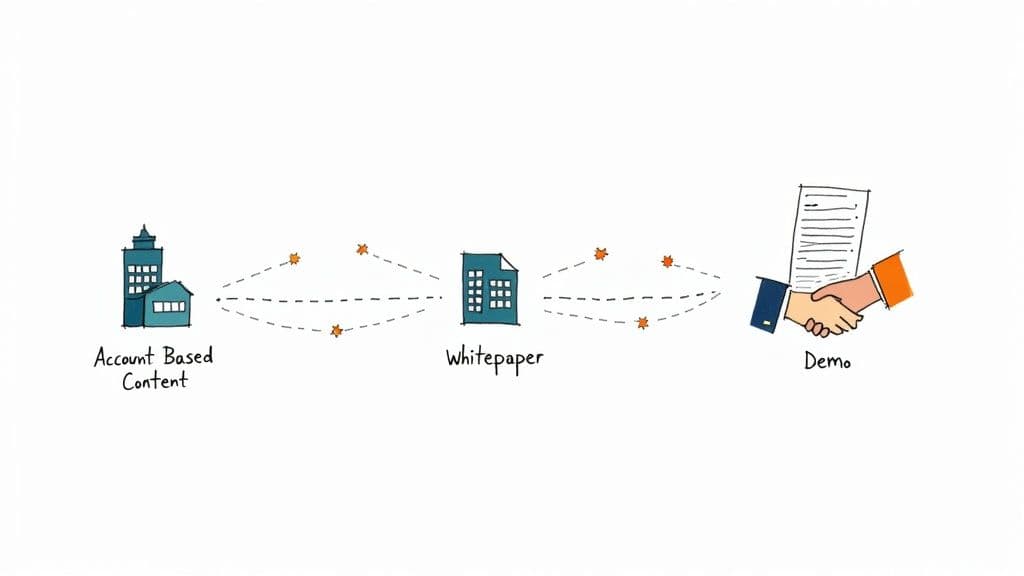
Account-Based Marketing (ABM) flips the traditional marketing funnel on its head. Instead of casting a wide net to capture many leads, ABM focuses marketing and sales resources on a defined set of high-value target accounts. This highly personalized approach treats individual accounts as unique markets, demanding a content strategy that is just as specific and tailored. This precision is a cornerstone of modern B2B content marketing best practices, ensuring resources are concentrated where they will yield the highest return.
The core principle is to create deeply relevant content that speaks directly to the specific challenges, roles, and industry context of key decision-makers within a target company. This alignment between sales and marketing teams is crucial, as insights from both sides inform the creation of personalized content journeys designed to engage and convert specific accounts.
Why ABM Content Works
This strategy is highly effective for B2B enterprises with long sales cycles and high-value deals because it fosters deeper relationships. Companies like Demandbase exemplify this by using their own platform to deliver dynamic website experiences that change based on the visitor's company, showing them hyper-relevant case studies and solutions. This level of personalization significantly increases engagement and demonstrates a profound understanding of the prospect's business.
Actionable Implementation Tips
To effectively integrate an ABM content strategy, B2B marketers should:
- Create Tiered Content Personas: Develop detailed content personas not just for a general audience, but for specific roles (e.g., CFO, CTO, Head of Operations) within your top-tier target accounts. Tailor messaging, formats, and channels to each one.
- Leverage Dynamic Content: Use marketing automation and ABM platforms to personalize your website, emails, and ad creatives. Show content that references a prospect’s industry, company name, or specific pain points identified by your sales team.
- Implement Account-Level Scoring: Move beyond lead scoring to account-level scoring. Track engagement from multiple contacts within a single company to gauge the entire buying committee's interest and prioritize outreach effectively.
- Align Sales and Marketing Cadence: Hold regular, structured meetings between sales and marketing to review account engagement, share insights, and plan the next wave of personalized content and outreach. This ensures a unified and consistent experience for the target account.
2. Thought Leadership Content
Thought leadership moves beyond simply explaining what your product does; it establishes your brand, executives, and subject matter experts (SMEs) as trusted authorities in the industry. It involves creating and distributing high-quality, original content that offers unique perspectives, data-driven insights, and forward-looking analysis. This strategy is foundational to modern B2B content marketing best practices because it builds brand credibility and trust long before a prospect considers a purchase.
The objective is to become the go-to resource for your target audience when they seek expert advice, trends, or solutions to their most complex problems. By consistently providing value without an overt sales pitch, you cultivate an audience that views your brand as a credible, indispensable partner, which naturally attracts high-quality inbound leads and fosters brand loyalty.
Why Thought Leadership Content Works
This approach is particularly effective in B2B markets where expertise, trust, and a deep understanding of industry challenges are critical purchasing factors. It differentiates your brand from competitors who focus solely on product-centric content. For instance, McKinsey & Company has built its global reputation by publishing cutting-edge business research and reports. This content isn't a direct sales tool for their consulting services, but it positions them as the definitive authority on business strategy, influencing decision-makers globally.
Actionable Implementation Tips
To effectively build a thought leadership platform, B2B marketers should:
- Publish Original Research: Conduct proprietary surveys or analyze unique data sets to generate insights no one else has. This makes your content a primary source that others will cite, amplifying your reach and authority.
- Establish an Executive Content Cadence: Create a structured plan for your executives and SMEs to publish content on platforms like LinkedIn and industry-specific publications. This builds their personal brands and, by extension, your company’s credibility.
- Repurpose Strategically: Transform a single piece of cornerstone research, like a detailed report, into multiple content formats. Create webinars, blog posts, infographics, podcast episodes, and social media snippets to maximize its impact across different channels and audience preferences.
- Collaborate with Industry Peers: Co-author articles, host joint webinars, or participate in roundtables with other non-competing experts. This cross-pollination of audiences lends third-party credibility to your insights and expands your influence.
3. Data-Driven and Research-Based Content
In a crowded digital landscape, original, data-backed content is a powerful differentiator. This practice involves creating authoritative assets by conducting and publishing proprietary research, surveys, and in-depth data analysis. Instead of curating existing information, this approach generates new knowledge, establishing your brand as a primary source and an industry thought leader. This is a cornerstone B2B content marketing best practice for building unmatched authority.
This type of content provides substantive, unique value that audiences cannot find elsewhere, making it an ideal asset to place behind a lead generation form. It naturally attracts high-quality backlinks, media attention, and social shares, significantly boosting organic visibility and brand credibility. To learn more about building a foundation for this approach, explore these data-driven marketing strategies.

Why Data-Backed Content Works
This strategy is highly effective because it moves beyond opinion and provides empirical evidence. Companies like HubSpot with their annual "State of Marketing" reports, and Gartner with its influential "Magic Quadrant" research, exemplify this model's power. They generate millions in earned media and brand impressions by creating indispensable resources that professionals rely on for strategic planning and purchasing decisions.
Actionable Implementation Tips
To effectively integrate a data-driven content strategy, B2B marketers should:
- Design Purposeful Research: Develop surveys and studies designed to answer your target audience's most pressing questions. Focus on uncovering trends, benchmarks, and pain points that are not widely documented.
- Partner for Credibility: Collaborate with academic institutions, industry associations, or complementary technology partners to co-author research. This enhances the credibility and reach of your findings.
- Create a Multi-Tiered Release: Gate the comprehensive report behind a form to capture leads, but create ungated assets like an executive summary, infographics, and blog posts to drive top-of-funnel awareness and encourage sharing.
- Plan a Long-Term Promotion Cycle: Treat your research report as a campaign cornerstone. Plan a multi-channel promotion strategy that includes PR outreach for earned media, paid social amplification, email nurturing, and empowering your sales team with key insights.
4. Strategic Blogging and SEO Content
Strategic blogging is the cornerstone of inbound marketing, leveraging search engine optimization (SEO) to attract a continuous stream of qualified organic traffic. Instead of one-off promotional pieces, this practice involves creating a consistent cadence of high-value articles that answer the specific questions your target audience is asking at every stage of the buyer's journey. This is a fundamental B2B content marketing best practice for building sustainable brand presence and authority.
The goal is to establish topical authority in your niche by systematically covering subjects relevant to your products and industry. By targeting specific keywords and aligning content with search intent, you create an asset that generates leads long after its initial publication date. This creates a powerful, self-sustaining marketing engine that nurtures prospects from initial awareness to final purchase decision.
Why Strategic Blogging Works
This approach is highly effective because it builds trust and credibility over time while significantly lowering customer acquisition costs. A well-executed blog becomes a primary resource for your industry. For example, HubSpot's blog attracts millions of monthly visitors by providing comprehensive, educational content on marketing, sales, and service, effectively turning its blog into its most powerful lead-generation tool. Similarly, the Moz Blog became an authoritative voice in SEO, building a loyal community and customer base through expert insights.
Actionable Implementation Tips
To effectively implement a strategic blogging and SEO content plan, B2B marketers should:
- Create Topic Clusters: Organize content around a central "pillar page" covering a broad topic, with multiple "cluster" blog posts linking back to it. This structure signals expertise to search engines and improves user navigation.
- Target the Full Buyer Journey: Conduct keyword research to identify terms for awareness (e.g., "what is data warehousing"), consideration (e.g., "snowflake vs. redshift comparison"), and decision stages (e.g., "best enterprise analytics platforms").
- Optimize for Search Intent: Go beyond keywords to understand the why behind a search. Is the user looking for a definition, a comparison, or a tutorial? Structure your content to provide the most direct and satisfying answer. To learn how this fits into a larger plan, explore how to develop a comprehensive content marketing strategy.
- Establish a Content Refresh Cadence: Regularly identify your top-performing blog posts and update them with new information, statistics, and examples. This keeps the content relevant, boosts its SEO value, and ensures it remains a valuable asset for your audience.
5. Interactive and Engaging Content Formats
Moving beyond static blog posts and whitepapers, interactive content transforms passive consumption into active participation. This approach involves creating tools, calculators, quizzes, and assessments that provide immediate, personalized value to the user. Instead of simply reading about a solution, the prospect engages with it directly, which is a powerful component of modern B2B content marketing best practices that significantly deepens engagement and data capture.
The principle is to offer a utility that solves a small, specific problem for your audience, giving them a tangible result in exchange for their time and information. This creates a memorable brand interaction and provides your marketing and sales teams with rich, first-party data that goes far beyond a simple form fill.

Why Interactive Content Works
This strategy excels in a crowded content landscape by offering genuine utility, which boosts lead quality and conversion rates. Interactive tools not only capture attention but also educate prospects about their own needs in the context of your solution. A prime example is HubSpot’s Website Grader, which has generated millions of leads by offering a free, instant analysis of a company's website performance, seamlessly connecting a user's pain point to HubSpot's software solutions.
Actionable Implementation Tips
To effectively develop and deploy interactive content, B2B marketers should:
- Provide Immediate, Personalized Value: Ensure the tool, whether it's an ROI calculator or an assessment, delivers instant, tangible results. The output should be directly relevant to the user's input and clearly demonstrate their need or the potential impact of a solution.
- Design a Mobile-First Experience: A significant portion of your audience will engage with your content on mobile devices. Interactive tools must be fully responsive, easy to use on a small screen, and load quickly to prevent user drop-off.
- Gate Content Strategically: Determine the right moment to ask for information. You can offer initial results for free and then gate the full, detailed report behind a form to capture high-intent leads without creating excessive friction upfront.
- Integrate with Marketing Automation: Connect your interactive tool directly to your CRM or marketing automation platform. This allows you to automatically enroll new leads into relevant nurturing sequences based on the results they received.
6. Video Content and Webinar Strategy
In today's attention-scarce digital landscape, video has emerged as a dominant and indispensable format. A robust video and webinar strategy is no longer a peripheral tactic but a central pillar of B2B content marketing best practices. It involves creating and distributing video content, from short-form social clips to in-depth live webinars, to engage audiences, build authority, and guide prospects through the buyer's journey with a more personal and dynamic medium.
The core principle is to leverage the high engagement and information retention rates of video to communicate complex B2B solutions effectively. By combining visual and auditory elements, brands can simplify intricate concepts, showcase product value, and connect with audiences on a more human level. This approach is critical for capturing and holding the attention of busy decision-makers who increasingly prefer watching over reading.
Why Video and Webinars Work
This strategy is highly effective because it caters directly to modern content consumption habits and excels at every stage of the funnel. From building top-of-funnel awareness with thought leadership videos to converting leads with product demos and on-demand webinars, video offers unparalleled versatility. Companies like Gong have mastered this, using their platform's data to create highly insightful, short-form videos and data-rich webinars that both educate their audience and subtly demonstrate their product's power. This positions them as indispensable industry leaders.
Actionable Implementation Tips
To effectively integrate a video and webinar strategy, B2B marketers should:
- Diversify Video Formats: Create a balanced portfolio of video content. Use short, engaging clips for social platforms like LinkedIn, produce in-depth thought leadership videos for your blog, and host detailed webinars for lead generation and nurturing.
- Optimize for Engagement: Design compelling video thumbnails and write SEO-friendly, benefit-driven titles to maximize click-through rates. For webinars, use interactive elements like live polls, Q&A sessions, and chat features to keep the audience actively involved.
- Repurpose Webinar Content Extensively: Treat each webinar as a content pillar. After the live event, edit the recording into bite-sized video clips, create audiograms for podcasts, transcribe the content for a blog post, and design an infographic with key statistics.
- Implement a Strategic Follow-Up Sequence: Don't let webinar engagement end with the live event. Create an automated email sequence that sends the recording, slides, related resources, and a clear call-to-action to all registrants, nurturing them further down the funnel.
7. Email Marketing and Nurture Campaigns
Email marketing remains one of the highest ROI channels in B2B, but its power is unlocked through sophisticated nurture campaigns. This practice involves guiding prospects through the sales funnel using automated, targeted email sequences that deliver relevant content based on their behavior, interests, and stage in the buyer's journey. Instead of generic email blasts, this is a strategic dialogue that builds trust and educates prospects over time.
The objective is to move a lead from initial awareness to sales-readiness by providing value at every step. By mapping content assets like blog posts, webinars, and case studies to specific funnel stages, B2B marketers can create automated workflows that engage prospects with the right information at the right time, making this a fundamental component of effective b2b content marketing best practices.
Why Email Nurturing Works
This strategy is highly effective because it meets buyers where they are, respecting their timeline and need for information. B2B sales cycles are often long and involve multiple decision-makers; nurture campaigns keep your brand top-of-mind and position you as a helpful authority. Platforms like HubSpot excel at this, with powerful workflow builders that trigger personalized email sequences based on actions like a content download or pricing page visit, ensuring communication is always timely and relevant.
Actionable Implementation Tips
To build effective email nurture campaigns, B2B marketers should:
- Segment Aggressively: Go beyond basic demographics. Segment lists by industry, company size, job function, past engagement, and specific content interests to ensure maximum relevance for every message.
- Create Persona-Based Tracks: Develop distinct nurture paths for different buyer personas. A CFO will care about different metrics and content than a CTO, so your email content should reflect those unique priorities and pain points.
- Utilize Behavioral Triggers: Set up automated emails based on user actions. If a prospect downloads a whitepaper on a specific topic, trigger a follow-up sequence with a related case study or webinar invitation.
- Implement Progressive Profiling: Use smart forms in your landing pages to gradually collect more information about your leads over time. This enriches your contact data without overwhelming prospects with long initial forms, allowing for deeper personalization in later stages.
8. Buyer Persona Development and Audience Research
At the foundation of all effective B2B content marketing best practices lies a deep, empathetic understanding of the target audience. Buyer persona development is the process of creating detailed, research-backed profiles of your ideal customers. These are not just demographic snapshots; they are rich, narrative-driven portraits that encapsulate a prospect's professional goals, daily challenges, primary pain points, and decision-making drivers. This disciplined approach ensures that every piece of content created is relevant, valuable, and directly aligned with the needs of the intended reader.
The goal is to move beyond assumptions and base your entire content strategy on data-driven insights. By codifying audience research into tangible personas, marketing teams can create content that resonates on a human level, building trust and authority by demonstrating a genuine understanding of the prospect's world. This clarity guides every decision, from topic ideation and format selection to channel distribution and messaging tone.
Why Persona-Driven Content Works
This strategy is highly effective because it forces marketers to focus on customer-centricity rather than product features. Companies like HubSpot have built their entire marketing empire on this principle, offering extensive resources and templates to help businesses create their own detailed personas. Their success demonstrates that when you write for a specific person with known challenges, your content becomes a solution rather than just another advertisement, drastically improving engagement and conversion rates.
Actionable Implementation Tips
To effectively develop and implement buyer personas, B2B marketers should:
- Conduct Qualitative Interviews: Go directly to the source. Schedule and conduct interviews with 8-10 real customers in each key segment to uncover nuanced pain points, motivations, and the language they use to describe their problems.
- Leverage Sales Team Insights: Your sales team is on the front lines, speaking with prospects daily. Hold structured interviews with them to gather raw, unfiltered feedback on common objections, frequently asked questions, and competitor mentions.
- Analyze Behavioral Data: Use analytics from your website, CRM, and marketing automation platform to identify common characteristics and content consumption patterns among your best customers. This validates qualitative findings with quantitative data.
- Create Living Documents: Personas should not be static. Formalize them into easily accessible documents for your entire organization and schedule annual reviews to update them based on new data, market shifts, or changes in your product offerings.
9. Content Distribution and Multi-Channel Strategy
Creating exceptional content is only half the battle; ensuring it reaches the right audience is the other critical half. A multi-channel distribution strategy is the framework for promoting your content across a strategic mix of owned, earned, and paid media. This approach moves beyond a "publish and pray" mentality, systematically amplifying your message to maximize reach, engagement, and ultimately, return on investment. This methodical promotion is a non-negotiable component of effective B2B content marketing best practices.
The core principle is to meet your target audience where they are already active. Instead of relying solely on your blog or website to attract visitors, you proactively push content into the channels your ideal customers frequent, from industry publications and social media platforms to email inboxes and professional networks. This ensures your valuable insights break through the noise and influence decision-makers at various stages of the buying journey.
Why Multi-Channel Distribution Works
This strategy is vital for B2B marketers because it exponentially increases the visibility and lifespan of every content asset. Companies like HubSpot are masters of this, seamlessly distributing a single pillar piece of content across their blog, email newsletters, social media channels, paid ads, and partner networks. By repurposing and promoting content in different formats tailored to each channel, they maximize their investment and create a ubiquitous brand presence that builds authority and trust.
Actionable Implementation Tips
To build a powerful content distribution engine, B2B marketers should:
- Map Channels to Buying Stages: Align specific channels with different stages of the buyer's journey. Use paid social and content syndication for top-of-funnel awareness, and targeted email nurture campaigns and retargeting for mid-funnel consideration.
- Implement a Content Repurposing Framework: Establish a process to deconstruct every major content asset (like a webinar or whitepaper) into multiple micro-assets. A single webinar can become several blog posts, a series of LinkedIn carousels, a short video clip for Twitter, and an infographic.
- Leverage Employee Advocacy: Encourage your team, especially sales and leadership, to share content on their professional networks like LinkedIn. Their personal endorsements can significantly extend your organic reach and add a layer of credibility.
- Build an Earned Media Pipeline: Proactively build relationships with journalists, bloggers, and influencers in your industry. Offer them exclusive insights or data from your content to secure valuable backlinks and mentions that drive high-quality referral traffic.
10. Measurement, Analytics, and Content ROI Tracking
Effective B2B content marketing best practices demand a shift from vanity metrics to tangible business outcomes. Simply creating and publishing content is not enough; a comprehensive measurement framework is required to track performance, attribute revenue, and prove the value of your efforts. This involves connecting content consumption to pipeline generation and closed-won deals, providing the data needed to optimize strategy and justify investment.
The core principle is to move beyond first-touch or last-touch attribution, which oversimplifies the complex B2B buyer's journey. Instead, sophisticated analytics and multi-touch attribution models provide a holistic view of how different content assets influence prospects at various stages of the sales cycle. This data-driven approach allows marketers to understand which topics, formats, and channels are most effective at driving revenue, not just traffic or engagement.
Why Data-Driven Measurement Works
This strategy is essential for B2B organizations with long, non-linear sales cycles. It provides clarity on content's contribution to the bottom line, enabling marketing leaders to make smarter budget decisions. Platforms like HubSpot and Marketo offer built-in multi-touch attribution reporting that directly connects marketing campaigns to CRM-tracked revenue, demonstrating how a series of blog posts, webinars, and whitepapers collectively influenced a major deal.
Actionable Implementation Tips
To effectively measure content ROI, B2B marketers should:
- Define Business-Aligned Metrics: Focus on metrics that matter to the C-suite, such as marketing-influenced pipeline, sales cycle velocity, and customer acquisition cost (CAC). While leading indicators like engagement are important, they should always connect to these lagging revenue indicators.
- Implement a Strict UTM Structure: Create and enforce a standardized UTM parameter convention across all campaigns. This ensures clean, consistent data collection, which is the foundation for accurate attribution and reporting in platforms like Google Analytics.
- Integrate Your Martech Stack: Ensure your marketing automation platform (e.g., Marketo, Pardot) is tightly integrated with your CRM (e.g., Salesforce). This connection is critical for tracking how an individual's content engagement translates into sales opportunities and closed deals. You can explore a detailed guide to how to measure marketing ROI for a deeper look at these integrations.
- Use Multi-Touch Attribution Models: Adopt a multi-touch attribution model (e.g., linear, U-shaped, or W-shaped) that assigns credit to multiple touchpoints along the buyer's journey. This provides a more accurate picture of content performance than single-touch models.
10-Point B2B Content Marketing Comparison
Building Your AI-Ready, Revenue-Driven Content Engine
The journey through the definitive b2b content marketing best practices reveals a clear, undeniable truth: modern success is not about isolated tactics but about building an integrated, self-reinforcing content ecosystem. The era of siloed blogging, sporadic webinars, and unmeasured social posts is over. The future belongs to enterprises that can weave these disparate threads into a cohesive, revenue-generating machine.
This new paradigm demands a strategic fusion of audience intelligence, authoritative content, and sophisticated distribution. It begins with deep buyer persona research, which informs not just your blog posts but the hyper-personalized assets for your Account-Based Marketing (ABM) campaigns. The data-driven insights from your original research then become the bedrock of your thought leadership, fueling webinars, white papers, and executive keynotes that establish your brand as an industry authority.
From Disparate Actions to an Integrated System
The core takeaway from this guide is the principle of synergy. Each practice we've explored amplifies the others.
- Strategic SEO blogging doesn't just attract organic traffic; it captures leads that are funneled into targeted email nurture campaigns.
- Interactive content, like ROI calculators or quizzes, provides valuable first-party data that refines your buyer personas and ABM target lists.
- High-impact video content, especially webinars, can be repurposed into blog posts, social media snippets, and email content, maximizing the ROI of a single flagship asset.
This interconnectedness is what transforms content from a marketing expense into a predictable driver of business growth. By implementing these practices in concert, you create a flywheel effect where each piece of content builds upon the last, strengthening your brand's authority, engaging prospects at every stage of the funnel, and delivering measurable results that tie directly back to revenue.
The AI Imperative: Optimizing for the New Search Landscape
Perhaps the most critical evolution in this landscape is the rise of Generative AI and its integration into search engines. Your audience is no longer just finding you through a list of blue links; they are getting direct answers from AI models. This shift makes it imperative to not only create high-quality, authoritative content but to ensure it is visible and cited within these AI-generated responses.
Optimizing for this new reality requires a new set of tools and a new mindset. Platforms that monitor AI visibility, like Attensira, are becoming essential for understanding where your content appears and identifying gaps where your competitors are winning. Mastering these b2b content marketing best practices now includes a proactive strategy for AI search, ensuring your well-researched, high-value content serves as the source of truth for the next generation of discovery. For deeper insights into leveraging AI in your operations, explore the latest top AI tools for content marketing to round out your tech stack.
By embracing this integrated, data-informed, and AI-ready approach, you move beyond simply creating content. You begin engineering a powerful engine for brand equity, lead generation, and sustainable revenue growth that will define your market leadership for years to come.
Ready to ensure your content is visible in the new age of AI search? Attensira provides the critical insights you need to track your visibility in AI-generated responses, analyze competitor strategies, and discover new content opportunities. See how your B2B content marketing strategy stacks up by visiting Attensira today.