Tired of persistent B2B marketing challenges? This guide offers proven strategies for lead quality, long sales cycles, and proving ROI to drive real growth.
Let's be honest, modern B2B marketing often feels like you're being asked to do more with less. It's a classic squeeze play: budgets are getting tighter, but the C-suite's expectations for growth just keep climbing. On top of that, disruptive tech like AI is rewriting the rules of the game, forcing everyone to get smarter about generating quality leads and proving their worth.
Confronting the Modern B2B Marketing Landscape
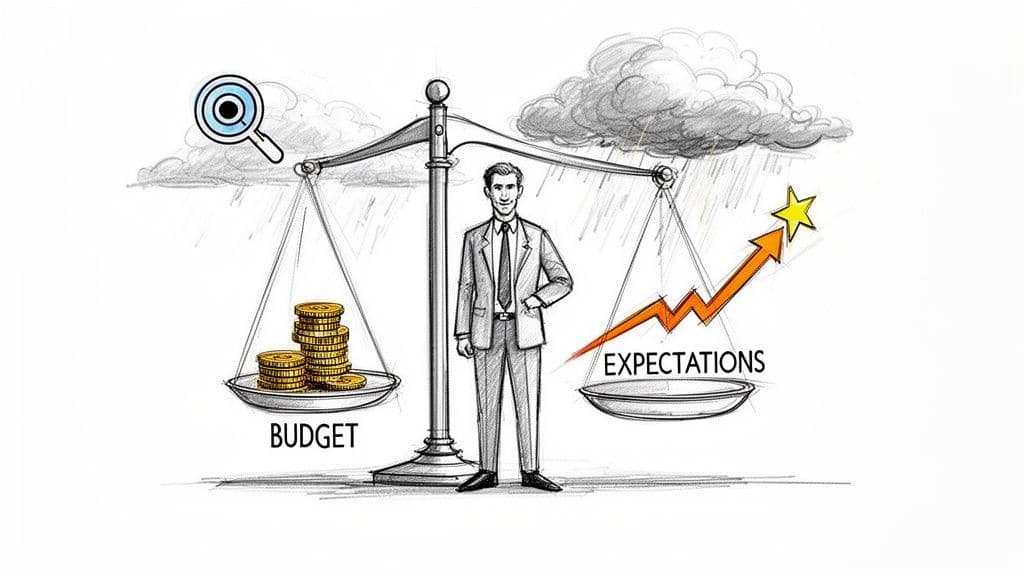
The pressure on B2B marketing leaders is immense. You're navigating a real paradox—economic uncertainty demands fiscal caution, yet the demand for predictable, quarter-over-quarter growth has never been louder. This operational vise grip is forcing teams to justify every dollar and rethink every single strategy.
Many marketing departments end up with a fragmented, disjointed approach as a result. If this sounds familiar, learning about fixing disconnected B2B tech marketing can help you pull the pieces together into a more cohesive plan.
This guide will give you a clear-eyed look at the biggest obstacles in B2B marketing today. We're going to move past the buzzwords and offer practical frameworks you can actually use to overcome these hurdles.
The Budget and Pipeline Paradox
One of the most immediate problems is what I call the "budget paradox." Recent data shows that 32% of B2B marketers have seen their budgets cut, yet they're still on the hook to hit—or even exceed—their pipeline targets. It’s no wonder so many are turning to outsourcing just to keep up; in fact, 84% of businesses now outsource their content creation to manage the workload.
In this kind of environment, efficiency stops being a nice-to-have and becomes a survival tactic. The teams that win are the ones who can ruthlessly prioritize what actually moves the needle, use technology to scale their efforts, and tie every action back to bottom-line value.
A Preview Of The Challenges Ahead
This guide is built to help you dismantle each major challenge, one by one. We'll dig into the root causes, unpack the real-world business impact, and give you concrete strategies you can put into action right away. From landing higher-quality leads to staying visible in an AI-driven search world, the goal is to turn these pain points into genuine opportunities.
To get started, let's look at the big picture. The table below summarizes the key challenges we'll be tackling, their potential damage, and where your strategic focus should be.
Top B2B Marketing Challenges and Their Business Impact
A summary of the most critical B2B marketing challenges, their consequences for the business, and the strategic focus needed to overcome them.
Each of these issues represents a significant threat, but also a chance to build a more resilient and effective marketing engine. Now, let's dive into the first one: the relentless pursuit of lead quality.
Moving from Lead Volume to Lead Quality
It’s easy to get caught up in the numbers game. A flood of new leads feels like progress, but it's often one of the most misleading metrics in B2B marketing. When your pipeline is jammed with unqualified prospects, you’re not just being inefficient—you're actively burning out your sales team and stalling growth.
The problem usually starts with a classic disconnect. Marketing gets rewarded for hitting a lead volume target (MQLs), while sales lives and dies by closed deals. This misalignment creates a system where marketing casts a wide, generic net, pulling in everyone from curious students to your direct competitors, instead of zeroing in on actual buyers.
The Real Cost of a Bad Lead
When your sales reps are stuck chasing ghosts, the ripple effects are huge. Think about it: every hour spent on a lead that goes nowhere is an hour they could have spent nurturing a high-value account. Research shows that sales reps can waste up to 50% of their time on unproductive prospecting, a direct result of a broken lead generation machine. This doesn't just hurt the numbers; it erodes trust between marketing and sales and turns pipeline forecasting into a total shot in the dark.
The goal isn't just to get more leads. It's to get more of the right leads. This shift starts when sales and marketing finally agree on a single, shared definition of what a truly "qualified" lead looks like.
To get there, you have to stop thinking about filling the top of the funnel and start focusing on filtering it. It’s a move from broad-stroke campaigns to a more surgical approach that attracts people who actually want to buy.
Building a Smart Lead Scoring Model
A lead scoring model is basically a bouncer for your sales team. It’s an automated system that assigns points to leads based on who they are and what they do, ensuring only the most promising prospects get through the door. This isn't about guesswork; it's a data-driven way to prioritize follow-up so your team can focus on the hottest opportunities first.
A solid model usually breaks down into two key areas:
- Demographic & Firmographic Scoring: How well does this lead fit your Ideal Customer Profile (ICP)? You'd assign points for things like job title (+15 for a C-level exec), company size (+10 for 100-500 employees), or industry (+20 if they're in your target vertical).
- Behavioral Scoring: This is all about gauging interest. A lead gets points for high-intent actions like visiting your pricing page (+25), requesting a demo (+50), or downloading a technical case study (+15).
Once a lead hits a certain score—say, 100 points—they’re automatically flagged as a Marketing Qualified Lead (MQL) and sent straight to sales. This simple system ensures that by the time a rep picks up the phone, they're already talking to someone who's shown they're a good fit and genuinely interested.
It All Starts with Your Ideal Customer Profile
Your Ideal Customer Profile is the foundation for everything. If your ICP is vague, like "mid-sized tech companies," you're practically asking for a flood of low-quality leads. But a razor-sharp ICP acts as a powerful filter for every marketing decision you make, from ad copy to content.
So, how do you sharpen it? Go talk to your best customers. Dig deeper than just their company size and industry. What’s in their tech stack? What specific, nagging business pain did you solve for them? What event kicked off their search for a solution in the first place? This kind of analysis turns your ICP from a static document into a dynamic, data-backed profile of your absolute best-fit accounts.
Using High-Intent Content to Your Advantage
The content you create can be a powerful self-qualification tool. Instead of churning out another generic ebook, focus on creating high-intent assets. Think ROI calculators, detailed product comparison guides, or industry-specific case studies. Anyone who engages with this kind of bottom-of-funnel content is sending a much stronger buying signal than someone who just reads a top-level blog post.
You can also get a huge leg up by using third-party intent data. Tools that provide this data monitor online activity across the web to identify companies that are actively researching solutions like yours. By targeting these "in-market" accounts, you focus your budget where it matters most—on buyers who are already well into their journey. This drastically improves lead quality and can shave weeks or even months off the sales cycle.
Conquering the Marathon: How to Win in a World of Long B2B Sales Cycles
Let's be honest: B2B sales cycles are a marathon, not a sprint. We're not selling a pair of shoes; we're selling complex solutions that require committee sign-offs, exhaustive research, and budget approvals. The journey from a prospect's first click to a signed contract can easily stretch across months, sometimes even quarters.
This drawn-out process is one of the most stubborn B2B marketing challenges out there. It makes revenue forecasts feel like a guessing game and drains momentum from even the most promising deals. Buyers are in the driver's seat, doing their homework and consuming tons of content long before they ever agree to a demo. If you’re not there with valuable insights every step of the way, you're not just losing to a competitor—you're losing to apathy and inaction.
The real challenge isn't just about patience. It's about building and sustaining trust over a long, winding journey. A killer ad or a single great discovery call won't cut it. You need a strategy that proves your value, again and again.
Stop Thinking Funnel, Start Thinking Web
First things first: you have to understand the path your buyers actually take. That old, neat, linear funnel? It's a relic. Today’s B2B buying journey is a chaotic web of interactions across dozens of channels, often involving an average of 11 to 20 stakeholders for any significant purchase.
Every one of those people has a different job to do and different questions they need answered. The engineer wants to know about integration, the project manager cares about implementation timelines, and the CFO is only looking at the ROI. If your marketing content doesn't speak to all of them, the entire deal can grind to a halt because one key person's concerns went unaddressed.
This is where the real work begins. You have to sift through all the initial interest to find the accounts that are truly on a path to purchase.
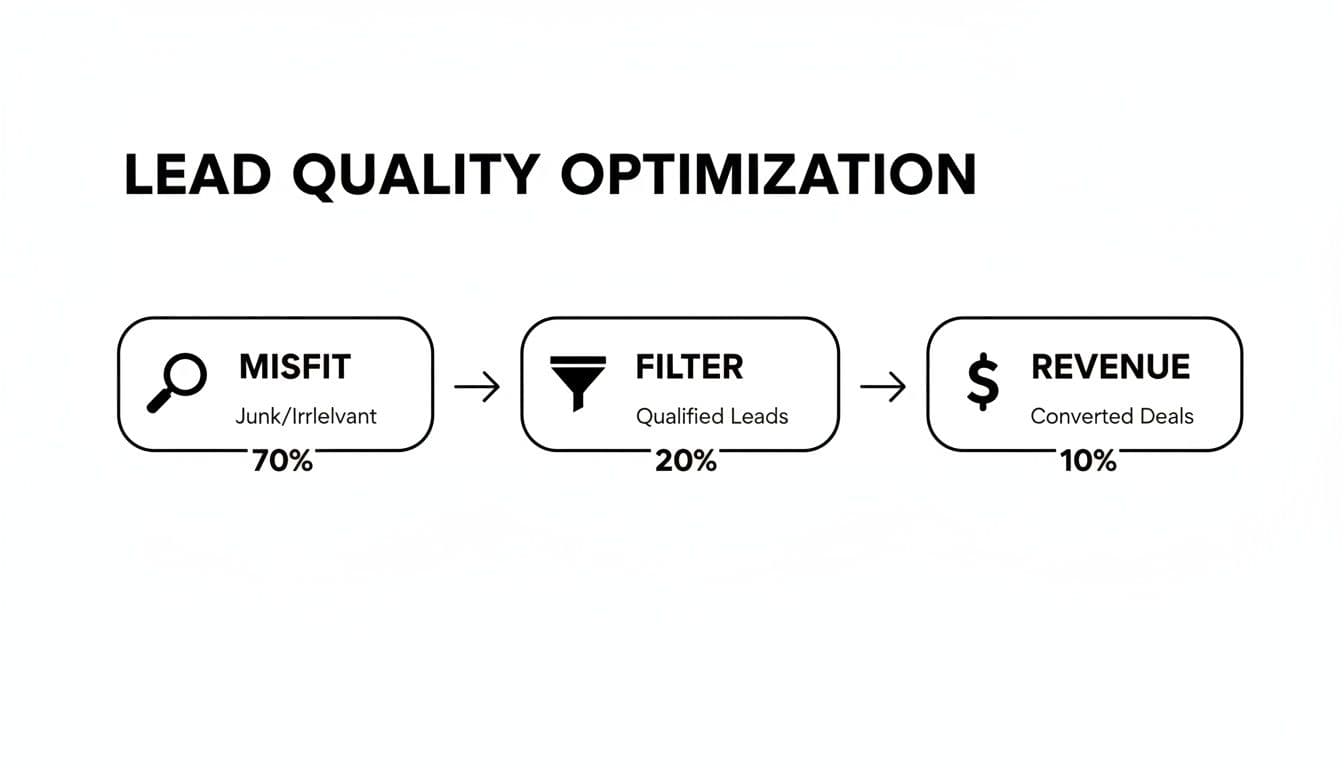
As you can see, a huge portion of what looks like "interest" is just noise. The key to managing a long sales cycle is to get brutally efficient at filtering out that noise and focusing every ounce of your energy on the small percentage of accounts with real potential.
Connecting the Dots with Multi-Touch Attribution
One of the biggest headaches of a long sales cycle is figuring out what's actually working. A deal finally closes nine months after the first contact. Was it the blog post they read on day one? The webinar they attended in month four? Or the case study that sealed the deal in the final weeks? Without the right model, you’re just guessing.
This is where a multi-touch attribution model becomes non-negotiable. Instead of giving 100% of the credit to the first or last interaction, it distributes value across the entire journey.
- Linear Model: Simple and fair. Every touchpoint gets an equal slice of the credit.
- Time-Decay Model: Values what's recent. The touchpoints closest to the sale get the most credit.
- U-Shaped Model: Highlights the bookends. It gives the most weight to the first touch that brought the lead in and the last touch that pushed them over the finish line.
Putting a model like this in place gives you a panoramic view of your marketing performance. You can finally see which channels and content are pulling their weight over the long haul, which is exactly the data you need to optimize your strategy and defend your budget.
By understanding the entire customer journey, you move from guessing what works to knowing what drives revenue. This clarity transforms your marketing from a series of disconnected campaigns into a cohesive, long-term growth engine.
Keep the Conversation Going with Smart Nurturing
Once you’ve mapped the journey and can measure what works, you can start delivering the right message at the right time. This isn’t about spamming prospects; it’s about creating a content library designed for each specific stage of their decision-making process.
For instance, a prospect who just discovered your brand might get a high-level, educational whitepaper. But someone who has spent time on your pricing page? That’s a signal to send them a targeted case study proving your ROI. This kind of intelligent nurturing keeps you top-of-mind and builds a rock-solid business case for your solution, piece by piece.
Marketing automation platforms are the engine that powers this entire operation. With tools like HubSpot or Pardot, you can:
- Segment your audience based on their behavior, role, or industry.
- Trigger personalized email sequences the moment a lead takes a meaningful action, like downloading a resource.
- Score leads based on their engagement, creating a clear signal for the sales team that a prospect is hot and ready for a conversation.
This blend of strategic content and smart automation turns a long, chaotic sales cycle into a structured, predictable process. It ensures no one falls through the cracks and gives you the framework to build the deep, lasting trust it takes to win today's complex B2B deals.
Executing Account-Based Marketing That Works
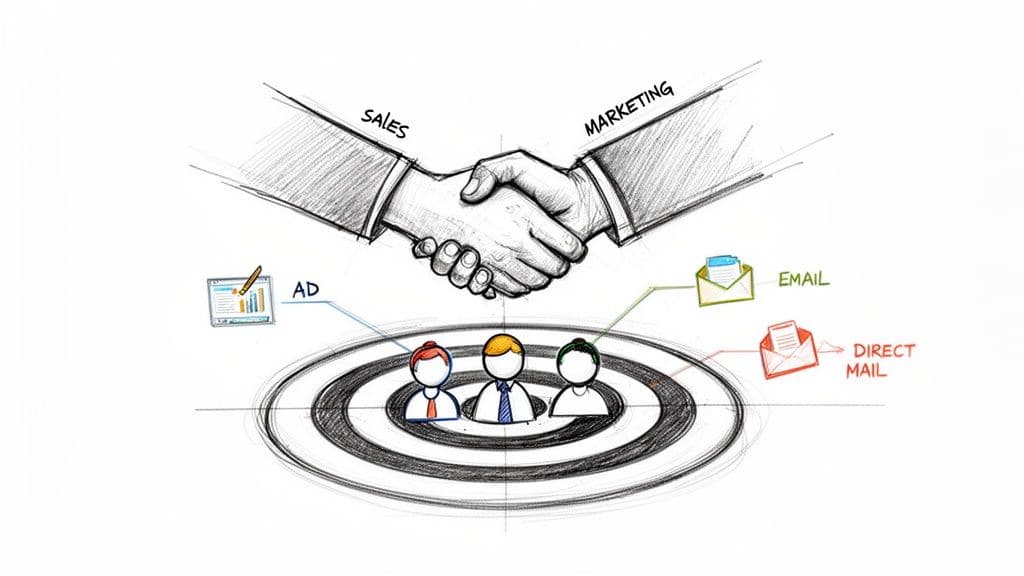
As B2B marketers, we’re all wrestling with lead quality and painfully long sales cycles. Account-Based Marketing (ABM) presents a compelling answer by flipping the traditional model on its head. Instead of casting a wide, hopeful net, ABM treats your most valuable accounts as individual markets.
It's a smart strategy, but one that often falls apart in practice. The culprit? Poor execution and a fundamental disconnect between sales and marketing.
The idea sounds simple enough: sales and marketing team up to go after a handpicked list of dream clients with incredibly personalized campaigns. But to actually pull this off, you have to break down the silos and operate as one unified revenue team. If that alignment is missing, even the most brilliant ABM campaign is dead on arrival.
Forging an Unbreakable Sales and Marketing Alliance
Let’s be clear: the absolute bedrock of a successful ABM program is a rock-solid alliance between your sales and marketing teams. This is so much more than a weekly check-in. It means co-owning the strategy, the execution, and the results from the very beginning. Misalignment is the number one killer of ABM initiatives.
This partnership has to start with creating the Target Account List (TAL) together. Sales brings the street-level intel—who has the budget, the authority, and the genuine need. Marketing then layers on firmographic data, intent signals, and engagement analytics to sharpen and validate that list.
What you get is a shared, agreed-upon roster of best-fit accounts that both teams are genuinely excited to pursue. For a deeper look at how B2B founders can target and win these key clients, check out this guide on Account-Based Marketing.
With the list locked in, both teams need to define what success looks like—using the same metrics. Ditch the separate KPIs and rally around numbers that show the health of the entire program.
- Account Penetration: How many key contacts have we actually reached within each target account?
- Account Engagement Score: A combined score tracking every marketing touchpoint and sales conversation.
- Pipeline Velocity: How fast are we moving target accounts from first touch to a qualified sales opportunity?
When sales and marketing share goals and speak the same language, the blame game stops. The conversation shifts from "marketing's leads are weak" to "how can we better engage this account?"
The Challenge of Personalization at Scale
At its core, ABM is about delivering messages so relevant they feel like a one-to-one conversation. This hyper-personalization is both the biggest opportunity and the biggest hurdle. The payoff for getting it right is huge, though. Strong personalization can lift revenues by up to 15% and boost marketing ROI by as much as 30%.
It's no surprise that 62% of B2B marketers are now using AI to handle tasks like content generation and predictive analytics, finally making personalization at scale a reality.
Think about a large enterprise you’re targeting. The CFO needs a bulletproof ROI case. The Head of IT wants to see the technical specs. The end-users just want to know how it makes their job easier. A generic, one-size-fits-all message will fall flat with all of them. This is where combining smart tech with a solid content strategy becomes essential. To get this right, you can explore our guide on B2B content marketing best practices.
Orchestrating Multi-Channel ABM Campaigns
Great ABM isn’t about one channel; it’s about conducting a symphony of coordinated touchpoints that surround the entire buying committee. This multi-channel approach ensures your message is seen in different places, reinforcing your brand and building trust over time.
A well-orchestrated ABM play might look like this:
- Digital Ads: Run highly targeted LinkedIn ads with a relevant case study, aimed only at specific job titles within your target accounts.
- Personalized Content: Drive that traffic to a custom landing page that greets them by their company name and offers a whitepaper built to solve their industry’s biggest headaches.
- Direct Mail: At the same time, send a high-impact direct mail piece—maybe a custom gift or a handwritten note—to the key decision-maker you've identified.
- Sales Outreach: The moment a contact engages with your content, an alert should fire off to the designated sales rep for a quick, context-aware follow-up.
This kind of coordinated effort feels personal and thoughtful, not automated and lazy. It shows you’ve done your homework and positions you as a strategic partner, not just another vendor trying to make a sale. And that’s the whole point of ABM.
6. Winning Visibility in the New Era of AI Search
The game has changed. For years, B2B marketers obsessed over ranking on Google’s ten blue links. But with the rise of AI-powered search engines that deliver direct answers, that old playbook is becoming obsolete. The new goal isn’t just to rank—it’s to become a foundational source of information that AI models trust and cite.
This shift presents a massive challenge. Your visibility now depends on whether an AI deems your content authoritative enough to include in its generated answers. If you’re not part of that answer, you're essentially invisible to a growing segment of your audience.
The New Currency of Trust: E-E-A-T
How do you win in this new environment? It all comes down to E-E-A-T (Experience, Expertise, Authoritativeness, and Trustworthiness). This isn't just another SEO buzzword; it's the core framework that search engines and AI models use to determine which sources are credible and which are just noise.
To put it simply, your content has to prove it's the real deal. It needs to be backed by verifiable experience and expertise that AI can easily identify and synthesize. This isn't about keyword stuffing; it's about building a fortress of trust signals around your brand.
Here’s how to build a rock-solid E-E-A-T foundation:
- Show, Don't Just Tell: Go beyond anonymous blog posts. Feature detailed author bios showcasing real-world credentials and link to their professional profiles. Let people (and AI) see the experts behind the content.
- Back Up Your Claims: Every significant claim should be supported by hard data. Link out to respected industry reports, academic studies, or other authoritative publications. This shows you've done your homework.
- Earn Third-Party Validation: This is digital word-of-mouth. Positive reviews, press mentions, and links from well-regarded industry websites are powerful trust signals. Even an unlinked mention on a major trade site tells AI that you're a legitimate player.
- Structure for Synthesis: Make it easy for AI to understand your key points. Use clear headings, factual statements, and structured data like bullet points or tables. The clearer your content, the more likely an AI is to use it accurately.
These signals are the breadcrumbs that tell AI models your content isn't just another opinion—it's a reliable source of information. Mastering this is so critical that we’ve covered additional strategies you can explore for optimizing your content for AI search.
Are You Flying Blind? Monitor Your Brand in AI Answers
Here's a critical question: Do you know how your brand is being portrayed in AI-generated answers right now? If the answer is no, you're flying blind in a completely new channel.
AI models could be misinterpreting your value proposition, citing outdated information, or worse, ignoring you completely in favor of a competitor. Manually checking this is impossible; the answers are dynamic and personalized. You need a systematic way to track your visibility.
This is where specialized tools come into play. Platforms like Attensira provide a dashboard to monitor your brand's presence in AI answers, giving you a clear picture of what’s happening.
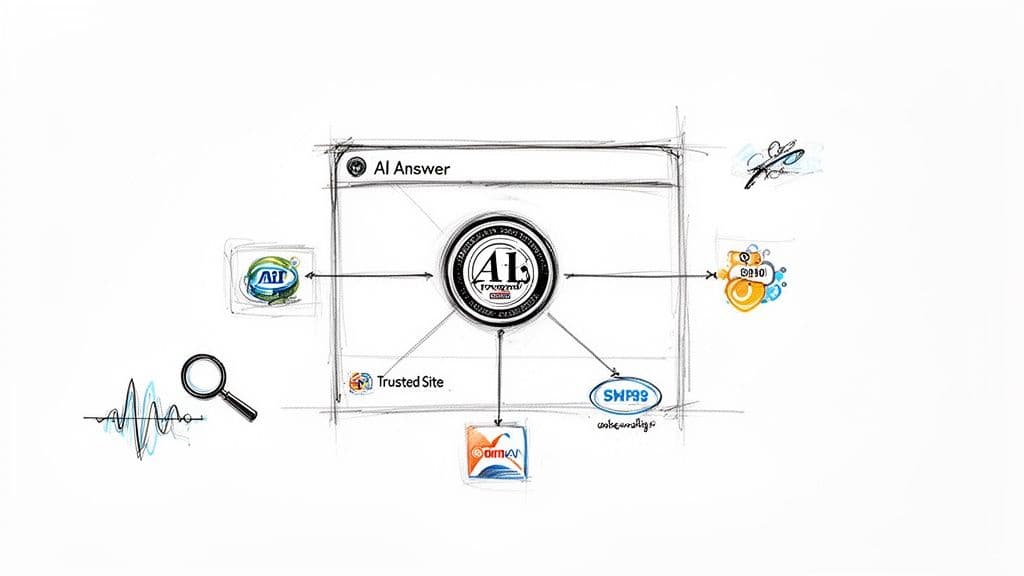
Proactive monitoring gives you the intelligence to:
- Spot Content Gaps: Discover key industry questions where your brand is absent. This is a roadmap for your next content pieces.
- Correct Misinformation: Quickly find and address instances where AI is getting your story wrong. You can then update your source content to be more explicit and clear.
- Benchmark Against Competitors: See which competitors are consistently showing up in AI answers and analyze their content to understand what they're doing right.
The challenge for B2B marketers has evolved. It’s no longer about climbing to the top of a results page. It's about becoming an essential, trusted source that AI models depend on. The brands that get this right will own the future of digital discovery.
Proving Your Marketing ROI to Leadership
"So, what did we actually get from that campaign?"
It's a question that echoes in every marketing leader's ears, and it’s one of the most persistent b2b marketing challenges out there. Answering it can feel like you're constantly on the defensive, especially when budget season rolls around. For too long, marketers have been stuck talking about vanity metrics—impressions, clicks, engagement rates—that just don’t resonate with a CFO staring at a P&L statement.
To get the respect and resources you need, you have to start speaking the language of the C-suite. That means shifting the entire conversation away from marketing activities and focusing squarely on business outcomes. The numbers that truly matter aren't hiding in your social media analytics; they're in your CRM and the company’s financial reports.
The goal is to transform your marketing department from a perceived cost center into a proven engine for business growth. This requires a disciplined focus on the numbers that directly connect your efforts to revenue.
This is a fundamental shift. It’s the difference between saying, "Our latest ebook got 1,000 downloads," and demonstrating, "Our latest ebook influenced $500,000 in new sales pipeline." That second statement is the one that gets heads nodding in the boardroom. It's what builds credibility and secures your budget for next year.
Focusing on Business-Critical Metrics
To build a powerful ROI case, you need to anchor your reporting on a few core metrics that leadership actually understands and cares about. These are the numbers that paint a clear picture of the company's financial health and operational efficiency.
Here are the three heavy-hitters you should obsess over:
- Customer Acquisition Cost (CAC): Simply put, this is your total sales and marketing spend divided by the number of new customers you brought in over a specific period. A lower CAC is a clear sign that you’re getting more efficient at turning investment into customers.
- Customer Lifetime Value (LTV): This metric forecasts the total revenue you can expect from a single customer over the entire course of your relationship. A high LTV means you’re not just winning deals, you’re winning the right deals with valuable, long-term partners.
- Marketing-Sourced Pipeline: This is the total dollar value of all the sales opportunities that started with a marketing touchpoint. It's a direct, forward-looking measure of your team's contribution to future revenue.
Telling a Compelling Data-Driven Story
Just having the numbers isn't enough. The real art is weaving them into a narrative that's both clear and persuasive. This is where dashboards become your best friend, visually connecting specific marketing activities—like a webinar series or a content campaign—directly to those core business metrics. You should be able to point to a chart and show exactly how an initiative impacted the sales pipeline that quarter.
Choosing the right attribution model is also a huge piece of this puzzle. In the B2B world, a simple "last-click" model just doesn't cut it. Sales cycles are long and complex. A multi-touch attribution model, which assigns credit to various touchpoints along the buyer's journey, gives a far more realistic view of how your channels work together to nurture a prospect from awareness to close.
If you’re ready to build out your own framework, our in-depth guide on how to measure marketing ROI breaks down the steps.
By mastering these metrics and the art of data storytelling, you can walk into any leadership meeting with the confidence to prove marketing’s vital role in driving predictable, sustainable growth for the business.
Frequently Asked Questions
You've got questions, we've got answers. Let's dig into some of the most common sticking points B2B marketers face when trying to put these strategies into practice.
How Can a Small B2B Marketing Team Tackle These Challenges?
When you're running a lean team, you can't do it all. The name of the game is ruthless prioritization. Instead of spreading yourself thin, focus on one or two areas that will give you the most bang for your buck. A great place to start is lead quality—really tighten up your Ideal Customer Profile (ICP) and build content that speaks directly to high-intent buyers.
Don't feel like you need an enterprise-level tech stack, either. Plenty of free and low-cost tools can handle basic analytics and lead scoring. For content, own one channel where you know your audience lives. A single, in-depth pillar piece can be sliced and diced into dozens of smaller assets for social media, email, and more. Automation is your best friend here; use it for repetitive tasks so you can spend your time on actual strategy.
What Is the First Step to Aligning Sales and Marketing?
It all starts with getting everyone in the same room to hash out a Service Level Agreement (SLA). This isn't just a document; it's a peace treaty. Built collaboratively, the SLA forces both teams to agree on concrete definitions for crucial terms like a Marketing Qualified Lead (MQL) and a Sales Qualified Lead (SQL).
The magic of an SLA is that it removes the guesswork. It should clearly map out the entire lead handoff process, set expectations for how quickly sales will follow up, and define the rules for when a lead gets sent back to marketing for more nurturing. It’s all about creating shared accountability.
How Do I Know If My Content Is Optimized for AI Search?
You can't just guess—you have to look. The only way to know for sure is to actively monitor where and how your brand shows up in AI-generated answers. Specialized tools are essential here, as they can track your brand's mentions across key industry questions. If you’re consistently invisible, that’s a major red flag that your content isn’t connecting.
To get on the AI's radar, you need to think like a machine:
- Be direct. Use clear, factual language without a lot of fluff.
- Be organized. Structure your content with clean headings, lists, and tables that are easy for AI models to parse and understand.
- Be authoritative. A strong backlink profile from reputable sites is still one of the most powerful signals of trust.
Is your brand invisible in AI search? Don't get left behind. Attensira provides the tools to monitor your visibility in AI-generated answers, identify content gaps, and optimize your strategy to win in the new era of search. Discover how you're really showing up online by visiting the Attensira website.