Discover how to find the right AI search optimization agency Japan. This guide covers vetting partners, setting KPIs, and navigating the Japanese AI market.
If your brand operates in Japan, your presence in AI-generated answers isn't just a new marketing channel—it's the next critical battleground. Relying on traditional SEO alone is like bringing a knife to a gunfight. To stay relevant, you need a specialized AI search optimization agency in Japan that understands how to get your business seen on platforms like Perplexity, ChatGPT, and Google’s Search Generative Experience (SGE).
Adapting to the New AI Search Landscape in Japan
The familiar list of blue links is fading. Customers are increasingly getting direct, synthesized answers from AI, which fundamentally changes how they discover brands and information. This shift from searching to asking presents both a massive opportunity and a very real risk for any business in Japan. The old SEO playbook, designed for ranking webpages, just doesn't cut it anymore.
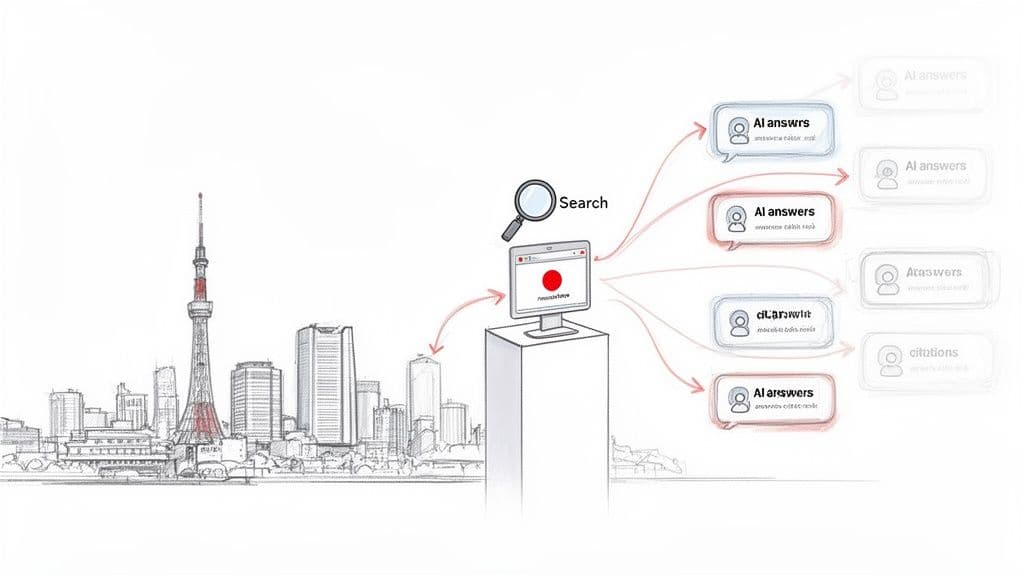
Make no mistake: AI invisibility is a direct threat to your bottom line. If your brand isn't cited in these AI responses—or worse, if the information is wrong—you’ve effectively disappeared for a growing chunk of your audience. This is exactly the problem that AI Search Optimization (ASO) was created to solve.
The Rise of AI and the Need for Specialization
Japan isn't just dabbling in AI; it's weaving it into the fabric of its economic future. The country's AI infrastructure market is exploding, on track to blow past $5.5 billion in 2026. What’s even more telling is that by 2028, spending on AI infrastructure is projected to eclipse non-AI spending. That’s a historic tipping point, signaling that businesses must pivot their digital strategies now or be left behind.
This new reality demands a completely different skill set.
AI search optimization isn't about getting one page to the top of the rankings. It’s about becoming such a trusted, authoritative source that AI models consistently cite your data across the entire digital ecosystem. It’s a game of authority, not just keywords.
This is why partnering with a dedicated AI search optimization agency in Japan has become a strategic necessity. They have the technical chops to understand the nuances of Large Language Models (LLMs) and ensure your brand’s story is told accurately in AI-powered answers.
Why Traditional SEO Falls Short
It’s easy to see why a new approach is needed when you compare the old way with the new.
Key Differences Between Traditional SEO and AI Search Optimization
This distinction is everything. While the fundamentals of good SEO provide a solid foundation, they simply don't account for how AI models gather, process, and present information. For a deeper dive, you can explore this analysis of https://attensira.com/blog/which-geo-metrics-matter-most-for-competitive-visibility-in-ai-search-in-2026.
And it's not just search. AI is reshaping entire industries. Seeing how other professions are adapting, like with the emergence of the best legal AI tools for lawyers, provides a wider perspective on the scale of this change. A proactive strategy is non-negotiable, and that includes constantly monitoring your brand’s visibility with tools like Attensira to build a lasting competitive edge in this fast-moving market.
Before you even consider talking to an AI search optimization agency in Japan, you have to get brutally honest about what you want to achieve. I've seen too many companies waste time and money chasing vague goals like "improving visibility." That's not a goal; it's a wish. To get any real return on your investment, your objectives have to be specific, measurable, and tied directly to the bottom line.
This means we have to move beyond the comfort of traditional SEO metrics and start speaking the language of AI search.
The entire game has shifted. We're no longer just trying to rank a page; we're trying to own a conversation. Your goals need to reflect this new reality. Instead of obsessing over keyword positions, we'll be measuring how often—and how accurately—your brand shows up in AI-generated answers.
From Vague Ideas to Concrete KPIs
So, how do we turn broad business ambitions into the kind of Key Performance Indicators (KPIs) that actually mean something for AI search? This exercise is all about creating clarity. It ensures that both you and your future agency partner are rowing in the same direction.
Let's look at a couple of real-world scenarios I've encountered:
- For a B2B SaaS company: Their main objective was to be seen as the go-to expert in a crowded software category. We defined their KPIs around increasing their share of voice in AI answers for questions about their product's core features and the problems it solves. Success wasn't about ranking #1; it was about how often their brand was named as the definitive solution.
- For a manufacturing firm: Their focus was less on lead generation and more on brand reputation and accuracy. We set clear objectives to find and correct factual errors about their products appearing in AI results. Another key goal was to increase citations from trusted industry publications within those generative answers, building a moat of credibility.
The most important first step, before you do anything else, is to benchmark where you stand right now. You can't measure improvement if you don't know your starting point. Any agency worth its salt will insist on auditing your brand’s current visibility and accuracy across major platforms like Perplexity, SGE, and ChatGPT.
This initial audit is your foundation. It gives you a baseline to measure all future progress against, turning your strategy from a shot in the dark into a data-driven campaign.
Tying AI Search KPIs to Business Outcomes
Meaningful KPIs can't live in a vacuum. They must connect directly to tangible business results. The right AI search strategy can do more than just make you look good; it can directly impact the quality of your leads, your brand's authority, and even shorten your sales cycle. It's on you to draw that line clearly.
Here’s a simple framework for connecting the dots:
This kind of framework makes your investment accountable. You're no longer just chasing abstract metrics—you're driving real business growth. When you define these goals upfront, you give a clear mandate to the AI search optimization agency you bring on in Japan. It changes the entire conversation from "What are you going to do?" to "How will you help us hit these specific targets?"
Of course, knowing which metrics to track in the first place is fundamental. If you want to dig deeper into this, understanding which search metrics impact SEO visibility is a great place to build your foundational knowledge. Ultimately, a crystal-clear set of goals is the bedrock of any successful agency partnership.
How to Spot a True AI Search Partner in Japan: Your Vetting Checklist
Choosing an agency to steer your brand’s presence in AI search isn't just another marketing decision. It’s a strategic choice with long-term consequences. Get it right, and you build a powerful, lasting advantage. Get it wrong, and you'll burn through your budget on tactics that are already obsolete.
This isn't about finding a team that's merely "aware" of AI. You're looking for a partner who lives and breathes it—one who can genuinely get inside the head of a Large Language Model (LLM) and strategically influence its outputs. This checklist is designed to help you separate the true experts from the pretenders in the Japanese market.
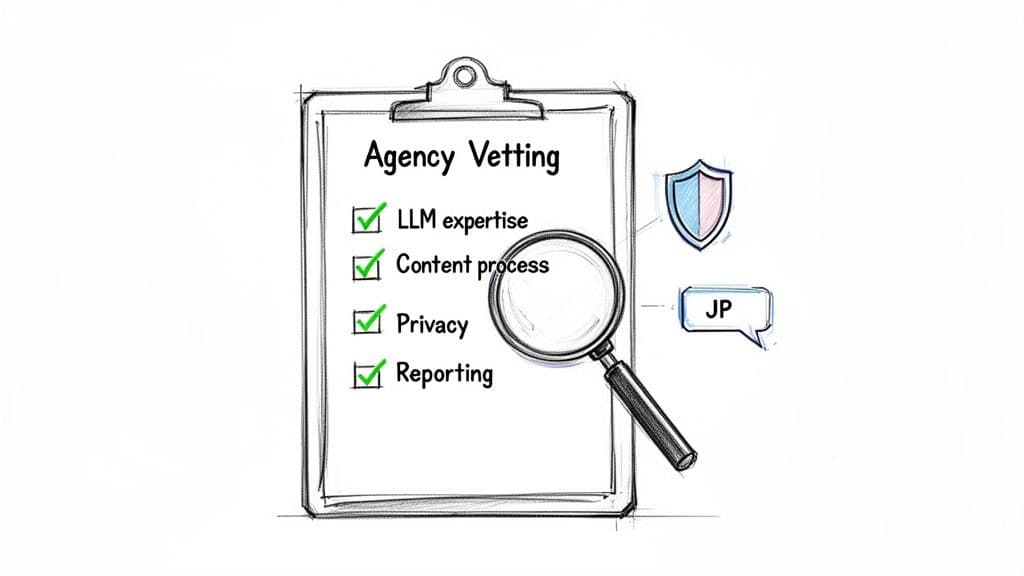
Probing for Real Technical and Strategic Depth
Any agency can talk about keywords and backlinks. A genuine AI search optimization agency in Japan will immediately pivot the conversation to entities, structured data, and knowledge graphs. Your first meetings should feel less like a sales pitch and more like a technical consultation. This is your first and best chance to see if they have the necessary depth.
So, how do you do that? Ask them point-blank to walk you through their methodology for influencing AI-generated answers. A weak answer will revolve around "creating high-quality content." A strong answer will get technical, fast.
Listen for their approach to:
- Entity Reconciliation: How do they plan to teach AI models that your brand, products, and key executives are distinct, authoritative entities worthy of citation?
- Structured Data Implementation: They should talk specifics about using schema markup, particularly JSON-LD, to spoon-feed context to machines.
- Knowledge Base Curation: What’s their process for building and syndicating a "source of truth" across the web—one that AI models will learn to trust and reference?
If they can't articulate a clear, repeatable process for making your information machine-readable, they simply aren't ready for this new era of search.
An agency’s ability to articulate a strategy for influencing multiple data sources—not just your own website—is a key differentiator. AI models synthesize information from across the web, so a single-site focus is fundamentally flawed.
Put them on the spot with a real-world scenario. Try this: "An AI platform is incorrectly stating our product's price in Japan. What are the first three steps you would take to correct this?" Their response will tell you everything you need to know about their practical problem-solving skills.
To help you systematically evaluate these capabilities, we've developed a scoring matrix. Use this to compare how different agencies stack up across the competencies that truly matter.
Core Competencies for an AI Search Optimization Agency
By scoring each potential partner against these points, you create an objective foundation for your decision, ensuring you're not just hiring an agency, but a strategic asset.
Do They Genuinely Understand Japan?
Operating in Japan introduces layers of nuance that a generalist agency, even a great one, will miss. This isn't just about having a few native Japanese speakers on staff. It's about a deep, ingrained understanding of the local digital ecosystem, business culture, and consumer behavior.
The explosive adoption of generative AI in the country makes this even more critical. The Japan generative AI market was valued at USD 5.90 billion in 2025 and is on a trajectory to hit USD 57.89 billion by 2034. According to Fortune Business Insights, this rapid growth is driven by enterprises embedding these tools into their core operations. Your agency must be fluent in this specific context.
Drill down with pointed questions:
- Which Japanese-specific data sources and platforms do you prioritize for knowledge syndication, and why?
- How do you adapt content strategy to account for Japanese linguistic nuances to ensure correct interpretation by AI?
- Can you describe your experience navigating Japan’s data privacy regulations, specifically the APPI?
If their answers are vague or they default to global platforms without mentioning local powerhouses like Yahoo! Japan's knowledge base or key industry sites, it's a major red flag. They aren't prepared. While the core principles of vetting an agency are universal—as this guide for finding an AI search optimization agency in London shows—the local execution is everything.
What Do Their Tools and Reports Actually Tell You?
Finally, you need absolute transparency in tooling and reporting. An agency is only as good as the data it uses to guide strategy and prove value. You must know exactly how they track progress against the business objectives you defined at the start.
Don't just take their word for it. Ask for a live demo of their reporting dashboard or at least a few sample reports from a non-confidential client.
Look for a clear visualization of metrics that matter for AI search, such as:
- Share of Voice in AI Answers: How often does your brand appear in responses for your target topics compared to competitors?
- Citation Frequency and Quality: Are you being cited as a source? How authoritative are those citations?
- Sentiment Analysis: Is the narrative surrounding your brand in AI outputs positive, negative, or neutral?
Ask them about their proficiency with dedicated monitoring platforms like Attensira. An agency that has already invested in modern AI monitoring tools is better equipped to hit the ground running and provide the data-backed insights you need. Ultimately, the clarity of their reports is a direct reflection of their confidence and competence.
Understanding Agency Pricing and Agreements
Let's get straight to the point: what does working with an AI search optimization agency in Japan actually cost? It's not just about the monthly retainer; it's about understanding what you're paying for and making sure the investment aligns with real business outcomes.
The market for these services is exploding. Japan’s AI sector was valued at USD 19,814.1 million in 2025 and is on a trajectory to hit an astonishing USD 194,727.6 million by 2033. This growth, which you can see in the full Japanese artificial intelligence market research, means more agencies are entering the space. That makes it more crucial than ever to understand how they structure their fees.
Common Pricing Models in Japan
In my experience, you'll see monthly fees in Japan start around 100,000 JPY for basic services. For a comprehensive strategy targeting a large enterprise, that number can easily climb past 300,000 JPY. Most agencies operate on one of three main models.
- Retainer-Based: This is the standard. You pay a set monthly fee for continuous optimization, monitoring, and strategic guidance. It’s the best fit for the long-term nature of AI search, where consistent effort builds lasting brand authority.
- Project-Based: Got a specific, one-off goal? Maybe you need to correct a persistent factual error in an AI’s knowledge base or optimize a key product line for generative answers. A project-based fee covers that defined scope of work.
- Performance-Based: This is still rare, mostly because directly attributing a specific sale to an AI-generated answer is tough. You might find a hybrid model, though—a smaller retainer plus bonuses for hitting clear KPIs, like reaching a target Share of Voice in AI results.
A retainer model provides the stability needed for the iterative, long-term work of influencing AI models. AI search optimization is a marathon, not a sprint, and this model aligns with the ongoing effort required to build and maintain authority.
Before you sign anything, get a clear picture of what’s included. Reviewing a transparent pricing structure for AI search monitoring can give you a solid baseline for the kinds of services and tools that factor into these costs.
Scrutinizing the Service Level Agreement
The Service Level Agreement (SLA) is where the rubber meets the road. This is the document that turns sales-call promises into contractual obligations. A vague SLA isn't just lazy; it’s a massive red flag.
Your job is to comb through this document and ensure it’s built to hold the agency accountable. Pay close attention to these key areas:
Don't be afraid to negotiate these terms. In fact, you must. A genuine partner will see this as an opportunity to align on goals and build a transparent relationship. Any AI search optimization agency in Japan worth its salt wants an SLA that clearly defines what success looks like for everyone involved.
Once the contract is signed, the real partnership begins. Don't make the mistake of thinking the hard part is over; this is where your collaboration with an AI search optimization agency in Japan truly starts. A well-managed onboarding process is the difference between a fast ROI and months of frustrating, circular conversations.
Think of this initial phase as laying the foundation. It's not just about handovers. It's about simultaneously granting the right access and, just as importantly, establishing how you'll measure success. If either piece is missing, you're essentially flying blind.
The entire engagement, from proposal to ongoing work, should function as a continuous loop.
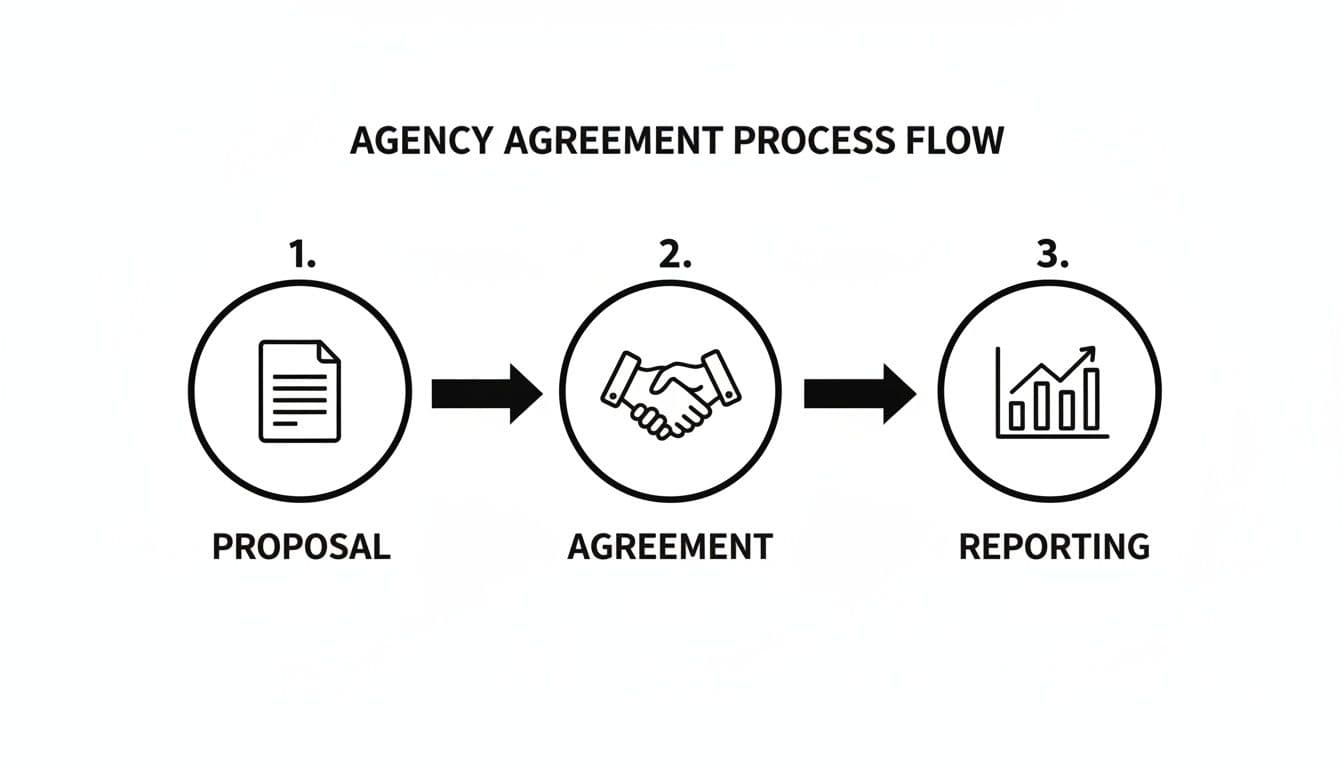
As you can see, the agreement isn't the finish line. It’s the gateway to the reporting and feedback cycle that will actually drive your optimization efforts forward.
Building the Knowledge Foundation
The first practical job is to get your new agency the raw materials they need to start working. This means giving them access to your data and then, critically, working together to curate your core brand information.
Right away, you'll need to tackle two key tasks:
- Granting Access: Your agency will need secure, role-based access to your Google Analytics, Google Search Console, and any relevant Content Management Systems (CMS). This is non-negotiable for them to map out your current search footprint and establish a performance baseline.
- Creating a 'Source of Truth': This is arguably the most important collaborative effort you'll undertake. Together, you’ll build a central, definitive knowledge base about your company—the one-stop-shop for everything an AI needs to know about you.
This "source of truth" isn't just a marketing folder. It's a meticulously curated library of verified, structured information. It’s the ammunition your agency will use to train AI models. It should contain everything from official executive bios and granular product specs to peer-reviewed whitepapers and vital case studies. The more precise this data is, the better equipped your agency will be to fight misinformation and build your brand’s authority in AI-generated answers.
Establishing Your Measurement Baseline
You can’t know if you’re winning if you don’t know where you started. Before a single optimization is made, your agency must benchmark your brand's current visibility in AI-driven search. This initial audit creates the yardstick against which all future progress will be measured.
A proper baseline analysis from a competent agency in Japan will tell you:
- Current Share of Voice: For your most important topics, what percentage of AI answers feature your brand compared to your key competitors?
- Sentiment Analysis: When your brand is mentioned, is the context positive, negative, or just neutral?
- Factual Accuracy Audit: Where are AI models currently wrong about your company, products, or services?
Setting this baseline is the only way to turn vague objectives into concrete, measurable goals. It's how "we want more brand mentions" becomes a specific KPI: "Increase our Share of Voice for 'enterprise software Japan' from 4% to 15% in six months."
This data-first approach creates accountability from day one and gets both teams aligned on the same set of challenges and opportunities.
Defining What Success Looks Like in Reporting
With a baseline in place, the conversation shifts to ongoing measurement. The old world of SEO reports focused on keyword rankings and organic traffic simply won't cut it. Your new reporting needs to track the metrics that actually matter for AI search.
You and your agency must agree on a reporting framework that visualizes progress toward the KPIs you just defined. Instead of simply showing website visits, for example, a good report will correlate changes in AI-generated answers to tangible business outcomes, like improved lead quality or a documented shift in brand sentiment.
Effective reporting answers real business questions:
- Are we fixing misinformation? A report should offer clear "before and after" snapshots showing specific inaccuracies that have been corrected in AI responses.
- Is our brand sentiment improving? You need to track the tone of AI summaries about your brand over time, looking for a measurable shift toward positive language.
- Are we becoming an authority? Reporting should quantify the increase in citations from trusted sources within AI answers, proving your brand is becoming a go-to reference.
Platforms like Attensira are designed for this new reality. They move beyond basic web analytics to give you a clear view of your brand’s presence in generative AI. You can learn more about what a dedicated AI search monitoring platform tracks and why it’s so critical for proving value. By insisting on this level of outcome-focused reporting from the start, you ensure your agency partnership is built for one thing: delivering measurable results.
Your Questions About AI Search Optimization in Japan, Answered
If you’re thinking about bringing on an AI search optimization agency in Japan, you’re bound to have questions. This is new territory, and it’s easy to get lost in the noise. It's critical to know what’s real, what works, and what to expect.
We’ve fielded these questions from B2B leaders and CMOs who are trying to get their arms around this discipline. Here are the direct, no-fluff answers you need.
How Is an AI Search Agency Different from a Traditional SEO Agency?
It’s a common point of confusion, but the distinction is fundamental. A traditional SEO agency is fighting to get your website ranked on Google. Their entire world is built around keywords, backlinks, and technical site health—all aimed at securing one of those coveted blue links. It’s a craft they’ve honed for decades, and it still has its place.
An AI search optimization agency, on the other hand, is playing an entirely different game. Their goal isn't just to rank your site; it’s to directly influence the knowledge base of the AI models themselves, like those behind Google’s SGE or ChatGPT. They work to make sure that when someone asks a question, your brand is the one cited accurately and favorably within the AI's generated answer.
To do this, their methods are completely different.
- They focus heavily on entity management, which is essentially teaching the AI what your company is, what it does, and why it’s an authority on a given topic.
- They rely on deep structured data and knowledge graph optimization to make your information perfectly legible to machines.
- Their work extends far beyond your own website. They syndicate verified information across a wide network of trusted sources that AI models use for training.
In short, while SEO gets you on the list, AI search optimization gets you into the answer.
How Long Does It Take to See Results?
This is always a top-of-mind question, and rightly so. Unlike a pay-per-click campaign that delivers instant traffic, AI search optimization is a strategic investment that builds over time. But that doesn’t mean you have to wait forever to see progress.
You can actually score some quick wins within a few weeks. These usually involve correcting glaring factual errors the AI has picked up about your brand—things like an old price, a wrong address, or an outdated product feature. A targeted effort can fix these relatively quickly as the models ingest the corrected, authoritative data.
Building true authority, however, takes more time. You should expect to see meaningful movement in metrics like Share of Voice and citation frequency within 3-6 months. Becoming the dominant, go-to source in your category is a longer-term effort, often developing over 12 months or more as you continually build and reinforce your brand’s digital authority.
Why Is a Japan-Specific Agency So Important?
For any company that’s serious about the Japanese market, this isn't just a "nice-to-have"—it's a deal-breaker. The reasons go far beyond simple translation and get to the very heart of how AI models understand and prioritize information in a local context.
An agency without deep roots in Japan will fundamentally misunderstand the data ecosystem. AI models prioritize local, authoritative Japanese sources that an international firm will almost certainly overlook, rendering their strategy ineffective from the start.
Here are three factors that make a local partner essential:
- Linguistic and Cultural Nuance: Japanese is a notoriously high-context language. A direct, literal translation often misses the mark and can be misinterpreted by an AI, leading to some truly awkward or flawed summaries. A local team gets the subtleties right.
- Local Data Sources: AI models learn from the data they're fed. In Japan, that means they place immense weight on sources like Yahoo! Japan, influential local industry blogs, and Japanese news outlets. A Japan-focused agency knows exactly which sources matter and has the relationships to get your information placed there.
- Local Market and Legal Expertise: The way Japanese users search and interact with digital content is unique. Just as important is navigating the country’s strict data privacy laws, like the Act on the Protection of Personal Information (APPI). A local agency builds a strategy that’s not only effective for the market but also fully compliant.
What Data Do I Need to Share with an Agency?
Success here is a two-way street. Your agency can't just work in a vacuum; they need your partnership to build a robust "source of truth" about your company. Initially, this involves standard access to tools like Google Search Console and Google Analytics for an audit.
The real work, though, comes from a collaborative effort to build and maintain a central knowledge base. This is the collection of verified information that your agency will use to teach the AI models. You should be ready to provide and regularly update:
- Official company history, mission, and core values.
- Detailed product specifications, datasheets, and pricing information.
- Up-to-date executive biographies and published thought leadership.
- Your best whitepapers, research reports, and marquee case studies.
This curated library becomes the ammunition your agency uses to ensure AI models learn about your brand from the most accurate, compelling, and authoritative information available.
Ready to stop guessing and start measuring your brand's presence in AI search? Attensira provides the clarity you need to see how your brand is represented across major AI platforms, track your share of voice, and get actionable insights to improve your visibility. Take control of your AI narrative by visiting https://attensira.com to learn more.