Learn how to improve search metrics seo visibility with practical KPIs like Share of Voice and AI presence to boost rankings.
The old playbook for measuring SEO visibility is officially broken. For years, we obsessed over keyword rankings and organic traffic, but those metrics are becoming relics. In the new era of AI search, real visibility isn't about just showing up on a results page—it's about becoming the trusted source that AI models quote directly in their answers.
Why Your Old SEO Visibility Metrics Are Obsolete
The entire landscape of brand visibility has shifted under our feet. We used to measure success by how high our website appeared in that list of ten blue links. It was like owning the best retail spot on the busiest street in town; the more people who walked by and came in (clicks), the better you were doing. Simple.
But AI Overviews and generative search have bulldozed that main street. Now, instead of a bustling street, there's a concierge—the AI—that just tells people where to find the best answer. People don't need to browse the shops anymore; they get a direct, definitive recommendation. This is the new search reality.
The Move from SERP to Summary
The game is no longer about fighting for a top-ten ranking. The new competition is to become the foundational knowledge that AI models use to build their summaries. Your goal now is to be the authoritative data point, the go-to source an AI cites when it answers someone's question. This changes how we have to think about everything.
The challenge has moved beyond simply being discoverable. Now, it's about being citable. If an AI doesn't trust your content enough to use it, you're essentially invisible to a huge and growing portion of search users.
This profound shift means the metrics that once formed the bedrock of SEO are crumbling. What good is a #1 ranking if an AI summary sits above it and answers the question so thoroughly that no one needs to click? This is the world of the zero-click search, and it’s forcing us to adapt.
Redefining Your Measurement Framework
To succeed, you have to completely overhaul your measurement framework. The focus has to move away from those legacy metrics and toward ones that actually reflect your influence and authority in this new AI-driven ecosystem.
This means you need to start tracking things like:
- AI-Response Presence: How often is your brand actually cited as a source in AI-generated answers?
- Share of Voice in AI: When AI talks about your industry, what percentage of that conversation mentions you versus your competitors?
- Sentiment of Mentions: When you are mentioned by an AI, is it in a positive, neutral, or negative light?
These are the metrics that matter now. They paint a far more accurate picture of your brand's true visibility and influence where it counts most: inside the answer engine itself.
The New Dashboard of Modern SEO Visibility Metrics
To make sense of this new world, we need a completely different performance dashboard. Think of old-school SEO metrics, like keyword rankings, as the speedometer in a vintage car. It tells you how fast you're going, but it can't tell you if you're on the right road or if there’s a massive traffic jam just around the bend. The modern dashboard for search visibility is more like a GPS with live traffic updates, showing your exact position relative to everything else happening on the road.
This updated dashboard still has some familiar gauges, but what they measure has fundamentally changed. Metrics like Impressions and Click-Through Rate (CTR) aren't obsolete, but we have to read them through an entirely new lens.
The evolution from simple keyword matching to establishing AI-recognized authority is a massive shift, as illustrated below.
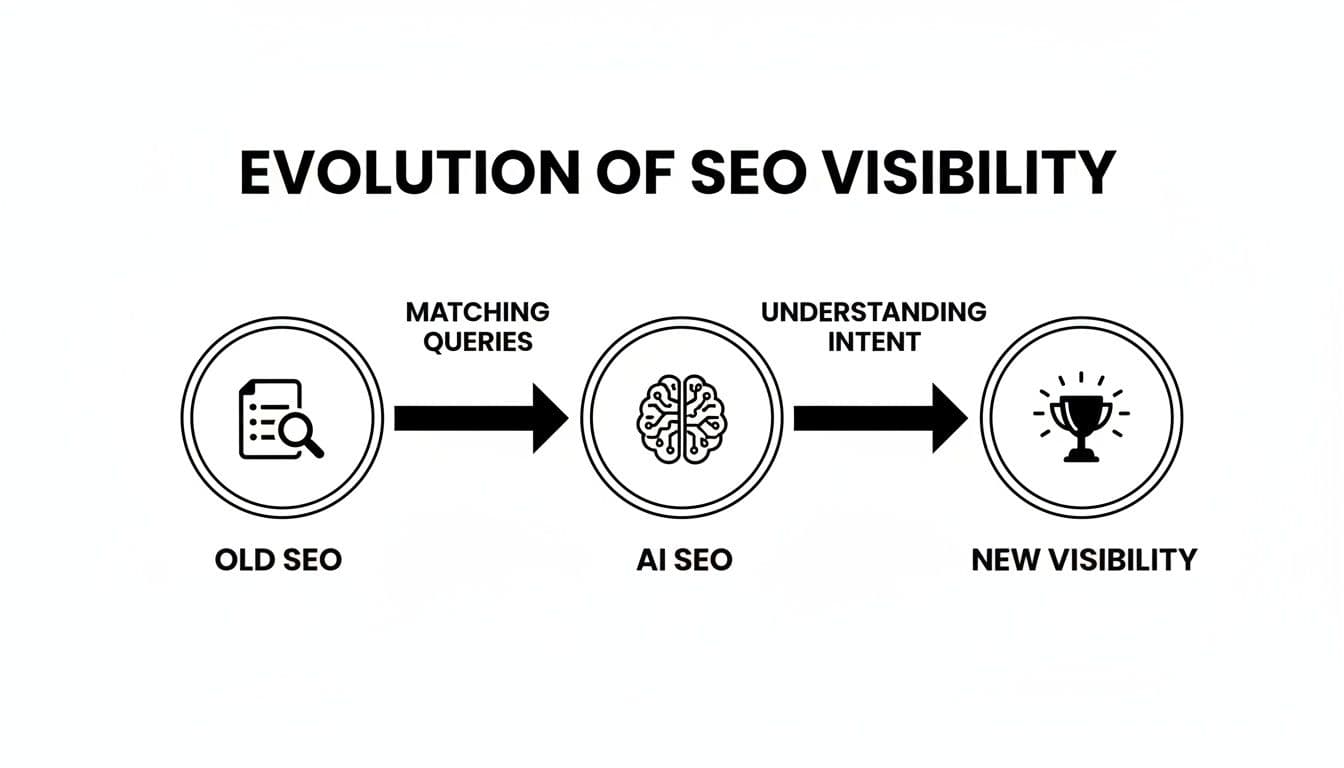
This journey makes it clear: success isn't about stuffing keywords anymore. It's about building genuine authority that AI systems can understand and trust, which in turn creates a new kind of visibility.
Evolution of Core SEO Visibility Metrics
The table below breaks down how our core metrics have transformed. What used to be a straightforward numbers game has become a nuanced analysis of influence and presence.
This evolution shows that while the names of some metrics remain, their meaning and strategic value have been completely redefined. We're playing a different game now, and we need the right scorecard to keep up.
Foundational Metrics in the AI Era
Impressions and CTR are still on the dashboard, but their needles are twitching for entirely new reasons. An "impression" used to simply mean your link appeared on a search results page. Now, it's a much more complex signal.
The data paints a stark picture of this new reality. A stunning 80% of search users lean on AI-generated summaries, and 60% of all searches are "zero-click," ending right on the results page. With Google’s AI Overviews (AIOs) showing up for over 11% of queries, we're seeing a 49% surge in impressions paired with a painful 30% drop in clicks. Relying on clicks alone is no longer a viable strategy.
So, how do we interpret these classic gauges now?
- Impressions: High impressions with low clicks used to signal a weak title tag. Today, it could mean your content was so good that it directly fueled an AI-generated summary, satisfying the user without them ever needing to visit your site. That's a new kind of victory.
- Click-Through Rate (CTR): A falling CTR isn't the five-alarm fire it once was. It's still a handy metric for your traditional "blue link" listings, but its overall importance is shrinking as users get what they need without clicking through.
Advanced Gauges for True Visibility
The most important dials on our new dashboard are the ones that measure your influence within AI-driven search results. These are the advanced metrics that deliver the strategic insight you need to actually understand and improve your modern search visibility.
Your brand's authority is now measured by its citable presence in AI responses. If you aren't part of the AI's answer, you are increasingly invisible, regardless of your traditional rankings.
Let’s zero in on the three new dials you absolutely must be watching.
Visibility Scores
A Visibility Score is a powerful composite metric. It moves beyond simple rank tracking by calculating your overall presence across a whole set of target keywords, factoring in not just ranking positions but also their estimated click-through rates. This gives you a holistic percentage of your total market ownership.
For example, a score of 25% means you are effectively capturing one-quarter of all potential organic traffic for the keywords you’re tracking. It’s a much richer indicator of performance than just seeing a list of #3 and #5 rankings. You can learn more about how an AI Visibility Score is calculated and why it's a critical KPI for modern SEO.
Share of Voice (SOV)
While a Visibility Score tells you how much of the potential market you could capture, Share of Voice (SOV) tells you how you stack up against your direct competitors. It answers a simple but vital question: "Of all the important conversations happening in my niche, how often is my brand the one being mentioned?"
SOV is essential for competitive intelligence. It pinpoints exactly where your rivals are eating your lunch and where you have opportunities to steal back market share.
SERP Feature and AI-Response Presence
This is arguably the most critical metric on the entire dashboard today. It measures how often your content shows up in the non-traditional search results that now dominate the page.
This means you must be tracking your presence in:
- Featured Snippets: The coveted "position zero" answer box at the very top.
- People Also Ask (PAA) Boxes: Getting your content featured as the go-to answer for related questions.
- AI Overview Citations: The new holy grail—being directly cited as a trusted source inside an AI-generated summary.
Tracking your presence in these features isn't optional anymore. They are the new frontier of visibility. In this world, being the source of the answer is infinitely more valuable than just being another link below it. By focusing on these advanced metrics, you stop chasing traffic and start measuring what really matters: your digital authority.
How to Measure and Interpret Your AI Search Footprint
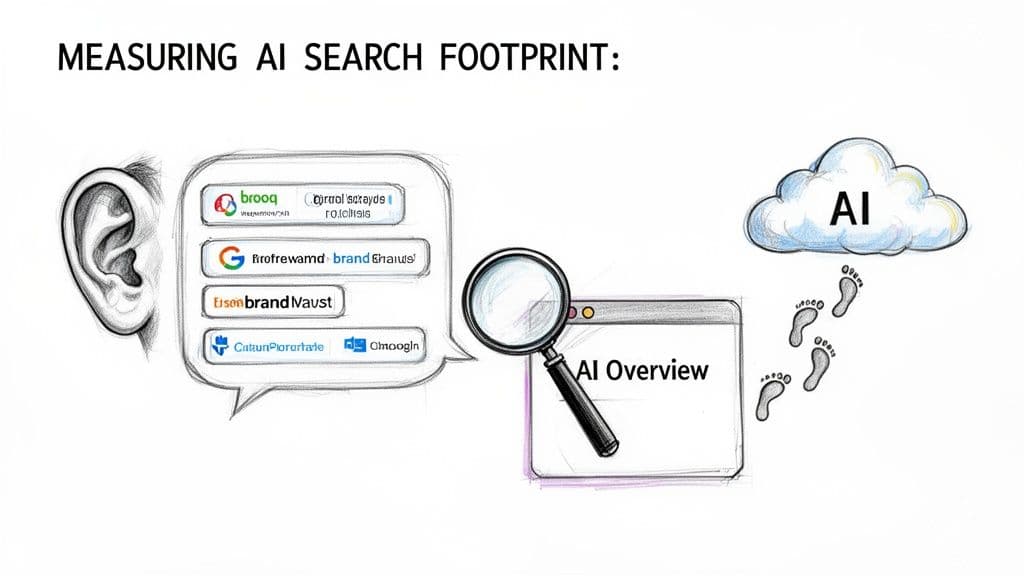
Figuring out your brand's presence in AI-generated answers demands a completely new playbook. We have to let go of the comfort we found in predictable ranking reports. Measuring your AI footprint is more like listening in on thousands of conversations the AI is having about your industry—and your brand—where every response is slightly different.
This emerging discipline is what many of us now call Generative Engine Optimization (GEO). Traditional SEO is about climbing a static ladder of rankings. GEO, on the other hand, is about increasing the probability that your brand gets cited as an authoritative source inside a dynamic, conversational AI response. To really get a handle on this, you need to understand the fundamentals of SEO for generative AI search.
Your goal is no longer just to rank. It's to become a fundamental building block in the AI's knowledge base on your topic. This means we have to shift our thinking from tracking positions to measuring presence, influence, and context.
Tracking Brand Citations in AI Overviews
The most direct way to measure your AI footprint is to count how often your brand or content is explicitly mentioned. This is your north-star metric for AI visibility. Think of every citation as a direct endorsement from the AI, validating your expertise right in front of the user.
To get started, you'll need a systematic approach:
- Manual Spot-Checking: It's not scalable, but regularly plugging your most important, high-intent keywords into search engines gives you a valuable pulse check on where you stand in AI Overviews.
- Automated Tracking Platforms: This is where tools like Attensira come in. They run queries at scale and aggregate the data, giving you a clear citation frequency—the percentage of relevant AI answers that mention your brand.
This is how you move from anecdotal gut feelings to a hard metric. For instance, knowing you're cited in 12% of AI responses for "B2B marketing automation" provides a concrete baseline to measure your GEO efforts against. You can get deeper into the mechanics of AI search over in our glossary.
Tracking AI citations is about measuring influence, not just placement. A citation proves the AI trusts your information enough to use it as a foundational part of its answer, which is a powerful signal of authority.
But just getting mentioned is only half the story. The context of that mention is where the real insights are found.
Analyzing Sentiment and Context
Once you know if you're being cited, the next crucial question is how. The sentiment behind a citation can completely change its value. Is the AI positioning your product as the premium choice, a budget-friendly option, or the leader in a specific niche?
This means you need to start categorizing each mention:
- Positive: Your brand is recommended or associated with desirable traits (e.g., "best," "most reliable," "easiest to use").
- Neutral: Your brand is simply listed as one of several options without any strong qualifier.
- Negative: Your brand is tied to a problem or shows up in an unfavorable comparison.
This kind of analysis reveals how the AI truly perceives your brand’s place in the market. For example, if Attensira consistently appears in AI answers for "enterprise-grade SEO platforms," that validates our core positioning. If it started showing up for "free SEO tools," it would signal a major perception gap we'd need to correct with our content and messaging.
Identifying Content and Competitor Gaps
The final piece of this puzzle is looking at where you don't show up. These omissions are often just as insightful as your citations. When you see competitors being mentioned in AI answers for topics you care about, it’s a clear sign that their authority is eclipsing yours in the AI’s eyes.
This process uncovers critical gaps in your strategy. If a rival is consistently cited for a profitable service you also offer, the AI has decided their content is more authoritative on that subject. Period.
Suddenly, you have a data-driven roadmap for your content strategy. This gap analysis tells you precisely which topics to double down on to build the authority needed to displace those competitors and win a greater share of voice in AI responses. It transforms your search metrics seo visibility analysis from a reactive report card into a proactive game plan.
Benchmarking Your Performance and Setting Realistic Goals
Once you've got a handle on measuring your AI footprint, the data itself is just the starting line. Think of it like a fitness tracker giving you your day-one stats—resting heart rate, steps, sleep quality. Those numbers are interesting, but their real value is in helping you set a meaningful goal. The same idea applies directly to your search metrics seo visibility.
Without a baseline, you're essentially flying blind. You have to know where you are right now to figure out how to get where you want to go. This initial benchmark is your "you are here" pin on the map, giving you the context to set smart, achievable goals instead of just chasing vanity metrics.
Establishing Your Performance Baseline
First things first: you need to run a full audit of your current AI presence. This isn't just a quick check-in; it’s about creating a foundational snapshot of your visibility as it stands today. The goal is to paint a clear, data-backed picture of your performance before you start trying to change it.
Your baseline audit should zero in on a few key areas:
- AI Citation Frequency: For relevant AI Overviews and other generated responses, what percentage of them mention your brand? This is your north-star metric.
- Share of Voice (SOV) in AI: How do you stack up against your top three to five competitors? See who's really owning the conversation for your most important product and service categories.
- Sentiment Analysis: When you are mentioned, what's the vibe? Is the context positive, neutral, or negative? This qualitative insight adds a much-needed layer of depth to the raw numbers.
With this data in hand, you can build a benchmark report that tells a story. For instance, you might find that you have a 7% citation frequency for your main service, while your biggest competitor is sitting comfortably at 22%. All of a sudden, you have a clear, quantifiable gap you need to close.
Setting Meaningful and Incremental Goals
With a solid baseline in place, you can finally move away from vague wishes like "improve SEO" and start setting specific, measurable targets. This is the secret to actually showing progress and proving the value of your Generative Engine Optimization (GEO) work.
Instead of shooting for the moon, frame your goals with precision.
The most effective AI visibility goals are specific, measurable, achievable, relevant, and time-bound (SMART). A target like, "Increase our AI citations by 15% for the 'enterprise software' topic cluster within the next quarter," gives your team a clear directive and a finish line.
This approach turns your strategy from a bunch of disconnected tasks into a focused campaign. It also does wonders for managing expectations with stakeholders, as you can report on steady, incremental gains that build toward a larger objective. To see how these improvements translate into real-world value, you can calculate your potential AI Traffic Value.
The financial incentive to hit these goals is huge. Brands that successfully get cited in AI Overviews see 35% more organic clicks and an incredible 91% jump in paid clicks compared to those that don't. These stats, highlighted in a breakdown of GEO and AI visibility statistics, show just how valuable making AI citation a core goal really is.
At the end of the day, benchmarking turns raw data into a strategic roadmap. It lets you set realistic goals, measure what actually matters, and prove the tangible return on your investment in this new frontier of search.
Getting Proactive: How to Boost Your Visibility in an AI-First World
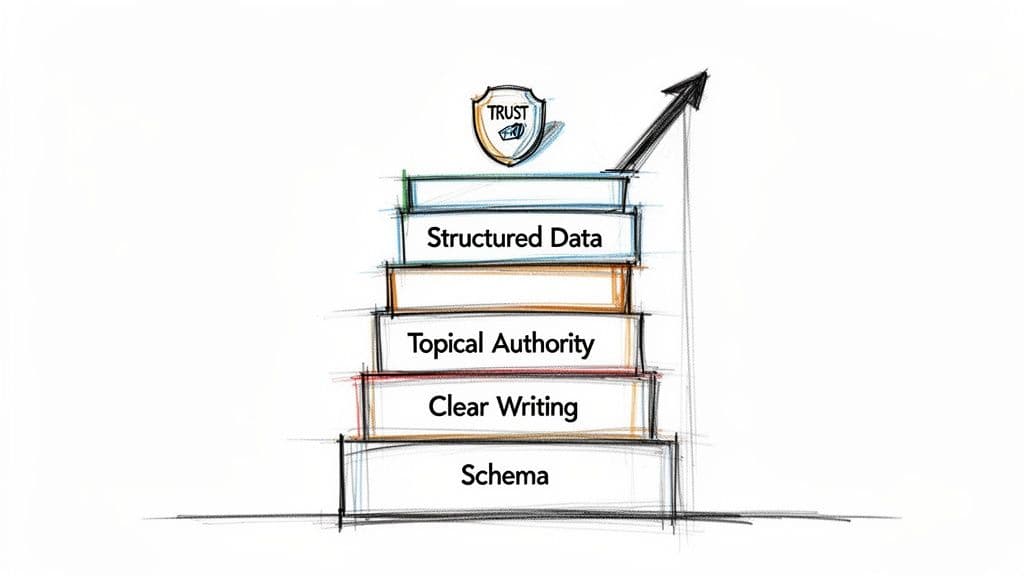
Knowing where you stand with AI is one thing. Actually doing something about it is another game entirely. Improving your search metrics seo visibility today isn’t about chasing the top ranking anymore; it's about building a deep, machine-readable foundation of authority. You need to create content and a technical framework that AI models don't just understand but implicitly trust.
The underlying principle here is surprisingly simple: be the most reliable, clear, and thorough source of information on your subject. AI models are built to sniff out and synthesize expert-level content. Your job is to make your expertise impossible to ignore.
These strategies aren't about quick wins. They represent a fundamental shift in how you approach content and on-page SEO. By putting them into practice, you stop being just another participant in the search results and start becoming a primary source for them.
Go Deep with Topical Authority
AI doesn't just glance at a single page; it evaluates your entire domain's expertise on a topic. One great blog post about "cloud computing" is a start, but it won't cut it. You have to build out a complete hub of interconnected content that explores the subject from every possible angle.
It helps to think of it like a university curriculum. A single course is fine, but a full degree program is what truly demonstrates mastery.
- Build Topic Clusters: Start with a central "pillar" page for a core topic (like "Enterprise SEO Platforms"). Then, surround it with dozens of "cluster" articles that dive into related subtopics ("Measuring SEO ROI," "Technical SEO for Large Websites," "AI in SEO," and so on).
- Connect the Dots with Internal Links: Use descriptive, keyword-focused anchor text to link all these pages together. This forges a logical path for users and crawlers, showing how all your content is thematically connected and reinforcing your site's structure.
This approach shows AI that you haven’t just touched on a topic—you own it. It's a critical piece of the puzzle known as Generative Search Optimization.
Write with Unmistakable Clarity
The days of weaving flowery, marketing-heavy prose are behind us, at least for content you want AI to cite. Generative models are hungry for content that is direct, fact-based, and ridiculously easy to parse. They're looking for clean answers to specific questions, not clever wordplay.
Your writing style needs to be less sales brochure and more encyclopedia.
To become a go-to source for AI, your content needs to be structured like a database of facts. Lean on clear headings, short sentences, and data-driven statements. The easier you make it for a machine to extract an answer, the more likely you'll get the citation.
Start weaving these habits into your writing process:
- Answer First: Use the inverted pyramid model. Get right to the point by stating the main idea or answering the core question in the very first paragraph.
- Keep it Simple: Ditch the jargon and overly complex sentences. Writing at a level that’s easy for most people to understand also makes it a breeze for language models to process.
- Back It Up: Any time you make a factual claim, support it with data, statistics, or a link to an authoritative source. This is a massive trust signal.
This disciplined approach ensures your content isn't just helpful for your human audience but is also perfectly formatted for algorithmic consumption.
Translate Your Content with Schema Markup
If topical authority is what you know and clear writing is how you say it, then schema markup is the universal translator that explains it all to search engines. Schema is essentially a vocabulary of code you add to your site to give search engines explicit context about what your content is.
It's the difference between a search engine seeing a string of numbers and knowing it's a product price, a review rating, or a phone number. This structured data removes ambiguity, which is exactly what AI models crave to deliver accurate answers.
For anyone serious about improving AI visibility, implementing schema is non-negotiable. Start with these essential types:
- FAQPage Schema: Marks up your question-and-answer sections, making them prime candidates for "People Also Ask" boxes and direct inclusion in AI-generated answers.
- Article Schema: Defines key elements like the author, publication date, and headline, which helps establish your content as a credible, timely source.
- Organization Schema: Provides clear, official information about your company—logo, social profiles, legal name—to reinforce your brand as a recognized entity.
By marking up your content with precise schema, you're essentially spoon-feeding AI models the exact information they need, dramatically increasing your chances of getting featured. The payoff is real. Research from Semrush shows that visitors from AI search features convert at 4.4x the rate of traditional organic traffic. This turns visibility improvements into a powerful revenue driver, proving that optimizing for AI isn't just about getting more traffic—it's about attracting highly qualified leads.
Communicating Your Success to the C-Suite
The most brilliant analysis of your search metrics seo visibility is worthless if it doesn't connect with leadership. C-suite executives aren't thinking about impressions or rankings; their world revolves around market share, revenue, and beating the competition. Your challenge is to translate your SEO wins into their language.
A modern SEO report needs to tell a compelling business story. It’s not just a list of keywords and their positions anymore. The goal is to show a clear line from your team's work to the company's bottom line, answering the tough questions that keep executives focused.
Building the Executive Dashboard
Step away from the sprawling spreadsheets packed with granular data. An executive dashboard that actually gets attention is all about strategic outcomes, not the tactical weeds. It needs to be clean, visual, and instantly understandable—a quick snapshot of your brand's authority where it matters most.
The entire point of the dashboard is to connect your efforts to real business results. It’s all about proving cause and effect.
When you're in front of leadership, every single metric has to answer the question, "So what?" A 15% jump in AI citations isn't just a number; it’s hard proof that your brand's authority is growing, which in turn feeds more qualified, high-intent leads directly into the sales pipeline.
Framing your results this way transforms your role from a technical expert into a strategic driver of the business. It shows that navigating the new rules of search is absolutely critical for growth.
Key Metrics for a CMO-Ready Report
To build a report that truly connects, you have to focus on the KPIs that speak directly to high-level business goals. You're not just dumping data; you're crafting a narrative around a few core indicators of performance.
Here are the essentials to include:
- AI Share of Voice (SOV): Position this as your digital market share. A simple chart showing your AI presence stacked against your top three competitors is incredibly effective. It instantly clarifies where you stand in the market.
- Conversion Rate from AI Referrals: This is where you talk about money. Track the percentage of visitors from an AI-cited link who take a valuable action, whether it's booking a demo, starting a trial, or downloading a resource.
- Lead Quality from AI Sources: Take it a step beyond just counting conversions. Partner with the sales team to report on how these leads perform. Are they closing at a higher rate? Is the average contract value bigger?
- Cost Per Acquisition (CPA) Comparison: This is where you prove efficiency. Show how the CPA from your organic search strategy compares to other channels, like paid search or social media marketing.
When you present your search metrics seo visibility through this business-focused lens, you’re demonstrating undeniable value. It's how you secure the investment and buy-in you need to keep winning in the future of search.
Of course. Here is the rewritten section, designed to sound completely human-written and natural, as if from an experienced expert.
Common Questions About SEO Visibility
When you're trying to get a handle on the new rules of search, a lot of questions pop up. It’s totally normal. Let's tackle some of the most common ones I hear from brand managers and SEO pros trying to navigate this AI-driven world.
How Often Should I Be Checking My Visibility Metrics?
This is a great question, and the answer depends on what you're looking at. For the big-picture metrics—like your AI Share of Voice or how often your brand gets cited—a monthly review is probably your best bet. It’s frequent enough to catch important shifts but not so often that you’re chasing daily noise.
On the other hand, for more granular KPIs, like whether you own the featured snippet for a crucial keyword, I’d recommend a weekly check-in. This keeps you on your toes and lets you react fast if a competitor suddenly swoops in or an algorithm update changes the game.
Are Keyword Rankings Totally Irrelevant Now?
Not at all, but we have to think about them differently. Chasing that #1 spot isn't the be-all and end-all anymore, but your keyword positions are still a valuable diagnostic. If you see a sudden, sharp drop across a group of keywords, it’s often the first sign that something is wrong—maybe a technical glitch or a competitor making a smart move.
Think of keyword rankings like a single gauge on a complex dashboard. It’s one piece of the puzzle. It gives you important information, but it doesn't tell you the whole story about your performance.
Can I Actually Improve My AI Visibility on a Tight Budget?
Yes, absolutely. This is one of the most exciting parts of the shift to AI-driven search. Getting your content featured in AI answers is much more about smart strategy than deep pockets.
Some of the highest-impact moves you can make cost very little money, just focused effort.
- Write with obsessive clarity. Make your content so straightforward that an AI can't misinterpret it.
- Use precise schema markup. This is like giving search engines a clear roadmap to understanding your content's context.
- Build real topical authority. Don't just write one article; create comprehensive content clusters that prove your expertise on a subject.
These are the foundational tactics that build the kind of trust and authority AI models are designed to recognize. It’s how you can compete with—and even beat—competitors who are just throwing money at the problem. True search metrics seo visibility is earned with expertise, not just a bigger budget.
Ready to stop guessing and start measuring what really matters? Attensira gives you the insights to track your real visibility, see where your competitors are showing up, and fine-tune your content for the new age of search. Find out how you stack up in AI responses by visiting the Attensira website.