


Discover how artificial intelligence monitoring protects your brand, manages risks, and secures your visibility in the new era of AI-driven search and chat.
Artificial intelligence monitoring is the practice of systematically tracking how your brand, products, and key messages appear in the responses of AI systems like ChatGPT. It's about looking over the AI's shoulder to see what it's telling people about you. This is the new frontier of brand management, moving beyond just social media and search results into the world of AI-generated conversations.
The New Reality of Brand Management
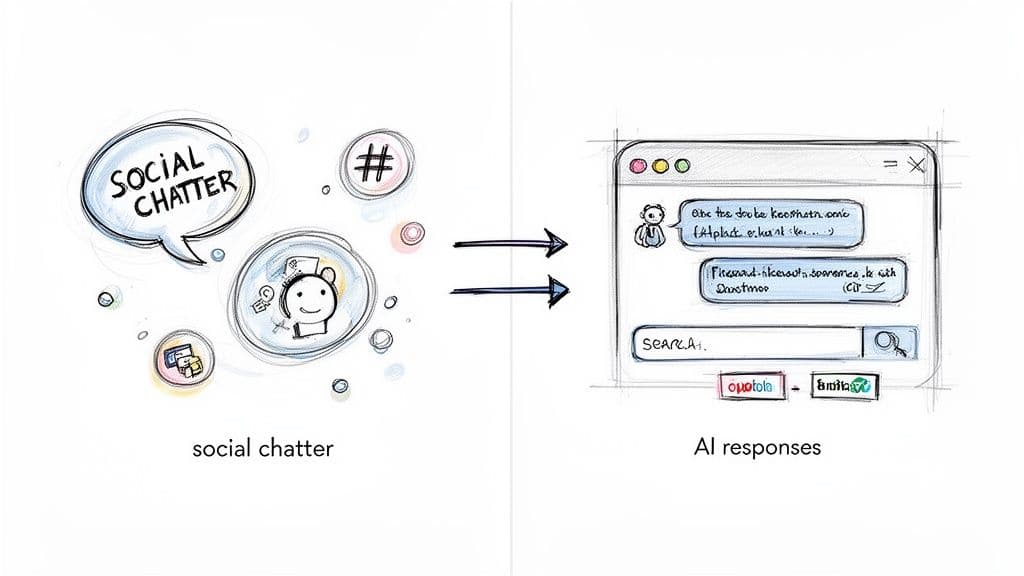
For the last decade, brand managers and SEO experts got really good at two things: social listening and ranking on Google. Success was a game of tracking tweets, dissecting Facebook comments, and fighting your way to the top of the search results. But the ground is shifting under our feet.
The new battleground for brand reputation isn't a social media feed—it's the answer box of an AI chatbot. Your customers are now turning to AI for everything from product comparisons and company history to direct purchase advice. This seismic shift raises a crucial question: is the AI representing your brand accurately, or is it getting things wrong... or even worse, leaving you out of the conversation completely?
From Social Listening to AI Monitoring
Think of it this way. Traditional social listening was like being in a crowded town square, able to overhear every public conversation about your brand. Artificial intelligence monitoring, on the other hand, is like getting a transcript of the private advice a trusted expert—the AI—is giving your customers. The stakes feel much higher because an AI's answer is often seen as objective fact, not just another opinion in the crowd.
This change demands a new toolkit and a new way of thinking. It's not enough to just count how many times you're mentioned anymore. Now, you have to dig into the substance of what AI models are saying. Proactive monitoring helps you get clear answers to some pretty vital questions.
You need to focus on a few key areas:
- Reputation Defense: Is the AI spreading inaccurate information about your products, services, or company values? You need to catch it before it becomes a widely accepted "fact."
- Competitive Intelligence: Are AI models recommending a competitor instead of you? Understanding why can uncover serious gaps in your market positioning and content.
- Content Strategy Validation: Is all that work you're doing to establish your brand as an authority actually paying off? AI responses are a great litmus test.
The game has changed. It’s no longer just about winning a top spot on a Google search page. It’s about winning the trust of the algorithms that directly answer your customers’ questions. This is a fight for factual accuracy and relevance in a brand-new channel.
The Urgency for CMOs and Brand Leaders
The global AI market is on an absolute tear, projected to rocket from USD 58.3 billion in 2021 to an incredible USD 309.6 billion by 2026. That's a compound annual growth rate of 39.7%, fueled by massive leaps in data processing and deep learning. What this means for your brand is that millions of AI-powered conversations are already shaping what people think about you, right now.
Ignoring this channel is a huge risk. You're either letting a false narrative build or accepting being invisible. For any CMO or brand leader today, setting up a solid artificial intelligence monitoring strategy isn't just a "nice-to-have" for the future. It's an immediate need for survival.
You can learn more about how to see how your brand shows up in ChatGPT in our detailed guide.
Why AI Monitoring Is a Non-Negotiable Strategy
Knowing what artificial intelligence monitoring is is one thing, but truly understanding why it’s become so essential is where smart strategy begins. Millions of people now treat AI models as trusted advisors, which means leaving your brand’s story to chance is no longer an option. The stakes are just too high.
Think about it. A potential customer asks an AI to compare products, and the answer it gives confidently misrepresents your key safety features. Or imagine an AI generating a "best of" list for your industry and completely leaving out your brand, even though you've been a leader for years. These aren't just hypotheticals—they're real, active risks businesses are facing right now. This highlights the double-edged nature of AI: it’s a massive opportunity for visibility, but also a huge risk for spreading damaging misinformation at lightning speed.
To really get why AI monitoring is so critical, you have to understand what AI-generated content is and how it’s changing the game. Every wrong or incomplete answer an AI gives about you chips away at the public's perception, slowly eroding the trust you’ve worked so hard to build.
Protecting Your Hard-Won Brand Equity
Your brand’s equity is one of your most valuable—and fragile—assets. It’s the culmination of every customer perception, experience, and ounce of trust you've painstakingly built over time. AI models, which learn from the vast, messy expanse of the internet, can tarnish that equity in an instant.
An AI might pull up an old, irrelevant pricing model, leaving customers confused and annoyed. It could dredge up a negative review from five years ago and present it as a current, mainstream opinion. Without monitoring, these digital lies spread like wildfire, becoming the accepted truth for users who see AI responses as gospel.
Proactive artificial intelligence monitoring is the new brand reputation management. It's about making sure the digital "expert in the room" has its facts straight about you, protecting the brand integrity you simply can't afford to lose.
Securing a Durable Competitive Advantage
While the risks are very real, the opportunities are just as big. The same AI models that can ignore your brand can also be guided to become its biggest advocate. Once you start monitoring and see how AIs gather information, you can pinpoint glaring content gaps and jump on strategic opportunities.
For example, you might discover that a competitor is consistently recommended for a use case where you actually lead the market. That insight is pure gold. It tells you exactly where your online content is falling short. By creating and promoting authoritative content to fill that void, you can start nudging the AI’s responses in your favor. Monitoring suddenly shifts from a defensive shield to a powerful offensive weapon for grabbing market share. Understanding your AI perception is now a key component of modern brand awareness measurement tools.
Future-Proofing Your Marketing Strategy
The content being published and indexed on the web today is the training data for the AI models of tomorrow. Every article, every product page, every shred of data is feeding the knowledge base that future AI systems will use to form their "opinions." That’s why you have to act now.
Brands that are actively monitoring and shaping their AI presence are building a serious long-term advantage. They are cementing their narrative into the foundational data that will drive information discovery for years to come. This isn't just about managing today's chatbots; it’s about locking in your brand's relevance and authority for the next decade. If you're not engaging in artificial intelligence monitoring, you're essentially letting your competitors write your company's future for you.
Understanding Your Brand's AI Health Score
Think of artificial intelligence monitoring as a routine physical for your brand's digital identity. A doctor doesn't just say you're "healthy"; they check specific vitals like blood pressure and heart rate. In the same way, we can measure a brand's health in the AI ecosystem by tracking a core set of metrics that combine into an "AI Health Score."
This score isn’t just some arbitrary number. It’s a composite of several critical data points that, taken together, give you a clear, honest picture of how AI models see and present your brand. Flying blind is no longer an option; without this data, you're just guessing about what millions of users are being told about you.
The Core Metrics of AI Brand Health
Good monitoring goes far beyond just counting how many times your brand gets mentioned. It’s about digging deeper to understand the quality, the context, and the real-world impact of every single appearance in an AI-generated answer. This is how you turn a pile of data into a strategic advantage.
There are four foundational metrics that tell the real story of your AI brand health:
- Mention Frequency: The starting point. This simply tracks how often your brand, products, or key people are named by AI models when users ask relevant questions. It's the first pulse-check on your visibility.
- Sentiment Analysis: This layer adds crucial context by analyzing the tone of the mention. Is the AI speaking about you in a positive, negative, or neutral way? A sudden dip into negative territory could be the first sign of a brewing reputation crisis.
- Factual Accuracy: This might be the most important metric of all. Is the information AI shares about your brand actually correct? This is where you catch dangerous errors like wrong product specs, old pricing, or outright false information about your company.
- Share of Voice (SOV): Here’s where the competition comes in. This KPI measures your visibility against your rivals. When a user asks for a recommendation in your industry, how much of the AI's answer is about you versus everyone else? A low SOV means your competitors own the conversation.
When you combine these metrics, you get a powerful diagnostic tool. It's the difference between knowing your brand was mentioned and understanding how it was portrayed, if the information was right, and who you were mentioned next to.
This idea of connecting monitoring to business goals is much more than a theory.
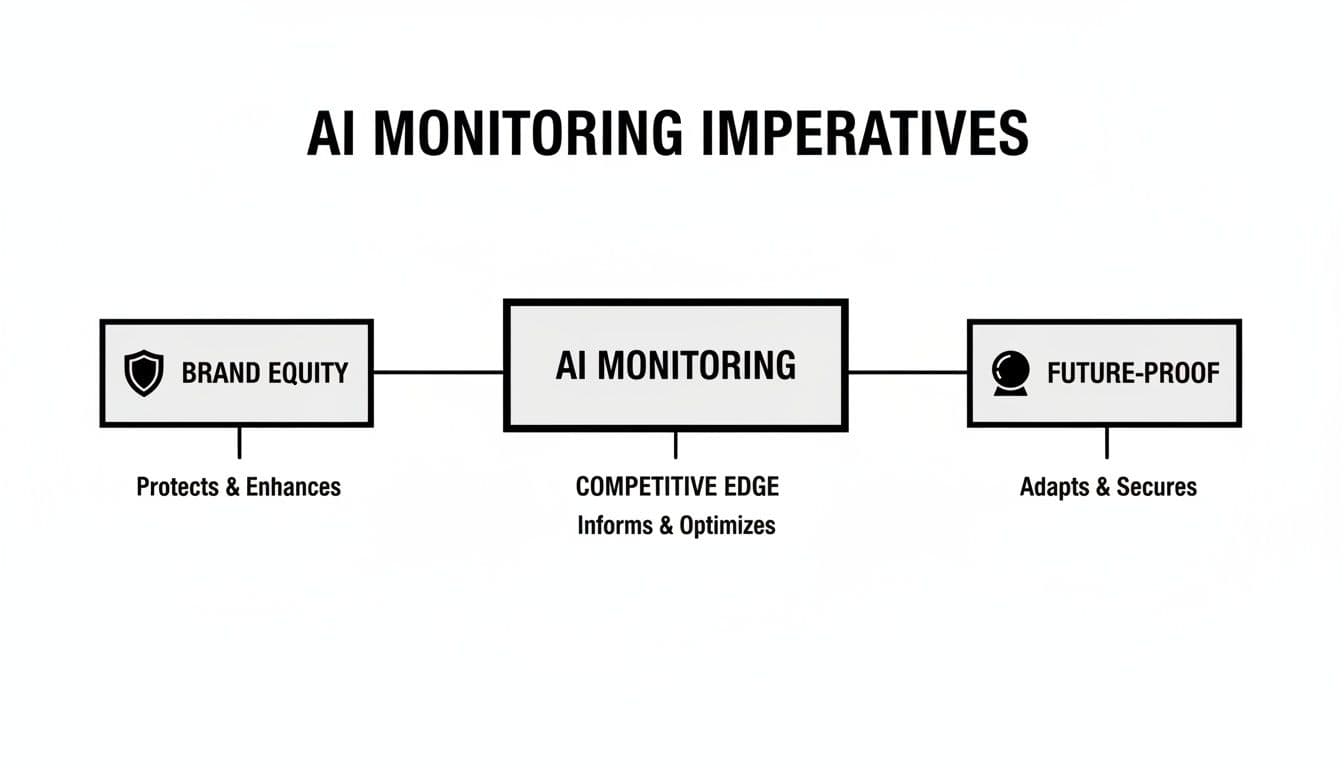
As you can see, there's a straight line from proactive monitoring to protecting your brand's value, getting a leg up on the competition, and securing your place in the market for the long haul.
Comparing Monitoring Approaches
Not all artificial intelligence monitoring is the same. The methods generally fall into two main camps, and knowing the difference helps you pick the right strategy for what you're trying to achieve.
- Passive Tracking: This is all about listening. You continuously monitor public AI models like ChatGPT or Gemini to see how they mention your brand organically. It's the best way to get a baseline understanding of your current reputation and spot any immediate red flags.
- Active Probing: This approach is more like a controlled experiment. You systematically ask AI models specific, strategic questions (prompts) to test their knowledge and recommendations. For example, you might ask, "What are the best CRM platforms for small businesses?" just to see if your product makes the list. Active probing is essential for sizing up competitors and seeing if your content strategy is actually working.
Of course, a key part of this whole picture is tying your efforts back to the bottom line, which includes having solid solutions for AI automation ROI tracking. If you're wondering where you currently stand, a great first step is to calculate your company's AI readiness score with our free tool. It can give you a clear starting point for building out your monitoring strategy.
Real-World Scenarios of AI Monitoring
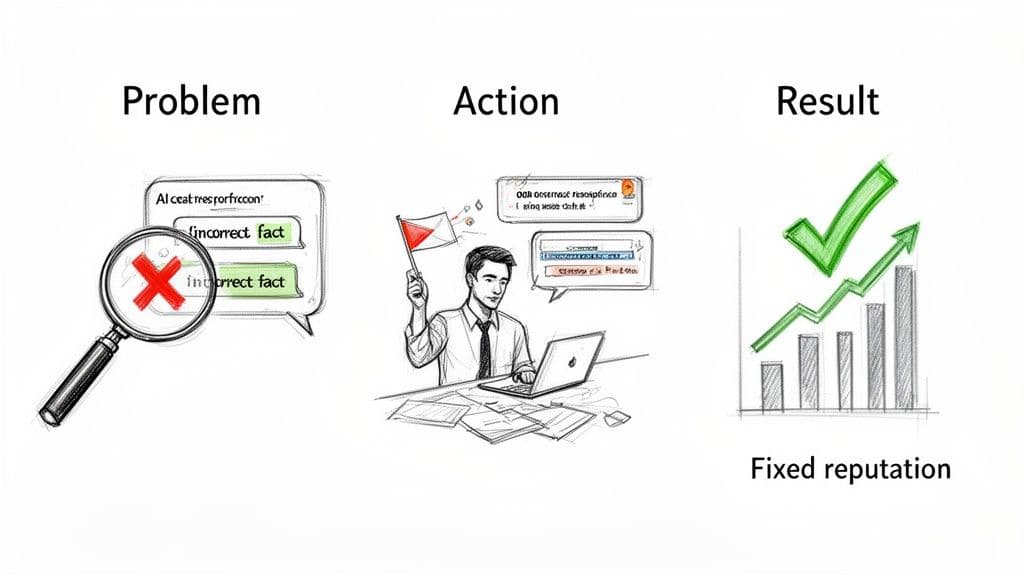
The theory behind AI monitoring is great, but its real value snaps into focus when you see it applied to actual business problems. This is where abstract data points turn into tangible outcomes, directly shaping strategy and protecting the company's bottom line.
These scenarios aren’t just hypotheticals; they show how monitoring insights become the catalyst for decisive action. Each one breaks down a common challenge into a simple problem-action-result format, making it clear how businesses can turn AI visibility issues into measurable wins.
Uncovering a Critical Content Gap
Imagine a B2B software company that's a leader in project management tools for huge enterprise clients. For years, they've been the go-to, topping industry reports and ranking high in search for their core offerings.
Problem: During a routine audit with an artificial intelligence monitoring tool, the marketing team noticed something alarming. When people asked popular AI models questions like, "What's the best project management software for large-scale construction projects?" their biggest competitor was getting the top recommendation. Their own brand was either a footnote or missing entirely.
Action: This set off alarm bells. The SEO team used this specific insight to conduct a deep content audit. It turned out their site, while full of case studies, didn't have direct, explanatory content about this niche that an AI could easily understand. They quickly built a new pillar page and a series of in-depth blog posts laser-focused on this exact topic.
Result: Within a few months, the change was obvious. The next round of monitoring showed that AI models were now citing their new content, and their brand was appearing as the top recommendation for those construction-related queries. They didn't just plug a competitive leak; they re-established their authority in a key market.
This is a perfect example of how monitoring shifts from defense to offense. It uncovers blind spots that traditional SEO tools often miss, giving you a clear roadmap for creating content that directly influences AI-powered recommendations.
Correcting Dangerous Misinformation
Now, let's switch to a popular consumer brand known for its plant-based health supplements. Their entire reputation is built on transparency and using only high-quality, natural ingredients.
Problem: The brand manager received an alert from their monitoring system about a dangerous inaccuracy popping up in a major AI assistant's answers. When asked about the ingredients in a best-selling product, the AI was incorrectly claiming it contained a common allergen. This was completely false and posed a huge risk to both customer safety and brand trust.
Action: The team moved fast. They gathered all their documentation—official ingredient lists, third-party certifications—and filed a correction request with the AI model's developer. At the same time, they beefed up the accurate content on their own website's FAQ and product pages to make sure the right information was impossible to miss.
Result: The AI provider confirmed the error and pushed an update. Follow-up monitoring verified that the AI assistant was now providing the correct, safe ingredient information. The brand successfully neutralized a massive reputational and legal threat before it could do any real harm. You can learn more about how to track brand visibility in top LLMs to get ahead of these problems.
Validating a Winning SEO Strategy
Finally, a story of success. An ambitious SEO team at a mid-sized tech company had spent the last year meticulously building a massive knowledge base. Their goal was to become the undisputed source of truth in their field.
Problem: Organic traffic was up, which was great, but they needed to prove their content was actually building authority, not just ranking for keywords. They needed to show that their huge investment was creating long-term brand equity.
Action: They started using an artificial intelligence monitoring platform. The objective was simple: see if AI models were referencing their guides and articles as source material when answering complex questions about their industry.
Result: The data was a home run. The dashboard lit up, showing their content was being frequently cited in AI-generated answers, often with direct links back to their site. This was the hard proof they needed to show their strategy was working, cementing their status as a trusted authority and easily justifying their budget for high-quality content.
How to Implement Your AI Monitoring Strategy
Knowing you should monitor AI and actually doing it are two different things. Making that leap from theory to action is where you start protecting your brand in earnest. Putting an artificial intelligence monitoring strategy in place might sound intimidating, but it’s really a straightforward, methodical process.
With a clear roadmap, any marketing team can shift from reacting to problems to proactively shaping their brand’s narrative. The whole point is to build a repeatable system for listening to, understanding, and ultimately influencing how AI models see you. This isn’t a one-and-done project; it’s a continuous loop that defends your reputation and even uncovers new avenues for growth. And it all starts with getting specific about what you need to protect.
Step 1: Define Your Monitoring Scope
Before you can track anything, you have to decide what actually matters. If your scope is too broad, you'll drown in noisy, useless data. Think of it like drawing a protective boundary around your brand's most critical digital assets.
Start by making a prioritized list of the keywords, names, and concepts that are non-negotiable for your brand. This list should absolutely include:
- Brand and Product Names: Every official name, common abbreviation, and even the misspellings people frequently use.
- Key Executives: The names of your CEO, CTO, and other public-facing leaders. Their personal reputation is inextricably linked to the company's.
- Competitor Names: You need to keep tabs on your direct rivals to see how you stack up and spot shifts in their messaging.
- Core Industry Terms: High-value, non-branded keywords where you aim to be seen as the authority (e.g., "best enterprise CRM software").
This list is the foundation of your entire strategy. It focuses your efforts on the conversations that directly impact your bottom line.
Step 2: Set Up Your Monitoring Dashboard
Once you know what to track, you need to set up your command center. This is where you’ll plug your keywords into a monitoring platform and get a baseline reading of your current AI health. A platform like Attensira is designed to handle this, translating streams of complex data into a dashboard you can actually understand.
A good dashboard gives you a clean, at-a-glance view of your brand's presence in AI, letting you spot trends and anomalies without needing a data science degree.
After the initial setup, the system gets to work, actively querying AI models and pulling the results together. Your main job here is to just let the data collect for a little while. This creates a reliable baseline—a snapshot of where your brand stands today, before you've made any changes. You can't measure progress if you don't know your starting line.
Step 3: Analyze Initial Reports
With a baseline established, it’s time to dig in. This is where you start finding the low-hanging fruit—the immediate risks and opportunities. Look for patterns in the first batch of reports. Are there consistent inaccuracies about your product’s features? Is a competitor always mentioned as the top alternative?
This analysis provides your first real glimpse into your brand's AI narrative. It's the moment you stop guessing and start knowing, giving you the hard evidence needed to build a targeted response.
This kind of monitoring is becoming central to business operations everywhere. The trends we see with smart sensors and IoT are mirrored here; we're filling critical knowledge gaps in our digital ecosystem. With AI expected to add trillions to the global economy—like an estimated USD 3 trillion to Asia's GDP by 2030—staying on top of your AI visibility is non-negotiable for market leaders. You can find more about these AI market drivers and regional trends on einpresswire.com.
Step 4: Build Your Action Plan
Insights are worthless without action. The final step is to turn your analysis into a concrete, measurable plan. Based on what you’ve found, prioritize the biggest issues and assign them to the right people on your team.
Your plan should be specific. For example:
- Correct Inaccuracies: If you find factual errors, task your content team with creating and publishing definitive articles that set the record straight.
- Fill Content Gaps: Is a competitor owning a key topic? Direct your SEO team to develop a pillar page or a blog series to establish your authority. Using tools for advanced prompt tracking is a great way to pinpoint these gaps.
- Amplify Strengths: When you find positive and accurate mentions, get your PR and social media teams to amplify that narrative across every channel you own.
This cycle—define, monitor, analyze, and act—is the engine of a successful artificial intelligence monitoring program. It moves brand management from a defensive, reactive game to a proactive strategy built for the world we live in now.
What To Do Next in an AI-Powered World
If you've made it this far, you understand a crucial new reality: artificial intelligence monitoring isn't just another marketing fad. It’s a fundamental part of managing your brand. We're moving past the simple goal of ranking on a search results page. Now, success is also about ensuring your brand shows up accurately and favorably in the direct, conversational answers people get from AI.
The brands that start shaping their AI presence today are creating a competitive moat. They're embedding their story into the knowledge base that will power how people discover information for years. Sitting on the sidelines isn't an option—it's a gamble that lets competitors and bad information define your brand for you. Getting ahead starts with a few practical steps.
Start With a Manual Brand Audit
Before you even think about new software, you need to get your hands dirty. A manual audit is your first look behind the curtain, giving you a raw, unfiltered view of how AI models see your brand right now. It’s a surprisingly simple but incredibly revealing first move.
- Fire up the big AI models: Open up ChatGPT, Google Gemini, and a few others.
- Ask real-world questions: Use the kinds of prompts your customers would. Think "What are the best alternatives to [Your Competitor]?" or "Compare [Your Product] vs. [Competitor's Product]."
- Screenshot everything: Document what you find. Pay close attention to where you're mentioned, where you're missing, and—most importantly—where the AI gets the facts completely wrong.
This quick exercise will immediately show you where your biggest risks and opportunities are hiding.
Treat this audit like your starting point. It's the "before" photo that gives you the justification and context you need to build a real monitoring strategy. The problems you uncover here will make the need for a dedicated platform crystal clear.
Look Into Automated Monitoring Tools
A one-off manual check is a great start, but it won't scale. To go from occasional spot-checks to a consistent, data-backed strategy, you need automation. This is where dedicated artificial intelligence monitoring platforms like Attensira come into play. They do the heavy lifting by running thousands of queries, tracking how responses change over time, and rolling it all up into reports you can actually use.
Taking a platform for a test drive shows you the power of seeing the full picture. You can graduate from just tracking mentions to analyzing sentiment, measuring your share of voice against the competition, and getting alerts the moment a new inaccuracy pops up. This is how you stop being a bystander and start actively managing your brand's AI story.
Weave AI Metrics Into Your Reporting
The final piece of the puzzle is to make AI visibility a non-negotiable part of your regular marketing reporting. Your AI health score belongs right alongside website traffic, keyword rankings, and social media engagement. Bringing these metrics into your official reporting ensures this new frontier gets the C-suite attention it deserves.
Start small. Add a new slide to your monthly marketing deck that covers:
- Mention Volume & Sentiment: How often are we showing up, and is the conversation positive?
- Share of Voice vs. Competitors: Are we mentioned more than our rivals in key conversations?
- Inaccuracies Found & Fixed: What risks did we catch and neutralize this month?
When AI monitoring becomes a routine part of your workflow, you guarantee your brand's story is protected and positioned for the future of search. The conversation is already happening; now is the time to make sure you're a part of it.
Frequently Asked Questions
Stepping into the world of artificial intelligence monitoring often raises practical questions. How does this fit with what we're already doing? What’s the real value? Let's clear up some of the most common queries and pinpoint its unique role in today's brand management playbook.
How Is AI Monitoring Different from SEO or Social Listening?
It’s easy to group them together, but they’re playing on completely different fields. SEO is all about getting your web pages to rank high in traditional search results. Social listening is about tuning into public chatter and brand mentions on platforms like X or LinkedIn.
AI monitoring, on the other hand, listens to a brand new channel: the direct, conversational answers coming from generative AI models. It tackles critical new questions that the other tools can't. When a user asks an AI for a recommendation in your category, are you in the running? Is the information it gives about your products actually correct? Think of it as a new frontier for brand defense, built for the age of AI-powered answers.
Can I Just Monitor My Brand Manually?
You could, of course, pop into a chatbot and ask a few questions about your brand every now and then. But for a business, that kind of spot-checking is far from scalable, consistent, or reliable.
The answers you get from an AI can change dramatically based on the slightest shift in how a question is phrased, the user's chat history, or the latest model update. A dedicated monitoring platform runs thousands of systematic queries on your behalf, tracking every little change over time. It gives you aggregated data and analytics that you could never hope to gather by hand. It’s the difference between occasionally guessing and having a continuous, data-driven strategy.
A manual check is like a single snapshot; automated monitoring is the full motion picture. It reveals the trends, catches those fleeting inaccuracies, and provides the complete oversight you need to truly protect your brand's reputation.
How Do You Influence AI Chatbot Responses?
Influencing what an AI says is an indirect game, but it's one you can win. It's all about building a digital footprint that’s so strong, clear, and authoritative that the models can't ignore it. You can't just log in and edit an AI's knowledge base, but you can feed it much better source material to learn from.
The best way to do this is by creating high-quality, factual, and well-structured content on your own website and other trusted sources. An artificial intelligence monitoring platform points you to exactly where the inaccuracies and omissions are happening. armed with that knowledge, you can create targeted content—like a detailed FAQ page or precise product spec sheets—to fill those gaps. Over time, as the AI models crawl and absorb this new, superior information, their answers will naturally start to reflect it.
What Is the ROI of an AI Monitoring Platform?
The return on investment for AI monitoring comes from two sides of the same coin: defense and offense.
- Defensive ROI: This is about risk mitigation. You're catching and correcting damaging misinformation that could tarnish your reputation, confuse potential customers, and directly cost you sales. It’s the value of the crises you avert.
- Offensive ROI: This is where you find new opportunities. You can spot chances to increase your visibility, capture a bigger share of voice in AI recommendations, and get a leg up on competitors who aren't paying attention.
By making sure your brand shows up accurately at the very moment a customer is asking for guidance, you're inserting yourself directly into their buying journey. That influence leads to very real, measurable growth.
Ready to take control of your brand's narrative in the new age of AI search? Attensira provides the tools you need to monitor your AI visibility, correct inaccuracies, and turn insights into a competitive advantage. Discover how your brand is being represented today by visiting https://attensira.com.