How to see brand visibility in chatgpt? Learn practical steps to measure, optimize, and boost your brand presence in AI conversations.
If you want to see how your brand shows up in ChatGPT, you need to start thinking differently. It's time to move past a traditional SEO mindset and adopt what we call an Answer Engine Optimization approach. This isn't about tracking keyword rankings anymore. It’s about methodically testing prompts, seeing if—and how—your brand gets mentioned, and digging into the sources the AI trusts.
Why Your Brand Is Invisible in ChatGPT
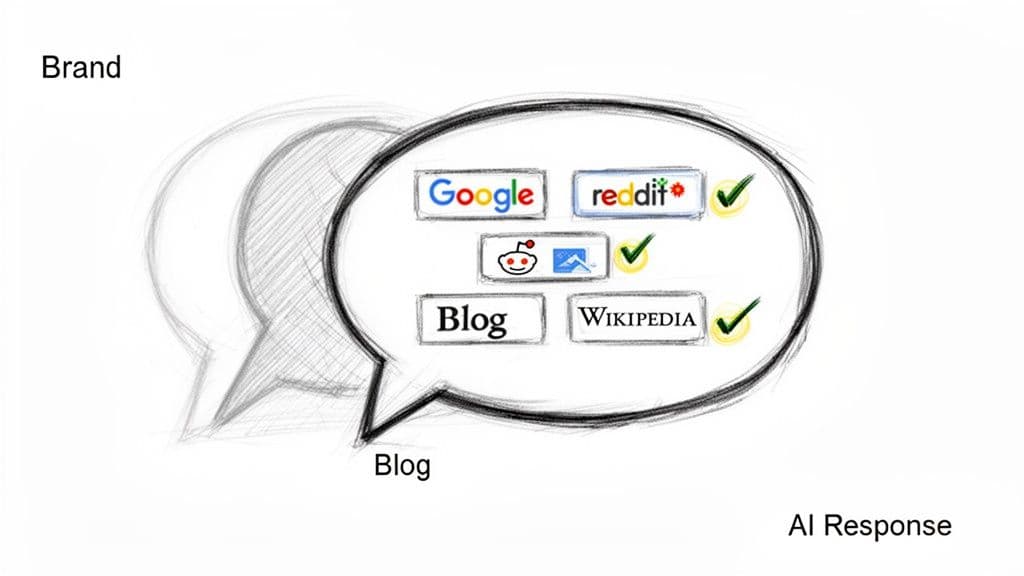
Are you dominating Google's search results but have completely vanished from AI conversations? You’re not alone. This is the new reality of how information is being put together and presented.
The reason for this gap is surprisingly straightforward: large language models like ChatGPT don't "rank" websites the way we're used to. Instead, they construct a complex web of understanding around concepts, which it treats as entities.
Your brand, your products, even the problems you solve—these are all entities in the AI's world. ChatGPT's job is to map a user's question to the most relevant entities it has learned about. That top spot on Google is still valuable, but for an AI, it's just one signal among many.
The Shift from Keywords to Entity Recognition
Old-school SEO revolved heavily around keyword density and backlinks to specific pages. While those things haven’t disappeared, AI models put far more weight on structured data and entity recognition. They're trying to answer a different set of questions:
- What is this brand, really?
- What specific problems does it solve for people?
- What do other trusted sources—like industry blogs, forums, and news sites—say about it?
If your online footprint doesn't offer clear, consistent answers to these questions, the AI simply won't have the confidence to recommend you. It prefers to pull from a diverse portfolio of trusted sources rather than relying on a single, well-optimized website. You can get a much deeper look at this in our guide on how ChatGPT indexes content.
We’ve seen this firsthand. A major entity-focused update rolled out, and the impact was immediate. Our analysis showed an average brand visibility drop of about 31%, with a staggering 85% of the brands we track seeing their mentions decline.
This update introduced structured entity fields, which essentially formalized the AI’s understanding. As a result, the average number of brand mentions per answer was slashed from 6-7 down to just 3-4, making the fight for each mention incredibly fierce.
Here’s a classic example we see all the time: A B2B SaaS company owns the #1 spot on Google for their main keyword. But when a potential customer asks ChatGPT, "What's the best tool for [solving X problem]," the AI recommends three of their competitors. The sources? A Reddit thread and two industry review sites.
This happens because those competitors built a stronger presence where real conversations happen—the exact places the AI has learned to trust for validation. They aren't just ranking for keywords; they're an integral part of the discussion. This is the new battleground for brand visibility.
If you're serious about understanding your brand's visibility in ChatGPT, you have to move past random, one-off searches. What you need is a structured, repeatable process. This gives you a clear baseline, helping you measure the impact of your efforts and see exactly where you stand against the competition. Without a framework, you’re just guessing.
A solid approach is to think like your customer. Your tests should mirror the real-world customer journey, using different types of prompts to simulate how people actually look for information. This isn't about running one or two simple queries; it's about systematically probing the AI's knowledge from multiple angles to find out not just if you’re mentioned, but why and when.
Three Tiers of Test Prompts
To get a complete picture, your testing should cover three distinct categories of user intent. Each tier uncovers a different piece of the puzzle regarding your brand's presence in the AI's knowledge base.
- Direct Brand Queries: These are the most straightforward tests. You're asking directly about your company or products to see how ChatGPT describes you. Think of it as checking your brand's digital ID card.
- Problem-Aware Prompts: Here's where the real insights are hiding. These queries focus on a customer's pain point without naming a specific solution. This is how you find out if you’re recommended when a potential customer is just starting their search for help.
- Competitive Analysis Queries: These prompts explicitly put you head-to-head with your rivals. The AI's response can reveal perceived strengths and weaknesses, often pointing to the third-party sources that have shaped its opinion.
The real goal here is to build a systematic workflow. You're tracking not just mentions, but the sentiment behind them and the sources the AI cites. A simple spreadsheet is all you need to get started and create that crucial baseline.
Putting the Framework into Action
Let's walk through an example. Imagine a B2B tech company called "Innovate Solutions" that sells project management software. A practical testing session would involve prompts from all three tiers.
Here’s a sample set they might use to get started:
- Direct: "What is Innovate Solutions?" or "Tell me about the features of Innovate Solutions' software."
- Problem-Aware: "What are the best tools for a remote marketing team to manage complex projects?"
- Competitive: "Compare Innovate Solutions and Asana for enterprise teams."
Running these queries provides a surprisingly rich dataset. For instance, that problem-aware prompt might reveal ChatGPT recommends competitors while citing a specific industry blog. That's a powerful, actionable insight. It tells you exactly where you need to focus on building more authority. This is a core part of learning how to track your brand's visibility in ChatGPT and other top LLMs.
Documenting Your Findings for Analysis
To make this process genuinely useful, you have to document everything. Over time, this record becomes invaluable. A basic tracking sheet can capture the most important data points from each test.
This kind of structured approach transforms random spot-checks into a reliable intelligence-gathering operation. It’s the foundational step to truly understanding—and eventually improving—how your brand shows up in the new world of AI-driven conversations.
How to Make Sense of ChatGPT’s Answers and Find Actionable Insights
So, you've run your tests and have a pile of responses from ChatGPT. The real work starts now. Just counting how many times your brand gets mentioned is only scratching the surface. To really understand your visibility, you need to dig into the context, the sentiment, and most importantly, the sources fueling every answer.
This is where you turn raw AI output into a real strategy. It’s about getting past the simple question of "Are we mentioned?" and digging into the "Why are we—or why aren't we—getting recommended?"
The flowchart below maps out the three essential types of prompts—direct, problem-based, and competitive—that form the backbone of a solid visibility audit.
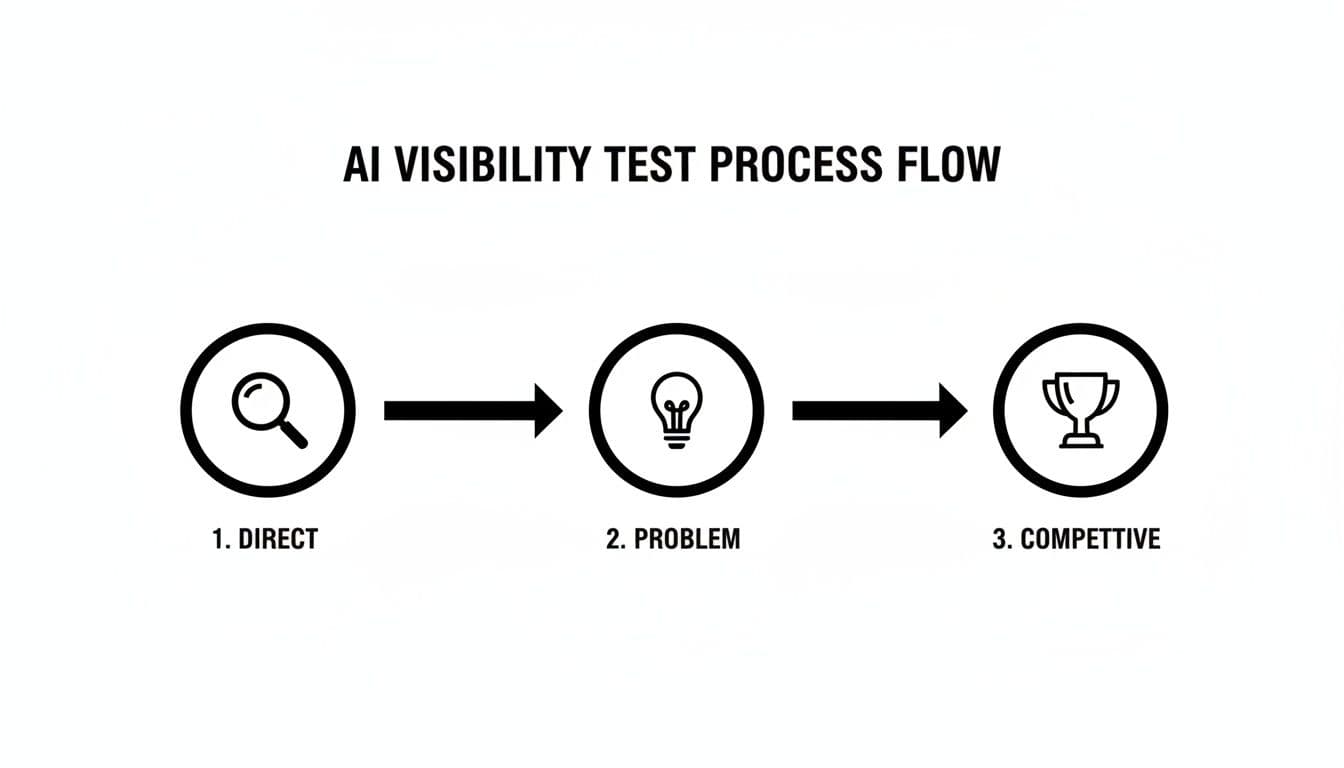
This process is your roadmap for running direct, problem-focused, and competitive queries, giving you a complete picture of where you stand.
Unpacking the AI's Logic by Analyzing Its Sources
The single most valuable piece of intel you can get from a ChatGPT response is understanding which sources it trusts. When a competitor gets the nod for one of your problem-aware prompts, your first move should be to figure out what content the AI likely used to make that call.
Was it a specific industry blog? A viral Reddit thread? A glowing review on a major tech site? These aren't just random links; they're road signs pointing you exactly where you need to build more authority.
For example, if you notice that answers in your space consistently reference specific forums, that's your cue. It's time to get active and become a recognized voice in those exact communities. This simple insight turns a vague goal like "improve brand awareness" into a concrete, measurable action plan.
Expert Tip: Stop focusing on who the AI mentions and start dissecting why. That "why" almost always comes down to the underlying sources it has learned to rely on for that topic. Your content strategy needs to be laser-focused on earning trust from those same sources.
Finding Your Content Gaps and Seizing Opportunities
Looking at the sources cited for your competitors is the fastest way to find your own content gaps. If a rival brand is mentioned alongside their new research report, the AI is literally telling you what kind of content it values.
Freshness is another huge piece of the puzzle. One study revealed that nearly 65% of ChatGPT hits point to content published within the last year. Following a recent update, AI models have doubled down on "answer-first" giants. We've seen Reddit citations shoot up by 87% and Wikipedia by over 60%.
This data gives your team a clear set of marching orders:
- Keep It Fresh: Make a habit of updating your most important content with new data, examples, and insights. Stale content gets left behind.
- Fish Where the Fish Are: The AI is sourcing information from high-authority platforms like Reddit. You need a game plan for engaging authentically in those spaces.
- Fill the Format Voids: If competitors are winning with certain types of content—like in-depth case studies or data-driven reports—it’s time to create your own, better versions.
This kind of detailed analysis is what separates a one-off spot check from a scalable monitoring system. For anyone serious about streamlining this, looking into automated prompt tracking and analysis is a logical next step. It provides the continuous data feed you need to actually stay ahead of the curve.
Getting Your Content in Shape for AI
When you find visibility gaps, the fix isn't about chasing algorithms in the old SEO sense. It's about being more deliberate in how you teach AI models about your brand. You have to clearly signal who you are, what you solve, and why you’re a credible answer.
It all starts with your own digital turf: your website.
Nail Down Your On-Page Signals
Think of your website as the primary textbook ChatGPT uses to learn about you. If that textbook is confusing, disorganized, or vague, the AI won't be able to recommend you with any confidence. The objective is to build an information architecture that’s so clear it leaves no room for AI misinterpretation.
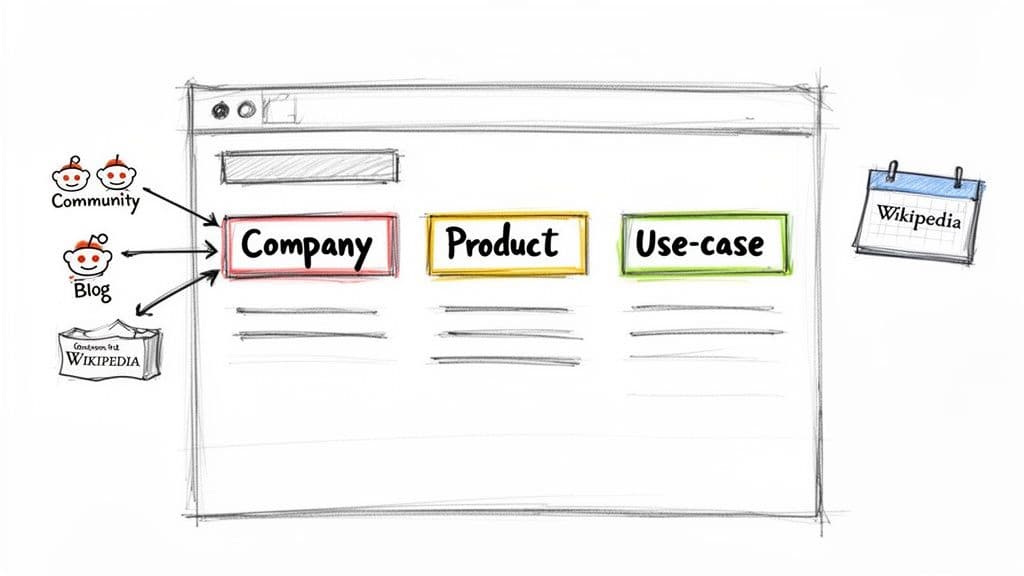
You're essentially building a "case file" for your brand. Each page should add a concrete piece of evidence that supports your expertise. Structure your content around key pillars:
- Your Company: A solid "About Us" page is crucial. Don't just list facts; tell your story, explain your mission, and introduce your leadership.
- Your Products/Services: Every single offering needs its own dedicated page. Detail the features, but focus more on the benefits and who it's for.
- Your Use Cases: Create content that explicitly connects what you sell to the real-world problems your customers face.
By logically interlinking these pages, you help the AI connect the dots and form a strong, cohesive understanding of your brand. This is a core tenet of the emerging field of Answer Engine Optimization.
Show Up on High-Authority Platforms
Your website lays the foundation, but AI models are skeptical. They look for third-party validation from sources they already trust. When you analyzed ChatGPT's responses, you probably noticed it loves to cite places like Reddit, Wikipedia, and respected industry forums. You need to be there.
This isn't about dropping links and running. It's about authentic engagement. Find the communities where people are already talking about problems you can solve. Offer real expertise, answer questions, and become a trusted voice. A genuinely helpful comment on a niche subreddit can do more for your AI visibility than a handful of mediocre backlinks.
If you want a deeper dive into how AI prioritizes sources, learning about ChatGPT real estate search visibility offers great parallels, as it often hinges on the same principles of external validation.
A common "before" scenario is a brand that's completely absent from Reddit. The "after" is that same brand's product expert regularly contributing to a relevant subreddit, offering advice without a sales pitch. Over time, the AI starts to associate that brand with genuine authority on the topic.
Keep Your Content Fresh and Relevant
AI models have a built-in preference for new information. I've seen countless analyses where the majority of citations are from content published in the last year or so. If your content is stale, the AI assumes your expertise is, too.
A content refresh calendar is the most practical way to tackle this.
- Pinpoint Your Core Content: Identify the guides, blog posts, and landing pages that are most critical to your business.
- Schedule Quarterly Reviews: At least once every three months, go through these key assets. Update old stats, fix broken links, and add new, relevant insights.
- Publish Timely Articles: Stay on top of industry news, current trends, and new customer questions. This fresh content signals that you're an active, authoritative participant in your field.
This steady drumbeat of activity tells the AI that you are a reliable and current source, making your brand a much more likely candidate for its answers.
Scaling Your AI Visibility Monitoring
Manual testing is a great way to get your feet wet. It gives you that gut-level, hands-on feel for how your brand shows up in AI conversations. But let's be realistic—it's not a long-term strategy. It just doesn't scale.
The AI models are constantly changing, and the number of prompts that matter to your business is enormous. Trying to keep up by hand is a recipe for falling behind. To really understand your brand visibility in ChatGPT consistently, you have to move past random spot-checks and embrace automation. It's the only way to get the hard data you need to make smart decisions.
From Simple Scripts to Comprehensive Platforms
If you have developers on your team, you might start with a simple script. They could use an AI's API to automatically send a list of your most critical prompts and log the answers. This saves some time on the front end, for sure. But it often just trades one problem for another: now you have a huge pile of raw text that someone still has to sift through and analyze manually.
This is exactly where specialized platforms come into the picture. A tool like Attensira is built to handle this whole workflow. It doesn’t just run prompts; it automates everything from testing thousands of queries across different AI models to analyzing the responses and showing you visibility trends over time. It turns a tedious, manual chore into a strategic advantage.
These platforms are designed specifically for this job, offering insights you'd never uncover with manual checks alone.
- Zero-Config Setup: You can literally just connect your domain and start tracking your AI presence. No complex setup or technical skills are needed.
- Automatic Content Gap Identification: The system pinpoints high-value prompts where your competitors get mentioned but you don't, handing you a prioritized list of content opportunities.
- Competitive Benchmarking: It delivers clear metrics showing how your AI visibility compares to your main rivals, so you know exactly where you stand.
A dedicated monitoring platform is the logical next step for any leader who needs reliable, continuous data. It shifts the focus from tedious data collection to high-impact strategic action, which is crucial for staying competitive.
The need for this kind of scale becomes obvious when you look at the audience size. ChatGPT is drawing billions of users every month. We're not talking about a niche channel anymore. Research from Chatbeat shows that 71.5% of U.S. consumers now use AI for searches, and this traffic converts a staggering 4.4 times better than traditional organic search.
When the stakes are that high, you can't afford to guess. For those looking to broaden their toolkit, exploring various brand awareness measurement tools can provide additional context.
A Few Lingering Questions on AI Brand Visibility
As you start digging into your brand's presence in generative AI, a few practical questions always seem to pop up. Let's tackle the most common ones I hear from brand and marketing leaders who are getting serious about this new channel.
How Often Should I Be Checking My Brand's Visibility in ChatGPT?
For most brands, a manual spot-check every two to four weeks is a good rhythm. It’s frequent enough to catch significant changes without bogging you down.
Of course, there are exceptions. You'll want to do a much deeper dive right after a major AI model update (like a new GPT version dropping) or after you've launched a big content campaign. Those are the moments when things are most likely to shift.
Once you move past manual checks, an automated platform is the way to go. It runs these queries for you around the clock, so you get alerts on meaningful changes as they happen, taking the guesswork out of it.
Can I Just Remove Negative Mentions of My Brand?
In short, no. You can't just go in and edit a ChatGPT response like it's a Wikipedia page. The only real move you have is to influence future answers.
Think of it as a long-term reputation management play. The strategy is to flood the sources that AI models trust with a higher volume of accurate, positive, and authoritative content about your brand. Over time, you're essentially creating a stronger, more positive signal that can drown out the negative noise.
What’s a Realistic Goal for Brand Visibility Here?
The aim isn't to show up in every single response—that’s just not how it works anymore. We've seen the models evolve to mention fewer brands, often just three or four, in any given answer.
A smarter goal is to become the consistent, go-to recommendation for high-intent, problem-aware queries. These are the prompts where your ideal customers are practically raising their hands asking for a solution like yours.
The most practical and achievable goal? Outperform your direct competitors on the handful of prompts that matter most to your bottom line. Use your visibility data to see where you stand and focus your efforts on winning the conversations with the highest commercial value.
Why Does ChatGPT Sometimes Pull From Really Old Sources?
It's a common frustration. While the models are definitely getting better at prioritizing fresh content, they are still built on a massive foundation of historical web data. This means that old-but-gold sources—like foundational industry reports, well-established Wikipedia pages, or landmark blog posts from years ago—can still carry a lot of weight.
If you see an outdated source being cited for a topic in your niche, don't get annoyed. See it for what it is: a huge opportunity. It’s a bright, flashing sign pointing to a content gap. The AI is practically telling you what it needs. This is your chance to create the definitive, up-to-date resource that replaces that old information. This is a core part of learning how to see brand visibility in ChatGPT and, more importantly, how to improve it.
Ready to stop guessing and start measuring your AI visibility? Attensira automates the entire process, tracking thousands of prompts to give you actionable insights and a clear competitive advantage. See how it works at Attensira.