
Discover ai visibility for therapists with actionable tactics to attract clients online. Simple steps you can implement today.
When we talk about "AI visibility" for therapists, we're talking about something entirely different from traditional Google rankings. It’s about making sure your practice gets recommended when a potential client asks an AI like ChatGPT or Gemini for help. This is a critical distinction because even top-ranking local practices are nearly invisible in AI-generated answers. In fact, it can be up to 30 times harder to show up in an AI recommendation than in a standard Google search.
Why Your Practice Is Invisible to AI Search
The way potential clients find therapists is undergoing a fundamental shift. For years, the playbook was straightforward: get your practice to rank high on Google. Now, more and more people are turning to AI assistants for direct, conversational recommendations, asking things like, "Find a good CBT therapist near me for anxiety." This creates a brand-new challenge, one where your hard-won Google ranking doesn't automatically mean you'll even be considered.
Your practice's visibility to these AI platforms is closely linked to its digital footprint, specifically how well it attracts organic search traffic. If the concept of organic traffic is new to you, getting a handle on it is the first real step toward showing up in these new AI-driven searches.
The AI Visibility Crisis for Therapists
The heart of the problem is this: AI models don't just "search" the web like Google does. They synthesize information from a massive web of sources—your website, patient reviews, professional directories, and published articles—to construct what they believe is the most trustworthy answer. If your digital presence lacks the specific signals of expertise and trust that AI prioritizes, your practice simply won’t make the cut, no matter how well it ranks on Google.
The data paints a pretty stark picture of this gap. This chart shows just how dramatically visibility drops when you compare Google's local pack to AI recommendations.
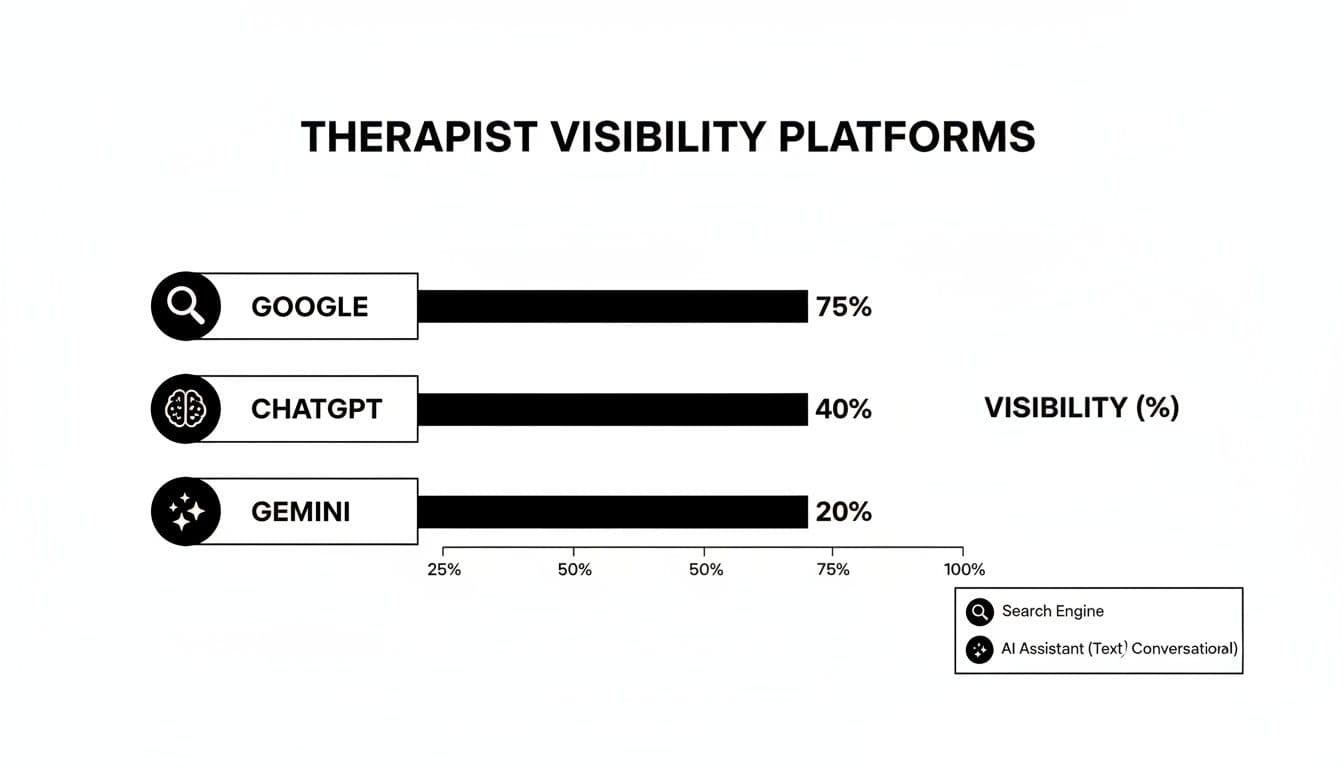
As you can see, even businesses with a strong presence on Google see their visibility plummet on AI platforms. This isn't some far-off trend; it's happening right now and directly impacting how new clients find you.
Research from SOCi's 2024 Localized Marketing Benchmark Report really drives home the severity of this crisis for local practices.
According to the report, AI assistants like ChatGPT recommend just 1.2% of top Google-ranked business locations. Gemini does a bit better at 11%, but both are a massive drop from the 35.9% appearance rate businesses see in Google’s local 3-pack.
Here's what that looks like in a table.
Traditional vs AI Search Visibility for Local Practices
The numbers show a significant drop-off for local businesses, including therapy practices, when moving from the familiar territory of Google's Local Pack to the new world of AI-generated answers.
This visibility chasm exists because AI models rely on a completely different indexing process. They're looking for structured data, clear markers of clinical expertise, and consistent information across multiple authoritative sources. We’ve actually written a guide on how ChatGPT indexes content that dives deeper into the technical side.
Understanding this new playing field is absolutely essential. It's the first and most important step toward future-proofing your practice and making sure you can continue to connect with the clients who need you most.
Auditing Your Practice's AI Footprint
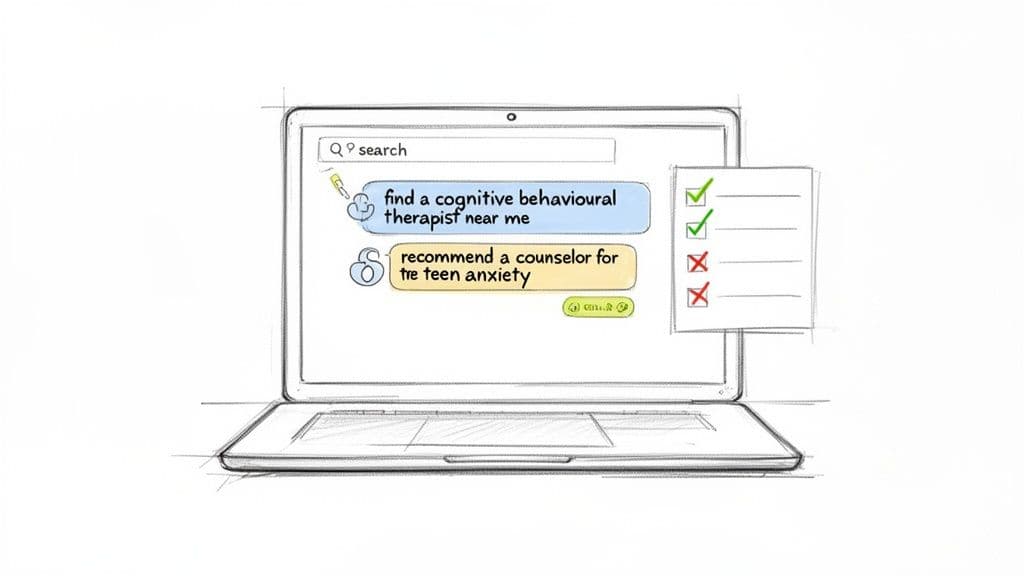
Before you can start improving your visibility on AI platforms, you first need to understand where you currently stand. This initial audit is about seeing your practice through the eyes of an AI, giving you a clear baseline of where your digital presence is strong and where it might be invisible.
You don't need fancy software for this part. It’s a hands-on process. You just need access to the major AI platforms and a methodical way of testing them.
Think like a potential client. Open up chatbots like ChatGPT, Gemini (what used to be Bard), and Perplexity. Your goal is to run a series of searches that mirror how real people look for mental health support. This is your first reality check. Are you even mentioned? Is the information correct? The answers will give you the concrete starting point you need to build a smart strategy.
Crafting Your Audit Queries
The trick is to use a mix of broad and very specific prompts. I always recommend starting with location-based searches, then drilling down into your clinical specializations. This combination gives you a sense of both your local footprint and your topical authority.
Here are a few real-world examples to get you going:
- Local General: "Find therapists near [Your City, State]"
- Local Specialty: "Recommend a cognitive behavioral therapist in [Your Neighborhood]"
- Problem-Focused: "Who is a good counselor for teen anxiety?"
- Method-Specific: "Can you suggest a practice that offers EMDR therapy for trauma?"
Run each of these prompts a few times on each platform, because AI responses can and do change. Keep track of everything in a simple spreadsheet—list the platform, the exact prompt you used, and the results. Make a note of whether your practice was mentioned, how high up you appeared, and which of your competitors showed up instead.
An effective audit goes beyond a simple yes or no. For therapists in competitive specialties, I advise tracking five key AI metrics: citation frequency, brand mention rate, share of voice vs. competitors, mention sentiment, and query coverage. This is how you gain influence in a world where being cited by an AI is the new click.
Analyzing Your Audit Results
Once you’ve gathered all that data, it’s time to look for patterns.
Are you consistently visible for certain specialties but completely missing for others? Do your competitors seem to own the responses for high-intent queries like "therapists near me accepting new clients"?
This analysis will point directly to your biggest gaps and opportunities. For example, if a nearby practice is always recommended for "couples counseling," go look at their website and online profiles. They are almost certainly providing the clear, structured information that AI models latch onto. In a way, they're giving you a roadmap for your own strategy.
This manual audit is a critical first step. For those who want to take it further and automate this kind of tracking, you can learn more about how to track your brand’s visibility in ChatGPT and other top LLMs.
Building the Foundational Trust Signals AI Needs
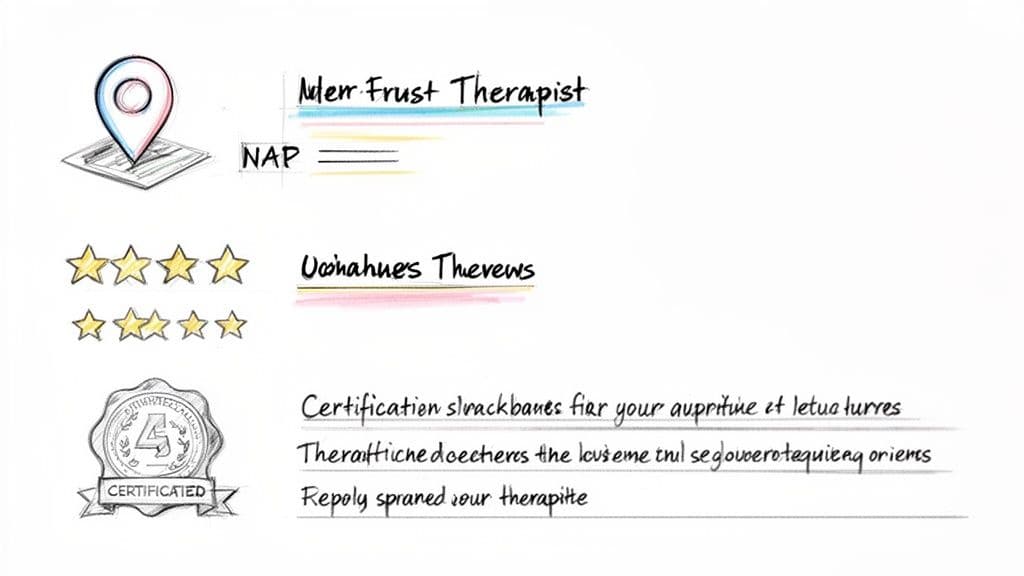
If you want to show up in AI-driven search, you have to start thinking like an AI. These models are designed to find and recommend sources they see as authoritative and trustworthy. For your therapy practice, that means intentionally building the digital signals that prove your clinical expertise and local credibility.
This isn't about trying to trick an algorithm. It's about making your professional identity incredibly clear and consistent for machines to interpret. And the whole process starts with the most powerful local trust asset you have: your Google Business Profile (GBP).
Maximize Your Google Business Profile
Your GBP isn't just a map listing anymore. It's now a primary data source for AI models, especially Google’s own Gemini. An incomplete profile sends a clear signal of low authority, which makes you far less likely to be recommended to a person in need.
Getting to 100% profile completion is non-negotiable. This means filling out every single available field, from the services you offer and your operating hours to accessibility details and high-quality photos of your office. It's also critical that your NAP data (Name, Address, Phone number) is perfectly consistent across your website and other online directories. Any discrepancy, no matter how small, can erode an AI's confidence in your information.
In the world of therapy, where trust signals like 4.8+ star ratings and complete NAP data are everything, an incomplete profile can make you invisible in AI results. For perspective, we've seen financial service pros like Liberty Tax boost their AI visibility to 19.2% on Gemini just by perfecting their profiles and ratings. This strategy is directly transferable to therapy practices.
Cultivate and Engage with Reviews
Client reviews are a powerful signal of social proof and an active, thriving practice. AI models look at more than just star ratings; they analyze the sentiment and recency of the reviews. A steady stream of new, positive feedback tells an AI that your practice is current and genuinely helping people.
But your engagement with these reviews is just as important. Take the time to respond to every single one—both positive and negative. This simple act shows you're an engaged, professional business owner. It also provides another layer of relevant text for AI to analyze, reinforcing your commitment to client care.
Build Authority Through Your Website Content
Your website is the central hub for demonstrating your clinical expertise. Two pages, in particular, are absolutely critical for building the E-E-A-T (Experience, Expertise, Authoritativeness, and Trustworthiness) that Google and other AI models demand.
- Your 'About' Page: This is where you clearly state your practice's mission, your values, and the specific problems you help clients solve. Think of it as establishing your brand's core identity.
- Therapist Bios: Each therapist's bio needs to be detailed and well-structured. Make sure you list credentials, licenses, educational background, and the specific therapeutic modalities you use (e.g., CBT, EMDR, Somatic Experiencing).
This next part is crucial. From these bios, you need to link out to external professional profiles like Psychology Today or LinkedIn, and to any published articles or research. These outbound links act as third-party verifications of your expertise, strengthening the web of trust around your practice. This is a foundational piece of a much broader strategy for improving AI visibility for healthcare companies.
Creating Content That AI Will Cite and Recommend
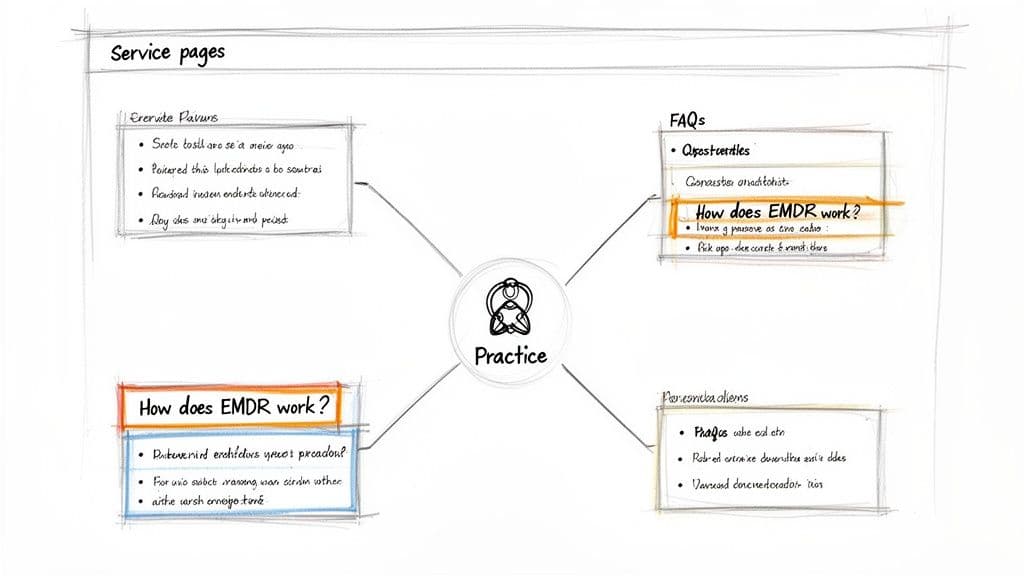
If you want an AI to recommend your practice, you have to become the source of its answers. This isn't about writing another generic blog post. It's about strategically creating content that an AI can easily understand, trust, and present to a potential client in their moment of need.
Essentially, you need to provide the direct, practical answers to the questions people are already asking. These are the exact queries that conversational AI is built to handle, and your content needs to meet that demand head-on.
Build Content Around Client Questions
Your content strategy needs to start with the real-world questions your ideal clients are asking. What are they typing into search engines or asking a virtual assistant at 2 AM? Think about their fears, their uncertainties, and the practical hurdles they face before even booking a session.
Instead of writing a broad article on "trauma," for instance, get hyper-specific. Create a dedicated service page that answers questions like:
- How exactly does EMDR therapy work for PTSD?
- What happens during the first couples counseling session?
- Is cognitive behavioral therapy a good fit for social anxiety?
This question-and-answer format makes your content highly "snippable." An AI can easily pull a concise, authoritative answer directly from your page and feature it. Think of every page as a direct response to a question a potential client might ask.
Your goal isn't just about ranking on Google anymore; it's about maximizing your AI citation rate. Current data shows that a staggering 86% of AI mentions are pulled from websites, business listings, and reviews. For therapists, even a handful of these mentions are incredibly valuable. We're seeing that AI-referred visitors convert at a rate 4.4 times better than those from traditional organic search.
Structure Your Content for AI Readability
AI models don't scan a webpage like a human does. They deconstruct it, looking for structural cues to understand the hierarchy and meaning of the information. This makes clean, logical formatting non-negotiable for good ai visibility for therapists.
Start with your headings. Ditch vague titles like "Our Approach" and opt for descriptive, action-oriented H2s and H3s. Something like "How We Use Somatic Experiencing to Treat Anxiety" immediately tells both a human and an AI what the section covers.
From there, use formatting to make complex information digestible:
- Bulleted lists are excellent for outlining the benefits or key features of a therapeutic modality.
- Numbered lists work perfectly for explaining a process, such as what to expect during an intake call.
- Tables can be used to clearly compare different types of therapy or service offerings.
This structured data makes it easy for an AI to parse your content and repurpose it confidently in an answer. For a deeper dive, our guide on effective web content creation has more practical tips.
Optimize for Entities, Not Just Keywords
Finally, you need to start thinking in terms of entities. An entity is simply a well-defined concept or thing—like your practice name, a specific therapist, a clinical specialty (like "EMDR"), or a condition (such as "Post-Traumatic Stress Disorder").
The game is to clearly define these entities on your website and show the relationships between them. Make sure your service pages explicitly state which therapists provide that service and which conditions it's designed to treat. This helps an AI connect the dots: "Dr. Jane Smith" is an expert in "EMDR" for treating "PTSD" at "[Your Practice Name]." The stronger you build these connections, the more likely an AI is to recommend you for a highly relevant client search.
How to Measure and Refine Your AI Visibility
Improving your visibility in AI-driven search isn't a one-and-done project. It’s a continuous cycle: you take action, measure the results, and refine your approach. If you're not tracking what's working and what isn't, you’re basically just guessing. Moving from guesswork to a data-backed strategy is the only way to get real, sustainable results.
The manual audit we walked through gives you a fantastic snapshot in time. But here's the catch: AI models are always changing. Their answers to the same questions can shift from one day to the next. Manually checking your visibility all the time is not just a drain on your resources; it's also prone to inconsistency. This is precisely where specialized monitoring tools come in, automating the grunt work so you can stay focused on the bigger picture.
Automating Your AI Visibility Tracking
Platforms like Attensira were built to solve this exact problem. Once you connect your website, you can set up automated tracking for the specific search queries that bring ideal clients to your door. Think of it as a smoke detector for your AI presence—it alerts you to important changes, good or bad, so you don't have to keep checking yourself.
This is what a typical dashboard looks like in Attensira, where you can see your visibility compared to competitors.
The dashboard gives you a clear look at your share of voice, showing how often you’re mentioned versus other local therapists. This takes you beyond a simple "am I mentioned or not?" and into a much deeper understanding of your actual position in the market.
For a therapist, this level of detail is a game-changer. For example, you could track your visibility for high-value queries like:
- "EMDR therapists in [Your City]"
- "Couples counselors who specialize in infidelity"
- "Best child psychologists for ADHD near me"
Automated tracking delivers the consistent data you need to make smart, informed decisions. Attensira is designed specifically for this, offering domain-connected tracking across different AI models, competitor benchmarking, and even content ideas based on your performance. The data shows this approach pays off; nearly 70% of businesses using AI in their SEO efforts report a higher ROI. Even better, practices that optimize for their location have seen visibility lifts of 30-40%.
Establishing a Quarterly Review Process
Having data is one thing; actually using it is another. A simple quarterly review is one of the most effective ways to translate your tracking insights into tangible actions. Block out time every three months to sit down with your AI visibility data and ask a few key questions.
- Where Did We Win? Start by identifying the queries where your visibility has improved. What content on your site supports those topics? Dig into what made it work. Can you apply that same successful formula to your other specialties or services?
- Where Are the Gaps? Next, look for valuable queries where you’re not showing up at all. This is often a direct signal of a content gap on your website. If a competitor is constantly being cited for "teen anxiety," that’s your cue to build a better, more comprehensive resource on that topic.
- How Is the Sentiment? Finally, pay attention to how the AI models are describing your practice. Are the descriptions neutral? A little negative? This could be a sign that you need to encourage more positive online reviews or refine the messaging on your core web pages.
This review cycle creates a powerful feedback loop that steadily builds your online authority. By pairing a consistent measurement tool with a structured process for refinement, you can systematically improve your practice’s presence where it matters most. To dive deeper into this process, check out our guide on AI search monitoring.
Answering Your Questions About AI Visibility
As a therapist, you're used to guiding people through uncertainty. Now, you're likely facing some of your own as you navigate this new world of AI search. It can feel a bit overwhelming, but the underlying concepts are actually quite familiar. Let's break down some of the most common questions I hear from practitioners.
How Is This Different From the SEO I’m Already Doing?
It’s a great question, and the distinction is crucial. Traditional SEO for your therapy practice focuses on getting you to rank for keywords on a Google search page. The main goal has always been to win that click.
AI visibility is a whole different ballgame. It’s not about ranking; it’s about being cited as a trusted answer inside an AI's conversational response. Success isn't a click—it's a direct recommendation.
Think of it this way: AI models don't just scan for keywords. They synthesize information from your entire digital presence—your website, your Google Business Profile, client reviews, and professional directory listings—to formulate a helpful answer. This process values holistic trust and authority far more than just your ranking for "therapist near me." A top spot on Google absolutely does not guarantee you'll get mentioned by an AI.
What Are the First Things I Should Actually Do?
Don't try to boil the ocean. Start with two foundational steps. First, do a quick manual audit. Go to chatbots like ChatGPT and Gemini and ask them for therapist recommendations in your city for your specific specialties. See what they say. Note who shows up and who doesn't—it's a revealing exercise.
Second, and this is non-negotiable, you have to fully optimize your Google Business Profile. This is probably the single most powerful signal you can control.
- Be meticulous. Fill out every single field available.
- Add recent, high-quality photos of your office and yourself.
- Triple-check that your name, address, and phone number (NAP) are identical everywhere they appear online.
- Make a habit of encouraging reviews and then responding to every single one, good or bad.
These actions aren't just busywork; they build the concrete trust signals that AI models heavily rely on when making their recommendations.
Is This Possible to Do on a Small Budget?
Absolutely. In fact, some of the highest-impact strategies are more about sweat equity than your bank account. For example, consistently writing specific, high-quality blog posts that answer the real questions potential clients have costs you time, not a ton of money.
Building authority is a game of consistency, not cash. The core work—managing your online reputation and creating genuinely helpful content—is accessible to any practice, regardless of size. While specialized tools can speed things up, the foundational work is what truly moves the needle.
Encouraging client reviews and actively managing your Google Business Profile are also completely free. It all comes down to consistent, focused effort on building genuine authority and showing that you're a trustworthy professional.
How Long Will It Take to See Any Results?
Improving AI visibility is a marathon, not a sprint. You might see some quick wins in a few weeks, particularly from polishing up your Google Business Profile, which can have a near-immediate effect on local map pack results.
But getting AI models to consistently cite your practice as an authority takes more time. These systems are constantly learning and re-evaluating their sources. Building a strong enough signal to become a regular feature in their answers is a gradual process. Realistically, you should expect to see measurable shifts in your citation frequency after 3 to 6 months of consistent work on your content and online reputation.
Ready to move from guesswork to a data-driven strategy? Attensira provides the automated tracking and actionable insights you need to measure, refine, and improve your practice's visibility across AI platforms. Stop wondering if your efforts are working and start seeing the results.