Struggling with AI visibility for healthcare companies? This guide offers actionable, HIPAA-compliant strategies to get your providers seen by AI search.
The game has changed for healthcare providers. For years, the goal was simple: get to the top of Google. Now, that top spot is often an AI-generated answer, and if your doctors and services aren't mentioned, you might as well be invisible. This is the new reality of AI visibility—it’s not about ranking on a page, but about being the trusted source an AI cites directly.
The New Front Door for Patient Care

Think about how patients are looking for care right now. A potential patient asking for a "cardiologist near me who accepts Aetna" no longer sifts through a dozen blue links. Instead, AI gives them a direct, synthesized answer, often naming a specific doctor or clinic.
If the AI doesn't name your cardiologist, you've lost that patient before they ever saw your website. This isn't a future problem; it's happening today, and it's fundamentally altering how patients find you.
Why Your Data is Holding You Back
For most healthcare systems, this shift exposes a massive, often overlooked, problem: data fragmentation. You might be a leader in cardiac surgery, but to an AI, your online presence is a confusing jumble of conflicting information.
Your provider data is likely scattered everywhere:
- The main hospital website
- Internal HR and credentialing systems
- Dozens of third-party review sites
- Various insurance provider directories
When an AI tries to find a definitive answer about a doctor's specialty or which insurance they accept, it hits a wall of contradictions. This inconsistency makes your data untrustworthy, so the AI simply ignores it and cites a competitor with a cleaner digital footprint. It's a quiet but devastating blow to your patient acquisition efforts.
How Patient Behavior Is Driving This Shift
This isn't just a technology issue; it's about people. Patients are rapidly adopting new ways to find health information. We're seeing 79% of U.S. adults turning to the internet for health questions, and a stunning 70% are open to using AI for their research. Even more telling, nearly 20% already trust AI more than traditional search engines.
This is a clear signal that the old methods are becoming obsolete. The ground has completely shifted from traditional search engine optimization (SEO) to what we now call answer engine optimization.
The new benchmark for success is no longer a click—it's a direct citation in an AI-generated response. Visibility has been redefined, and the old SEO playbook is officially outdated.
Comparing Traditional SEO and AI Visibility
The strategic pivot from classic SEO to AI visibility requires a fundamental change in mindset and execution. The table below breaks down the key differences.
This comparison makes it clear: while SEO fundamentals still have a place, they are no longer sufficient.
To win in this new environment, you have to think like an AI. That means building a unified, structured, and completely verifiable data ecosystem that models can consume and trust without hesitation. See how today's leading healthcare organizations are stacking up in this new era by exploring the rankings of top-performing institutions.
How to See What AI Says About You
Before you can start fixing your visibility in AI search, you need an unfiltered look at where you stand right in this moment. Think of an audit not as a one-and-done task, but as a diagnostic playbook you run regularly. It’s about benchmarking your presence and finding the most damaging data gaps before they cost you patients.
The process starts by thinking like a patient. What questions are they actually asking when they turn to AI for help? You aren't just looking for your brand name; you're trying to see the digital reality your potential patients experience when they ask for care.
Probe AI Models the Way a Patient Would
First, open up a few different AI interfaces. I'd suggest starting with Google AI Overviews, Perplexity, and ChatGPT. Don't stick to just one—they pull from different data sets, so checking several gives you a much more complete picture of your digital footprint.
The trick is to use queries that mirror the three main ways patients search.
1. Direct Questions About Your Brand and Doctors
These are the most straightforward tests of your foundational data. Try asking things like:
- "What do patients say about Dr. Jane Smith at Mercy General Hospital?"
- "What services does the cardiology department at City Health System offer?"
- "Is the orthopedic clinic at Springfield Medical Center open on Saturdays?"
2. Questions About a Problem, Not a Brand
This is where the patient journey usually begins. Most people don't search for a specific hospital; they search for a solution to their problem. Test location-based queries like:
- "Find a pediatrician near me who accepts Blue Cross."
- "What's the best hospital for knee replacement surgery in Houston?"
- "Where can I get a sports physical for my kid this week?"
3. Head-to-Head Comparisons
You need to know how you appear when a patient is weighing their options. This is where you see how you stack up directly against the competition in your area.
- "Compare the maternity wards at Mercy General and St. Luke's."
- "Who is a better-rated neurologist, Dr. Smith or Dr. Jones?"
As you get responses, document everything. I mean everything. Note where your practice or doctors show up, where you're completely absent, and—most importantly—where the information is just plain wrong.
Pinpoint the Data That’s Actively Harming You
An AI's answer is only as good as the data it’s fed. Your audit will quickly shine a light on common but critical errors that are steering patients away from you.
Be on the lookout for these specific failures:
- Incorrect Physician Affiliations: Does the AI say a doctor works at a hospital they left two years ago? This happens all the time.
- Outdated Service Offerings: Is an AI response highlighting a service you no longer provide, or is it missing a new, high-value one?
- Wrong Contact Information: Bad phone numbers, old addresses, or incorrect insurance plans are direct barriers to booking an appointment.
- Total Invisibility: If you don't appear at all for those crucial non-branded searches, you're invisible to a huge and growing group of potential patients.
An AI model citing an old address or the wrong insurance information is worse than not being mentioned at all. It creates a frustrating patient experience before they’ve even had a chance to contact you.
Trace the Errors Back to the Source
Finally, you need to play detective and trace these inaccuracies back to their origin. AI models aren't just making this stuff up; they're scraping and piecing together information from all over the web.
The usual suspects are the foundational profiles that underpin your entire digital presence. I recommend a manual check of these key data sources:
- Google Business Profiles: You need one for every single location and every provider. No exceptions.
- Third-Party Directories: Think Healthgrades, Vitals, Zocdoc, and any others relevant to your specialty.
- Insurance Carrier Directories: Are your doctors listed correctly on the websites of the insurers you accept?
- Your Own Website: Is your provider directory built with structured data that machines can easily read and understand?
By methodically testing patient questions and then digging into the underlying data sources, you'll move from guesswork to a concrete, actionable plan.
To get a quick diagnostic of where your organization stands today, you can also check your AI readiness score with our free tool and identify the most urgent areas for improvement.
Weaving a HIPAA-Compliant Content Strategy for AI
Creating content in healthcare feels like walking a tightrope. You need to produce in-depth, authoritative material that AI models can digest and trust. At the same time, the Health Insurance Portability and Accountability Act (HIPAA) looms large, demanding absolute protection of patient privacy. Many marketers freeze up here, seeing HIPAA as a roadblock. I see it as an advantage.
A privacy-first content strategy isn't a limitation. It’s the very thing that builds the kind of deep trust and authority that AI algorithms are programmed to find and reward. The trick is to shift your mindset from telling individual patient stories to creating broad, educational narratives that serve everyone.
Before you even start writing, you need to know where you stand. A foundational audit is essential to see how AI perceives you right now and to pinpoint exactly where the visibility gaps are.
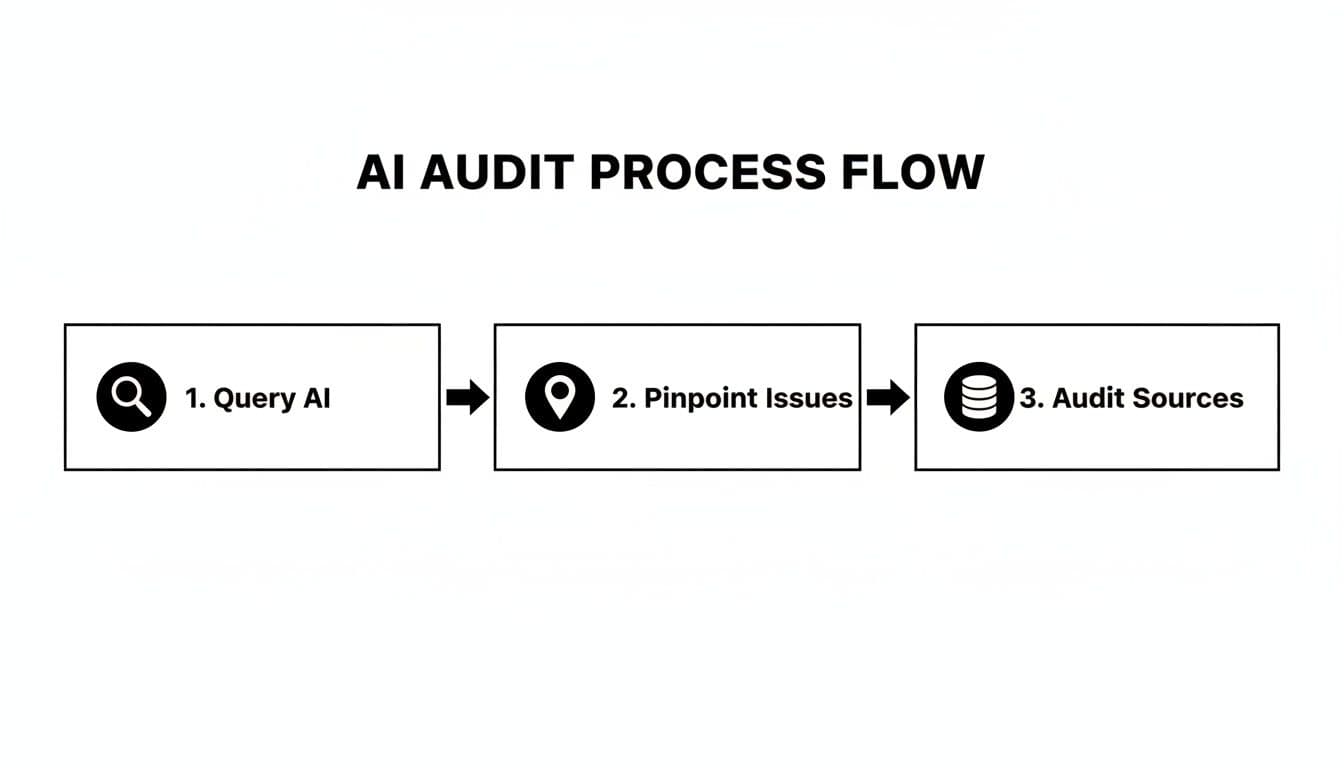
This kind of structured analysis ensures your content plan is built on solid ground, addressing real-world problems instead of just guessing.
Building Authority Without Sacrificing Privacy
So, how do you demonstrate expertise without crossing the line into Protected Health Information (PHI)? You create content around anonymized scenarios. Think of them as composite sketches—blending common patient experiences to illustrate a condition, the diagnostic journey, and treatment outcomes without ever revealing a single piece of personal data.
For instance, instead of a specific case study, you could publish an article like "A Typical Patient’s Journey Through ACL Recovery." This piece can walk readers through the stages of physical therapy, highlight common obstacles, and celebrate key milestones. It offers immense value to someone facing that surgery, all while remaining completely anonymous and HIPAA-compliant.
This approach directly tackles the trust paradox in healthcare AI. We know that 79% of patients are looking online for health information, and a surprising six in ten find AI-generated answers reliable. Yet, there’s a huge disconnect: nearly 66% of U.S. adults also say they distrust healthcare AI, citing safety and privacy fears.
By producing expert-led, privacy-first content, you become the solution to that paradox, building the trust that both patients and AI systems are desperate to find.
The Content Formats That AI Craves
AI models don't care about marketing fluff. They are machines built for structure and clarity, designed to find the most direct answers to specific questions. Feeding them content in their preferred formats is a shortcut to getting noticed.
Here’s what works exceptionally well:
- Dedicated FAQ Pages: Don't just bury questions at the bottom of a service page. Create robust, standalone FAQ sections for each major service line ("Orthopedic Surgery FAQs," for example) and for every single provider.
- Deep-Dive Service Descriptions: A simple list of procedures is not enough. You need to explain what a procedure actually involves, who makes a good candidate, what the preparation looks like, and what to expect during recovery. The more detail, the better.
- Comprehensive Provider Bios: A doctor’s bio should be more than a headshot and a list of credentials. Build out a true profile that details their clinical interests, research publications, treatment philosophy, and unique approach to patient care. This showcases expertise in a way AI can easily process.
A privacy-first, authoritative content strategy isn't a barrier to AI visibility—it's the exact thing AI algorithms are designed to trust and amplify. The more you prioritize patient privacy and factual accuracy, the more AI will see you as a reliable source worth citing.
This kind of detailed, expert-driven content also sends strong signals for what Google calls Your Money or Your Life (YMYL) topics, where the stakes are high and accuracy is everything. Understanding YMYL is non-negotiable for anyone serious about AI visibility in healthcare.
To lock everything down, consider bringing in specialists for a HIPAA pentesting audit. It’s a proactive way to find and fix security vulnerabilities, protecting patient data and reinforcing the very trust you’re working so hard to build with your content. In this new AI-driven environment, it’s an essential layer of defense.
Getting Technical: How to Structure Your Content for AI
Now that you have a HIPAA-compliant content strategy, the real work begins. You have to make sure your digital assets are not just readable for people, but perfectly structured for machines. AI models don't browse your website like a patient would. They parse it, systematically hunting for explicit signals that define who you are, what you do, and why you should be trusted.
This is where technical and on-page SEO become the absolute foundation for your AI visibility.
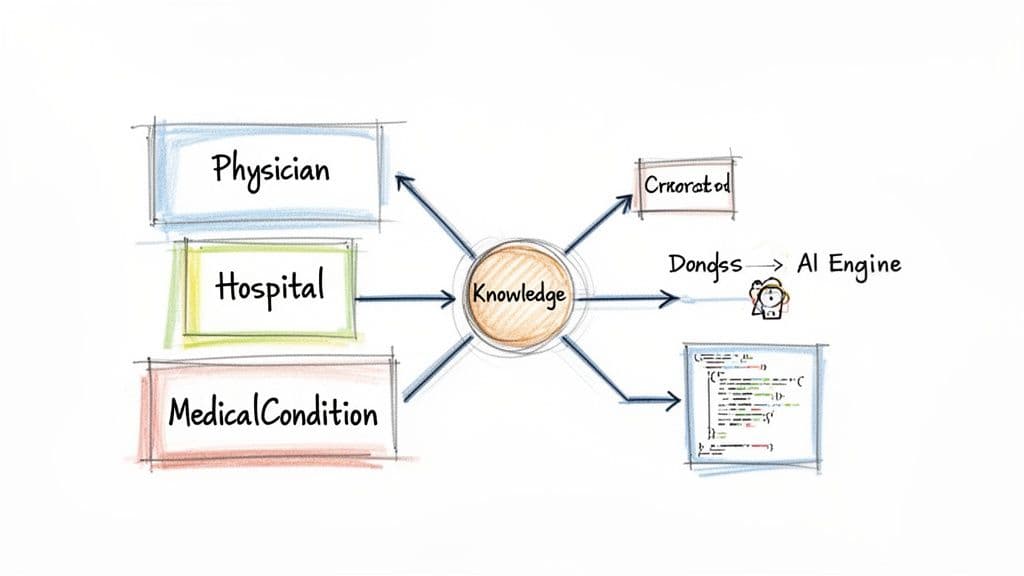
Think of your website like a complex medical textbook. A person can flip through chapters and use the index to find what they need. An AI, however, needs that index to be hyper-detailed and machine-readable to truly grasp the relationships between concepts. Schema markup is that index.
Put Essential Healthcare Schema to Work
Schema markup is essentially a behind-the-scenes vocabulary you add to your website's code. It's not for users to see; it’s for search engines and AI. For healthcare, this isn't a "nice-to-have"—it's a must. It removes all the guesswork, turning your unstructured text into clean, organized data that an AI can easily digest.
Your development team needs to prioritize these core schema types:
- Physician: This markup defines an individual doctor. It should detail their specialty, where they went to medical school, hospital affiliations, and even which insurance plans they accept.
- Hospital or MedicalClinic: Use this to describe a facility, including its location, contact info, hours, and the specific medical services available there.
- MedicalCondition: When you publish educational content, this schema is crucial. It outlines a condition, its symptoms, common treatments, and risk factors, cementing your website as a true knowledge source.
When you structure your data this way, you make it incredibly simple for an AI to connect Dr. Jane Smith to her clinic, the specific conditions she treats, and her credentials. It's a foundational piece of becoming a citable, authoritative source.
Reframe E-E-A-T for an AI-First Reality
Google's E-E-A-T framework—Experience, Expertise, Authoritativeness, and Trustworthiness—has always been important, but now it has to be demonstrated in a way that AI can process. An AI can't just infer trust from well-written prose; it needs to see cold, hard proof.
This means you have to go beyond just writing great content and start weaving a web of verifiable signals around it.
- Make Author Bios Count: Every piece of clinical content must be attributed to a qualified medical professional. That means a direct link from the article to a comprehensive bio page for that author, complete with credentials, publications, and professional experience.
- Show Your Work on Medical Reviews: Don't just say your content is accurate. State explicitly on the page that it has been medically reviewed. Include the reviewer's name (linked to their own bio) and the date of the most recent review.
- Cite Like a Researcher: When you mention statistics or studies, link directly to the primary source, whether it's a paper in a reputable medical journal or a page on a government health site. This proves your claims are grounded in credible evidence.
In the world of AI, trust isn't earned—it's proven through data. The goal is to create an unbroken chain of evidence that connects your content to verifiable experts and authoritative sources. Leave no room for ambiguity.
The race for AI visibility is heating up. Zero-click answers are becoming the norm, and being cited in an AI-generated summary is often more valuable than a traditional #1 ranking. We're already seeing how Google's AI Overviews are changing search for disease information, but even top-ranking sites get left out if their content lacks the structure AI needs. With platforms like ChatGPT and Gemini capturing over 85% of global generative AI traffic—a number that's only growing as patients ask about symptoms—a technically sound website is non-negotiable.
Build a Centralized Knowledge Hub
Finally, don't underestimate the power of your site's architecture. A scattered collection of blog posts and service pages is far less effective than a deliberately organized knowledge hub. This should be a central section of your website dedicated to housing all your authoritative educational content, organized logically by medical specialty or condition.
This strategy accomplishes two critical goals. First, it creates a clear topical hierarchy, which helps AI understand the full breadth and depth of your expertise. Second, it simplifies your internal linking, letting you build a strong, interconnected web of content that reinforces the relationships between different topics.
A well-structured knowledge hub sends a powerful signal that your organization is a definitive source of truth in its field. Exploring how the right tools can help you build and manage this vital asset is a great next step, which you can learn more about in our overview of advanced content optimization features.
Scaling Your AI Presence with Attensira

Running manual audits and carefully updating your content is a great start for building AI visibility for healthcare companies. But let’s be realistic—those tactics only get you so far before they hit a wall.
If you’re managing a large health system with hundreds of providers and dozens of locations, manually tracking how every single person and place shows up across multiple AI engines is a recipe for burnout. It’s an impossible, never-ending task.
This is the point where your strategy has to evolve. You need to shift from putting out fires to building a system for proactive, sustainable growth. A manual approach is a good first step, but it’s not a long-term solution. To truly get a handle on your AI presence and make it better over time, you have to bring in automation.
Moving From Manual Audits to Continuous Monitoring
Think about it. Could your team manually query ChatGPT, Perplexity, and Google AI Overviews for every single doctor, service line, and clinic in your network? And then do it again next week, and the week after? Of course not.
The sheer amount of work is staggering, and by the time you finished collecting the data, it would already be out of date. This is exactly the operational headache that platforms like Attensira were designed to solve.
Instead of relying on occasional spot-checks, Attensira gives you continuous, automated monitoring. The platform is always querying the key AI engines, tracking every mention of your brand, your providers, and your facilities. This creates a live, detailed picture of your entire AI footprint—something you could never piece together by hand.
This automated system completely changes the game by delivering insights you’d otherwise miss. It can pinpoint exactly where AI models are pulling up wrong information or, even more critically, where you’re completely invisible for important patient searches that don't mention your brand by name.
Pinpointing and Resolving AI Content Gaps
One of the biggest advantages of an automated platform is its ability to find content gaps from the AI's point of view. Attensira doesn’t just flag a problem; it shows you why it’s happening by analyzing the AI's answers and tracing them back to weak spots in your content.
For instance, the system might notice that AI models never mention your new, state-of-the-art imaging center when asked about local diagnostic services. That's not just a random finding; it's a direct signal telling you to create or improve the content specifically about that facility and its capabilities.
The real value isn't just in finding problems, but in using AI-driven insights to guide your content strategy. It's about letting the AI itself tell you what information it's missing, then systematically filling those gaps.
This turns your content creation from a guessing game into a data-driven operation. You're no longer just writing articles based on keyword research. You're building assets specifically designed to fix documented weaknesses in how AI assistants perceive your organization.
Automating Content Optimization for Healthcare
Once you've found a gap, the next job is to create optimized content to fill it. This is another area where manual work just doesn't scale, especially for a large healthcare organization.
Attensira helps close this loop by generating optimized content drafts that are tailored to fix specific AI visibility issues. If a provider's profile is thin, for example, the platform can help draft a more robust bio that covers their specialties, treatment philosophies, and accepted insurance plans—all structured in a way that’s easy for machines to understand.
For a busy healthcare marketing team, this approach has some very real benefits:
- Speed: You can go from insight to action in a fraction of the time it would normally take.
- Consistency: It helps make sure all your content follows the best practices for AI readability and technical SEO.
- Focus: It frees up your team to concentrate on high-level strategy and crucial medical reviews, instead of getting stuck in the weeds of content production.
At the end of the day, scaling your AI presence is really about operationalizing visibility. It’s about weaving automated monitoring, insight generation, and content optimization into a smooth, continuous workflow. That’s how you turn the chaotic task of managing your AI footprint into a measurable and manageable part of your core marketing function.
Common Questions About AI Visibility in Healthcare
As healthcare marketing teams start to wrap their heads around AI-driven search, a lot of good questions come up. The shift from classic SEO to this new world isn't just a small tweak—it's a whole new playbook. Let's tackle some of the most common questions I hear from leaders trying to navigate this change.
How Is AI Visibility Different From Traditional Healthcare SEO?
It’s easy to think AI visibility for healthcare companies is just a new buzzword for SEO, but they're fundamentally different. The distinction is everything.
Traditional SEO is a race for the top of the search results page. Your goal is to get your webpage as high as possible in that list of blue links, hoping for a click. Success is measured in traffic.
AI visibility, on the other hand, is a competition for the citation. The goal is for an AI like ChatGPT or Perplexity to pull your organization's information—your doctors, your locations, your specific expertise—directly into its answer. Success isn't about getting a click anymore; it's about being the answer.
This forces a complete pivot in strategy. Instead of obsessing over keywords and backlinks, you have to prioritize creating highly structured, verifiable, and consistent data everywhere your brand exists. AI models need to cross-reference facts between your website, insurance directories, and third-party review sites. A single inconsistency, like a wrong phone number, can erode that trust and lead the AI to cite your competitor instead.
What Are the Biggest HIPAA Risks with AI Content?
The moment you mention "AI" and "healthcare" in the same sentence, the HIPAA alarm bells start ringing. The biggest risk is, without a doubt, the accidental exposure of Protected Health Information (PHI). This is a serious concern, but it's completely manageable if you build your strategy on a privacy-first foundation from day one.
The idea isn't to stop creating content; it's about creating the right kind of content within a strict, compliant framework.
Your entire content strategy has to operate with privacy as its core principle. This means:
- Using Anonymized Scenarios: When you create case studies or walk through a patient journey, you must use hypothetical or composite stories. These should reflect common experiences without ever using details from a real individual.
- Focusing on General Education: Pour your energy into becoming an authority on general conditions, treatments, and wellness topics. Steer completely clear of anything that could ever be traced back to a specific person.
- Securing Interactive Tools: If you have tools like symptom checkers or chatbots on your site, they absolutely must be HIPAA-compliant and operate in a secure environment. No exceptions.
Your objective is to become a trusted source of medical truth for the public, not a database of private patient information. When you get this right, your commitment to privacy actually boosts your authority and trustworthiness in the eyes of an AI.
How Do We Actually Measure the ROI of AI Visibility?
Measuring the return on this kind of work requires a new set of metrics. Your old SEO KPIs, like keyword rankings and website traffic, don't tell the whole story anymore. Since the goal is citation, not clicks, your measurement has to reflect that.
A solid measurement plan focuses on the quality and frequency of your mentions inside AI-generated answers.
Success in this new era is measured by influence and authority, not just web traffic. Tracking how often and how accurately AI cites your organization provides a much clearer picture of your true digital footprint and its impact on patient acquisition.
Here are the core KPIs you should be tracking:
- Frequency of Mentions: Use a monitoring tool to count how often your brand, doctors, or locations are named in AI answers to relevant patient questions.
- Accuracy of Mentions: Don't just count the mentions; audit them. Is the AI providing the correct phone numbers, addresses, and specialties? Is the context positive?
- Reduction in Misinformation: Actively look for incorrect information about your services in AI responses. Track how these errors decrease over time as you clean up your data sources.
- Lift in Branded Search: While AI might answer some informational questions directly, a positive mention builds brand recall. This often leads people to search for your brand or doctors by name, driving higher-intent traffic and better-qualified appointment requests.
Where Should a Small Practice with a Limited Budget Start?
If you're running a smaller clinic or an independent practice, you don't need a massive budget to make a real impact. The key is to be strategic and focus on the fundamentals that give you the biggest bang for your buck.
Start by perfecting the data sources that AI models lean on most heavily. Your top priority should be creating a single source of truth about your practice that is perfectly consistent online.
Here’s a simple, three-point plan to get you started:
- Master Your Google Business Profile: This is non-negotiable. Fill out every single field completely and accurately. Keep it updated with your services, accepted insurance, hours, and contact info.
- Standardize Directory Listings: Claim and meticulously update your provider listings on major healthcare sites like Healthgrades, Vitals, and Zocdoc. Consistency across these platforms is a huge trust signal for AI.
- Build Out Core Service Pages: Forget trying to write hundreds of blog posts. Instead, create one or two incredibly detailed and authoritative pages for your most important services. On those pages, answer every common question a patient might have.
These foundational steps create the clean, consistent, and structured data that AI algorithms need to see you as a trustworthy source. To get a better sense of where you stand today, it's worth understanding what an AI visibility score means for your practice and how you can start improving it.
Ready to move beyond manual tracking and scale your AI visibility? Attensira provides the continuous monitoring and actionable insights you need to win in the new era of search. See how our platform can automate your workflow and give you a decisive advantage. Get started with Attensira today.