Dominate AI-powered search. This guide provides actionable strategies for improving AI visibility for HR tech to ensure your brand is seen, cited, and chosen.
If your HR tech solution isn't showing up in AI-generated answers, you're becoming invisible. This is the new reality of AI visibility for HR tech. It's no longer about simply ranking on Google; it’s about being cited and recommended where a huge chunk of B2B buyers now start their search.
The New Frontier of HR Tech Discovery
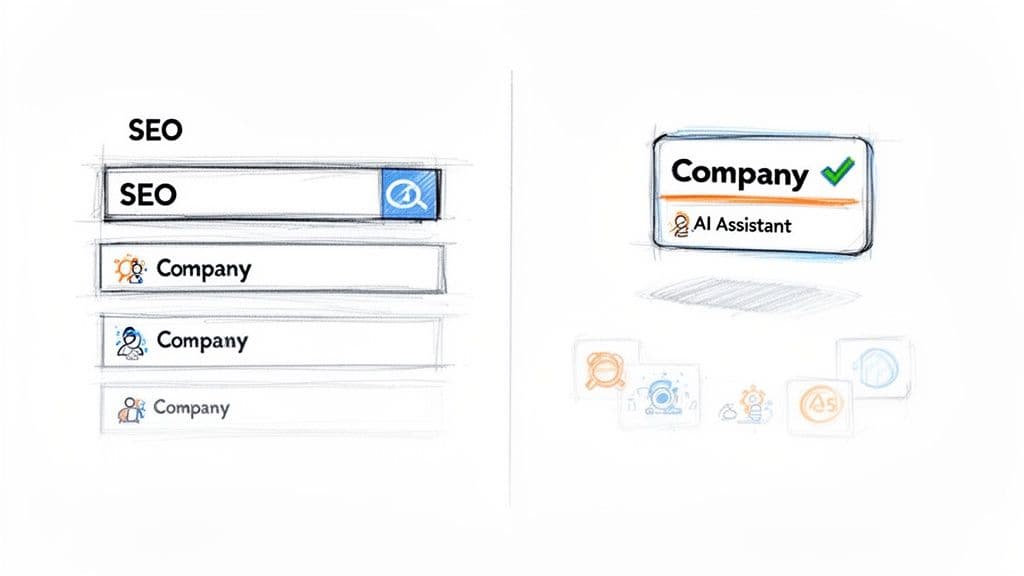
The way HR leaders find and vet new technology has been completely upended. That familiar routine of scrolling through pages of Google results is quickly being replaced by direct conversations with AI assistants like ChatGPT, Gemini, and Perplexity. This isn't some far-off prediction. It’s the new normal.
For HR tech vendors, this is a massive shift. Your brand's first impression is no longer made on a landing page you've painstakingly designed. Instead, it happens within an AI-generated response you don't directly control. It fundamentally breaks the marketing playbook most of us have been following for the last decade.
From Ranking to Being Cited
The game isn't about hitting the #1 spot anymore. The real prize is being cited as a credible solution inside an AI's summarized answer. When an HR Director asks, “What are the best payroll platforms for remote teams?” you need your company to be part of that AI-driven recommendation.
This change is backed by some pretty stark user behavior data. Recent studies show that 50% of B2B buyers now kick off their software search with AI chatbots—a staggering 71% jump in just four months. What's more, traffic coming from AI search converts at a rate 4.4 times higher than traditional organic search, proving this isn't just window shopping.
In the age of AI, getting cited is the new top ranking. The algorithms' interpretation of your brand's authority and trustworthiness is what decides if you even make it into the buyer's initial consideration set.
As we all adapt, understanding how specialized solutions surface is also critical. For example, niche products like the Hubdrive HR add-on for Microsoft Dynamics 365 Business Central can gain significant traction through this new form of discovery. This is why the principles of AI product discovery optimization are becoming a non-negotiable skill for modern marketing teams.
Traditional SEO vs. AI Visibility: A Quick Comparison
To win in this new environment, you have to understand just how much the rules have changed. The old SEO tactics still have a place, but they won’t get you cited by an AI on their own.
Here's a breakdown of the core differences between classic search engine optimization and the new focus on AI visibility.
The table makes it clear: while SEO is about getting people to your site, AIO (AI Optimization) is about projecting your brand's authority beyond your site, right into the conversational platforms where decisions are being shaped.
How to Audit Your Brand's AI Footprint
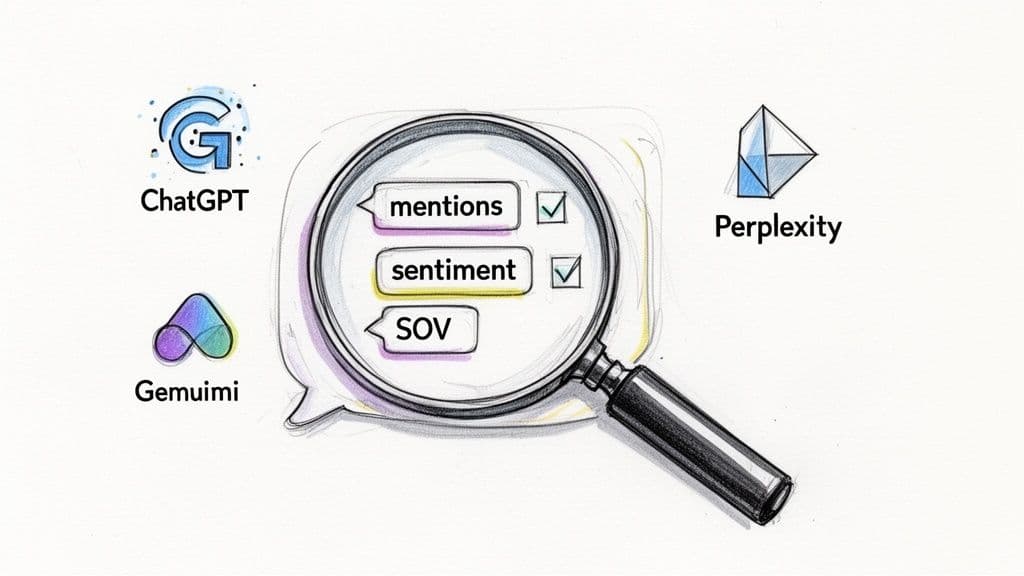
Before you can start improving your ai visibility for hr tech, you need to know where you stand. And I don't mean running a few simple queries for your brand name. A proper AI footprint audit is a deep diagnostic to figure out how today's large language models (LLMs) perceive your company's authority, products, and overall relevance.
Think of it as the data-driven foundation for your entire optimization strategy. Without this baseline, any effort to boost your presence is just a shot in the dark. The goal here is to trade assumptions for hard evidence about what you're doing right and, more importantly, where the gaps are.
Formulate Customer-Centric Queries
The first step is to get inside the head of your ideal customer. An HR director or a talent acquisition lead isn’t just plugging brand names into a chat window. They're asking questions driven by specific problems and intentions. Your job is to map out a solid list of these queries.
To make this manageable, break your prompts down to cover different points in the buyer's journey:
- Problem-Awareness Queries: "how to reduce employee turnover in tech" or "best ways to streamline performance reviews"
- Solution-Comparison Queries: "compare [Your Brand] vs [Competitor A]" or "what are the top applicant tracking systems for small businesses"
- Feature-Specific Queries: "which HR platform has the best analytics dashboard" or "payroll software that integrates with [Specific ERP]"
- Best-of Queries: "best all-in-one HR platform for remote teams" or "top-rated onboarding software 2026"
Prompts like these mirror how people actually use these tools, giving you a much richer and more realistic dataset than just asking an AI, "What is [Your Company Name]?"
The quality of your audit hinges entirely on the quality of your questions. Generic queries will give you generic results. But specific, customer-focused queries are what truly expose the gaps in your AI visibility.
Conduct a Manual Cross-Platform Check
With your query list ready, it's time to roll up your sleeves and do a manual audit. For B2B research, the big three right now are ChatGPT, Gemini, and Perplexity. You absolutely have to test all three; they pull from different data and often spit out wildly different answers.
As you run each query, you need to be documenting a few key things:
- Brand Mentions: Do you show up at all? Is it a top recommendation or just a footnote?
- Competitor Positioning: Which competitors are consistently named for your target use cases? Are they framed as the leaders in the space?
- Sentiment: When you are mentioned, is the context positive, negative, or neutral? Does the AI play up your strengths or call out your weaknesses?
- Source Citations: What sources is the AI referencing when it talks about you or your competition? This is pure gold for your content strategy.
I know, this manual check sounds tedious, but the insights are priceless. You might find you're the top recommendation for "SMB payroll software" but completely invisible in searches for "enterprise talent management platforms"—a critical piece of business intelligence. Getting a feel for these nuances is a huge part of effective AI search monitoring.
Analyze and Benchmark Your Findings
Once you've gathered all this raw data, the real analysis begins. Dump everything into a simple spreadsheet and start looking for patterns. Are there recurring themes? Maybe you'll see a specific competitor dominating a product category, or notice that your brand is still being associated with an outdated feature.
This audit highlights an urgent reality. By 2026, AI search analytics will be non-negotiable for HR tech brands that want to be seen. Already, 60% of searches end without a click. The AI just gives the answer, with websites only appearing in 25% of responses even if they rank high in traditional search. And while AI platforms aren't yet the biggest source of traffic, an eye-opening 68.94% of websites are already getting some AI-driven visits. You can see more on these findings in this in-depth roadmap to AI visibility.
This initial audit gives you your benchmark. It’s the "before" picture you'll measure against as you start implementing the optimization tactics we'll cover next. This isn’t a one-and-done task; plan on repeating this process quarterly to track your progress and adjust your strategy as the AI models continue to evolve.
Optimizing Your Content for AI Ingestion
Your initial audit showed you where you stand with AI. Now it’s time to get to work. Improving your AI visibility for HR tech isn't just about tweaking a few pages; it's about fundamentally rethinking your content strategy. You need to turn your website into a deep, reliable knowledge base that AI models see as a definitive source.
Think of it this way: AI models don't just "read" your site. They dissect it, looking for patterns, expertise, and signals of credibility to build their answers. Your content has to be great for your human audience, of course, but it also needs to be structured for a machine to understand and trust.
Build Deep Topical Authority
The old playbook of writing thin, one-off blog posts to rank for a single keyword is dead. To become a source AI models rely on, you have to prove you own a topic. This means building deep topical authority by creating content hubs that explore a specific HR domain from every possible angle.
For example, don't just publish one article on "performance management." Go bigger. Build out a complete topic cluster:
- Pillar Page: "The Complete Guide to Modern Performance Management"
- Supporting Articles: "Using Analytics to Improve Employee Performance" and "Best Practices for Continuous Feedback"
- Case Study: Show how a client achieved a 20% reduction in turnover with your platform.
- Original Research: A report on "The State of Performance Reviews in Hybrid Workplaces"
This interconnected approach shows AI models that you're not just adding to the conversation—you are the conversation on that subject.
Write for Summarization and Citation
AI assistants are, at their core, summarization engines. Your job is to make it incredibly easy for them to do theirs. This often means adopting a writing style that prioritizes absolute clarity and scannability. Walls of text are a non-starter.
Start structuring your articles as if you expect them to be broken down into key points:
- Clear, Action-Oriented Headings: Your H2s and H3s should act as a mini-outline of the content.
- Lists, Lists, and More Lists: Use bullet points and numbered lists to break down processes, features, or benefits. They are a goldmine for AI extraction.
- Highlight Key Takeaways: Use blockquotes to pull out critical statistics or powerful insights.
- Short, Punchy Paragraphs: Aim for one or two sentences per paragraph to deliver information in clean, distinct thoughts.
For instance, when describing a product feature, skip the dense prose. A simple bulleted list of benefits makes it effortless for an AI to grab that data and use it in a response. To really get into the mechanics of this, our guide on how ChatGPT indexes web content is a great next read.
The Technical Side: Speaking AI's Language with Structured Data
Great content alone isn't enough. The technical foundation of your site is critical for how AI models interpret and value your information. The most important tool in your arsenal here is structured data, specifically Schema.org markup. It's essentially a vocabulary you add to your site's code to tell AI exactly what your content is about, removing any ambiguity.
Think of schema markup as the nutritional facts label for your webpage. It tells AI engines exactly what's inside—this is a product, that's a review, here's our company address—removing all guesswork and building trust.
For HR tech companies, focusing on a few specific schema types can have an outsized impact on your visibility.
Here's a quick look at some of the most effective tactics for content and data optimization:
Key AI Optimization Tactics for HR Tech
By implementing these, you make it trivially easy for an AI to understand what you offer and why it's a credible source of information. It’s one of the highest-impact technical changes you can make.
Don't Forget Third-Party Validation
Finally, what others say about you online matters—a lot. AI models don't just take your word for it. They look for third-party validation from sources they already trust as a powerful signal of authority and credibility.
When a model sees your brand mentioned positively on a major software review site like Capterra or featured in a Gartner report, it cross-references and validates the claims you make on your own website. This external credibility can be the deciding factor that gets you cited over a competitor. Your PR and outreach efforts must be directly aimed at earning these high-authority mentions, as they directly influence how AI models perceive your brand.
Building a Proactive AI Visibility Workflow
If you're only checking your AI visibility sporadically, you're already behind. Gaining traction in AI-generated answers isn't a one-and-done project. It's an ongoing operational function, much like SEO or performance marketing. The only way to win here is to move from reactive spot-checks to a dedicated, continuous workflow.
This requires a fundamental shift in thinking. The goal isn't just to ask, "Did we get mentioned?" but rather, "How can we systematically influence future mentions?" With the right process and tools, this becomes a manageable and, more importantly, a measurable part of your marketing engine. It’s all about building a repeatable loop: monitor, analyze, and act.
From Manual Checks to Automated Intelligence
Manually auditing your AI footprint is a great way to get a baseline, but as a long-term strategy, it's a non-starter for any lean HR tech marketing team. The models update constantly. New competitor mentions can pop up overnight. It's simply too much to track by hand.
This is where automation becomes your most valuable player. A platform like Attensira is designed to do this exact heavy lifting, shifting your team's focus from tedious data entry to genuine strategic oversight. It puts brand mentions, competitive intelligence, and sentiment analysis across the major AI engines on autopilot.
A truly effective workflow means you stop chasing yesterday's AI responses and start shaping tomorrow's. It redirects your team's valuable time from data collection to high-impact strategic action.
This frees up your experts from the mind-numbing task of running hundreds of manual queries. Instead, they get clear alerts and reports that highlight exactly what’s changed and what needs their attention, letting them focus on strategy, not spreadsheets.
This flow chart visualizes how a dedicated platform integrates AI-driven content guidance, structured data, and mention analysis into a continuous optimization cycle.
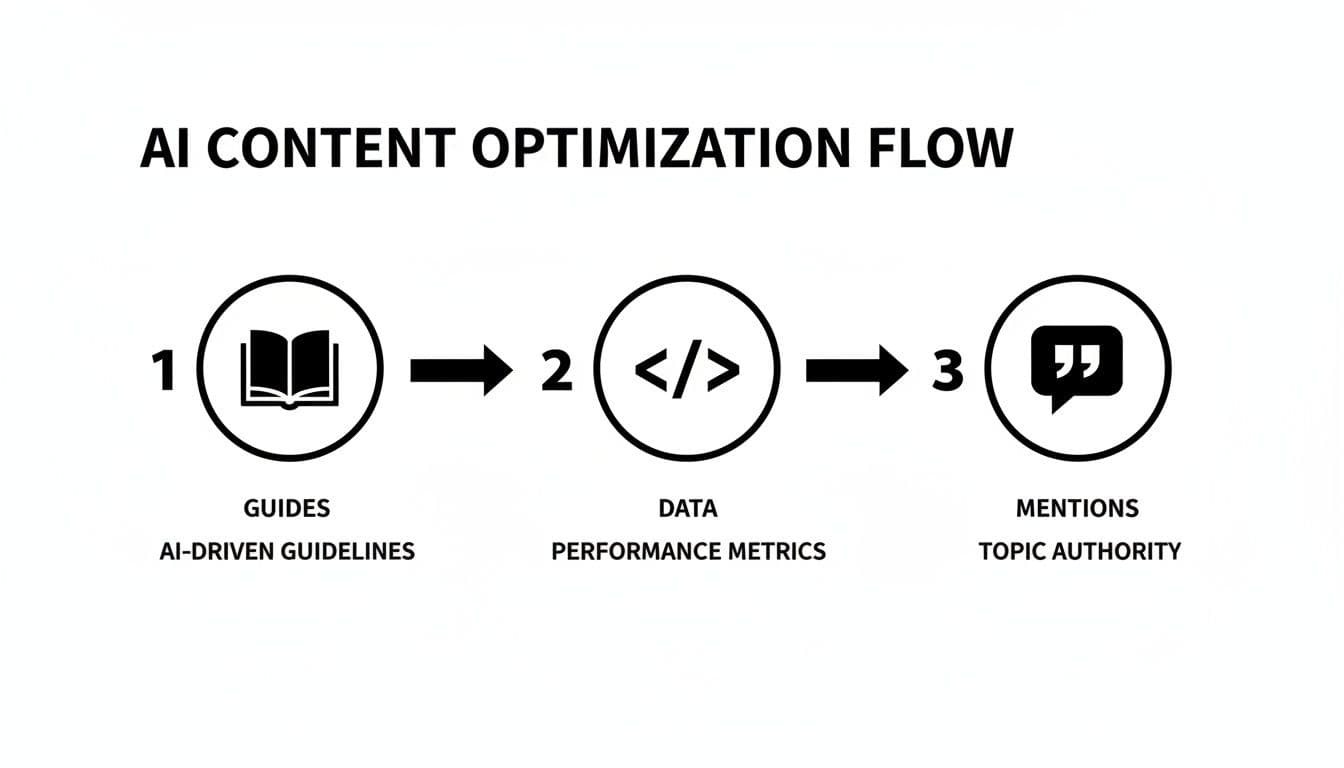
The crucial insight here is that these aren't siloed tasks. They are all interconnected parts of a feedback loop designed to build—and defend—your visibility within AI.
Creating an Action-Oriented Workflow
Once automated monitoring is running, you can design a workflow that triggers specific actions based on the incoming data. This is how you turn raw intelligence into immediate marketing plays.
Picture this real-world scenario. Your team gets an automated alert from Attensira on a Tuesday morning. A key competitor is now being consistently recommended by AI for "best enterprise onboarding software"—a core category you're fighting for. The dashboard immediately shows the probable sources fueling the mention, pointing to a new series of high-authority case studies the competitor just published.
Without a workflow, this is a fire drill. With one, it’s an opportunity.
Your content strategist uses the platform's insights to dig into the competitor's new content. They quickly identify thematic gaps and weak points in their argument—angles your brand is perfectly positioned to own.
Based on this analysis, the strategist generates an AI-optimized content brief directly from the platform. The brief outlines a new, powerhouse guide—"The Ultimate Onboarding Playbook for Global Enterprises"—complete with the exact headings, data points, and schema markup required to be easily digested and cited by AI models. This turns a competitive threat into a strategic countermove in hours, not weeks.
Integrating Workflows with Your Martech Stack
For this process to be truly effective, it can't live on an island. Your AI visibility workflow has to plug directly into the martech and sales tools your team already uses every single day.
Think about these practical integrations:
- Project Management Tools: A new content brief is generated in Attensira, and it automatically creates a task in Asana or Jira for your writing team, complete with the brief, context, and a deadline.
- CRM and Sales Platforms: A significant positive shift in AI sentiment for a specific product could trigger a notification in Salesforce or HubSpot, arming your sales reps with fresh, third-party validation for their calls that day.
- Communication Hubs: Critical alerts—like a new negative mention or a competitor suddenly ranking for a top-tier keyword—can be pushed directly to a dedicated channel in Slack or Microsoft Teams, ensuring the right people see it instantly.
By connecting these systems, you embed AI visibility into the very DNA of your marketing operations. It stops being one person's side project and becomes a shared, strategic priority.
Measuring Success and Proving ROI in AI
So, you’ve put in the work to boost your AI visibility for HR tech. The next big question from your leadership team is inevitable: what's the return on this investment? How do you prove that getting mentioned in an AI chat actually translates to business value?
The answer isn’t just counting your brand mentions. That’s a vanity metric. Real proof comes from connecting your AI footprint to the KPIs that matter—pipeline, qualified leads, and ultimately, revenue. You need concrete evidence that shows your AI optimization efforts are more than just a marketing experiment.
Moving Beyond Simple Mention Counts
The most basic starting point is, of course, seeing if your brand shows up in AI responses at all. But that's just scratching the surface. The real story unfolds when you dig into the context and see how you stack up against the competition.
To get a clearer picture, you need to track a more sophisticated set of metrics:
- Share of AI Voice (SOAV): This is your market share within AI conversations. It measures how often your brand gets mentioned for high-intent keywords versus your direct competitors. For example, what percentage of the time does your brand appear in responses to "best applicant tracking system for startups"? A high SOAV for your core terms is a powerful signal of authority.
- Sentiment Analysis: It’s not just if you're mentioned, but how. Is the AI citing sources that paint your product in a positive, neutral, or negative light? Tracking sentiment gives you a read on brand perception and helps you understand if you're building trust.
- Source Authority Correlation: This one is crucial. Pay close attention to the sources AI models cite when they mention you. Are they pulling from your own blog posts and case studies? Or are they referencing high-authority review sites and industry publications? This tells you which content assets are actually influencing the AI.
Proving ROI isn't about showing you were mentioned; it's about demonstrating that the right mentions, in the right context, are driving tangible business outcomes. The goal is to connect a positive AI presence directly to qualified lead generation.
Connecting AI Metrics to Business Objectives
Ultimately, these AI-specific KPIs have to tie back to the bottom line. The bridge between AI visibility and revenue is the quality of traffic and leads it generates. We often see that traffic coming from AI-driven discovery converts at a much higher rate, so making that connection is everything.
For HR tech companies serving specific local or regional markets, the challenge is even steeper. Gaining visibility in AI-powered search for local services can be up to 30 times harder than ranking in Google’s traditional local 3-pack. It's a tough environment. A recent report revealed that AI platforms are incredibly selective, with ChatGPT recommending a mere 1.2% of the business locations it analyzed. This is a massive gap that HR firms specializing in local talent solutions absolutely must measure their progress against. You can dive into the complete findings in the 2026 AI local visibility report on Search Engine Land.
To tie it all together, you need a way to spot trends. For instance, can you correlate a 15% increase in your Share of AI Voice for "enterprise payroll solutions" with a jump in demo requests from that exact segment? This is where a platform like Attensira becomes invaluable, helping you track these metrics over time and draw clear lines between your activity and the results. If you want to build a more robust framework for this, check out our guide on how to properly measure marketing ROI.
By diligently tracking and correlating this data, you can stop talking about AI visibility as an abstract marketing activity and start presenting it as a measurable driver of business growth. That's how you prove your value.
Common Questions About AI Visibility
Diving into AI optimization brings up a ton of questions for HR tech marketers. It feels like a new frontier, so it's only natural to wonder where to even begin and what AI visibility for HR tech actually looks like on the ground.
Let's cut through the noise. Here are some of the most common questions I hear, with straight-up answers to help you build a practical strategy.
Can We Still Focus on Traditional SEO?
Yes, but it's no longer enough on its own. Your traditional SEO efforts are still crucial for getting people to your website from a standard Google search. Don't stop doing what works there.
The big difference is the end goal. SEO is about earning a click. AI Optimization, on the other hand, is about earning a mention directly in the AI's answer. Since users are increasingly getting what they need without leaving the chat interface, getting cited is the new click.
Think of it this way: a strong SEO foundation makes your site more credible to AI models, so the two definitely support each other. But you have to add that extra layer—semantic content, structured data, and third-party mentions—to actually show up in AI-generated results.
How Long Does It Take to See Results?
Everyone asks this, and the honest answer is, it depends. This isn't like a PPC campaign where you can flip a switch and see traffic. Influencing the knowledge base of massive language models is a long game.
You should realistically expect to see the first signs of movement in a few months, not a few weeks. The actual timeline really hinges on a few things:
- Your Starting Point: If your brand is already a known authority with a deep library of quality content, you'll see traction much faster than a company just starting out.
- Niche Competitiveness: Trying to break through on a query like "best applicant tracking system" is a heavy lift. It will take more time and effort than owning a more specific category.
- Consistent Effort: This is the big one. Publishing a couple of optimized blog posts and calling it a day won't cut it. Momentum comes from a steady, consistent output of expert-level content over time.
Building visibility in AI is like building a brand reputation. It demands patience and sustained effort, but the results compound, establishing your company as a go-to authority that AI models—and customers—trust.
Is This Only for Big Companies with Large Budgets?
Absolutely not. While big enterprises can throw more money at content, smaller and mid-sized HR tech companies have a secret weapon: agility. You can win by being smarter and more focused.
Instead of trying to be known for everything, pick your lane and dominate it. For example, forget targeting a broad term like "HR software." Instead, aim to become the definitive source for something specific, like "compliance software for remote-first startups."
Smaller teams can move fast, creating hyper-specific, expert content that addresses niche problems a big corporation might ignore. If you want to learn more about how to track your progress without a massive budget, our guide on how to see brand visibility in ChatGPT breaks down tactics that work for teams of any size.
What Is the Single Most Important First Step?
If you only do one thing right now, go implement Product and FAQPage schema markup on your main product and solution pages. This is the single most direct and powerful technical move you can make.
Structured data is the native language of AI. It spells everything out, removing any guesswork for the models about what your product is, what it does, and what problems it solves. It’s a low-effort, high-impact starting point that makes all your other content and optimization efforts work harder.
Ready to stop guessing and start measuring your brand's presence in AI? Attensira provides the automated monitoring and strategic insights you need to win in the new era of search. Take control of your AI visibility by visiting https://attensira.com to see how it works.