Unlock growth with AI product discovery optimization. This guide provides a practical framework for boosting your AI solution's visibility and driving adoption.
When we talk about "AI product discovery optimization," we're really talking about a fundamental shift in how we get our products in front of the right people. It's about meticulously structuring your product information so that AI platforms—think ChatGPT or Google’s AI Overviews—can easily find, understand, and, most importantly, recommend it. This isn't your classic, keyword-driven SEO. It's about feeding AI systems clear, factual data that establishes your brand as the go-to authority.
The whole point is to make sure that when a high-intent B2B buyer asks a complex, conversational question, your solution is the one the AI presents.
The New B2B Growth Engine: AI Product Discovery
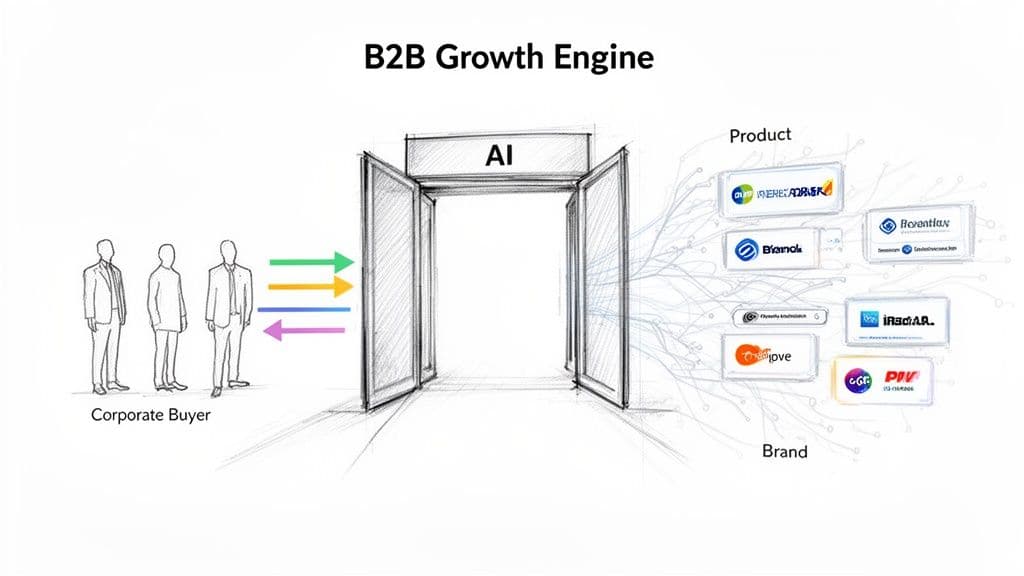
The playbook for how B2B buyers find and vet products has been completely rewritten. While traditional SEO certainly still has its place, it's no longer the only game in town for driving high-quality traffic. Buyers are evolving past simple keyword searches. Now, they're having detailed conversations with AI assistants to get the answers they need.
This is a genuine turning point. AI is quickly becoming the primary filter for product discovery, especially for users who are ready to buy. Instead of wading through pages of search results, buyers are asking pointed questions and getting back curated answers, often with specific product suggestions baked right in. For B2B brands, getting your name inside those AI-generated responses is the new competitive battlefield.
Why AI Discovery Demands a New Strategy
Getting your strategy right for AI isn't just a technical checkbox; it's a core business imperative. The speed at which this is happening is hard to ignore. We've seen data showing that daily AI search usage in the United States shot up from 14% in February 2025 to a staggering 29.2% by August 2025—that’s nearly double in just six months.
What’s even more compelling for B2B companies is that AI-referred traffic converts at 2-3x higher rates than what we see from traditional search. This tells us these users are not just browsing; they are highly qualified and deep into their purchasing journey.
This new environment requires a different mindset than conventional SEO. You can dive deeper into the specifics with our complete guide to AI Search Engine Optimization, but the big idea is to shift from just trying to rank pages to becoming a trusted source of data.
The goal is no longer just to rank on a results page. The new imperative is to become a citable, authoritative source of truth that AI models confidently recommend to their users.
The Opportunity for B2B Brands
For any B2B company paying attention, this is a massive opportunity. If you can establish your brand as an authority within these Large Language Models (LLMs) right now, you can carve out a significant piece of the market. Think about it: when an AI cites your product as the answer to a user's complex problem, it comes with a built-in endorsement that's far more powerful than any ad or standard search result.
This guide is designed to give you a clear, repeatable framework to build that authority. We’ll walk you through a practical process for:
- Auditing where—and if—you're showing up in AI-generated answers today.
- Mapping the specific user intents driving your customers' conversational queries.
- Structuring all your product data and content so AI can consume it effectively.
- Monitoring your performance and continuously refining your strategy based on real data.
Mastering ai product discovery optimization is about making sure your brand is the answer when your ideal customer finally asks the right question.
Auditing Your Current AI Visibility
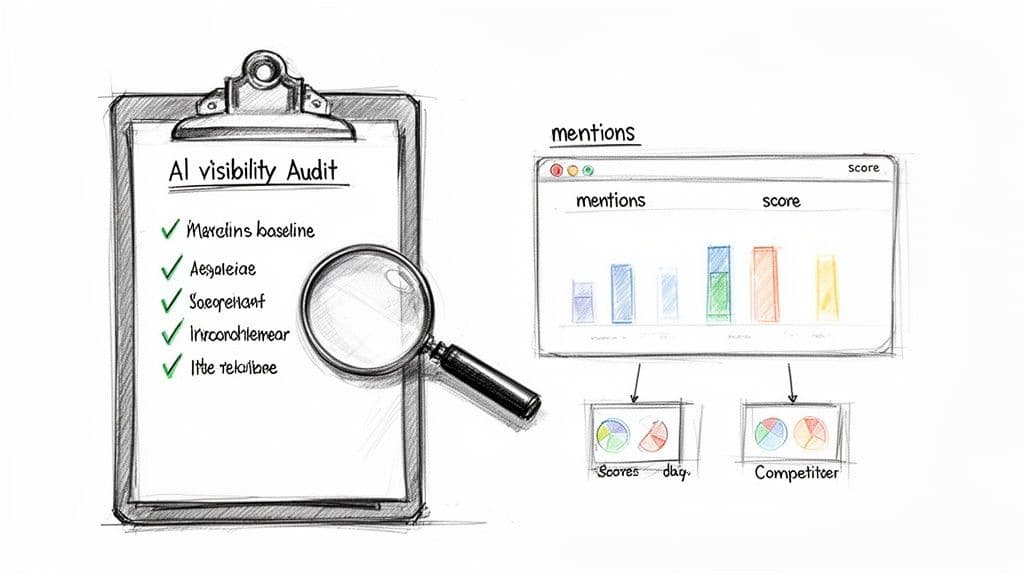
Before you can chart a new course, you have to know where you stand. When it comes to getting your product discovered by AI, that means taking a brutally honest look at your current visibility—or lack thereof—across platforms like ChatGPT, Google's AI Overviews, and others.
This isn't just a box-checking exercise; it's a critical diagnostic. Without a clear baseline, you're essentially flying blind, making changes without any way to measure what’s actually working. The goal here is to build a detailed scorecard that shows how often your brand gets mentioned, in what context, and how you're performing against the competition.
Start by Thinking Like Your Customer
The first move in any worthwhile audit is to step into your customer's shoes. Ditch the old-school keyword lists and start thinking about the natural language questions a B2B buyer would actually ask an AI assistant.
You need to map out queries that cover the entire buyer's journey to see where—and if—your brand shows up. I recommend brainstorming questions for each stage:
- Top-of-Funnel (Informational): "What are the best CRMs for a small tech startup?" or "How do I automate lead scoring?"
- Middle-of-Funnel (Comparison): "Compare HubSpot vs Salesforce for B2B marketing."
- Bottom-of-Funnel (Transactional): "Which project management tool integrates with Slack and has strong reporting features?"
Manually plugging these prompts into a few AI models is a decent start, but it's not a scalable strategy. For a truly comprehensive audit, you need a systematic way to monitor these responses over time. If you want a deeper dive into this process, we've outlined a full methodology on how to track your brand's visibility in ChatGPT and other top LLMs.
Building Your Baseline Performance Scorecard
With your list of queries ready, it's time to gather the data. You can start with a simple spreadsheet, but I’ve found that specialized tools are what really provide the deeper analytics you need. Your objective is to document the answers to a few key questions for every query you test.
An AI visibility audit isn't about finding a single score. It’s about building a multi-dimensional picture of your brand's presence, uncovering both strengths to amplify and critical weaknesses to address.
For example, a platform like Attensira automates this whole process. It tracks your mentions and sentiment across dozens of LLMs and gives you a clear dashboard view of your performance.
A dashboard like this instantly visualizes how your brand is being mentioned across different AIs, highlighting trends and sentiment shifts. From this data, you can quickly see which platforms favor your content and which ones are ignoring you completely.
The Essential Audit Checklist
To make sure your audit is thorough, focus on these critical data points. This structured approach ensures you capture everything needed to inform your AI product discovery optimization strategy.
- Brand Mention Frequency: How often does your brand or product pop up in relevant answers? Keep a simple count.
- Competitor Mentions: When you're not mentioned, who is? Make a list of the competitors that are consistently recommended for your target queries.
- Sentiment Analysis: Are the mentions positive, neutral, or negative? An AI might mention you but frame it in a way that highlights a known weakness or an outdated feature.
- Source Citations: What content is the AI citing when it mentions you? This is gold—it tells you which of your assets are already "AI-friendly."
- Content Gaps: Where are you completely absent? Pay close attention to queries where neither you nor your direct competitors appear. These are wide-open opportunities.
By methodically working through this audit, you'll replace guesswork with a data-backed starting point. This baseline is the foundation for everything that follows, allowing you to prioritize your next moves and demonstrate clear, measurable progress down the line.
Mapping User Intent for Conversational Search
AI-driven discovery works on a completely different level than traditional search. It’s less about matching keywords and more about understanding intent—the real "why" behind a user's question. To get this right, you have to stop thinking about what users type and start focusing on what they’re trying to achieve.
Think about it. A user asking an AI, "How can I reduce customer churn with my current software stack?" has a much different goal than someone typing "CRM software" into Google. The first query is a cry for a solution, while the second is a broad, category-level search. Your entire AI discovery strategy needs to be built around answering that first, more specific, problem-solving mindset.
From Keywords to Problem-Solving
Mapping intent really begins when you break down the core problems your product actually solves. To do this well in a conversational search context, you need a solid grasp of the underlying tech, particularly Large Language Models (LLMs). These models are built to pick up on nuance and context, so your content needs to deliver direct, clear answers to some pretty complex questions.
And this isn't just theory—it's how people are already using these tools. Recent data shows that 66% of weekly shoppers are using AI assistants to help make decisions. What's even more telling is that 34% of these frequent users look to AI for their initial product discovery, especially when they're just exploring and don't know exactly what they need yet.
This trend reveals a clear split: traditional search is still king for simple transactional queries, but AI is quickly becoming the go-to for navigating complex, multi-step problems. For more on this, check out the insights on how AI is changing the product discovery journey on yotpo.com.
A Framework for B2B Intent Categories
To get organized, it helps to sort user queries into three main B2B intent buckets. This simple framework lets you build out content that meets buyers right where they are, without any guesswork.
- Informational Intent: This is your top-of-funnel stuff. The user is just trying to understand a problem or explore a new concept. They aren’t anywhere near ready to buy; they're in pure learning mode.
- Example Query: "What are the common security risks for a remote workforce?"
- Comparison Intent: At this stage, the user knows solutions exist and is actively weighing their options. They’re digging for differentiators, integration details, or specific use cases that match their own.
- Example Query: "Compare project management tools like Asana and Monday for a software development team."
- Transactional Intent: This is the bottom of the funnel. The user knows what they need and is looking for the best product to get the job done, right now.
- Example Query: "Which cloud data warehouse offers the best real-time analytics capabilities and integrates with Tableau?"
Your content needs a promotion. It has to move from being just a marketing asset to becoming a functional knowledge base. Every article, every blog post, should be structured as a direct, citable answer to a specific user problem, making it incredibly easy for an AI to find, understand, and recommend.
By aligning your content with these intent categories, you're essentially matching your product's story to the natural flow of a buyer's conversational research. Our guide on Answer Engine Optimization dives deeper into the specific tactics for structuring your content this way.
This methodical approach isn’t just about creating more content—it’s about building a library of precise, authoritative solutions. When an AI model needs a credible, expert answer to a tough B2B problem, it’s going to pull from the source that has provided that information most clearly and accurately. Your job is to be that source.
Getting Your Content and Data Ready for AI
After you’ve mapped out what people are asking, it's time to get your hands dirty. The next step is all about structuring your product information in a way that AI models can actually understand and use. This isn't about writing slick marketing copy; it's about building a clean, factual, machine-readable foundation for everything you offer.
Think of it this way: AI models, especially the LLMs powering today's search and chat experiences, thrive on clarity. They need unambiguous data to confidently recommend a product. If your content is disorganized, incomplete, or purely narrative, you're creating friction. That makes it much harder for an AI to parse the essential details—what your product does, who it’s for, and why it's the right choice.
This is the journey your content needs to support, moving from general curiosity to a specific purchase decision.
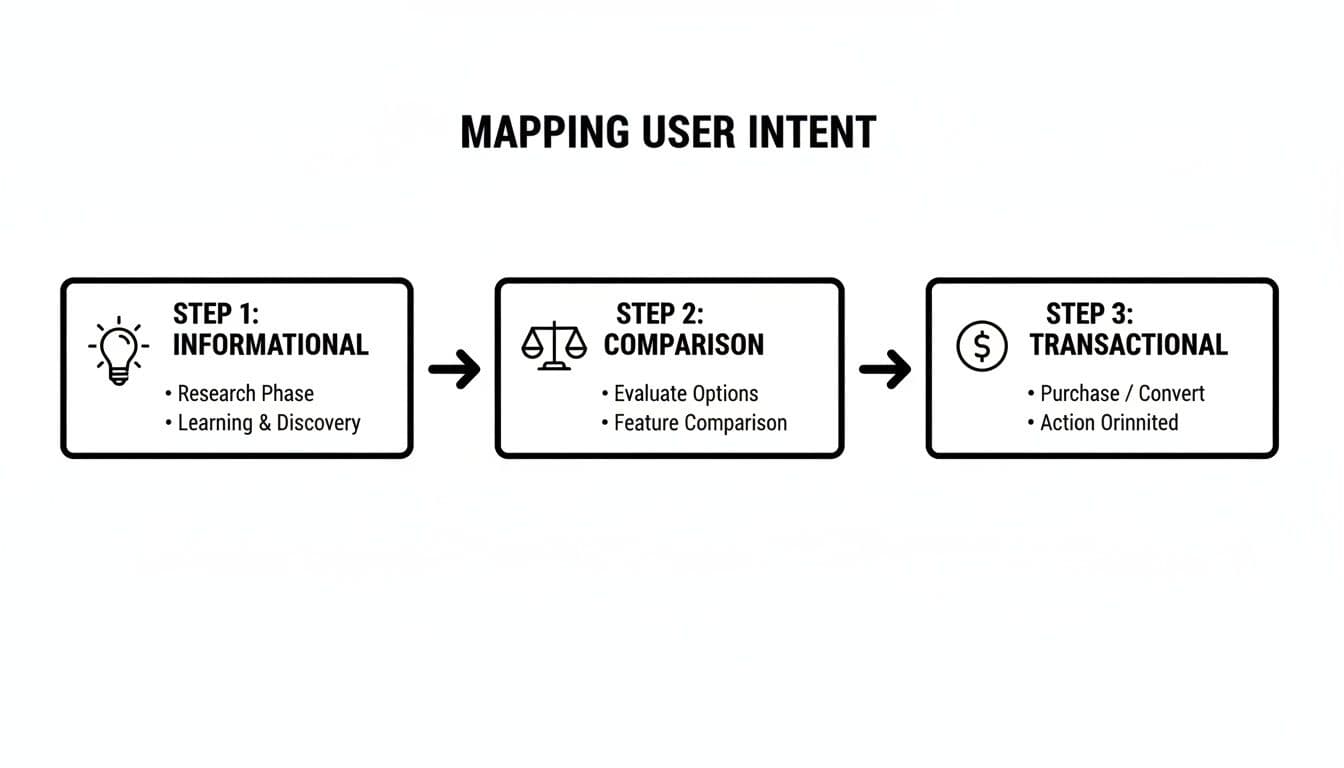
The path from informational queries to transactional ones shows a clear funnel of increasing specificity. Your data structure has to answer questions at every single stage.
The Cornerstone of AI Visibility: Your 'Golden Record'
If there's one thing you should focus on for AI product discovery optimization, it's creating a 'Golden Record' for each product. This is your single source of truth—a centralized, perfectly structured repository containing every last attribute, spec, and data point about your product.
This isn’t just some theoretical best practice; it has a massive, direct impact on your bottom line. We've seen that product data quality is directly tied to AI visibility. Stores that achieve 99.9% attribute completion—the Golden Record standard—are seeing 3-4x higher visibility in AI-driven recommendations. That multiplier effect turns meticulous data management from a tedious backend task into a primary engine for growth.
To build out this record, you have to dig much deeper than just a basic product description.
- Core Specifications: Get granular. Include every technical detail, from dimensions and weight to compatibility standards and performance benchmarks.
- Use Case Attributes: Tag products with the specific problems they solve. For instance, a CRM shouldn't just be a "CRM"; it should be tagged for "B2B SaaS lead management" or "real estate client tracking."
- Integration Data: Don't just say you integrate with other platforms. Detail every single one, right down to the specific version compatibilities.
- Pricing and Tiers: Clearly break down your pricing plans. Outline precisely which features are included at each level so an AI can make accurate comparisons.
This is the level of detail that gives an AI the factual ammunition it needs to match your product to those highly specific, long-tail queries that signal real purchase intent.
Shifting from Articles to a Knowledge Base
Your marketing content—the blogs, whitepapers, and case studies—also needs a complete overhaul. An AI doesn't read a blog post for its narrative flair; it scans it for direct, citable answers to user questions.
The fundamental shift here is from writing articles to building a knowledge base. Every piece of content you produce should be treated as a potential citation—a direct source of truth that an AI can reference with complete confidence.
So, how do you make this happen? It starts with a few key principles for writing and formatting. First, use clear, factual language. Ditch the ambiguous marketing-speak. Second, structure your content with descriptive headings (H2s and H3s) that essentially ask and answer a question. A heading like "How Our Platform Integrates with Salesforce" leaves no doubt about the information that follows.
This structure is absolutely critical because it mirrors how AI models process information. We’ve actually dived deep into this topic in our guide on how ChatGPT indexes and understands web content.
Finally, break down complex topics into formats that are easy for both people and machines to scan.
- Use bulleted lists for features and benefits.
- Use numbered lists for any step-by-step processes.
- Create comparison tables to show how you stack up against competitors.
As you adapt your strategy, it's important to understand how the rules of the game have changed. Optimizing for AI discovery isn't just a new label for SEO; it requires a different mindset and approach.
Key Differences in Optimization Approach
This table highlights the transition from optimizing for visibility on a results page to optimizing for being the authoritative answer within an AI-generated response.
Let's look at a quick example.
Imagine you sell a B2B cybersecurity platform. A traditional blog post might be titled "The Importance of Endpoint Security." An AI-optimized article, however, would be built with headings that directly address user intent:
- What Is Endpoint Detection and Response (EDR)?
- Key Features of a Modern EDR Solution
- How to Choose an EDR Platform for a Financial Services Firm
- Comparing Our EDR with CrowdStrike and SentinelOne
This approach transforms your content from a passive marketing asset into an active, authoritative resource for AI systems, positioning your brand as the definitive source of information in your field.
Measuring and Refining Your AI Discovery Strategy
Getting your AI product discovery optimization strategy off the ground is one thing. Keeping it effective is another challenge entirely. The AI ecosystem is in a constant state of flux; models are always updating their knowledge graphs and tweaking their algorithms. What works brilliantly today could be obsolete next month.
This means you can't just set it and forget it. To stay visible and relevant, you have to build a data-driven feedback loop. This isn't about chasing vanity metrics; it's about tracking the right signals, making sense of the results, and using those insights to make sharp, strategic adjustments.
Without this cycle of measurement and iteration, any initial gains you make will quickly fade as competitors adapt and the AI models themselves evolve.
Defining Your Key Performance Indicators
Before you can measure success, you have to define what it looks like. While traditional web metrics like page views and bounce rates still have their place, they don't give you the full picture of your AI performance. You need to zero in on KPIs that directly reflect how your brand shows up in AI-generated answers.
These metrics go beyond simple website traffic. They measure your actual influence and authority within the AI's understanding of your market.
Here are the essential KPIs I always recommend tracking:
- Mention Frequency: Simply put, how often does your brand, product, or key person get mentioned in answers to your target queries? This is your baseline visibility score.
- Mention Share: What slice of the pie do you own? This metric compares your mention frequency to your competitors' for a specific query, giving crucial context to your numbers.
- Sentiment Score: When you are mentioned, is the AI framing you in a positive, neutral, or negative light? A high mention frequency with poor sentiment is a problem you need to fix, fast.
- Citation Quality: Are the links from AI responses driving quality traffic? You need to look at post-click behavior like time on page and conversions from this specific referral source.
- Attribute Mentions: Which specific product features, benefits, or use cases is the AI latching onto? This shows you which parts of your core messaging are actually sticking.
Setting Up Your Monitoring Dashboard
Trying to track these KPIs by hand across a dozen different AI platforms is a recipe for disaster. It's time-consuming, inconsistent, and you’ll miss the subtle patterns that matter. You need a centralized dashboard to automate the data collection. This is where a tool like Attensira becomes invaluable, giving you a single source of truth for your AI visibility.
A well-designed dashboard lets you spot trends instantly. You might see your mention frequency for "comparison" queries dipping, which could mean a competitor just dropped a killer piece of comparison content. Or you could see mentions spike right after you’ve updated your product's structured data.
A monitoring dashboard isn't just a reporting tool for showing off wins. It's a diagnostic tool that flags emerging threats and new opportunities before they become major issues.
This steady stream of data is the bedrock of an agile strategy. For a deeper dive into the tools that can power this, our guide on brand awareness measurement tools covers concepts that are directly applicable to AI monitoring.
Analyzing Performance to Find Opportunities
With your data all in one place, the real work begins: analysis. This is where you connect the dots between the actions you took and the results you're seeing. Your analysis should always focus on answering three critical questions.
1. Which Content Resonates?
Pinpoint the specific articles, pages, and data sheets that AI models are citing most often. These are your star players. Break them down—look at their structure, their language, their formatting—and use what you learn to create a playbook for future content.
2. Where Are the Gaps?
Hunt for high-value queries where your brand is getting low or zero mentions. These are glaring content gaps. If an AI isn't recommending you for a core problem your product solves, it’s a clear sign your content isn't structured to answer that question effectively.
3. What Are the Emerging Narratives?
Pay close attention to the specific product attributes the AI keeps bringing up. I've seen cases where a model consistently highlights a feature the company considered minor. That's a powerful insight—it might be a more important differentiator than you realized, and it could influence both your product roadmap and your marketing messages.
By systematically working through this process, you create a powerful, self-reinforcing loop. The insights from your performance data directly inform your next round of content and data updates, driving continuous improvement in your AI product discovery optimization efforts. This is how you win and hold a dominant position in an AI-driven world.
Frequently Asked Questions About AI Optimization
When you first start thinking about optimizing for AI product discovery, a lot of practical questions bubble up. It's totally normal. Getting these sorted out early on helps clarify the path forward and sets the right expectations for what it's going to take in terms of time and resources. Let's walk through some of the most common questions I hear.
How Quickly Can We Expect Results?
This is probably the number one question, and the answer is refreshingly different from traditional SEO. You're not necessarily waiting six months to see the needle move. We’ve seen initial visibility gains pop up in just a few weeks, especially right after a major push to update structured product data and key content.
Why so fast? AI models are constantly crawling and updating their knowledge. Once you make high-quality, structured information available, it can get picked up and start appearing in answers pretty quickly. That said, becoming a true "authority"—the go-to source that AI platforms consistently trust and cite—is a marathon, not a sprint. For a deeper dive into common questions, this external FAQ page on AI optimization is a great resource.
The Single Most Important Ranking Factor
If you force me to pick just one thing, it’s the quality and completeness of your structured product data. Hands down. AI systems are built on logic; they crave clear, unambiguous, and comprehensive information. A product profile that's nearly 100% complete—what we call a "Golden Record"—is just fundamentally more likely to get recommended.
This means getting into the weeds with details like technical specs, specific use cases, up-to-the-minute pricing, and a full list of integrations, all correctly marked up with schema. This data is the foundation of fact that an AI needs to feel confident putting your product forward as a real solution.
While great articles and guides are crucial for context, it’s the hard, structured data that gives an AI the confidence to present your product as a definitive answer. Think of it as the non-negotiable bedrock of your entire strategy.
Reusing Existing SEO Content
So, you've got a huge library of blog posts and articles. That’s a fantastic starting point, but you can't just copy and paste it into this new world. The content needs a serious makeover to work for an AI. Most of your existing content was written to rank a webpage based on keywords.
AI-optimized content, on the other hand, needs to be structured to give direct answers to very specific questions. This usually involves a few key steps:
- Deconstruction: Taking long-form articles and breaking them down into bite-sized, self-contained Q&A pairs.
- Clarification: Rewriting sentences and paragraphs to be brutally clear and fact-based, sometimes even at the expense of a nice narrative flow.
- Transformation: Shifting your mindset from seeing a "content library" to building a "knowledge base" that a machine can easily parse and reference.
Impact of Customer Reviews on AI Discovery
Customer reviews are no longer just a nice-to-have for social proof on your website; they are absolutely critical for AI discovery. AI models look at review volume, how recent they are, and the overall sentiment as primary signals of trust and product quality. It makes sense, right? A product with hundreds of recent, detailed, and positive reviews is a much safer bet for an AI to recommend.
In fact, many of these platforms have internal thresholds. They simply won't recommend a product that has a tiny number of reviews or none at all. This means your strategy for encouraging authentic customer feedback just got a major promotion. It’s no longer just a conversion tactic—it’s a core visibility driver.
Ready to see exactly how your brand appears in AI-generated answers? Attensira provides the tools to audit your current visibility, track competitor mentions, and build a data-driven strategy for AI discovery. Get started at https://attensira.com.