



Dominate the new era of search. This guide provides actionable strategies to master AI visibility for ecommerce brands and drive measurable growth.
When we talk about AI visibility for an ecommerce brand, we're really asking one simple question: how often do AI-driven search engines cite your products and content as the answer? This goes way beyond old-school rankings. It’s about becoming the source of truth for the AI models that are quickly turning into personal shopping assistants for consumers.
The New Ecommerce Battleground: AI Search Visibility
Picture your customer for a moment. Instead of sifting through endless pages of search results, they just ask a question: "What are the best running shoes for marathon training under $150?" In return, they get a direct, summarized answer. This isn't some far-off concept—it's happening right now on platforms like Google's AI Overviews and Perplexity.
This is arguably the biggest shake-up in how people find products in more than a decade. The old fight was for the top spot on page one of Google. The new battleground is inside that AI-generated answer box. Simply ranking well doesn't guarantee you'll get seen anymore. If your brand isn't cited directly in that AI summary, you’re basically invisible to a huge and growing group of shoppers.
From Rankings to Recommendations
This fundamental change in how search works demands a new way to measure success: AI visibility. It's no longer about your position in a list of ten blue links. It's about becoming a trusted, authoritative source that AI engines feel confident enough to recommend directly. Think of it as a shift from winning a popularity contest (traditional SEO) to passing a rigorous background check (what we call Answer Engine Optimization).
The new shelf space isn’t a store; it’s the AI summary. Brands need to understand their earned footprint across AI-generated answers. Who gets cited? Who’s trusted? Who’s missing? That’s the new baseline of visibility.
The latest data shows just how fast this is happening. An incredible 91% of eCommerce queries now trigger AI-generated results. In categories like fashion and beauty, that number jumps to between 94% and 95%. This direct-answer format is causing click-through rates for traditional organic links to plummet by as much as 55%.
But here's the most telling statistic: 66% of the citations in AI Overviews come from websites outside the top 10 organic results. This is proof that AI cares more about high-quality data and real-world relevance than it does about old-school ranking signals.
Why This Is an Opportunity
While this new reality completely upends the old SEO playbook, it also creates a massive opportunity for brands that can adapt quickly. AI actually levels the playing field. It gives companies with better product data, more authentic reviews, and genuinely helpful content a chance to leapfrog bigger competitors who are still stuck on legacy tactics. The broader impact of AI in sales and marketing is worth digging into to see just how deep this change goes.
By focusing on the signals that AI models actually value, your brand can become a preferred source. This doesn't just drive traffic; it drives high-intent buyers who see the AI's answer as a trusted endorsement. The strategies to get there are different, and knowing how to optimize for this new world is everything. You can learn more about specialized approaches for this at https://attensira.com/industries/ecommerce.
How AI Engines Discover and Rank Ecommerce Products
Generative AI can sometimes feel like an impenetrable black box, spitting out recommendations that seem to come from nowhere. But when it comes to e-commerce, the process is far more structured and predictable than you might think. These AI engines aren't just guessing; they’re methodically building a comprehensive "digital resume" for every single product they find.
Think of it like this: a traditional search engine scans your site for keywords, much like a recruiter skims a resume for job titles. An AI engine, on the other hand, reads the entire document. It cross-references your product’s features, specifications, and—most importantly—its customer reviews to decide if it’s the best "candidate" for a user's question. For e-commerce brands, high AI visibility comes down to building the most compelling and trustworthy resume for every item you sell.
This isn’t magic. It’s a deliberate process of pulling in data from specific, clearly defined sources. The richness and consistency of that data directly determine how often an AI engine will cite your products in its answers.
The Core Data Sources AI Relies On
AI models are incredibly data-hungry, but they have a strong preference for information that is structured, verifiable, and consistent across the web. For any e-commerce brand, three sources form the bedrock of a product's digital resume.
- Structured Product Data (Schema.org): This is the machine-readable language you embed directly into your website's code. It explicitly tells AI engines crucial details like the product name, price, availability, SKU, and average rating, removing any ambiguity. A product page without proper schema is like a resume with no clear headings—it’s confusing and gets overlooked.
- Comprehensive Product Feeds: Your data feeds, especially those submitted to platforms like Google Merchant Center, are a clean, centralized, and authoritative source for your entire product catalog. Think of this as a direct line of communication to the AI, offering detailed attributes that go beyond what’s on the product page itself, like precise shipping rules or real-time inventory levels.
- User-Generated Content (UGC): Authentic customer reviews, star ratings, and Q&A sections are incredibly powerful trust signals. AI models analyze this content for sentiment, common themes, and real-world performance insights. A product with dozens of positive, detailed reviews has much stronger "references" and is seen as a far less risky recommendation.
This diagram shows how AI Search acts as a bridge, taking signals from traditional SEO and using them to generate new outputs like AI Overviews, which in turn demands a new set of metrics to track performance.
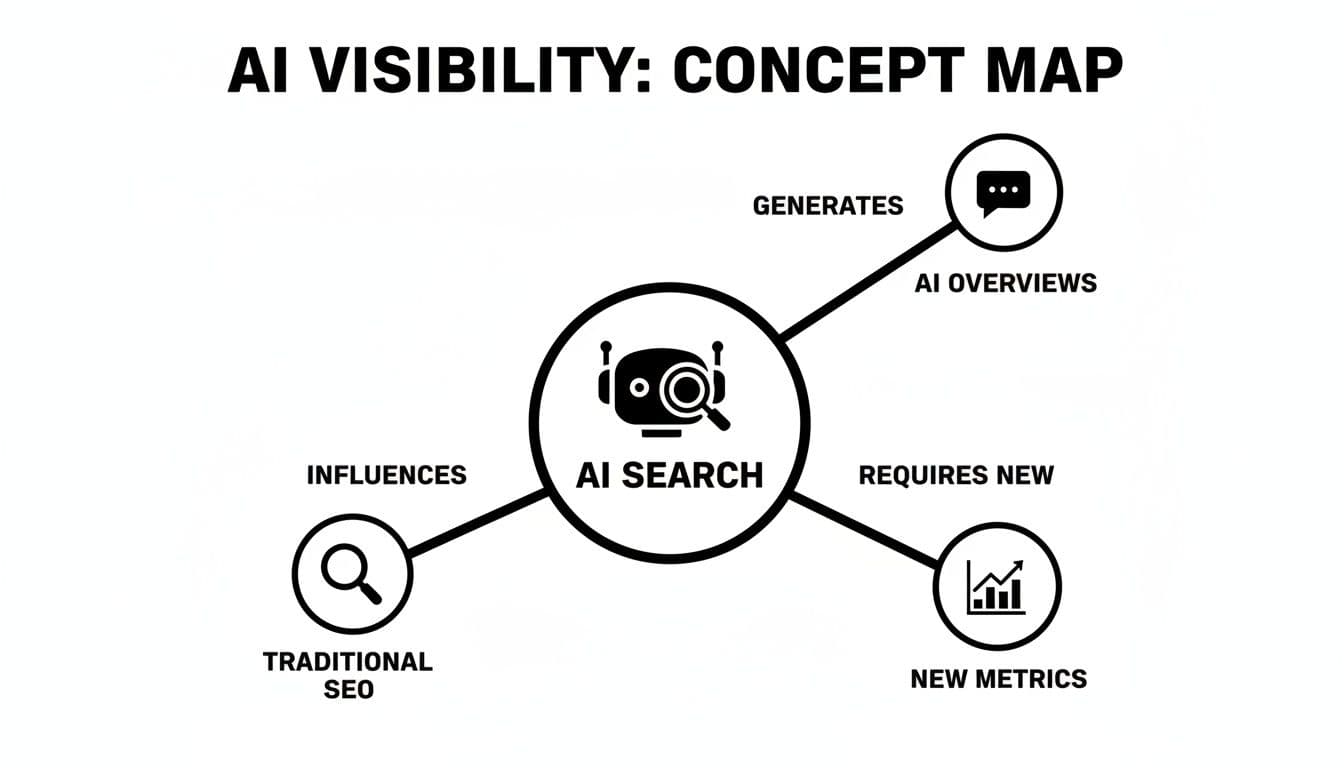
As the visual makes clear, success is no longer just about where you rank; it’s about providing the right data to get featured directly within AI-generated summaries.
From Raw Data to Authoritative Answers
An AI engine doesn't look at these data points in isolation. It synthesizes them to build a multi-dimensional profile of your product. It combines the factual, structured data from your schema and feeds with the qualitative, real-world context it gets from your customer reviews. When a user asks a complex question, the AI can then query this internal knowledge base to find the product that truly fits the need.
AI visibility isn't achieved by tricking an algorithm. It's earned by providing clear, consistent, and comprehensive information that makes it easy for the AI to understand and trust your product's value.
Understanding the mechanics of different AI-driven platforms is crucial here. In fact, brands can learn a lot from established systems by studying things like maximizing product visibility on Amazon with the A9 algorithm, since many of the core principles of data-driven ranking apply across the board.
A product with detailed schema, a robust feed, and strong social proof is simply far more likely to be surfaced in an AI-generated answer. You can see how this plays out on specific platforms; for instance, our guide on https://attensira.com/platform-visibility/perplexity offers deeper insights into one such engine. On the flip side, a lack of this clean, structured data renders a product nearly invisible, no matter how great its traditional SEO might be.
Optimizing The Signals That Drive AI Citations
Knowing how AI engines surface information is one thing, but actively shaping the data they find is where the real work begins. Getting high AI visibility for ecommerce brands isn't some mystical art. It's a methodical process of feeding these systems clear, structured, and trustworthy signals that make your products the most logical and reliable answer to a user's query.
Think of it like preparing an expert witness for a trial. You wouldn't just give them some vague notes and wish them luck. You'd arm them with organized, factual evidence—precise product specs, clear shipping details, and glowing testimonials—so they can present an undeniable case. Your digital assets need to do the exact same thing for AI.
This means we have to consciously shift our focus from some classic SEO metrics to the specific data points that build an AI's confidence in your brand.
Building The Foundation With Granular Product Data
Your raw product data is the absolute bedrock of AI visibility. AI models crave specifics; the more detailed and machine-readable your information, the better your chances. Two areas, in particular, need your immediate attention.
The first is your product feed, like the one you use for Google Merchant Center. It needs to go way beyond just a product name and price. You should be enriching it with every possible attribute: material composition, exact dimensions, warranty details, and even energy efficiency ratings. This level of detail is what allows an AI to match your product to a very specific query, like "Find a wool-free men's sweater with a lifetime warranty."
Second is advanced Schema.org markup. Basic product schema is just table stakes now. To stand out, you need to implement more nuanced types. Use ProductGroup to logically connect all your variants (like different colors or sizes of the same shirt) and OfferShippingDetails to explicitly define shipping costs, destinations, and delivery estimates. This kind of structured data removes all the guesswork for the AI, making your product a safer, more citable option.
The Overwhelming Power Of Social Proof
Data alone won't cut it. AI engines are designed to reduce risk for users, which means they lean heavily on signals of trust and authority. In this new world, social proof has become a non-negotiable asset. Genuine customer reviews are probably the single most powerful signal you have.
AI models analyze the volume, velocity, and sentiment of reviews to understand real-world product performance and customer happiness. A product with hundreds of recent, detailed, positive reviews simply presents a much stronger case than one with a few old, one-line ratings.
ECommerce brands face a volatile new reality in AI search visibility, where 40-60% of domains cited in AI answers change within just one month. Trust signals are paramount; 89% of shown products boast 4.1-5 star ratings, with sub-3-star items appearing in just 0.9% of cases. A 2024 Forrester report adds that first-position AI recommendations drive 60% higher engagement than second or third, making every slot a battleground. Discover more insights on the impact of trust signals from Uof.Digital's 2024 analysis.
This data makes one thing crystal clear: a poor customer experience will directly torpedo your AI visibility. Optimizing your products and services to earn high ratings is no longer just a customer service goal—it's a core SEO activity. For a deeper look at making your on-site information more effective, you might find our guide on content optimization strategies useful.
A New Optimization Mindset
To adapt successfully, we have to let go of some long-held SEO beliefs. While traditional signals haven't vanished, AI has definitely reordered their importance. The table below really highlights this critical shift in focus.
Traditional SEO Signals vs AI Visibility Signals
The game has changed from impressing crawlers with keywords and links to providing AI with verifiable facts and strong social proof.
This comparison shows you where the new priorities lie. While backlinks aren't irrelevant, an ecommerce brand will likely get a bigger AI visibility boost from improving its average star rating from 4.1 to 4.6 than from acquiring a few more high-authority links. This shift demands that our teams align their efforts with the data signals that directly build an AI's trust and understanding of what we sell.
A Tactical Playbook for Getting Seen by AI
Knowing what signals matter is one thing; putting that knowledge to work is what gives you an edge. Improving your AI visibility isn't about finding a single silver bullet. It’s about a coordinated effort across your product data, on-page content, and the entire customer experience.
Think of this as your playbook—a clear set of actionable tasks your team can start on today. These tactics are designed to systematically build the trust and clarity that AI engines need before they'll confidently feature your products and brand in their answers.
Structure Your Product Content for Direct Answers
Your first priority should be making your content as easy as possible for an AI to pull apart and use. This means shifting your mindset from writing keyword-rich prose to creating factual, citable information fragments. Your product pages need to act less like a sales pitch and more like a detailed encyclopedia entry.
Start your product descriptions by front-loading the most critical details—material, key features, and primary use case—right in the first sentence. This helps the AI immediately lock onto the product's core identity.
Then, break down complex features into formats that are easy to scan. Instead of burying a product's benefits in a long paragraph, use a bulleted list or a small comparison table to clearly lay out specs and advantages. This kind of structure is incredibly digestible for AI models.
Mini Case Study: A Home Goods Brand
A mid-sized home goods company was puzzled why its best-selling office chair never showed up in AI answers for queries like "best ergonomic chairs for back pain." A quick audit revealed the problem: their product description was one dense, style-focused paragraph.
They completely refactored the page to include:
- A "Specifications" section with bullet points for dimensions, weight capacity, and materials.
- An FAQ section that directly answered questions like "Is this chair good for sitting all day?"
- A quick "Return Policy" summary right on the page.
Within six weeks, the chair started appearing in AI-generated summaries. The AI was now able to specifically cite the product’s 30-day free returns and 350 lbs weight capacity as key selling points, pulling them directly from the newly structured content.
Get Hyper-Specific with Schema Markup
In this new landscape, basic product schema just isn't enough to stand out. To really improve your AI visibility for ecommerce brands, you have to provide structured data that leaves zero room for an AI to guess. This means going deeper with more specialized schema types.
For every product, make sure you're using the right markup to define not just what it is, but its relationship to other items and its specific offer details.
ProductGroupSchema: Use this to explicitly connect all the variations of a single product, like different sizes, colors, or materials. This tells the AI that these aren't competing products, but simply options within a single offer.OfferShippingDetailsSchema: Don't make the AI infer your shipping policies. This schema lets you spell out exact shipping rates, eligible regions, and delivery windows in a format machines understand perfectly.FAQPageSchema: If you have a Q&A on your product pages, mark it up. This signals to AI engines that you're providing direct answers to common questions, making your content a prime source to be cited.
This granular detail makes your product a "safer" and more reliable choice for an AI to recommend. When an AI can definitively state your product's shipping cost and return window, it lowers the risk of it providing a bad user experience.
The goal of advanced schema is to eliminate any inferential work for the AI. You are not hinting at your policies; you are declaring them in a language the machine can perfectly understand.
Cultivate and Showcase Your Social Proof
AI models are heavily influenced by signals of real-world satisfaction. Your customer reviews aren't just for shoppers anymore—they are a critical data source for AI engines trying to figure out your product's quality and trustworthiness.
Actively encourage customers to leave detailed reviews that talk about specific use cases and product features. A review that says, "This backpack's waterproof zipper kept my laptop dry in a downpour" is infinitely more valuable to an AI than one that just says "Great product!"
Feature review summaries and star ratings prominently on your product and category pages. Making this user-generated content highly visible reinforces its importance and makes it easier for AI systems to access and analyze. For brands looking to build a resilient AI presence, understanding these nuances is key. You can explore more strategies for brand visibility on platforms like Attensira.
By focusing on these tactical areas, you provide the clear, structured, and trustworthy signals that form the foundation of high AI visibility.
How to Measure and Improve Your AI Visibility
Trying to optimize for AI signals you can’t see is like flying a plane with no instruments—you’re just guessing. To actually improve your AI visibility for ecommerce brands, you have to ditch traditional analytics and adopt a mindset of continuous, specialized monitoring. After all, you can't improve what you don't measure.
The AI search space is a moving target. The answers and citations change constantly. Manually asking a few questions here and there is completely unreliable, especially with personalization and rapid-fire updates. That approach just doesn't give you the solid data needed to make smart, strategic moves.
Moving Beyond Manual Spot-Checks
To get a real handle on your AI presence, you need a system. This is exactly where specialized monitoring platforms come into play. Tools like Attensira are designed specifically to track your brand’s footprint across the major AI engines, giving you the intelligence you need to compete.
These platforms go way beyond simple rank tracking to focus on the metrics that actually matter in an AI-first world:
- Citation Frequency: How often do your brand and products pop up in relevant AI-generated answers?
- Share of Voice: When someone asks about your product category, what percentage of the answers mention you versus the competition?
- Sentiment Analysis: Are the mentions of your brand positive, neutral, or negative? The context is everything.
- Competitor Presence: Which competitors are getting cited most often, and what content or data are the AIs pulling from them?
This kind of consistent monitoring turns an invisible problem into a measurable one. It gives you the hard data you need to justify spending time and money on this and prove the ROI.
Using Data to Refine Your Strategy
The insights you get from a dedicated AI visibility platform aren't just for a weekly report; they are the fuel for your entire optimization strategy. By digging into this data, you can uncover some major opportunities and find the weak spots in your current approach.
For instance, a dashboard might show that your flagship product is cited all the time, but your new product line is basically a ghost. That’s an immediate signal that you have a content or data gap to fix. Maybe you're missing schema markup on the new product pages, or perhaps there just aren't enough user reviews yet.
Here’s a look at what an AI visibility monitoring dashboard in Attensira actually looks like:
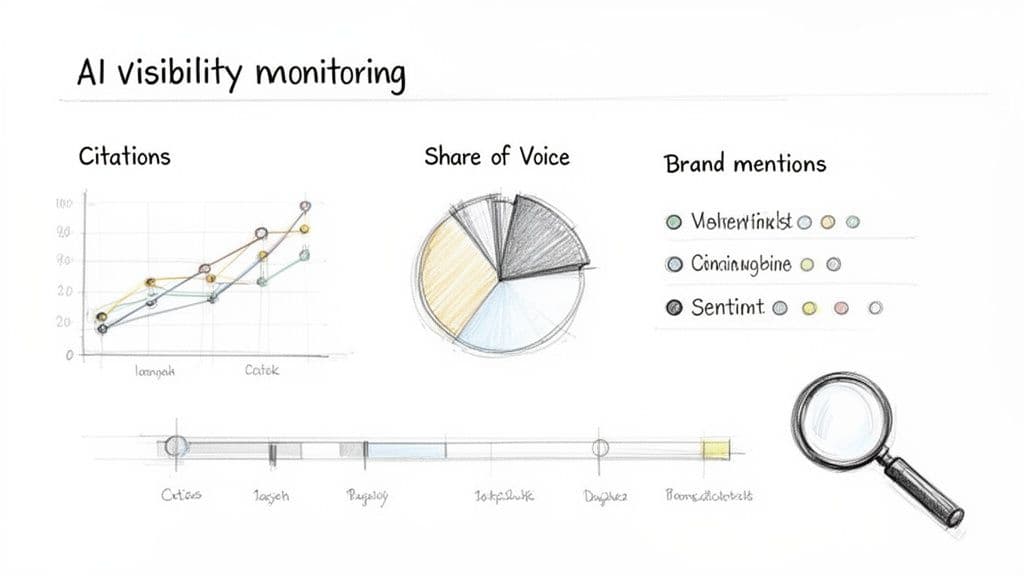
You can see the clear trend line for brand mentions and a competitive breakdown of share of voice, giving a brand manager a quick, at-a-glance view of performance.
The Growing Urgency for Measurement
The need for this kind of oversight is quickly becoming a top-tier business concern. Over 91% of decision-makers have raised red flags about AI visibility in the last year, pushing the issue all the way up to the C-suite as brands scramble to adapt. The stakes are getting higher. Copilot-powered shopping journeys are reportedly 33% shorter and 76% more likely to convert. And with 61.7% of eCommerce searches now triggering an AI-powered shopping mode, brands can't afford to be in the dark any longer. You can find more of these critical AI search statistics on Digitaloft.co.uk.
Monitoring your AI visibility isn't just about counting mentions. It's about understanding the narrative AI is building around your brand and actively working to shape it with better data and content.
By tracking these new metrics, you can begin to treat AI visibility as a core performance indicator. This makes it much easier to build a business case for dedicating real resources to schema optimization, review generation, and creating high-quality, citable content. Eventually, you can even start to estimate the financial impact. If you're curious, you can use our tool to calculate the value of your AI-driven traffic.
Without a dedicated monitoring strategy, brands are simply left guessing while their data-driven competitors steal the most valuable digital shelf space.
Your AI Visibility Checklist for Immediate Impact
Alright, let's get down to business. Knowing what to do is one thing, but actually putting it into practice is what gets results. This checklist is your starting point—a clear, step-by-step guide to get your AI visibility efforts off the ground.
Think of this as a roadmap. It’s not about doing everything at once. Start with the foundational pieces to get your house in order, then move on to the more nuanced content and trust-building work. This isn't a "set it and forget it" task; it's a continuous loop of improvement.
Foundational Tasks: Data and Structure
First things first. These are the absolute must-dos. Getting your data and technical setup right is the bedrock of everything else. If AI engines can't easily understand and trust your product information, even the most brilliant content won't get you cited.
- Overhaul Your Product Feeds: Don't just settle for the basics. Dig into your Google Merchant Center feeds and enrich them. We're talking granular details like material, precise dimensions, warranty information, and country of origin. The more specific, the better.
- Deploy Advanced Schema: Go beyond standard
Productschema. ImplementProductGroupto tie all your variants (like colors and sizes) together neatly. UseOfferShippingDetailsto spell out shipping costs and delivery windows so there's zero ambiguity. - Centralize Your Reviews: Make sure every single product page features authentic customer reviews, and make them prominent. Use a system that gathers this user-generated content and, critically, ensures it's easy for search engine crawlers to find and index.
Intermediate Tasks: Content and Context
With your data structured and clean, it's time to focus on the content that gives it all meaning. This is where you prove your expertise to AI models by directly answering the questions real people are asking.
The new shelf space isn’t a store; it’s the AI summary. Brands need to understand their earned footprint across AI-generated answers. Who gets cited? Who’s trusted? Who’s missing? That’s the new baseline of visibility.
- Rethink Product Descriptions: Shift from flowery marketing copy to fact-based, citable information. Break down specifications into bullet points and put the most important attributes right at the top. Make your descriptions a source of truth.
- Create Helpful Buying Guides: Develop in-depth content that compares products within a category. These guides should tackle the common, top-of-funnel questions your potential customers have before they're ready to buy.
- Add On-Page FAQs: Put a dedicated FAQ section on your most important product and category pages. Mark it up with FAQ schema and use it to address common friction points, hesitations, and queries head-on.
Advanced Tasks: Authority and Measurement
You've got a solid foundation and content that adds real context. The final piece of the puzzle is building undeniable trust and setting up a system to measure what's working so you can double down on it.
- Run a Proactive Review Campaign: Don't just wait for reviews to trickle in. Actively encourage your recent customers to leave detailed, high-quality feedback that tells a story.
- Set Up Continuous AI Monitoring: This is non-negotiable. You need a platform like Attensira to track how often you're being cited in AI answers and see how your "share of voice" stacks up against your main competitors.
- Analyze and Adapt: Your monitoring data is a goldmine. Review it regularly to spot content gaps and find opportunities for improvement. This creates the feedback loop you need to keep getting better over time.
Common Questions About AI Visibility
What's the Real Difference Between SEO and AI Visibility?
Think of it this way: traditional SEO is about winning a spot on the results page—a high rank in that list of blue links. It’s a game largely played with backlinks, keyword placement, and technical site health.
AI Visibility, sometimes called Answer Engine Optimization (AEO), is a whole different ballgame. The goal isn't just to be listed; it's to be the answer. Your brand’s information, product details, and expert advice get woven directly into the AI-generated summary at the top of the page. This new discipline shifts the focus to things like structured data, content clarity, and verifiable trust signals like customer reviews.
How Can I Actually See if My Brand Is Showing Up in AI Answers?
You could try searching for your products over and over, but you'll quickly realize that what you see isn't what your customer sees. AI results are notoriously personalized and change constantly, making manual checks a frustrating exercise in futility.
The only reliable way to know where you stand is to use a platform built specifically to track ai visibility for ecommerce brands.
These tools cut through the noise. They're designed to consistently monitor your brand's mentions, share of voice, and how you stack up against competitors across AI platforms like Google’s AI Overviews and Perplexity. You get stable, actionable data instead of just a random snapshot.
What Kind of Content Do I Need to Create to Get Noticed by AI?
AI engines cast a wide net for information, but for any ecommerce brand trying to get cited, a few specific assets are non-negotiable.
- Product Data Feeds: Your feed is your foundation. It can't just be "good enough"; it needs to be incredibly detailed, accurate, and packed with every attribute you can possibly provide.
- Structured Data: On-page Schema.org markup is your way of spoon-feeding the AI. Use it to explicitly label everything from product specs and pricing to shipping policies and available sizes.
- Authoritative Content: Go beyond product descriptions. Write the definitive buying guide for your category. Create FAQ pages that genuinely solve your customers' problems. This is how you prove your expertise.
And don't forget reviews. A steady stream of positive, authentic customer feedback is one of the most powerful trust signals you have. It validates everything else you're doing.
Ready to stop guessing and start measuring your AI presence? Attensira provides the specialized monitoring you need to track competitor performance, uncover content gaps, and build a winning strategy. See how you stack up.