Discover ai visibility for agencies with a practical playbook that boosts transparency, client trust, and results across your agency.
AI visibility isn't just a new buzzword for agencies; it's about tracking and optimizing how your clients show up in AI-generated answers, not just a list of blue links. This is a fundamental pivot. The goal is no longer just to rank—it's to become the answer inside platforms like ChatGPT and Google's AI Overviews. To succeed here, you need a completely new playbook, one that gets your clients cited as the authority where modern discovery is actually happening.
The New Reality of AI Visibility for Agencies

Let’s be real for a minute. For years, the agency mission was crystal clear: get clients to the top of Google. But what do you do when the entire search landscape starts to shift under your feet? The quick rise of AI answer engines—from ChatGPT and Perplexity to Google's own AI Overviews—is building a new discovery layer right on top of the traditional search engine results page.
This isn't just some new channel you tack onto your reporting. It represents a deep, structural change in how people find information and decide what to buy. A client could be dominating the #1 spot for all their money keywords and still be completely invisible if AI models don't cite their brand as a trusted source in the summarized answers they provide.
Why Traditional SEO Alone Won't Cut It
The problem is that our old metrics just don't see this new world. Your agency could be crushing every KPI for keyword rankings and organic traffic, but your client could be quietly losing market share in the AI-driven conversations where their most valuable customers are getting answers.
Think about a real-world example. A B2B software client has invested heavily for years to rank at the top for "best project management tools." They've done everything right. But when a prospect asks ChatGPT that same question, the AI spits out a neat summary mentioning three of their competitors—and leaves them out completely. Despite all their SEO success, the client is now invisible at the most critical point in the buyer's journey.
This creates a dangerous visibility gap. Your client is no longer just competing for a spot on a list; they're fighting to be woven into the very fabric of an AI's response. Without a dedicated strategy for AI visibility, your agency is essentially flying blind.
Understanding the Shifting Search Landscape
The numbers paint a pretty clear picture. While Google Search still handles a massive 89.6% of global queries, that doesn't tell the whole story. AI-native platforms are carving out a high-value niche. ChatGPT is already fielding an estimated 2 billion queries a day, and perhaps more importantly, AI search is converting at 14.2%—a huge jump from Google's 2.8%. For agencies, leaving that kind of high-intent traffic on the table is a massive risk.
This new reality demands a more proactive strategy. You have to:
- Track AI Mentions: Start monitoring where and how clients, their products, and even their key executives are mentioned across the major AI platforms.
- Find the Gaps: Figure out where competitors are getting cited and your client is being ignored. This is your opportunity map.
- Optimize for Citation: Rework content to be more factual, clearly structured, and unmistakably authoritative. The easier you make it for an AI to parse and trust your information, the better. Our guide on https://attensira.com/blog/ai-search-optimization dives deep into these tactics.
Tools like Attensira are becoming non-negotiable for this work. They provide the hard data needed to audit, track, and actually optimize for this new type of discovery. By embracing AI visibility for agencies, you stop just reporting on rankings and start proving real influence where it counts, ensuring your clients are the ones being cited as the definitive answer.
Before you can start optimizing for AI, you have to know where you stand. Think of it as mapping the terrain. A systematic AI visibility audit is your starting point, giving you that critical baseline of a client's current footprint. Flying blind with optimization tactics is just guessing, and that’s not a strategy.
This isn't about plugging a few random queries into ChatGPT. It's about developing a repeatable framework that consistently finds visibility gaps, flags competitor mentions, and paints a data-driven picture of your client's presence across the entire AI ecosystem.
Defining Your Core Tracking Entities
First things first, you need to decide precisely what you're going to track. Ambiguous searches give you ambiguous, useless results. A proper audit means pinpointing the core entities that make up your client's identity in the market.
Break the client's business down into a clean, trackable hierarchy. A great place to start is with these three pillars:
- The Company Itself: How do AI models talk about the brand? Is it positioned as an industry leader, a disruptive newcomer, or just another option?
- Key Products or Services: You have to track each major offering separately. It's common to see a client with strong visibility for one flagship product while another is a complete ghost.
- Executive Leadership: The C-suite and other key thought leaders are huge brand assets. You need to know if they're being cited as experts in relevant AI-generated answers.
By defining these entities from the get-go, you build a structured checklist. This ensures your audit is methodical, not just a series of random searches. This approach also makes it incredibly easy to set up monitoring in a platform like Attensira, which is built to automate this kind of complex tracking.
This dashboard from Attensira shows how you can visualize AI visibility data, tracking things like brand mentions and sentiment over time.
What this really does is turn a fuzzy concept like "AI presence" into hard, measurable KPIs you can actually show a client.
Engineering Prompts to Uncover Insights
Once you know what you're tracking, the next step is figuring out how to ask the right questions. Prompt engineering is part art, part science. Your goal is to mimic the real-world queries a potential customer would use when they're researching solutions and making buying decisions.
This means going way beyond simple brand name searches. You have to probe the AI models from multiple angles to truly understand how they perceive your client in the context of the competition.
The most powerful insights almost always come from comparative and categorical prompts. These queries force the AI to make a judgment, revealing its underlying map of the market and where your client fits in—or if they even show up at all.
Let's say you're working with a B2B SaaS client. You wouldn't just ask, "What is [Client Company]?" That’s a dead end. Instead, you get strategic and use prompts designed to expose the competitive landscape.
Here are a few practical examples:
- Direct Comparison Prompts:
- "Compare [Client Product A] vs. [Competitor Product X]."
- "What are the pros and cons of using [Client Platform] for enterprise teams?"
- Categorical & "Best of" Prompts:
- "Who are the leading providers of [Client's Service Category]?"
- "List the top 5 software solutions for [Client's Core Use Case]."
- Problem/Solution Prompts:
- "How can a marketing team solve [Common Industry Problem]?"
- "What tools are best for improving [Specific Business Metric]?"
Carefully documenting the responses to these prompts for each of your core entities becomes the raw data for your audit. Yes, doing this manually is time-intensive, but it’s the only way to grasp the nuances of AI responses when you're starting out.
For any agency serious about scaling this service, automating prompt execution and data collection with a dedicated platform is the only sustainable path. Once you have the data, you can package it into a clear, compelling report. Our guide on creating an effective SEO audit report format offers a solid framework that you can adapt for AI visibility, turning a complex manual chore into a streamlined, high-value service.
Optimizing Content To Earn AI Citations And Mentions
An AI visibility audit gives you the map; now it's time to actually build the roads. Identifying where your clients are invisible is only half the battle. The real work starts when you begin actively shaping their content to earn those valuable citations and mentions in AI-generated answers.
This isn’t about chasing the latest algorithm fad or stuffing keywords into a blog post. It’s about fundamentally rethinking how you structure information. You need to turn standard web pages into machine-readable, authoritative assets that AI models can easily parse, trust, and pull from.
Think of it as preparing your client's content to be the definitive, go-to source in an AI's ever-growing library.
Structuring Content for Machine Readability
AI models don't "read" content the way we do. They process it by recognizing patterns, hierarchies, and the semantic relationships between concepts. Because of this, a clear, logical structure isn't just nice to have—it's non-negotiable.
Start with the basics: semantic HTML and a logical heading hierarchy (H1, H2, H3). These tags are like signposts, helping models understand the flow and importance of the information on a page. One of the most effective tactics we've seen is framing H2s and H3s as direct questions, then providing a clear, concise answer in the very first sentence of the following paragraph. This perfectly mirrors the query-and-answer format that AI engines are built on.
The entire process, from tracking to optimization, really hinges on this simple, repeatable workflow.
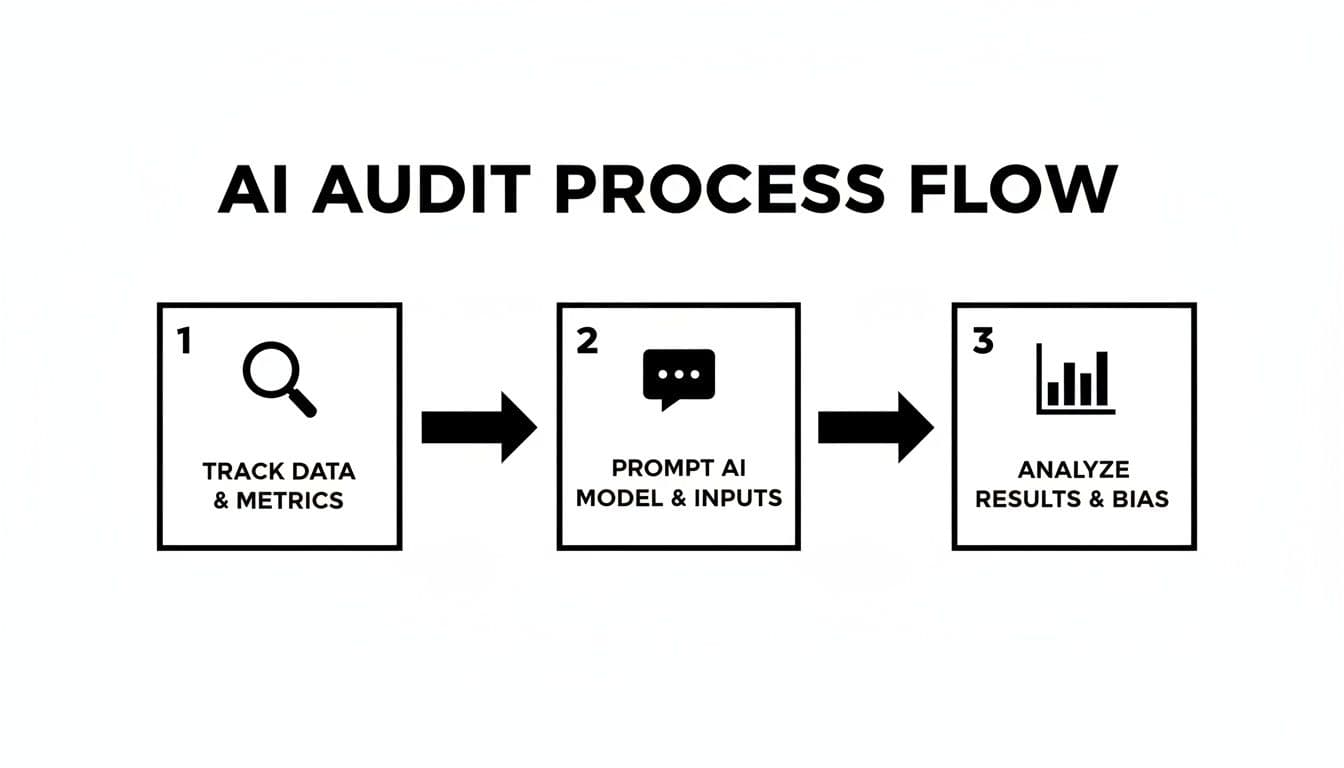
This Track, Prompt, Analyze loop is the foundation you'll build every successful optimization effort on.
The urgency here can't be overstated. The data shows that AI search traffic is exploding, with a 527% yearly growth rate, and nearly 69% of websites are already getting some AI-driven visits. With ChatGPT holding a dominant 80.1% of the AI search market share, users are being trained to expect direct answers, making content primed for citation an absolute must-have.
Amplifying Authority with E-E-A-T and Schema
To get cited, content must be seen as credible. This is where Google’s E-E-A-T framework (Experience, Expertise, Authoritativeness, and Trustworthiness) becomes even more crucial for ai visibility for agencies.
- Expertise: Clearly showcase author credentials, degrees, and relevant professional experience.
- Experience: Go beyond theory. Include real-world case studies, first-hand accounts, and specific examples.
- Authoritativeness: Build a strong web of internal and external links from other well-respected sites in your client's niche.
- Trustworthiness: Make sure all information is factual, kept up-to-date, and free of any errors.
You're not just writing for a human reader anymore; you're building a trust signal for a machine. Every data point, every cited statistic, and every clear author bio contributes to a cumulative score of trustworthiness that AI models are specifically designed to recognize.
Beyond E-E-A-T, Schema markup is your technical superpower. It's a vocabulary you add to your site's HTML to give search engines and AI models explicit context. Implementing Article, FAQPage, and Organization schema helps define what your content is, who wrote it, and the specific questions it answers. This structured data makes your content an easy and highly reliable source for AI to pull from.
For agencies ready to go deeper, exploring advanced Answer Engine Optimization is the logical next step in mastering this discipline.
From Standard Page to AI-Friendly Asset
Let's make this practical. Think about a typical feature page for a B2B SaaS client. It’s probably full of marketing copy, vague benefits, and a CTA. To make it AI-ready, you need to transform it.
- Before: A feature page titled "Our Revolutionary Reporting Dashboard." The text is loaded with marketing jargon like "gain unparalleled insights."
- After: The H1 becomes a clear, searchable question: "What Is a B2B Marketing Analytics Dashboard?" An H2 directly asks, "How Does This Dashboard Track ROI?" and the paragraph that follows gives a factual, data-driven answer. You also add an FAQ section with schema markup answering related user questions.
That simple shift—from vague marketing-speak to factual, question-answering content—makes the page exponentially more valuable to an AI model compiling an answer about marketing analytics tools.
To help your team put this into practice, we've developed a checklist that covers the most critical optimization points.
Actionable Checklist for AI Content Optimization
Use this checklist to audit existing content or guide the creation of new assets. Each item is designed to improve the odds of your client's content being sourced and cited by AI.
By systematically applying these principles, you move from hoping for visibility to actively engineering it.
For any agency managing multiple clients, this optimization process can become a serious resource drain. This is where a platform like Attensira can be a game-changer. Attensira helps generate AI-optimized content drafts that are already structured for citation, which allows your team to scale production efficiently and focus on high-level strategy instead of getting stuck in the weeds of manual rewrites.
How to Talk to Clients About AI Visibility (And Get Their Buy-In)
Showing clients the value of your work is what keeps them around. But as you fold AI visibility tracking into your agency’s services, your reporting and onboarding have to evolve right along with it.
You can't just slap a few new numbers onto an old report and call it a day. You have to weave a narrative that draws a clear line from a client's presence in AI answers to their bottom line. This means changing how you communicate, starting with the very first conversation you have. Your job is to help them see beyond traditional search rankings and embrace a more holistic view of their digital authority.
Setting the Stage: The AI Visibility Mindset
Your first onboarding meeting or the next quarterly business review is the perfect time to introduce these ideas. A lot of clients, even seasoned CMOs, might not fully appreciate how quickly this space is moving. It's on you to show them why tracking their citations in AI responses is just as crucial as watching their keyword rankings.
Use this time to explain the fundamental shift happening in search: their audience is increasingly getting answers, not just a list of links. You need to frame AI visibility as a leading indicator of brand health and how the market perceives them.
To make it real, lean on these talking points:
- The New "Word of Mouth": Explain that AI models are synthesizing information from all over the web to figure out who the real authorities are. Getting cited in an AI answer is the new digital equivalent of a trusted expert’s recommendation.
- A New Angle on Competitors: Position AI tracking as a powerful new way to conduct competitive analysis. Show them exactly which competitors are getting mentioned for key topics when their brand is nowhere to be seen.
- Future-Proofing Their Business: This isn't just another shiny object or a fleeting trend. It's a foundational change in how people find information. If they ignore it, they risk becoming invisible on the channels their future customers will be using every day.
By setting these expectations early, you position your agency as a forward-thinking partner who sees what's coming, not just a vendor reacting to change.
Making the Data Make Sense
Raw data about AI mentions will make a founder’s or CMO’s eyes glaze over. They don't care about the numbers; they care about the "so what?" behind them. The trick is to translate abstract metrics into clear, visual stories that connect directly to their business goals.
Don’t just give them a list of citation counts. Build compelling charts and graphs that tell a story at a glance. Your visuals should be designed to answer the big questions they have about their business.
The best AI visibility reports don’t just show data—they interpret it. Your real value as an agency is connecting the dots between their Share of Voice in AI and their ultimate goals, like generating more leads or becoming the recognized leader in their market.
A solid report should visualize key metrics like:
- Share of Voice in AI: Use a simple pie chart to show what percentage of AI-generated answers for their most important topics mention your client versus their top three competitors.
- Sentiment at a Glance: A bar graph categorizing mentions as positive, neutral, or negative gives them a quick read on brand perception.
- Competitor Citation Trends: A trendline graph comparing the number of your client's citations against a key rival over the past quarter can be incredibly powerful.
These visuals make complicated data easy to digest and instantly flag wins and opportunities. For more ideas on structuring these, our deep dive on building a comprehensive SEO report is a great resource.
Outlining a Realistic Roadmap
Finally, a huge part of your strategy is managing expectations. Dominating AI visibility isn't an overnight flip of a switch. It takes a sustained, deliberate effort to build authority and create the kind of high-quality content that gets cited.
The best way to manage this is with a performance roadmap that lays out a clear, phased approach. Map out key milestones for the next 6-12 months, starting with the initial audit, moving to optimizing a core batch of content, and then re-evaluating citation frequency down the line.
The market is already moving fast. According to a recent report, 38% of business decision-makers have already set aside budgets for AI Search Optimization, seeing it as critical for B2B growth. With AI platforms projected to generate 1.13 billion referral visits in June 2025—a staggering 357% jump from the prior year—the cost of sitting on the sidelines is massive. You can dig into more of these trends in the full AI search statistics report from Exposure Ninja.
This kind of proactive planning demonstrates that you have a long-term vision for their success, solidifying your agency's role as an essential partner.
How To Scale Your AI Visibility Services For Profitability
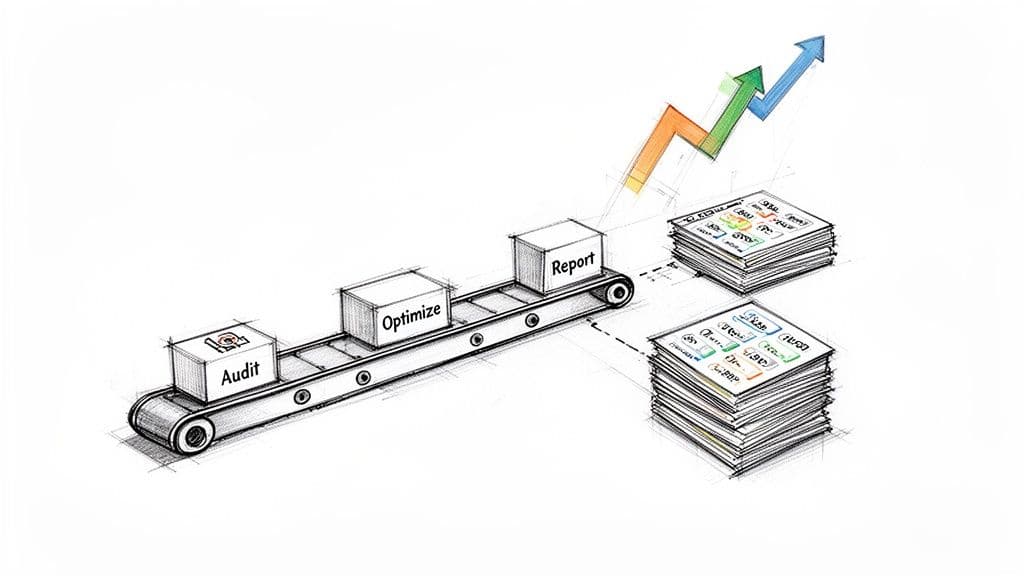
Moving your agency into the AI visibility space isn't just a smart move; it's a strategic necessity. But the real win isn't just offering the service. It’s about turning this new discipline from a chaotic, time-sucking task into a profitable, scalable, and defensible part of your business.
Without a solid plan to productize your offering, you'll find yourself stuck in a cycle of one-off projects that burn through your team's hours and kill your profit margins. The goal is to build a repeatable system that delivers consistent, high-quality results for every client, every single time.
This means getting smart about how you price your services, building airtight operational workflows, and using the right tech to handle the grunt work.
Choosing Your Pricing and Service Model
Before you can think about scaling, you have to decide how you're going to package and sell your AI visibility services. There’s no magic bullet here; the right model really depends on your agency's current structure, your client roster, and where you want to go.
Here are three battle-tested models to consider:
- The Standalone Service: This is a dedicated, focused offering. It’s perfect for attracting clients who are specifically searching for AI visibility expertise or for tackling large-scale projects, like a comprehensive initial audit. The biggest advantage is its clarity—the client knows exactly what they’re getting.
- The Premium Retainer Add-On: A popular route is to bundle AI visibility as an add-on to your existing SEO retainers. This is an excellent way to boost your average revenue per client. More importantly, it positions the service as a crucial evolution of modern SEO, not just another line item.
- The Project-Based Offering: You can also sell specific, fixed-scope projects. Think of an "AI Visibility Baseline Report" or a project to optimize a small cluster of high-value content. This approach lowers the barrier to entry, letting you prove your value before pitching a recurring retainer.
No matter which path you take, your pricing needs to reflect the immense strategic value you’re providing. You’re not just tweaking content—you’re shaping how a client’s brand is perceived in the world's new answer engines.
Building Efficient and Repeatable Workflows
In the agency world, profitability is a direct byproduct of efficiency. You simply can't scale a service that requires you to hire another person for every new client you sign. This is where standardized processes become your most valuable asset.
Your workflow for AI visibility for agencies needs to operate like a well-oiled machine, moving clients from one stage to the next without constantly reinventing the wheel.
Your goal is to build an operational playbook that anyone on your team can pick up and follow. This system should cover everything from the initial audit and prompt engineering to content optimization and monthly reporting.
This ensures every client gets the same high standard of service, every time.
The whole system should be built around a core loop:
- Systematic Auditing: Use a consistent framework to establish a baseline for every new client. Define the core entities, products, and competitors you need to track.
- Strategic Optimization: Develop a clear process for identifying content gaps and then creating or refining assets designed to earn those valuable AI citations.
- Insightful Reporting: Create standardized report templates that visualize progress using key KPIs, like Share of Voice in AI and competitor citation frequency.
When you have these processes documented and templated, onboarding a new client becomes a simple matter of executing a proven playbook—not a frantic scramble.
Leveraging Technology to Eliminate Manual Work
Let's be blunt: trying to scale this service manually is a recipe for burnout. Imagine your team running hundreds of prompts across multiple AI platforms for dozens of clients every month. It’s just not feasible.
Technology is the only way to make this profitable.
Platforms like Attensira were built to solve this exact operational bottleneck. By automating the most labor-intensive parts of the process—like tracking brand mentions, running prompts at scale, and surfacing competitive insights—you free up your team to focus on high-value strategic work.
Instead of spending hours copying and pasting AI responses into spreadsheets, they can spend their time analyzing the data and crafting winning strategies for your clients.
This technology-first approach allows your agency to manage a larger portfolio of clients without sacrificing an ounce of quality. The right platform turns a complex challenge into a manageable, scalable, and highly profitable service that will set your agency miles apart from the competition. For agencies looking to get ahead, exploring how to get started with automated content creation can provide a significant competitive advantage.
Common Questions (And Straightforward Answers)
As agencies start dipping their toes into AI visibility, a lot of the same questions pop up. The old SEO playbook doesn't always apply, so it's natural to have a few things to sort out. Here are some of the most common queries we hear and our direct, no-nonsense answers.
How Is AI Visibility Really Different From SEO?
The simplest way to put it is this: traditional SEO is a battle for a spot on a list. You're fighting for that top position on a search results page using keywords, backlinks, and technical wizardry.
AI visibility is entirely different. The goal isn't just to rank; it's to become a trusted source that an AI cites in its answer. You're aiming to be woven directly into the synthesized response. This shift means your focus has to be razor-sharp on creating structured, factual, and unambiguously authoritative content that a machine can easily parse and trust. It's less about winning a rank and more about becoming the definitive answer.
SEO gets your client a seat at the table. AI visibility gets their name mentioned in the toast. You’re moving from being an option on a menu to being the chef's official recommendation.
This means agencies have to get serious about things like entity definition, semantic clarity, and proving expertise in a way that leaves no room for doubt. If the AI models don't trust your client's information, they simply won't use it.
What’s a Realistic Timeframe to See Results?
This is where things get tricky, and it's certainly not the predictable 6-to-12-month cycle we're used to in SEO. The impact can sometimes be shockingly fast—we've seen changes in AI responses show up in just a few weeks when a model happens to pull in freshly optimized content during a data refresh.
But don't bank on that speed. It’s entirely dependent on things you can't control, like the AI model’s update schedule, how competitive the topic is, and how many other "authoritative" sources it's looking at.
A much safer bet is to set client expectations for a three-to-six-month window. That gives you enough time to get a solid baseline, implement the first round of content optimizations, and start seeing real movement in citation frequency and Share of Voice. This is a long game of consistency, not a one-and-done project.
How Do I Justify the Cost to My Clients?
When it comes to the budget conversation, you need to tie your work directly to business goals and, frankly, to future survival. Frame the investment around these core points:
- Future-Proofing Their Brand: Be direct. This is about adapting to a massive shift in how people find information. Sticking your head in the sand is a surefire way to become invisible to the next wave of customers.
- Capturing High-Intent Traffic: Let the data talk. People using AI for search are often deeper in the buying funnel and convert at a higher clip. This is a direct line to a more qualified audience that traditional search might overlook.
- Gaining a Serious Competitive Edge: Nothing lights a fire under a client like showing them a report where ChatGPT or Perplexity is recommending their top competitor by name. AI tracking is potent competitive intelligence.
You’re not just selling another marketing tactic; you’re selling strategic foresight. You are offering the roadmap to stay relevant and authoritative where business is now being won. It’s a proactive defense of their market share, and that's an investment with a very clear ROI.
Ready to turn AI visibility from a challenge into a profitable service? Attensira provides the platform your agency needs to audit, optimize, and report on client performance across AI answer engines. Stop guessing and start delivering data-backed results. Learn more about our agency solutions.