
Unlock AI visibility for accountants with this guide. Learn how to optimize your firm's content for AI search and attract more high-value clients.
When we talk about "AI visibility" for accountants, we're really talking about a fundamental shift in how potential clients find you. It’s the art and science of making your firm's online presence so clear, authoritative, and trustworthy that AI-driven search engines—like Google's AI Overviews or Perplexity—don't just find you, they cite you.
The goal has changed. It's no longer enough to just show up in the search results. You need to become the definitive source when a business owner or individual asks an AI for financial advice.
Why AI Visibility Is Critical for Modern Accountants
The accounting world has always been quick to adopt new technology for back-office efficiencies. But the real battleground for growth has moved. It's now squarely in the client acquisition process, and that process is being completely reshaped by AI search. The old SEO playbook, while still having its place, just isn't built for this new reality.
Think about how people are finding experts now. Instead of scanning a page of ten blue links, they’re getting direct, synthesized answers from conversational search tools. If your firm’s expertise and content aren't the fuel for those answers, you’re invisible to a huge and growing portion of your target market. It’s an adapt-or-disappear moment.
The Shift From Searcher to Answer Engine
What's really happening is that search engines are transforming from directories into answer engines. They don't just point you to a list of websites anymore; they digest the information from the best sources and present a single, confident response.
For an accounting firm, this means your online presence can't have any ambiguity. You have to position yourself as an undeniable source of truth on the topics you specialize in. Understanding the mechanics of this requires a solid grasp of leveraging AI tools not just for your own work, but for how your clients will find you.
The goal is no longer just to rank on a results page but to become the answer itself. AI models are looking for clarity, expertise, and trust signals that prove your firm is the most reliable source for a specific financial query.
An Opportunity for Proactive Firms
As daunting as this sounds, it's actually a massive opportunity for firms willing to move first. The good news is that most accountants are already comfortable with technology. We know that 93% of accountants use AI to improve their strategic advisory services, and 46% use it daily—that's nearly double the rate of other small businesses. This built-in tech savvy is the perfect launchpad for mastering your external AI visibility.
By focusing on this now, your firm can get ahead of the curve. You can learn more about how we help firms embrace these changes with our finance industry solutions.
Getting this right allows you to:
- Establish Authority: Become the recognized expert for hyper-specific client problems, whether it's "tax planning for startups" or "forensic accounting for legal disputes."
- Capture High-Intent Leads: Connect with prospects who are past the initial research phase and are asking detailed questions, signaling they're ready to hire an expert.
- Future-Proof Your Marketing: Build a resilient online foundation that can withstand the constant evolution of search algorithms and AI models.
Building Your Foundational Content for AI Search
AI-driven search engines aren't just scanning for keywords anymore. They're trying to understand content the way a person would, looking for genuine expertise and authority. For an accounting firm, this means your website can't just be a digital business card; it needs to become a go-to resource for financial knowledge. This is the stuff AI models will use to build answers for your ideal clients.
The goal is to shift from broad service descriptions to hyper-specific, detailed information that solves real problems. You're essentially creating content that answers a prospect's question before they even know how to ask it. This is a powerful signal to AI that your firm truly understands its subject matter.
From General Services to Niche Solutions
Let's start with your service pages—they're the bedrock of this strategy. A generic page titled "Tax Services" just doesn't cut it in an AI-driven world. Search algorithms are looking for content that maps directly to a specific user's problem.
To get on their radar, you have to get granular.
Think about breaking down a broad service like "tax" into dedicated, detailed pages. For example, instead of one page, you could build out:
- Tax Planning for E-commerce Startups: Here, you'd get into the weeds on sales tax nexus, inventory valuation methods, and the kinds of deductions unique to SaaS businesses.
- International Tax Compliance for Remote Teams: This page would cover foreign tax credits, treaty benefits, and the specific payroll challenges of managing a globally distributed workforce.
- Forensic Accounting for Shareholder Disputes: You could outline your process for uncovering financial discrepancies and explain how you provide expert witness support.
See the difference? This level of detail isn't just about attracting a niche client. It demonstrates a depth of knowledge that AI systems are specifically designed to identify as authoritative. When someone asks a conversational question about a complex tax issue, the AI is far more likely to feature content from a page that tackles that exact topic head-on.
Showcasing Real Expertise with Better Author Bios
Here's something I see firms overlook all the time: the "About Us" or "Our Team" page. AI models are getting smarter about connecting content to the people who create it. Those vague, one-sentence bios for your partners and staff are a huge missed opportunity.
Your team bios should be treated as valuable assets that broadcast credentials and hard-won experience.
AI algorithms don't just see a name; they see a web of connected signals that confirm expertise. A well-written bio is a powerful trust signal, telling both users and AI that the information on your site comes from qualified, real-world professionals.
Don't just say "John Doe, CPA." Flesh out that profile. Give it some substance.
- Credentials and Specializations: CPA, Certified Fraud Examiner (CFE).
- Real-World Experience: "John has spent over 15 years specializing in financial audits for mid-sized manufacturing firms across the Midwest."
- Proof of Authority: Add links to articles he's published in trade journals or videos of talks he's given at industry conferences.
This tactic directly links your great content to the credible experts behind it, boosting your site's overall authority. For a more structured approach, you might want to look into building an AI-first content strategy. By getting this foundation right, you’re feeding AI search the rich, specific, and expert-backed content it’s designed to find and promote.
Using Structured Data to Speak AI's Language
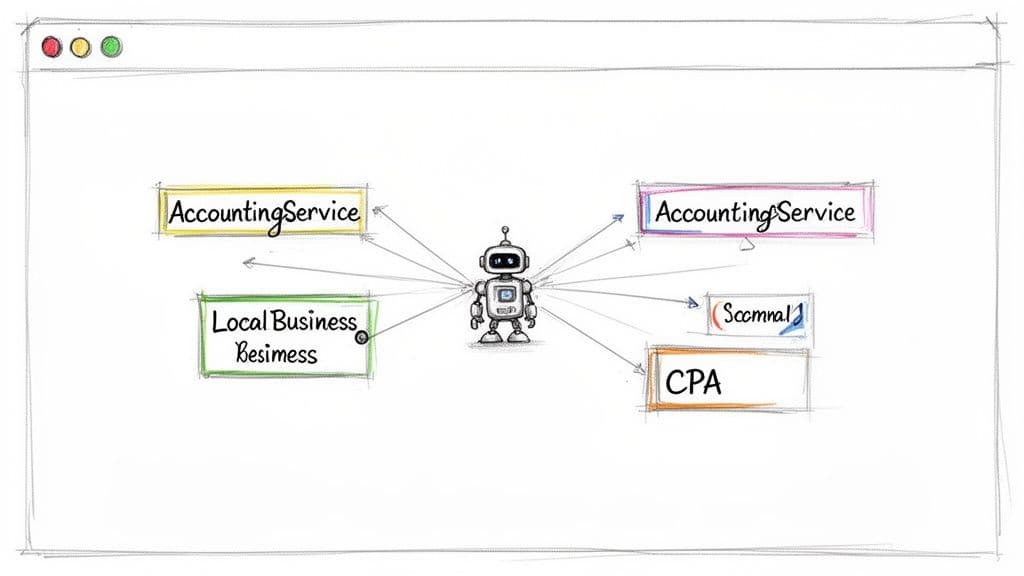
If your website content is the expertise you're sharing, think of structured data as the clear, organized label you put on it. You'll often hear it called schema markup, and it’s basically a shared vocabulary that translates your firm's information into a language that AI and search engines can digest instantly.
Without it, you’re making the AI guess what your pages are about. With it, you’re handing the system a verified cheat sheet, making it incredibly easy to understand who you are, what you do, and who you serve. This isn't some minor technical tweak; it's a fundamental step for improving your ai visibility for accountants.
When a potential client asks an AI assistant for "CPAs near me specializing in real estate," schema is what helps pull your firm's details into that answer accurately. It directly feeds the knowledge panels and rich results that make a local firm impossible to ignore.
Essential Schema for Accounting Firms
Getting started with schema might sound intimidating, but it just boils down to marking up the most important information on your website. For any accounting firm, there are a few types of schema that are completely non-negotiable.
Here are the ones I always recommend starting with:
- LocalBusiness: This is the absolute foundation. It explicitly tells search engines your firm’s name, address, phone number (NAP), and hours. It's the bedrock of local search performance.
- AccountingService: This is where you get specific. Use this to define your services like "TaxPreparation" or "FinancialAuditing." You can even nest details like the audience ("small businesses") and your service area.
- ProfessionalService: A slightly broader category that helps reinforce your firm's identity and professional offerings.
- Person or CPA: For your "About Us" or team bio pages, you can use this to mark up individual accountants. It’s perfect for highlighting credentials, specializations, and linking their expertise directly to the content they’ve written.
By using schema, you are essentially pre-verifying your firm’s data for AI. This structured information provides the confidence AI models need to feature your firm as a reliable and relevant answer to a user's query.
Putting Schema into Practice
Let's say your firm has a deep expertise in modern audit services. The adoption of AI in auditing is exploding, with rates jumping from 8% to 21% in just one year, saving early adopters thousands of hours. You can use schema on your audit services page to signal this cutting-edge expertise, telling AI that you’re a leader in the field. To learn more, check out this great piece on the impact of AI on auditing practices.
If you're new to this, it’s worth taking a deeper look—you can check out our guide on schema markup to get more comfortable with the concepts.
The main takeaway is to be as specific as possible. Don't just list "consulting" on your website. Use schema to define it as a specific service, targeted at a particular industry, and designed to solve a clear problem. That level of precision is exactly what an AI needs to recommend your firm with confidence.
Creating Conversational Content That Answers Client Questions
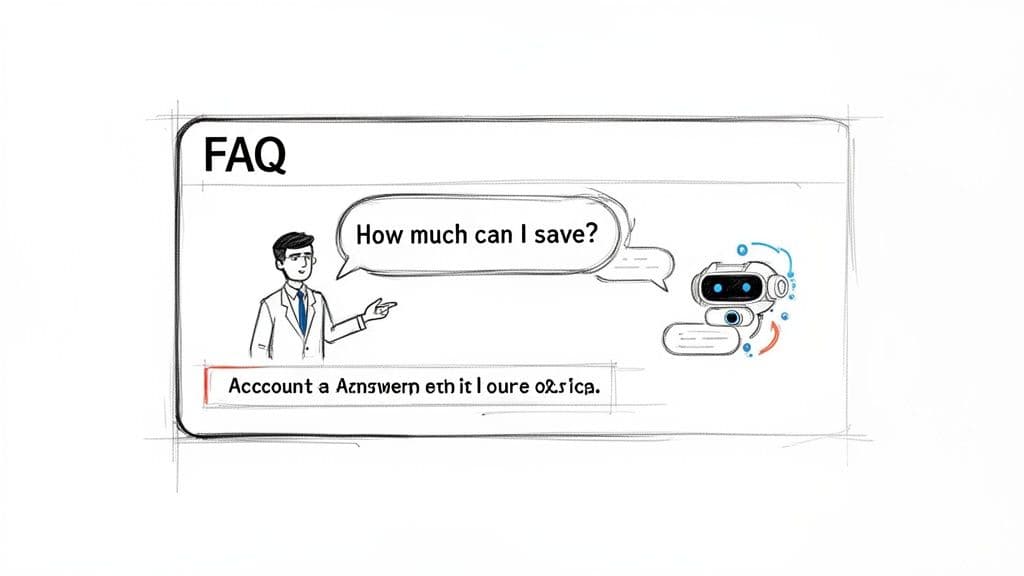
At its core, AI-driven search is a massive Q&A engine. To really gain ai visibility for accountants, your content needs to stop broadcasting statements and start delivering direct, authoritative answers to the questions your ideal clients are asking every day.
Think about it from the AI's perspective. Its job is to find the single best solution to a user's query. When your content is structured as a clear answer to a common question, you're essentially spoon-feeding the AI exactly what it needs to feature your expertise.
Uncovering Your Clients' Real Questions
So, how do you find these questions? The good news is your potential clients are already telling you what they want to know. You just have to know where to look.
Here are a few practical places I always start:
- Mine Google's "People Also Ask" Boxes: Go search for one of your main services, like "small business tax preparation." That PAA section is a goldmine—it's Google telling you, "Here are the exact follow-up questions real people have."
- Tap into Free Keyword Tools: A tool like AnswerThePublic is fantastic for this. Pop in a core term and it will spit out a huge list of questions people are searching for, usually starting with "how," "what," "why," and "can."
- Just Listen to Your Clients: This one is low-tech but incredibly powerful. Pay attention during discovery calls and client meetings. The questions that come up over and over are the very same ones countless others are typing into search bars.
The most powerful content meets the user right at their point of need. By framing your expertise as an answer to their specific question, you’re aligning your firm perfectly with the intent that fuels AI search.
Structuring Content for AI Consumption
Once you have a list of real client questions, the next move is to build your content around them. This goes way beyond just slapping up an FAQ page. It's about shifting your entire content mindset to a Q&A format. If you want to dive deeper into the mechanics, it's worth understanding the principles of conversational search.
Let's use a real-world example: R&D tax credits.
The old way of writing a blog post would be to title it something like, "An Overview of R&D Tax Credits." It's factual, but it’s not how a busy founder searches for information.
A much more effective, AI-friendly approach reframes it completely:
New Title: How Much Can My Small Business Actually Save with the R&D Tax Credit?
See the difference? This simple tweak changes everything. It immediately signals to both a human reader and an AI that you are providing a direct, valuable answer.
Then, within the article, you can use subheadings to answer the obvious follow-up questions: "What expenses qualify for the R&D credit?" and "What documentation do I need to claim it?" This structure makes your content incredibly easy for AI to parse, pull from, and feature in its summarized answers.
Amplifying Your Firm's Authority Across the Web
AI doesn’t just look at your website and take your word for it. To really understand your firm's authority, these algorithms scan the entire web, piecing together a mosaic of mentions, reviews, and professional listings. Think of it as the AI doing its own due diligence on your firm.
These external trust signals are powerful, independent endorsements of your expertise. Every single one contributes to the bigger picture of your credibility. This isn't just a nice-to-have marketing tactic anymore; it's a fundamental requirement for proving your authority to the algorithms now recommending firms to your next potential clients.
Earning Mentions in Authoritative Places
One of the most powerful ways to build credibility is to get your firm—or your partners—cited by sources that already have it. A mention in a major financial publication, a feature in an industry journal, or even a quote in a respected accounting blog carries enormous weight. These aren't just backlinks; they are digital votes of confidence.
For instance, say a partner at your firm authors a guest post for a well-known financial news outlet breaking down a new IRS regulation. When an AI model finds that article, it doesn't just see content. It sees an authoritative source validating your firm's deep expertise on that specific tax issue. That kind of third-party validation is gold because it's so hard to fake.
So, where should you focus your efforts? Start by building relationships with:
- Financial News Outlets: Pitch yourself as an expert source for commentary on breaking economic news.
- Industry Trade Publications: Write articles that dive deep into the niche topics where your firm truly shines.
- Local Business Journals: Cement your firm's reputation as the go-to expert for the regional business community.
Managing Your Reputation Through Reviews
In the world of AI search, client reviews have a dual purpose. They provide social proof for humans, of course, but they also serve as structured data points that AI systems use to measure your quality and trustworthiness. A well-maintained Google Business Profile, packed with recent, detailed, and positive reviews, sends an undeniable signal that your firm is the real deal.
AI models are trained to see a high volume of positive, recent reviews as a direct indicator of real-world authority and client satisfaction. This feedback loop has a tangible impact on your visibility in local search and AI-powered answers.
Don't just ask for reviews; ask for specific feedback. A review that says, "They were great," is fine. But one that says, "Their team helped us navigate a complex R&D tax credit application and saved us thousands," is infinitely more valuable. It’s loaded with the contextual keywords and phrases that help AI connect your firm to very specific client needs.
Securing Your Place in Professional Directories
Finally, you need to make sure your firm's information is listed accurately and consistently across all relevant professional directories. This is about more than just Google. We're talking about platforms like the AICPA, state CPA society directories, and any other industry-specific listings.
Each consistent entry—same name, same address, same phone number, same specializations—reinforces your firm's digital identity.
This consistent data creates a verification network for AI. When an algorithm sees your firm's details repeated across dozens of trusted directories, its confidence in your data skyrockets. This makes it far more likely that your firm will be surfaced as a reliable, verified local option for accounting services.
5. How to Measure and Improve Your AI Visibility
You can’t prove the value of your marketing efforts without good data. When it comes to AI visibility, that means moving past familiar SEO metrics like keyword rankings and looking at a whole new set of indicators.
The goal is to track your firm's performance right where clients and AI models are actually interacting. Without a clear measurement system, you're flying blind, unable to connect all that hard work on content and authority-building to real business results. The idea is to create a feedback loop where data guides your strategy, helping you refine and improve over time.
Key Performance Indicators for AI Search
To get started, you need to monitor the right KPIs. This isn't just about website traffic anymore; it's about influence and presence in AI-generated answers.
Your primary focus should be on:
- AI Answer Mentions: This is the big one. You absolutely need to know how often AI overviews cite your firm, its partners, or your content as a source.
- Citation Frequency: How many times is your firm mentioned for core service queries, like "tax planning for startups"? This shows your authority on specific topics.
- Share of Voice: Measure your visibility for key conversational questions against your direct competitors. This helps you understand who truly owns the narrative in your niche.
Monitoring these metrics tells you whether your content and authority signals are successfully influencing AI models. A steady increase in citations is a direct indicator that your strategy is working.
It's all part of an interconnected process. You build authority through things like publications, client reviews, and professional directories.
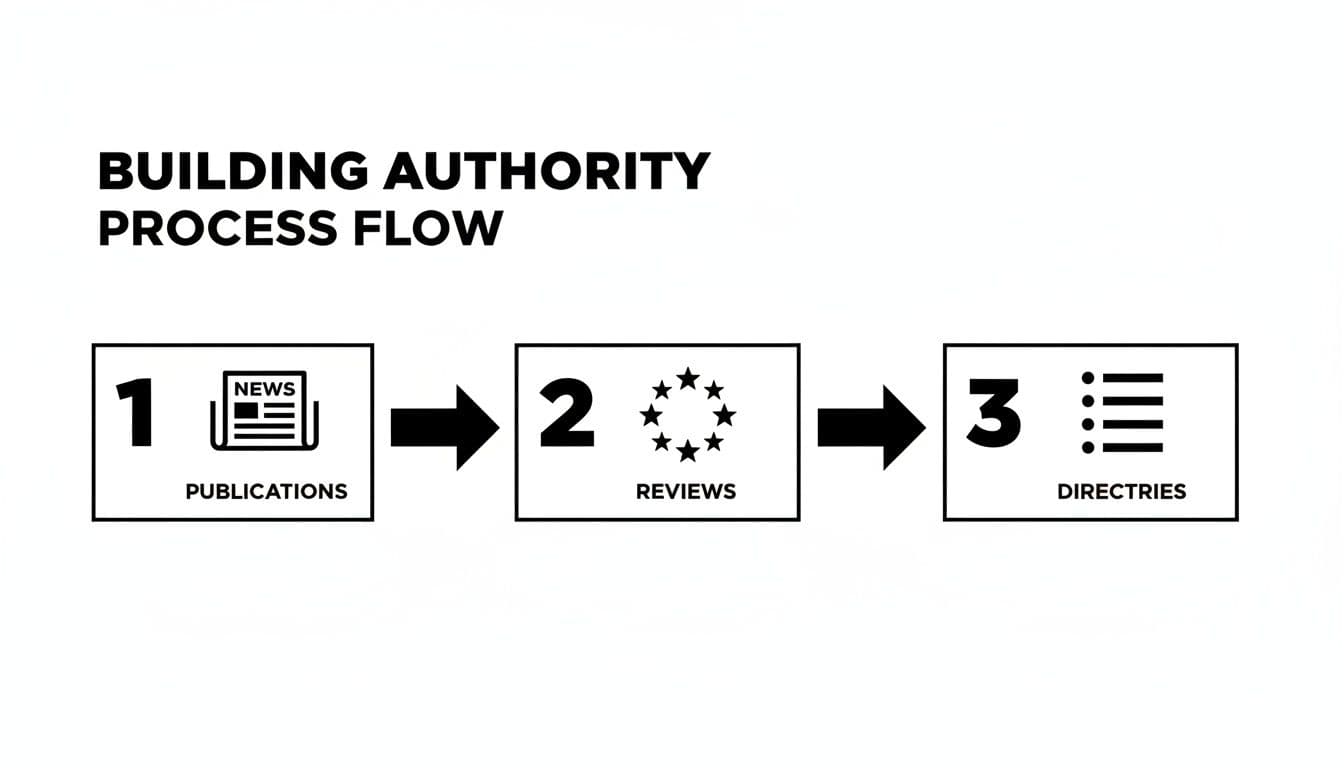
Each of these steps reinforces the others, creating a web of trust signals that both AI algorithms and potential clients can easily verify.
Tools for Tracking and Improvement
Trying to manually track mentions across different AI platforms is a recipe for frustration—it's practically impossible. This is where specialized tools become non-negotiable.
Here’s a look at some of the tools that can help you monitor and manage your firm's presence in this new search environment.
Essential Tools for AI Visibility Monitoring
Using a dedicated platform built for this purpose is the most effective approach. For example, platforms like Attensira are designed specifically to monitor major AI models and alert you whenever your brand is cited. This gives you a clear, quantifiable way to measure the impact of your visibility campaigns. You can see exactly where your firm stands by checking your firm's AI Readiness Score.
A good tool allows you to pinpoint which articles are driving citations, identify content gaps where competitors are getting featured, and make sharp, data-driven decisions. This continuous cycle of measuring, analyzing, and improving is the key to building—and keeping—strong AI visibility.
Answering Your Questions About AI Visibility
As accounting firms start digging into AI-driven search, a few key questions always come up. It's a new frontier, so it's only natural to wonder about the practical side of things—like timelines, how it fits with what you're already doing, and where firms tend to go wrong.
How Long Does This Actually Take?
Let's get right to it: "How long until we see results?" We've all been conditioned by traditional SEO to think in terms of 6 to 12 months, but this is a bit different.
You can often see your firm get cited in AI-generated answers much faster. By focusing on your core service pages and getting your schema markup right, you’re feeding the algorithms clean, structured data they can process quickly. I've seen firms get picked up within a few months for specific queries once these foundational elements are in place.
Does This Replace Our Current SEO Efforts?
No, absolutely not. Think of it as an evolution, not a replacement. Your work on AI visibility for accountants actually strengthens your existing SEO because it's built on the exact same principles: expertise, authority, and trustworthiness (E-E-A-T).
You're essentially adding a powerful new channel to your marketing. All that effort you've put into ranking for local keywords is still critical. This just adds a layer on top, positioning your firm to be the direct, definitive answer when someone asks a question instead of just typing in a keyword.
Your goal is to create content so clear and authoritative that both traditional search engines and new AI models see your firm as the most credible source. This dual approach future-proofs your client acquisition strategy.
What's the Biggest Mistake We Could Make?
This one is simple: using generic, cookie-cutter content. AI models are specifically designed to sniff out and ignore unoriginal information.
If your website is full of the same vendor-supplied articles that hundreds of other accounting firms are using, AI has absolutely no reason to feature your content. It's just noise. The single most impactful thing you can do is publish unique, insightful content that speaks directly to your ideal client's pain points. Original thought leadership is no longer a "nice-to-have"; it's a necessity.
Ready to see how your firm measures up in the age of AI? Attensira provides the tools to track your brand's presence in AI-generated answers and turn insights into a competitive advantage. Get started with Attensira today.