Master AI shopping results optimization with this guide. Learn how to audit, optimize, and measure your brand's visibility in AI-driven search results.
AI shopping results optimization is all about structuring your product data and content so that AI assistants and generative search engines recommend your brand to consumers. It’s a shift from classic SEO toward an intense focus on data accuracy, contextual relevance, and brand authority. The goal is to ensure your products are the ones selected and surfaced in those conversational, direct answers.
The New Reality of Ecommerce Visibility

The ground has shifted beneath the feet of B2B companies. For years, the game was straightforward: rank high on a list of blue links. Now, AI-powered assistants and generative search are the new gatekeepers, completely changing how customers discover, compare, and ultimately buy products.
This new environment plays by a different set of rules. Instead of just matching keywords to a page, AI models pull information from countless sources to deliver a single, definitive answer. Visibility isn't about your ranking anymore; it’s about being chosen as part of that trusted response.
Why Traditional SEO Is Not Enough
Your foundational SEO practices are still important, but they won't get you across the finish line in this new race. AI agents don’t just crawl your website; they dissect your data. They're hunting for structured, crystal-clear information they can process with absolute confidence.
Think about these critical changes in approach:
- From Keywords to Context: AI cares about the why behind a search. It connects a product's features to a customer's real-world problem, making contextual relevance far more valuable than simple keyword density.
- From Content to Structured Data: AI speaks the language of data. Well-organized product feeds, rich attributes, and detailed schema markup are how you communicate most effectively.
- From Backlinks to Authority: AI measures authority by looking at the consistency and accuracy of your brand's information across the entire web, not just by tallying up backlinks.
The real challenge has changed. It’s no longer about making your content findable for a search engine. It’s about making it ingestible and trustworthy for an AI model that’s acting as a personal shopper for the consumer.
The Impact on B2B Growth
For any B2B company, this is a five-alarm fire. Your customers are already asking AI assistants to "recommend the best CRM for a small marketing agency" or "compare project management tools for remote teams." If your products aren't optimized to show up in these answers, you're effectively invisible to a growing wave of high-intent buyers.
It's clear how AI models for e-commerce are pushing brands to rethink their strategies, cutting content costs while driving sales. Getting ahead of this with proactive AI shopping results optimization isn't just a "nice-to-have" strategy; it's an essential move to protect your market share.
This is precisely the complex new arena that platforms like Attensira are designed for. To see how we help brands navigate this shift, check out our solutions for the ecommerce industry.
Auditing Your Current AI Shopping Presence
Before you can build a roadmap, you need to know where you're starting from. Auditing your presence in AI-driven shopping isn't just a box to check; it’s the only way to get a clear, honest picture of how AI models see your brand right now. Without this baseline, you’re just guessing.
The process is pretty straightforward: you systematically check how your brand, your products, and your core messaging show up across the major AI platforms. You're hunting for mentions, recommendations, and the little conversational snippets that AI is using to describe you to potential customers. This isn't a vanity search—it's about taking back control of your narrative.
Let's be clear: using AI to shop isn't some future-state fantasy. It's happening now. During the 2025 holiday season, a staggering 50.3% of shoppers used generative AI at least once, and 81% said they plan on using it. This isn't just a trend; it's a fundamental shift in consumer behavior. You can dive deeper into this shift and what it means for 2026 by reading the full research on retail agility.
Simulating Real Consumer Queries
The heart of any good audit is putting yourself in your customer’s shoes. You have to ask the questions they’re asking. Think about the entire buying journey, from initial curiosity to comparing specific options, and craft your prompts to match.
If you’re a B2B SaaS company, for example, your queries might look something like this:
- Top-of-Funnel: "What are the best project management tools for remote teams?"
- Mid-Funnel Comparison: "Compare [Your Brand's Tool] vs. [Competitor's Tool] on pricing and features."
- Problem-Based Search: "Recommend a CRM for a small marketing agency with a limited budget."
As you get the responses, document everything. I mean everything. Don't just scan for your brand name. Note who else is mentioned, which features get highlighted, and where the AI is pulling its information from. This raw data is gold.
A critical mistake I see all the time is companies only searching for their own brand. The real insights are found in the queries where you should have appeared but didn't. That’s where your biggest opportunities are hiding.
Analyzing the Results for Gaps and Opportunities
Once you've gathered all that data, it's time to dig in and find out what it's telling you. The goal is to pinpoint exactly where you’re weak and where your competitors are eating your lunch. This is where a platform like Attensira can be a huge help, as it automates the tracking and gives you a structured way to make sense of it all.
Be on the lookout for these red flags:
- Content Gaps: Are competitors showing up for key features that you offer, too? That's a clear signal you have a content or product data problem.
- Inconsistent Messaging: Does the AI's summary of your brand actually match your value proposition? If not, it’s piecing together a distorted view of you from fragmented sources.
- Negative or Neutral Sentiment: When you are mentioned, is the tone positive? A lukewarm mention can be just as damaging as not being mentioned at all.
- Missed Opportunities: For broad, solution-focused questions, are you even in the conversation? If AI isn't recommending you, you’re losing customers before they even know you exist.
This audit gives you a real, actionable punch list. It takes the vague goal of "optimizing for AI" and turns it into concrete tasks, like "build a comparison page for X competitor" or "enrich our product feed to highlight Y feature." It’s the diagnostic that makes everything that comes next strategic.
To get a quick snapshot of where you stand, you can assess your brand's readiness with our AI Readiness Score tool.
Mastering the Technical Groundwork for AI Agents
AI shopping agents don't see your website the way people do. They don't care about your beautiful design or clever branding. They operate in a world of pure data, parsing structured information to find the most direct, accurate answers.
This is a fundamental shift. Your success in AI shopping results optimization depends less on traditional SEO and more on ruthless technical precision. The name of the game is data integrity.
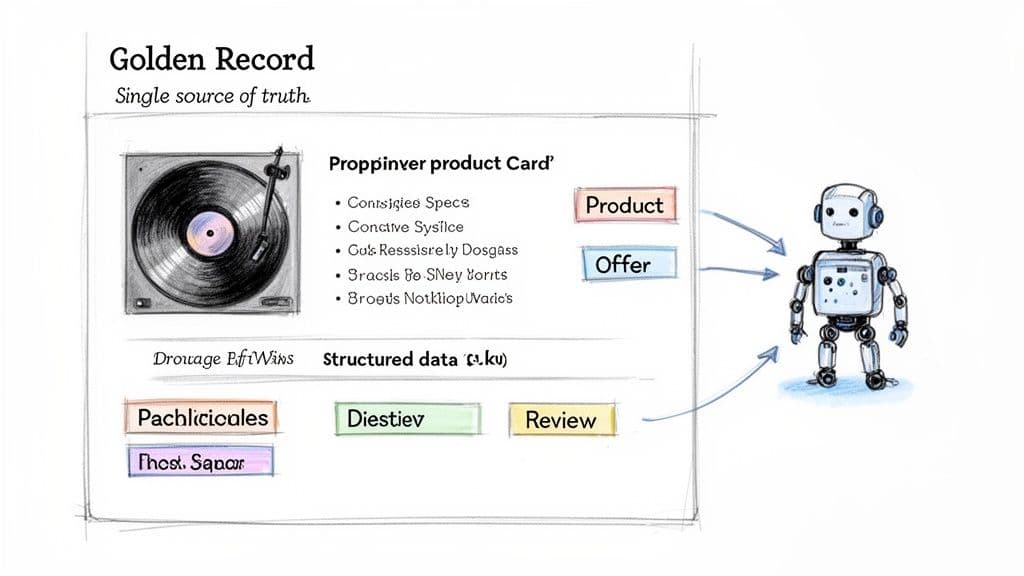
The goal? Create a 'Golden Record' for every single one of your products. This isn't just a buzzword—it's about building a single, authoritative, and exhaustive source of truth for your offerings. When an AI can tap into that complete record, it can recommend your product with absolute confidence.
Building Your Product's Golden Record
It all starts with your product feeds. The days of getting by with just a product name and a price are long gone. You have to start thinking like a machine, anticipating every possible question a B2B buyer could have and embedding those answers directly into your data.
This means going incredibly deep on attributes, specifications, and use cases. For a B2B software product, that could mean detailing:
- Integration Capabilities: Don't just say you integrate. List every single platform: Salesforce, Slack, Google Workspace, HubSpot, etc.
- Target User Persona: Be specific. Instead of "businesses," define the user as a "Project Manager in a mid-size tech firm."
- Specific Use Cases: Go beyond features. What problems does it actually solve? "Automates weekly reporting for marketing teams" is a great example.
- Technical Requirements: Spell out the nitty-gritty—operating systems, browser compatibility, and any necessary hardware.
This level of detail has moved from "nice-to-have" to absolutely essential. In fact, product data quality is now a massive competitive advantage. From what we've seen, stores that achieve 99.9% attribute completion—a true Golden Record—are getting 3-4x higher visibility in AI recommendations. That’s a game-changer where data quality, not ad spend, dictates who wins.
Getting Serious About Advanced Schema Markup
Schema markup is how you speak the language of AI. It’s the vocabulary that translates your content from an ambiguous block of text into clearly defined entities that a machine can instantly understand. Think of Product, Offer, or Review. Getting this right is completely non-negotiable.
Without schema, an AI just sees "Project Management Tool - $50/month." But with proper schema, it understands the context:
Product: This is a project management tool.Offer: The price is $50, the currency is USD, and the billing cycle is monthly.Review: Its aggregate rating is 4.8 stars, based on 250 reviews.
This structured data leaves no room for error, which is exactly what an AI needs to make a reliable recommendation. For a query like, "Find a top-rated project management tool under $60 per month," an AI can confidently match your product because every piece of information is explicitly defined.
The key takeaway is consistency. The information in your product feed, on your product page, and within your schema markup must align perfectly. Any discrepancy erodes the AI's trust and reduces your chances of being featured.
You can run a quick check to see if your site’s headers and structured data are properly implemented with our free Header Validator tool. It's a simple step that can uncover glaring issues that might be making your products invisible to AI agents.
To help you get started, here’s a breakdown of the key technical elements you need to focus on. These are the building blocks that AIs use to understand and trust your B2B offerings.
Key Technical Optimizations for AI Visibility
Mastering these elements is about making your product data as clean, clear, and comprehensive as possible. It’s the foundational work that allows AI to see your product as the best possible answer.
The Hidden Power of Data Consistency
Finally, remember that this technical work extends beyond the borders of your own website. AI models build their understanding by synthesizing information from all over the web. That means the data on your site must align with the data on third-party review platforms, industry marketplaces, and business directories.
If your website lists one price but your G2 profile shows another, you've created a data conflict. This kind of inconsistency signals untrustworthiness to an AI, which will almost always default to a competitor with clean and consistent data.
Ultimately, all this technical optimization serves one core purpose: to make it dead simple for an AI to understand what you sell, who it’s for, and why it's a credible choice. By building a Golden Record, implementing flawless schema, and maintaining cross-channel consistency, you give AI agents the clear, authoritative signals they need to put your products front and center.
Crafting Content That AI Loves to Recommend
Once you've tuned up your technical foundation, the next move is all about content. Think of generative AI models as obsessive researchers—they sift through mountains of information from all over the web to piece together their shopping recommendations. Your job is to create content that’s deliberately designed for this new reality, shifting from flowery marketing copy to structured, solution-focused information.
The goal is simple: answer every question a potential customer could ever think to ask, before they ask it. You’re not just writing a product page anymore; you’re building an exhaustive internal knowledge base that an AI can tap into on demand. When done right, you’re basically spoon-feeding the AI the exact phrases and data points it needs to build a glowing recommendation for your product.
Write Product Descriptions for Machines First
Traditional product descriptions are often built around brand voice and emotional connection. For AI, that takes a backseat to clarity and structure. AI assistants don't get swept away by prose; they break down content into discrete, usable facts.
This means your descriptions need to be modular. Ditch the long, dense paragraphs and start breaking out features and benefits into scannable lists or tables. This makes it incredibly easy for a machine to pinpoint a specific piece of information and pull it directly into an AI-generated answer.
Let’s look at a real-world example:
- The Old Way: Our powerful CRM streamlines your entire sales process, providing unparalleled insights into your customer journey and helping your team close more deals, faster.
- The AI-Ready Way: This CRM centralizes sales activities by automating lead assignment, tracking every customer interaction, and generating real-time pipeline reports to shorten the sales cycle.
See the difference? The second example is less about brand fluff and more about precise, functional language. You're giving the AI a checklist of verifiable facts it can use to perfectly match your solution to a user's problem. You can get even more granular with a dedicated product description optimizer tool.
Build a Robust Ecosystem of Supporting Content
A single, lonely product page won’t cut it in the age of AI. To really establish your authority and become a trusted source, you need a whole ecosystem of content that frames your product as the clear answer in its category. This content becomes the raw material AI models use to build confidence in their recommendations.
Your content playbook should branch out to include:
- In-Depth FAQ Sections: Move way beyond the basics like shipping and returns. Tackle the tough technical questions, address common sales objections, and unpack your most complex features. Crucially, frame these as natural language questions—exactly how a real person would ask an AI assistant.
- Detailed "How-To" Guides: Show, don't just tell. Create practical, step-by-step guides that walk users through solving a specific problem with your product. If you sell a project management tool, an article like "How to Manage a Sprint for an Agile Marketing Team" is gold.
- Honest Comparison Articles: Don't be afraid to put your product head-to-head with the competition. Acknowledge their strengths, but be crystal clear about where you win. This transparency builds trust and gives AI models the kind of balanced, objective information they're programmed to favor.
An AI doesn’t "read" a page from top to bottom like a human. It deconstructs it. By organizing your content into clear, logical chunks—FAQs, feature lists, comparison tables—you're making it easier for the AI to parse, rank, and reassemble your information into a helpful answer.
Adopt a Conversational and Semantic Approach
The language you choose is more important than ever. AI-powered shopping queries are conversational by nature—think "what's the best software for a company that..." Your content needs to reflect that same natural, intent-driven tone.
Cut the corporate jargon. Instead, focus on semantic clarity. This means using synonyms and related concepts to build a rich contextual web around your product. For example, if you're selling a "quiet dishwasher," your content should also be peppered with phrases like "low decibel rating," "ideal for open-concept kitchens," and "sound-dampening technology."
This strategy helps the AI connect the dots between someone's casual question and your product's technical specs. You're moving beyond optimizing for simple keywords and are now optimizing for genuine understanding. Do this well, and you position your brand as the most reliable and authoritative source for an AI to cite.
Building a Measurement and Improvement Framework
Optimizing for AI shopping isn't a "set it and forget it" task. It's a living, breathing process of monitoring, testing, and constantly refining your approach. Without a solid way to measure what's working, you’re just guessing—unable to tell which tweaks are driving results and which are falling flat.
You need to create a feedback loop where real data informs your next move. This is how you build a targeted, impactful strategy that keeps you ahead in a space that’s changing by the day.
This flow shows a solid process for creating content that AI models can actually understand and use, starting with broad guides and drilling down into specific FAQs and conversational snippets.
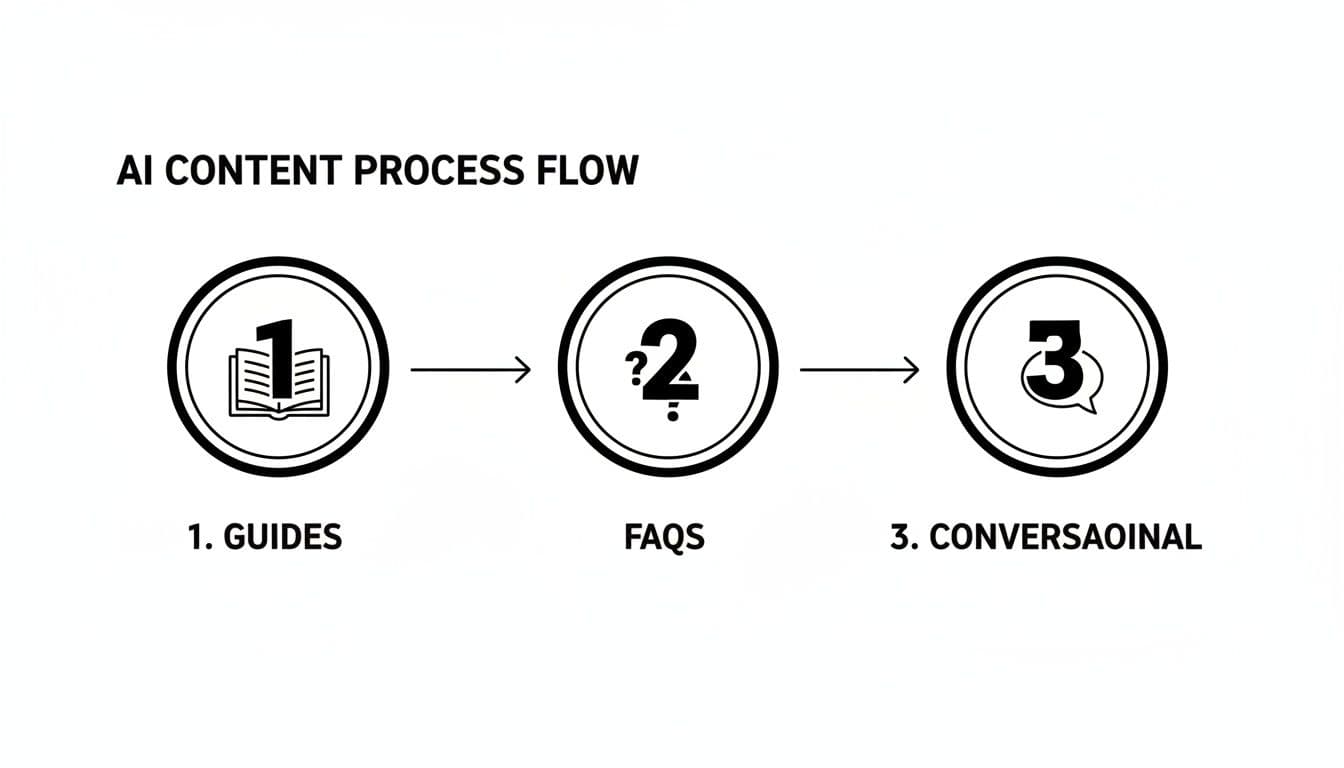
As you can see, layering your content this way builds a comprehensive knowledge base that AI agents can pull from with confidence when making recommendations.
Establish Continuous Monitoring
First things first, you need a system to track your visibility in AI-generated answers. This is a whole different ballgame than traditional web analytics. A platform like Attensira is built for this, letting you continuously monitor how your brand and products are mentioned across the major AI platforms.
This isn't about running a few spot checks. It’s about automated, large-scale tracking that captures the subtle shifts in how AI models talk about your brand over time. This is what turns a mountain of data into sharp, actionable intelligence.
And things are moving fast. We're entering the era of agentic commerce, where AI agents make purchases for customers. With 91% of retail leaders already investing in AI, the early movers are seeing returns six times faster than those holding back. This is no longer optional.
Identify the Right Key Performance Indicators
Your old-school metrics like page views and bounce rate won't cut it here. They don't tell you anything about your influence within AI-powered shopping. You need to zero in on KPIs that measure your performance in this new arena.
Here are the metrics that actually matter.
Essential KPIs for AI Shopping Optimization
To truly gauge your success, you need to track metrics that reflect your influence in AI-generated conversations, not just on your own website. This table breaks down the most critical KPIs.
These KPIs give you a far more accurate picture of your performance. A high Share of AI Voice is great, but not if the sentiment is negative. That’s a red flag. On the other hand, frequent inclusion in high-intent queries is a clear signal your strategy is hitting the mark.
Tracking these metrics together is what gives you the full story. It’s the combination of quantitative visibility and qualitative accuracy that defines success in AI-driven commerce.
Curious about what this visibility could be worth? You can use specialized tools to estimate the https://attensira.com/tools/ai-traffic-value.
A Framework for A/B Testing and Refinement
Once you have your monitoring set up and your KPIs defined, you can start running experiments to see what works best. It's all about controlled tests to figure out what resonates with the AI models.
You can A/B test almost anything:
- Product Descriptions: Pit a feature-heavy description against a benefit-driven one. Which one gets quoted in AI snippets more often?
- FAQ Phrasing: Try different ways of asking and answering common questions. See which format the AI prefers to use as a direct response.
- Data Structure: Test the impact of adding more specific attributes to your product feed or implementing new schema markup. Does it improve how accurately your products are represented?
The process is a simple loop: monitor your baseline, run a test, measure the impact on your KPIs, and roll out the winner. This iterative cycle is the engine that drives continuous improvement.
To make sure your content doesn't just get seen but actually converts, folding in a proven conversion optimization strategy is a smart move. This completes the feedback loop from AI visibility to actual sales, turning your optimization efforts into a real, sustainable advantage.
Your Questions About AI Shopping, Answered
Diving into the world of AI shopping optimization is bound to stir up some questions. It’s a new frontier, sitting at the intersection of technical SEO, content strategy, and data management. It can feel a bit tangled at first, so let's unpack some of the most common things B2B pros are asking.
How Is This Different From the SEO I Already Do?
This is the big one. The core difference is the objective. With traditional SEO, your whole game is about getting your webpage to rank high enough to win a click. AI shopping optimization, on the other hand, is about getting your product’s information chosen, synthesized, and featured directly inside an AI-generated answer.
Think of it like this: SEO is about getting a potential customer to walk into your digital store. AI optimization is about convincing the store's expert sales associate to pick up your product and recommend it by name.
This means the focus shifts. You’re moving away from a pure obsession with keywords and backlinks and toward an intense focus on structured data, contextual relevance, and making sure the AI knows exactly what your product is. You're no longer optimizing for a click; you're optimizing for a direct recommendation.
What's the Single Most Important Thing I Can Do?
If you’re looking for the one thing that gives you the most leverage, it’s the quality and completeness of your structured product data. Period. This is the foundation for everything else. AI models need clear, comprehensive, and accurate data to feel confident enough to feature one product over another.
You have to build a “Golden Record”—a single, clean, and totally consistent source of truth for each product. Without it, even the most brilliant content strategy will struggle. AI agents are built to prioritize data they can trust. Any inconsistencies in your product feeds or schema will immediately knock you out of the running.
All your other work, like writing great conversational content, is what amplifies the power of that data. But without that solid data foundation, the AI simply won't have the certainty it needs to understand and recommend what you sell.
How Long Until I See Any Real Results?
This isn’t an overnight flip of a switch, but you’ll likely see movement faster than with a traditional SEO campaign. The timeline really depends on what you’re doing.
- Technical Fixes: Tweaking your product data feeds and schema markup can show results surprisingly fast. Once AI crawlers re-index your site and pull in that richer information, you could notice a difference in how your products show up in a matter of weeks.
- Content Plays: Building out new content—think detailed buyer’s guides, in-depth FAQ pages, and honest comparison articles—is more of a long game. Just like classic content marketing, it takes time for this material to build authority and for AI models to recognize it as a go-to source.
The trick is to be consistent. This can't be a one-and-done project. Continuously tracking your visibility with a purpose-built tool is the only way to see what’s working from day one and understand which of your efforts are actually moving the needle.
Can We Even Do This Without a Big Technical Team?
Yes, absolutely. While the terminology sounds heavy, getting started with AI shopping optimization is far more about smart strategy than it is about a massive team of engineers.
For a smaller or more nimble business, the key is to be focused and work in stages:
- Start with Your Winners: Don't try to boil the ocean by optimizing your entire product catalog. Focus on creating those Golden Records for your best-selling or most strategic products first.
- Clean Up Your Data: The first, best step is often just cleaning up the data you already have. Make sure product names, SKUs, and key attributes are perfectly consistent everywhere.
- Use the Right Tools: The right platform makes this accessible to everyone. For example, you don't need a technical background to start using a monitoring tool to see where you stand and find your most critical gaps.
The goal here is to make smart, targeted changes, not to kick off a massive, resource-draining overhaul. By zeroing in on the highest-impact areas first, even a small team can build a real advantage.
Ready to take control of your brand's narrative in the AI era? Attensira provides the tools you need to monitor your visibility, identify content gaps, and optimize your presence in AI-generated answers. Start tracking your AI performance today.