Discover how to choose the right AI search optimization agency UK for your business. This guide covers criteria, questions, pricing, and partner evaluation.
The way your customers find you is fundamentally changing. The familiar search engine results page—that tidy list of ten blue links—is quickly becoming a thing of the past. An AI search optimization agency isn't a "nice-to-have" for the future; it's a critical partner for right now.
The goal has shifted from just ranking your website to making your brand the trusted, go-to source for AI-generated answers. It's about securing your visibility in this new world of conversational, AI-driven discovery.
Why Your UK Business Needs an AI Search Strategy Now
We're witnessing a seismic shift in search behaviour. Both consumers and B2B buyers are moving away from simple keyword queries. Instead, they're asking complex, conversational questions directly to AI tools. This isn't just an update; it's a complete rethink of how we find and process information.
The numbers don't lie. Nearly 90% of B2B buyers now use generative AI at some point in their purchasing journey. They aren't just looking for websites anymore; they're demanding synthesised answers, immediate product comparisons, and solutions to their problems from models like ChatGPT and Google's AI Overviews.
The Rise of Generative Engine Optimization
This new search reality calls for a completely new playbook: Generative Engine Optimization (GEO).
Traditional SEO was all about getting your webpage to the top of a list. GEO, on the other hand, is about embedding your brand's knowledge and data as the factual foundation for AI-generated answers. Success means your brand is cited as the authority within the AI's response, literally becoming part of the answer.
If your content isn't structured for AI interpretation, you become invisible in these crucial new channels. Getting a handle on how to rank in AI Overviews is no longer optional for maintaining online visibility.
The market data for the UK underscores the urgency. The UK’s artificial intelligence in marketing sector was valued at USD 1,005.7 million in 2023. Projections show it will explode to USD 4,881.3 million by 2030, driven by a massive compound annual growth rate (CAGR) of 25.3%. This isn't just growth; it's a tidal wave of investment and strategic focus. You can discover more insights about the UK's AI in marketing market to see where the industry is headed.
Agency vs. Platform vs. In-House: A Quick Decision Framework
Choosing the right path forward can be daunting. You're essentially choosing between expert partnership, powerful tooling, or internal development. This table breaks down the core differences to help you decide which model fits your business needs, resources, and long-term goals.
Each path has its merits. An agency provides immediate, specialised expertise. A platform gives your existing team powerful tools. An in-house team offers deep integration but at a significant cost and time investment. The right choice depends on your organisation's current capabilities and future ambitions.
Why an Agency Is Often the Best Strategic Move
For most UK enterprises, building a dedicated GEO team from scratch is a slow, expensive, and risky proposition. The field is simply moving too fast. This is where a specialist AI search optimization agency becomes a powerful strategic asset.
Partnering with experts offers clear advantages:
- Deep, Ready-to-Deploy Knowledge: They live and breathe the technical nuances of influencing AI models. They've already done the R&D.
- Dedicated Tools and Resources: They have the technology and people to constantly monitor and optimise your brand’s presence across dozens of AI platforms.
- Strategic Agility: They are on the front lines, tracking every algorithm change and platform update, ensuring your strategy never falls behind.
Hiring a specialist agency isn't just about outsourcing a function. It's about embedding a strategic partner into your marketing team—one whose sole focus is securing your brand's future in an AI-first world.
This is a proactive move to ensure your brand not only survives but thrives in the new search landscape. For a deeper dive into the mechanics, our guide on AI search engine optimization offers more context on this critical shift.
Defining What Success Looks Like for AI Search
Before you even think about shortlisting an ai search optimization agency in the UK, you have to know what you’re aiming for. Showing up with a vague goal like "better AI visibility" is a recipe for wasted time and money. It leads to fuzzy strategies and results you can't really measure. You need to walk into those conversations with a clear, commercially-driven definition of success that an agency can actually build a strategy around.
This all starts with a mental shift. You have to let go of the old-school SEO vanity metrics like keyword rankings and raw organic traffic. In the new world of AI search, success is all about influence and authority. Are you the one shaping the conversation in your industry? Is your company’s data the bedrock for the answers AI models generate? These are the questions that really matter now.
Auditing Your Current AI Presence
First things first: you need a baseline. Conduct a thorough audit of your brand’s current visibility across the big AI platforms to get that crucial "before" picture. Don't just do a few lazy searches; you need to be systematic about it.
Put yourself in your customers' shoes. What questions would they be asking on platforms like ChatGPT, Google's AI Overviews, or Microsoft Copilot?
- Brand Mentions: How often does your brand pop up in answers related to what you do? More importantly, is the context positive, neutral, or are you getting slated?
- Information Accuracy: When your brand is mentioned, is the information even correct? AI models stitch together data from all over the web, which can lead to glaring factual errors, old product specs, or wrong pricing. Document every single inaccuracy you find.
- Competitive Landscape: Look at who is being cited as the authority. Make a note of which competitors are getting all the attention and, crucially, dig into the sources the AI is referencing for them. This is where you’ll find your content gaps.
A proper audit gives you more than just a data dump; it gives you a narrative. It shows you the story AI is currently telling about your brand, providing a clear mandate for the changes you need to make.
From Business Goals to Tangible AI Outcomes
With your baseline audit complete, the next job is to translate your big-picture business objectives into specific, concrete AI search goals. This alignment is absolutely critical. It’s how you ensure the agency's work actually contributes to your bottom line. Any decent agency will help you refine these, but you'll get a much better result if you come to the table with a clear vision.
For a sense of the sophisticated approaches top agencies are using, it's worth understanding the principles behind AI-driven AdWords optimization tactics, as many of the data-centric concepts overlap.
Here’s how you can connect common business needs to specific outcomes in AI search:
Setting Measurable and Realistic KPIs
Once your goals are locked in, the final piece of the puzzle is setting the Key Performance Indicators (KPIs) you'll use to judge the agency’s performance. These can't be fluffy; they have to be specific, measurable, and realistic. A good ai search optimization agency with a UK focus will get the nuances of the local market and help you set sensible benchmarks.
Here are a few examples of effective KPIs for AI search:
- Share of Voice (SoV) Growth: Target a 15% increase in brand mentions for a core set of 20 strategic topics within the first six months.
- Misinformation Reduction: Aim to correct 80% of identified factual inaccuracies within the first quarter by feeding the models better source data.
- Citation Quality Score: Track the percentage of citations coming from authoritative, brand-controlled sources (your website, your research) versus random third-party sites.
- AI-Referred Lead Conversion Rate: Measure the conversion rate of traffic that originates from AI platforms and see how it stacks up against your other channels.
Defining success with this level of clarity turns the hunt for an agency from a simple procurement exercise into a proper strategic investment. For a deeper dive into these foundational concepts, our guide on Answer Engine Optimization is a great resource. It will ensure that you and your future partner are perfectly aligned on the mission from day one.
How to Evaluate UK AI Search Optimization Agencies
Finding the right AI search optimization partner in the UK isn't about running through a standard agency checklist. It's a deep-dive technical and strategic audit. You’re not just hiring another SEO vendor; you're looking for a specialist who genuinely understands how to influence the complex, often black-box world of large language models (LLMs). The real goal is to find a team that moves past buzzwords and can actually shape AI-driven narratives.
This means your whole evaluation process needs to shift. Forget asking about keyword rankings. You need to be probing their understanding of entity optimization, knowledge graphs, and the data sources that fuel models like ChatGPT and Google's AI Overviews. Asking the right questions will quickly separate the real experts from traditional SEO shops that have simply slapped "AI" onto their services list.
Assessing Technical Grasp and Proprietary Methods
A credible agency must be able to clearly explain how they influence AI. Vague promises about "optimizing content" are a massive red flag. You need to hear their specific technical approach for making your brand an authoritative, citable source for these new systems.
Their process has to go well beyond simple on-page tweaks. A true AI search expert will be talking about a strategy that weaves together several critical threads:
- Entity Reconciliation: How do they plan to make sure an AI model understands your brand, products, and key people as distinct, interconnected entities with clear attributes?
- Knowledge Graph Management: What's their game plan for influencing and correcting information in sources like Wikidata and other structured databases that LLMs rely on for factual grounding?
- Source Funneling: Do they have a clear strategy for getting your proprietary data, white papers, and original research into the ecosystem of sources that AI models are trained on and reference?
The heart of a successful partnership is an agency's ability to prove they can do more than just attract search engine crawlers—they have to educate and influence machines. Their methodology needs to show a deep understanding of how AI synthesizes information, not just how search engines rank links.
This is a crucial distinction in the UK marketing sector, which is projected to grow to USD 31.50 billion by 2030. Within this booming market, AI optimization is the new frontier, demanding a level of technical skill that goes far beyond traditional digital marketing.
This decision tree shows how different AI search goals lead to completely different strategies, whether you're trying to boost brand mentions, fix bad information, or capture new customers.
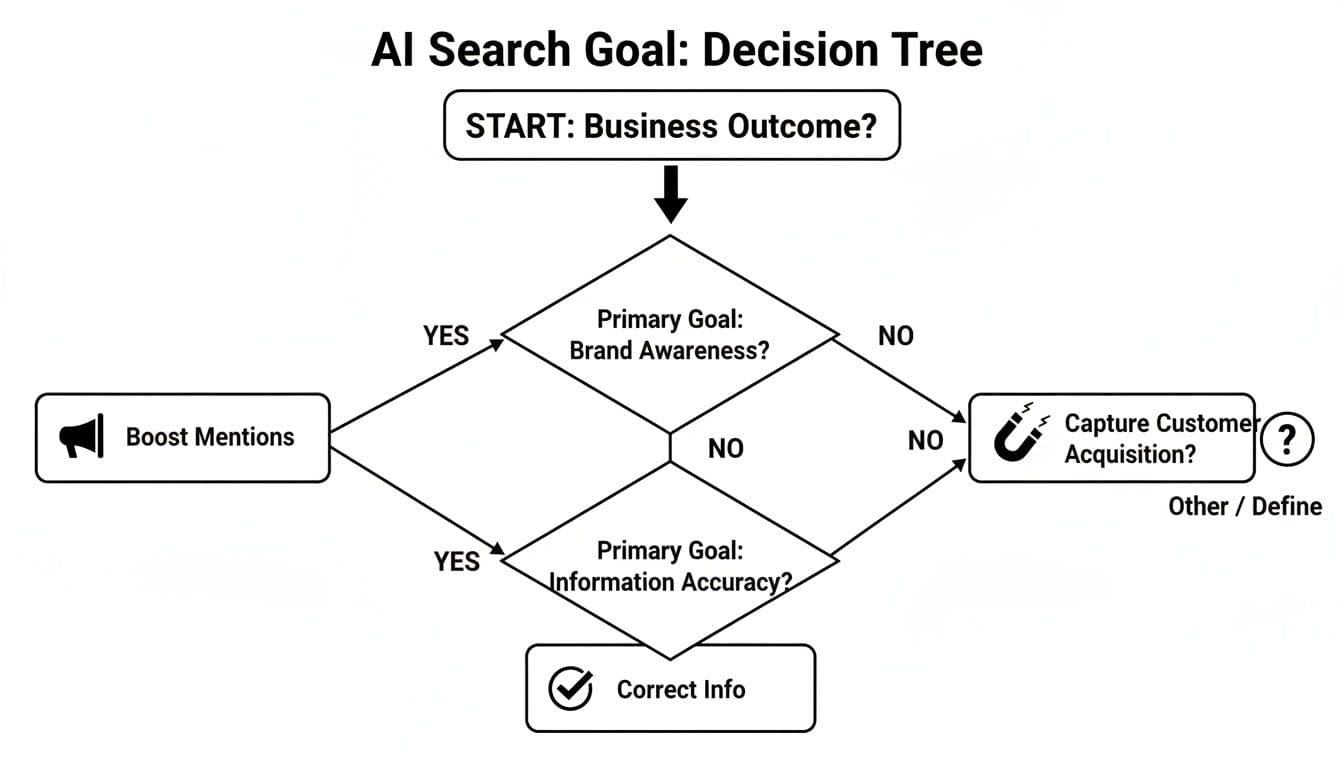
As the diagram shows, there is no one-size-fits-all "AI search" strategy. The right approach is entirely dictated by your business outcome, a point you need to align on with any agency from day one.
Insightful Questions That Reveal True Expertise
Ditch the generic RFP questions. Your objective is to spark a conversation that reveals an agency's strategic depth and real-world experience. Their answers to a few pointed questions will tell you everything you need to know.
To get straight to the point, you need to ask questions that cut through the fluff and test an agency's real-world capabilities.
An agency’s answers to these questions will quickly tell you whether they are true specialists or just jumping on the AI bandwagon. For a deeper look at the metrics involved, check out our guide on how to track your brand’s visibility in top LLMs.
Using the Agency's Own Presence as a Litmus Test
Finally, one of the most revealing evaluation tools is simply turning the lens back on the agency itself. Before you even schedule a call, do a little digging into their own visibility in AI search. An ai search optimization agency uk that's a true leader in the space should be a walking example of its own work.
Give them a quick mini-audit:
- Ask ChatGPT: "Who are the top AI search optimization agencies in the UK?"
- Ask Google's AI Overviews: "What are the key strategies for Generative Engine Optimization?"
- Ask Microsoft Copilot: "Explain the difference between GEO and traditional SEO."
Do they show up? Are they cited as an authority? Is their thought leadership part of the AI-generated consensus? If an agency can’t make itself visible for its own core service, it raises a serious red flag about its ability to do it for your business. This simple, practical test helps you find a partner who doesn't just talk the talk, but demonstrably walks the walk.
Navigating Agency Pricing, Contracts, and Red Flags
Getting the commercial side of hiring an ai search optimization agency in the UK right is every bit as crucial as vetting their technical skills. A poorly structured contract or a partnership built on shaky promises can torpedo your strategy before it ever gets going. You need to invest with confidence, and that starts here.
The pricing models for this kind of specialised work are still taking shape, but they generally fall into a few predictable buckets. Each model has its pros and cons, suiting different levels of engagement, from a one-off audit to a full-blown strategic partnership.
Decoding Agency Pricing Models
The most common structure you'll come across is the monthly retainer. It’s simple, predictable, and covers ongoing strategy, execution, and reporting. For UK businesses, retainers for a dedicated AI search programme typically start around £4,000 per month and can easily climb past £15,000 for large enterprises in fierce markets.
Another option is project-based pricing. This is perfect for specific, time-boxed needs like an initial AI visibility audit or a targeted campaign to correct widespread misinformation about your brand. These projects can run anywhere from £3,000 to £7,000 or more, depending on just how deep the rabbit hole goes.
Finally, there’s the performance-based model, which is less common. Here, a slice of the agency's fee is tied to hitting pre-agreed KPIs, like a specific lift in your Share of Voice in AI answers. It sounds great on paper, but these deals demand incredibly precise and reliable tracking to work without disputes.
Make no mistake, this investment is fast becoming a core part of marketing budgets. Over half of all corporate AI budgets are already being funnelled into sales and marketing automation. We've seen 57% of businesses ramp up investment in prospecting and personalisation in the last year alone. In the UK, where 64% of marketers plan to increase their AI spend for 2026, the results are tangible: 65% are reporting better SEO outcomes thanks to AI, generating 24% more organic traffic on average. You can discover more insights about AI sales and marketing statistics to see the broader trends.
Red Flags to Watch For Before You Sign
A great agency sells proven expertise and a sound process, not impossible dreams. As you sift through proposals, be on high alert for promises that sound too good to be true—they almost always are.
Keep a sharp eye out for these major red flags:
- Guaranteed Rankings in AI: This is the number one warning sign. Nobody can guarantee a specific ranking or a permanent spot in an AI-generated answer. The models are simply too fluid and unpredictable for that.
- Vague or Secretive Methodology: If an agency can’t walk you through their process for influencing AI—what data they target, how they approach entity optimization—they probably don’t have a real one.
- A Cookie-Cutter Strategy: A generic proposal that doesn't mention your specific audit findings, your competitors, or your unique business goals is a clear sign of lazy work.
- Over-reliance on Old-School SEO Metrics: If the pitch is loaded with talk of keyword rankings and backlinks but feels light on AI-centric KPIs like citation quality or sentiment analysis, they're not a true specialist. They're just repackaging old services.
A credible agency will manage your expectations. They'll focus on the strategic inputs they can control and the measurable influence they can build over time, not on promising you the impossible.
Essential Contract Clauses to Scrutinise
The contract is your safety net. It needs to be a clear, unambiguous document that protects both you and the agency, setting the stage for a transparent partnership. Before you sign anything, have your legal team give it a thorough review, paying close attention to these key areas.
Your contract absolutely must define:
- Scope of Work (SoW): This needs to be incredibly detailed. It should spell out every deliverable, activity, and reporting schedule. Ambiguity here is a recipe for future arguments.
- Data Ownership and GDPR Compliance: The contract must state, in no uncertain terms, that you own all of your data. It also needs to detail how the agency will handle that data in full compliance with UK GDPR.
- Key Performance Indicators (KPIs): The exact KPIs you agreed upon during the evaluation phase must be written into the contract, along with the specific methodology for measuring them.
- Termination Clause: How do you part ways if things don't work out? A fair agreement will include a reasonable notice period (usually 30-90 days) for either party, without slapping you with excessive penalties.
By carefully vetting the pricing, spotting the red flags, and ensuring your contract is rock-solid, you protect your investment and set yourself up for a successful partnership. For more context on potential costs, you can also explore our platform pricing options to use as a benchmark.
Forging a True Partnership with Your Agency
Signing on the dotted line isn’t the finish line; it’s the starting block. The real work of building a productive, results-focused partnership with your AI search optimization agency begins the moment the ink is dry.
This is all about seamless integration, transparent data sharing, and getting on the same page about what success actually looks like. The first 90 days are critical.
The Onboarding and Integration Blueprint
A well-structured onboarding process should feel like a strategic alignment, not just a series of administrative tasks. It's the agency’s chance to properly embed themselves in your world and your opportunity to give them the context they need to deliver.
You should expect this to be a multi-stage process, not a single kickoff call.
- Deep-Dive Discovery: These sessions go far beyond the sales pitch. The agency should be meeting with key people from your marketing, content, product, and even sales teams. They need to understand the internal workflows, the nuances of your brand voice, and your real commercial priorities.
- Technical Access & Audits: This is where the rubber meets the road. They’ll need access to your analytics platforms (like Google Analytics), CMS, and any brand monitoring tools you use. This access is crucial for conducting their own deep-dive audits and setting a clear performance baseline.
- Setting the Rhythm: A clear communication cadence is vital. You should agree on weekly check-ins, monthly strategic reviews, and quarterly business reviews (QBRs) from the outset. This keeps everyone aligned on progress and nimble enough to adjust priorities.
True integration means treating the agency as an extension of your team, not just a vendor you farm work out to. For example, your in-house content writers should be collaborating directly with the agency on briefs for new assets. Your product team needs to clue them in on feature launches before they happen, so the agency can seed the right information online ahead of time.
Why Data Sharing is Non-Negotiable
Let’s be clear: an AI search optimization agency cannot work effectively in a data vacuum. If you want them to influence how large language models perceive your brand, they need access to the same internal data that shapes your own strategy.
Holding back critical information will directly throttle the results you can achieve.
We’re not just talking about top-line marketing analytics, either. They need the good stuff:
- Customer Insights: Think customer surveys, themes from support tickets, and voice-of-customer data. This helps them understand the real questions your audience is asking.
- Product Roadmaps: Knowing what's coming next allows them to proactively build a foundation of accurate information online before a launch.
- Proprietary Research: Your internal white papers, case studies, and data reports are gold. Sharing them gives the agency unique, powerful assets to establish your authority.
An agency relationship built on trust and open data can move from simply reacting to problems to proactively shaping your brand’s narrative. They become the guardians of your brand's digital truth—but only if you give them the source material.
Measuring Success Beyond Clicks and Conversions
Ultimately, you need to see a return on your investment. But in the world of AI search, ROI is more nuanced than just tracking traffic and leads, though those still matter. You need to be tracking more sophisticated KPIs that actually reflect your influence on AI-driven conversations.
For a deeper look at this, our guide on how to see brand visibility in ChatGPT breaks it down further.
Your focus should be on a new set of metrics that tell the whole story.
- AI Share of Voice (SoV): This is a big one. It measures how often your brand is mentioned in AI-generated answers for your target topics compared to your competitors. A rising SoV is a direct signal of growing influence.
- Sentiment Analysis: It’s not just about getting mentioned; it’s about how you’re mentioned. You need to track the sentiment (positive, neutral, negative) of your brand within AI responses. This is the new frontier of reputation management.
- AI-Attributed Leads: Direct attribution can be tricky, but a good agency will help you set up methodologies to trace leads and conversions that start from AI-driven discovery, connecting their work directly back to your bottom line.
Building this kind of partnership takes commitment. When you provide the access, data, and internal collaboration an agency needs, you empower them to deliver results that will secure your brand’s relevance for years to come.
Your AI Search Optimization Questions Answered
Diving into AI search can feel like you've been handed a rulebook in a language you don't quite speak yet. You can tell it's the future, but the plays, the scoring, and the path to victory look completely different from the digital marketing you’ve mastered. This section tackles the most common, pressing questions we hear from UK business leaders who are ready to explore working with an AI search optimization agency.
Let's cut through the noise with some straight answers. Consider this your pre-flight briefing before you start talking to potential partners.
What Is the Difference Between AI Search Optimization and Traditional SEO?
This is the most fundamental question, and the answer changes everything.
For years, traditional SEO has been about one thing: winning a spot on a ranked list of blue links. The entire game was about targeting keywords to climb the search engine results page (SERP). Success was measured by your page's position.
AI Search Optimization (AISO), or what many are calling Generative Engine Optimization (GEO), plays on a completely different field. It’s not about ranking your webpage. It's about embedding your brand’s information as the factual bedrock for the AI's answer. The objective is to directly influence the conversational responses that Large Language Models (LLMs) generate.
GEO is focused on becoming a cited, authoritative source within the AI's generated response. Success isn't about being another link on the page—it's about becoming part of the answer itself by proving your factual accuracy and being recognized as a distinct entity.
This requires a total mindset shift. As the team at Yoast aptly put it, "The game is shifting from chasing position to securing presence in the AI layer of search." A specialist agency's focus has to pivot from traditional ranking signals to new relevance signals, ensuring your content is structured for machines to understand and trust.
How Long Does It Take to See Results?
Let's set realistic expectations from the start: this isn't like flicking on a PPC campaign. Influencing how vast, complex information systems perceive your brand is a process that builds momentum over time. How quickly you see an impact really depends on your starting point and what you're trying to achieve.
We generally see results roll out in two phases:
- Short-Term Wins (2-3 Months): The first wave of improvements usually comes from fixing foundational data. This is the low-hanging fruit—correcting glaring inaccuracies in your brand’s knowledge panel, clarifying product specs, or simply making sure your opening hours are correctly understood by AI models. Think of it as cleaning up your digital footprint.
- Long-Term Influence (6+ Months): Changing the AI's mind on complex, narrative-based answers in a competitive space takes much longer. This is the real strategic work. It involves a consistent strategy of publishing genuinely authoritative content, building your brand as a recognized entity, and ensuring that information filters through the many data sources LLMs rely on.
Any credible agency will kick things off with a deep audit to give you a realistic timeline based on your current domain authority, the intensity of your industry, and the state of your brand's information ecosystem.
Should I Choose an Agency or an AI Monitoring Platform?
This is a critical fork in the road, and the right path depends entirely on your team's bandwidth, expertise, and strategic goals. It’s not always a simple either/or.
An AI monitoring platform like Attensira is an incredibly powerful piece of kit. It’s designed to empower your in-house team, giving them the raw data and actionable insights to see how your brand shows up in AI responses. If you have a sharp marketing team ready to do the work, a platform provides the essential intelligence to direct their efforts.
An AI search optimization agency, on the other hand, delivers the complete, end-to-end service. They bring the specialised strategy, the niche expertise, and the hands-on execution. From the initial audit to implementation and reporting, they run the whole show.
For many UK enterprises, a hybrid approach is proving to be the most effective. The platform provides the continuous, real-time data, and the agency uses that intelligence to execute a sophisticated strategic plan that the in-house team simply doesn't have the time or specific skillset to manage. If you're just starting and have a capable team, a platform is a fantastic first step.
Ready to gain full visibility into how AI sees your brand? Attensira provides the data-driven insights you need to monitor and optimize your presence across major AI platforms. Start tracking your brand's AI visibility today.